RIKEN Accelerator-driven compact neutron systems
Yoshie Otake1,*
1RIKEN Center for Advanced Photonics, Neutron Beam Technology Team, RIKEN 351-0198 Saitama, Japan
Abstract. RIKEN Accelerator-driven compact neutron source, RANS, has been operational since 2013. There are two major goals of RANS research and development. One is to establish a new compact low energy neutron non-destructive evaluation system on-site of floor-standing type for industrial use. Another goal is to invent a novel transportable compact neutron system for the preventive maintenance of large scale construction such as a bridge. The low energy transmission imaging, neutron diffractometer, small angle scattering instruments, fast neutron transmission imaging, fast neutron back scattering imaging, neutron induced prompt gamma-ray analysis and neutron activation analysis are available with RANS. To solve the lack of nuclear data to develop compact neutron sources, we have created new function which gives neutron spectrum from the 9Be +p reaction with protons of energy below 12 MeV. For further compact neutron system, RANS-II is now ready to generate neutrons in the RANS experimental hall with individual shielding system. The novel proton accelerator tube and 500 MHz solid state high-frequency amplifier for RANS-III, of a transportable neutron system, are now ready to be developed in RIKEN.
1 Introduction
Accelerator-driven compact neutron sources have attracted much attention not only in neutron and X-ray fields but also in fields such as materials development aimed at significant weight reduction in automobiles and other transportations, cancer therapy, and non-destructive inspection technology. A neutron beam has unique characteristics such as high penetration power for penetrating into steels and metals and high sensitivity for light elements (e.g., hydrogen, lithium, and boron), thus making the neutron beam an ideal probe for material development. RIKEN has developed an driven compact neutron source, RIKEN accelerator-driven compact neutron source (RANS) with 7 MeV proton and the beryllium target, as shown in Fig. 1 [1]. There are two major goals of RANS research and development. One is to establish a new compact floor-standing type low-energy neutron system for industrial use. This is RANS-II which is becoming one of the typical model of this type. Another goal is to invent a novel transportable compact neutron system for the preventive maintenance of large-scale construction, such as bridges and airports, using fast neutron whose energy is above 500 keV.
For the accelerator driven compact neutron source development, the discrepancy of the neutron spectrum and its angular distribution between any of nuclear data of 9Be +p reaction and experimental results, is now widely recognized especially for the lower energy of proton. To solve this issue to develop compact neutron sources, we have created new formalism which gives neutron
spectrum from the 9Be +p reaction for protons of energy below 12 MeV [2]. Here about the formalism will be explained in next chapter, and the RANS spectrum for various kinds of moderator will be shown based on it. Some results of thermal and fast neutron imaging, neutron scattering with RANS and further compact neutron system will be also explained.
2 Formalism of neutron spectrum of
9Be+p reaction for compact neutron
source [2]
The measured radiation background around RANS and the neutron spectrum of RANS did not agree with the designed value which was studied based on Monte Carlo simulation and nuclear data base [3]. We have developed new formalism, a function, to give the total neutron production cross section, angular distribution, and energy spectrum via the 9Be + p reaction by fitting experimental data to characterize compact neutron sources with thick
Be targets bombarded by protons with energy below 12 MeV [2].
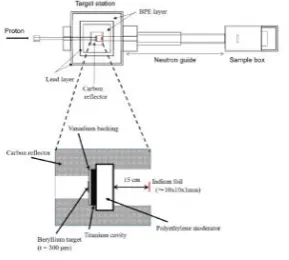
To derive the neutron production with a certain thick target, a computer program with a Monte Carlo calculation was developed by incorporating the function and the energy loss in the target material calculated by the SRIM code [4]. The program requires only proton energy and the target thickness as input parameters. The calculation was carried out using the C++ programming language and the ROOT framework [5]. The function was examined at RANS as shown in Fig.2. The 115In(n,
n’)115mIn reaction rates calculated using GEANT4 with
source neutrons given by both the function and ENDF/B-VII.0 were compared with that measured at RANS to evaluate the neutron spectrum above 1 MeV. The function slightly overestimated the measurement by 14% and the calculation with ENDF/B-VII.0 underestimated by 35%. It was concluded that the function can be applied in compact neutron source designs.
Now, for the design of new compact neutron sources with beryllium target and proton whose energy is less than 12 MeV, the program with this function is available. The neutron spectrum and angler distribution will be obtained when the target thickness, and proton energy are given.
3. RANS neutron spectrum with
moderator change system
Neutron non-destructive visualization with slow and fast neutron, neutron engineering diffraction for microstructural analysis of iron and steel samples, elemental analysis with neutron induced prompt gamma-ray activation analysis are the major subjects that we are requested to perform with RANS based on the strong request from the users of such field as industry, public work. RANS can offer users optimized neutron system, by introducing different kinds of moderators. Users can choose suitable moderator for each experiments.
The neutron spectrum at the exit of target station with different moderator condition of case 1, 2, 3, 4 which are listed in Table.1, are shown in Fig.3. The neutron spectrum from the beryllium target [6] is given by the function which was explained in the previous session [2].
The moderator exchange system is available so that the users can chose suitable moderator for their measurements. They can choose one among several kinds of the neutron energy spectrum and pulse characteristics by changing the different types of the moderator from fast neutron to cold neutron. The table 1 shows the different types of moderator of RANS in 2019. The moderator choice is as following. Case 1, without moderator for fast neutron experiment, case 2 to case 4 are thermal neutron moderators with polyethylene of different thickness, 2 cm, 4 cm, 6 cm, respectively. Case 5 is the decoupled moderator with 2 cm polyethylene surrounded by B4C rubber. Case 6 is cold moderator which is now under up-grade development with the cooperation with the group of J-PARC center [7]. The neutron spectrums of type 1 to 4 are shown in Fig. 4. The fast neutron flux decreases according to the thickness of moderator increasing.
Table 1. RANS different types of moderator
From Fig.3 there is no difference of the neutron flux around 50 meV among case 3, 4 cm, and case 4, 6 cm, but the fast neutron flux above 1 MeV with case 4 is more than 50% less than case 3, so that the users can perform the scattering experiment with less background caused by fast neutron by choosing case 5 moderator.
Fig.4 shows four kinds of the moderators from case 2 to case 5. The right one shows the decoupller, B4C rubber of decoupled moderator, Case 5.
Moderator material Thickness, and type
1 None
2 Polyethylene (thermal moderator)
2cm coupled
3 4cm coupled
4 6cm coupled
5 4cm decoupled
6 Mesitylene (cold
moderator) up-grade development Fig.2 Schematic view of the neutron measurement with
115In(n,n’)115mIn reaction at RANS [2]
For the coupled moderator case 2 are designed based on the pulse width measurements of RANS with diffraction peak evaluation by changing the proton pulse width and sample thickness [8]. Further shorter neutron pulse, thermal decoupled moderator case 5 is designed and now has being estimated by the RANS diffraction experiment.
4 Capabilities of RANS, compact neutron
source
4.1 Neutron scattering instruments
From 2013, the number of neutron scattering instruments are increasing at RANS. For example, the neutron low energy imaging starts in 2013, the visualization of the water movement which is related to the painted steel corrosion has been observed and new analytical method has been developed [9]. The neutron engineering diffraction method has been developed from 2014 [8], and the diffractometer are now ready for users as shown in Fig.5.
The retained austenite volume fraction evaluation of RANS diffractometer agrees with that of J-PARC Takumi-beamline measurement within 1% accuracy [10]. Texture evaluation of IF steel samples are measured and compared with J-PARC TAKUMI results and HIPPO
results [11]. One diffraction pattern measurement of the iron sample with 1 cm3volume takes about one to three
minutes by RANS. Small angle neutron scattering instrument also has been developed by Ibaraki University. Some results agree with those of J-PARC iMATERIA [12].
4.2 RANS-II
For further development towards the floor-standing compact system for industrial use, almost all these instruments are expected to be operational on-site. RANS-II succeed to generate neutron with lithium target system as shown in Fig. 6. RANS-II is the floor standing type model for on-site use, and at the same time, it is the prototype of the transportable neutron source [13]. Since July 2019, RANS and RANS-II are operational independently; each has their own interlock safety system.
4.3 Infrastructure non-destructive test
techniques
The deterioration of transportation infrastructure is a serious yet common problem around the world. Most large structures, such as bridges, tunnels, and elevated roads, are made of concrete and steel. In 2018, and 2019, large bridges collapsed in Italy and Taiwan [14]. It is becoming increasingly important to establish new inspection techniques.
We have developed back scattered neutron imaging method, novel method to visualize the degradation under the pavement, degradations of the floor-slab of the bridges. The fast neutrons penetrate through more than 20 cm concrete or asphalt layer of pavement. By choosing the proper timing and the energy of the back scattered neutron, the visualization of the water or air hole in the floor slab behind the first layer of the pavement [15].
We also have successfully developed the salt concentration distribution evaluation method with neutron induced prompt gamma-ray activation analysis for thick concrete slab with RANS [16], as shown in Fig. Fig.4 Four kinds of thermal moderator of RANS. Case 2 to
case 5 from left to right.
Fig.5 Diffractometer of RANS without shielding
Fig.5 Diffractometer of RANS without shielding
7. The different depth of the salt existence in the concrete can be distinguished.
5. Summary
Compact neutron systems have been developed in RIKEN with proton linac.
The low energy transmission imaging, neutron engineering diffractometer, small angle scattering instruments, fast neutron transmission imaging, fast neutron back scattering imaging, neutron induced prompt gamma-ray analysis and neutron activation analysis are available with RANS.
The up-grade of the RANS target station including cold neutron source optimization is planning in 2020.
For the transportable, the development of RANS-III, which is expected to be a transportable neutron system is now started. Smaller proton linac with 500 MHz is designed [17].
Acknowledgment
This work was partially supported by the Council for Science, Technology and Innovation (CSTI), the Cross-Ministerial Strategic Innovation Promotion Program (SIP), “Infrastructure Maintenance, Renovation and Management” (funding agency: JST), and the Photon and Quantum Basic Research Coordinated Development Program from the Ministry of Education, Culture, Sport, Science, and Technology, Japan. It was also supported by JSPS KAKENHI, Grant Numbers 25289265 and 25420078. The authors would like to thank the Iron and Steel Institute of Japan (ISIJ) Research Group for their beneficial assistance.
References
1. Y. Otake " A Compact Proton Linac Neutron Source at RIKEN", “Applications of Laser-Driven Particle Acceleration”, eds. Paul Bolton, Katia Parodi, Jörg Schreiber, June 5 pp.291-314 (2018) CRC Press
2. Yasuo Wakabayashi, Atsushi Taketani, Takao Hashiguchi, Yoshimasa Ikeda, Tomohiro Kobayashi, Sheng Wang, Mingfei Yan, Masahide Harada, Yujiro Ikeda, and Yoshie Otake: "A function to provide neutron spectrum produced from the 9Be + p reaction with protons of energy below 12 MeV[J].", Journal of Nuclear Science and Technology Vol. 55 (2018.3) pp.859-867
3. Baolong Ma, Yoshie Otake, Sheng Wang, Hideyuki Sunaga, Yutaka Yamagata, Atsushi Taketani, Huasi Hu, Qinggang Jia, Guang Hu, Unico Bautista: "Shielding design of a target station and radiation dose level investigation of proton linac for a compact accelerator-driven neutron source applied at industrial sites”, Applied Radiation and Isotopes Vol.137 (2018.7) pp. 129-138
4. Ziegler JF, Biersack J, Littmark U. The stopping and range of ions in solids. New York: Pergamon Press; 1985.
5. ROOT a Data Analysis Framework [internet]: CERN; c2014-2018. Available from: https://root.cern.ch
6. Y.Yamagata, K.Hirota, J.Ju, S.Wang, S.Morita, J.Kato, Y.Otake, A.Taketani, Y.Seki, Y.Yamada, H.Ota, U.Bautista, Q.Jia: “Development of a neutron generating target for compact neutron soruces using low energy proton beams, “Journal of Radioanalytical and Nuclear Chemistry 305, Issue 3 (2015.9) pp787-794
7. B.Ma UCANS8 presentation
8. Y. Ikeda, et al "Prospect for application of compact accelerator-based neutron source to neutron engineering diffraction", Nucl. Instr. Meth. A 833 (2016) pp 61-67
9. Atsushi Taketani, et al. "Visualization of water in corroded region of painted steels at a compact neutron source" ISIJ International vol.57 N.1 (2017) pp.155-161
10. Y. Ikeda, M. Takamura, T. Hakoyama, Y. Otake, M. Kumagai, and H. Suzuki, “On-site Measurement Technique of Retained Austenite Volume Fraction by Compact Neutron Source RANS”, Tetsu to Hagane, Vol.104 (2018) pp.18-pp.24
11. P.G. Xu, UCANS8 presentation
12. S.Koizumi, et al. “A Variety of Small-angle Neutron Scattering Instruments Available in Tokyo Area, Japan —Complimentary Use of Accelerator and Reactor—” JPS Conf. Proc. 25, 011004 (2019) 13. T.Kobayashi et al, UCANS8 presentation
14.
https://edition.cnn.com/2019/10/01/asia/taiwan-bridge-collapse-intl-hnk-scli/index.html
15. Y. Ikeda, Y. Otake, and M. Mizuta: nondestructive measurement for water and voids in concrete with compact neutron source", Plasma and Fusion ResearchVol.13 (2018.3)pp.2406005-1-5 DOI: 10.1585/pfr.13.2406005
16. Y.Wakabayashi UCANS8 presentation Fig.7 Salt distribution evaluation method with PGAA