AN ADAPTIVE AGENT ARCHITECTURE
FOR THE DESIGN OF
COMPLEX DECISION SUPPORT SYSTEM
WITH APPLICATIONS TO
POWER SYSTEM PROTECTION
VICTORIA :
UNIVERSITY!
o
-<
Sow Kum Wong
BA (Hens), MSc.
Thesis Submitted to the Department of Computer and Mathematical
Sciences for the Research Degree of
Statement of Original Authorship
The work contained in this thesis has not been previously submitted for a degree or
diploma at any other tertiary educational institute. To the best of my knowledge
and belief, this thesis contains no material previously published or written by
another person except where due reference is made.
Sow Kum Wong
My dearest mother, L.T. Cheang; my family
and
Wong-(Don't give Vpll
'When youfeeCthat you are
in the midst of heading nowhere
and the -whole world seems to Be against you going down a road which does not
have any arrows of directions to guide you to your destination <Perservere and (Don't despair
Loo^into one Bright spot inyourCife to cheer you up
as you Brave on the stormy weather Eventually, you wiCCfind that
after all the frustrated tum-arounds and tiring journeys you've made, wiCCworth it ad
JLs Cong as you do not give up haCfthe way
Acknowledgements
I am thankful and very gratefUl to many people who have helped me in the course of this work, either directly or indirectly - people who provided the
needed resources or technical assistance, who read and commented on the various drafts of the dissertation, who provided the much needed
encouragement and moral support at all times. I list here some of these people that I would especially like to thank.
For his advice, moral support and encouragement, I wish to thank Professor Akhtar Kalam. His confidence in me gave me the strength to push on, helped to
keep
my research on track and to complete this thesis on time.
Professor Clement Leung for his supervision, valuable advice and
comments. His suggestions and recommendations regarding the final draft of the thesis were very much appreciated and I thank him for it.
I would like to thank Charles Biasizzo and Adam Klebanowski for their
expert advice and patience in explaining the terms and concepts of power
system protection to me.
The former and the current Head of Department of Computing and
Mathematical Science - Associate Professor Ian Murray and Associate
Professor Neil Barnett for granting me the scholarship, providing me the
opportunities to attend some conferences and giving me the financial support
through sessional teaching.
The Head of Department of Electrical and Electronics Engineering,
Associate Professor Wally Evans for kindly accepting me into the department,
i l l
The technical staff, Rajendran Ponnusamy, Damon Burgess and Zoltan
Varga, for their kind assistance and for tolerating my endless problems with the
computers and printers especially.
My constant source of encouragement, my mentor, my guardian - Ted Alwast, I am indebted and forever grateful to him. His great confidence in me
gave me the much needed inspiration and encouragement to pursue on to my
Master and then my Doctorate. His faith in me gave me the sfrength that I need to carry on especially at times when I get weary and just about to give up. He is
always there to guide and advise me, and give me the moral support - in my work and in my personal matters. Without him, I would not be where I am
today. My deepest and sincere thanks to him.
To Robert Hinterding, Iwona Miliszewska, Grace Tan, the administrative staff of Computing and Mathematical Sciences Department and all my other
friends and colleagues. Their kind advice, generous assistance and for being there for me meant a lot and it made my stay at Victoria University a very
pleasant, enjoyable and memorable one.
My family, of course, especially my mother for her love, understanding,
encouragement and being my source of inspiration. My second sister and my youngest brother who are here with me, for their patience, care, understanding
and encouragement. To the rest of my other brothers and sisters, even though
they are not here with me, they have always been my source of encouragement
and inspiration. Without my family, I would not be here at all.
Preface
In the early 1990s, there was a notable lack of intelligent systems in the area
of power system protection. Moreover, there was no legacy software that would
design a coordinated protection scheme for a power system, although there was
considerable interest in such applications shown by people from the industry.
However, to build a good, robust and efficient application system, the
architecture must be designed properly and with care. It is the architecture that
eventually builds up the core of an operational system. Therefore, serious
thought and consideration must be given to the study of the architecture.
Unfortunately, literature review showed that not many research projects were
undertaken in this area. This prompted investigation into the analysis and design
of a generic agent architecture for the development of an intelligent system
which could be applied to any application domain.
The approach used here to design the agent architecture is an adaptive and
incremental approach. One of the main attractive features of the agent
architecture is the dynamic knowledge component of the system. The
knowledge base can grow and modify itself automatically so that it can adapt
itself to the ever changing environment and demands. The design of the agent
architecture is developed and built using a layered architecture approach.
Layering is a very powerful technique that enables effective representation and
integration of various techniques and paradigms into one single architecture.
Communication is performed via message passing between the adjacent layers.
One of the advantange of this adaptive approach is the development of
solving. The agents attempt to apply their past experiences or skills when
resolving a problem. Over the time, as they go through more problem solving
tasks, their experiences, skills and knowledge also grow. The technique used to
selectively retains the experience, copes with the memory requirements for
knowledge expansion, while the organisation of the memory layer allows the
agent to confidently add the reliability factor to the proposed solution.
There are basically three main types of agents developed for the
implementation of an intelligent multiagent system in this thesis. These are the
Interface agent, Coordinator agent and Design agent.
The agents can be organised in a number of ways to constmct different
system architectures. Architectures can differ in many ways including the
organisation of the architecture - hierarchical or heterarchical, the nature of the
control mechanism - distributed or centralised, and the number of entities or
processing units employed in the system. There are a number of factors that
contribute to the different architectures such as the types of agents employed,
the requirements and environmental issues. However, the degree of agent's
autonomy is probably the main influencing factor. In this thesis, different types
of agents of varying degree of autonomy are employed and organised in
different ways to develop a number of system architectures. This is possible
because like many design problems, there is no one absolute design solution for
a system architecture. Causal links are studied and the agent's existence is
justified as each is added to the system architecture.
The different system architectures developed represent multiagent systems
distributed problem solving, multiparadigm approach and employment of
multireasoning strategies. In addition, a blackboard system and a federated
system organisation are also employed.
The reasoning paradigms employed are case based reasoning, rules,
explanation based and argumentation. However, case based reasoning appears
to be the most natural reasoning technique that imitates the human approach to
solve design problems. Therefore, case based reasoning is chosen as the main
reasoner in the system.
The three system architectures have been produced by utilising different
organisation of the agents developed in this thesis. It should be pointed out that
the autonomy of the agents decreases with each system listed below :
• System architecture using distributed knowledge in a knowledge
based environment;
• System architecture using distributed knowledge/shared
knowledge in an object oriented environment;
• System architecture using distributed knowledge within a
federated system framework in an object oriented environment.
The first system architecture consists of three types of semi-autonomous
agents namely Interface agent. Coordinator agent and Design agents which are
organised hierarchically. The hierarchical organisation supports the natural
grouping of functionally related agents to facilitate cooperative problem
solving. Communication between the agents is accomplished using message
Vll
the system and the outside world. The Coordinator agent is responsible for
decomposing a problem into smaller problems and also for coordinating the
partial solutions into a coherent and integrated solution to the original problem.
The Design agents also known as problem solving agents are specialised agents.
Each specialises in a particular aspect of the application domain. They apply
their respective expertise to generate partial solutions to the problem.
The second system architecture is similar to the first architecture with the
addition of a shared knowledge base and a blackboard system. The common
knowledge possessed by the various agents in the system is shared and
communication is carried out via the blackboard. The partial solutions proposed
by the Design agents are posted to the blackboard, also known as the Global
Database. The Coordinator agent then prepares the final solution using the
information posted to the blackboard.
The third system architecture is similar to the second architecture where a
Global Base is employed to house a community agents. However, in this
federated system, the agents surrender their autonomy to the Facilitators. The
Facilitators are responsible in selecting and placing partial solutions,
represented by the agents, in the Global Base. The Controller/Modifier agent
then organises and modifies the agents in the Global Base so to produce the
final design solution.
The system architectures have been implemented in order to study the
System evalutions are carried out based on the three system architectures
produced. Each system architecture is studied, compared and analysed in order
to deduce the best solution for the design of the architecture given all the
constraints including operating environments.
The thesis closes with a final conclusion regarding the work accomplished
in the thesis. A number of recommendations regarding possible enhancements
IX
List of Abbreviations
ABSI ACL AEPD AI API BA cts CA CAD CAPE CBR CIDIM CPU DAI DARES DPS DSS EMMA
Agent Based Software Interoperation
Agent Communication Language
Automated Electric Plat Design
Artificial Intelligence
Application Program Interface
Bus Agent
current transformers
Controller Agent
Computer-Aided Design
Computer-Aided Protection Engineering
Case Based Reasoning
Cooperating Intelligent systems for Distribution
Management systems
Central Processing Unit
Distributed Artificial Intelligence
Distributed Automated Reasoning System
Distributed Problem Solving
Decision Support System
GDSS GIS GRATE lA IDSS ISPP KIF KQML LA NASA NEST OODB OODBMS PAS P/T SIF URD
Group Decision Support Systems
Geographic Information System
Generic Rules and Agent Model Testbed Environment
Interface Agent
Intelligent Decision Support System
Intelligent System for Power Protection
Knowledge Interchange Format
Knowledge Query and Manipulation Language
Line Agent
National Aeronautics and Space Administration
Networked Expert Systems Testbed
Object Oriented Databases
Object Oriented Database Management System
Persistent Application Systems
Petri Net
Simplified Interchange Format
XI
List of Figures
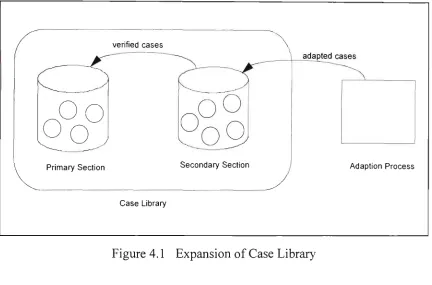
Figure 4.1 Expansionof Case Library 73
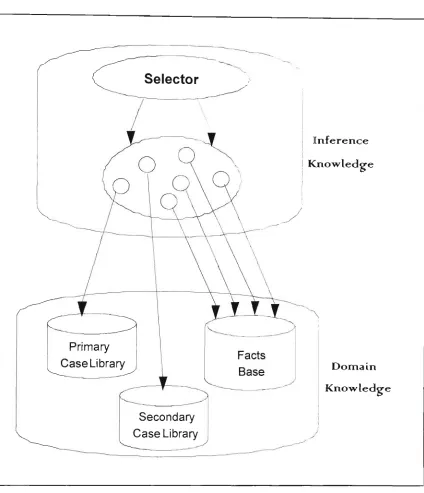
Figure 4.2 Domain Knowledge and Inference Knowledge 77
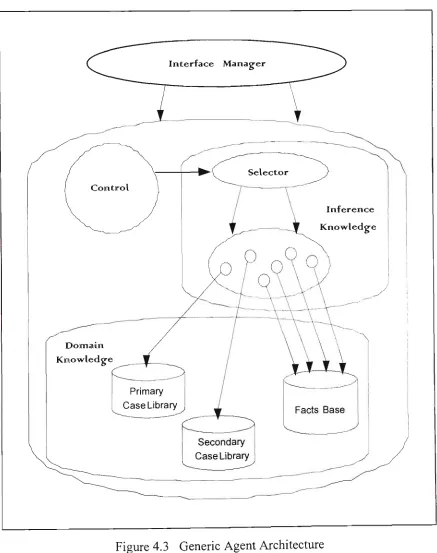
Figure 4.3 The Agent Architecture 80
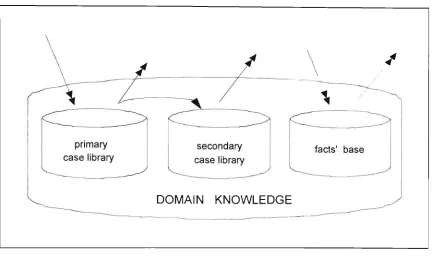
Figure 4.4 Domain Knowledge 84
Figure 4.5 Knowledge Base and Control 86
Figure 5.1 Agent Architecture 97
Figure 5.2 Layered Agent Architecture 99
Figure 5.3 Agent's Domain Knowledge 105
Figure 6.1 Hierarchical Strata Organisation of the System Agents 129
Figure 6.2 The Flow of Interactions Between Agents 130
Figure 6.3 Architecture of a Distributed Knowledge Base System 133
Figure 6.4 Architecture of Initiator and Coordinator agents 140
Figure 6.5 Architecture of Design agent 140
Figure 6.6 Architecture of a Distributed/Shared Knowledge
Base System 141
Figure 6.7 Example of a Federation Architecture [Khedro et a/. 93] 145
Figure 6.8 Agent Architecture 149
Figure 6.9 Architecture of a Distributed Knowledge Base System
within a Federated System 154
Figure 7.1 Control Flow of the System 164
Figure 7.2 Agent's Inference Knowledge 166
Figure 7.3 Agent's Knowledge Base 167
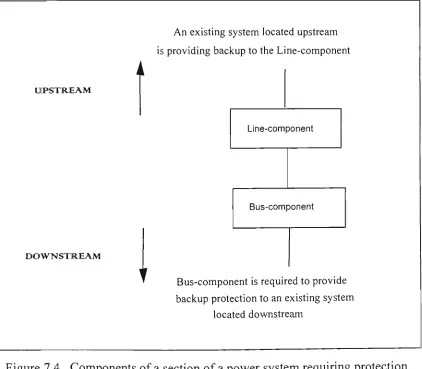
Figure 7.4 Components of a section of a power system requiring
protection 178
Figure 7.6 System Operation 185
Figure 7.7 Flowchart of the System Operation 187
Figure 7.8 Interactions between System Modules 192
Figure 7.9 System Operation 194
List of Tables
X l l l
Table 7.1 Coordinator agent performatives
Table 7.2 Interface agent performatives
Table 7.3 Bus/Line agent performatives
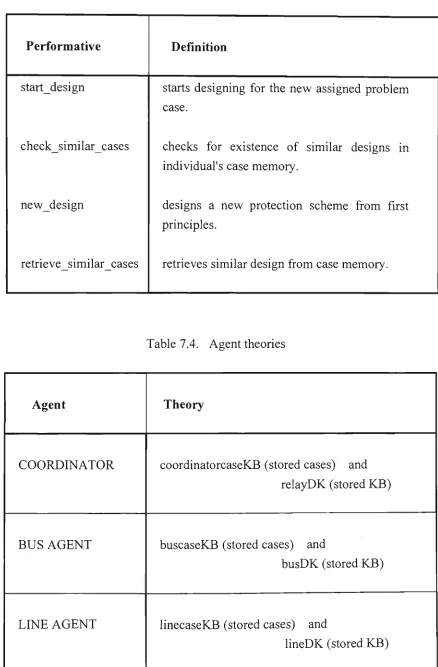
Table 7.4 Agent theories
Table 8.1 Evaluation of Systems by Comparison
Table of Contents
Acknowledgements . . ii
Preface iv
List of Abbreviations i x List of Figures x i
List of Tables x i i i
PARTI
The Problem:
The Intelligent Multiagent System and Design
Problems
Chapter One - Introduction
1.0 Introduction 3 1.1 Existing System, Current Technologies and
Future Trends Especially in Power System 6
1.2 Problem Statement 11 1.2.1 Nature of the Research 13
1.2.2 Project Initiatives 16 1.2.3 Research Objectives 17 1.2.4 Original Contributions 20
1.3 Thesis Overview 21
Chapter Two - Literature Review
2.0 Introduction 26 2.1 Agent Technology and Distributed Artificial Intelligence 28
2.1.1 Multiagent System 32 2.1.2 Review of Systems 36 2.2 Power System Protection 41
2.2.1 A Brief Technical Background in Power System
Protection 41 2.2.2 Intelligent Systems in Power System Protection . . 44
2.2.3 Review of Systems 47
XV
PART II
The Work:
The Architecture Design of a Generic Agent
Chapter Three - Approaches to Knowledge Organisation
3.0 Introduction 54 3.1 Study of Architecture 56
3.2 Design Based Approach 58 3.3 System Requirements 60
3.3.1 Distributed Artificial Intelligence - Design
Considerations 60
3.4 Conclusion 63
Chapter Four - A New Architectural Design Paradigm
4.0 Introduction 66 4.1 Requirements of an Intelligent System 68
4.1.1 The Approach to the Design of an Intelligent Agent 70
4.1.1.1 Domain Knowledge 70 4.1.1.1.1 Case Library 71 4.1.1.1.2 Facts Base 73 4.1.1.2 Inference Knowledge and
Domain Knowledge 74
4.1.1.3 Control 78 4.1.1.4 Interface Manager 78
4.2 Developing an Intelligent System 81 4.2.1 Agents Requirements 81 4.2.2 Developing an Intelligent Agent 83
4.3 Issues of Considerations - Comparing with Altematives . 86
4.3.1 Expert Systems 87 4.3.2 Domain Knowledge 88
4.4 Conclusion 90
Chapter Five - Agent Design and Architecture
5.0 Infroduction 93 5.1 Agent Design 96 5.2 Agent Architecture 98
5.2.1.2 The Control 102 5.2.1.3 The Inference Knowledge 103
5.2.1.4 The Domain Knowledge (Memory) 104
5.2.1.4.1 Case Library 106 5.2.1.4.2 Facts Base 107
5.3 Multiparadigm Approach 107 5.3.1 Case based reasoning 108 5.3.2 Rule based reasoning 112 5.3.3 Argumentation 113 5.3.4 Explanation based reasoning 115
5.4 The Agents' Function 116 5.4.1 The Interface Agent 116 5.4.2 The Coordinator Agent 117 5.4.3 The Design Agent 118
5.5 Conclusion 119
PART III
The Solution:
Application and Implementation of Different
System Architectures
Chapter Six - Organisation of Agents
6.0 Introduction 123 6.1 Multiagent Systems 125
6.1.1 Agents Autonomy 126 6.2 The Design of a Distributed Knowledge Base System . . . 128
6.2.1 The Organisation of the System 128
6.2.2 System Design 132 6.3 Design of a Distributed/Shared Knowledge Base System . 135
6.3.1 Disfributed Approach and Agent Technology . . . . 1 3 5
6.3.2 Object Oriented Technology 136 6.3.3 Blackboard Architecture 138 6.3.4 Agent Architecture 139
6.3.4.1 The Components of the Agent Architecture 142
6.3.5 Agents' Function 143 6.4 Design of a Distributed Knowledge Base System within
a Federated System 146 6.4.1 The System's Agents and Modules 148
XVll
6.4.1.2 Facilitators 151 6.4.1.3 Agent-Generators 152
6.4.1.4 Modifier 152 6.4.1.5 Controller 153 6.4.2 System Design 153
6.4.2.1 Organisation of the System 155
6.5 Conclusion 157
Chapter Seven - System Implementation
7.0 Introduction 159 7.1 Intelligent System for Power Protection (ISPP)
- System Requirements 161 7.2 Applying Agent Technology in Developing an
Intelligent System for Power Protection (ISPP) 162 7.3 Distributed Knowledge Base System in a
Knowledge Base Environment 163 7.3.1 Environment and Software 163 7.3.2 System Flow of Control 163 7.3.3 Constmcting the Agent 165
7.3.4 Agent Functions 171 7.3.5 Communication among ISPP Agents 175
7.3.6 System Operation 177 7.3.7 An Example of a Coordinated Design 178
7.4 Distributed/Shared Knowledge Base System in an
Object Oriented Environment 179
7.4.1 Objects/Classes 180 7.4.1.1 Constmcting the Agents 181
7.4.2 System Architecture 183 7.4.3 System Operation 184 7.4.4 Illustration of a Design Problem 188
7.5 Distributed Knowledge Base System within a
Federated System 190 7.5.1 System Development 191
7.5.2 System Operation 194
7.6 Conclusion 197
Chapter Eight - System Evaluations
8.0 Introduction 199 8.1 The Multiagent Systems - A General Perspective 201
8.2.1 The Distributed Knowledge Base System in Lisp . 206 8.2.2 The Distributed/Shared Knowledge Base System
in 0 2 208 8.2.3 The Distributed Knowledge Base System within
a Federated System 209
8.3 Conclusion 213
PART IV
The Conclusion:
Discussion and Future Work
Chapter Nine - Conclusion
9.0 Introduction - Review of Thesis 219 9.1 Contributions of this Research 222
9.2 Conclusion 225 9.3 Scope for Future Work 229
Appendices
Appendix A: Application Program Interface (API) 231
Appendix B: Epic and Epilog 233 Appendix C: Agents' Knowledge Base 235
Appendix D: Edited Run of the Program 237 Appendix E: Blackboard Architecture 244 Appendix F: Case Based Reasoning 247
XIX
Addendum
List of Refereed Publications:
1. Development of a Decision Support System for Power System Protection System Design, Analysis and Assessment,
The 29th Universities Power Engineering Conference, 1994 in University Galway, Ireland, Proceedings of UPEC '94, pp.39-42.
S.K Wong, A. Kalam
2. A Decision Support System Using Case Based Reasoning in Power System Protection,
Australiasian Universities of Power Engineering Conference in University of South Australia, Australia, Proceedings of AUPEC '94, pp.682-687.
S.K Wong, A. Kalam, A.Klebanowski.
3. Incorporating Distributed Problem Solving Technique into a Case Based System,
Eighth Intemational Conference on Industrial and Engineering Applications of Artificial Intelligence and Expert Systems 1995 in Melbourne University, Australia, Proceedings of lEA/AIE '95.
S.K Wong, A. Kalam, C.H.C Leung.
4. Development of A Power Protection System using an Agent Based Architecture.
Intemational Conference on Energy Management and Power Delivery in Singapore, Proceedings of EMPD 95, pp. 433-438.
S.K Wong, A. Kalam.
5. Distributed Intelligent Power System Protection using Case Based and Object Oriented Paradigms.
Intemational Conference on Intelligent Systems Applications to Power Systems in Oriando, Florida, USA, Proceedings of ISAP '96, pp.74-78.
S.K Wong, A. Kalam.
6. Intelligent Power System Protection Using Agent Technology.
The 31st Universities Power Engineering Conference (UPEC 96) to be held in Technological Educational Institute Iraklio, Iraklio, Greece, 18-20 September 1996,pp.858-861.
Agent Based Technology and its Application in Power System Protection.
Accepted for publication in the Intemational Journal of Power and Energy
Systems vol.22 no. 17, The Intemational Association of Science and Technology for Development (lASTED), Canada.
S.K Wong, T. Alwast, C. Biasizzo, A. Kalam.
An Agent Approach to Designing Protection Systems.
Published in Sixth Intemational Conference on Developments in Power System Protection (DPSP 97) to be held in University of Nottingham, UK, 25-27 Mar 1997.
PARTI
THE PROBLEM
Chapter 1: Introduction
Abstract
Design of a system architecture is like an art, as there is no one absolute design for a system. There are many issues to be resolved, for example, performance requirements, integrity, reliability, system requirements and expectations. There are various designs that could be applied to build a system. However, that does not necessarily means that the architecture is appropriate at all. The main focus of this research is on the study of architecture and the presentation of a new approach to the design of architecture. This architecture is then applied to the development and implementation of an intelligent system. The approach - is an incremental and adaptive process where components are developed and their existence are justified and assessed with the environment and task requirements before they are integrated and put together to construct the complete architecture. This chapter gives an introduction to existing systems, current technologies and future trends. It also presents the research objectives, and the contributions of the research.
1.0 Introduction
The design of a system architecture is more like an art. There is no absolute
design for one system. There are a variety of ways in which the architecture of a
system could be designed and numerous variations of techniques and
approaches that could be applied and integrated. There may not be much
difference in the system, once implemented, from the user point of view.
development and implementation of the same system based on the different
architectures.
The design and the eventual implementation of a system involves a number
of issues which need to be resolved. Among these issues are:
• inter-process communication;
• module structure;
• software and hardware constraints;
• reliability;
• integrity;
• performance requirements;
• application requirements.
In distributed systems, they are fiirther characterised by either
:-• physical separation of computing resources;
• logical separation of multiple processing units.
In most systems, and more so in the distributed systems, some sort of
communication between the resources or the processors is required. In the latter
systems, the processing units may be housed together or be physically separate
and may or may not share memory [Vickers and McDermid '93].
Furthermore, when designing a system architecture, one of the most
important issue that needs to be resolved is knowledge representation. However,
Chapter 1: Introduction
consider and the designer usually do not have to worry about the knowledge
representation. The traditional expert systems usually employ mles in the
knowledge base and relatively, they have one inference engine only.
Most of the application systems developed even up to the past few years,
utilised the more conventional approach of building one single large expert
system and employing production mles to perform the inferencing. These
systems can easily exceed to hundreds and thousands of formal expert mles in
the knowledge base. Rule based systems are simple and easy to implement,
however one of the main drawbacks of such systems is the problem of
maintenance. A change in one mle or a change in the environment can have a
big impact and undesirable effects on the other mles in the knowledge base.
Other limitations of mle based systems include :
(i) brittleness of the system;
(ii) the domain is restricted to a narrow and well-defined area.
Hence to build a robust, flexible, maintainable and expandable system, a
system cannot depend on just production mles alone. Therefore, other
methodologies have been introduced and used to either replace or integrate with
rules. Some of these methodologies for example, are memory based reasoning,
case based reasoning, explanation based reasoning, reasoning under
uncertainties, causal reasoning, function based reasoning, experiential
reasoning, goal based reasoning and so on. In fact, many application systems
nowadays are hybrid systems that employ multiparadigm reasoning techniques.
Different reasonings and techniques are needed to complement one another and
In addition to adopting multiparadigm approach and using AI techniques,
distributed problem solving technique and agent based architectures seem to be
the present and future interest and direction for developing intelligent systems.
The current growth of interest is more widespread in areas such as medical,
concurrent engineering, diagnosis, manufacturing, networking, aerospace and
robotics [Buttier 95, Hayes-Roth 94, Huang et al. 94, Jennings et al. 93, Khedro
et al 93, Peligry 94, Rossomando 92, Smith and Slade 92, Winter et al 95,
Wittig et al. 94]. Distributed problem solving employs knowledge sources, also
known as agents or expert systems. This technique not only allows knowledge
bases to be represented in multiple forms and also to reside in different
environments/platforms.
However, regardless whether the agents and/or knowledge are distributed
within the same or different platforms, some sort of coordination or cooperation
between the agents would be necessary. Cooperation in these systems is
important, and could mean interactions and communication between agents
directly or indirectly so that a coherent and consistent solution can be
constructed.
1.1 Existing Systems, Current Technologies and Future Trends
Especially in Power Systems
While the main thmst of the research is to develop an adaptive intelligent
system which could be applied to any domain, it is imperative, nevertheless, to
select an application area where the viability of the architecture of the system
Chapter 1: Introduction
not only offer a challenging problem but which could also benefit from the new
technology.
The application domain chosen for the implementation of the intelligent
multiagent system is power system protection. Power system protection is an
interesting area which represents a class of design problems where protection
schemes can be designed for parts of or the whole power system. Even though
different schemes can be applied to a power system, it is imperative to ensure
that the schemes are reliable. Reliability is an important factor because of the
potential risk and dangers involved when a protection scheme fails to operate
when a fault occurs in a power system.
Most of the older generation systems built in power protection or in any
other areas, for that matter, employ one relatively simple inference engine to
work on the knowledge base. The knowledge base is maintained in a particular
representational format, usually as production rules. As reported by Wielinga et
al. [Wielinga et al. 92], the knowledge base of the more traditional systems, eg.
MYCIN, hides various important properties of the reasoning process and of the
stmcture of the knowledge in the application domain. Certain mles, or parts of
mles, remain implicit in such knowledge based systems and this implicitness
impairs the acquisition and refinement of knowledge, reuse of the system, its
explanatory power and the assessment of its relation with other systems.
Recent attempts to develop larger and more complex knowledge based
systems have revealed the shortcomings and problems of centralised, single
expert system architectures [Adler et al. 92]. As a result, there are now an
diverting from the more traditional and monolithic systems. According to
Decker [Decker 87], one of the most powerful aspects of AI approach to
problem solving is the ability to deal with uncertain and incomplete
information. Consequently, there is a fast growing interest in the use of multi
agent paradigm in homogeneous as well as in heterogeneous systems. As Adler
et al. in [Adler et al. 92] said :
"MuCti agent refers to the coordination of a numBer of agents (goals, ^owCedge, pCans and so on) to solve proBCems, that is, an emergent system where the whole is greater than the parts."
In the recent conferences on power systems [EMPD 95, lEA/AIE 95, ISAP
96], it is revealed that there is a significant infiation and a strong emerging trend
in the use of Al techniques in the development of intelligent systems in various
areas of power system. Such AI techniques include fuzzy logic, genetic
algorithm, case based reasoning, temporal reasoning.
Genetic algorithms (GAs) has been a popular topic of research in the past
few years. It was developed in the mid 1960s by Holland [Holland 92]. Genetic
algorithms are search algorithms based on the mechanics of natural selection
and natural genetics, where the principle of 'survival of the fittest is applied
[Goldberg 89, Jenkins 92,]. It is a stochastic, iterative, evolutionary,
general-purpose search strategy which is based on the principles of population genetics
and natural selection [Galletly 92]. It has been applied in many areas especially
where optimisation is the main issue of interest. Celko [Celko 93] has applied
GA in databases to find the optimal set of indexes based on a set of queries
Chapter 1: Introduction
cutting in order to minimise wastage. In power system, GAs have been
employed in the area of distribution [Brown et al. 96, Choi et al. 95 ], security
assessment, control and planning [El-Sharkawi and Huang 96, Lai and Ma 96,
Oyama 96] and also in a real time system [Sakata and Iwamoto 96].
Fuzzy logic is another AI technique that has been popularised over the
recent years. It has been widely applied to areas where uncertainties persist,
especially in the areas of robotics and control [Kagan and Oliveira 96, Stoica
and Wingate 93, Li et al. 95, Isomursu et al. 95, Hill and Schmalenbach 95].
The National Aeronautics and Space Administration (NASA) is another cenfre
where researchers are using fuzzy logic for a number of applications, from
controlling the docking of spacecraft, to controlling ambient conditions within
space habitats [Hoffmann 94]. Fuzzy logic has also become an active research
topic in power system. It has been applied in the areas from fault diagnosis and
power system diagnosis [Chang et al. 96, da Silva and Zebulum 96] to
controllers, outage determination and stabilisers [Dash and Panda 95, Huang
and El-Sharkawi 96, Hariri and Malik 96, Park et al. 96, Sumic and Vidyanand
96].
Interesting enough, case based reasoning represents a general paradigm for
reasoning from experience [Slade 91]. It is a natural approach which simulates
the human's approach to problem solving, has somehow escaped the attention of
researchers in power system'. The number of research in the application of case
based reasoning to develop case based systems has increased many folds the
past few years [Case-Based Reasoning 91, EWCBR 93, AIC 93, AAAI 94]. Its
area of applications has grown which include those using cases to resolve
disputes, design, planning, legal reasoner and diagnosis [Koton 88, Sycara 88,
Kolodner 91, Kolodner 93, Bardasz and Zeid 93].
Expert systems has used to dominate the development of application
programs in power systems [Lo and Nashid 93]. Now, there is a growing
number of knowledge base and decision support systems. For example,
McArthur et al. [McArthur et al. 96] developed a knowledge based decision
support system for protection engineers. Other knowledge based systems have
been developed in the areas of fault location and diagnosis [Eickhoff et al. 91,
Marin and Banerjee 94, Tang et al. 96, Vazquez et al. 96], power system
restoration and power plant upgrading [Jiang and Teo 95, Tangen and Stoa 96]
and real-time plant protection and safety [Taylor et al. 90].
Over the recent years, there has been a steady growth in the use of object
oriented paradigm and object oriented database management systems to develop
systems in many diversified areas. In power system, object oriented database
has been used in distribution network and protection areas [Kawamura and
Wakizono 96, Wong et al. 95, Chen et al. 94] has applied object oriented
paradigm to develop an expert system for power system on-line restoration.
More interestingly, there is a new wave of interest in the development of
intelligent systems in power system. Even though the growth of the interest in
power system is slow, it is definitely growing. For example, some of the
intelligent systems have been built in the area of power distribution [Hagg and
Chapter 1: Introduction 11
et al. 94, Elders 96, Lee et al. 96] and power protection [Wong et al. 95, Wong
and Kalam 96, Wong et al. 96].
Looking at the direction in which the research is going, there is a sfrong
indication that this healthy but forceful trend will definitely continue on well
into the future and into the 21st century. This statement is substantiated by the
study made by Holen [Holen 96] on the future need for intelligent systems in
the changing utility environment. Holen concluded that the new environment is
more complex from the market, business, demand and regulation views, and
that everything is undergoing a rapid change. This resulted in higher stress on
people and systems and thus, giving rise to the need for intelligent systems to
accommodate the changing world.
1.2 Problem Statement
Literature survey revealed that there has been a very small number of
research projects in the development of intelligent systems in power system
protection. Previous systems developed in this domain employed traditional
approaches and have relied on mles to represent the domain knowledge. One of
the major limitation or drawback of using the traditional approach has been that
such knowledge is not amenable to automatic adaptation to new contexts.
Modifying or updating the knowledge base is known to be a tedious task which
can be very difficult, if not impossible in some systems.
For example, the two systems developed by Kalam et al. and Liu et al.,
systems which focus on the design of protection scheme for transformer
components only. Further literature survey reveals that there is no existing
system in the design and assessment of a power system which utilises agent
technology and multiparadigm techniques.
However, the construction of the intelligent system itself is no simple task
too. They have to undergo the development life cycle which includes study of
problem domain, analysis requirements, design, implementation, testing and
maintenance. Every phase is important and should be carried out with due
considerations to ensure the success of the system in the future. The design of
the architecture should be emphasised. Once the analysis requirements are
completed, it is very important that the architecture is designed with care and
evaluations should be done on the system components and other altemative
design. The efficiency, robustness and adaptability of the system to changes or
expansion would depend on the architecture of the system and how it was
constmcted.
Even though, there is an awareness on the importance of the architecture of
a system, there is still a lack of significance and emphasis in the study of
architecture. However, there are currently some approaches or methodologies
developed to the design of architecture. The solution of design problems
necessitates considerable intelligence, flexibility, and adaptability. A versatile
architecture is necessary to support such a task. In this thesis, a new adaptive
approach for the design of a generic architecture is given. The architecture is
constmcted to enable the agent to behave and operate more like an expert. This
is a novel approach which constitutes a major part of the thesis. Investigations
Chapter 1: Introduction 13
agents can affect the system architecture. The architectures are then applied to
develop an adaptive intelligent multiagent system in power system protection
-that is, to design protection schemes for a power system or parts of it. The
application of multiagent system is new and has never been applied to the area
of power system protection. As a conclusion to the study, different system
architectures were designed, prototyped and compared where evaluations were
then drawn.
1.2.1 Nature of the Research
The aim of this research project is to apply artificial intelligence techniques
to the development of a new generic and adaptive intelligent agent for the
development of an intelligent multiagent system in any disciplinary area. Being
a generic agent, its architecture can be modified and adapted easily to constmct
different types of agents to meet the requirements of different systems. In order
to build an agent which is adaptive and intelligent, the agent architecture is
constmcted using the analogy of the human mind. The advantages of using this
approach is that the agents developed simulate the human natural approach to
problem solving and it possess the similar skills and capability of a human
expert in decision making and solving problems in the presence of uncertainties
and limited knowledge.
An intelligent system is expected to behave intelligently in a consistent and
reliable manner and to mimic the behaviour of human experts of the same
domain. The application domain in which the intelligent system is applied to in
is to assist the engineers in the design of protection schemes for power system
or a part thereof Designing protection schemes requires more than just
theoretical knowledge obtained from references or textbooks, experience is very
important as the decisions made during problem solving are subjective and
follow the 'mles of thumb'. However, it can be a repetitive task as well, when
the engineers are involved in designing protection schemes for the same or
similar components of a power system more often than not. Thus, the need
arises for an intelligent system that would assist the engineers in the design and
assessment of power system protection scheme.
The system would provide assistance and facilitates in decision making, and
in expediting repetitive work so that the engineers could spend more time in
other 'qualitative' work. Besides, this system could also serve as a library of
references where detailed information and knowledge about the protective
schemes and relays used could be assessed easily that is, at fingertips (so to
say), rather than, being distributed in various sources and locations. Moreover,
new inexperienced engineers could leam, and acquire knowledge and
experience from this type of systems more effectively. But nevertheless, such
system or any other intelligent or decision support systems for this matter, will
not be able to replace human experts.
As Burstein et al. puts it [Burstein et al. 94] :
" fin important aspect of decision support system has
Chapter 1: Introduction 15
In other words, an intelligent or decision support system is meant to provide
assistance with problem solving techniques and/or with additional knowledge
about the problem domain itself rather than giving the prescription of outcomes.
In order to implement the above system, the architecture has to be designed
and the decisions on the use of appropriate artificial intelligence (AI) techniques
must be made. While there are many studies and research carried out on the
different AI techniques and the development of intelligent systems using the
various methodologies and paradigms, the same cannot be said on systems'
architectures. Until recently, there were no serious or formal studies on systems
architectures. The Knowledge Systems Lab at Stanford University, US,
[Hayes-Roth 94, Hayes-[Hayes-Roth et al. 94] and The Cognition and Affect Group at
University of Birmingham, UK, [Read 93, Read 94, Read and Sloman 93,
Sloman 92, Sloman et. al 94, Sloman 95] are ones of the very few minority who
pursued into the study of architecture from a formal viewpoint. Sloman [Sloman
95] came up with a new methodology in the study of architecture - design based
approach which explores an architecture of intelligent system as a possible
design solution to a collection of requirements derived in part from analysing
aspects of human mental life. Read [Read 93, Read and Sloman 93, Read 94]
extended the design based approach to provide a methodology for studying
'emotion' and other allied phenomena in biological organisms called systemic
/ . 2.2 Project Initiatives
Literature study showed that there is no system as yet which looks into the
designing and assessing the protection scheme for a power system. Many design
companies have a wealth of knowledge and expertise which they utilise daily
for the purpose of decision making [Lai 89]. However, this knowledge is rarely
recorded explicitly and even if there is recorded data, access to it is often
cumbersome. This introduces complications for a company when the expert
staff retire or move to other employment. The knowledge and expertise of the
expert staff are no longer readily available as expected. Further problems arise
where non expert staff will have difficulties in re-learning something from first
principles or locating information which could be dispersed everywhere. Thus,
time, effort and consequently money is wasted in gathering information,
knowledge and expertise whenever it is required [Lai 89]. Therefore, to avoid
this wastage and related problems from cropping up, an intelligent system could
be developed to record the knowledge and expertise of the experts and make it
readily available any time, whenever experts advice or heuristics decision is
required.
Furthermore, it has been noted that there exists a serious problem of
shortages of expertise in this area of power system protection and/or are
expected to stay in the organisation. This problem is expected to worsen in time
to come. As one of the possible solution, a need for some sort of an intelligent
knowledge based system is called for. This system to be built is expected to
assist in management of changes in an organisation by preserving the expertise
and minimise the effects of the loss of protection engineers, and also to retrain
Chapter 1: Introduction 17
It is largely due to the above reasons that this research project is initiated.
The aim of the research is to build an intelligent system which automates the
process of designing a protection scheme for a power system. Feasibility study
has to be made to select the most applicable methodologies and techniques to be
used and to adopt an appropriate approach in designing the system architecture.
In addition, a prototype is later built to ensure the successful implementation of
the system.
1.2.3 Research Objectives
The system discussed in this thesis is an adaptive multiagent system. It has a
distributed knowledge base and the domain knowledge is separated into several
smaller units. These units of knowledge reside with a number of loosely
coupled knowledge sources or software components, better known as agents.
The division of domain knowledge into specialised areas gives the agents the
necessary expertise; the employment of multireasoning paradigms and strategies
gives the agent the required skills - both the features characterise an agent as a
specialised problem solver. In addition, the sophisticated inference mechanism
is sufficiently advanced to reflect and imitate the expert's way of thinking. They
also have the ability to select the most appropriate strategy for a task while
switching between them whenever necessary.
The main focus of this research is on the study of agent architecture with a
presentation of an approach to the design of the architecture which consequently
brings to the development and implementation of the system. The domain area
A power system consists of many components that need to be protected
against occurrence of any series or shunt faults. Protection of a power system is
mainly concemed with protection for all the components of the power system.
The protection schemes available vary depending on a lot of factors viz.
location and importance of the power system, the components to be protected,
the economic constraints, the availability of resources, the authority's policies,
etc. One of the biggest influencing factors is the availability of funds for the
implementation of a protection scheme.
There have been a large and ever increasing number of research and
development of expert system applications in power system [ESAP 93, EMPD
95, lEA/AIE 95, ISAP 96]. The areas of interest cover power system
management, system restoration, forecasting, protection, communication,
distribution, transmission, scheduling, monitoring, security, control and many
more. However, the number of research projects in intelligent power system
especially in the protection area is relatively small. These include application
and simulation systems developed for setting calculations for distance
protection in zones 2 and 3, load forecasting, distance relaying, alarm
processing, fault analysis and transformer protection [APSCOM 91, Gora and
Kacejko 89, Lee et al. 89a, Lee et al. 89b, Kalam and Negnevitsky 93, Liu et al.
94].
The generic agent architecture design can be applied to build a wide range
of intelligent or decision support system applications. Problem solving by
agents is handled sufficiently by employment of multireasoning paradigm. The
different agents in the system include a coordinating agent, design agent and an
Chapter 1: Introduction 19
problem into a set of subtasks which are distributed to the other problem solving
agents (i.e., design agents). Instead of a bidding protocol [Genesereth and
Ketchpel 94], decomposed tasks are assigned to the various agents based on
their knowledge and expertise in the specific problem domain. Coordination and
convergence of the sub-solutions into a single solution are achieved by the
coordinating agent. The interface agent is responsible for communicating the
system's response with the user. In other words, all communications between
other agents with the user is accomplished via the interface agent.
This research presents a novel approach to the design of an agent
architecture using the layered methodology based on the study of system
requirements. The design is an incremental and adaptive process where the
components of the system are developed and their existence is justified with the
environment and task requirements before the components are integrated and
put together to constmct the complete architecture. Subsequently, the agent
architecture is used to build different types of agents which are then applied to
build intelligent multiagent systems. Three multiagent systems based on
distributed knowledge base systems are designed. They are then prototyped,
studied and compared to enhance the understanding of the compositions of the
underlying stmcture. The implementations are carried out in different
environments such as knowledge base and object oriented environments.
The application area chosen for the implementation of the multiagent
systems in this thesis is power system protection. Power system protection is
selected because it represents a sophisticated class of engineering designs. The
system is intended to assist protection engineers in the design, selection and
system protection is not a simple task; it is tedious work which requires a great
deal of expertise and experience. The knowledge of a professional practising
protection engineer cannot be acquired from just texts and reference books only
and the decisions that have to be made are usually subjective and heuristic. The
integration of different methodologies and techniques is used by the system to
aid the protection engineers in decision-making especially in the design and
assessment of a protection scheme. In addition, the system can be taken as a
teaching tool that will provide some training exercises to the inexperienced
engineers in the protection area.
1.2.4 Original Contributions
The constmction of the intelligent agent is based on the generic and adaptive
agent architecture. The result is the development of intelligent agents that are
capable of solving problems which may require heuristics and subjective
decision making. These agents are then organised in a variety of ways to build
intelligent multiagent systems.
The architecture of the multiagent systems which employs different types of
agents have been designed using a new approach to the study and design of
architecture. The multiagent together with the multireasoning paradigm is used
to address the design and coordination of protection schemes for a power
system. The system is definitely new in the application domain and has not been
Chapter 1: Infroduction 21
This thesis makes the following contributions :
a) It makes use of an innovative and adaptive approach to the modelling
and design of a generic architecture for intelligent agent;
b) The application of agent technology and multiparadigm reasoning
techniques in the development of an intelligent multiagent system is new
in the area of power system protection;
c) The concept of automating the process of designing a protection scheme
for a power system is original;
d) The separation of the case library/case memory into primary and
secondary memories helps to generate reliable outputs and improve the
efficiency of the system performance and search time;
e) The index of a case encodes the key features of the case which is used to
interpret a case and used as a basis to retrieve cases of the similar set of
features.
1.3 Thesis Overview
This thesis is divided into the following four parts:
• Part I consists of chapters one and two which presents the problem that
needs to be solved.
• Part II consists of chapters three, four and five. This part make up the
main theme of the thesis and the work that is carried out to solve the
• Part III which contains chapters six, seven and eight presents the
organisation of the intelligent agents in various ways to model and
design different multiagent systems' architectures. The systems are
applied to the same application domain but implemented in different
system environments. Subsequently, evaluations are carried out and
presented in chapter eight.
• Part IV concludes with a review of the thesis and closes with a scope for
future direction in chapter nine.
Chapter one gives an overview of literature, an introduction to the research
initiatives, outlining the research objectives and the contributions of the project
work.
Chapter two reviews the agent technology, distributed artificial intelligence
and power system protection. Multiagent systems are discussed with a review
on the development of some systems that have applied various approaches in
diversified fields. A brief technical background on power system protection is
given, which was felt to be necessary as the application domain of this research
is in power system protection. This is further followed with a review on the
systems developed in power system protection.
Chapter three gives a brief review on the study of architecture and the
importance of architecture design. A short description on the design based
approach introduced by Sloman [Sloman et al 94] is also presented.
Chapter four presents an innovative approach to the design of an agent or
Chapter 1: Introduction 23
robust and efficient system. Therefore, the need to emphasise and conduct the
study of architecture arises. Even though there have been some research in
system architectures carried out by The Knowledge Systems Lab at Stanford
University [Hayes-Roth 94, Hayes-Roth et al. 94] and The Cognition and Affect
Group at University of Birmingham [Read 93, Read 94, Read and Sloman 93,
Sloman 92, Sloman et. al 94, Sloman 95], the overall growth of interest in the
area is slow. This chapter introduces a different approach to the design of an
agent/system architecture and follows on to the study of architectures with the
discussion and comparison of the altematives to the architecture.
Chapter five expounds on the application of the architecture presented in the
previous chapter to the development of an intelligent agent. This chapter details
the design of the agent architecture with the aim of developing a generic,
adaptive and intelligent agent for the constmction of multiagent systems which
are applicable to a wide range of problem domains.
Chapter six presents three possible multiagent systems' architectures which
were designed by reorganising and redefining the responsibilities of the agents
in the systems. The three systems are a distributed knowledge base system with
centralised control, a distributed/shared knowledge base system with centralised
control and a distributed knowledge base system within a federated system
framework.
Chapter seven presents the application of the systems to power system
protection and the eventual implementations of a prototype for each of the
system architecture which has been designed in chapter six. The environments
knowledge base environment) and O2 (an object oriented environment) running
on SPARC Sun OS 4.1.x under Open Windows 3.0. In the first system
environment, two additional libraries of Common Lisp subroutines were loaded
into the working environment - Epilog and Api. (Refer to Appendix A and B for
further information on Epilog and Api packages).
Chapter eight presents the evaluations on the systems' implementations,
studying the advantages and limitations of each system architecture.
Chapter nine gives a discussion on the evaluations carried out and reviews
the completed work on chapter basis. It concludes the thesis with suggestions
Abstract
There have been more and more intelligent systems built nowadays, using agent technology and distributed problem solving technique. These technologies have often been used and applied in the development of the more complex and complicated systems. Many have concentrated in building a generic architecture that could be reused to build similar systems in various domains. However, as more intelligent systems are applied to many diversified areas, there are still many interesting areas that are yet to be explored. One of these areas is power system protection. This research brings together the popular technologies with multiparadigm approach and their application to power system protection. Building an application system is not as easy as it seems -there are many issues to be resolved. Such issues begin with getting the system architecture correct - questions that need to be answered include determining the system's requirements, main components of the systems, and the type of paradigms or techniques that would be employed. These issues will be discussed
in detaU in the subsequent chapters. This chapter reviews on agent technology, multiagent systems and power system protection; and the current application systems being developed in the protection area.
2.0 Introduction
There are increasingly more developed systems and research projects in
intelligent systems using distributed problem solving technique and agent based
Chapter 2: Literature Review 27
problem solving together with Artificial Intelligence (AI) techniques, and agent
technology seem to be the present and future directions for developing
intelligent systems in many diversified areas including medical, manufacturing,
diagnosis, networking and engineering [Wielinga et al. 92, Huang and Brandon
93, Jennings et al. 93, Khedro et al. 93, Huang et al 94, Peligry 94].
Recent attempts to develop larger and more complex knowledge based
systems have revealed the shortcomings and limitations of centralised, single
expert system architectures [Adler et al. 92]. The latter type of architectures are
known to be monolithic, inflexible and can not adapt to changes. There are very
few distributed applications and intelligent systems in the power area [Huber
and Wu 91, Ngan et al. 91, Sriyananda and Silva 91] and the growth of such
applications in the area is rather slow [APSCOM 91, AUPEC 94, MS 93, ISAP
96]. Furthermore, these systems have been only to serve as an integration unit
for a number of geographically distributed systems or different components
within a system. The fimctions of these systems basically involve data exchange
and monitoring - the reasoning technique employed is mainly inductive
reasoning.
As a response to the current problems to overcome the shortcomings of the
more traditional systems which are too monolithic and rigid, we have come up
with an adaptive intelligent system using agent technology and distributed
problem solving technique with multireasoning paradigms incorporated in the
knowledge base. The system developed in this thesis is an adaptive system
• In the operating sense, it can adapt itself to the dynamic environment
and provide appropriate solutions to the ever changing requirements
of the user;
• In the implementation sense, it can be easily adapted and expanded
to accommodate other modules and/or agents.
2.1 Agent Technology and Distributed Artificial Intelligence
The term 'agent' has become a popular keyword and concept in the field of
research nowadays [Adler et al. 92, Huang and Brandon 93]. It is often applied
in the development of the more complex and complicated systems. Such
systems are usually decomposed into smaller subsystems which are then made
to interact or communicate with each other for the purpose of cooperating to
solve problems. These subsystems which may be distributed logically or
geographically, could be built and represented by agents. These agents are often
referred to as distributed artificial intelligence (DAI).
Distributed artificial intelligence is a sub-area of Artificial Intelligence
which is also referred to as cooperative Distributed Problem Solving (DPS)
[Uma et al. 93]. DPS is concemed with the application of AI techniques and
multiple problem solvers (ie. agents) [Decker 87]. DPS is characterised by the
existence of interdependencies between the decomposed tasks leading to a need
for the agents to cooperate extensively during problem solving. It involves
distributing control and data to achieve cooperation, coordination and
collaboration among the agents which are necessary to solve a given problem.
Chapter 2: Literature Review 29
or tasks to be solved by multiple processing units such as CPUs or agents [Oates
et al. 94]. There are many forms of cooperation, such as task-sharing and result-sharing [Smith and Davis 81]. Cooperation as discussed by Smith and Davis
[Smith and Davis 81] is a method used when each agent has different
knowledge and is an expert in its particular domain. Most of the agents in a
distributed system has sufficient knowledge to generate at least a partial or a
sub-solution. Therefore, cooperation or coordination among the agents is
inevitable and necessary to solve a problem. Cooperative frameworks can also
minimise communication, allow load balance, distribute control and knowledge,
while maintaining coherent behaviour [Decker 87, Smith and Davis 81].
Agents have only partial and incomplete global views of solution
requirements and the state of problem solving. Consequently, they arrive at
partial solutions which are then interacted and coordinated to form the global
solution. Tenney and Sandell called this independent decision agent with a
model only of some subsystem on which it is an "expert" as domule [Tenney
and Sandell 81]. One of the most important feature about agent that helps to
achieve results in the presence of complexity and uncertainty is cooperation.
Cooperation between problem solvers or agents must be stmctured as a series of
carefully planned exchanges of information (i.e., communication) [Uma et al
93]. Communication is important as an individual agent has no knowledge of
the stmcture of the system outside its domain and it is only through
communication that some desired overall performance could be achieved.
Performance, on the other hand, depends on the problem solving architecttire
[Uma et al. 93]. Therefore, it is appropriate to consider carefully the frameworks
or architectures and the necessary sfrategies required for cooperation when
blackboard model, distributed, parallel blackboard models, scientific
community metaphor and organisational stmcturing [Uma et al. 93].
P^ agent based system can be represented by a collection of agents whose
objectives are to solve any problems for which they have sufficient knowledge
[Gaiti and Pujolle 92]. There are basically three main types of agents
architecture that have been identified and developed over the past years :
i. Autonomous agents;
ii. Agents which surrender their autonomy to another agent;
iii. Semi-autonomous agents.
The autonomous agents are the independent entities which usually maintain
their own knowledge base. They have total and equal control, and participate in
group problem solving and negotiations to reach an agreement [Bussmann and
Muller 93, Genesereth and Ketchpel 94]. They are the competitive agents
which bid for a job or a task. Direct communication is achieved via message
passing or broadcasting through the use of a blackboard. These agents spend
majority of their time communicating with one another for knowledge or
information exchange. More importantiy, they have beliefs, revisions and they
can perceive, reason and act in a cooperative manner to achieve multiple goals
in dynamic, uncertain and complex environments payes-Roth et al. 94, Sycara
94].
In a federated system, the agents relinquish their autonomy to a
representative or a higher level agent (i.e., a facilitator) [Devapriya et al. 92,
Chapter 2: Literature Review 31
rather through their local facilitators which take up the responsibility to fulfil
their needs. The agents send application-level information and request the
facilitators which transform them into application-level messages. These
messages are then routed to their appropriate destinations. Cooperation and
coordination are handled through the communication and cooperation between
the facilitators. The common mode of communication in this type of
architecture is through message passing, even though blackboard is also used at
times.
In system architectures where semi-autonomous agents are employed, an
agent usually involve other agents in its own problem solving tasks, for
example, request for information or for tasks to be performed [Maes 94, Wittig
et al. 94]. Collaboration and communication between various agents, according
to Lashkari et al. [Lashkari et al. 94], takes two general forms:
a) desperation based communication where an agent seeks the help of
other agents because of its own insufficient experience to make a
confident prediction;
b) exploratory communication which is initiated by agents in bid to
find the best set of peer agents for help in certain classes of
situations.
According to Durfee et al [Durfee et al. 85], there are three important
approaches to improve coordination among cooperating nodes (agents):
• multiagent planning;