Verifiably Encrypted Signatures with Short Keys
based on the Decisional Linear Problem
and Obfuscation for Encrypted VES
?Ryo Nishimaki and Keita Xagawa NTT Secure Platform Laboratories,
3-9-11 Midori-cho, Musashino-shi, Tokyo, 180-8585 Japan, {nishimaki.ryo, xagawa.keita}@lab.ntt.co.jp
Abstract. Verifiably encrypted signatures (VES) are signatures encrypted by a public key of a trusted third party and we can verify their validity without decryption. This paper proposes a new VES scheme which is secure under the decisional linear (DLIN) assumption in the standard model. We also propose new obfuscators for encrypted signatures (ES) and encrypted VES (EVES) which are secure under the DLIN assump-tion.
All previous efficient VES schemes in the standard model are either secure under standard assumptions (such as the computational Diffie-Hellman assumption) with large verification (or secret) keys or secure under(non-standard) dynamicq-type assumptions (such as theq-strong Diffie-Hellman extraction assumption) with short verification keys. Our construction is the first efficient VES scheme with short verification (and secret) keys secure undera standard assumption (DLIN).
As by-products of our VES scheme, we construct new obfuscators for ES/EVES based on our new VES scheme. They are more efficient than previous obfuscators with respect to the public key size. Previous ob-fuscators for EVES are secure under non-standard assumption and use zero-knowledge (ZK) proof systems and Fiat-Shamir heuristics to obtain non-interactive ZK, i.e., its security is considered in the random oracle model. Thus, our construction also has an advantage with respect to as-sumptions and security models. Our new obfuscator for ES is obtained from our new obfuscator for EVES.
keywords: verifiably encrypted signature, obfuscation, encrypted verifi-ably encrypted signature, decisional linear assumption
? IACR 2013. This article is the final version submitted by the authors to the IACRc
1 Introduction
1.1 Background
In verifiably encrypted signature (VES) schemes, there are a signer, veri-fiers, anda trusted third party, called the adjudicator. The signer generates a signature, encrypts it under the public key of the adjudicator, and adds extra contents to make it verifiable without decryption. The adjudica-tor can recover ordinary signatures from encrypted ones by using his/her decryption key.
VES was introduced by Asokan, Shoup, and Waidner [2] and Boneh, Gentry, Lynn, and Shacham proposed an efficient (non-interactive) VES scheme based on Boneh-Lynn-Shacham signature scheme in the random oracle model (ROM) [8, 9]. VES has useful and important applications such as online contract signing and optimistic fair exchange [2, 3]. Sup-pose a situation that a user, say Alice, wants to buy digital goods from a company online. Alice gives the company her VES for a contract instead of paying money and the company returns the requested digital goods if it receive a valid VES. Alice sends an ordinary signature as effective one to the company if she receives the goods. If a malicious company does not return the requested goods when it receives a VES, Alice can claim that the VES is of no use for the contract since it is encrypted. If malicious Alice does not return a ordinary signature when she receives the goods, the company sends the encrypted signature together with the transcript to the adjudicator and the adjudicator extracts an ordinary signature from the VES by using the secret key of the adjudicator and returns it to the company. The adjudicator is offline, that is, it should be active only when malicious Alice cheats the company. As another appli-cation, Fuchsbauer used a certain kind of VES to construct delegatable anonymous credentials [16]. Anonymous credentials are very useful for access control [5]. In some system with access control, users must prove to have the required credential issued by an authority to use the system. The authority may want to delegate its right to other entities to avoid centralization of power.
achieves constant size verification key and signature based on standard assumptions.
Program Obfuscation and Encrypted Signature/VES. Encrypted VES (EVES)
is an extension of encrypted signature (ES) proposed by Hada [23]. ES/EVES functionalities output encryption of signatures/VES. They do not encrypt messages but signatures, and can be used as building blocks of signcryp-tion funcsigncryp-tionalities as Hada pointed out [23]. If Alice uses free web-mail services to send a mail to Bob on low computational power devices such as smart-phones and her web browsers do not have enough resources to sign messages and encrypt them with Bob’s public key, then she wants web-mail providers to carry out its process instead of her. However, she does not want to reveal her signing key. The obfuscation for ES/EVES will give a solution. A program obfuscator is an algorithm which transforms a program into a completely unintelligible program whose functionality is the same as the original one [4, 22]. Informally speaking, obfuscators should guarantee that what is efficiently computed given an obfuscated program is nothing more than what is computed givenblack-box access to the original program. If Alice gives an obfuscated program for ES/EVES functionalities, then she can securely delegate her signing capability to web-mail providers. Moreover, in a situation that president Alice on va-cation want to have vice president Carol sign contracts for Bob (only Alice to Bob) instead of her, Alice can give Carol an obfuscated program for EVES functionality. In the case of the obfuscator for ES by Hada, if a malicious party has access to Bob’s decryption key, then Alice’s signing key is extracted from the obfuscated program [23]. However, in the case of our obfuscator for EVES, even such a malicious party cannot extract Alice’s key due to the existence of the adjudicator’s key. Thus, obfuscators for EVES have useful applications.
(ex-plained in the next section), which is required for secure VES schemes, of their scheme.
In general, obfuscators for ES/EVES can be obtained from fully homo-morphic encryption (FHE) schemes [17]. However, existing FHE schemes are still inefficient [11, 12, 14, 18–20, 29]. so we do not rely on expensive FHE schemes but directly construct obfuscators for ES/EVES.
1.2 Our Contributions and Constructions
We propose a new efficient VES scheme based on the decisional linear
assumption (DLIN) in the standard model. Our main advantages over
previous VES schemes are as follows:
1. It is efficient and secure under a standard (i.e., notq-type) assumption in the standard model.
2. The verification key and signature size is small (constant).
As a by-product of our VES scheme, we construct secure obfuscators for ES/EVES functionality based on the DLIN assumption in the standard model. Main advantages of our obfuscators for ES/EVES over previous obfuscators for ES/EVES are as follows: They aresecure under the DLIN assumption in the standard model with short verification keys.
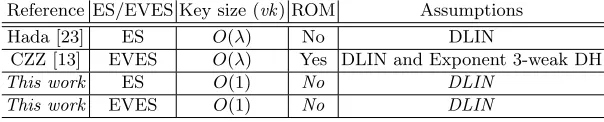
Comparison and Related Works. Comparisons of our results and previous results of VES schemes and obfuscators for ES/EVES are shown in Ta-ble 1 and in TaTa-ble 2, respectively. Letλdenote the security parameter. In this paper, the CDH assumption is considered in bilinear groups. There is no efficient VES scheme and obfuscator for ES/EVES which are secure under standard assumptions in the standard model with short verifica-tion keys prior to our work. The VES scheme by Lu et al. needs a quite large verification key but its signature size is small and its security is based on a standard CDH assumption, so one may think that the scheme of Lu et al. is better than our scheme in terms of signature size. How-ever, we think it is incomparable with our new scheme and we showed a tradeoff between the verification key size and signature size. R¨uckert proposed a VES scheme based on full-domain hash RSA signature, but it is secure in the ROM [25]. R¨uckert, Schneider, and Schr¨oder proposed
Table 1.A summary of previous efficient schemes and ours for VES
Reference Key size (vk/sk) VES size Assumptions ROM
BGLS [8] 1G/1Zp 2G CDH Yes
ZSS [32] 2G/2Zp 1G CDH Yes
LOSSW [24]O(λ)G(>160G)/1Zp 3G CDH No
RS [27] 4G/2Zp 2G+ 1Zp q-strong DH extraction No
This work 16G+ 1GT/3G 12G+ 2Zp DLIN No
Table 2.A summary of previous obfuscation for encrypted ES/EVES
Reference ES/EVES Key size (vk) ROM Assumptions
Hada [23] ES O(λ) No DLIN
CZZ [13] EVES O(λ) Yes DLIN and Exponent 3-weak DH
This work ES O(1) No DLIN
This work EVES O(1) No DLIN
Our Construction Technique. Loosely speaking, a VES scheme consists of a signature scheme and a encryption scheme as Lu et al. and R¨uckert and Schr¨oder [24, 27]. We use a signature scheme presented by Waters at CRYPTO’09 [31] as an underlying signature scheme. We call it the Waters dual signature in this paper to distinguish from Waters’ signature at Eurocrypt’05 [30]. Someone may think that a combination of the Wa-ters dual signature and ElGamal encryption easily yields a secure VES scheme under the DLIN assumption,but that is not the case. The reason is as follows: We can prove unforgeability of VES by relying on unforge-ability of the underlying signature scheme as previous schemes [8, 24, 27],
but opacity is non-trivial. Opacity means that it is difficult to extract ordinary signatures from VES, i.e., decrypt VES. Moreover, it is highly non-trivial whether we can prove opacity from standard assumptions or not. The reason is as follows: The VES scheme of Lu et al. is a combina-tion of Waters’ signature (Eurocrypt’05) [30] and the ElGamal encryp-tion scheme and they proved its opacity from the aggregate extracencryp-tion assumption [8] (fortunately, it is equivalent to the CDH assumption [15]). On the other hand, the VES scheme of R¨uckert and Schr¨oder is a combi-nation of Boneh-Boyen signature scheme [6] and the ElGamal encryption scheme, but they proved its opacity fromq-strong DH extraction assump-tion, which is astronger assumption than that of underlying Boneh-Boyen signature scheme [27].
Our construction is a combination of the Waters dual signature scheme and the ElGamal encryption scheme. We encrypt only signature elements
is different from that of many known secure signature schemes such as Boneh-Boyen [6], Waters [30], so we must employ a different proof strat-egy from that of Lu et al. and R¨uckert and Schr¨oder. The Waters dual signature has two types of signature, standard signature (which is called type A) and semi-functional signature (which is called type B). Semi-functional signatures also pass the verification algorithm as standard ones and areindistinguishable from standard ones [21,31]. We extend the proof strategy of this dual form signature technique to prove opacity. First, we employ type B signatures as normal signatures output by a normal sign-ing algorithm and type A signatures are used for simulation. Both type A and B signatures are valid signatures and there is no essential differ-ence in terms of functionality as long as a normal verification algorithm is used. We employ this swap of role since we do not know how to prove that the adversary cannot extract a valid type A signature from given VES when the oracle answers type A signatures.
In the experiment of opacity, the adversary can output a pair of a signature and a message such that the message was queried to an ora-cle which returns a VES for the queried message. This causes the main difficulty for proving the opacity since the adversary may output a re-randomized signature obtained by using valid signatures from oracles. Unfortunately, the Waters dual signature is re-randomizable. Thus, we modify the Waters dual signature scheme to make it strongly unforge-able. Strong unforgeability guarantees that the adversary cannot output a forgery even for a queried message, so it must hold that if the adversary output valid signature for queried message in the experiment of opacity, then the signature is identical to the signature generated by the VES creation oracle (otherwise, contradict to strong unforgeability). This fact can be used to prove the opacity of our scheme.
Thus, it is showed that the adversary cannot output a valid signature forqueried messageto the VES creation oracle. For non-queried messages, we can use the proof technique for unforgeability of dual form signatures. We show that the adversary cannot output a type A signature when the oracle returns type B signatures (VES).
Next, we change the type of signatures used to generate VES which are answered by the VES creation oracle. Answers of the adjudication oracle depend on the type of the VES creation oracle. Thus, we show that the view of the adversary is indistinguishable even if the type of answers are changed from type B to type A one-by-one for each query. This order of change is reverse to the original proof, but it is not essential difference. Lastly, we show that the adversary cannot output a type B signature when the oracle returns type A signatures (VES).
Secure obfuscations for ES and EVES based on the Waters dual sig-nature scheme are also non-trivial because the signing keys of the Waters dual signature scheme consist of multiple group elements and the signing algorithm computes exponentiation of the signing keys with randomness in contrast to Waters’ signature presented at Eurocrypt’05, whose sign-ing key is only one group element and signsign-ing algorithm only multiplies it by other group elements [30]. We overcome this hurdle by using additive homomorphic property of ElGamal and the linear encryption schemes [7]. Cheng et al. use the linear encryption scheme for not only encryption of VES but also the construction of VES itself, so their VES scheme cannot check the validity of ciphertext by using only the pairing technique and they need (NI)ZK [13]. We do not need (NI)ZK because our new VES scheme uses the ElGamal encryption scheme and can verify the validity of VES by using only pairings.
Remark. In this extended abstract, we do not have enough space to write complete proofs and all definitions, so we omitted some of them.
2 Preliminaries
Notations and Conventions. For any n ∈ N \ {0}, let [n] be the set
for anyλ > kc. Hereafter, we usef <negl(λ) to mean thatf is negligible
in λ. Let Γ := (p,G,GT, e, g) be a description of groups G and GT of
prime order p equipped with efficient bilinear map e : G×G → GT.
We often omit common parametersΓ. LetGbmp be a standard parameter generation algorithm for bilinear maps that outputsΓ.
Definition 1 (DLIN assumption).The DLIN problem is to guessβ ∈ {0,1}, given (Γ, g, f, ν, gx, fy, Qβ)
R
← Gdlin
β (1λ), where Gβdlin(1λ): Γ :=
(p,G,GT, e, g) R
← Gbmp(1λ), f, ν ←U G, x, y ←U Zp, Q0 := νx+y, Q1 U
← G, return (Γ, g, f, ν, gx, fy, Qβ). The advantage is AdvDLINA (λ) :=
Pr
h
A(I)→1 I
R
← Gdlin 0 (1λ)
i
−Pr h
A(I)→1 I
R
← Gdlin 1 (1λ)
i
. We say
that the DLIN assumption holds if for all probabilistic polynomial-time (PPT) adversary A, AdvDLINA (λ)<negl(λ).
Definition 2 (Aggregate Extraction (AgExt) assumption [8,15]).
The AgExt problem in bilinear groups is to compute gxy, given Γ := (p,G,GT, e, g)
R
← Gbmp(1λ) and (gx, gy, gβ, gδ, gxy+βδ) for x, y, β, δ ←U Zp. The advantage is AdvAgExtA (λ) := Pr[z =gxy |Γ ← GU bmp(1λ);x, y, β, δ ←U
Zp;z R
← A(Γ, gx, gy, gβ, gδ, gxy+βδ)]. We say that the AgExt assumption holds in bilinear groups if for any PPT A, AdvAgExtA (λ)<negl(λ).
Definition 3 (CDH assumption).The CDH problem in bilinear groups is to compute gxy, given Γ := (p,G,GT, e, g)
R
← Gbmp(1λ) and (gx, gy)
for x, y ←U Zp. The advantage is AdvACDH(λ) := Pr[z = gxy | Γ
U
← Gbmp(1λ);x, y ←U Zp;z ← AR (Γ, gx, gy)]. We say that the CDH assump-tion holds in bilinear groups if for any PPT A,AdvCDHA (λ)<negl(λ).
The AgExt assumption is equivalent to computational Diffie-Hellman (CDH) assumption, which is implied by the DLIN assumption.
Theorem 1 ( [15]). The AgExt and CDH problems are Karp reducible to each other with O(1)computation.
Verifiably Encrypted Signature (VES). A VES scheme consists of follow-ing seven algorithmsVES={AdjGen,Gen,Sign,Vrfy,Create,VesVrfy,Adj}: Adjudicator Key Generation: AlgorithmAdjGentakes as input secu-rity parameter 1λ and outputs a pair of key for an adjudicator, that is, (apk,ask)←R AdjGen(1λ).
Signing: AlgorithmSigntakes as input a signing key and a message and outputs signatureσ. That is,σ ←R Sign(sk, M), where M ∈ Mvk and
Mvk is a message space defined by vk.
Verification: AlgorithmVrfyis deterministic and takes as inputvk,M, and σ and outputs bit b. If b= 1 then the signature is valid. Else, it is invalid. That is,Vrfy(vk, σ, m)→b.
VES Creation: Algorithm Create takes as input sk, apk, and M and outputs VESω on M. That is, ω←R Create(sk,apk, M).
VES Verification: Algorithm VesVrfyis deterministic and takes as in-putapk,vk,ω, andM and outputs bitb,VesVrfy(apk,vk, ω, M)→b. Adjudication: Algorithm Adj takes as input ask,apk,vk, ω, and M. If ω is valid, it extracts an ordinary signature σ on M and returns σ, that isσ ←R Adj(ask,apk,vk, ω, M) ifVesVrfy(apk,vk, ω, M)→1. For correctness, it is required that∀λ∀(apk,ask)←R AdjGen(1λ)∀(vk,sk)←R
Gen(1λ) ∀m ∈ Mvk VesVrfy(apk, pk,Create(sk,apk, M), M) → 1 and
Vrfy(vk,Adj(ask,apk,vk,Create(sk,apk, M)), M)→1.
ExperimentsVesForgeA(λ) and OpacA(λ) are defined as follows:
Experiment VesForgeA(λ)
(apk,ask)←R AdjGen(1λ); (vk,sk)←R Gen(1λ); (M∗, ω∗)←R
ACO(sk,apk,·),AO(ask,apk,vk,·,·)(vk,apk);
Return 1 iff
VesVrfy(apk,vk, ω∗, M∗)→1 and M∗∈/ QC and M∗∈/ QA.
Experiment OpacA(λ)
(apk,ask)←R AdjGen(1λ); (vk,sk)←R Gen(1λ); (M∗, σ∗)←R
ACO(sk,apk,·),AO(ask,apk,vk,·,·)(vk,apk);
Return 1 iff
Vrfy(vk, σ∗, M∗)→1 and M∗∈/ QA.
where the creation oracle,CO(sk,apk,·), returns a VES for a queried mes-sage, the adjudication oracle, AO(ask,apk,vk,·,·), extracts and returns a signature for a queried message/VES pair, and QC and QA are sets of
messages queried by the adversary toCO and AO, respectively.
Definition 4 (Secure VES [8]). A VES scheme is secure if it satisfies unforgeability and opacity, i.e., it holds for any PPTA,Pr[VesForgeA(λ)→
1]<negl(λ) andPr[OpacA(λ)→1]<negl(λ).
Collision Resistant Hash Functions (CRHF). LetH:={Hk}be a keyed
hash family of functionsHk:{0,1}∗ → {0,1}n indexed byk∈ Kλ where
Definition 5. We say that H is (t, )-collision-resistant if for any ad-versary A running in time t, we have that AdvCRHFA,H (λ) := Pr[m0 6=
m1∧Hk(m0) = Hk(m1) | (m0, m1) R
← A(k)] < where the probability is taken over the random choice of k∈ Kλ and random coins ofA.
3 Strongly Unforgeable Waters Dual Signature
Waters Dual Signature Scheme. We review a signature scheme presented by Waters [31] since we use it as a essential building block. However, we add a few minor changes to fit the scheme to this paper. We will explain the differences between the original scheme and modified scheme WdSig.
Wd.Gen(1λ, Γ): On input security parameterλandΓ := (p,G,GT, e, g) R
← Gbmp(1λ), it chooses generators v, v1, v2, w, u, h
U
← G and exponent a1, a2, b, α
U
← Zp, computes τ1 := vv1a1, τ2 := vv2a2, and sets VK :=
(Γ, gb, ga1, ga2, gba1, gba2, v, v
1, v2, τ1, τ2, τ1b, τ2b, w, u, h, e(g, g)αa1b) andSK
:= (VK, gα, gαa1, ga1a2). Hereafter we often omit input 1λ.
Wd.Sign(SK, M): On input messageM ∈Zp, it selectsr1, r2, z1, z2, γ,stag U
←Zp, setsr:=r1+r2, computessig := (σ0, σ1, . . . , σ7,stag), where
σ0:= (uMwstagh)r1, σ1 :=gαa1vrg−a1a2γ, σ2 :=g−αvr1gz1ga2γ,
σ3:= (gb)−z1, σ4 :=vr2gz2ga1γ, σ5 := (gb)−z2,
σ6:= (gb)r2, σ7 :=gr1.
Wd.Vrfy(VK,sig, M): On input VK, M, andsig, it outputs 1 if and only if it holds that
e(uMwstagh, σ7) =e(g, σ0),
e(gb, σ1)e(gba1, σ2)e(ga1, σ3) =e(τ1, σ6)e(τ1b, σ7),
e(gb, σ1)e(gba2, σ4)e(ga2, σ5) =e(τ2, σ6)e(τ2b, σ7)e(g, g)αa1b.
The differences are as follows: In the original Waters dual signature scheme, (1) the verification equation is only one equation and proba-bilistic, (2) values v, v1, v2 are included in secret keys, (3) value ga1a2 is
not included in the signing key, (4) the (normal) signing algorithm does not multiply g−a1a2γ,ga2γ,ga1γ inσ
1,σ2,σ4, respectively.
that if a signature passes the equations, then the signature is either type A or B. The original equations use ciphertexts and the decryption pro-cedure of the Waters dual encryption scheme, so it is probabilistic and has a semi-functional verification algorithm that uses semi-functional ci-phertexts [31]. Type A signatures are signatures with γ = 0 and pass both the normal and semi-functional verification equations. Type B sig-natures are sigsig-natures with γ 6= 0 and cannot pass the semi-functional verification equations (Gerbush, Lewko, O’Neill, and Waters defined them as backdoor verification tests [21]). As long as the verification equations are normal, both type A and type B signatures are valid signatures and there is no essential difference. Thus, we employ type B signatures in the normal signing algorithm.
Even ifv, v1, v2are disclosed, we cannot computev2b(and semi-functional
ciphertexts of the dual system encryption of Waters [31]). Thus, we add (v, v1, v2) to the verification key and this does not affect its security since
gα andgαa1 (andvb
2) are kept secret and they are essential secret signing
keys. This is observed by Abe et al. [1]. For the minor changed version above, the following theorem holds [1, 31].
Theorem 2. If the DLIN assumption holds, then WdSig := Wd.{Gen,
Sign,Vrfy} is existentially unforgeable against adaptive chosen message attacks (EUF-CMA).
The original Waters dual signature is not strongly unforgeable since it is re-randomizable. “Strong” means that the adversary cannot forge a signature even for a queried message to the signing oracle. In order to make our VES scheme satisfy opacity, we modify the Waters dual signature. We extend the technique by Boneh, Shen, and Waters [10]. They introduced a property called 2-partitioned to convert unforgeable signature schemes intostrongly unforgeable signature schemes. We extend 2-partitioned to 3-partitioned.
Definition 6. A signature scheme is 3-partitioned if it satisfies the fol-lowing two properties:
– The signing algorithm consists of three deterministic algorithms F1,
F2, and F3
1. chooses random R∈ R (R is a space for randomness),
2. computesΣ1 :=F1(M, R,VK),Σ2 :=F2(R,VK),Σ3:=F3(R,SK),
3. and outputs signature σ:= (Σ1, Σ2, Σ3).
– GivenM andΣ2 there is at most one (Σ1, Σ3) such that(Σ1, Σ2, Σ3)
A 2-partitioned signature isσ = (Σ10, Σ20) whereΣ10 =F10(M, R,SK) and Σ20 =F20(R,SK) [10]. ValueΣ20 binds all randomnessR, soM andRfully determine Σ10. For VES, signature elements related to the secret signing key (i.e., Σ3) should be encrypted, so we cannot use such elements as
inputs to hash functions (we will use hash functions to obtain strongly secure signature) and want to isolate the secret signing key from Σ20. Otherwise, encrypted signatures are not verifiable. If Σ3 is not used as
an input of hash function, then hash values are not changed even if Σ3
is encrypted. This is the reason why we introduced 3-partitioned andΣ1
and Σ2 are independent of the secret signing key.
Let Π := (Gen,Sign,Vrfy) be an existentially unforgeable signature scheme. New signature scheme Π0 := (Gen0,Sign0,Vrfy0) is as follows:
Gen0(1λ): It generates (VK,SK)←R Gen(1λ), chooses ¯h←U Gand random hash keyk∈ K, and sets (VK0,SK0) := ((VK,¯h, k),SK).
Sign0(SK0, M): On input message M ∈ {0,1}`, it chooses exponent ϕ U
←
Zp and randomnessR∈ R, computesΣ2 :=F2(R,VK),ϑ:=Hk(M k
Σ2) (viewϑas an element inZp),m:=Hk(gϑ¯hϕ),Σ1:=F1(m, R,VK)
andΣ3 :=F3(R,SK), and outputs a signature sig:= (Σ1, Σ2, Σ3, ϕ). Vrfy0(VK0,sig, M): On inputVK0, M, and signaturesig= (Σ1, Σ2, Σ3, ϕ),
it computes ϑ0 := Hk(M k Σ2) (view ϑ0 as an element Zp), m0 :=
Hk(gϑ
0¯
hϕ), It outputs 1 if and only ifVrfy(VK,(Σ1, Σ2, Σ3), m0)→1.
Theorem 3. Signature scheme Π0 is (t, q, )-strongly existentially un-forgeable if Π is (t, q, /3)-existentially unforgeable, the (t, /3)-DL as-sumption holds in G, and H is (t, /3)-collision-resistant.
This is easily proved by extending the proof of Boneh, Shen, and Wa-ters [10]. The DL assumption means the discrete logarithm assumption. The essential point is that given message M and partial signature Σ2,
the randomness which is used to generate the whole signature is deter-mined and there is at most one (Σ1, Σ3) such that (Σ1, Σ2, Σ3) is a valid
signature onM underVK. Intuitively, in the construction ofΠ0, we sign not only messageM but also randomnessR to bind the randomness and prevent re-randomization. Moreover, in order to prevent message m be-ing determined by randomness R, new randomness ϕ is introduced and chameleon hash functions (gϑ¯hϕ) are used. Value mwill be signed. Theorem 4. The Waters dual signature is 3-partitioned.
Proof. Let R:= {(r1, r2, z1, z2,stag, γ)| r1, r2, z1, z2,stag, γ U
← Zp}, then functionsF1,F2, andF3are defined as follows:R
R
σ0 = (uMwstagh)r1,F2(R,VK) := (σ3, . . . , σ7,stag) = (g−bz1, v2rgz2 ·ga1γ,
g−bz2, gbr2, gr1,stag),F
3(R,SK) := (σ1, σ2) = (gαa1vr·g−a1a2γ, g−αvr1gz1·
ga2γ) where γ ←U Z
p is chosen for type B signatures. If the signature is
type A, then γ := 0. We can interpret σ3, σ5, σ6, σ7 (outputs of F2) as
g−bz1, g−bz2, gbr2, gr1, respectively and it followsσ
0 = (uMwstagh)r1 from
the first verification equation, that is, the output of F1 is fixed. If we
interpret σ4 as v2rgz2 ·ga1γ, then by the second and third equations two
unknowns σ1 and σ2 are fixed to gαa1vr·g−a1a2γ and g−αvr1gz1,
respec-tively, that is, the output of F3 is fixed. Thus, if the output ofF2 andM
are fixed, then the outputs of F1 and F3 are also fixed.
We can see that even if (σ1, σ2) is encrypted by the ElGamal encryption,
hash value ϑ = Hk(M k (σ3, . . . , σ7,stag)) is not changed, so it can be
fitted to VES schemes. Note that we assume that each elementg∈Ghas a unique encoding. We can obtain strongly secure scheme sWdSig:
sWd.Gen(1λ, Γ): It generates (VK0,SK0) R
←Wd.Gen(1λ, Γ), chooses ¯h U
←
Gand random hash keyk∈ K, and sets (VK,SK) := ((VK0,h, k¯ ),SK0).
sWd.Sign(SK, M): On input message M ∈ Zp, it selects r1, r2, z1, z2, γ, stag, ϕ←U Zp, sets r:=r1+r2, computesσ1:=gαa1vr·g−a1a2γ,σ2 :=
g−αvr1gz1 ·ga2γ,σ
3 := (gb)−z1,σ4 :=v2rgz2 ·ga1γ, σ5 := (gb)−z2,σ6 :=
(gb)r2,σ
7 :=gr1,ϑ:=Hk(M kΣ2) where Σ2 = (σ3, . . . , σ7,stag) and
viewϑas an element in Zp,m:=Hk(gϑh¯ϕ), σ0 := (umwstagh)r1, and
outputssig:= (σ0, σ1, . . . , σ7,stag, ϕ).
sWd.Vrfy(VK,sig, M): On inputVK, M, and signaturesig= (σ0, σ1, . . . ,
σ7,stag, ϕ), it computes ϑ0 := Hk(M k (σ3, . . . , σ7,stag)), m0 :=
Hk(gϑ
0¯
hϕ), andWd.Vrfy(VK0,sig0, m0)→bwheresig0 := (σ0, . . . , σ7,stag),
and outputsb.
Corollary 1. The scheme above is strongly unforgeable against adap-tive chosen message attacks if the DLIN assumption holds. In particular,
for any PPT adversary F against sWdSig that makes at most q
sign-ing queries, there exists PPT algorithm B0 for DLIN and C for CRHF,
AdvsEUFF,sWdSig-CMA(λ)≤ {(q+3)/3}AdvDLINB0 +(1/3)AdvCRHFC,H whereAdvsEUFF,sWdSig-CMA(λ) and AdvEUFF0,WdSig-CMA(λ) is the advantage of the adversary for sWdSig.
Note that the DL assumption is implied by the DLIN assumption.
4 Construction of Our VES
scheme is basically the same as the strongly unforgeable Waters dual sig-nature scheme in Section 3 except that we encrypt sigsig-nature elements which include secret keys (gα, gαa1, ga1a2) by the ElGamal encryption scheme. That is, in our creation algorithm, onlyσ1 andσ2 are encrypted.
In order to verify encrypted signatures, we add extra elements and can-cel out group elements which are generated by pairing computation of encrypted signatures in the verification equation. sWdVESis as follows:
AdjGen(1λ): It selects β←U Zp and sets apk :=ζ :=gβ and ask :=β. Gen(1λ): It generates (VK0,SK0) := ((g, gb, ga1, ga2, gba1, gba2, τ
1, τ2, τ1b, τ2b,
v, v1, v2, w, u, h,¯h, k, e(g, g)αa1b),(gα, gαa1, ga1a2)) R
←sWd.Gen(1λ) and setsvk :=VK0 andsk := (VK0,SK0).
Sign and Vrfy: Same assWd.{Sign,Vrfy} in Section 3, respectively.
Create(sk,apk, M): It generates (σ0, . . . , σ7,stag, ϕ) R
←sWd.Sign(SK0, M), selectsρ1, ρ2
U
←Zp, outputsω:= (K0, . . . , K7, K10, K20,Kˆ1,Kˆ2,stag, ϕ),
where (K0, K3, . . . , K7) := (σ0, σ3, . . . , σ7) and
K1 :=σ1·ζρ1, K10 :=gρ1, Kˆ1 := (gb)ρ1,
K2 :=σ2·ζρ2, K20 :=gρ2, Kˆ2 := (gba1)ρ2.
VesVrfy(apk,vk, ω, M): It parsesω= (K0, . . . , K7, K10, K20,Kˆ1,Kˆ2,stag, ϕ),
and computes ϑ0 :=Hk(M k(K3, . . . , K7,stag)), m0 :=Hk(gϑ
0¯
hϕ), It
outputs 1 if and only if it holds that
e(K10, gb) =e(g,Kˆ1) , e(K20, gba1) =e(g,Kˆ2)
e(um0wstagh, K7) =e(g, K0)
e(gb, K 1)
e(ζ,Kˆ1)
·e(g
ba1, K 2)
e(ζ,Kˆ2)
·e(ga1, K
3) =e(τ1, K6)e(τ1b, K7)
e(gb, K1)
e(ζ,Kˆ1)
·e(gba2, K
4)e(ga2, K5) =e(τ2, K6)e(τ2b, K7)e(g, g)αa1b
Adj(ask,apk,vk, ω, M): It parsesω = (K0, . . . , K7,stag, ϕ) and computes
σ1 :=K1·(K10)−β,σ2 :=K2·(K20)−β,σ3 :=K3,σ4 :=K4,σ5:=K5,
σ6 :=K6, σ7 :=K7,σ0 :=K0. If VesVrfy(apk,vk, ω, M) →1, then it
outputs (σ0, . . . , σ7,stag, ϕ). These are valid signatures.
R¨uckert and Schr¨oder defined key-independence and extractability of VES to prove unforgeability and collusion-resistance of VES in a modular way [26,27]. Key-independence means that a VES creation algorithm con-sists of a signature generation part and a transformation (into VES) part and they are independent. Extractability means that if VES ω is valid, then the adjudicator can extract a valid (ordinary) signature σ with ex-cept negligible probability. Collusion-resistance means that no adversary can forge VES even if the adjudicator is corrupted, i.e., adversary ob-tains the secret decryption key of the adjudicator. R¨uckert and Schr¨oder showed the following theorem.
Theorem 5 ( [27]).LetVESbe an extractable and key-independent ver-ifiably encrypted signature scheme. VES is unforgeable if and only if the underlying signature scheme Sig is unforgeable.
As a corollary,sWdVES is unforgeable under the DLIN assumption since we can easily show that oursWdVESbased onsWdSigis key-independent and extractable though we omit proofs in this extended abstract.
Theorem 6. sWdVESis opaque if the DLIN assumption holds and there exists CRHF.
Proof. If adversaryAoutputs forgeryσ∗= (σ0∗, . . . , σ∗7,stag∗, ϕ∗) andM∗ such thatM∗is not queried toAO, then it means thatAbreaks opacity of
sWdVES.Adirectly forges a signature of underlyingsWdSigor extracts a signature by breaking the one-wayness of the ElGamal encryption scheme. In order to prove opacity, we introduce the following games: LetGame-(i) denote a game whereCOanswers encryption of type A signatures for the first i (i ∈ [qC] and qC is the number of creation query by A) queries
and encryption of type B signatures for the remaining (qC−i) queries
and AO answers signatures extracted from queried VES for all qA (the
number of adjudication query) queries. Let Advforgei -A (resp. Advforgei -B) denote the advantage of the adversary in Game-(i) for outputting type A (resp. B) forgery for a non-queried message (a message which is not queried to CO). Let Advextract0 -B denote the advantage of the adversary in Game-0 for extracting a type B signature from a VES for a queried message (a message which is queried to CO).
1. InGame-(0), CO returns encryption of type B signature and AO re-turns type B signature. First, we show Lemma 1: IfAoutputs a valid type B signature for message Mi which has been already queried to
forgery for messageM∗such thatM∗6=Mifor alli∈[q]. We can show
that ifA outputs forgery of type A signature, then we can construct algorithmB1 which solves the CDH problem.
2. Next, we considerGame-(i). We can show that ifAdetects the change from type B answer to type A answer by CO, then we can construct algorithmB2 which solves the DLIN problem.
3. Last, we considerGame-(qC), where all answers for VES queries ofA
are encryption of type A signature. We can show that ifA outputs a forgery of type B signature, then we can construct algorithmB3 which
solves the DLIN problem.
Thus, if the DLIN assumption holds, the signature scheme is opaque. The core part is Lemma 1. By statements described above except Lemma 1, we can showAdvOpacA (λ) =Advforge0 -A+Adv0extract-B+Advforge0 -B<Advextract0 -B+
AdvFEUF,WdSig-CMA<Adv0extract-B+ (qC+ 2)AdvDLINB . By Lemma 1, we can show
Advextract0 -B< qCAdvAgExtE +Adv
sEUF-CMA
F0,sWdSig +AdvCRHFC
< 4qC+ 3 3 Adv
DLIN
B +
4 3Adv
CRHF
C .
Thus, it holdsAdvOpacA (λ)<((7qC+ 9)/3)AdvDLINB + (4/3)AdvCRHFC .
Lemma 1. If there exists adversary A that outputs a type B forgery for a queried message Mi in Game-(0), then we can construct algorithm E
that solves the AgExt problem.
Proof of lemma. E is given instance (Γ, gx, gy, gβ, gδ, gxy+βδ) of the AgExt problem.Egenerates the verification key as follows: Chooses expo-nents a1, b, yv, yv1, yv2, yw, yh, yu, η
U
← Zp and hash key k ∈ K, computes g := g, gb := gb, ga1 := ga1, ga2 := gy, gba2 := (gy)b, gba1 := gba1,
v := gyv, v
1 := gyv1,v2 := gyv2, w := gyw, u := gyu, h := gyh, ¯h := gη,
ζ := gβ, e(g, g)αa1b := e(gx, gy)a1·b (it implicitly holds α = xy though
E does not have α), τ1 := vva11, τ1b, τ2 := v(gy)yv2, and τb
2, and sets
VK := (g, gb, ga1, ga2, gba1, gba2, τ
1, τ2, τ1b, τ2b, w, u, h,¯h, k, e(g, g)αa1b) and
apk := ζ = gβ. Note that E does not have a2 = y and gα = gxy, so E
cannot directly compute Type B signature.
Simulation of Creation Oracle: Einitializes listQList:=∅.Echooses ran-dom indexj←U [qC], i.e., guesses which VESAselects and outputs its
ex-traction.E outputs encryption of Type B signatures fori-th VES creation queryMias follows: Ifi6=j, then choosesr1, r2, z1, z2, γ0,stag, ϕi, ρ1, ρ2
U
←
Zp, sets r := r1 +r2 (we want to set γ := x+γ0), computes σi,1 :=
(gy)−γ0a1 ·vr = (gαa1vr)·g−a1a2γ (where a
(gy)γ0v1rgz1 = (gαvr
1gz1)·ga2γ, K3 := σi,3 := (gb)−z1, K4 := σi,4 :=
(gx)a1ga1γ0vr
2gz2 = (v2rgz2)·ga1γ,K5 :=σi,5:= (gb)−z2,K6:=σi,6 :=gr2b,
K7 :=σi,7:=gr1,ϑi :=Hk(Mi kΣi,2) whereΣi,2 := (σi,3, . . . , σi,7),mi :=
Hk(gϑi¯hϕi),K0 :=σi,0 := (umiwstagh)r1,K1:=σi,1·ζρ1,K10 :=gρ1, ˆK1 :=
(gb)ρ1, K
2 := σi,2 ·ζρ2, K20 := gρ2, ˆK2 := (gba1)ρ2, stores (Mi, σi, Ri :=
(r1, r2, z1, z2,stag, γi := γ0)) in QList where σi := (σi,0, . . . , σi,7,stag, ϕi)
and outputs ω := (K0, . . . , K7, K10, K20,Kˆ1,Kˆ2,stag, ϕi) for Mi. We can
verify σi is a correct type B signature.
Embedding Instance:Ifi=j, thenEchoosesr∗1, r∗2, z1∗, z2∗, γ∗,stag∗, ϕ∗, ρ∗1, ρ∗2 ←U Zp, setsr∗ =r∗1+r2∗, answersK1∗ := (gxy+βδ)a1·vr
∗
·(gy)−a1γ∗ζρ∗1 = (gαa1vr∗)·g−a1a2γ∗ζρ01 (where a2 = y, xy = α, ρ0
1 := a1δ+ρ∗1), K1∗0 :=
(gδ)a1gρ1∗ = gρ01, ˆK∗
1 := (gδ)ba1gbρ
∗
1 = (gb)ρ01, K∗
2 := (gxy+βδ)−1vr
∗
1 gz
∗
1 ·
(ga2)γ∗(gβ)ρ∗2 = (g−αvr∗ 1 gz
∗
1) ·ga2γ∗ζρ02 (where ρ0
2 := −δ +ρ∗2), K2∗0 :=
(gδ)−1gρ∗2 =gρ
0
2, ˆK∗
2 := (gδ)−ba1gba1ρ
∗
2 = (gba1)ρ02, K∗
3 := (gb)−z
∗
1, K∗ 4 :=
v2r∗gz2∗ga1γ∗,K∗
5 := (gb)−z
∗
2,K∗ 6 :=gr
∗
2b,K∗ 7 :=gr
∗
1,ϑ∗:=Hk(K∗
3, . . . , K7∗, stag∗),m∗ :=Hk(gϑ
∗¯
hϕ∗), andK∗
0 := (um
∗
wstag∗h)r∗1 and records (Mj, ω∗ := (K0∗, . . . , ϕ∗), j, γ∗) as the challenge instance. It can be verifiedω∗ is a correct encryption of type B signature.
Simulation of Adjudication Oracle: When A makes `-th adjudication
query (M`, ω`), then we know that A must have queried M` to CO by
the theorem of R¨uckert and Schr¨oder (Otherwise, it is a forgery. This is the same argument by R¨uckert and Schr¨oder in [27]). First, E verifies the query and returns ⊥ if it is invalid. Otherwise, E acts as follows: If M` =Mj, that is, the guessed index ((Mj, . . .) ∈/ QList), then E aborts.
Otherwise, there exists (Mi, σi, Ri) ∈ QList for some i 6= j such that
M` =Mi and the signature is Type B. In this case (M` =Mi), for query
(M`, ω = (K0, . . . , K7, K10, K20,Kˆ1,Kˆ2,stag, ϕ)), if ϕ6=ϕi, thenA breaks
strong unforgeability of our modified Waters dual signature. We consider an intermediate game where if ϕ6=ϕi, thenE aborts. The probability E
aborts with this condition is less than the success probability of break-ing strong unforgeability of sWdSig. That is, it holds ϕ = ϕi without
negligible probability. If ϕ = ϕi, then it holds K3 = σi,3, K4 = σi,4,
K5 =σi,5,K6 =σi,6, K7 =σi,7,stag=stagi since otherwise it means A
outputs (K3, . . . , K7,stag) such that Hk(σi,3, . . . , σi,7,stagi) =ϕi =ϕ=
Hk(K3, . . . , K7,stag) and (K3, . . . , K7,stag) 6= (σi,3, . . . , σi,7,stagi). This
is a collision of the hash function and contradicts to the collision-resistant property. We consider an intermediate game where ifHk(σi,3, . . . , σi,7,stagi
of (K3, . . . , K7,stag) is the same as that of (σi,3, . . . , σi,7,stagi) without
negligible probability.
By using K3 = g−bz1, K5 = g−bz2, K6 = gbr2, K7 = gr1, E can
compute gr2 = (K
6)1/b, gr1 = K7, gz1 = (K3)−1/b, gz2 = (K5)−1/b,
vr = (gr1 ·gr2)yv, vr
1 = (gr1 ·gr2)yv1, and v2r = (gr1 ·gr2)yv2 since E
has b, yv, yv1, yv2 and it holds that v = g
yv v
1 = gyv1 v2 = gyv2. E can use the same computation procedure in the simulation of CO above by using γi stored in QList. Therefore, E can return valid Type B signature
(σ0, . . . , σ7,stag, ϕ) such that the randomness r inσ1,σ2 is the same as
that in K1,K2 by using stored information σi. That is, AO is perfectly
simulated by E.
Solving the Problem: At some point, A outputs a Type B extraction,
M∗ = Mj, stag∗, σ1∗ = gαa1vr
∗
g−a1a2γ∗, σ∗
2 = g−αvr
∗
1 gz
∗
1ga2γ∗, σ∗ 3 =
(gb)−z1∗, σ∗ 4 = vr
∗
2 gz
∗
2ga1γ∗, σ∗
5 = (gb)−z
∗
2, σ∗ 6 = gr
∗
2b, σ∗ 7 = gr
∗
1, ϑ∗ =
Hk(σ3, . . . , σ7,stag∗), m∗ = Hk(gϑ
∗
¯
hϕ), and σ∗0 = (um∗wstag∗h)r∗1 (not queried toAObutCO) such thatrandomness are the same as those used when B embedded the problem instance at j-th query and (Mj, ω∗, j, γ∗)
is recorded as the challenge instance. This is guaranteed by the strong unforgeability and collision-resistance as we discussed above. By using these values, E can compute gr∗2 = (σ∗
6)1/b, gr
∗
1 = σ∗ 7, gz
∗
1 = (σ∗ 3)−1/b,
gz2∗ = (σ∗
5)−1/b,vr
∗
= (gr1∗·gr
∗
2)yv,vr
∗
1 = (gr
∗
1·gr
∗
2)yv1,vr
∗
2 = (gr
∗
1·gr
∗
2)yv2, since E has b, yv, yv1, yv2 and it holds that v = g
yv v
1 = gyv1 v2 =gyv2.
Thus, E can compute gz∗1 ·vr∗ 1 ga2γ
∗
/σ2∗ = gα = gxy since E has a 1 and
γ∗ is recorded. That is, E can output solution gxy of the AgExt problem if the adversary outputs a Type A extraction for queried messageMj to
CO. E guesses indexj, so its success probability is degraded by a factor of 1/qC. However, it still breaks the AgExt problem with non-negligible
probability /qC where is the success probability ofA.
5 Application to Obfuscators for ES and EVES
Our VES scheme can be used to construct new obfuscators for ES and EVES. Hada constructed an obfuscator for ES by combining Waters’s signature (2005) and the linear encryption scheme [23]. The linear en-cryption scheme proposed by Boneh, Boyen, and Shacham [7] and is as follows:
L.Gen(1λ): It generates Γ ← GR bmp(1λ), selects exponents xe, ye U
← Zp, and outputspk:= (fe, he) := (gxe, gye),dk:= (xe, ye).
L.Enc(pke, m): On inputm∈Gandpk= (fe, he) it selectsr, s U
←Zp and outputsc:= (fr
Hada’s idea is as follows: Suppose that signature σ is computed as σ =
sk ·G(m) where sk ∈ G is the signing key, m ∈ Zp is the message and
G : Zp → G is an efficiently computable function. Then, for ciphertext c =L.Enc(pk,sk), we can compute ˜c:= c·G(m) =L.Enc(pk,sk ·G(m)) by homomorphic property of the linear encryption scheme. This is ex-actly an encrypted signature. The ciphertext of sk can be seen as an obfuscated circuit for encrypted signatures since the linear encryption scheme is semantically secure and no information about sk is revealed. We extend Hada’s construction, that is, we combine our VES scheme based on the strongly unforgeable Waters dual signature and the linear encryption scheme. However, our VES scheme is based on the Waters dual signature, which is more complex than Waters’ signature at Euro-crypt’05, so it is non-trivial whether we can use Hada’s technique directly or not. Especially, in Waters’ signature at Eurocrypt’05, the signing al-gorithm does not exponentiate sk, but in the Waters dual signature, it does. We can resolve this problem by using the multiplicatively ho-momorphic property of the linear encryption scheme, that is, we can compute cr ·G(m) = L.Enc(pk,skr ·G(m)). Therefore, if we encrypt
sk = (gα, gαa1, ga1a2) by linear encryption, then we can construct an obfuscator for ES/EVES. We omit details of these constructions since we do not have space to present them. We will present them in a full version.
References
1. M. Abe, M. Chase, B. David, M. Kohlweiss, R. Nishimaki, and M. Ohkubo. Constant-size structure-preserving signatures: Generic constructions and simple assumptions. InASIACRYPT, volume 7658 ofLNCS, pages 4–24. Springer, 2012. full version available from http://eprint.iacr.org/2012/285.
2. N. Asokan, V. Shoup, and M. Waidner. Optimistic fair exchange of digital sig-natures (extended abstract). InEUROCRYPT, volume 1403 ofLecture Notes in Computer Science, pages 591–606. Springer, 1998.
3. F. Bao, R. H. Deng, and W. Mao. Efficient and practical fair exchange protocols with off-line TTP. In IEEE Symposium on Security and Privacy, pages 77–85. IEEE Computer Society, 1998.
4. B. Barak, O. Goldreich, R. Impagliazzo, S. Rudich, A. Sahai, S. P. Vadhan, and K. Yang. On the (im)possibility of obfuscating programs. J. ACM, 59(2):6, 2012. 5. M. Belenkiy, J. Camenisch, M. Chase, M. Kohlweiss, A. Lysyanskaya, and H. Shacham. Randomizable proofs and delegatable anonymous credentials. In
CRYPTO, volume 5677 ofLNCS, pages 108–125. Springer, 2009.
6. D. Boneh and X. Boyen. Short signatures without random oracles and the SDH assumption in bilinear groups. J. Cryptology, 21(2):149–177, 2008.
8. D. Boneh, C. Gentry, B. Lynn, and H. Shacham. Aggregate and verifiably en-crypted signatures from bilinear maps. InEUROCRYPT, volume 2656 ofLecture Notes in Computer Science, pages 416–432. Springer, 2003.
9. D. Boneh, B. Lynn, and H. Shacham. Short signatures from the Weil pairing. In
ASIACRYPT, volume 2248 ofLNCS, pages 514–532. Springer, 2001.
10. D. Boneh, E. Shen, and B. Waters. Strongly unforgeable signatures based on computational Diffie-Hellman. InPKC’06, volume 3958 ofLNCS, pages 229–240, 2006.
11. Z. Brakerski, C. Gentry, and V. Vaikuntanathan. (Leveled) fully homomorphic encryption without bootstrapping. InITCS, pages 309–325. ACM, 2012.
12. Z. Brakerski and V. Vaikuntanathan. Efficient fully homomorphic encryption from (standard) LWE. InFOCS, pages 97–106. IEEE, 2011.
13. R. Cheng, B. Zhang, and F. Zhang. Secure obfuscation of encrypted verifiable encrypted signatures. InProvSec, volume 6980 ofLNCS, pages 188–203. Springer, 2011.
14. J.-S. Coron, A. Mandal, D. Naccache, and M. Tibouchi. Fully homomorphic en-cryption over the integers with shorter public keys. InCRYPTO, volume 6841 of
Lecture Notes in Computer Science, pages 487–504. Springer, 2011.
15. J.-S. Coron and D. Naccache. Boneh et al.’s k-element aggregate extraction as-sumption is equivalent to the Diffie-Hellman asas-sumption. InASIACRYPT, volume 2894 ofLNCS, pages 392–397. Springer, 2003.
16. G. Fuchsbauer. Commuting signatures and verifiable encryption. In EURO-CRYPT, volume 6632 ofLNCS, pages 224–245. Springer, 2011.
17. C. Gentry. Fully homomorphic encryption using ideal lattices. InSTOC, pages 169–178. ACM, 2009.
18. C. Gentry and S. Halevi. Fully homomorphic encryption without squashing using depth-3 arithmetic circuits. InFOCS, pages 107–109. IEEE, 2011.
19. C. Gentry and S. Halevi. Implementing Gentry’s fully-homomorphic encryption scheme. InEUROCRYPT, volume 6632 ofLNCS, pages 129–148. Springer, 2011. 20. C. Gentry, S. Halevi, and N. P. Smart. Fully homomorphic encryption with polylog overhead. InEUROCRYPT, volume 7237 ofLNCS, pages 465–482. Springer, 2012. 21. M. Gerbush, A. B. Lewko, A. O’Neill, and B. Waters. Dual form signatures: An approach for proving security from static assumptions. InASIACRYPT, volume 7658 ofLNCS, pages 25–42. Springer, 2012.
22. S. Hada. Zero-knowledge and code obfuscation. InASIACRYPT, volume 1976 of
Lecture Notes in Computer Science, pages 443–457. Springer, 2000.
23. S. Hada. Secure obfuscation for encrypted signatures. InEUROCRYPT, volume 6110 ofLecture Notes in Computer Science, pages 92–112. Springer, 2010. 24. S. Lu, R. Ostrovsky, A. Sahai, H. Shacham, and B. Waters. Sequential aggregate
signatures and multisignatures without random oracles. InEUROCRYPT, volume 4004 ofLecture Notes in Computer Science, pages 465–485. Springer, 2006. 25. M. R¨uckert. Verifiably encrypted signatures from RSA without NIZKs. In
IN-DOCRYPT, volume 5922 ofLNCS, pages 363–377. Springer, 2009.
26. M. R¨uckert, M. Schneider, and D. Schr¨oder. Generic constructions for verifiably encrypted signatures without random oracles or NIZKs. InACNS, volume 6123 of
Lecture Notes in Computer Science, pages 69–86, 2010.
28. V. Shoup. Lower bounds for discrete logarithms and related problems. In EURO-CRYPT, volume 1233 ofLNCS, pages 256–266, 1997.
29. M. van Dijk, C. Gentry, S. Halevi, and V. Vaikuntanathan. Fully homomorphic encryption over the integers. InEUROCRYPT, volume 6110 ofLecture Notes in Computer Science, pages 24–43. Springer, 2010.
30. B. Waters. Efficient identity-based encryption without random oracles. In EURO-CRYPT’05, volume 3494 ofLNCS, pages 114–127. Springer, 2005.
31. B. Waters. Dual system encryption: Realizing fully secure IBE and HIBE un-der simple assumptions. InCRYPTO’09, volume 5677 ofLNCS, pages 619–636. Springer, 2009. full version available from http://eprint.iacr.org/2009/385. 32. F. Zhang, R. Safavi-Naini, and W. Susilo. Efficient verifiably encrypted signature