Balloon: A Forward-Secure Append-Only
Persistent Authenticated Data Structure
Tobias Pulls1 and Roel Peeters2 1
Karlstad University, Dept. of Mathematics and Computer Science, Sweden [email protected],
2 KU Leuven, ESAT/COSIC & iMinds, Belgium
Abstract. We present Balloon, a forward-secure append-only persistent authenticated data structure. Balloon is designed for an initially trusted author that generates events to be stored in a data structure (the Bal-loon) kept by an untrusted server, and clients that query this server for events intended for them based on keys and snapshots. The data struc-ture is persistent such that clients can query keys for the current or past versions of the data structure based upon snapshots, which are generated by the author as new events are inserted. The data structure is authenti-cated in the sense that the server can verifiably prove all operations with respect to snapshots created by the author. No event inserted into the data structure prior to the compromise of the author can be modified or deleted without detection due to Balloon being publicly verifiable. Bal-loon supports efficient (non-)membership proofs and verifiable inserts by the author, enabling the author to verify the correctness of inserts with-out having to store a copy of the Balloon. We formally define and prove that Balloon is a secure authenticated data structure.
1
Introduction
providing proofs of time, when only some versions of the Balloon have been time-stamped. Since Balloon is append-only, we can greatly improve the efficiency in comparison with other authenticated data structures that provide the same properties as described above, such as persistent authenticated dictionaries [1].
Balloon is a key building block for privacy-preserving transparency logging to make data processing by service providers transparent to data subjects whose personal data are being processed. Balloon can also be used as part of a secure logging system, similar to the history tree system by Crosby and Wallach [6]. Another closely related application is as an extension to Certificate Transparency (CT) [12], where Balloon can be used to provide efficient non-membership proofs, which are highly relevant in relation to certificate revocation for CT [11,12,18].
For formally defining and proving the security of Balloon, we take a similar approach as Papamanthouet al.[19]. We view Balloon in the model of authenti-cated data structures (ADS), using thethree-party setting [23]. The three party setting for ADS consists of thesource(corresponding to our author), one or more servers, and one or moreclients. The source is a trusted party that authors a data structure (the Balloon) that is copied to the untrusted servers together with some additional data that authenticates the data structure. The servers answer queries made by clients. The goal for an ADS is for clients to be able to verify the correctness of replies to queries based only on public information. The public information takes the form of a verification key, for verifying signatures made by the source, and somedigest produced by the source to authenticate the data structure. The source can update the ADS, in the process producing new digests, to which is further referred to assnapshots. The reply we want to enable clients to verify is the outcome of amembership query, which provesmembership ornon-membership of an event with a provided key for a provided snapshot.
After we show that Balloon is a secure ADS in the three party setting, we extend Balloon to enable the author to discard the data structure and still per-form verifiable inserts of new events to update the Balloon. Finally, we describe how monitors and a perfect gossiping mechanism would prevent the an author from undetectably modifying or deleting events once inserted into the Balloon, which lays the foundation for the forward-secure author setting.
We make the following contributions:
– A novel append-only authenticated data structure named Balloon that al-lows for both efficient membership and non-membership proofs, also for past versions of the Balloon, while keeping the storage and memory requirements minimal (Section3).
– We formally prove that Balloon is a secure authenticated data structure (Section4) according to the definition by Papamanthouet al.[19].
– Efficient verifiable inserts into our append-only authenticated data structure that enable the author to ensure consistency of the data structure without storing a copy of the entire (authenticated) data structure (Section5).
– In Section7, we show that Balloon is practical, providing performance results for a proof-of-concept implementation.
The rest of the paper is structured as follows. Section 2 introduces the back-ground of our idea. Section 8 presents related work and compares Balloon to prior work. Section 9 concludes the paper. Of independent interest, Appendix
B shows why probabilistic proofs are insufficient for ensuring consistency of a Balloon without the burden on the prover increasing greatly.
2
Preliminaries
First, we introduce the used formalisation of an authenticated data structure scheme. Next, we give some background on the two data structures that make up Balloon: a history tree, for efficient membership proofs for any snapshot, and a hash treap, for efficient non-membership proofs. Finally we present our cryptographic building blocks.
2.1 An Authenticated Data Structure Scheme
Papamanthou et al. [19] define an authenticated data structure and its two main properties: correctness and security. We make use of these definitions and therefore present them here, be it with slight modifications to fit our terminology.
Definition 1 (ADS scheme).LetDbe any data structure that supports queries
q and updates u. Letauth(D)denote the resulting authenticated data structure and sthe snapshot of the authenticated data structure, i.e., a constant-size de-scription ofD. An ADS schemeAis a collection of the following six probabilistic polynomial-time algorithms:
1. {sk,pk} ← genkey(1λ): On input of the security parameterλ, it outputs a secret keyskand public keypk;
2. {auth(D0),s0} ← setup(D0,sk,pk): On input of a (plain) data structure
D0, the secret key sk, and the public key pk, it computes the authenticated data structureauth(D0)and the corresponding snapshot s0;
3. {Dh+1,auth(Dh+1),sh+1, upd} ← update(u, Dh,auth(Dh),sh,sk,pk): On
input of an updateuon the data structureDh, the authenticated data
struc-tureauth(Dh), the snapshotsh, the secret key sk, and the public key pk, it
outputs the updated data structureDh+1along with the updated authenticated data structureauth(Dh+1), the updated snapshotsh+1 and some relative in-formationupd;
4. {Dh+1,auth(Dh+1),sh+1} ←refresh(u, Dh,auth(Dh),sh, upd,pk): On
in-put of an updateuon the data structureDh, the authenticated data structure
auth(Dh), the snapshotsh, relative informationupdand the public keypk, it
5. {Π(q), α(q)} ←query(q, Dh,auth(Dh),pk): On input of a query q on data
structureDh, the authenticated data structure auth(Dh)and the public key
pk, it returns the answer α(q)to the query, along with proof Π(q);
6. {accept,reject} ←verify(q, α, Π,sh,pk): On input of a query q, an
an-swer α, a proof Π, a snapshot sh and the public key pk, it outputs either
acceptorreject.
Next to the definition of the ADS scheme, another algorithm was defined for deciding whether or not an answerαto queryqon data structureDhis correct:
{accept,reject} ←check(q, α, Dh).
Definition 2 (Correctness).LetAbe an ADS scheme{genkey,setup,update, refresh,query,verify}. The ADS schemeAis correct if, for all λ∈N, for all {sk,pk}output by algorithmgenkey, for allDh,auth(Dh),shoutput by one
in-vocation ofsetup followed by polynomially-many invocations ofrefresh, where
h≥0, for all queriesqand for allΠ(q), α(q)output byquery(q, Dh,auth(Dh),pk)
with all but negligible probability, whenever algorithmcheck(q, α(q), Dh)outputs
accept, so doesverify(q, α(q), Π(q),sh,pk).
Definition 3 (Security). Let A be an ADS scheme {genkey,setup,update, refresh,query,verify},λ be the security parameter,(λ)be a negligible func-tion and {sk,pk} ← genkey(1λ). Let also Adv be a probabilistic polynomial-time adversary that is only given pk. The adversary has unlimited access to all algorithms of A, except for algorithms setup andupdate to which he has only oracle access. The adversary picks an initial state of the data structure D0 and computesD0,auth(D0),s0 through oracle access to algorithm setup. Then, for
i = 0, ..., h = poly(λ), Adv issues an update ui in the data structure Di and
computesDi+1,auth(Di+1)andsi+1 through oracle access to algorithmupdate. Finally the adversary picks an index 0 ≤ t ≤ h+ 1, and computes a query q, answer α and proof Π. The ADS scheme A is secure if for all λ∈ N, for all {sk,pk} output by algorithm genkey, and for any probabilistic polynomial-time adversaryAdvit holds that
P r
{q, Π, α, t} ←Adv(1λ,pk);accept←verify(q, α, Π,st,pk)
reject←check(q, α, Dt).
≤(λ) (1)
2.2 History Tree
– ci ←H.Add(e): Given an event ethe system appends it to the history tree
H as thei:th event and then outputs a commitment3 c
i.
– {P, ei} ←H.MembershipGen(i, cj): Generates a membership proofP for the
i:th event with respect to commitmentcj, wherei≤j, from the history tree
H. The algorithm outputsP and the eventei.
– P←H.IncGen(ci, cj): Generates an incremental proofP betweenciandcj,
wherei≤j, from the history treeH. OutputsP.
– {accept,reject} ← P.MembershipVerify(i, cj, e0i): Verifies that P proves
thate0i is thei:th event in the history defined bycj (wherei≤j). Outputs
acceptif true, otherwisereject.
– {accept,reject} ←P.IncVerify(ci0, cj): Verifies thatPproves thatcjfixes
every event fixed by c0i (where i ≤ j). Outputs accept if true, otherwise reject.
2.3 Hash Treap
A treap is a type of randomised binary search tree [2], where the binary search tree is balanced using heap priorities. Each node in a treap has a key, value, priority, left child and right child. A treap has three important properties:
1. Traversing the treap in order gives the sorted order of the keys;
2. Treaps are structured according to the nodes’ priorities, where each node’s children have lower priorities;
3. Given a deterministic attribution of priorities to nodes, a treap isset unique andhistory independent, i.e., its structure is unique for a given set of nodes, regardless of the order in which nodes were inserted, and the structure does not leak any information about the order in which nodes were inserted.
When a node is inserted in a treap, its position in the treap is first determined by a binary search. Once the position is found, the node is inserted in place, and then rotated upwards towards the root until its priority is consistent with the heap priority. When the priorities are assigned to nodes using a cryptographic hash function, the tree becomes probabilistically balanced with an expected depth of logn, where n is the number of nodes in the treap. Inserting a node takes expectedO(logn) operations and results in expectedO(1) rotations to preserve the properties of the treap [9]. Given a treap, it is straightforward to build a hash treap: have each node calculate the hash of its own attributes4together with the hash of its children. Since the hash treap is a Merkle tree, its root fixes the entire hash treap. The concept of turning treaps into Merkle trees for authenticating the treap has been used for example in the context of persistent authenticated dictionaries [7] and authentication of certificate revocation lists [18].
We define the following algorithms on our hash treap, for which we assume that keysk are unique and of predefined constant sizecst:
3
A commitment ci is the root of the history tree for the i:th event, signed by the system. For the purpose of this paper, we omit the signature from the commitments. 4
– r ←T.Add(k, v): Given a unique key k and value v, where |k| = cst and |v|>0, the system inserts them into the hash treapT and then outputs the updated hash of the rootr. The add is done with priority Hash(k), which results in a deterministic treap. After the new node is in place, the hash of each node along the path from the root has its internal hash updated. The hash of a node isHash k||v||left.hash||right.hash
. In case there is no right (left) child node, the right.hash (left.hash) is set to a string of consecutive zeros of size equal to the output of the used hash function 0|Hash(·)|.
– {PT, v} ← T.AuthPath(k): Generates an authenticated path PT from the root of the treapT to the keykwhere|k|=cst. The algorithm outputsPT
and, in case of when a node with keyk was found, the associated value v. For each nodei in PT,k
i andvi need to be provided to verify the hash in
the authenticated path.
– {accept,reject} ←PT.AuthPathVerify(k, v): Verifies thatPT proves that
k is a non-member ifv =? null or otherwise a member. Verification checks that|k|=cstand|v|>0 (if6=null), calculates and compares the authen-ticator for each node inPT, and checks that each node inPT adheres to the
sorted order of keys and heap priority.
Additionally we define the following helper algorithms on our hash treap:
– pruned(T)←T.BuildPrunedTree(<PT
j >): Generates a pruned hash treap
pruned(T) from the given authenticated paths PT
j in the hash treap T.
This algorithm removes any redundancy between the authenticated paths, resulting in a more compact representation as a pruned hash treap. Note that evaluating pruned(T).AuthPathVerify(k, v) is equivalent with eval-uatingPT.AuthPathVerify(k, v) on the authenticated path PT through k
contained in the pruned hash treap.
– r ← PT.root(): Outputs the root r of an authenticated path. Note that pruned(T).root() andPT.root() are equivalent for any authenticated path PT contained by the pruned tree.
2.4 Cryptographic Building Blocks
We assume idealised cryptographic building blocks in the form of a hash func-tion Hash(·), and signature scheme that is used to sign a message m and ver-ify the resulting signature: {accept,reject} ← Verifyvk Signsk(m), m. The hash function should be collision and pre-image resistant. The signature scheme should be existentially unforgeable under known message attack. Furthermore, we rely on the following lemma for the correctness and security of a Balloon:
Lemma 1. The security of an authenticated path in a Merkle (hash) tree reduces to the collision resistance of the underlying hash function.
3
Construction and Algorithms
Our data structure is an append-only key-value store that stores events e con-sisting of a key k and a value v. Each key ki is assumed to be unique and of
predefined constant sizecst, wherecst← |Hash(·)|. Additionally, our data struc-ture encodes some extra information in order to identify in which set (epoch) events were added. We define an algorithm k← key(e) that returns the key k
of the evente.
Our authenticated data structure combines a hash treap and a history tree when adding an event an event eas follows:
– First, the event is added to the history tree:ci ←H.add Hash(k||v). Let i
be the index where the hashed event was inserted at into the history tree.
– Next, the hash of the event keyHash(k) and the event position iare added to the hash treap:r←T.Add(Hash(k), i).
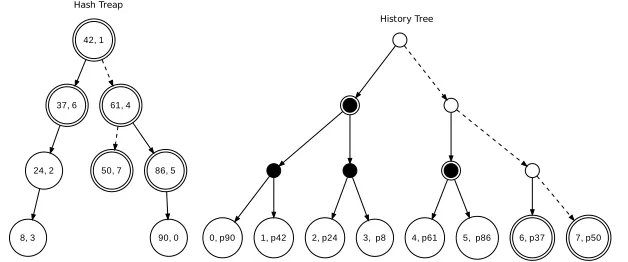
Figure1visualises a simplified Balloon with a hash treap and a history tree. For the sake of readability, we omit the hash values and priority, replace hashed keys with integers, and replace hashed events with place-holder labels. For example, the root in the hash treap has key 42 and value 1. The value 1 refers to the leaf node in the history tree with index 1, whose value is p42, the place-holder label for the hash of the event which key, once hashed, is represented by integer 42.
Hash Treap
History Tree
42, 1
37, 6 61, 4
24, 2
8, 3
50, 7 86, 5
90, 0 0, p90 1, p42 2, p24 3, p8 4, p61 5, p86 6, p37 7, p50
Fig. 1: A simplified example of a Balloon consisting of a hash treap and history tree. A membership proof for an evente= (k, v) withHash(k) = 50 andHash(e) denoted by p50 (place-holder label) consists of the circle nodes in both trees.
3.1 Setup
Algorithm {sk,pk} ← genkey(1λ) : Generates a signature key-pair {sk,vk} using the generation algorithm of a signature scheme with security level λand picks a functionΩthat deterministically orders events. Outputs the signing key as the private key sk=sk, and the verification key and the ordering function
Ωas the public keypk={vk, Ω}.
Algorithm {auth(D0),s0} ← setup(D0,sk,pk): Let D0 be the initial data structure, containing the initial set of events < ej >. The authenticated data
structure,auth(D0), is then computed by adding each event from the set to the, yet empty, authenticated data structure in the order dictated by the function
Ω←pk. The snapshot is defined as the root of the hash treaprand commitment in the history treeci for the event that was added last together with a digital
signature over those:s0={r, ci, σ}, whereσ=Signsk({r, ci}).
3.2 Update and Refresh
Algorithm {Dh+1,auth(Dh+1),sh+1, upd} ← update(u, Dh,auth(Dh),sh,sk,
pk): Letube a set of events to insert intoDh. The updated data structureDh+1 is the result of appending the events inutoDhand indicating that these belong
the (h+ 1)th set. The updated authenticated data structure,
auth(Dh+1), is then computed by adding each event from the set to the authenticated data structureauth(Dh) in the order dictated by the functionΩ←pk. The updated
snapshot is the root of the hash treapr and commitment in the history treeci
for the event that was added last together with a digital signature over those:
sh+1 = {r, ci, σ}, whereσ =Signsk({r, ci}). The update information contains
this snapshotupd=sh+1.
Algorithm {Dh+1,auth(Dh+1),sh+1} ←refresh(u, Dh,auth(Dh),sh, upd,pk):
Let u be a set of events to insert into Dh. The updated data structure Dh+1 is the result of appending the events in uto Dh and indicating that these
be-long the (h+ 1)th set. The updated authenticated data structure,auth(D
h+1), is then computed by adding each event from the setuto the authenticated data structure auth(Dh) in the order dictated by the function Ω←pk. Finally, the
new snapshot is set tosh+1=upd.
3.3 Query and Verify
Algorithm {Π(q), α(q)} ← query(q, Dh,auth(Dh),pk) (Membership): We
consider the queryqto be “a membership query for an event with keyk in the data structure that is fixed bysqueried”, wherequeried≤h. The query has two
possible answersα(q):{true, e}in case an eventewith keykexists inDqueried,
otherwisefalse. The proof of correctnessΠ(q) consists of up to three parts:
2. The index iof the event in the history tree;
3. A membership proof P on indexi in the history tree.
The algorithm generates an authenticated path in the hash treap, which is part of auth(Dh), to k0: {PT, v} ← T.AuthPath(k0). If v =? null, then there is no event with keykinDh(and consequently inDqueried) and the algorithm outputs
Π(q) =PT andα(q) =false.
Otherwise, the value v in the hash treap indicates the index i in the his-tory tree of the event. Now the algorithm checks whether or not the indexi is contained in the history tree up till auth(Dqueried). If not, the algorithm
out-puts α(q) =false andΠ(q) ={PT, i}. If it is, the algorithm outputs α(q) =
{true, ei}andΠ(q) ={PT, i, P}, where{P, ei} ←H.MembershipGen(i, cqueried)
andcqueried←squeried.
Algorithm {accept,reject} ←verify(q, α, Π,sh,pk) (Membership): First,
the algorithm extracts {k,squeried} from the query q and {PT, i, P} from Π,
where i and P can be null. From the snapshot it extracts r ← sh. Then the
algorithm computes x ←PT.AuthPathVerify(k, i). If x ?
= false ∨ PT.root()
6
=r, the algorithm outputsreject. The algorithm outputsacceptif any of the following three conditions hold, otherwisereject:
– α=? false∧i=?null;
– α=? false∧i > queried[−1]5;
– α=? {true, e} ∧key(e)=?k∧y=? true,
fory←P.MembershipVerify(i, cqueried,Hash(e)) andcqueried←squeried.
4
Security
Theorem 1. Balloon{genkey,setup,update,refresh,query,verify} is a cor-rect ADS scheme for a data structure D, that contains a list of sets of events, according to Definition 2, assuming the collision-resistance of the underlying hash function.
The proof of correctness can be found in AppendixC.1.
Theorem 2. Balloon {genkey,setup,update,refresh,query,verify} is a se-cure ADS scheme for a data structure D, that contains a list of sets of events, according to Definition 3, assuming the collision-resistance of the underlying hash function.
The full proof of security can be found in AppendixA.
5
queried[−1] denotes the index of the last inserted event in versionqueried of the
Proof (Sketch).Given that the different versions of the authenticated data struc-ture and corresponding snapshots are generated through oracle access, these are correct, i.e., the authenticated data structure contains all elements of the data structure for each version, the root and commitment in each snapshot correspond to that version of the ADS and the signature in each snapshot verifies.
For all cases where thecheckalgorithm outputs reject, Advhas to forge an authenticated path in the hash treap and/or history tree in order to get the verifyalgorithm to output accept, which implies breaking Lemma1.
5
Verifiable Insert
In practical three-party settings, the source typically has less storage capabilities than servers. As such, it would be desirable that the source does not need to keep a copy of the entire (authenticated) data structure for update, but instead can rely on its own (constant) storage combined with verifiable information from a server. We define new query and verify algorithms that enable the construction of apruned authenticated data structure, containing only the nodes needed to be insert the new set of events with a modified update algorithm. The pruned au-thenticated data structure is denoted bypruned auth(Dh), u
, whereauth(Dh)
denotes the version of the ADS being pruned, anduthe set of events where this ADS is pruned for.
Algorithm {Π(q), α(q)} ←query(q, Dh,auth(Dh),pk) (Prune): We consider
the query q to be “a prune query for if a set of events ucan be inserted into
Dh”. The query has two possible answers: α(q): true in case no key for the
events inualready exist inDh, otherwisefalse. The proof of correctnessΠ(q)
either proves that there already is an event with a key from an event in u, or provides proofs that enable the construction of a prunedauth(Dh), depending
on the answer. For everykj ←key(ej) in the setu, the algorithm uses as a
sub-algorithm {Πj0(q), α0j(q)} ← query(q0j, Dh,auth(Dh),pk) (Membership) with
q0 ={kj,sh}, wheresh fixesauth(Dh). If anyα0j(q)
?
=true, the algorithm out-putsα(q) =falseandΠ(q) ={Πj0(q), kj}and stops. If not, the algorithm takes
PT
j from eachΠj0(q) and creates the set <PTj >. Next, the algorithm extracts
the latest event ei inserted into the history tree from auth(Dh) and uses as
a sub-algorithm {Π0(q), α0(q)} ← query(q0, Dh,auth(Dh),pk) (Membership)
withq0={key(ei),sh}. Finally, the algorithm outputsα(q) =trueandΠ(q) =
{<PT
j >, Π0(q)}.
Algorithm {accept,reject} ← verify(q, α, Π,sh,pk) (Prune): The
algo-rithm starts by extracting < ej >← ufrom the queryq. Ifα=? false, it gets {Πj0(q), kj}fromΠand uses as a sub-algorithmvalid←verify(q0, α0, Π0,sh,pk)
(Membership), withq0={k,sh},α0=trueandΠ0=Πj0(q), wherek←kj. If
If α=? true, extract {<PT
j >, Π0(q)} from Π. For each event ej in u, the
algorithm getskj←key(ej), finds the corresponding PjT fork0j=Hash(kj), and
uses as a sub-algorithmvalid←verify(q0, α0, Π0,sh,pk) (Membership), with
q0 ={kj,sh}, α0 =false and Π0 =PTj. If no corresponding PTj to kj0 is found
in <PT
j > or valid
?
= reject, then the algorithm outputs reject and stops. Next, the algorithm uses as a sub-algorithm valid ← verify(q0, α, Π0,sh,pk)
(Membership), withq0 ={key(ei),sh} andΠ0 =Π0(q), whereei ∈Π0(q) . If
valid=? acceptandi=?h[−1] the algorithm outputsaccept, otherwisereject.
Algorithm {sh+1, upd} ← update*(u, Π,sh,sk,pk): Let ube a set of events
to insert intoDh andΠ a proof that the sub-algorithmverify(q, α, Π,sh,pk)
(Prune) outputs accept for, where q = u and α = true. The algorithm ex-tracts {<PT
j >, Π0(q)} from Π and builds a pruned hash treap pruned(T) ←
T.BuildPrunedTree(<PT
j >). Next, it extractsP fromΠ0(q) and constructs the
pruned Balloonpruned auth(Dh), u← {pruned(T), P}. Finally, the algorithm
adds each event in uto the pruned Balloon pruned auth(Dh), u
in the order dictated byΩ←pk. The updated snapshot is the digital signature over the root of the updated pruned hash treap r and commitment in the updated pruned history treeci for the event that was added last:sh+1={r, ci},Signsk({r, ci}).
The update information contains this snapshotupd=sh+1.
Lemma 2. The output of update and update* is identical with respect to the root of the hash treap and the latests commitment in the history tree ofsh+1and
upd6.
The proof of Lemma 2 can be found in in Appendix C.2. As a result of Lemma2, theupdatealgorithm in Balloon can be replaced byupdate*without breaking the correctness and security of the Balloon as in Theorems1and2. This means that the server can keep and refresh the (authenticated) data structure while the author only needs to store the last snapshot shto be able to produce
updates, resulting in a small constant size storage requirement for the author. Note that, in order to reduce the size of the transmitted proof, verify (Prune) could output the pruned authenticated data structure directly. Since pruned(T). AuthPathVerify(k, v) and PT.AuthPathVerify(k, v) are equiva-lent, the correctness and security of verify(Prune) reduce toverify( Mem-bership). Section7shows the reduction in the size of the proof with pruning.
6
Publicly Verifiable Consistency
While the server is untrusted, the author is trusted. A stronger adversarial model assumes forward security for the author: the author is only trusted up to a certain point in time, i.e., the time of compromise, and afterwards cannot change the past. In this stronger adversarial model, Balloon should still provide correctness
6
and security for all events inserted by the author up till the time of author compromise.
Efficient incremental proofs, realised by the IncGen and IncVerify algo-rithms, are a key feature of history trees [9]. Anyone can challenge the server to provide a proof that one commitment as part of a snapshot isconsistent with all previous commitments as part of snapshots. However, it appears to be an open problem to have an efficient algorithm for showing consistency between roots of different versions of a treap (or any lexicographically sorted data structure) [8]. In appendix B, we show why one cannot efficiently use probabilistic proofs of consistency for a Balloon. In absence of efficient (both for the server and verifier in terms of computation, storage, and size) incremental proofs in hash treaps, we rely on a concept from Certificate Transparency [12]: monitors.
We assume that a subset of clients, or any third party, will take on a role referred to as a “monitor”, “auditor”, or “validator” in, e.g., [3,10,11,12,21,26]. A monitor continuously monitors all data stored at a server and ensures that all snapshots issued by an author are consistent. We assume that clients and monitors receive the snapshots through gossiping.
Definition 4 (Publicly Verifiable Consistency). An ADS scheme is
pub-licly verifiable consistent if anyone can verify that a set of eventsuhas been cor-rectly inserted inDh andauth(Dh), fixed bysh to form Dh+1 and auth(Dh+1) fixed bysh+1.
Algorithm {α, Dh+1,auth(Dh+1),sh+1} ←refreshVerify(u, Dh,auth(Dh),sh,
upd,pk): First, the algorithm runs {Dh+1,auth(Dh+1),sh+1} ← refresh(u,
Dh,auth(Dh),sh, upd,pk) as a sub-algorithm. Then, the algorithm verifies the
updated snapshot{r, ci, σ} ←sh+1←upd:
– verify the signature:true=? verifypk(σ,{r, ci}) ; and
– match the root of the updated hash treapr0=? r; and
– match the last commitment in the updated history treec0i=? ci.
If the verify succeeds, the algorithm outputs{α=true, Dh+1,auth(Dh+1),sh+1}.
Otherwise, the algorithm outputsα=false.
Theorem 3. WithrefreshVerify, Balloon is publicly verifiable consistent ac-cording to Definition 4, assuming perfect gossiping of the snapshots and the collision-resistance of the underlying hash function.
The proof of publicly verifiable consistency can be found in AppendixC.3. Note that for the purpose of verifying consistency between snapshots, it is not necessary to keep the data structure D. Moreover, the storage requirement for monitors can be further reduced by making use of pruned versions of the au-thenticated data structure, i.e., by using a refresh∗ sub-algorithm, similar to theupdate∗ algorithm. Finally, to preserve event privacy towards monitors, one can provide the monitors with ˜u=<e˜j >, where ˜ej = Hash(kj),Hash(ej)
7
Performance
We implemented Balloon in the Go7 programming language using SHA-512 as the hash function and Ed25519 for signatures [4]. The output of SHA-512 is truncated to 256-bits, with the goal of reaching a 128-bits security level. The source code and steps to reproduce our results are available at http://www. cs.kau.se/pulls/balloon/. Our performance evaluation focuses on verifiable inserts, which are composed of performing and verifying |u|+ 1 membership queries, since these algorithms presumably are the most common. Figure2shows the size of the proof fromquery(Prune) in KiB based on the number of events to insert ranging from 1–1000 for three different sizes of Balloon: 210, 215, and 220events. Figure2aincludes redundant nodes in the membership query proofs, and shows that the proof size is linear with the number of events to insert. Figure 2b excludes redundant nodes between proofs, showing that excluding redundant nodes roughly halves the proof size with bigger gains the more events are inserted. For large Balloons the probability that any two authenticated paths in the hash treap share nodes goes down, resulting in bigger proofs, until the number of events get closer to the total size of the Balloon, when eventually all nodes in the hash treap are included in the proof as for the 210Balloon.
0 200 400 600 800 1000
events to insert
1000 2000 3000 4000
proof size (KiB)
2^20 Balloon 2^15 Balloon 2^10 Balloon
(a) Including redundant nodes.
0 200 400 600 800 1000
events to insert
500 1000 1500 2000
proof size (KiB)
2^20 Balloon 2^15 Balloon 2^10 Balloon
(b) Excluding redundant nodes.
Fig. 2: The size of the proof fromquery (Prune) in KiB based on the number of events to insert|u|for different sizes of Balloon.
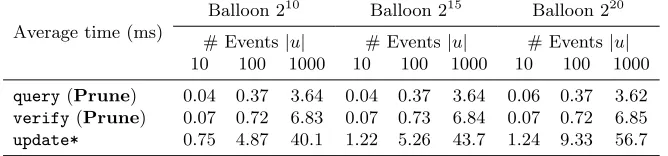
Table 1 shows a micro-benchmark of the three algorithms that enable ver-ifiable inserts: query(Prune),verify(Prune), andupdate*. The table shows the average insert time (ms) calculated by Go’s built-in benchmarking tool that performed between 30–30000 samples per measurement. Theupdate*algorithm performs the bulk of the work, with little difference between the different Bal-loon sizes, and linear scaling for all three algorithms based on the number of events to insert.
8
Related Work
Balloon is closely related to authenticated dictionaries [18] and persistent au-thenticated dictionaries (PADs) [1,7,8]. Balloon is not a PAD because it does not
7
Table 1: A micro-benchmark on Debian 7.8 (x64) using an Intel i5-3320M quad core 2.6GHz CPU and 7.7 GB DDR3 RAM.
Average time (ms)
Balloon 210 Balloon 215 Balloon 220
# Events|u| # Events|u| # Events|u|
10 100 1000 10 100 1000 10 100 1000
query(Prune) 0.04 0.37 3.64 0.04 0.37 3.64 0.06 0.37 3.62 verify(Prune) 0.07 0.72 6.83 0.07 0.73 6.84 0.07 0.72 6.85 update* 0.75 4.87 40.1 1.22 5.26 43.7 1.24 9.33 56.7 allow for the author to remove or update keys from the data structure, i.e., it is append-only. By allowing the removal of keys, the server needs to be able to con-struct past versions of the PAD to calculate proofs, which is relatively costly. In Table2, Balloon is compared to the most efficient tree-based PAD construction according to Crosby & Wallach [8]: a red-black tree using Sarnak-Tarjan ver-sioned nodes with a cache-everywhere strategy for calculated hash values. The table shows expected complexity. Note that red-black trees are more efficient than treaps due to their worst-case instead of expected logarithmic bounds on several important operations. We opted for using a treap due to its relative sim-plicity. For Balloon, the storage at the author is constant due to using verifiable inserts, while the PAD maintains a copy of the entire data structure. To query past versions, the PAD has to construct past versions of the data structure, while Balloon does not. When inserting new events, the PAD has to store a copy of the modified authenticated path in the red-black tree, while the storage for Balloon is constant. However, Balloon is less efficient when inserting new events with regard to the proof size due to verifiable inserts.
Table 2: Comparing Balloon and an efficient PAD construction [8]. The number of events in the data structure isnand the size of the version cache isv.
Expected ComplexityTotal Storage Size (A)
Query Time (current)
Query Time (past)
Insert Storage Size (S)
Insert Time (A)
Insert Time (S)
Insert Proof Size
Balloon O(1) O(logn) O(logn) O(1) O(logn) O(logn) O(logn) Tree-based PAD O(n) O(logn) O(logv·logn) O(logn) O(logn) O(logn) O(1)
Miller et al. [17] present a generic method for authenticating operations on any data structure that can be defined by standard type constructors. The prover provides the authenticated path in the data structure that are traversed by the prover when performing an operation. The verifier can then perform the same operation, only needing the authenticated paths provided in the proof. The verifier only has to store the latest correct digest that fixes the content of the data structure. Our verifiable insert is based on the same principle.
proofs, nor efficient membership-proofs for past versions of the data structure when only some versions (snapshots) are timestamped.
All the following related work operates in a setting that is fundamentally different to the one of Balloon. For Balloon, we assume a forward-secure au-thor with an untrusted server, whereas the following related work assumes a (minimally) trusted server with untrusted authors.
Certificate Transparency [12] and the tamper-evident history system by Crosby & Wallach [6] use a nearly identical8data structure and operations. Even though in both Certificate Transparency and Crosby & Wallach’s history system, a num-ber ofminimally trusted authors insert data into a history tree kept by a server, clients query the server for data and can act as auditors or monitors to challenge the server to prove consistency between commitments. Non-membership proofs require the entire data structure to be sent to the verifier.
In Revocation Transparency, Laurie and Kasper [11] present the use of a sparse Merkle tree for certificate revocation. Sparse Merkle trees create a Merkle tree with 2N leafs, whereN is the bit output length of a hash algorithm. A leaf is set to 1 if the certificate with the hash value fixed by the path to the leaf from the root of the tree is revoked, and 0 if not. While the tree in general is too big to store or compute on its own, the observation that most leafs are zero (i.e., the tree is sparse) means that only paths including non-zero leafs need to be computed and/or stored. At first glance, sparse Merkle trees could replace the hash treap in a Balloon with similar size/time complexity operations.
Enhanced Certificate Transparency (ECT) by Ryan [21] extends CT by using two data structures: one chronologically sorted and one lexicographically sorted. Distributed Transparent Key Infrastructure (DTKI) [26] builds upon the same data structures as ECT. The chronologically sorted data structure corresponds to a history tree (like CT). The lexicographically sorted data structure is similar to our hash treap. For checking consistency between the two data structures, ECT and DTKI use probabilistic checks. The probabilistic checking verifies that a random operation recorded in the chronological data structure has been cor-rectly performed in the lexicographical data structure. However, this requires the prover to generate past versions of the lexicographical data structure (or cache all proofs), with similar trade-offs as for PADs, which is relatively costly. CONIKS [14] is a privacy-friendly key management system where minimally trusted clients manage their public keys in directories at untrusted key servers. A directory is built using an authenticated binary prefix tree, offering similar properties as our hash treap. In CONIKS, user identities are presumably easy to brute-force, so they go further than Balloon in providing event privacy in proofs by using verifiable unpredictable functions and commitments to hide keys (iden-tities) and values (user data). CONIKS stores every version of their (authenti-cated) data structure, introducing significant overhead compared to Balloon. On the other hand, CONIKS supports modifying and removing keys, similar to a PAD. Towards consistency, CONIKS additionally links snapshots together into a snapshot chain, together with a specified gossiping mechanism that greatly
in-8
creases the probability that an attacker creating inconsistent snapshots is caught. This reduces the reliance on perfect gossiping, and could be used in Balloon. If the author ever wants to create a fork of snapshots for a subset of clients and monitors, it needs to maintain this fork forever for this subset or risk detection. Like CONIKS, we do not prevent an adversary compromising a server, or author, or both, from performing attacks: we provide means of detection after the fact.
9
Conclusions
This paper presented Balloon, an authenticated data structure composed of a history tree and a hash treap, that is tailored for privacy-preserving transparency logging. Balloon is a provably secure authenticated data structure, using a sim-ilar approach as Papamanthou et al. [19], under the modest assumption of a collision-resistant hash function. Balloon also supports efficiently verifiable in-serts of new events and publicly verifiable consistency. Verifiable inin-serts enable the author to discard its copy of the (authenticated) data structure, only keeping constant storage, at the cost of transmitting and verifying proofs of a pruned version of the authenticated data structure. Publicly verifiable consistency en-ables anyone to verify the consistency of snapshots, laying the foundation for a forward-secure author, under the additional assumption of a perfect gossiping mechanism of snapshots. Balloon is practical, as shown in Section7, and a more efficient solution in our setting than using a PAD, as summarised by Table2.
Acknowledgements
We would like to thank Simone Fischer-H¨ubner, Stefan Lindskog, Leonardo Mar-tucci, Jenni Reuben, Philipp Winter, and Jiangshan Yu for their valuable feed-back. Tobias Pulls has received funding from the Seventh Framework Programme for Research of the European Community under grant agreement no. 317550. This work was supported in part by the Research Council KU Leuven: GOA TENSE (GOA/11/007).
References
1. Anagnostopoulos, A., Goodrich, M.T., Tamassia, R.: Persistent Authenticated Dic-tionaries and Their Applications. In: ISC. LNCS, vol. 2200, pp. 379–393. Springer (2001)
2. Aragon, C.R., Seidel, R.: Randomized Search Trees. In: FOCS. pp. 540–545. IEEE Computer Society (1989)
3. Basin, D.A., Cremers, C.J.F., Kim, T.H., Perrig, A., Sasse, R., Szalachowski, P.: ARPKI: attack resilient public-key infrastructure. In: CCS. ACM (2014)
4. Bernstein, D.J., Duif, N., Lange, T., Schwabe, P., Yang, B.Y.: High-speed high-security signatures. J. Cryptographic Engineering 2(2), 77–89 (2012)
6. Crosby, S.A., Wallach, D.S.: Efficient Data Structures For Tamper-Evident Log-ging. In: USENIX Security Symposium. pp. 317–334. USENIX (2009)
7. Crosby, S.A., Wallach, D.S.: Super-Efficient Aggregating History-Independent Per-sistent Authenticated Dictionaries. In: ESORICS. LNCS, vol. 5789, pp. 671–688. Springer (2009)
8. Crosby, S.A., Wallach, D.S.: Authenticated dictionaries: Real-world costs and trade-offs. ACM Trans. Inf. Syst. Secur. 14(2), 17 (2011)
9. Crosby, S.A.: Efficient tamper-evident data structures for untrusted servers. Ph.D. thesis, Rice University (2010)
10. Kim, T.H., Huang, L., Perrig, A., Jackson, C., Gligor, V.D.: Accountable key in-frastructure (AKI): a proposal for a public-key validation inin-frastructure. In: World Wide Web Conference. pp. 679–690. ACM (2013)
11. Laurie, B., Kasper, E.: Revocation transparency (2012),http://www.links.org/ files/RevocationTransparency.pdf
12. Laurie, B., Langley, A., Kasper, E.: Certificate Transparency. RFC 6962 (2013), http://tools.ietf.org/html/rfc6962
13. Ma, D., Tsudik, G.: Extended abstract: Forward-secure sequential aggregate au-thentication. In: IEEE Symposium on Security and Privacy. pp. 86–91. IEEE Com-puter Society (2007)
14. Melara, M.S., Blankstein, A., Bonneau, J., Freedman, M.J., Felten, E.W.: CONIKS: A privacy-preserving consistent key service for secure end-to-end commu-nication. Cryptology ePrint Archive, Report 2014/1004 (2014),https://eprint. iacr.org/2014/1004
15. Merkle, R.C.: A Digital Signature Based on a Conventional Encryption Function. In: CRYPTO. LNCS, vol. 293, pp. 369–378. Springer (1987)
16. Merkle, R.C.: A Certified Digital Signature. In: CRYPTO. LNCS, vol. 435, pp. 218–238. Springer (1989)
17. Miller, A., Hicks, M., Katz, J., Shi, E.: Authenticated data structures, generically. In: POPL. pp. 411–424. ACM (2014)
18. Nissim, K., Naor, M.: Certificate revocation and certificate update. In: USENIX. pp. 561–570. USENIX (1998)
19. Papamanthou, C., Tamassia, R., Triandopoulos, N.: Optimal verification of op-erations on dynamic sets. In: CRYPTO. LNCS, vol. 6841, pp. 91–110. Springer (2011)
20. Pulls, T., Peeters, R., Wouters, K.: Distributed privacy-preserving transparency logging. In: WPES. pp. 83–94. ACM (2013)
21. Ryan, M.D.: Enhanced Certificate Transparency and End-to-End Encrypted Mail. In: NDSS. The Internet Society (2014)
22. Schneier, B., Kelsey, J.: Secure audit logs to support computer forensics. ACM Trans. Inf. Syst. Secur. 2(2), 159–176 (1999)
23. Tamassia, R.: Authenticated data structures. In: Algorithms - ESA 2003. LNCS, vol. 2832, pp. 2–5. Springer (2003)
24. Vliegen, J., Wouters, K., Grahn, C., Pulls, T.: Hardware strengthening a dis-tributed logging scheme. In: DSD. pp. 171–176. IEEE (2012)
25. Yavuz, A.A., Ning, P., Reiter, M.K.: BAF and FI-BAF: efficient and publicly ver-ifiable cryptographic schemes for secure logging in resource-constrained systems. ACM Trans. Inf. Syst. Secur. 15(2), 9 (2012)
A
Proof of Security
Theorem 2. Balloon {genkey,setup,update,refresh,query,verify} is a se-cure ADS scheme for a data structureD, that contains a list of sets of events, according to Definition 3, assuming the collision-resistance of the underlying hash function.
Proof. The adversary initially outputs the authenticated data structureauth(D0) and the snapshot s0 through an oracle call to algorithm setup. The adver-sary picks a polynomial number i = 0, . . . , h of updates with ui insertions of
unique events and outputs the data structureDi, the authenticated data
struc-ture auth(Di), and the snapshot si through oracle access to update. Then it
picks a queryq= “a membership query for an event with keyk∈ {0,1}|Hash(·)| in the data structure that is fixed by sj, with 0 ≤ j ≤ h+ 1”, a proof Π(q),
and an answer α(q) which is rejected by check(q, α(q), Dj) as incorrect. An
adversary breaks security if verify(q, α(q), Π(q),sj,pk) outputs accept with
non-negligible probability.
Assume a probabilistic polynomial time adversaryAdvthat breaks security with non-negligible probability. Given that the different versions of the authenti-cated data structure and corresponding snapshots are generated through oracle access, these are correct, i.e., the authenticated data structure contains all ele-ments of the data structure for each version, the root and commitment in each snapshot correspond to that version of the ADS and the signature in each snap-shot verifies.
The tuple (q, α(q), Dj) is rejected bycheckin only three cases:
Case 1 α(q) =false and there exists an event with keyk inDj;
Case 2 α(q) ={true, e} and there does not exists an event with keykinDj;
Case 3 α(q) = {true, e} and the event e∗ with key k in Dj differs from e:
e= (k, v)6=e∗= (k, v∗) or more specificallyv6=v∗;
For all three cases where thecheckalgorithm outputsreject,Advhas to forge an authenticated path in the hash treap and/or history tree in order to get the verifyalgorithm to output accept:
Case 1 In the hash treap that is fixed by sh+1, there is a node with key k0 = Hash(k) and the value v0 ≤ j[−1]. However for the verify algorithm to output accept for α(q)=false, the authenticated path in the hash treap must go to either no node with keyk0 or a node with key k0 for which the valuev0 is greater than the index of the last inserted event in the history tree that is fixed bysj:v0> j[−1].
Case 2 In the hash treap that is fixed by sh+1, there is either no node with key k0 = Hash(k) or a node with key k0 for which the value v0 is greater than the index of the last inserted event in the history tree that is fixed bysj: v0 > j[−1]. However for theverify algorithm to outputaccept for
Case 3 In the hash treap that is fixed by sh+1, there is a leaf with key k0 = Hash(k) and the valuev0 ≤j[−1]. In the history tree, the leaf with keyv0
has the valueHash(e∗). However for theverifyalgorithm to outputaccept forα(q) ={true, e}, the authenticated path in the hash treap must go to a leaf with keyk0, where the value v0 ≤j[−1], for which the authenticated path in the history tree must go to a leaf with keyv0and the valueHash(e).
From Lemma 1 it follows that we can construct a probabilistic polynomial time adversaryAdv∗, by usingAdv, that outputs a collision of the underlying
hash function with non-negligible probability. ut
B
Negative Result on Probabilistic Consistency
Probabilistic proofs are compelling, because they may enable more resource-constrained clients en-mass to verify consistency, removing the need for monitors that perform the relatively expensive role of downloading all events at a server. Assume the following pair of algorithms:
– P ←B.IncGen(si,sj,rand): Generates a probabilistic incremental proof P
using randomnessrandbetweensiandsj, wherei≤j, from the BalloonB.
OutputsP.
– {accept,reject} ←P.IncVerify(si,sj,rand): Verifies thatP
probabilisti-cally proves thatsjfixes every event fixed bysi, wherei≤j, using
random-nessrand.
B.1 Our Attempt
Our envisioned B.IncGen algorithm shows consistency in two steps. First, it uses the H.IncGenalgorithm from the history tree. This ensures that the snap-shots are consistent for the history tree. Second, it selects deterministically and uniformly at random based on rand a number of events E =< ej > from the
history tree. Which events to select from depend on the two snapshots. For each selected event, the algorithm performs a query (Membership) for the event keykj←key(ej) to show that the event is part of the hash treap and points to
the index of the event in the history tree.
TheP.IncVerifyalgorithm checks the incremental proof in the history tree,
verify(Membership)=?acceptfor each output ofquery(Membership), and that the events E were selected correctly based on rand. Next, we explain an attack, why it works, and lessons learnt.
B.2 Attack
The following attack allows an attacker to hide an arbitrary event that was in-sertedbefore author compromise. The attacker takes control over both the author and server just after snapshotst. Assume that the attacker wants to remove an
1. Remove the event key k0j =Hash(kj), where kj ←key(ej), from the hash
treap, insert a random key, and rebalance the treap if needed. This results is a modified ADSauth(Dt)∗.
2. Generate a set of new eventsuand update the data structure:update(u, Dt,
auth(Dt)∗,st,sk,pk), resulting in a new snapshotst+1.
It is clear that the snapshotst+1 is inconsistent with all other prior snapshots,
sp, wherep≤t.
Now, we show how the attacker can avoid being detected by P.IncVerify in the case that the verifier challenges the server (and therefore the attacker) to probabilistically prove the consistency between sp and st+1, AND that the randomnessrandprovided by the verifier selects the eventejthat was modified
by the attacker. The attacker can provide a valid incremental proof in the history tree, usingH.IncGen, since the history tree has not been modified. However, the attacker cannot create a valid membership proof for an event with key kj ←
key(ej) in the ADS, since the key k0j = Hash(kj) was removed from the hash
treap inauth(Dt+1). To avoid detection, the attacker puts back the event keyk0j
in the hash treap and rebalances the treap if needed. By inserting a set of events using update, anew snapshot st+2 is generated, which is then used to perform the membership query against that will now output a valid membership proof.
B.3 Lessons Learnt
This attack succeeds because the attacker can, once having compromised the author and server, a) create snapshots at will; and b) membership queries are always performed on the current version of the hash treap.
In settings where snapshots are generated periodically, e.g., once a day, the probability of the attacker getting caught in this way is non-negligible given a suf-ficient number of queries. However, as long as the attacker can create snapshots at will, the probability that it will be detected with probabilistic incremental proofs is zero, as long as it cannot be challenged to generate past versions of the hash treap; and there are no monitors or another mechanism, that prevent the attacker from modifying or deleting events that were inserted into the ADS prior to compromise.
C
Extended version: Additional proofs
This section contains the proofs that are not present in our paper as in the conference proceedings of ESORICS 2015. The rest of the paper is identitical to the conference version (with the exception of referring to these proofs).
C.1 Correctness
Proof. For every membershipqueryqand for every answerα(q) that is accepted by thecheck algorithm and proof output byquery, verifyaccepts with over-whelming probability. Letqbe a membership query for a keykin the snapshot
sj. Regardless of the queried snapshot, in the hash treap, the current rootr∈sh
is used to construct the authenticated path verified byverify.
If there is no event with keykinDh, then there is no key withk0 ←Hash(k)
in the hash treap with overwhelming probability (a hash collision has negligible probability), andverifyaccepts only ifα(q)=? false. If there is an event with keykinDh, then there is a node with keyk0in the hash treap andα(q) is either
{true, e}orfalse. Ifα(q) isfalse, then the event with keykwas inserted into
Dhafter sj. This means that the indexiin the history tree, that is the valuev0in
the hash treap node fork0, isi >j[−1] and hence theverifyalgorithm accepts. Finally, ifα(q) is{true, e}, then the proof contains a membership proof in the history tree for the key i and value Hash(e) and hence the verify algorithm accepts.
C.2 Verifiable Insert
Lemma 2. The output of update and update* is identical with respect to the root of the hash treap and the latests commitment in the history tree ofsh+1and
upd.
Proof. Forverify(Prune), whenα=? true, the algorithm verifies|u|+ 1 mem-bership queries using as a sub-algorithmverify(Membership), which is cor-rect and secure according to Theorems 1and2. Furthermore,verify(Prune) verifies that no event inuhas already been inserted into the Balloon and that a membership query fixes the last event inserted into the history tree. This enables update* to verifiably create pruned auth(Dh), u
← {pruned(T), P}. Next we show that inserting events u into pruned auth(Dh), u
and auth(Dh) result in
the same rootrof the hash treap and commitmentcion the history tree.
The pruned hash treappruned(T)is the only part of the hash treap that is subject to change when inserting the events u. This follows from the fact that the position to insert each a new node in a treap is determined by a binary search (which path a membership query fixes and proves), and that balancing the treap using the heap priority only rotates nodes along the authenticated path. Since a treap is also set unique, i.e., independent of the insert order of events, all these authenticated paths can safely be combined into one pruned tree. As such the root of the hash treap after inserting the events will be identical when using the pruned and full hash treap.
To compute the new root of a Merkle tree after adding a leaf node, one needs the authenticated path of the last inserted leaf node to the root and the new leaf. Note that any new leaf will always be inserted to the right of the authenticated path. As such the roots (and by consequence the commitments) of the new history tree after adding all events in the order determined by Ω←pkwill be
C.3 Publicly Verifable Consistency
Theorem 3. WithrefreshVerify, Balloon is publicly verifiable consistent ac-cording to Definition 4, assuming perfect gossiping of the snapshots and the collision-resistance of the underlying hash function.
Proof. By assuming perfect gossiping, one is assured that it receives all snapshots in the order they were generated and that these snapshots have not been altered afterwards.
First, one starts from the initial data structureD0and constructs the initial authenticated data structureauth(D0) by adding the events contained inD0 to an empty Balloon. It then verifies the initial snapshots0(received by gossip) as in refreshVerify(). If snapshot verifies, one now has {D0,auth(D0),s0} and is assured these values are consistent with the (authenticated) data structure as constructed by the author. Under the assumption that the underlying hash function is collision resistant, this follows directly from Lemma 1 and the fact that our authenticated data structure consists of two Merkle trees: a hash treap and a history tree.