STUDY OF EMERGING OPERATING SYSTEM
GOOGLE ANDROID
Mohd Salman Khan
1, Akanksha Jain
21
Assistant Professor, ABES-IT Group of Institutions, Ghaziabad, (India)
2
B.Tech (IT) Scholar, ABES-IT Group of Institutions, Ghaziabad, (India)
ABSTRACT
Over the years, the use of mobile phones has been increasing. If PC’s and mobiles are compared then there is 3.5 times more use of mobiles. Today, there is nothing that can’t be accessed on the mobiles and hence becoming very
important for each one of us. As the importance of mobile devices increases, competition tinkered between
technology giants like Microsoft, Apple and Google so as to capture huge market share. Android, which is an
operating system designed primarily for touch screen devices i.e. Smart phones and tablets. Since its official public
release, it has become world’s most powerful mobile platform.
This paper aims to analyze various mindset, characteristics and appropriateness of android for mobile device.
Keywords:
Android, Mobile OS, Open Source Software Platform, Smartphones, Versions
I. INTRODUCTION
Android is an OS that can be referred to as a software stack of different layers, where each layer is a group of
several program components. Together it includes operating system, middleware and important
applications. Google’s Linux-based open source mobile platform – Android powers hundreds of millions of mobile
devices across the world. Android claims the largest installed base of any mobile platform and is growing rapidly thanks to it’s open source nature. Since, its release, it has grabbed a major position in the market and is in the
limelight of general public, developers and companies. From the time it has launched to till date there are various enhancements in its features to make it more compatible with hardware and users. Milestones of android are as follows:
October 2003:
Android Inc founded Andy Rubin, Rich Miner, Nick Sears & Chris White.
5 November 2007:
Open Handset Alliance (OHA) formed, Android unveiled.
12 November 2007:
Android Beta SDK released.
23 September 2008:
Android 1.1 update released for T-Mobile G1.
Android is achieving stability both in mobile industry and industries with different hardware architecture and it is due to two basic reasons:
1. Open Source structure.
2. Architectural Model.
This open-source code which is released under the Apache License and permissive licensing allows the software to be freely modified and distributed by device manufacturers, wireless carriers and enthusiast developers. Additionally, Android has a large community of developers writing applications ("apps") that extend the functionality of devices, written primarily in a customized version of the Java programming language. The Android SDK provides the tools and APIs required to begin developing applications on the Android platform using the Java programming language. About the design, Kernel of Android is based on Linux kernel and further furnished by Google. As java is used as the language for the creation of the android applications therefore virtual machine environment is used. Android has Delvik virtual Machine (DVM), which executes on byte code to make Dex files. These files are compatible and efficient than class files. All the facts make Android compatible to work on different provided environments. In this paper Section II consists of description of Android Architecture, Android features, and framework for programming & Android Versions and their Market Analysis.
II. ANDROID BACKGROUND
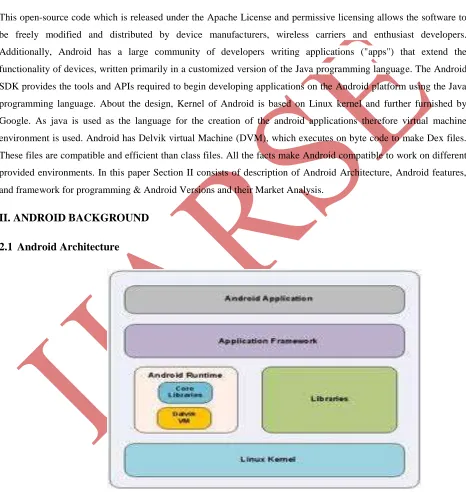
2.1 Android Architecture
The above figure shows the diagram of Android Architecture. This architecture consists of Linux Kernel, Libraries, Android Runtime, Application Framework and Android Applications. Each layer in the architecture provides different services to the layer just above it. Top most level of the architecture is of Android Applications with only which user interacts. These are written in Java Programming Language. These applications must be made to run to use its services. More than one application can be run simultaneously as for example one can listen music at the same time while reading SMS.
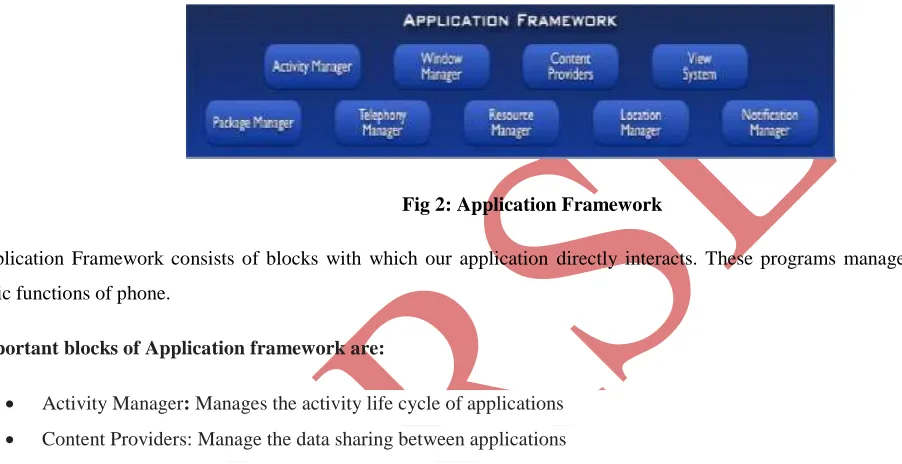
Fig 2: Application Framework
Application Framework consists of blocks with which our application directly interacts. These programs manage basic functions of phone.
Important blocks of Application framework are:
Activity Manager: Manages the activity life cycle of applications Content Providers:Manage the data sharing between applications
Telephony Manager: Manages all voice calls. We use telephony manager if we want to access voice calls in
our application.
Location Manager:Location management, using GPS or cell tower
Resource Manager:Manage the various types of resources we use in our Application
Android runtime consists of:
Dalvik Virtual Machine: It is a type of JVM used in android devices to run apps and is optimized for low processing power and low memory environments. Unlike the JVM, the Dalvik Virtual Machine doesn’t run
.class files, instead it runs .dex files. .dex files are built from .class file at the time of compilation and provide higher efficiency in low resource environments. The Dalvik VM allows multiple instance of Virtual machine to be created simultaneously providing security, isolation, memory management and threading support. It is developed by Dan Bornstein of Google.
Core Java Libraries: These are different from Java SE and Java ME libraries. However, these libraries
provide most of the functionalities defined in the Java SE libraries.
Libraries: Next layer consists of Android’s Native Libraries. This layer enables the device to handle different type of data. These libraries are written in C or C++ and these are specific for a particular hardware.
Media framework: Media framework provides different media codecs allowing the recording and playback of different media formats
SQLite: SQLite is the database engine used in android for data storage purposes Web Kit: It is the browser engine used to display HTML content
OpenGL: Used to render 2D or 3D graphics content to the screen.
Surface Manager: It is used for compositing window manager with off-screen buffering. Off-screen buffering means you can’t directly draw into the screen, but your drawings go to the off-screen buffer. There it is combined with
other drawings and form the final screen the user will see. This off screen buffer is the reason behind the transparency of windows.
Linux Kernel, The basic layer is the Linux kernel. The whole Android OS is built on Linux 2.6 Kernel with some
further architectural changes that are made by Google. It is this Linux that interacts with the hardware and contains
all the essential hardware drivers. Drivers are programs that control and communicate with the hardware. The Linux
kernel also acts as an abstraction layer between the hardware and other software layers. Android uses the Linux for
all its core functionality such as Memory management, process management, networking, security settings etc. As
the Android is built on a most popular and proven foundation i.e. Linux, it made the porting of Android to variety of
hardware, a relatively painless task.
2.2
Features Of Android
SQLite, a lightweight relational database, is used for data storage purposes.Android supports multiple languages.
Android supports connectivity technologies including GSM/EDGE, IDEN, CDMA, EV-DO, UMTS,
Bluetooth, Wi-Fi , LTE, NFC and WiMAX.
Multitasking of applications, with unique handling of memory allocation, is available.
Most Android devices include micro SD slot and can read micro SD cards formatted with FAT 32 ,
Ext3 or Ext4 file system.
Enables reuse and replacement of components.
Based on Open Source Web kit engine.
Most Android applications are written in Java.
2.3
Programming Framework
To develop an Android application environment plays an important role. Environment consists of:
Android SDK(Software Development kit)
JDK(Java Development kit)
Android SDK: A software development kit that enables developers to create applications for Android platform. The Android SDK includes sample projects with source code, development tools, an emulator, and required libraries to build Android applications. Applications are written using the Java programming language and run on Dalvik, a custom virtual machine designed for embedded use which runs on top of a Linux kernel.
JDK: JDK needs to be preinstalled as the JDK includes--among other useful things--the source code for the standard Java libraries
Emulator: The Android SDK includes a virtual mobile device emulator that runs on your computer. The emulator
lets you prototype, develop and test Android applications without using a physical device.
The Android emulator mimics all of the hardware and software features of a typical mobile device, except that it
cannot place actual phone calls. It provides a variety of navigation and control keys, which you can "press" using
your mouse or keyboard to generate events for your application. It also provides a screen in which your application
is displayed, together with any other active Android applications.
III. ANDROID VERSIONS AND THEIR MARKET ANALYSIS
The Distribution of the versions of Android across devices is computed in the form of Pie Chart.
This pie chart is shown below:
Above distribution concludes that the Gingerbread version of android is largely shared on the devices.
According to Strategy Analytics' latest report, Android is getting dangerously close to worldwide dominion with a
record 80% of all smartphone running the mobile OS. This study is based on the number of Android Devices that
have accessed Google Play within a 14-day period ending on 3 Jan, 2013.
"Global smartphone shipments grew 47 percent annually from 156.5 million units in Q2 2012 to 229.6 million in Q2
2013. Growth was driven by strong demand for Android models across all price-tiers in developed and developing
markets, such as the US, China and Brazil. Android now accounts for an impressive 8 in 10 of all smartphones
shipped on the planet." said Scott Bicheno, Senior Analyst with the company.”said Scott Bicheno, Senior Analyst
This simply shows that Android is taking over the world. 80% of all smartphones run Google's OS i.e. Android
Operating System.
IV. CONCLUSION
This paper consists of information regarding Android, its architecture & features as well as comparison are made
between its versions and their market analysis. Findings of this review are that Android is superior as compared to
its competitive systems & acting as an Emerging Software Platform(Operating system) for Mobile Devices. Android
in the coming time will become the leader in mobile platform.
REFERENCES
1. Reto Meier, Professional Android Application Development, Indianapolis: Wiley Publishing, Inc., 2009 2.
http://www.phonearena.com/news/Android-is-taking-over-the-world-80-of-all-smartphones-run-Googles-OS_id46001, Chris P, Aug 2, 2013
3. http://www.tech2crack.com/history-android, Manish Yadav, Dec 30, 2011 4. http://visual.ly/brief-history-android, Jan 2013
5. http://technoblimp.com/2013/09/14/a-brief-history-of-android,Sept 14, 2013 6. http://www.android-app-, market.com/android-architecture.html, Feb 17,2012 7. http://developer.android.com/tools/devices/emulator.html
8. http://en.wikipedia.org/wiki/Android_(operating_system), Oct 2, 2013