Physics and recent results from LHCb
G. Passalevaaon behalf of the LHCb Collaboration
Istituto Nazionale di Fisica Nucleare - Sezione di Firenze, Florence, Italy
Abstract. The LHCb experiment has collected more than 1 fb−1of integrated
luminos-ity in 2010 and 2011 and is producing a large amount of results in beauty and charmed meson physics. An overview of the most recent results on rare B decays, CP violation, and charmless B meson decays will be given along with an outlook to the physics perspectives and to the LHCb upgrade.
1 Introduction
The LHCb experiment at the CERN Large Hadron Collider (LHC), has been designed to search for potential effects of physics beyond the Standard Model (SM) in CP violation and rare decays using charm and beauty hadrons. Flavour physics observables have sensitivity to new particles via their indirect effects in loop diagrams and allow to probe a mass scale far beyond that accessible in direct searches. Of particular interest are processes that are strongly suppressed in the SM, such as flavour– changing neutral current b → s transitions where the expected very small branching ratios can be strongly enhanced by additional amplitudes involving new heavy particles. In a complementary way, any deviation observed comparing precision measurements of Cabibbo-Kobayashi-Maskawa matrix elements obtained from decays which are not sensitive to new physics and from decays where physics beyond the SM can contribute to the decay amplitudes, would be an evidence of new physics effects. LHCb is optimized to exploit the large b¯b production cross section at LHC energies which has been measured to be (288±4±48)µb at √s=7 TeV [1]. The large c¯c production cross–section allows also a very rich charm physics program at LHCb. In 2010 and 2011 LHCb collected a total integrated luminosity of 1.1 fb−1 allowing the collaboration to provide very important results on some of the key measurement of the experiment’s physics program [2]. In these proceedings some of the most important results are reviewed.
2 The LHCb Detector
Due to the strongly forward peaked b¯b production cross–section at the LHC, the LHCb detector is designed as a single-arm forward spectrometer with an angular acceptance of 2 < η < 5 whereηis the pseudorapidity. LHCb captures almost 40% of the b¯b production cross–section at the LHC while covering only about 4% of the solid angle. The detector consists of: a silicon micro-strip vertex de-tector (Vertex Locator) around the interaction region; a tracking system comprising a tracking station equipped with silicon strip detectors (TT) upstream of the about 4 Tm dipole magnet and three track-ing stations (T1-T3) downstream of the magnet; two RICH detectors (RICH1 just downstream of the VELO and RICH2, placed downstream of T3); an electromagnetic and a hadronic calorimeter; a muon system made of five stations equipped with multiwire proportional chambers and Gas Electron Multi-pliers (GEM) detectors. Key performance parameters are an excellent vertex resolution resulting in a proper time resolution of about 50 fs; a momentum resolution for charged particles better than 0.6%
a e-mail:[email protected]
DOI: 10.1051/
C
Owned by the authors, published by EDP Sciences, 2012 epjconf 20123/ 701004
up to above 100 GeV/c; good kaon/pion separation in the momentum range 2 GeV/c up to 100 GeV/c; muon identification efficiency of 97% with a misidentification rate of 0.7%. A key element of the ex-periment is the trigger system which features two levels to reduce the 40 MHz input rate to the 3–4 kHz output rate to the storage system. The first level, called L0 (Level 0), is implemented in custom electronic boards working in a fully synchronous architecture with a fixed latency of 4µs and a maxi-mal output rate of 1 MHz. The L0 trigger selects high transverse momentum muons, photons, electrons and charged hadrons. The second level, called HLT (High Level Trigger), is a fully software trigger running on a dedicated farm of about 2000 CPUs. The HLT first reduces the rate to about 30 kHz using the tracking information to confirm the L0 candidates, adding, if required, an impact parameter (IP) cut. Then, inclusive and exclusive selections are applied using the full event reconstruction. In 2010 and 2011 LHCb has collected 1.1 fb−1with an efficiency exceeding 90%. In 2011 a luminosity level-ing procedure allowed the experiment to run at constant luminosity throughout the fill. The luminosity was gradually increased up to 4×1032cm−2s−1which is twice the design LHCb luminosity and is the value chosen for the 2012 run.
3 Search for the rare decays
B
0s→
µ
+µ
−and
B
0→
µ
+µ
−The decays B0s → µ+µ− and B0 → µ+µ−are very rare flavour–changing neutral current processes whose branching ratios, within the SM, areB(B0s→µ+µ−)=(3.2±0.2)×10−9andB(B0→µ+µ−)=
(0.1±0.01)×10−9respectively [3, 4]. The branching ratios can be strongly enhanced in many models beyond the SM. For example, in the framework of the Minimal Supersymmetric Standard Model (MSSM) the branching ratio is proportional to (tanβ)6[5], so that it can be larger than the SM value by more than one order of magnitude. LHCb has already published an upper limit based on 0.37 fb−1 [6]. The results discussed here are an update with based on 1.0 fb−1 of pp collisions. While B0
s →µ+µ−or B0→µ+µ−signal is relatively easy to trigger and reconstruct, the background rejection
requires a quite complex analysis. After simple selection of opposite charge muon pairs with a common vertex, the analysis relies on two variables: the invariant mass of the selected muon pairs Mµµand a discriminant built on the output of a Boosted Decision Tree (BDT) [7], based on kinematical and topological variables. The events are categorized in a bidimensional distribution in Mµµ and BDT. The mass distributions are calibrated directly with data, taking the central values from B0s → K+K− and B0 → K+π− samples respectively, while the mass resolutions are obtained with a power-law interpolation between the measured resolutions of charmonium and bottomonium resonances decaying into two muons. The results of the interpolation areσ(mB0
s) = (24.8±0.8) MeV/c
2 andσ(m
B0) =
(24.3±0.7) MeV/c2 cross checked also with B0(s) → h+h′− control channels. The BDT is trained with simulated events but the probability to have a given BDT output is calibrated on data using
] -9 ) [10 -µ + µ → s 0 B(B
1 2 3 4 5 6 7 8 9
CLs
0 0.2 0.4 0.6 0.8 1
LHCb
] -9 ) [10 -µ + µ → 0 B(B
0.2 0.4 0.6 0.8 1 1.2 1.4 1.6 1.8
CLs
0 0.2 0.4 0.6 0.8 1
LHCb
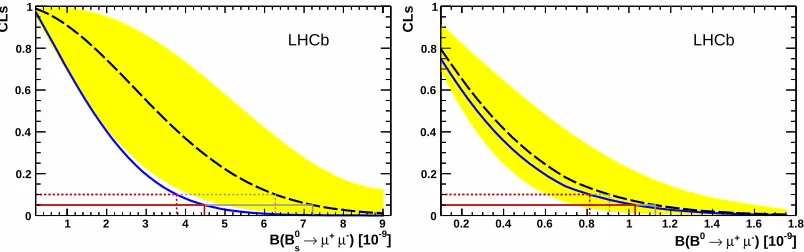
Fig. 1. CLs as a function ofBfor (left) B0
sand (right) B0decays inµ+µ−. The long–dashed lines are the expected
CLs distributions (background+SM signal for B0
sand background only for B0) while the yellow areas represent
B0 (s) →h
+h′− events selected without particle identification requirements and candidates in B
(s)mass sidebands for signal and background respectively. The branching fractions are measured relative to three different normalization decays: B+
→ J/ψK+, B0
s → J/ψφ and B0 → K+π− (including the
charge conjugated processes), giving consistent normalization factors which are averaged to a single event sensitivity of (0.319±0.028)×10−9. The ratio of production fractions used in the normalization is measured directly by LHCb: fs/fd =0.27+−00..2120[8]. The number of candidates and expected signal and background events is extracted from the bidimensional distribution of Mµµ and BDT and the compatibility of the observed distribution of events with that expected for a given branching fraction hypothesis is computed using the CLs method [9]. The results obtained are shown in Figure 1. From these curves, the upper limits on the branching ratios for the two decays can be derived: B(B0
s →
µ+µ−)<4.5×10⁻⁹and
B(B0
→ µ+µ−)<1.3×10⁻⁹at 95% CL, which are the most stringent upper limits to date. The B0
s → µ+µ− branching ratio has also been directly measured:B(B0s → µ+µ−) =
0.8+−11..83×10−9.
4 Measurement of the CP-violating phase
φ
sin
B
0sdecays
In B0
s decays, CP violation can arise from the interference between B0smixing and decay to the same
final state, like for example in the decays B0s→ J/ψφor B0s →J/ψf0[10]. In these decays the time de-pendent CP violation asymmetry can be expressed in terms of∆Γs, the decay width difference between
the B0
smass eigenstates, and a single phaseφs[11]. In the SM,φs is predicted, with good precision,
to be small:φS M
s = (0.036±0.002) rad [12]. This quantity, therefore is very sensitive to
contribu-tions from physics beyond the SM that could lead to much larger values [13]. LHCb has published results with the 2010 data [14]; in these proceedings recent measurements ofφsby LHCb in the decay
modes B0
s → J/ψφand B0s → J/ψπ+π−with a data sample corresponding to 1.0 fb−1 are presented.
Since the J/ψφfinal state is not a pure CP eigenstate, a full angular analysis is needed to extractφs
from B0
s → J/ψφ. On the contrary, the final state for B0s → J/ψπ+π−is almost purely CP odd and
no angular analysis needed. In the measurement of all the time dependent amplitudes, the value of ∆msis taken from LHCb measurements based on 2010 and 2011 data:∆ms =(17.63±0.11±0.02)
ps−1[15] and∆m
s=(17.725±0.041±0.026) ps−1 [16]. The remaining nine parameters:Γs, ∆Γs, φs,
three amplitude ratios and three strong phase differences, are extracted from fits to the experimen-tal distributions, including a K+K−S–wave component. The effective tagging power is found to be εtagD2 =(2.43±0.08±0.26)% and the time resolution measured from the B0s →J/ψφdecay time
dis-tribution is 45 fs. From the analysis of B0
s →J/ψφdecays, the measured values ofφs,Γsand∆Γsare:
φs=(−0.001±0.101±0.027) rad,Γs=(0.6580±0.0054±0.0066) ps−1,∆Γs=(0.116±0.018±0.006)
ps−1. The last result is the first observation at more than 5σlevel of∆Γs ,0. With a simultaneous fit
(MeV)
KK
m 990 1000 1010 1020 1030 1040 1050
(rad)S
δ
-3 -2 -1 0 1 2 3 4 5 6
solution I
solution II LHCb
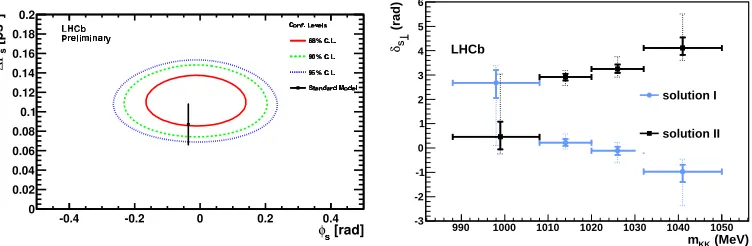
Fig. 2. Left: measured∆Γsversusφs68%, 90% and 95% C.L. contours. The ful square with error bars represent
with the channel B0s →J/ψπ+π−, LHCb obtainsφs=(−0.002±0.083±0.027) rad which is the most
precise measurement ofφs to date. Details of this analysis can be found in [17]. These preliminary
results are summarized in Figure 2 (left plot). Since the time dependent differential decay rates are invariant under the transformation (φs, ∆Γs)→(π−φs,−∆Γs) the above analysis (Solution I,∆Γs>0)
allows for a complementary solution with ∆Γs < 0 (Solution II). From an analysis of the decays
B0s → J/ψK+K−, LHCb has determined the sign of∆Γsby measuring the phase difference between
the S–wave amplitude and the perpendicular P–wave amplitudeδ⊥which is expected to decrease as a function of the invariant mass of the K+K−system mKK. From this measurement it was found that ∆Γs≡ΓL−ΓH>0 at 4.7σlevel [18]. The result is shown in Figure 2 (right plot).
5 Charmless
b
decays
Decays of B mesons into charmless final states are very interesting from the flavour physics point of view. In particular, they can provide important measurements of direct as well as indirect CP violation and, assuming U-spin symmetry, they provide a way to measure the angleγ. At LHCb they are selected by the hadronic trigger and by exploiting the excellentπ/K/p identification power of the experiment’s RICH system. Some of these decays have very small branching ratios like the decay B0
s → π+π−
observed for the first time by LHCb with a branching fraction of B(B0
s → π+π−) = (0.98−+00..2319 ± 0.11)×10−6 [19]. Direct CP violation effects can be studied in a straightforward way by looking for asymmetries between flavour specific B(s) → Kπdecays and their charge conjugated. Direct CP violation is clearly visible, as shown in Figure 3. The measured asymmetries are ACP(B0 → Kπ) =
−0.088±0.011±0.008 and ACP(Bs0→Kπ)= +0.27±0.08±0.02. The first measurement is the first
observation of direct CP violation in B decays at a hadron collider and the most precise measurement to date while the second constitutes the first evidence of direct CP violation in B0
sdecays [20].
5 5.2 5.4 5.6 5.8
2
Events / ( 0.02 GeV/c
0 500 1000 1500 2000 2500 3000 )
LHCb
(a)
) 2invariant mass (GeV/c −
π +
K −π+ invariant mass (GeV/c2)
K
5 5.2 5.4 5.6 5.8
)
2
Events / ( 0.02 GeV/c
0 500 1000 1500 2000 2500 3000
LHCb
(b)
B →Kπ
B →Kπ
B →ππ
B →KK B→3-body Comb. bkg 0 0 0 0 s s 0 50 100 150 200 250 300 350 400 ) 2
Events / ( 0.02 GeV/c
5 5.2 5.4 5.6 5.8 )
2
invariant mass (GeV/c − π + K
LHCb
(c)
0 50 100 150 200 250 300 350 400 ) 2Events / ( 0.02 GeV/c
5 5.2 5.4 5.6 5.8 )
2
invariant mass (GeV/c
+ π − K
LHCb
(d)
Fig. 3. Invariant mass distributions of the selected(B¯)0
(s)→K±π∓decays. The asymmetry between charge
By studying the decays B0→π+π−and B0s →K+K−, the results shown above can be extended to
the measurement of time dependent CP asymmetries defined as:
ACP(t)=
Adirf cos(∆mt)+Amix
f sin(∆mt)
cosh(∆Γ2 t)−A∆Γ
f sinh(
∆Γ 2 t)
, (1)
where f is the K+K−orπ+π− final state. These measurements allow to extract gamma in loop pro-cesses, a key test of the SM consistency. The analysis can provide also a test of U-spin symmetry (d ↔ s) since, in the case of negligible annihilation contributions for Kπmodes we have: ACP(B0→
Kπ) ≈ Adir
KK and ACP(B
0
s → Kπ) ≈ Adirππ [21]. The measurement of time dependent asymmetries re-quires the flavour tagging of the neutral B mesons, whose performance is studied directly on data using the flavour specific Kπfinal states described above. From these measurements LHCb has ob-tained the following values for Adir
ππ, Amixππ (first measurements at a hadron collider), AdirKKand A mix KK(first
measurements): Adir
ππ =0.11±0.2±0.03, Amixππ =−0.56±0.17±0.03, AdirKK =0.02±0.18±0.04 and
Amix
KK=0.17±0.18±0.05.
6 The LHCb upgrade
The excellent results reviewed in the previous sections along with many others not included in these proceedings demonstrate that LHCb is able to cover a vast program of flavour physics both with beauty and charmed hadrons. However, even if LHCb is presently running at twice the design luminosity, there are many important channels sensitive to physics beyond the SM where the current experimental sensitivity can not reach the theoretical uncertainties. To bring the statistical and systematic errors at the level or below the theoretical errors for these decay channels, the LHCb collaboration is designing an upgraded detector that should increase the annual yield by a factor 10 for leptonic channels and by a factor 20 for hadronic ones and should collect 50 fb−1at a constant luminosity of about 1033cm−2s−1 with 25 ns bunch spacing. The sub–systems under study should sustain a peak luminosity of 2×1033 cm−2s−1. The key element of the upgrade is a fully software trigger (the so called Event Filter Farm) able to process data at an input rate of 40 MHz. The upgraded LHCb should start taking data in 2018 after the second long shutdown of the LHC. Details of the project can be found in the Letter of Intent of the LHCb upgrade [22].
7 Conclusion
Some of the most important LHCb results obtained with a data sample corresponding to about 1 fb−1 of pp collisions have been briefly reviewed. These results are a sample of a large amount of measurements provided by LHCb covering a vast program in flavour physics. In 2012 LHCb is taking data at an instantaneous luminosity which is twice the design value and is expected to provide a large number of results in beauty and charm physics in the near future. An upgraded detector is currently under design to fully exploit the experiment’s discovery potential in very rare meson decays.
References
1. LHCb collaboration, R. Aaij Eur. et al., Phys. J. C 71 (2011) 1645. 2. LHCb collaboration, B. Adeva et al., arXiv:0912.4179 [hep-ex].
3. A.J. Buras, M.V. Carlucci, S. Gori, G. Isidori, JHEP 1010 (2010) 009, arXiv: 1005.5310; 4. A. J. Buras, Acta Phys. Pol. B 41 (2010) 2487.
5. L.J. Hall, R. Rattazzi, U. Sarid, Phys. Rev. D 50 (1994) 7048;
C. Hamzaoui, M. Pospelov, M. Toharia, Phys. Rev. D 59 (1999) 095005; C.-S. Huang, W. Liao, Q.-S. Yan, Phys. Rev. D 59 (1999) 11701; S.R. Choudhury, N. Gaur, Phys. Lett. B 451 (1999) 86;
6. LHCb collaboration, R. Aaij et al., Phys. Lett. B 708 (2012) 55.
7. P. Speckmayer, A. Hocker, J. Stelzer, and H. Voss, J. Phys. Conf. Ser. 219 (2010) 032057. 8. LHCb collaboration, R. Aaij et al., Phys. Rev. D 85 (2012) 032008.
9. A. Read, J. Phys. G 28 (2002) 2693.
10. LHCb collaboration, R. Aaij et al., Phys. Lett. B707 (2012) 497, arXiv:1112.3056. 11. A. B. Carter and A. Sanda, Phys. Rev. Lett. 45 (1980) 952;
A. B. Carter and A. Sanda, Phys. Rev. D 23 (1981) 1567; I. I. Bigi and A. Sanda, Nucl. Phys. B 193 (1981) 85; I. I. Bigi and A. Sanda, Nucl. Phys. B 281 (1987) 41.
12. J. Charles et al., Phys. Rev. D 84 (2011) 033005, arXiv:1106.4041. 13. A. J. Buras, PoS EPS-HEP2009 (2009) 024, arXiv:0910.1032;
C.-W. Chiang et al., JHEP 1004 (2010) 031, arXiv:0910.2929.
14. LHCb collaboration, R. Aaij et al., Phys. Rev. Lett. 108 (2012) 101803; LHCb collaboration, R. Aaij et al., Phys. Lett. B 707 (2012) 497. 15. LHCb collaboration, R. Aaij et al., Phys Lett. B 709 (2012) 177.
16. LHCb collaboration, LHCb-CONF-2011-050; CERN-LHCb-CONF-2011-050. 17. LHCb collaboration, LHCb-CONF-2012-002; CERN-LHCb-CONF-2012-002. 18. LHCb collaboration, R. Aaij et al., Phys. Rev. Lett. 108 (2012) 241801. 19. LHCb collaboration, LHCb-CONF-2011-042; CERN-LHCb-CONF-2011-042. 20. LHCb collaboration, R. Aaij et al., Phys. Rev. Lett. 108 (2012) 201601. 21. R. Fleischer, Phys. Lett. B 459 (1999) 306.