authentication protocol
Seyed Farhad Aghili and Hamid Mala
Department of Information Technology Engineering, Faculty of Computer Engineering, University of Isfahan, Hezar Jerib St., Isfahan 81746-73441, Iran
{sf.aghili@eng, h.mala@eng}.ui.ac.ir
Abstract. Design of ultra-lightweight authentication protocols for RFID systems conformed with the EPC Class-1 Generation-2 standard is still a challenging issue in RFID security. Recently, Maurya et al.have proposed a CRC based authentication protocol and claimed that their protocol can resist against all known attacks in RFID systems. However, in this paper we show that their protocol is vulnerable to tag imperson-ation attack. Moreover, we show that how an attacker can easily trace a target RFID tag. Our analyses show that the success probability of our attacks is “1” while the complexity is only one session eavesdropping, two XORs and one CRC computation.
keywords:RFID, EPC-C1G2, Cyclic Redundancy Code, Ultra-lightweight, Authentication, Impersonation Attack, Traceability Attack.
1
Introduction
In the recent decade, several ultra-lightweight authentication protocols have been proposed for RFID sys-tems which are designed for EPC-C1G2 standard. In these schemes, some designers have used CRC and PRNG [14, 15] and some others have designed their schemes based on bitwise operations like AND, XOR and OR [25, 26, 20]. Although these protocols are ultra-lightweight and conformed with EPC-C1G2 standard, they are vulnerable against attacks such as tag and reader impersonation, secret disclosure, tag traceability and de-synchronization attacks. Moreover, some schemes have proposed in the literatures which use simple operations such as bitwise XOR, modular addition and also shift operation [17, 16, 13, 28]. However, these protocols are vulnerable to several attacks such as secret disclosure and impersonation attacks [2, 4, 10, 8].
Recently, Mauryaet al.proposed a coding theory based ultra-lightweight RFID authentication protocol with CRC [23]. They claimed that their protocol is ultra-lightweight and owned the security properties neces-sary for RFID systems. In this paper, we show that this protocol has serious vulnerabilities.
The rest of this paper is organized as follows. Section 2 briefly introduces the related work. Notations and preliminaries used in the paper are introduced in Section 3. We describe Mauryaet al.[23] authentication pro-tocol in Section 4. In Section 5, we analyze the security of Mauryaret al.protocol and propose two important attacks against this protocol. Finally, in Section 6 we present the conclusion.
2
Related Work
So far, many authentication protocols conformed to EPC-C1G2 standard have been proposed in the litera-ture [9, 12, 14, 15, 19, 18, 22, 27, 34, 35] but most of them cannot provide security robustness and suffer from various security vulnerabilities [12, 14, 15, 19, 27, 34, 35]. In this section, we briefly review some recent ultra-lightweight RFID authentication protocols compatible to the EPC-C1G2 standard.
In 2007, Chien proposed the first ultra-lightweight protocol calledSASI [13] which is based on bit-wise functions such as XOR and rotation operations. However, Caoet al.[10] showed that this protocol has several vulnerabilities such as denial-of-service and traceability based on a compromised tag.
In 2009, another ultra-lightweight protocol was proposed calledGossamer[28]. This protocol was de-signed to improve the security weaknesses of previous ultra-lightweight protocols. Later, in [8] the authors showed thatGossamerprotocol is also vulnerable to several attacks.
security, Chien and Chen proposed a new method to solve these problems [14]. They claimed that their scheme is secure against known attacks to RFID systems. But later cryptanalysis of their scheme by Peris-Lopez et al.showed that it cannot guarantee forward secrecy and location privacy of tags and it does not resist against tag and back-end database impersonation attacks [24].
In 2012, Tianet al.[32] used bitwise XOR, left rotation and a very lightweight permutation function to propose an ultra-lightweight protocol calledRAPP. Although that function was ultra-lightweight, the scheme was vulnerable to traceability, secret disclosure, and de-synchronization attacks [5, 6, 30, 7].
In 2016, Tewari and Gupta [31] proposed an RFID authentication protocol and claimed that their protocol is robust against de-synchronization, secret disclosure and traceability attacks. But later, secret disclosure attack was presented against it [29, 33]. Moreover, Fan et al.[17] presented a protocol calledU LRMAPCand claimed that their protocol has strong security compared with other existing protocols. However, the authors in [2] showed thatU LRMAPC protocol is vulnerable against denial of service (DoS), impersonation and de-synchronization attacks.
Recently, Mauryaet al.[23] proposed an ultra-lightweight authentication protocol. They used CRC and PRNG functions and claimed that their protocol is conformed with the EPC-C1G2 standard and robust against most attacks presented in RFID systems. In this paper, the security of this protocol is investigated and several weaknesses are presented against it.
3
Notation and Preliminaries
In this section we describe the preliminaries and notations used in this paper. The notations used in the paper are depicted in Table 1.
Definition 1: syndrome decoding The syndrome decoding is an error correction method of coding theory. In this theory, a linear codeCof length n and dimension kover F2 by distance d of the codeC is called
A matrixGis the generator of the binary linear codeCwhose rows form a basis ofC. A matrixH is a parity-check matrix of the linear codeCwhich is a generator matrix of the dual codeC⊥. The coset leader
u∈F2nis in the codeCif and only if the rank ofG0=
G
u
isk.
For anyw∈F2n, the wordS(w) =wHT ∈F2n−kis the syndrome ofwwith respect to the parity-check matrix H. Constructing a syndrome look-up table is as follow.
– List all cosets for the codeC, choose a word of least weight as coset leaderufrom each coset;
– Use the parity-check matrixHfor the codeC, and calculate its syndromeS(u) =uHTfor each coset leader u.
(For more details, the reader can refer to [21]).
Definition 2: Cyclic Redundancy Code (CRC) A Cyclic Redundancy Code (CRC) is a checksum algo-rithm and is completely linear. The EPC-C1G2 standard supports on-chip 16-bit CRC. This code has a linear property which can be discribed as follows. For any binary stringsa,b,c,d,eand f, it holds that [24]:
CRC(akbkc)⊕CRC(dkekf) =CRC(a⊕dkb⊕ekc⊕f) (1)
Table 1.Notation Notation Description
C The binary code generated byG c A codeword of the codeC n The bit-length of each parameter wt(c) The hamming weight of the codewordc G The generator matrix of the codeC k The dimension of the codeC d The hamming distance of the codeC t The error correction capability of the codeC RT Random numbers generated by the tag Rr Random numbers generated by the reader IDi The identity of theith tag
K The secret key shared between the reader and the tag ⊕ Exclusive OR operation
Calculates V3 HT
Computes 𝑅𝑇′ and 𝐼𝐷′from syndrome of V3
𝑉2′← CRC(𝐼𝐷′||𝑅𝑇′|| Rr) If 𝑉2 = 𝑉2′ then
Tag is authenticated Else: Fail
Server
K K,ID
Tag Reader
Extracts Rr from V1
Generates 𝑅𝑇
V2 ← CRC(𝐼𝐷||𝑅𝑇 || Rr)
V3 ← IDRT
H
1. V1
2. V2, V3
3. V2, V3, Rr
Generates 𝑅𝑟 V1 ← RrK
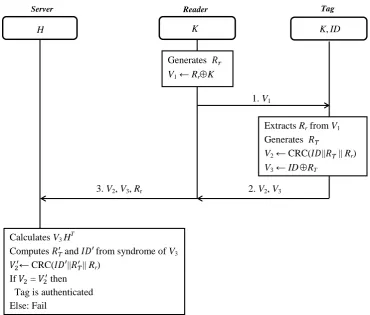
Fig. 1.Mauryaet al.authentication protocol
In this paper we use Eq. (1) and show that Mauryaet al.[23] authentication protocol is vulnerable to tag impersonation attack. Moreover, we show that how an attacker can easily trace a target RFID tag.
4
Maurya
et al.
Authentication Protocol
4.1 Phase 1: Initialization
In this phase, a binary linear codeC with a generator matrixGof orderk×nwith a minimum distanced and the corresponding parity-check matrixHare stored to a legitimate server. The initiator uses the generator matrix to generate 2kcodewords as unique identification numbers for all tags. (Note: In this scheme, maximum number of the tags are 2k). The initiator also shares a secret keyKbetween any legitimate tag and the legitimate reader. Finally, the server stores all syndromes and corresponding coset leaders on its database.
4.2 Phase 2: Authentication
The authentication protocol, as shown in Fig. 1, runs as below:
1. The reader generates a random numberRr and uses the stored secret keyKto computeV1=Rr⊕Kand then starts the protocol by sendingV1to the target tag;
2. Once the tag receivedV1does as follow:
– Generates a random numberRT,(wt(RT)≤t); – ExtractsRr=V1⊕K;
– ComputesV2=CRC(IDkRTkRr)andV3=ID⊕RT; – ForwardsV2andV3to the reader.
3. The reader forwards the tuple(V2,V3,Rr)to the server. 4. Once the server received the tuple(V2,V3,Rr), it acts as follow:
– Calculates the syndrome ofV3by using the equationS(V3) =V3HT;
– Uses the stored syndromeV3HT and finds the corresponding coset leaderRT; – ComputesID=V3⊕RT;
– ComputesV20=CRC(IDkRTkRr);
– IfV20=V2then it authenticates the expected tag, otherwise the authentication fails.
5
Security Analysis of the Maurya
et al.
Protocol
5.1 Tag Impersonation Attack
In this attack, an adversary can cheat the reader to authenticate him/her as a legitimate tag. This attack consists of two phases: learning phase and execution phase which is described as follow:
1. Learning Phase: In this phase, an adversary stores required information by eavesdropping only one run of the protocol as below.
– The adversary eavesdrops one complete run of the protocol;
– The adversary storesV11=R1r⊕K,V21=CRC(IDkR1TkR1r)andV31=ID⊕R1T.
2. Execution Phase: In this phase, an adversary uses the information stored in learning phase and executes the attack as below.
– The reader generates a random numberRrand computesV12=R2r⊕Kand starts another run of the protocol by sendingV12to the target tag which now is the adversary;
– Once the adversary receivedV12does as follow: • ComputesV1=V11⊕V12=R1r⊕R2r;
• ComputesV2=V21⊕CRC(0k0kV1) =CRC(IDkR1TkR2r); • ForwardsV2andV31to the reader.
– The reader forwards the tuple(V2,V31,R2r)to the server. – Once the server received the tuple(V2,V31,R2r), it acts as follow:
• Calculates the syndrome ofV1
3 by using the equationS(V31) =V31HT; • Uses the stored syndromeV31HT and finds the corresponding coset leaderR1
T; • ComputesID=V31⊕R1T;
• ComputesV20=CRC(IDkR1TkR2r);
• Now the checking processV20=V2is passed and it authenticates the adversary as an expected tag.
Hence, following the given attack the tag is impersonated by the adversary. The success probability of this attack is “1" while the complexity is only “2" runs of protocol.
5.2 Tag Traceability Attack
1. Learning Phase: In this phase, an adversary stores required information by eavesdropping one runs of protocol as below.
– The adversary eavesdrops the messages transmitted between the tag and the reader in one run of the protocol;
– The adversary storesV11=R1r⊕K,V21=CRC(IDkR1TkR1r)andV31=ID⊕R1T.
2. Decision Phase: In this phase, an adversary uses the information stored in the learning phase and executes the attack as below.
– When the reader computes the messageV12=R2r⊕K and sendsV12to the target tag, the adversary eavesdrops this message;
– According to the sequence of the protocol, once the tag receivedV12, it does as follow: • ComputesV12=R2r⊕K;
• ComputesV22=CRC(IDkR2TkR2r)andV32=ID⊕R2T; • ForwardsV22andV32to the reader.
– Now, the adversary eavesdrops messagesV22andV32and acts as follow: • ComputesV1=V11⊕V12=R1r⊕R2r;
• ComputesV3=V31⊕V32=R1T⊕R2T;
• Now, if the checking processV21⊕V22=CRC(0kV3kV1)is passed, it concludes the current tag is the one in the learning phase. This checking process is passed as below by considering Eq. (1).
V21⊕V22=CRC(IDkR1TkR1r)⊕CRC(IDkR2TkR2r) =CRC(ID⊕IDkR1T⊕R2TkR1r⊕R2r) =CRC(0kR1T⊕RT2kR1r⊕R2r) =CRC(0kV3kV1)
One can see that the adversary can trace the target tag with probability “1” and with the complexity of only one session eavesdropping, two XORs and one CRC computation.
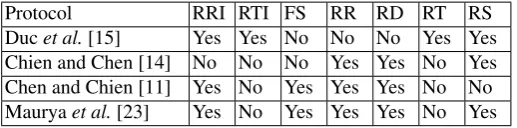
In Table 2, we lists some CRC based RFID protocols. These protocols cannot provide any basic security features. In this table, the symbol “Yes” represents that the scheme prevents attack and the symbol “No” rep-resents that the scheme does not resist against that. We denote resistance against server/reader impersonation attack byRRI, resistance against tag impersonation attack byRT I, forward security byFS, resistance against replay attack byRR, resistance against denial of service attack byRD, resistance against traceability attack by RT and finally resistance against secret disclosure attack byRS.
Table 2.Security features of some CRC based RFID protocols
Protocol RRI RTI FS RR RD RT RS
Ducet al.[15] Yes Yes No No No Yes Yes Chien and Chen [14] No No No Yes Yes No Yes Chen and Chien [11] Yes No Yes Yes Yes No No Mauryaet al.[23] Yes No Yes Yes Yes No Yes
6
Conclusion
In this article, we investigated the security of the Mauryaet al. authentication protocol. This CRC based protocol was recently proposed for ultra-lightweight RFID systems. We showed that Mauryaet al.protocol is vulnerable to tag impersonation and tag traceability attacks. Our attacks are based on the linear property of CRC function. The success probability of presented attacks is “1" while the complexity is only one session eavesdropping, two XORs and one CRC computation.
References
1. EPCglobal Inc. Class 1 Generation 2 UHF Air Interface Protocol Standard Version 1.09. Available online at http://www.gs1.org/gsmp/kc/epcglobal/uhfc1g2. Last access 2013/12/14.
2. S. F. Aghili, M. Ashouri-Talouki, and H. Mala. DoS, impersonation and de-synchronization attacks against an ultra-lightweight RFID mutual authentication protocol for IoT.The Journal of Supercomputing, pages 1–17, 2017.
4. S. F. Aghili and H. Mala. Security Analysis of an Ultra-lightweight RFID Authentication Protocol for M-commerce. IACR Cryptology ePrint Archive, 2017:547, 2017.
5. Z. Ahmadian, M. Salmasizadeh, and M. R. Aref. Desynchronization attack on RAPP ultralightweight authentication protocol.Information processing letters, 113(7):205–209, 2013.
6. G. Avoine and X. Carpent. Yet Another Ultralightweight Authentication Protocol That Is Broken.RFIDSec, 7739:20– 30, 2012.
7. N. Bagheri, M. Safkhani, P. Peris-Lopez, and J. E. Tapiador. Weaknesses in a new ultralightweight RFID authentica-tion protocol with permutaauthentica-tionâ ˘AˇTRAPP.Security and Communication Networks, 7(6):945–949, 2014.
8. Z. Bilal, A. Masood, and F. Kausar. Security analysis of ultra-lightweight cryptographic protocol for low-cost RFID tags: Gossamer protocol. InNetwork-Based Information Systems, 2009. NBIS’09. International Conference on, pages 260–267. IEEE, 2009.
9. M. Burmester and B. de Medeiros. The Security of EPC Gen2 Compliant RFID Protocols. In S. M. Bellovin, R. Gennaro, A. D. Keromytis, and M. Yung, editors,ACNS, volume 5037 ofLecture Notes in Computer Science, pages 490–506, 2008.
10. T. Cao, E. Bertino, and H. Lei. Security analysis of the SASI protocol.IEEE Transactions on Dependable and secure Computing, 6(1):73–77, 2009.
11. C.-L. Chen and C.-F. Chien. An ownership transfer scheme using mobile rfids. Wireless personal communications, 68(3):1093–1119, 2013.
12. C.-L. Chen and Y.-Y. Deng. Conformation of EPC Class 1 Generation 2 standards RFID system with mutual authen-tication and privacy protection.Eng. Appl. of AI, 22(8):1284–1291, 2009.
13. H.-Y. Chien. SASI: A new ultralightweight RFID authentication protocol providing strong authentication and strong integrity.IEEE Transactions on Dependable and Secure Computing, 4(4):337–340, 2007.
14. H.-Y. Chien and C.-H. Chen. Mutual authentication protocol for RFID conforming to EPC Class 1 Generation 2 standards.Computer Standards & Interfaces, 29(2):254–259, 2007.
15. D. N. Duc, J. Park, H. Lee, and K. Kim. Enhancing security of EPCglobal GEN-2 RFID tag against traceability and cloning.in Proceedings of the Symposium on Cryptography and Information Security, pages 17–20, 2006.
16. K. Fan, N. Ge, Y. Gong, H. Li, R. Su, and Y. Yang. An ultra-lightweight RFID authentication scheme for mobile commerce.Peer-to-Peer Networking and Applications, pages 1–9, 2016.
17. K. Fan, Y. Gong, C. Liang, H. Li, and Y. Yang. Lightweight and ultralightweight RFID mutual authentication protocol with cache in the reader for IoT in 5G.Security and Communication Networks, 9(16):3095–3104, 2015.
19. S. Karthikeyan and M. Nesterenko. RFID security without extensive cryptography. In V. Atluri, P. Ning, and W. Du, editors,SASN, pages 63–67. ACM, 2005. Proceedings of the 3rd ACM Workshop on Security of ad hoc and Sensor Networks, SASN 2005, Alexandria, VA, USA, November 7, 2005.
20. T. Li. Employing Lightweight Primitives on Low-Cost RFID Tags for Authentication. InVehicular Technology Conference, 2008. VTC 2008-Fall. IEEE 68th, pages 1–5. IEEE, 2008.
21. S. Ling and C. Xing.Coding theory: a first course. Cambridge University Press, 2004.
22. N.-W. Lo and K.-H. Yeh. An Efficient Mutual Authentication Scheme for EPCglobal Class-1 Generation-2 RFID System. In M. K. Denko, C.-S. Shih, K.-C. Li, S.-L. Tsao, Q.-A. Zeng, S.-H. Park, Y.-B. Ko, S.-H. Hung, and J. H. Park, editors,EUC Workshops, volume 4809 ofLecture Notes in Computer Science, pages 43–56. Springer, 2007.
23. P. K. Maurya, J. Pal, and S. Bagchi. A Coding Theory Based Ultralightweight RFID Authentication Protocol with CRC.Wireless Personal Communications, pages 1–10.
24. P. Peris-Lopez, J. C. H. Castro, J. M. Estévez-Tapiador, and A. Ribagorda. Cryptanalysis of a novel authentication protocol conforming to EPC-C1G2 standard.Computer Standards & Interfaces, 31(2):372–380, 2009.
25. P. Peris-Lopez, J. C. Hernandez-Castro, J. M. Estevez-Tapiador, and A. Ribagorda. EMAP: an efficient mutual-authentication protocol for low-cost RFID tags. InOTM Confederated International Conferences" On the Move to Meaningful Internet Systems", pages 352–361. Springer, 2006.
26. P. Peris-Lopez, J. C. Hernandez-Castro, J. M. Estevez-Tapiador, and A. Ribagorda. M2AP: A minimalist mutual-authentication protocol for low-cost RFID tags. InInternational Conference on Ubiquitous Intelligence and Comput-ing, pages 912–923. Springer, 2006.
27. P. Peris-Lopez, J. C. Hernandez-Castro, J. E. Tapiador, and J. C. A. van der Lubbe. Cryptanalysis of an EPC Class-1 Generation-2 standard compliant authentication protocol.Eng. Appl. of AI, 24(6):1061–1069, 2011.
28. P. Peris-Lopez, J. C. Hernandez-Castro, J. M. Tapiador, and A. Ribagorda. Advances in ultra-lightweight cryptography for low-cost RFID tags: Gossamer protocol. InInternational Workshop on Information Security Applications, pages 56–68. Springer, 2008.
29. M. Safkhani and N. Bagheri. Passive secret disclosure attack on an ultralightweight authentication protocol for Internet of Things.The Journal of Supercomputing, pages 1–7, 2016.
30. W. Shao-hui, H. Zhijie, L. Sujuan, and C. Dan-wei. Security analysis of RAPP an RFID authentication protocol based on permutation.College of computer, Nanjing University of Posts and Telecommunications, Nanjing, 210046, 2012.
31. A. Tewari and B. Gupta. Cryptanalysis of a novel ultra-lightweight mutual authentication protocol for IoT devices using RFID tags.The Journal of Supercomputing, 73(3):1085–1102, 2016.
33. K.-H. Wang, C.-M. Chen, W. Fang, and T.-Y. Wu. On the security of a new ultra-lightweight authentication protocol in IoT environment for RFID tags.The Journal of Supercomputing, pages 1–6, 2017.
34. T.-C. Yeh, Y.-J. Wang, T.-C. Kuo, and S.-S. Wang. Securing RFID systems conforming to EPC Class 1 Generation 2 standard.Expert Syst. Appl., 37(12):7678–7683, 2010.