
Pellet Seeding of Wheatgrasses on Southern Idaho
Rangelands A. c. 11?J11. <I?-. 155
Forage and Water PL. R. H~mphrc!j 164
The Economics of Grassland Development and Im-
provement in New Zealand PcrrzJ f’. Philipp 170 Ecology of a Southern Illinois Bluegrass-Broomsedge
Pasture .JOll?l IV. l-olgt 175
A Comparison of the Charting, Line Intercept, and Line Point Meihods of Sampling Shrub Types of Vegetation. Hclrold F. Hecldy. Robert P. Gibbens.
and Robert IV. Powell 180 Annual-Range Fertilization in Relation to Soil Mois-
ture Depletion Cyrus M. McKell.
Jrtck~Major.~nnd Eugene R. Perrier 189 Plant Control - Some Possibilities and Limitations
II. Vital Statistics of Range Management
Kenneth B. Plntt 194 Changes in Grazing Use and Herbage Moisture Con-
fenf of Three Exotic Lovegrasses and Some Native Grasses. _. Dwight R. Cable clnd John W. Bohning Technical Notes
200 A Rotary Lawn Mower for Sampling Range
Herbage. __ “_ __ . . ..Willium J. McGinnies Additional Modifications of the Point
Frame ..__. _____ __... Justin G. Smith Limestone Pelleting of Subterranean
Clover Tested on Acid Soil
William A. Williams and Burgess L. Kay Book Reviews: The Heritage of the Middle West
(Murray) ; Improvemeni of Livestock (Bogart) :
Perspective on Conservation (Jarrett ) _ .._________________._______.. ____
Current Literature. ..__. ._______._ .-Lee A. Sharp 203 204
205
With fhe Sections _____ .._ ..__ __ __.._...__..___ ______ News and Notes .._.. _ __ ___._..___.__.. .________...._.______. ___
American
Society of Range Management
The American Society of Range Management was created allied teuhnologists, and to encourage professional improvement in 1947 to foster advancement in the science and art of grazing of its members.
land management, to promote progress in the conservation and Persons shall be eligible for membership who are interested greatest sustained use of forage and soil resources, to stimu- in or engaged in practicing range or pasture management or late discussion and understanding of scientific and practical animal husbandry; administering grazing lands; or teaching, range and pasture problems, to provide a medium for the or conducting research, or engaged in extension activities in exchange of ideas and facts among society members and with range or pasture management or related subjects.
T
he JOURNAL OF RANGE MAN- AGEMENT, published bi-monthly, is the official organ of the American Society of Range Management. The Society, however, assumes no responsibility for the statements and opinions expressed by authors and contributors.Office, Executive Secretary. Address all inquiries and correspondence including memberships, renewals, replacements of JOURNALS, etc., to Executive Secretary, American Society of Range Management, P.O. Box 5041, Portland 13, Oregon. Dues. Membership dues should be sent to the Executive Secretary. The dues are $8.00 per year including . a suhscrip- tion to the JOURNAL OF RANGE MAN- AGEMENT. Dues for student members are $4.00 per year, including the JOURNAL. All subscriptions mailed outside the North American continent and insular possessions of the U. S. are $8.50 per year. Subscrip- tions must be paid in advance. Remit by draft or check on U. S. banks in U. S. funds. Reprinfing. The reprinting’ of articles or parts of articles published in the JOURNAL OF RANGE MANAGEMENT is author- ized on the express condition that full credit be given the JOURNAL and the author. The date of original publication must be shown with the credit line.
Posf Office Enfry. Second-class post- age paid at Portland, Oregon, and at +d- ditional offices.
Change of Address. Notices of change of address should be received by the Execu- tive Secretary one month before the date of issue on which the change is to take effect. Both the new and old addresses should be sent to the Executive Secretary, American Society of Range Management, P.O. Box 5041, Portland 13, Oregon.
Printers. The Nebraska Farmer Company, 1420 P Street, Lincoln, Nebraska. Copyright 1959 by the American Society of Ranae Management.
OFFICERS OF THE SOCIETY President:
DONALD F. HERVEY Colorado State University
Fort Collins, Colorado
Vice President: Executive Secretary:
FRED H. KENNEDY JOHN G. CLOUSTON
U. S. Forest Service P. 0. Box 5041
Albuquerque, N. Mex. Portland 13, Oregon
BOARD OF DIRECTORS
1957-59
KENNETH CONRAD E. WM. ANDERSON
Wray, Colorado Soil Conservation Service
Pendleton, Oregon 1958-60
JAMES L. FINLEY MELVIN S. MORRIS
Holbrook, Arizona University of Montana
Missoula, Montana 1959-61
JOHN CHOHLIS C. H. MCKINNON
Western Livestock Journal LK Ranches, Ltd.
Sacramento, California Calgary, Alberta
Past President: ROBERT S. CAMPBELL
U. S. Forest Service New Orleans 13, La.
HISTORIAN: A. A. BEETLE, Dept. of Agronomy, University of Wyoming, Laramie, Wyoming
JOURNAL OF RANGE MANAGEMENT EDITOR
WARREN C. WHITMAN
Department of Botany, North Dakota Agricultural College Fargo, North Dakota
EDITORIAL BOARD 1957-59
FRANK GYBERG E. J. WOOLFOLK
Cornville, Arizona Pacific Southwest Forest & Range Exp. Sta. Berkeley 1, California 1958-60
ARNOLD HEERWAGEN W. R. HANSON
Soil Conservation Service Eastern Rockies Forest 321 New Customs Building Conservation Board
Denver 2, Colorado Calgary, Alberta
1959-61
DONALD R. CORNELIUS JACK R. HARLAN
Agricultural Research Service Oklahoma State University
P. 0. Box 245 Stillwater, Oklahoma
Journal of
Volume 12, Number July, 1959 4RANGE
MANAGEMENT
Pellet Seeding of Wheatgrasses on Southern
Idaho Rangelandsl
A. C. HULL, JR.2
Range Conservationist, AgricuZturaZ Research Service, U. S. Department of Agriculture, Logan, Utah
Most seed pellets tested for range use have been of three general types: coated, extruded, and compressed. Coated seed pel- lets are generally ellipsoidal and are built up by coating the indi- vidual seed with successive lay- ers of finely powdered materi- al. Extruded pellets are made by pressing a pasty seed and soil mixture through round holes to form ribbon-like strings, which are broken into short cylindrical pellets. Compressed pellets, gen- erally spherical, are normally made by running a seed and soil mixture through pressure disks
(Moomaw, 1951; Silen, 1948). During 1946-49, Congress ap- propriated over one-half million dollars for airplane pellet seed-
’ This article is a summary of por- tions of the author’s Ph.D. thesis submitted to the Range Manage- ment Department of Utah State University. Field work was coop- erative with the Bureau of Land Management and the Bureau of Indian Affairs.
2Appreciation is expressed to the co- operating agencies for permission to use the field data, to Utah State University, and to all persons who assisted in the field and laboratory phases of this study. Special thanks are expressed to R. K. Pierson, Evan Flory, Wesley Keller, L. A. Stoddart, and E. W. Tisdule for helpful suggestions on the study and for review of the manuscript.
ing by various land-managing agencies. Most of this work was done with compressed pellets. In 1954, Congress appropriated $200,000 for pellet and airplane seeding. The pellet phases of this work were done with coated- seed pellets.
low in productivity. Rough ter- rain often precludes drilling. The need for improvement has caused a search for an inexpensive method of seeding which would give stands comparable to drill- ing. Broadcasting pelleted seed was proposed. Pelleting vegeta- ble and flower seed led to an in- terest in the pelleting of seed for use on range lands. It was hoped that pelleted seed could be uni- formly distributed and that the coating material would provide seed covering and conditions fav- orable for germination and growth of seedlings on range lands.
Previous Studies
The chief reason for Congres- When compressed pellets were sional action was the desire to developed, many felt that they improve western rangelands. would be adapted to range seed- Many of these lands have been ing. Extravagant claims were depleted of valuable forage made as to their usefulness. plants and are comparatively After 4 years of testing, techni-
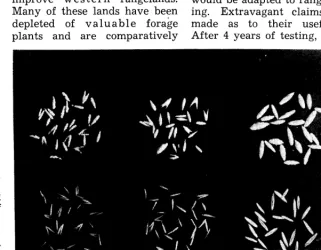
FIGURE 1. Unpelleted (bottom row) and pelleted (top row) seeds of crested wheatgrass (left and center) and intermediate wheatgrass (right). The seed at the left was pel-
leted by Germain ; that at the center and right by Volgesang.
156 A. C. HULL, JR.
FIGURE 2. Left: Germain crested wheatgrass pellets broadcast by plane on a sagebrush burn at Summit 2 in November 1954. Center: Close-up photo showing that pellets were not covered by the sagebrush ashes. Right: Repeat photo of airplane-seeded area in July 1956. The seeded plants on this plot are producing only 2 pounds of air-dry herbage per acre, and the native grasses, weeds, and shrubs are increasing.
cians concluded that seeding compressed pellets was not suc- cessful (Barnard, 1950; Bleak and Phillips, 1950; Moomaw, 1951; Moomaw et al., 1954; Plum- mer et al., 1955; Rudolf, 1949; Silen, 1948; Tisdale and Platt, 1951; Wagner, 1949; Wagner and Kinkor, 1950). Three major drawbacks were (1) failure to cover seed; (2) the high ratio of soil to seed in the pellet, making transportation costs high; and
(3) damage to the seed during pelleting. Several studies showed that compression presumably damaged the seed and reduced germination as much as 80 per- cent (Allen, 1948; Bleak and Phillips, 1950; Gatherurn, 1951; Moomaw, 1951; Moomaw et al.,
1954; Stevenson, 1949; Tisdale and Platt, 1951). Naked seed broadcast by plane gave poor stands but still much better than compressed pelleted seed and at a lower cost (Bleak and Phillips, 1950; Bleak and Hull, 1958).
Reports by Bleak and Phillips (1950)) Hull and Stewart (1948)) Stewart (1949)) and Plummer et al. (1955) indicate that broad- casting by airplane is successful only where there is no competing vegetation and where natural seed covering is provided; such as leaf-fall of deciduous trees and deep ashes of heavy brush
or timber burns.
The coating process of pellet- ing seed was successfully used on flower and vegetable seeds (Carolus, 1954; Nissley, 1955). Laboratory tests showed little or no reduction in germination of range grasses as the result of pel- leting by coating (Gatherurn, 1951; Moomaw, 1951; Tisdale and Platt, 1951). Coated-seed pellets were tested in small range plots and in one large range area in southwestern Idaho (Moomaw et al., 1954; Tisdale and Platt, 1951). Dry weather followed the large seeding, and an almost complete failure resulted.
Experimental Procedures Tests on coated seed pellets were carried out in southern Ida- ho on lands administered by the Bureau of Land Management and the Bureau of Indian Affairs. There were several phases of the testing. Pelleted and unpelleted seeds were tested for germina- tion in a germinator and in the greenhouse. Experimental seed- ing tests were carried out at eight field locations to compare results of airplane and hand- broadcasting of pelleted and un- pelleted seed with drilling. Re- sults from adjacent large-scale seedings were compared with the experimental seedings. Soils on
the experimental areas also were compared. The University of Idaho ran germination tests on the same lots of seed and pellets. Their results were similar to the tests reported here. The signifi- cance of results of all germina- tion tests, seedling counts, and forage yields was determined by analysis of variance. If the anal- ysis of variance showed a signi- ficant difference among the treatments, the Duncan (1955) multiple-range test was then used to determine which differ- ences between individual treat- ments were significant or highly significant.”
Seed and Pellet Studies Three lots of unpelleted seed were used in this study: two of crested wheatgrass (Agropyron desertorum) and one of inter- mediate wheatgrass (A. inter- medium). Four lots of pellets were made from these seeds. These seven lots of seed and pel- lets are as follows:
Crested wheatgrass:
Bureau of Land Management seed.
PELLET SEEDING ON IDAHO RANGELANDS 1.57
Germain pellets made from Bureau of Land Management seed.
Vogelsang pellets made from Bureau of Land Management seed.
Bureau of Indian Affairs seed.
Vogelsang pellets made from Bureau of Indian Affairs seed.
Intermediate wheatgrass: Bureau of Indian Affairs seed.
Vogelsang pellets made from Bureau of Indian Affairs seed.
Part of the seed was pelleted by Germain’s Inc. (Nissley, 1955) and part by Processed Seeds Inc., known as Vogelsang (Westrin, 1948). Pelleting costs averaged 90 cents per pound of seed for lots of 9,000 to 35,000 pounds. The ratio of unpelleted to pel- leted seed ranged from 1: 3.6 to 1: 5.4 Samples of seed and pellets are shown in Figure 1.
In laboratory tests at Logan, Utah, both kinds of pellets ab- sorbed water readily. On satu- rated blotters they became moist in 7.5 to 8.7 seconds. Water was dropped from a 3-foot height up- on individual pellets. With Ger- main pellets, an average of 1.7 drops washed the coating from the top of the seed. The Vogel- sang pellets kept their coating better and after 50 drops of water, the coating was still in- tact. In a 21-day germination test the Vogelsang pellets re- tained their shape whereas the Germain pellets looked like ‘a drop of gray mud around a seed.
Germination Tests
The three lots of seed and the four lots of pellets were tested for germination in a germinator and at two seeding depths in the greenhouse. Before germination, all seeds and pellets were kept in cold storage at approximately 40” F. for 7 days (U S. Dept. Agric., 1952). Within each of the following 3 methods of germina- tion the 7 lots of seed or pellets
replica- were randomized with 6
tions of each treatment:
I
1. Germinator, between 68” and 86” F.
2. Greenhouse at %-inch depth, between 60” and 90” F.
3. Greenhouse on the soil sur- face, between 60” and 90” F.
Seeds and pellets were placed in the germinator on May 27, 1955. Germination commenced on May 30. Seeds and pellets were planted in greenhouse flats on May 26. Sprinkling was done every day if necessary to keep the soil surface moist. As seed- lings emerged, they were counted and marked with toothpicks. Emergence commenced on June 1 for surface seedings and on June 2 for %-inch seedings.
Results and Discussion
In a germinator the unpelleted
seed of crested wheatgrass ger- minated more rapidly than did pelleted seed of the same lot. Two days after germination com- menced 74 to 77 percent of the bare seed had germinated, whereas only 1/4 as much of the pelleted seed had germinated. Carolus (1954) indicated that pelleted vegetable seed required
1 or 2 more days for germination than unpelleted seed. An analy- sis of variance showed a lower germination for Germain pel- leted crested wheatgrass seed than for other seed and pellets.** There was no difference among other seed and pellets.
Seed and pellet germination at 3/4-inch depth in the greenhouse averaged slightly lower than in the germinator. An analysis of variance showed a difference in percent germination among the
Table 1. Seeding methods and rates for pelleted and unpellefed crested and intermediate wheafgrasses @ 8 locations in southern Idaho. (All seeding meihods on 3 seedbeds: plowed, burned, and not treated.)
Seeding Species 8~ Seeding Location
Method pellet rate per Summit Dubois Sand Buckskin Portneuf
type’ acre (lbs.) #l R-2 #l #2 #l #2
Drilling Airplane broad- casting Hand broad- casting
Hand Acr 6
broad- Acr GP 6
casting Acr VP 6
on snow Ai VP 6
Acr 1
Acr 6
Acr 6
Acr 12
Ai 1
Ai 6
Acr 5-14
Ai lo-26
Acr GP 5-9 Acr VP 3-5 Ai VP 3-4
Acr 6
Acr 12
Ai 6
Acr GP 6
Acr GP 12
Acr VP 6
Acr VP 12
Ai VP 6
Ai VP 12
Number of Plots
x X x X X X X X X
l”o
l Acr-Crested wheatgrassAi -Intermediate wheatgrass GP -Germain pellets
VP -Vogelsang pellets
158 A. C. HULL, JR.
Table 2. Actual and average precipitation in inches af sfafions mosf com- parable wifh fhe seeding.
- Ft. Hall
Hill City Spencer (Sand & Putnam Mt.
(Summit) (Dubois) Buckskin) (Portneuf)
Period 28-yr.
Covered Actual Av. Actual 32-yr. Av. Actual 39-yr. Av. Actual 22-yr. Av.l
1954 12.07 - 15.58
1955 15.57 14.09 19.11
1956 12.79 12.18
Ott-Dee 1954 3.21 4.88 3.40 Jan-March 1955 2.66 5.20 3.83 April 1955 1.45 1.06 1.49
May 1955 1.31 1.09 2.44
June 1955 .47 .78 2.83
July 1955 .37 .29 1.07
August 1955 0 .37 1.45
17.93
4.43 4.44 1.50 2.28 1.93 1.18 .99
9.01 - 12.20 -
9.89 10.00 16.10 16.28
7.83 - 2 -
1.79 2.50 2.20 4.07 1.65 2.29 2.40 4.58
1.36 .89 1.80 1.17
.95 1.13 3.20 1.23
2.29 .92 2.40 1.75
.30 .59 .90 .79
.91 .66 .60 .97
l From Blackfoot Dam. The Weather Bureau estimates that Blackfoot Dam and Putnam Mt. are comparable. The Portneuf studies are midway be- tween.
2 Data not available. Partial 1956 records are as follows:
January-2.70, February- 1.50, March 2, 1956 to April 23, 1957-9.00.
various lots of seeds and pel- lets**, but neither seed nor pel- lets were superior.
The surface plantings aver- aged only one-eighth to one-half as many seedlings ‘as the s/4-inch depth. Sprinkling caused some surface seeds and pellets to be covered with the loose soil. An analysis of variance showed dif- ferences in germination among surface-seeded seed and pel- lets* *, but germination pellets and seed averaged about equal. Germination tests in a germi- nator and in greenhouse flats showed no consistent trend to favor either pelleted or unpel- leted seed. One critical factor in seeding success is seed covering. In these tests pelleting was no substitute for proper covering of seed with soil.
Field Studies Location and Descripfion The experimental studies were
carried out at the eight field lo- cations in Idaho as listed at the top of the columns in Table 1. The first three locations are on Bureau of Land Management land and the others on the Fort Hall Indian Reservation. Annual precipitation ranges from 10
inches to 16 inches (Table 2). Elevation ranges from 4,450 to
6,000 feet.
All eight locations are within the sagebrush-grass vegetation type. Vegetation at-summit 1 is
mainly sagebrush (Artemisa tri-
dentata) with a bluebunch wheatgrass (Agropyron spica- turn) understory. At Summit 2 the vegetation is mixed big and low sagebrush (Artemisia arbu- scula) with an understory of bluebunch wheatgrass, Idaho fescue (Festuca idahoensis), and bluegrasses (Poa spp.) . Dubois
vegetation is mixed big and three-tip sagebrush (Artemisia tripartita) with an understory of bluebunch and streambank wheatgrasses (Agropyron ripari- urn). A sparse stand of big sage- brush occurs at Sand and Buck- skin 1 and 2 with an understory of sand dropseed (Sporobolus cryptandrus), and cheatgrass
(Bromus tectorum) at Sand, needle-and-thread (Stipa coma- ta) at Buckskin 1, and needle- and-thread and bluegrasses at Buckskin 2. Vegetation at Port- neuf 1 and 2 is mainly three-tip sagebrush, thickspike wheatgrass
Table 3. Average number of seedlings per square foof in June 1955 from different methods of seeding on 3 seedbeds af 8 locafions in southern Idaho in November, 1954.
Seedlings per sq. ft.
Species 8~ Seeding (number) for indicated seedbed preparation Locations Seeding pellet rate per
Method - type* acre (lb.) Plowing Burning2 None represented (number) Drilling Acr 1 1.1 ( 1.4)4 1.4 ( 1.7)
Acr Acr Ai Ai
Hand Acr
broad- Acr casting Ai
Acr GP Acr GP Acr VP Acr VP Ai VP Ai VP
Hand Acr
broad- Acr GP casting Acr VP on snow Ai VP
6 3.6 (5.9) 12 6.7 (7.8) 1 2.2 (2.5) 6 6.2 (7.7) 6 .8 (1.9) 12 1.5 (3.9) 6 .8 (1.0) 6 .6 (1.4) 12 2.2 (3.6) 6 .3 ( .5) 12 .4 ( .6>
6 .6 ( .S) 12 1.5
6 .9
6 .5
6 2.2 (3.9) 6 1.3 (1.9)
4.7 ( 7.8) 10.8 (14.1) 2.0 ( 2.0) 5.1 ( 7.5) .2 ( .3) .4 ( .7) .l ( .2) .2 ( .3) .3 ( .5) .l ( .3) .l ( .l> .l ( .l> .l .5 .2 .4 ( .7) .7 ( 1.4)
1.9 ( 2.2) 3 4.5 ( 5.3) 83 10.5 (12.9) 3
2.0 ( 2.1) 2 6.3 ( 7.4) 4
.l ( .2) .2 ( .5) . .l ( .l> .l ( .l) .4 ( .6) .l ( .l> .l ( .l) .l ( .l> .1
8 8 2 8 3 4 2 2 1 1 1 3 3 .4
.2 .5 ( 1.3) .2 ( .3)
1 Acr-Crested wheatgrass Ai -Intermediate wheatgrass GP -Germain pellets VP -Vogelsang pellets
2 Effective only at Summit 1 and 2 and Dubois.
s This treatment was applied twice at four of the locations, making a total of 12 plots at the 8 locations. These are averaged for the figures in this row.
PELLET SEEDING ON IDAHO RANGELANDS 159
FIGURE 3. At Summit 2, burning to kill the brush resulted in good stands of crested wheatgrass. Top : Plot burned and drilled in November 1954. Bottom: The same plot in August 1956. The plants were 15 inches tall and producing 453 pounds of air-dry herbage per acre.
(Agropyron dasystacfiyum) and bluegrasses, with some bitter- brush (Purshia trident&a) at Portneuf 2.
Because soil differences may have caused differences in seed- ing success among treatments or between locations, the soils were checked in the field and analyzed in the laboratory. A rough soil surface permitted more covering of broadcast seed at some loca- tions than at others. This was the only soil factor seemingly re- lated to seeding success.
Design
Each experimental area was 300 feet wide and 520 feet long. It was divided lengthwise into three strips 100 feet wide on which the following three meth- ods of seedbed preparation were used: Plowing, burning, and no treatment. Seeding methods were applied at right angles to the seedbed preparation strips so that each seeding treatment crossed over each strip. Seeding methods at each location are shown in Table 1. Seeding treat- ment plots were 40 feet wide so that each treatment in each preparation strip was applied to 40 x 100 feet or .09 acre. Air- plane-seeded plots were double this width, or 80 x 100 feet, to help keep drifting seed and pel- lets on the plots.
Seedbed Preparation and Seeding
Treatments were carried out
during the summer and fall of 1954. Burning was done in Au- gust at Summit 1 and 2, Septem- b; at Dubois, and October and November at Sand, Buckskin 1 and 2, and Portneuf 1 and 2. The early burning at Summit 1 and 2 and Dubois resulted in clean seedbeds. Because of the late burning at Sand, Buckskin 1 and 2, and Portneuf 1 and 2, there were clean seedbeds in only three small spots at Buckskin 1 and in only 2 at Portneuf 2. Ex- cept on these spots, burning was similar to no treatment at these locations.
Plowing was done during Oc- tober and November. A disk- type plow was used on all areas except Dubois, where an under- cutting blade was used. Plowing killed a high percentage of sage- brush and shallow-rooted plants. It was not effective on rhizo- matous grasses, root-sprouting
Table 4. Average number of 2-year-old planis of cresied and intermediate wheafgrasses per square foot in 1956 from different methods of seeding 3 seedbeds in November 1954 af 8 locations in southern Idaho.
Seedlings per sq. ft.
(number) for indicated Locations seedbed preparation represented Plowing Burning2 None ____- (number) Species & Se;dFef
Seeding pellet
Method type’ acre (lb)
Drilling Acr 1 .8 (1.0)4 0 0 3
Acr 6 1.4 (2.0)
Acr 12 2.0 (2.3)
Ai 1 1.3 (1.3)
Ai 6 2.0 (2.8)
Hand broad- casting
Acr 6 .5 ( .8)
Acr 12 .7 (1.1)
Ai 6 .4 ( .4)
Acr GP 6 .5 ( .9) Acr GP 12 .6 ( .S) Acr VP 6 .2 ( .5) Acr VP 12 .2 ( .3)
Ai VP 6 .5 ( .6)
Ai VP 12 1.0
.6 (2.0) .l ( .2) .3 ( .9) .l ( .2) .2 ( .2) .l ( .2) .l ( .3) .l ( .3) .l ( .l> 0 .l ( .2) 0
0 0
0 0
0 0
.l ( .l) 0
0 0
0 0
0 0
8” 3 2 4
Hand Acr 6 .4 .5 0 1
broad- AcrGP 6 .l .2 0 1
casting AcrVP 6 .6 ( .9) .l ( .l) 0 3
on snow Ai VP 6 .3 ( .6) .l ( .l) 0 3
1 Acr-Crested wheatgrass Ai -Intermediate wheatgrass GP -Germain pellets VP -Vogelsang pellets
2 Effective only at Summit 1 and 2 and Dubois.
s This treatment was applied twice at four of the locations, making a total of 12 plots at the 8 locations. These are averaged for the figures in this row.
160 A. C. HULL, JR.
shrubs, and deep-rooted forbs. The seedbed was left loose and uneven.
Table 5. Average pounds of air-dry seeded grass per acre in 1956 from dif- ferent methods of seeding on 3 seedbeds at 8 locations in southern Idaho in November 1954.
All areas were seeded between November 3 and 21. Seeding was mostly at 6 pounds per acre for seed and 6 pounds per acre seed equivalent for pellets (Table 1). Drilling was at right angles to plowing; so drill disks were sometimes out of the ground and often cut 4 inches deep. Seed covering ranged from 0 to 3 inches, but most of the seeds were in the 1/4 to 1 inch range. On burns the drill cut furrows
1/2 to 1% inches deep, and seed was covered about V’4 to % inch deep in the bottom of the fur- rows. On non-treated areas the furrows were cut similarly to those on burned areas, but the disks were often out of the ground in going over brush.
Seedlings per sq. ft.
Species & Seeding (number for indicated seedbed preparation2 Locations
Seeding pellet rate per represented
Method type’ acre (lb) Plowing Burning None (number)
Drilling Acr 1 347 (511)4 4( 8) 1 ( 3) 3
Acr 6 487 (879) 154 (453) 7 (29) 83
Acr 12 627 (818) 98 (288) 5 (15) 3
Ai 1 651 (892) 11 ( 18) 7 (12) 2
Ai 6 576 (928) 3 ( 11) 6 (19) 4
Hand Acr 6
broad- Acr 12
casting Ai 6
Acr GP 6
Acr GP 12
Acr VP 6
Acr VP 12
Ai VP 6
Ai VP 12
Hand Acr 6 142 119 0 1
broad- Acr GP 6 54 54 4 1
casting Acr VP 6 108 (143) 26 ( 59) 1 ( 4) 3 on snow Ai VP 6 97 (257) 14 ( 18) 1 ( 2) 3 Airplane broadcasting of seed
was not satisfactory on the ex- perimental plots. $trong winds, flying lower than the normal 100 feet, and not flying as flagged often concentrated the seed on some portions of the plot. To get better coverage some plots were flown over more than the planned number of times. This gave more uniform coverage but high seeding rates (Table 1). Because of these varied rates, airplane broadcast seedings are not included in the analysis with other seeding treatments.
1 Acr-Crested wheatgrass Ai -Intermediate wheatgrass GP -Germain pellets VP -Vogelsang pellets
2 Effective only at Summit 1 and 2 and Dubois.
3 This treatment was applied twice at four of the locations, making a total of 12 plots at the 8 locations. These are averaged for the figures in this row.
4 Numbers in parenthesis indicate the largest average number of plants per square foot on any of the areas. Omitted where only one area is represented.
c
airplane on freshly plowed soil or burned or untreated areas just hit and bounced with no penetra- tion, and poor stands resulted.
Results and Discussion
Fortunately, all airplane- broadcast plantings of pelleted and unpelleted seed were dupli- cated by hand-broadcasting at 6 pounds per acre. Also at Summit 1 and Dubois, seeding rates for airplane broadcasting of pelleted and unpelleted seed were close to each other and close to the uniform 6-pound rate per acre. At these two locations, an anlysis of variance of the numbers of seedlings and 2-year-old plants and the forage yields showed no difference between hand and air- plane broadcasting or between broadcasting pelleted and unpel- leted seed*. Pellets or seed broadcast either by hand or by
The success of the different seeding methods was measured by numbers of seedlings in 1955; numbers of 2-year-old plants, and forage yields in 1956; and plant vigor in 1955, 1956, and 1957.
Plant numbers:
The outstanding result in 1955 was that the number of seedlings resulting from drilling the seed was 10 times that of any broad- cast seeding (Table 3). When all eight locations and three seed- beds seeded at the 6-pound rate per acre were averaged, drilled crested wheatgrass was found to produce 4.3 seedlings per square foot as compared with .4 and .2 seedlings for hand-broadcast
182 (388) 10 ( 50) 0 197 (530) 9 ( 25) 6 (21) 210 (307) 1( 1) 6 (11) 147 (243) 6 ( 26) 1 ( 9) 186 (208) 13 ( 30) 3 ( 9) 101 (236) 9 ( 24) 1 ( 2)
67 ( 74) l(2) 0
276 (397) 0 1 ( 1)
588 0 2
seed and pellets. Intermediate wheatgrass averaged 5.9 plants from drilling and .3 and .2 plants from hand-broadcasting seed and pellets. There were 5 times as many seedlings from drilling at only 1 pound per acre as from broadcasting seed or pellets at 6 times this rate. Seedling num- bers from broadcast seed or pel- lets were the same.
The large and comparable number of seedlings from drill- ing on all three seedbeds indi- cated that seed covering was an important factor in seedling emergence.
PELLET SEEDING ON IDAHO RANGELANDS 161
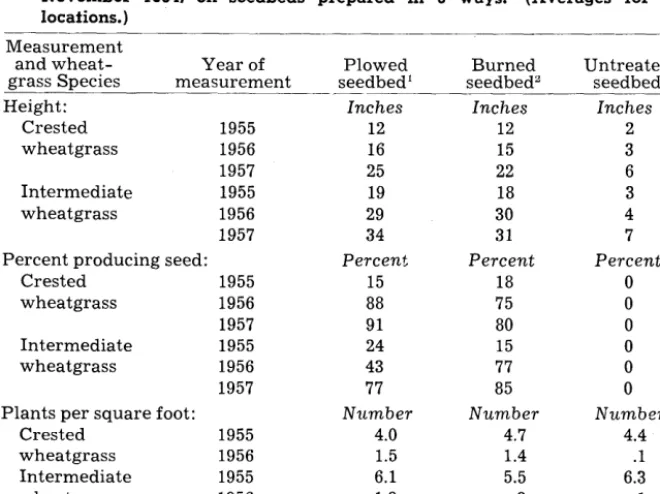
Table 6. Height, seed production, and survival of wheafgrass drilled in November 1954, on seedbeds prepared in 3 ways. (Averages for 8 locations.)
Measurement
and wheat- Year of Plowed Burned Untreated
grass Species measurement __~_____ seedbed’ seedbed seedbed Height:
Crested 1955
wheatgrass 1956
1957
Intermediate 1955
wheatgrass 1956
1957 Percent producing seed:
Crested 1955
wheatgrass 1956
1957
Intermediate 1955
wheatgrass 1956
1957 Plants per square foot:
Crested 1955
wheatgrass 1956
Intermediate 1955
wheatgrass 1956
Inches Inches Inches
12 12 2
16 15 3
25 22 6
19 18 3
29 30 4
34 31 7
Percent Percent Percent
15 18 0
88 75 0
91 80 0
24 15 0
43 77 0
77 85 0
Number Number Number
4.0 4.7 4.4
1.5 1.4 .l
6.1 5.5 6.3
1.9 .3 .l
l Plots at Buckskin damaged by wind in 1955 excluded. 2 Poor burns at Ft. Hall excluded.
bois had a greater number of seedlings from drilling at 6 pounds per acre than from bFoadcasting**. At Sand and Buckskin 1 and 2, there were more seedlings on plots drilled at the 6-pound rate than on any broadcast plot*. At Portneuf 1 and 2, crested and intermediate wheatgrasses drilled at 6 pounds per acre were superior to these same grasses in any broadcast treatments**. Intermediate wheatgrass drilled at 1 pound per acre was better than when it was broadcast at 6 or 12 pounds per acre*.
The 1956 plant counts showed more plants from drilling than from broadcasting (Table 4). Even on plowed seedbeds, drill- ing seed produced 1.6 plants per square foot as compared with .4 plant for hand-broadcasting seed or pellets. Where drilling rates of seed were only 1 pound per acre, there were 2 to 5 times as many plants as from broadcast- ing pellets or seed at 6 pounds per acre. Two sets of photo- graphs at Summit 2 show the development of stands of crested
wheatgrass from 1954 to 1956 as a result of poor and good meth- ods of seedbed preparation and seeding (Figures 2 and 3) . Herbage yields:
Drilling seed at 6 pounds per acre produced 2 to 10 times as much grass as did hand broad- casting seed or pellets at 6 pounds per acre (Table 5). Drilled at 6 pounds per acre on a plowed seedbed the two wheat- grasses averaged 517 pounds of grass per acre as compared with 196 pounds of grass from broad- casting seed and 175 from broad- casting pellets.
An analysis of variance of plant yields of the 4 treatments alike on all areas showed that yields from drilling were greater than yields from hand-broadcast- ing seed or pellets*. At Summit 1 and 2 and Dubois yields from drilling at 6 pounds per acre were greater than from yields from broadcasting seed or pellets at 6 or 12 pounds per acre* *.
Seedbed preparation and competing vegefafion:
Of the three methods of seed- bed preparation, plowing gener-
ally removed the most competing vegetation. The loose-plowed seedbed resulted in uneven and often too deep covering for drilled seed. This loose seedbed was favorable for broadcast seed and pellets because the rough soil surfaces sloughed in and pro- vided covering. Broadcasting on burned seedbeds resulted in poor stands but slightly better than those on untreated plots.
Because of poor burning con- ditions, burning showed up poor- ly as a method of seedbed prepa- ration on the experimental plots
FIGURE 4. Growth of seeded grass was pro- portional to the effectiveness of seedbed preparation. Top : Crested wheatgrass drilled in sagebrush with no seedbed prep- aration at Buckskin 1 in November 1954 suffered high mortality. The plants alive in 1957 averaged 6 inches tall. Bottom:
162 A. C. HULL, JR.
FIGUR’E 5. Plowing to kill the brush re- sulted in a good stand of intermediate wheatgrass at Portneuf 2. Top: This plot was plowed and drilled in November 1954. By August 1956 the plants were 28 inches tall and producing 806 pounds of air-dry grass per acre. Bottom: This photograph was taken of the same plot in 1957, when the stand was even better. The plants aver- aged 36 inches in height.
at Ft. Hall. However, on other seedings at Ft. Hall and in the Bureau of Land Management seedings, drilling on properly burned sites was an effective means of stand establishment.
Results in 1956 showed that the seedbed preparation which killed the most native vegetation gave the most a-year-old plants and the highest yields. Results from drilling crested and inter- mediate wheatgrasses at 6 pounds per acre at all 8 eight locations
were averaged. Plowed plots had 1.6 plants per square foot and yielded 509 pounds per acre, compared with 1.4 plants and 390 pounds on burned plots (the poor burns at Ft. Hall excluded), and .1 plant and 7 pounds on un- treated plots.
An analysis of variance of plant numbers and plant yields at all locations showed that plowed seedbeds produced a greater number of plants** and a greater yield of forage* than seedbeds which were burned or had no treatment. In 1957 the difference between good and poor methods of seedbed prepa- ration and seeding was even more striking than in 1956 (Fig- ures 4 and 5).
Plant vigor and survival:
Seedlings established them- selves and grew well during 1955. Where competition was re- moved by plowing or burning, crested wheatgrass seedlings av- eraged 10 to 15 inches in height and 5 to 20 percent of them pro- duced seed. Seedlings were shorter, and none produced seed where competing vegetation was not killed. Typical differences
in height and percentage pro- ducing seed are shown in Table 6.
Where there was good seedbed preparation there was less seed- ling mortality. Grasses drilled on three seedbeds on each of the eight locations averaged as fol- lows: Plowed seedbeds had 4.4 plants per square foot in 1955 and 1.6 in 1956, a loss of 64 per- cent. Burned seedbeds averaged 5.9 seedlings in 1955 and 1.4 plants in 1956, a loss of 76 per- cent but still a good stand. Drill- ing with no seedbed preparation averaged 5.1 seedlings in 1955 and .07 plants in 1956, a seedling loss of 99 percent.
Large Seedings
All experimental seedings were within or adjacent to larger areas totaling 13,985 acres seeded in 1954. Large areas were seeded by burning and airplane broad- casting of pellets, burning and airplane broadcasting of seed, plowing and airplane broadcast- ing of seed or pellets, burning and drilling, and plowing and drilling. Results from these large areas agree with results from similar methods on experimental areas.
Table 7. Seeding costs. pounds of air-dry grass per acre from 2-year-old stands of crested and intermediate wheafgrasses, and returns from seeding by various methods. (Six pounds of seed or seed equivalent per acre.)
Seeding method and species
Cost per acre (dollars)
Grass per year Air-dry grass per dollar
per acre’ invested _ (pounds) (pounds) PLOWED SEEDBED
Drilled seed:
Crested wheatgrass 6.90 487 71
Intermediate wheatgrass 9.20 576 63
Airplane broadcast seed:
Crested wheatgrass 6.00 125 21
Intermediate wheatgrass 8.30 110 13
Airplane broadcast pellets:
Crested wheatgrass 11.40 146 13
Intermediate wheatgrass 13.70 186 14
BURNED SEEDBED Drilled seed:
Crested wheatgrass 3.65 154 42
Airplane broadcast seed:
Crested wheatgrass 2.75 17 6
Airplane broadcast pellets:
Crested wheatgrass 8.15 11 1
PELLET SEEDING ON IDAHO RANGELANDS 163
Cosfs
Returns from the different seeding methods are shown in table 7. Seeding costs in this table are calculated from con- tract seedings for large areas. Grass yields are from 2-year-old stands on experimental plots. Per dollar expended, crested wheatgrass seed which was drilled produced 3 times as much grass as seed which was broad- cast by airplane, and 5 times as much as pelleted seed broadcast by airplane. Plots drilled to in- termediate wheatgrass produced 5 times as much grass as plots airplane-broadcast to seed or pellets. On burned and drilled plots crested wheatgrass yielded 7 times as much grass as plots broadcast by airplane and 40 times as much as plots broadcast by airplane to pelleted seed.
Pelleting cost about 90 cents per pound of seed. Assuming a seeding rate of 6 pounds per acre, it would seem better to put this $5.40 per acre into good seedbed preparation and drilling to help insure good stands.
Summary
Two lots of unpelleted crested wheatgrass seed, one lot of un- pelleted intermediate wheatgrass
seed, and four lots of coated seed pellets made from these seeds were tested in the laboratory and in the field. Tests in a germi- nator and in the greenhouse showed that coating probably did not affect the germination percentage of this seed.
The seven lots of seed and pel- lets were seeded in November 1954 at eight range locations in southern Idaho. First-year re- sults showed little difference be- tween drilling on seedbeds which were burned or plowed or had no preparation. Seed coverage was an important factor determining seedling emergence. Drilling at 6 pounds per acre on any of the seedbeds was superior to broad- casting at 6 or 12 pounds per acre* *. Broadcasting on plowed areas produced better stands
than broadcasting on burned or untreated areas. -Even the best stands from broadcast seeding were poor. In 1956, drilled plots produced 1.6 2-year-old plants per square foot and 517 pounds of grass per acre, as compared with .4 plants and 196 pounds for broadcast plots. This difference indicated that drilling is superior to broadcasting seed or pellets**. The seedbed preparation which best eliminated competing plants gave the most seeded plants and the highest yields. The first-year plant numbers were similar from drilling on plowed, burned and untreated seedbeds. By the sec- ond year 99 percent of the plants on the untreated areas were dead and the remainder reached only 3 to 4 inches in height. In con- trast, 2-year-old plants on plowed or burned seedbeds were 15 to 30 inches tall and producing several hundred pounds of herbage per acre. Each dollar expended on plowing or burning for seedbed preparation and drilling pro- duced 3 to 7 times as much grass as a dollar spent on airplane broadcasting seed on the same type seedbed and 5 to 40 times as much as one spent on airplane broadcasting pellets.
Comparable but poor stands were obtained from either air- plane or hand broadcasting of pellets. With pelleting costs of 90 cents per pound of seed, on the basis of this study, coated seed pellets cannot be recom- mended for seeding range lands.
LITERATURE CITED ALLEN, CHARLES E. 1948. Some notes
on “pelleted” crested wheatgrass seed. Newsletter Assn. Off. Seed Analysts 22: 39-40.
BARNARD, DONALD M. 1950. An evalu- ation of pellet seeding as it applies to range land. Wyo. Range Mangt. 21. 6 pp. (Proc.).
BLEAK, A. T. AND A. C. HULL, JR. 1958. Seeding pelleted and unpelleted seed on four range types. Jour. Range Mangt. 11: 28-33.
-AND T. A. PHILLIPS. 1950. Seedling stands from airplane broadcasting of pelleted and un- pelleted seed in southeastern Utah.
Int. Forest and Range Exp. Sta. Res. Paper. 22. 14 pp. (Proc.). CAROLUS, R. L. 1954. Pelleted seed
for precision planting. Amer. Veg. Grower 2: 5, 16-17.
DUNCAN, DAVID B. 1955. Multiple range and multiple F tests. Bio- metrics 11: l-42.
GATHERUM, GORDON E. 1951. Pellet seeding on sagebrush range. M.S. Thesis, Dept. Range Mangt., Utah State Univ. 41 pp.
HULL, A. C. JR. AND GEORGE STEWART. 1948. Seeding southern Idaho range lands by airplane. Int. Forest and Range Exp. Sta. Res. Paper 16. 14 pp. (Proc.) .
MOOMAW, J. C. 1951. Some effects of pelleting on seeds of range for- age species. M.S. Thesis, Coll. of Forestry, Univ. of Idaho. 63 pp. -, E. W. TISDALE, L. A. SHARP
AND K. B. PLATT. 1954. Studies of pelletized seed for range reseed- ing. Univ. of Idaho For., Wildlf., and Range Exp. Sta. Res. Note 11. 10 pp. (Proc.).
NISSLEY, CHARLES. 1955. Pelleted seed and precision planters. Mar- ket News 84: 36.
PLUMMER, A. PERRY, A. C. HULL, JR., GEORGE STEWART AND JOSEPH H. ROBERTSON. 1955. Seeding range- lands in Utah, Nevada, southern Idaho and western Wyoming. U. S. Dept. of Agr. Handbook 71. 73 pp. RUDOLF, PAUL 0. 1949. Pelleted seed for reforestation. Lake States For. Exp. Sta. Rept. 7 pp. Append. A and B, 18 pp.
SILEN, ROY R. 1948. A walking stick planter for pelleted Douglas fir seed. Thesis, Yale School of For- estry. 92 pp.
STEVENSON, E. W. 1949. Results of preliminary tests of pelletized crested wheatgrass seed. Pacific N.W. For. and Range Exp. Sta. Res. Note 53. 7 pp. (Proc.) . STEWART, GEORGE. 1949. Range re-
seeding by airplane compared with standard ground methods. Agron. Jour. 41: 283-288.
TISDALE, E. W. AND KENNETH B. PLATT. 1951. Pellet reseeding trials on southern Idaho range lands. Spec. Res. Rept. Proj. 16. Univ. of Idaho and Bur. Land Mangt. 23 pp. U. S. DEPT. OF AGRICULTURE. 1952.
Testing agricultural and vegetable seeds. U. S. Dept. Agr. Handbook 30. 440 pp.
WAGNER, JOE A. 1949. Results of air- plane pellet seeding on Indian res- ervations. Jour. Forestry 47: 632- 639.
-, AND CLARENCE P. KINKOR.
1950. Will pellet seeding work? Amer. Forests 56: 25, 44-45. WESTRIN., W. 1948. Seed pellets-
Forage and Water1
R. R. HUMPHREY
Professor of Range Management, University of Arizona, Tucson, Arizona
The subject of forage and water is indeed a broad topic, and for purposes of this discus- sion I shall restrict my coverage of the subject to the forage pro- duced on non-irrigated and non- cultivated lands; in other words, to the ranges and forests that are sometimes classed as wildlands.
Vegetation of any sort may af- fect water in three principal ways. (1) It may intercept a portion of the rain or snow that falls and either temporarily or permanently keep it from reach- ing the ground, (2) it plays a role in the retention of water and soil, reducing runoff and erosion and, (3) it uses water directly in the growth process. I shall examine each of these effects briefly. Extensive timber stands or even windbreaks may modify the climate to some extent but forage probably has little or no effect on climate and I shall not go into that phase of the prob- lem.
Wafer Use
One of the major studies of the amounts of water used by vari- ous kinds of plants was made at the University of Arizona dur- ing the period 1931 to 1936 (Mc- Ginnies, 1939). Water consump- tion of a number of forage grasses, as well as of several des- ert trees and shrubs was meas- ured in this study. The results were expressed as the ratio be- tween water used and the dry
‘Paper presented at the 83rd Annual Meeting of the American Forestry Association, Tucson, Ark., Sept. 29, 1958. Contribution from the Ark Agr. Exp. Sta., Univ. of Ark, Tucson. Published with the ap- proval of the Director of Ariz. Agr. Exp. Sta. as Journal Article No. 510.
weight of aboveground plant ma- terial produced. Thus, the fig- ures do not represent actual water usage. Neither do they in- dicate water use by the various species under field conditions of various degrees of water stress. Water was added to the cans in which the plants were growing whenever they indicated a weight loss of 1.5 kilograms. “A constant and uniform moisture supply was maintained through the year” As a uniformly mixed lot of soil with a moisture equi- valent of about 12 was used in all cans, essentially the same amount of moisture was lost from each can before water was added.
The perennial grasses were clipped periodically; annuals were clipped at the end of their life span. Shrubs and trees were harvested “when they became too unwieldy to handle.”
Although the grasses that were studied were all native to the area, they were divided into the following three “geographical” groups
1. Desert Grassland
Rothrock grama Curly mesquite Slender grama Black grama
Santa Rita threeawn Poverty threeawn 2. Plains Grassland
Blue grama Hairy grama Sideoats grama 3. Southern Tall Grasses
Tanglehead Cottongrass Feathergrass
It was concluded that the water requirements of the per- ennial grasses were fairly uni- form; also, that there was less
164
difference between the geo- graphical groups than within the groups. Winter annuals were about as efficient in their use of water as the perennial grasses during the same season. This could be expected, however, since these annuals make all of their growth during the winter, while the perennial grasses make most of their’s during the sum- mer. Summer annuals were more efficient than perennials, but this would appear due to the fact that these annuals make their entire growth during a few weeks when temperatures are high.
The most significant fact ob- tained from the study was that the trees and shrubs produced much less dry matter on a given amount of water than either the annuals or the perennial grasses. Mesquite, for example, required almost five times as much water as Rothrock grama. Other shrubs tested, all of which were very ef- ficient (though slightly less so than mesquite) in their use of water, were jojoba, Mormon tea, burroweed and catclaw. Only foothill paloverde approached the grasses in efficiency and even this tree was somewhat less efficient than the perennial grasses.
FORAGE AND WATER 165
species such as smooth brome- grass might be planted. Or, when high forage production is not of paramount importance, and more runoff (though still with erosion control) is desired, a species such as Kentucky bluegrass might be used. A cover of weeds on the other hand, that produces little forage and provides poor erosion control, would seem to have no place in any watershed manage- ment program.
Fredricksen (1938) measured the water used by native prairie vegetation near Lincoln, Nebras- ka, and compared it with that used by a field of alfalfa. He found that the alfalfa used 72.5 percent more water daily than the native vegetation. Each of the two kinds of vegetation used about the same amount of water to produce a given weight of dry matter. Weaver and Crist (1924) in a somewhat similar study, found that alfalfa used approxi- mately 30 percent more water than a stand of upland prairie vegetation.
Studies on the Sierra Ancha Experimental Forest in southern Arizona (Anonymous, 1953), al- though not providing specific fig- ures on water use, do furnish in- teresting relative data from a chaparral-grassland area. For ex- ample:
1. The amount of water lost from bare soil by evaporation was nearly as much as that lost by plants, plus evaporation.
2. Shrubs used more water than grass.
3. Water was used by plants at different times during the year, depending upon when they were growing and/or when water was available for use.
4. Shrubs and half shrubs used water most heavily in the spring and again during late summer.
5. Perennial grasses used little water until late summer, primar- ily during August and Septem- ber.
6. Winter annuals used little
water during the winter, hit a peak for about six weeks during the spring, and then tapered off to none for the balance of the year.
Blaney, Taylor and Young (1930) made a study of evapora- tion and transpiration losses from chaparral in the San Ber- nardino area. They concluded that “out of a total of 32 inches of natural and artificial rain dur- ing the 1927-28 season, 27 inches were lost by evaporation and transpiration.” Facilities did not permit determination of the ac- tual amount lost by transpira- tion as contrasted with evapora- tion. It is significant to note, however, that approximately 84 percent of the total precipitation was lost as water vapor.
At a second location, all of the precipitation that fell during the three successive years 1927-28, 1928-29 and 1929-30 either evapo- rated or transpired. Again, these two sources of water loss were not separated. As a result of their studies the authors con- cluded: “A seasonal rainfall of less than nineteen inches is usually consumed by the brush cover before any portion of it reaches the ground water.” In contrast with this, a total of 10 to 12 inches was utilized by a cover of weeds and grass. The brush cover involved in this study, therefore, apparently used 7 to 9 inches more water than the weeds and grass.
In the same study, measure- ments were made of the con- sumptive use of water by native vegetation along stream chan- nels. During the 30-day period from April 28 through May 27 there was a total water loss of
12.9 acre-inches per acre. This was three times the amount lost from a free-water lake surface. The vegetation in this instance had ample water available and, as a consequence, the rate of loss was presumably higher than would be the case during periods of water stress. However, even
in the Sonoran desert of the Southwest, soil moisture is ade- quate over extended periods to permit unrestricted loss by trans- piration.
Reliable measurements of moisture used by individual trees or by whole forests are very difficult to obtain. One study that attempted to get in- formation of this sort was made in southern California (Anony- mous, 1940). Streamflow was used as an index of water use in this instance. By comparing the flow from similar, adjacent watersheds, one of which sup- ported riparian vegetation of alders, sycamores, bay, oak, and an understory of herbaceous spe- cies, and another that had been cleared of vegetation, water use of the plants was calculated. It was determined that water con- sumption by the plants amounted to 45 inches per acre during the 6-month summer period of 1931.
In a somewhat similar study Croft and Monninger (1953) re- corded annual evapotranspira- tion losses in an aspen-herba- ceous type of 18.70 inches, 14.83 inches where the aspen had been removed, and 11.21 inches on bare ground. More than half of the total loss, therefore, was as evaporation from bare ground.
166 R. R. HUMPHREY
showed that a stand of tules used only 95 percent as much water as evaporated from an open pan.
. A somewhat similar study was
conducted in central New Mexico. In this investigation cat- tails were found to use 63 per- cent more water during a 4- month growing period than evaporated from an open water surface, and sedges 18 percent more. Saltgrass and willows used only 57 and 46 percent as much respectively as was evap- orated. It would seem that re- moval of these kinds of vegeta- tion from these study areas would have resulted in a reduc- tion of water loss essentially equivalent to the amounts tran- spired.
Veihmeyer (1951) reviews the observations of a number of workers on the effect of differ- ent kinds of range vegetation on runoff and streamflow. In this review he cites Croft as saying that “deep-rooted aspen trees take more water from the soil than shallow-rooted herbaceous plants. Cutting aspen trees and leaving only herbaceous plants increased the amount of water available for streamflow.” The herbaceous cover on the other hand was as effective as the aspen in preventing erosion. Re- placement of deep-rooted plants by shallow-rooted ones is sug- gested as one method of increas- ing streamflow.
Veihmeyer (idem) also cites the farming practice common in some parts of the West of sum- mer fallowing or letting the land lie idle in alternate years, thus conserving the moisture that would otherwise be lost as tran- spiration. Even with this prac- tice, moisture continues to be lost by evaporation from the soil but, as the fields are kept free of weeds, none is lost as tran- spiration.
Veihmeyer (idem) studied the effect of removing brushy vege- tation in a California chaparral- covered area and permitting na-
tural revegetation to grasses. He found that soil moisture losses were in proportion to depth of rooting of the vegetation and its persistence through the growing season. Shallow-rooted or short- lived grasses used much less moisture than the deeper-rooted shrubs. He concluded that tran- spiration was the principal cause of soil moisture loss below the surf ace layer.
Veihmeyer (1953) used soil moisture records from burned and unburned California brush ranges as an indication of rela- tive amounts of water used by brush as compared with grasses and forms. He obtained no spe- cific data on the actual amounts of water used by the different kinds of vegetation. He did con- clude, however, that (1) “losses by evaporation directly from the soil surface are small compared to transpiration,” and (2) “water use by grasses and forbs was less than by the brush.”
It should be noted that the first of these conclusions is not in agreement with observations made in a similar type in south- ern Arizona (Anonymous, 1953), where it was concluded that al- most as much moisture was lost by evaporation alone as by evap- oration plus transpiration.
Except in a general way it is difficult to summarize the re- sults of these studies on water use. It is evident that the infor- mation on water use is at best inadequate and often completely wanting. For example, almost nothing is known on the amounts of moisture that our range plants use. Neither yearlong or sea- sonal use figures are available on individual species, although some general relative data are avail- able on water use by vegetation types. Although large amounts of water are lost as transpiration, much is lost also as evaporation from the soil. Evaporation losses may be greater than those from transpiration or they may be less, the relative importance of
these two depending on amount and kind of vegetation and amount of bare soil exposed.
The volume of water lost as transpiration depends on total leaf surface, the length of time the leaves remain green and amount of available water. As one or all of these increases, so too, does transpiration. Thus, evergreen trees and shrubs use more water than broadleaf herbs and these, in turn, than grasses. Perennials, which remain alive throughout the year, use more moisture than annuals, which may grow actually for only a few weeks.
The plant cover of a water- shed may be modified with the end in view of conserving mois- ture to produce additional over- land flow or for storage in the soil and eventual use as spring, well or stream water. The amount that can be stored de- pends first of all on amount and distribution of precipitation and, when it falls as snow, on the rate of snow melt and depth of frost in the soil. Secondly, it de- pends on the water-holding ca- pacity of the soil layer. This is in part a function of soil depth.
FORAGE AND WATER 167
would be made available for storage if the brush were con- verted to grass, but only if the growth of forbs was prevented.
One hydrologic viewpoint of soil is that it constitutes a stor- age reservoir for water. As water is removed by evaporation or transpiration the soil pore spaces are emptied and become avail- able for storage of additional water. Relatively little water is lost by evaporation; the princi- pal losses are from transpiration (Lassen, Lull and Frank, 1952). Consequently, anything that alters the rate of transpiration has a major effect on the capac-
. ity of the soil to store additional
water.
Transpiration ceases when plants are killed; it may be markedly reduced when they are seriously injured. This reduc- tion stems from two causes, as pointed out by Lassen, Lull and Frank; (1) there will probably be a reduction in total leaf area or transpiring surface, and (2) since development of the root system depends upon maintenance of an adequate photo-synthetic are a, total root volume may be de- creased. As a consequence, fewer and shorter roots will be avail- able to draw water from the soil. As water movement within the soil is extremely slow, absorp- tion by roots is highly dependent upon their being where water is available. On overgrazed ranges, therefore, where grass roots have been stunted by heavy use, mois- ture removal by transpiration is greatly curtailed. The extent to which root growth may be re- duced by grazing was shown by Biswell and Weaver (1933). In this _ study typical perennial
prairie grass dominants were clipped at 14-day intervals dur- ing the summer. When the roots were examined at the end of this period, 5 of the 9 grasses had a total root volume less than 5 per- cent that of those that were un- clipped. This drastic a reduction would undoubtedly have a
marked effect on the ability of the plants to extract water from the soil.
Water use by vegetation may be sufficient to affect spring and stream flow to a marked de- gree. Biswell and Schultz (1958) studied the effects on springs and streams of removing trees and brush in Madera and Lake Counties, California. Shrubs and low-growing trees were the principal plants in the areas, though annual weeds were abundant in season. The flow was measured from one creek and nine springs. Conclusions of the study were in part as fol- lows: “Where the spring water is dependent on the local water- shed, it is not unreasonable to expect some increase in flow as a result of manipulation of the plant cover.” This conclusion was based on flow measurements from three springs that served as a check, and on which there was no manipulation of cover, and from six nearby springs on which the cover was either burned or cut. During the period of study the trend of flow from the untreated springs was con- sistently downward. On 5 of the 6 where cover was manipulated, there was an immediate increase in flow, but with continued drought the flow often soon de- creased again. In some instances the increase was immediate and large. Grapevine Spring, for ex- ample, immediately increased from 1.5 gallons per day to 360; Tank Spring from 198 to 486; and Willow Spring from 31.5 to 122.
The authors concluded that the increase in spring flow that might be expected would vary considerably, “depending on such factors as the size of the watershed, density and kind of plants on the watershed, type and depth of soil, geologic forma- tion, amount of rainfall, and source of water.”
Interception
Rather large amounts of pre-
cipitation, both snow and rain, may be intercepted by vegeta- -
tion. These amounts are roughly proportional to the denseness and valllrne of the plant cover. _
In dense evergreen forests or brush much of the snow may never reach the ground but may evaporate from the leaves and twigs. Dense vegetation with a large surface area of leaves and branches may intercept much of the precipitation that falls as rain and may retain it until it has evaporated. Portions may run down the stems and ulti- mately reach the ground, but in light, scattered showers this amount will usually be small.
Grass, as a forage species, in- tercepts little snow as compared with a stand of lodgepole pine. Dunford and Niederhof (1944), concluded that interception of snow in dense pine stands is probably responsible for the loss of more moisture than either transpiration or evaporation from snow or ground surfaces.
The earlier classic Wagon Wheel Gap study in Colorado also indicated much the same re- lationship (Bates and Henry, 1928). Both of these studies also showed that aspen, which can be classed as a forage species, inter- cepted only slightly more of the total annual precipitation than grass.
Croft and Monninger (1953), in a more recent study of aspen for- est in Utah, found that 15.8 per- cent of the annual precipitation was intercepted in an aspen- herbaceous cover type and 10.5 percent where the aspen had been removed and the herba- ceous cover remained. Runoff down the stems does not seem to have been measured.






![[A quest for the perfect bowl]](data:image/gif;base64,R0lGODlhAQABAIAAAP///wAAACH5BAEAAAAALAAAAAABAAEAAAICRAEAOw==)