Cryptanalysis of Multiple-Server Password-Authenticated Key
Agreement Schemes Using Smart Cards
Sang-Gon Lee
Division of Computer and Information Engineering, Dongseo University Busan, 617-716 - KOREA
e-mail: [email protected]
Abstract
Password-based user-authentication schemes have been widely used when users access a server to avail internet services. Multiserver password-authentication schemes enable remote users to obtain service from multiple servers without separately registering with each server. In 2008, Jia-Lun Tsai proposed an improved and efficient password-authenticated key agreement scheme for a multiserver architecture based on Chang-Lee’s scheme proposed in 2004. However, we found that Tsai’s scheme does not provide forward secrecy and is weak to insider impersonation and denial of service attacks. In this article, we describe the drawbacks of Tsai’s scheme and provide a countermeasure to satisfy the forward secrecy property.
KeywordsMultiserver Password-authentication, Insider Impersonation Attack, DoS Attack, Key Agreement.
1. Introduction
Password authentication is one of the simplest and most convenient authentication mechanisms followed over public networks. Conventional password-authentication schemes are suitable for solving the privacy and security problems of a single user operating under a client-server architecture. As the network becomes larger, the password-authentication schemes that only support a single server are clearly not sufficient to address the users’ growing needs. Therefore, many dynamic password-authentication schemes have been proposed for the multiserver architecture [1∼5]. In the multiserver architecture, there are two types of servers-the service server and the control server. The service server is a public server that allows all legitimate users to access the network, whereas the control server is a private back end server, which is not disclosed. Multiserver password-authentication schemes enable remote users with a single password to access multiple servers without separately registering with each server. In addition, most of them provide an added functionality to derive a session key (SK), such as an encryption key or a message authentication code (MAC) key, for each session, particularly for subsequent secure communication use, to protect the messages transmitted during each session. These schemes are therefore referred to as password-authenticated key agreement protocols.
assumes that the registration centre(RC) and all the service servers are trustworthy and that the RC sends each server a shared secret key through a secure channel. This assumption is not practical because the service server is a public domain and thus is the major target of the adversary. Moreover, sharing of the secret key between the RC and the service server facilitates impersonation of each other. In 2007, Tsai proposed a password-authenticated key agreement scheme for a multiserver architecture using hash functions without the need for a verification table [6]. Tsai’s scheme assumes that only the RC is trustworthy. This assumption is more practical because the service server is open to all legitimate users, but the control server is maintained private in the back end. However, we find that Tsai’s scheme does not provide for forward secrecy under its assumption, and some potential threats to the scheme have been negligently unexplored in the corresponding security analysis. In this study, we will analyze these issues in detail.
The structure of this article is organized as follows. In the next section, we will recapitulate Tsai’s multiserver password-authenticated key agreement scheme using smart cards. In section 3, we will discuss a few cryptographic flaws of Tsai’s schemes and provide a countermeasure to satisfy the forward secrecy property. In the last section, we will conclude this article.
2. Review of Tsai’s Scheme
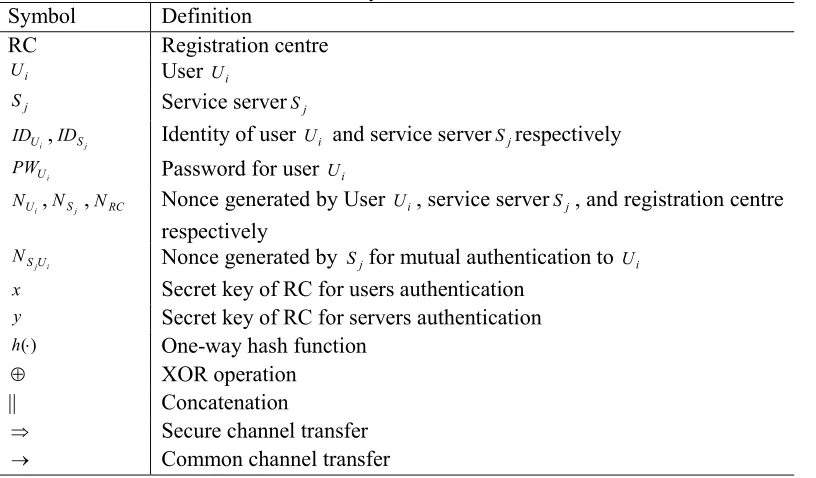
The main notations used throughout this article are listed as follows.
Table 1. Symbol Definition
Symbol Definition
RC Registration centre
i
U User Ui
j
S Service serverSj
i
U
ID ,IDSj Identity of user Ui and service serverSjrespectively
i
U
PW Password for user Ui
i
U
N ,NSj,NRC Nonce generated by User Ui, service serverSj, and registration centre
respectively
i jU
S
N Nonce generated by
j
S for mutual authentication to Ui
x Secret key of RC for users authentication
y Secret key of RC for servers authentication
) (⋅
h One-way hash function
⊕ XOR operation
|| Concatenation
⇒ Secure channel transfer
→ Common channel transfer
This subsection reviews Tsai’s multiserver password-authenticated key agreement scheme [2]. Tsai’s scheme consists of 4 phases: registration phase, login phase, authentication-server and RC phase, and authentication-server and user phase. The details of these phases can be described as follows.
Step R1. :{ , }
i
i U
U i RC ID PW
U ⇒
Initially, a user Ui , with identity IDUi , chooses a password PWUi and
submits IDUi ,PWUito the RC through a secure channel.
Step R2. RC⇒Ui :Smart cards with information { (), }. 0 C h⋅ On reception of the same, RC computes
) || (ID x h R
i
U i
U = ; (1)
and
). (
0 RUi hPWUi
C = ⊕ (2)
Then, the RC successfully issues a smart cards containing information {h(⋅), C0} to Ui through a secure channel.
2.2 Login phase
Step L1. Ui inserts the smart card into a card reader and enters his/her identity IDUi and
password PWUito request access to the serverSj.
Step L2. Ui Sj :IDUi,C1 →
The smart card extracts information h(IDUi||x) from the smart card by computing )
|| (ID x
h Ui = 0 ( )
i
U
PW h
C ⊕ . The reader generates a random nonce
i
U
N and computes
i
i U
U x N
ID h
C = ( || )⊕
1 . (3)
The reader sends IDUiand C1 to the serverSj.
2.3 Authentication-server and RC phase
Step SR1. Sj RC :IDUi,IDSj,C1,C2
→
j
S generates a random nonceNSj,and computes
j
j S
S y N
ID h
C2= ( || )⊕ . (4) Then Sjsends IDUi,IDSj,C1, andC2 to the RC.
Step SR2. RC→ Sj :C3
The RC computes NSj C2 h(IDSj||y)
⊕ =
′ and generates a random nonce
RC
N to computes
RC
S y N
ID h C
j ⊕
= ( || )
3 ; (5)
3
C is then sent to Sj.
Step SR3. Sj→RC :C4
j
S retrieves NRC′ by computing C3 h(IDSj||y)
⊕ and further computes
. ) || ) || ( (
4 hhIDS y NS NRC
C
j j
′ ⊕
= (6)
It sends C4 to the RC.
The server Sj computes C hhIDSj y NSj NRC
⊕ ′ =
′ ( ( || )|| )
4 and checks whether
4 4 ?
' C
C . (7)
If Eq. (7) does not hold, Sj is legal, and the following steps are processed. If they are not
equal, Sj is not legal, and RC terminates the session.
Step SR5. RC→ Sj :C5,C6
RC retrieves information NUi h(IDUi||x) C1 ⊕ =
′ and next computes
5
C and C6 as follows:
) || || ) || ( (
5 hhIDS y NS NRC
C
j j
′
= , and (8)
) 2 || 1 || ) || ( (
6=hhIDS y NS′ + NRC+
C
j
j h(h(IDUi||x)||NUi).
′
⊕ (9)
It sends C5 andC6 to Sj.
Step SR6. C5′ ? C5
j
S computes C5 h(h(IDSj ||y)||NSj||NRC)
′ =
′ and verifies whether
5 5 ?
' C
C . (10)
If Eq. (10) does not hold, Sj terminates the session. If yes, Sj proceeds to the next phase.
2.4 Authentication-server and user phase
Step SU1. Sj→Ui :V2, C9
After successfully verifying the identity of the RC, Sj must obtain the user
-authentication key. Sj computes C7 as follows;
C7=C6⊕h(h(IDSj ||y)||NSj +1||NRC′ +2)
( ( || )|| )
i
U i
U x N
ID h
h ′
= ; (11)
and generates a random nonce .
i jU
S
N It also computes C8,C9and V2 as shown below;
i
i U
u x N
ID h C C C
C = ⊕ = ⊕ ( || )⊕
7 1 7
8 , (12)
, 7
2 C NSjUi
V = ⊕ (13)
and
. ) ||
( 7 8
9 hC N C
C
i jU
S ⊕
= (14)
It sends V2 and C9 to Ui
Step SU2. C9′ ? C9
i
U computes 7 ( ( || )|| )
i
U i U x N
ID h h
C′ = ,
2 7 V C N i jU
S′ = ′⊕ , and C8′=C7′⊕C1
i
U i
U x N
ID h
C′⊕ ⊕
= ( || )
7 .
It also computes
8 7
9 h(C ||N ) C
C′ = ′ SjUi ⊕ ′ (15)
and verifies whether
. ? 9
9 C
If the result is negative, Ui terminates the session. If positive, Ui proceeds to the next step.
Step SU3. Ui→Sj :C10
i
U computes
) || || ( 7 8 10 hC C NSjUi
C = ′ ′ ′ (17)
and sends it to Sj.
Step SU4. C10′ ? C10
j
S computes
) || || ( 7 8 10 hC C NSjUi
C′ = (18)
and verifies whether
10 10 ? C
C′ . (19)
If it does not hold, Sj aborts. If it holds, Sj computes the SK
) 3 ||
2 || 1
( 7+ 8+ +
=
i jU
S
N C C h
SK . (20)
i
U also can computes the SK
). 3 ||
2 || 1
( 7′+ 8′+ ′ +
=
i jU
S
N C C h
SK (21)
The SK is applied for the encryption of all ensuing communications between Sj and Ui.
3. Weaknesses
3.1 Weakness to Forward Secrecy.
Provision of the forward-secrecy property by a password-based authenticated key agreement protocol is of the utmost importance for avoiding past SKs from being recovered by the compromise of any participating entity’s long-term secret key. Tsai’s scheme assumes that only the RC is trustworthy. The service server, which is open to all legitimate users, can be penetrated through various means, such as hackers, viruses, worms, misconfigurations, and disgruntled system administrators. Therefore, assuming that the adversary can obtain the service server’s long-term authentication key, h(ID ||y)
j
S , is entirely reasonable.
Let us assume that an adversary has acquired a set of transaction messages of the previous session and the service server’s long-term authentication key h(IDSj ||y). The adversary can
compute NSj, NRC, C7, and NSjUiusing Eqs. (4), (5), (9) and (13), respectively, and C8 using
Eqs. (3) and (11). Now, the adversary can compute the SK of the previous session with the knowledge obtained from the derived information {C7, C8, NSjUi} .
Countermeasure. From our experience, we can say that forward secrecy in a key agreement protocol cannot be achieved using only the hash function and symmetric encryption schemes. We need to use public-key techniques (e.g., exponentiations in a multiplicative group).
An efficient approach to the preservation of the forward-secrecy property is to slightly modify the protocol specification. Instead of choosing NUi, NSj, and NRC as random nonces,
i U i
r U g
N = , for *
R
q U Z
ri∈ ; (22)
j S
j
r S g
N = , for *
R
q
S Z
r j
∈ ; (23)
and
RC
r RC g
N = , for *
R
q RC Z
r ∈ . (24)
Moreover, we include additional components rSj rRCrSj
RC g
N = , rUi rRCrUi
RC g
N = , and
i U i S j S i
U r r
RC r
r
RC N
N ) ( )
( = rSi rUi rRCrUirSj
RC g
N =
=( ) in the SK derivation function such that
) || || || || || ) (( : i j J i i U j S i U j S j
i U S SU
r RC r RC r r RC S U
i SK h N N N ID ID N
U = ; and (25)
) || || || || || ) (( : i j J i i U j S j S i U i
j U S SU
r RC r RC r r RC U S
j SK h N N N ID ID N
S = . (26)
With these modifications, if an adversary happens to learn h(Sj||y) after completion of a
key-establishment session, he/she will only be able to derive rSj
RC
N and rUi
RC
N but not the shared
secret rUirSjrRC
g (bound by the intractability of the Computational Diffie-Hellman Problem)
because he/she does not possess the knowledge of any private ephemeral key rUi, rSj, or rRC.
Intuitively, the secrecy of the SK and the security of the scheme can be significantly preserved.
3.2 Insider impersonation attack
Tsai’s scheme does not check the freshness of the nonce. Exploiting this fault, an adversary can impersonate as a legal user. Let us assume that an adversary has acquired a service server’s long-term authentication key h(IDSj ||y). As the first step of the attack, the adversary replays
the login message {IDUi,C1} of Ui from the previous session to login. Because the adversary
has the service server’s long-term authentication key, he/she can pass the authentication-server and RC phase and generate a legal response C10 in the authentication-server and user phase. Finally, the adversary agrees to a new SK represented as follows: SK=h(C7+1||C8+2||NSjUi +3). Hence, we can easily deduce that Tsai’s scheme cannot
withstand Insider impersonation attack also.
3.3 Denial of service attack
In the specification for Tsai’s protocol, the server and RC do not check whether the login request is legal until the session reaches the Step SU3 of the authentication-server and user phase. The adversary can launch denial of service (DoS) attacks by just sending login messages {IDUi,C1A}, where C1A is an arbitrary nonce chosen by the adversary. The adversary can deprive both the service server and the RC of computing power without incurring any cost except that of sending a message.
4. Conclusion
appropriate security considerations while designing future password-authenticated key agreement schemes to preclude the above-discussed vulnerabilities.
References
[1] C.-C. Chang, J.-S. Lee, An Efficient and Secure Multi-server Password Authentication Scheme using Smart Cards, International Conference on Cyberworlds (CW ’04) (2004) 417-422.
[2] L. Hu, X. Niu , Y. Yang, An Efficient Multi-server Password Authenticated Key Agreement Scheme using Smart Cards, International Conference on Multimedia and Ubiquitous Engineering (MUE ’07) (2007) 903-907.
[3] W.-S. Juang, Efficient Multi-server Password Authenticated Key Agreement using Smart Cards, IEEE Trans. on Consumer Electronics 50 (2004) 251-255.
[4] I.-C. Lin, M.-S. Hwang, and L.-H. Li, New Remote User Authentication Scheme for Multi-server Architecture, Future Generation Computer Systems 19 (2003) 13-22.
[5] L.-H. Li, I.-C. Lin and M.-S. Hwang, A Remote Password Authentication Scheme for Multi-server Architecture using Neural Networks, IEEE Trans. on Neural Networks 12 (2001) 1498-1504. [6] J.-L Tsai, Efficient multi-server authentication schemes based on one-way hash function