Leakage-Resilient Cryptography in the Standard Model
Stefan Dziembowski
University of Rome
La Sapienza
Krzysztof Pietrzak
CWI Amsterdam
May 28, 2008
Abstract
We construct a stream-cipher S whose implementation is secure even if arbitrary (ad-versely chosen) information on the internal state of S is leaked during computation. This capturesall possible side-channel attacks onSwhere the amount of information leaked in a given period is bounded, but overall can be arbitrary large, in particular much larger than the internal state of S. The only other assumption we make on the implementation of S is that only data that is accessed during computation leaks information. The construction can be based on any pseudorandom generator, and the only computational assumption we make is that this PRG is secure against non-uniform adversaries in the classical sense (i.e. when there are no side-channels).
The stream-cipherSgenerates its output in chunksK1, K2, . . ., and arbitrary but bounded
information leakage is modeled by allowing the adversary to adaptively chose a function
fℓ : {0,1}∗ → {0,1} λ
before Kℓ is computed, she then gets fℓ(τℓ) where τℓ is the in-ternal state of S that is accessed during the computation of Kℓ. One notion of security we prove for S is that Kℓ is indistinguishable from random when given K1, . . . , Kℓ−1,
f1(τ1), . . . , fℓ−1(τℓ−1) and also the complete internal state ofSafterKℓ has been computed (i.e. our cipher is forward-secure).
1
Introduction
When analyzing the security of a cryptosystem, we can either think of the system as a math-ematical object, or try to analyze the security of an actual implementation. Traditionally, cryptographers have mostly considered the former view and analyzed the security of the mathe-matical object, and it is generally believed that our current knowledge of cryptography suffices to construct schemes that, when modeled in this way, are extremely secure. On a theoreti-cal side, we know how to construct secure primitives under quite weak complexity-theoretic assumptions, for example (symmetric) encryption can be based on any one-way function [15]. Also from the practical perspective, the currently used constructions have very strong security properties, e.g. after 30 years of intensive cryptanalytic efforts still the most practical attack on the DES cipher is exhaustive key search.
Side-Channel Attacks. The picture is much more gloomy when the security of real-life implementations is considered. This is because when considering an implementation of a cryp-tosystem, one must take into account the possibility of side-channels, which refers to leakage of any kind of information from the cryptosystem during its execution which cannot be efficiently derived from access to the mathematical object alone. In the last decade many attacks against cryptosystems (still assumed to by sound as mathematical objects) have been found exploiting side-channels like running-time [20], electromagnetic radiation [27, 13], power consumption [21], fault detection [4, 3] and many more (see e.g. [28, 25]).
A typical countermeasure against this type of attacks is to design hardware that minimizes the leakage of secret data (e.g. by shielding any electromagnetic emissions), or to look for an algorithm-specific solution, for example by masking intermediate variables using randomization (see [25] for a list of relevant papers). The problem with hardware-based solutions is that protection against all possible types of leakage is very hard to achieve [1], if not impossible. On the other hand, most algorithm-specific methods proposed so far are only heuristic and do not offer any formal security proof (we mention some exceptions in Sect.1.1). Moreover, they are ad-hoc in the sense that they protect only against some specific attacks that are known at the moment, instead of providing security against a large well-defined class of attacks. This raises the following, natural question: is there a systematic method of designing cryptographic schemes so that already their mathematical description guarantees that they are provably-secure, even if they are implemented on hardware that may be subject to a side-channel attack belonging to a large well-defined class of attacks? Ideally, one would like to develop a theory that (1) provides precise definition of such a class of attacks, and (2) shows how to construct systems that are secure in this model (under the assumptions that are as weak as possible). This should be viewed as moving the task of constructing cryptosystems secure against side-channel attacks from the realm of engineering or security research to cryptography, which over the last 3 decades was extremely successful in defining security models, and constructing cryptosystems that are provably-secure in this models.
General Model for Leakage Resilience. We propose a model for cryptographic computa-tion where the class of possible side-channel attacks is extremely broad, yet simple and natural. Models similar to ours have been proposed before, in particular Micali and Reyzin [23] explicitly stated the “only computation leaks” assumption we will use. The only other assumption on the implementation we make is that the amount of leakage in each round is bounded. This approach is inspired by the bounded-storage and bounded-retrieval models and has to best of our knowledge never been used in this context. We stress however, that the main contribution of this paper is not the definition of the model, but the construction of an actual cryptosystem (a stream-cipher) which is provably secure in this model, details follow.
onM(i.e. the secret key). Clearly the most general side-channel attack against a cryptosystem
CS(M0) is one in which the adversary can choose any polynomial-time computable leakage
function f and retrieve f(M0) from the cryptographic machine.1 Of course no security is achievable in this setting, as definingf(M0) =M0 the adversary learns the complete random key. Thus a necessary restriction we must make on f is that its output range is bounded to
{0,1}λ whereλ≪ |M0|.
We assume that the adversary can apply this attack many times throughout the lifetime of the device. Technically, this will be done by dividing the execution of the algorithm imple-mentingCSintorounds, and allowing the adversary to evaluate a function on the internal state of CS in each of those rounds (let fj denote the leakage function that she chooses in the jth
round, for j = 1,2...). Almost all cryptographic tasks can be divided into rounds in a natural way: in particular, in this paper we will construct a stream cipher that outputs data in chunks of a few bits, and each chunk will be computed in a separate round.
Let q be the number of rounds we want our cryptosystem CS to run, and let M0 be the
secret key that is used in the scheme. At first sight one may think that to hope for any security we would need to assume that q·λ < M0, as otherwise the adversary can learn the entire
M0, by just retrieving in every round λ different bits of it. This trivial attack does not work
any more if we consider cryptosystems which occasionally update their state. For this let Mj
denote the state of CSafter roundj.
Unfortunately, no security is possible even if we allowCSto update its state (i.e. whenMj
is not necessarily equal to Mj+1) if we allowany fj, to see this let t=⌈|M|/λ⌉ and consider
fj, j ≤ t where each fj outputs different λ bits of Mt (note that the function fj, j ≤ t can
compute the future state Mt from the current state Mj). After thetth round the adversary
has learned the complete stateMt, and no security is possible beyond this point. We call this thekey-precomputation attack.
Hence, we have to somehow restrict the leakage function if we want security even when the amount of leaked information is (much) larger than the internal state. The restriction that we will use is that in each round, the leakage function fj only gets as input the part of the state
Mj that is actually accessed in the jth round by CS. This translates into a requirement on
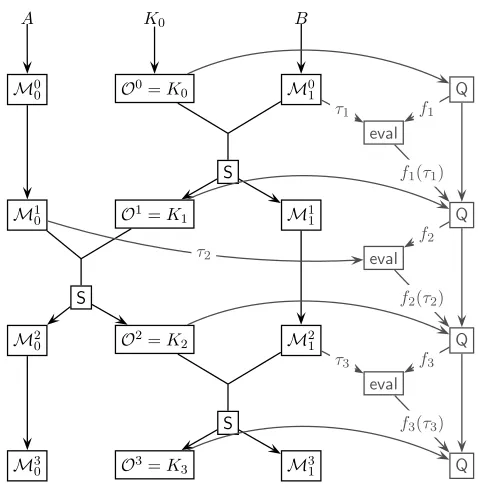
the implementation: we assume that only computation leaks information, and the “untouched memory cells” are completely secure. As illustrated in Figure 1, in our construction of a stream-cipher,Mwill consists of just three partsM0,M1 and O(whereO is the output tape), and in
thejth round the circuitCS(and thus the leakage functionfj) will access onlyMjmod 2 andO
. We give the leakage function (in thejth round) access to the completeMjmod 2,O, even if the
computation of CSonly access a small part of it. Thus in an actual implementation, one only must ensure that in thejth roundMj+1 mod 2 does not leak. This requirement should easily be
realizable by an actual implementation having M0 and M1 use different static memory cells
(here “static” refers to the fact that this memory needs not to be refreshed, and thus should not leak any kind of radiation when not used).2
Let us mention that the above restriction is not the only natural restriction that one could make on the leakage functions to avoid the key-precomputation attack. One other option might be to allow the state to be refreshed using external randomness, which would make the key-evolution non-deterministic. Though, this option is a bit difficult to handle for many
1Without loss of generality we can assume that the leakage function is applied only toM0since all the other
internal variables used in computation are deterministic functions ofM0.
2Let us mention that this model also covers the case where (the not accessed)M
j+1 mod 2does leak in roundj,
as long as this leakage is independent of the leakage of (the accessed)Mjmod 2(i.e. when we consider an adversary Q′
who can in roundjchoose two functionsf′
jandf
′′
j and then getsf
′
j(Mjmod 2) and alsof
′′
j(Mj+1 mod 2)). The
reason is that we can simulateQ′
by an adversaryQwho just chooses one functionfjwhich outputsf
′
j(Mjmod 2)
and alsof′′
j+1(Mjmod 2) (thusQin roundjsimply precomputes the information thatQ
′
will learn in roundj+ 1 on the non-leaking part). Note that it’s not a problem thatQ′
might computef′′
j+1 adaptively as a function of
the information leaked in roundj, as the leakage functionfj has this information too, and thus can compute the
f′′
j+1thatQ
′
cryptosystems including ciphers, as here one would have to make sure all legitimate parties knowing the secret key use the same randomness (and this randomness cannot be agreed upon initially). Another option is to require that the leakage function is in some very weak complexity class not including the function used for key evolution.3
Leakage Resilient Stream-Cipher. The main contribution of this paper is the construction of a stream cipher S which is provably secure in the model described above. Letτℓ denote the
data on S’s memory which is accessed in theℓth round, and let Kℓ denote the output written
by Son its output tapeO in theℓth round.
The classical security notion for stream ciphers implies that one cannot distinguishKℓ from
a random string given K1, . . . , Kℓ−1, of course our construction satisfies this notion. But we
prove much more, namely that Kℓ is indistinguishable from random even when not only given
K0, . . . , Kℓ−1, but additionally Λ1, . . . ,Λℓ−1 where Λj = fj(τj) and each fj is a function with
range {0,1}λ chosen adaptively (as a function ofK1, . . . , Kℓ−1,Λ1, . . . ,Λj−1) by an adversary.
If the adversary also gets Λℓ, we cannot hope that Kℓ is indistinguishable from random any
more, as fℓ could for example simply output theλ first bits of Kℓ. The best we can hope for
in this case, is thatKℓ is unpredictable (or equivalently, has high HILL-pseudoentropy), in the
full version of this paper we will show that for our construction this indeed is the case.
Forward Security. In many settings, it is not enough that Kℓ is indistinguishable (or
un-predictable) given the view of the adversary after round ℓ−1 as just described, but it should stay indistinguishable even if Sleaks some information in the future. In our construction such “forward-security” comes up naturally, as the keyKℓis almost independent (in a computational
sense) from the state ofS afterKℓ was output. Precise security definitions are given is Sect. 2.
Our Construction. The construction, as described in detail in Section 2.2, uses the idea of alternating extraction previously used in the intrusion-resilient secret-sharing scheme from [12]. We move this concept to the computational setting by proving a lemma that states that the output of any PRG has high HILL pseudoentropy (i.e. is indistinguishable from some distribution with high min-entropy) even if arbitrary information about the seed is leaked. Our construction can be instantiated with any pseudorandom-generator, and the amount of leakage
λthat we can tolerate in each step depends on the strength of the underlying PRG, it is at least logarithmic, but can be as large as a constant fraction of the internal state of S if the PRG is exponentially secure.
On (Non-)Uniformity. Throughout the paper, we always consider non-uniform adversaries.4 In particular, our stream-cipher is secure against non-uniform adversaries, and we require the PRG used in the construction to be secure against non-uniform adversaries. The only step in the security proof where it matters that we are in a non-uniform setting, is in Section 5, where we use a theorem due to Barak et al. [2] which shows that two notions of pseudoentropy (called HILL and metric-type) are equivalent for circuits. In [2] this equivalence is also proved in a uniform setting, and one could use this to get a stream-cipher secure against uniform adversaries from any PRG secure against uniform adversaries. We won’t do so, as for one thing the non-uniform setting is the more interesting one, and also the exact security we could get
3Interestingly, that would probably be the first case of a real-life cryptographic application where it makes
sense to assume that the computational power of the adversary (in some parts of the attack scenario) is smaller than the computational power needed to execute the scheme. Hence, one could hope to obtain results that do not require any additional intractability assumptions (except, say, that one-way functions exist), since the hierarchy results separating such complexity classes are known to hold unconditionally).
4Recall that a uniform adversary can be modelled as a single Turing-machine which as input gets a security
in the uniform setting is much worse (due to the security loss in the reduction from [2] in the uniform setting).
1.1 Related work
A general theory of side-channel attacks was put forward in [23], where the authors propose a number of “axioms” on which such a theory should be based. In particular they formulate the assumption, that we also use in this work, that only computation leaks information. As mentioned in the introduction, most published work on securing cryptosystems against side-channel attacks are ad-hoc solutions trying to prevent some particular attack or some general heuristics coming without security proofs. A notable exception is the work of Ishai et al. [17, 16], who propose a general way of making circuits provably secure [17] and even tamper resistant [16] against adversaries who can read/tamper the value of a bounded number of arbitrary wires in the circuit (the more restricted model where an adversary can learn the value of someinput
bits has been extensively investigated [5, 8, 18]). It is interesting to compare the result from this paper with the approach of Ishai et al. On one hand, their results are generic, in the sense that they provide a method to transform any cryptosystem given as a circuit C into another circuit Ct that is secure against an adversary that can read-off up to t wires, whereas we only
construct a particular primitive (a stream-cipher). On the other hand, we prove security against any side-channel attack, whereas Ishai et al. consider the particular case where the adversary can read-off the values of a few individual wires. Moreover Ishai et al. require special gates that can generate random bits, we do not assume any special hardware.
The idea to define the set of leakage functions by restricting the length of function’s output is taken from the bounded-retrieval model [7, 10, 9, 6, 12], which in turn was inspired by the bounded-storage model [22].5
Some constructions of ciphers secure against general leakages were also proposed in the literature, however, their security proofs rely on very strong assumptions. For example [26] works only in the ideal-cipher model, and [23] reduce the existence of such a cipher to one-way permutations which do not leak any information at all.
1.2 Notation
We denote with Un the random variable with distribution uniform over {0,1}n. With X ∼
Y we denote that X and Y have the same distribution. Let random variables X0, X1 be
distributed over some set X and let Y be a random variable distributed over Y. Define the
statistical distance between X0 and X1 asδ(X0;X1) = 1/2Px∈X |PX0(x) −PX1(x)|. Moreover
letδ(X0;X1|Y) :=d(X0, Y;X1, Y) be thestatistical distance betweenX0 andX1 conditioned on
Y. IfXis distributed over{0,1}nthen letd(X) :=δ(X;Un) denote thestatistical distance ofX from a uniform distribution (over {0,1}n), and let d(X|Y) :=δ(X;U
n|Y) denote the statistical
distance of X from a uniform distribution, given Y. If d(X) ≤ ǫ then we will say that X is
ǫ-close to uniform.
5The bounded-storage model is limited in its usability by the fact that the secret key must be larger than the
2
A Leakage-Resilient Stream-Cipher
We will now formally define our security notions which we already informally discussed and motivated in Sect. 1.
Initialization. The secret key of our stream cipher S consists of the three variables A, B ∈ {0,1}randK
0∈ {0,1}k. The valuesA, B, K0should be sampled uniformly at random, but only
A, Bmust be secret,K0 must not, one can think ofK0 as the firstkbits of output ofS. We also
do not really need A and B to be uniformly random, they just must be independent and have sufficiently high min-entropy. In an implementation, the memory of S is assumed to be split in three parts, M0,M1,O, and for j > 0 we denote with Mj0−1,M
j−1
1 ,Oj−1 the contents of
M0,M1,Oat the beginning of thejth round, in particular the initial state isM00=A,M01=B
and O0 =K 0.
Computation. As illustrated in Fig. 1, in the jth round S does only access (which means reads and possible rewrites) Mjmod 2 and the output tape O. Let τℓ denote the values (on
eitherM0 orM1) that is accessed in theℓth round, andτℓ the value which is not accessed, i.e.
τℓdef= Mℓℓ−1mod 2 τℓdef= Mℓℓ−1+1 mod 2 (1)
We will refer to the output of theℓth round (i.e. the value Oℓ on the output tapeO at the end of this round) asKℓ.
Adversary. As illustrated in Figure 1, we consider adversaries Qwhich in the ℓth round can adaptively choose a function fℓ with range{0,1}λ, and at the end of the round gets the output
Kℓ and
Λℓ def= fℓ(τℓ)
i.e. the output of fℓ on input the data accessed byS in this round.
We denote with Aλ adversaries as just described restricted to choose leakage functions
with range {0,1}λ. As we consider non-uniform adversaries, we can without loss of generality
assume that they are deterministic. Let viewℓ denote the view of the adversary after Kℓ has
been computed, i.e. viewℓ ={K0, . . . , Kℓ,Λ1, . . . ,Λℓ}.
Indistinguishability. The security notion we consider requires that Kℓ is indistinguishable
from random, even when given viewℓ−1.
For an adversaryQ∈ Aλ we denote withS(A, B, K0) ℓ Qthe random experiment whereQ
attacksS(initialized with a keyA, B, K0) forℓrounds (cf. Figure 1), and withview(S(A, B, K0) ℓ
Q) we denote the viewviewℓofQat the end of the attack. For any circuitDind:{0,1}∗ → {0,1}
(with one bit output), we denote with AdvInd(Dind,Q,S, ℓ) the advantage ofDindin
distinguish-ingKℓ from random givenview(Sℓ−1Q), formally
AdvInd(Dind,Q,S, ℓ) = |preal−prandom| where
prandom = Pr
A,B,K0
[Dind(view(S(A, B, K0)ℓ−1Q), Uk) = 1] (2)
preal = Pr A,B,K0
[Dind(view(S(A, B, K0)ℓ−1Q), Kℓ) = 1] (3)
In the full version of this paper, we will also consider the case where the distinguisher also gets Λℓ, i.e. we assume that information leaks also in round ℓ. Although then we can’t hope for Kℓ
to be indistinguishable from random (as Λℓ could for example be the firstλbits of Kℓ), we still
A K0 B
M0
0 O0=K0 M01 Q
eval
S
M1
0 O1=K1 M11 Q
eval
S
M2
0 O2=K2 M21 Q
eval
S
M3
0 O3=K3 M31 Q
f1 τ1
f1(τ1)
f2 τ2
f2(τ2)
f3 τ3
f3(τ3)
Figure 1: General structure of the random experimentS(A, K0, B) 3 Q(the regular evaluation
ofS, generating outputK1, K2, . . ., is shown in black. The attack related part is shown in gray).
Here Qis the adversary andevaldenotes a circuit which on input the description of a function
f and some inputτ outputsf(τ). The adversary can, beforeKi is computed, adaptively choose
a leakage functionfi:{0,1}r → {0,1}λ, after theith round she then gets Ki and Λi
def
= fi(τi).
Forward Security. As motivated in the introduction, we’ll also consider “forward-secure” notions of the above definition. Informally, we’d like to extend the definitionsAdvIndjust given, but additionally give the attacker Dind the complete state Mℓ0,Oℓ,Mℓ1 of S after Kℓ has been
computed. Of course thenKℓ =Oℓ cannot be secure in any way as it is given to Dind entirely.
We could simply not give Oℓ to Dind, but then we cannot claim that we leaked the state of S
completely, as in our construction Oℓ is needed to compute the future outputs ofS. There are at least two ways around this problem. We could relax our requirement on forward security, and not leak the state after roundℓ, but only after roundℓ+ 1 (in terms of the implementation, this would mean that the outputKℓis indistinguishable, if in roundsℓand ℓ+ 1 nothing leaked,
even given the complete state ofS after roundℓ+ 1).
Another possibility, which we we’ll use, is to split the value on the output tape into two partsOℓ =Kℓ=KℓnxtkKℓout, such that only theKℓnxt part is actually used bySto compute the
future state. We then require that the Kout
ℓ (and not the entire Kℓ) is indistinguishable from
random if in round ℓnothing leaked, even when given the state of Safter roundℓ, where Kout
ℓ
is not considered to be part of the state. Let stateℓ :={Mℓ
0, Kℓnxt,Mℓ1} denote the state ofS after roundℓ (not containingKℓout as
just explained). The forward secure indistingusihability notion is given by
AdvIndFwd(Dind,Q,S, ℓ) = |pf wdreal−pf wdrandom| where
pf wdrandom = Pr
A,B,K0
[Dind(view(S(A, B, K0)ℓ−1Q,stateℓ), U|Kout|) = 1]
pf wdreal = Pr
A,B,K0
[Dind(view(S(A, B, K0)
ℓ−1
Q,stateℓ), Kout
ℓ ) = 1]
Note that the only difference to AdvInd is that nowDind additionally getsstateℓ, and we only
require Kout
ℓ (and not the whole Kℓ) to be indistinguishable. Thus, if forward security is an
issue, one must always discard the first Knxt
will be just a random seed for an extractor, using existing constructions we can make this part logarithmic in the total length of Kℓ, thus the efficiency loss one has to pay to get forward
security is marginal.
2.1 The Ingredients
The main ingredients of our construction is the concept of alternating extraction introduced in the intrusion-resilient secret-sharing scheme of [12] (which again was based on ideas from the bounded storage model [11, 22, 29]), combined with the concept of HILL-pseudoentropy (cf. Def. 3, Sect. 5) which we use to get a computational version of alternating extraction.
Alternating Extraction. Let ext: {0,1}kext × {0,1}r → {0,1}k be an (ǫext, next)-extractor
(cf. Def. 1, Sect. 4.1). Consider some uniformly randomA, B∈ {0,1}r and some randomK0 ∈
{0,1}k. As illustrated in Figure 3 in Sect. 4, letK
1, K2, . . .be computed asKi =ext(Kinxt−1, Ci)
(where Knxt denotes the k
ext first bits of K and Ci = B if i is odd and Ci = A otherwise).
So the Ki’s are computed by alternately extracting from A and B. It is not hard to show
thatKi =ext(Kinxt−1, Ci) is iǫext close to uniformly random givenK0, . . . , Ki−1 while Ci has still
enough min-entropy for our extractor (i.e. H∞(Ci|K1, . . . , Ki−1)≥next).
As shown in [12], the key Ki is even close to uniformly random when not only given
K1, . . . , Ki−1 but also some values f1(C1), . . . , fi−1(Ci−1) for arbitrary functions fi as long
asCi has min-entropy at least next (conditioned on K0, . . . , Ki−1,and f1(C1), . . . , fi−1(Ci−1)).
Consider a “stream cipher” S∗(A, B, K0) which outputs K1, K2, . . . computed as described
above, and an adversary Q which, before Ki is computed, can adaptively choose a function
fi and then gets Ki, fi(Ci) (as Ki−1 can be hard-coded into fi, this function has access to all
the data accessed during the computation ofKi =ext(Kinxt−1, Ci). As explained in the previous
paragraph, we can give the following security guarantee for S∗: as long as the min-entropy of
Ci is at leastnext (given the adversary’s view), the next outputKi is close to uniformly random
(given the view of the adversary so far).
Pseudoentropy. The stream cipher S∗ just described is not very useful, as it only provides security (in the sense that the next output looks random given the current view as required by
ourAdvInd security notion) as long as the output (i.e. theKi’s plus the leaked information) is
shorter (by at least next bits) than the initial key.
To get security beyond that bound, we will “refresh” the values A, B after we extracted from them. Let Ai = Mi0 and Bi = Mi1 denote the values on M0 and M0 after round
i respectively. In round i (we assume i is odd, otherwise replace the role of A and B) we extract (Ki, Xi) = ext(Kinxt−1, Bi−1), and use Xi to compute the fresh Bi := prg(Xi) using a
pseudorandom generator prg as illustrated in Figure 2. If at the beginning of the ith round
Bi−1 has min-entropy at leastnext (given the adversaries view),Kinxt−1 is pseudorandom (given
Bi) and we assume that during thisith round no information is leaked, thenXi, and thus also
Bi =prg(Xi) is pseudorandom given the view of the adversary.
Of course assuming that the refreshing phase does not leak any information is completely unjustified, and we do not want to make such an assumption. As we give Λi = fi(Bi) to the
adversary, we cannot hope for Bi to be pseudorandom (just consider the case wherefi(Bi) are
the λ first bits of Bi). Fortunately, Bi needs not to be (pseudo)random to apply alternating
extraction, all we need is that Bi has high min-entropy. Of course Bi =prg(Xi) cannot even
have min-entropy more thanXi, but as we consider computationally bounded adversaries, it is
enough ifBi is indistinguishable from some distribution with high min-entropy. Such a variable
which is computationally indistinguishable from some variable with min-entropy k is said to have HILL-pseudoentropy k. It is not hard to see that a pseudorandom value Bi has high
for our application, as the leakage function fi is given access to Bi−1 (and not just Bi), from
which it can compute the seed Xi used to compute Bi = prg(Xi). We will prove (Lemma 8)
that for any pseudorandom generator prg, the output ofprg(X) on a random seed X has high HILL-pseudoentropy even if some function (with sufficiently short output) ofX (and not only
prg(X)) is leaked.
Using this lemma, we can prove that refreshing using a PRG as just described actually works, and will result in a “fresh” valueBi (orAi for eveni) having high HILL-pseudoentropy.
2.2 The construction
M0 O M1
A0 K0=Knxt
0 kK0out B0 Q
eval
(K1, X1) :=ext(Knxt 0 , B0)
A1=A0 K1 B1=prg(X1) Q
eval
(K2, X2) :=ext(Knxt 1 , B1)
A2=prg(X2) K2 B2=B1 Q
eval
(K3, X3) :=ext(Knxt 2 , B2)
A3=A2 K3 B3=prg(X3) Q
f1 τ1
f1(τ1)
f2 τ2
f2(τ2)
f3 τ3
f3(τ3)
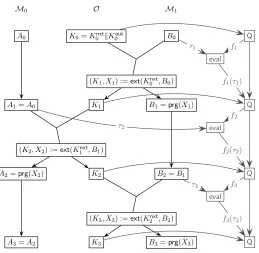
Figure 2: The random experiment S(A0, B0, K0) 3 Q for our construction of a stream cipher
S as described in Section 2.2. The outputs Ki = KinxtkKiout are computed by alternating
extraction (Ki, Xi) = ext(Kinxt−1, τi) from the values in M0 and M1 and written on the output
tape O. The value τi (on Mimod 2) which is accessed in round i, is replaced with a “fresh”
value computed as prg(Xi).
We will now formally define the construction just outlined, based on an extractor ext :
{0,1}kext × {0,1}r → {0,1}mext and a pseudorandom generatorprg:{0,1}kprg → {0,1}r.
State: The state of Sat the beginning of roundℓ isMℓ0−1,Mℓ1−1,Oℓ−1.
Get Key: Read Kℓ−1=Oℓ−1 and parse it as Kℓ−1 = (Kℓnxt−1, Kℓout−1)∈ {0,1}kext × {0,1}kout.
Extract next Key and Seed: Computeext(KℓL−1,Mℓℓ−1mod 2) and parse it as (Kℓ, Xℓ)∈ {0,1}k×
{0,1}kprg.
Write output: WriteKℓ onO (so Oℓ =Kℓ).
Refresh: Computeprg(Xℓ) and write it on Mℓmod 2.
3
Security of
S
Total Size. We denote withsize(D) the size size of the circuitD. For an adversaryQ∈ Aλ,
Theorem 1 (Main Result: Security of S) Let ext : {0,1}kext × {0,1}r → {0,1}mext be an
(ǫext, next) extractor, and letprg:{0,1}kprg → {0,1}r be an (ǫprg, sprg) pseudorandom generator.
Consider any ǫHILL>0 and letsˆ≈ǫ2HILLsprg/8r.6 Consider any ǫgap >0,∆>0 where
ǫprg≤
ǫ2
gap
2λ −2
−∆ and n
ext ≤r−∆−(λ+mext)−2 log(1/ǫgap) (4)
Then for all adversariesQ∈ Aλ andDwhere size(S ℓ
Q) +size(D)≤sˆwithδℓ def= ℓ2(3ǫgap+
ǫHILL+ǫext)
AdvInd(D,Q,S, ℓ)≤δℓ and AdvIndFwd(D,Q,S, ℓ)≤δℓ (5)
We actually do not even need the initial key to S to be uniformly random, but only require a weaker condition as give by equations (27) and (28).
The proof of Theorem 1 is split in three parts. The first part in Section 4 on alternating extrac-tion is informaextrac-tion theoretic and uses ideas from the intrusion-resilient secret-sharing scheme from [12]. In the second part (Section 5) we revisit some notions and results on computational pseudoentropy. We then prove that the output of any pseudorandom generator has high HILL pseudoentropy even if information about the seed is leaked. In Section 6 we prove Theorem 1 by using the result from Section 5 to get a computational version of alternating extraction from Section 4.
How Much Leakage can we Tolerate? The amount of leakage we can tolerate is bounded by (4) asǫprg≤ǫ2gap/2λ−2−∆. For concreteness, assume we set ∆ such that 2−∆≤ǫprg/2 and
ǫgap≥ 4
p
ǫprg/4, then we can set
λ=
$
logǫ−1prg
2
%
To see what this means it is convenient to take an asymptotic viewpoint and think of S as a
family of stream ciphers indexed by a security parameter which we identify with kprg, i.e. the
input length toprg. Ifprgis secure against polynomial-size circuits, thenǫprg = 2−ω(logkprg)(and
thusλ∈ω(logkprg)), and if prg is secure against exponential size circuits, thenǫprg = 2−Θ(kprg)
(andλ∈Θ(kprg)).
Let us mention that already the case where λ ∈ ω(logkprg), i.e. the leakage is
super-logarithmic, covers quite a large class of real-life attacks. In particular, many attacks that are based on measuring the power consumption result in logarithmic-size leakages. For example in a so-called Hamming weight attack(see e.g. [19]) the adversary just learns the number of wires carrying the bit 1. Of course this value is of logarithmic length in the size of the circuit, and hence also inkprg.
The case where prg is exponentially hard and thus λ ∈ Θ(kprg) actually means that we
can leak a constant fraction of the entire state of S (it needs some work to check that using existing constructions of extractors, one can set the parameters such that the entire state has size Θ(kprg)).
4
Random Keys by Alternating Extraction
We first prove an information theoretic result which is inspired by the security proof of the intrusion-resilient secret-sharing scheme from [12]. Basically, we consider the random experi-mentS ℓ Qbut without the refreshing. For this let S∗ denoted the constructionSbut without
A K0=Knxt
0 kK0′ B Q
eval
ext
A K1=ext(Knxt
0 , B) B Q
eval
ext
A K2=ext(Knxt
1 , A) B Q
eval
ext
A K3=ext(Knxt
2 , B) B Q f1 τ1
f1(τ1)
f2 τ2
f2(τ2)
f3 τ3
f3(τ3)
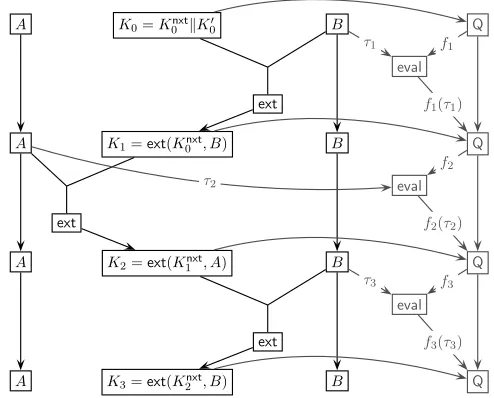
Figure 3: The “alternating extraction” random experimentS∗(A, B, K0) 3 Q as considered in
Lemma 1.
refreshing: thus in the random experimentS∗(A, B, K0) ℓ QwhereQ∈ Aλ, in thejth roundQ
chooses a functionfj :{0,1}r→ {0,1}λ and as output getsKj =ext(Kjnxt−1, τj) and Λj =fj(τj)
whereτj =B ifj is odd andτj =A otherwise.
As Q attacks S∗, she learns information on A and B, and thus the min-entropy of A and
B degrades (recall that a variableX has min-entropy k, denoted H∞(X) =k, if maxxPr[X=
x] = 2−k). We show that as long as the min-entropy of A and B is high enough (which means more than next as required by the extractor ext), the next key Kj to be output is close to
uniformly random when given the view after Kj−1 has been computed.
Lemma 1 belows similar to Lemma 8 from [12] (for the special case of two players). One difference is that in [12] the variables A, B, K0 were all independent and uniformly random,
whereas in the Lemma below this is somewhat relaxed (cf. equation (6)). Further in [12] there was no conditioning on τℓ in equation (8). For the security proof of S, we’ll only need the
lemma for the special case ℓ = 1, we prove this more general version as for one thing it’s not significantly harder, and it can be used to prove the security of variations ofS where one does not refresh in every round.
Definition 1 (Extractor) A function ext : {0,1}kext × {0,1}r → {0,1}mext is an (ǫext, next)
extractor if for anyX withH∞(X)≥next and K∼Ukext we have that d((ext(K, X), K)≤ǫext.
Lemma 1 (Alternating Extraction) Letext:{0,1}kext×{0,1}r → {0,1}mext be an(ǫext, next)
-extractor. Let A, B ∈ {0,1}r and K
0 ∈ {0,1}k be random variables where A and B are
inde-pendent and
d(K0|B)≤ǫ0 H∞(A)≥r−∆ H∞(B)≥r−∆, (6)
Consider any λ,∆, r≥0 and 1≥ǫgap>0which satisfy
next≤r−∆− ⌈ℓ/2⌉(λ+mext)−log(1/ǫgap). (7)
Consider any adversary Q∈ Aλ and the random experimentS∗(A, B, K0) ℓ Q and letviewℓ=
{K0, . . . , Kℓ, Λ1, . . . ,Λℓ} and τℓ=B if ℓis odd and τℓ=B otherwise. Then
d(Kℓ+1|viewℓ, τℓ)≤(ℓ+ 1)ǫext+ 2ǫgap+ǫ0, (8)
i.e. given the view of Q after the computation ofKℓ and τℓ, the next key Kℓ+1 to be output by
4.1 Basic Lemmata
We state some basic information theoretic lemmata which will be needed in the proof of the alternating extraction lemma. The following Lemma similar to Lemma 5 from [12] (the latter can be seen as a special case where Xi = Xj and Yi = Yj for all i 6=j). Its proof appears in
Appendix A
Lemma 2 Let X0, Y0 be independent random variables, andφ1, φ2, . . . be any sequence of
func-tions. LetX1, X2, . . ., Y1, Y2, . . . and V1, V2, . . . be defined as
((Xi+1, Vi+1), Yi+1) := (φi+1(Xi, V1, . . . , Vi), Yi) if iis even
(Xi+1,(Vi+1, Yi+1)) := (Xi, φi+1(Yi, V1, . . . , Vi)) otherwise
ThenYi → {V1, . . . , Vi} →Xi (andXi→ {V1, . . . , Vi} →Yi) is a Markov chain (or equivalently,
Xi and Yi are independent given the V1, . . . , Vi)
By identifying Xℓ, Yℓ from Lemma 2 with A, B in the random experiment S∗(A, B, K0) ℓ Q,
or withAℓ, Bℓ in the random experimentS(A, B, K0) ℓ Q, we get the following corollary.
Corollary 1 (i) InS∗(A, B, K0) ℓ Q,AandB are independent givenviewℓ. (ii) InS(A, B, K0) ℓ
Q, Aℓ =Mℓ0 andBℓ=Mℓ1 are independent given viewℓ.
The proofs of Lemmata 3–6 appear in Appendix A
Lemma 3 Let X and Y be (in general dependent) random variables where Y ∈ {0,1}µ, and let Z be a random variable which is independent of X given Y, i.e. I(X, Z|Y) = 0. Then for any ǫgap>0 we have that Pry:=Y[H∞(X|Z, Y =y)≤H∞(X)−µ−log(1/ǫgap)]≤ǫgap.
Lemma 4 For random variablesA, Band any functionφ,d(A|B) =d(A|B, φ(B))andd(A|B)≥
d(A|φ(B)).
Lemma 5 Let K,K, R, Te be random variables such that K is uniformly random, and let φ be any function. Then d(φ(K, Re )|K, Te )≤d(φ(K, R)|K, T) +d(Ke|T).
Lemma 6 Consider any random variablesK′, V, Rwhered(K′|V, R)≤ǫandH
∞(R|V)≥next,
and let extbe an (ǫext, next)-extractor, then d(ext(K′, R), K′|V)≤ǫ+ǫext.
4.2 Proof of Lemma 1 (alternating extraction)
By the following claim, the min-entropy of A and B is unlikely to fall below next during the
random experiment.
Claim 1
Pr
v=view ℓ
[H∞(A|viewℓ =v)≤next]≤ǫgap Pr
v=view ℓ
[H∞(B|viewℓ =v)≤next]≤ǫgap
Proof of Claim: For b ∈ {0,1}, let viewb
ℓ = {Ki,Λi : i ≥ 1, i = 0 modb}, then viewℓ =
K0∪view0ℓ∪view1ℓ. The claim now follows by Lemma 3 and eq. (7), observing that |viewbℓ| ≤
⌈ℓ/2⌉(λ+mext) and thatA is independentview1ℓ givenview0ℓ, K0 (andB is independentview0ℓ
given view1
ℓ, K0). △
By the above claim, the probability that the min-entropy ofA orB drops belownext during
the random experiment is at most 2ǫgap. Below we will assume that this will not be the case,
the 2ǫgap term in (8) accounts for this assumption. We will show by induction onithat
Note that is the statement of the Lemma fori=ℓ(modulo the 2ǫgap term). We first prove that
(9) holds fori= 1. The left side of (9) for i= 1 by definition is
d(K1|view0, A) =d(K1|K0, A) =d(ext(K0nxt, B)|K0, A)
Now, as by Corollary 1 the variables A and B are independent and we already condition on
K0, this is equivalent to d(ext(K0nxt, B)|K0). Further, using Lemma 5 (belowK ∼Uk), we can
upper bound this by ≤ d(ext(Knxt, B)|K) +d(K
0|B) ≤ ǫext+ǫ0, which proves (9) for i = 1.
Assuming (9) holds for i−1, we can show that it holds also for i as follows (the steps will be explained in detail below, here again K∼Uk)
d(Ki|viewi−1, τi−1) = d(ext(Kinxt−1, τi)|viewi−2, Ki−1, fi−1(τi−1), τi−1) (10)
= d(ext(Kinxt−1, τi)|viewi−2, Ki−1, τi−1) (11)
= d(ext(Kinxt−1, τi)|viewi−2, Ki−1) (12)
≤ d(ext(Knxt, τ
i)|viewi−2, K) +d(Ki−1|viewi−2) (13)
≤ ǫext+d(Ki−1|viewi−2) (14)
≤ ǫext+ (i−1)ǫext+ǫ0 ≤i·ǫext+ǫ0 (15)
Step (10) just uses the definition. The next step (11) uses Lemma 4 (observing thatfi−1 can be
computed fromviewi−2). Step (12) follows asτi andτi−1 are independent by Corollary 1. Step
(13) uses Lemma 5. In step (14) we use our assumption thatH∞(τi|viewi−2)≥H∞(τi|viewℓ)≥
nextand the fact thatextis an (ǫext, next)-extractor. The last step (15) follow from the induction
hypothesis (9) for i−1.
5
Pseudoentropy
In this section we will prove that the output of a PRG has high HILL-pseudoentropy even if some function of the seed is leaked. We only actually prove this result for a weaker notion of pseudoentropy called “metric-type”, and then use the equivalence of metric-type and HILL-pseudoentropy (Lemma 7) to get our lower bound for HILL-HILL-pseudoentropy.
Basic Definitions We denote with δD(X;Y) the advantage of a circuit D in distinguishing the random variables X, Y, i.e.: δD(X;Y)def= 1
2|Pr[D(X) = 1]−Pr[D(Y) = 1]|. With δs(X;Y)
we denote maxDδD(X;Y) where the maximum is over all circuits D of size s. For a random
variableX over {0,1}z,ds(X)def= δs(X;Uz).
Definition 2 (Pseudorandom Generator) A function prg : {0,1}n → {0,1}m is a (δ, s) -secure pseudorandom generator (PRG) if ds(prg(Un))≤δ.
Definition 3 (HILL pseudoentropy[15, 2]) We sayX has HILLpseudoentropy k, denoted byHHILL
ǫ,s (X)≥k, if there exists a distribution Y where H∞(Y)≥k andδs(X, Y)≤ǫ.
The above definition requires that there exists a distribution Y with high min-entropy that is indistinguishable from X by all distinguishers. It is natural to consider a definition where the quantifiers are exchanged, i.e. to allow the distribution to depend on the distinguisher.
Definition 4 (Metric-type pseudoentropy [2]) We say X has metric-type pseudoentropy
k, denoted HMetricǫ,s (X) ≥ k, if for every circuit D of size s there exists a distribution Y with H∞(Y)≥k and δD(X, Y)≤ǫ.
Barak et al. [2] use the von Neumann’s min-max theorem [24] to prove the equivalence ofHHILL
Lemma 7 (Equivalence of HHILL and HMetric for Circuits (Thm.5.2 from [2])) LetXbe
a distribution over{0,1}n. For everyǫ, ǫ
HILL>0andk, ifHMetricǫ,s (X)≥kthen HHILLǫ+ǫHILL,sˆ(X)≥
k where s∈ O(nˆs/ǫ2HILL) or equivalently sˆ∈Ω(ǫ2HILLs/n). More precisely (by inspection of the proof of Thm.5.2 in [2])s≤8ns/ǫˆ 2
HILL−ζ whereζ is the size of a circuit needed to compute the
majority of 8n/ǫ2HILL bits.
5.1 Pseudoentropy of a PRG
By the following lemma, the output of a PRG has high metric-type pseudoentropy (and thus by Lemma 7 also high HILL-pseudoentropy) even if some function of its input is leaked.
Lemma 8 (Metric/HILL Pseudoentropy of a PRG) Let prg : {0,1}n → {0,1}m and
f : {0,1}n → {0,1}λ (where λ < n < m) be any functions. If prg is a (ǫprg, sprg)-secure
pseudorandom-generator, then for any ǫ,∆ > 0 satisfying7 ǫ
prg ≤ ǫ
2
2λ −2−∆, we have with
X∼Un
Pr
y:=f(X)[H
Metric
ǫ,sprg (prg(X)|f(X) =y)≥m−∆]≥1−ǫ (16)
and for any ǫHILL >0
Pr
y:=f(X)[H
HILL
ǫ+ǫHILL,sˆ(prg(X)|f(X) =y)≥m−∆]≥1−ǫ (17)
where sˆ≈ǫ2HILLsprg/8m.
Proof Eq. (17) follows from (16) by Lemma 7. To prove (16) assume for contradiction that it does not hold. Hence, by Def. 4, there exists a subset
S ⊆ {0,1}λ where Pr[f(Un)∈ S]> ǫ (18)
such that for each a∈ S there exists a distinguisher Da of size at most sprg such that for every
random variable Z with H∞(Z)≥m−∆ we have (again X∼Un)
|Pr[Da(Z) = 1]−Pr[Da(prg(X)) = 1|f(X) =a]| ≥ǫ (19)
Consider somea∈ S for which
Pr[f(Un) =a]>2−λǫ (20)
Such an aexists by (18) and by the fact that the range of f has a size 2λ. Our distinguisher for the PRGprgwill be the distinguisherDa satisfying (19) and (20). It remains to prove that
Dabreaksprgwith advantage more thanǫprg. For b∈ {0,1} letIb :={x∈ {0,1}m :Da(x) =b}
Claim 2 For some β ∈ {0,1} we have |Iβ|<2m−∆
Proof of Claim: Assume for contradiction that|Ib| ≥2m−∆ forb= 0 andb= 1. Forb∈ {0,1}
and X ∼Un let pb = Pr[Da(prg(X)) = b|f(X) =a]. Let Z′ be a random variable distributed
uniformly over S0′ ∪S1′ where Sb′ is an arbitrary subset of Ib of size pb2m−∆ (here we use the
fact that|Ib| ≥2m−∆). Clearly since|S0′ ∪S1′|= 2m−∆ we have thatH∞(Z′) =m−∆ and by
construction (withX ∼Un)
Pr[Da(Z′) = 1]
| {z }
=Pr[Z′∈S′
1]=p1
−Pr[Da(prg(X)) = 1|f(X) =a] = 0
contradicting (19). This finishes the proof of the claim. △
Forβ as guaranteed by the above claim, we have
Pr[Da(Um) =β] =|Iβ|/2m<2−∆. (21)
By equation (19), using that H∞(Um) =m > m−∆ we get:
|Pr[Da(Um) =β]
| {z }
<2−∆
−Pr[Da(prg(X)) =β|f(X) =a]| ≥ǫ
We can assume that ǫ≥ǫ2/2λ>2−∆ as otherwise the Lemma is trivial. As for anyx, y, ǫ≥0
we have that|x−y| ≥ ǫand ǫ > ximplies y ≥ǫ, the above equation implies Pr[Da(prg(X) =
β|f(X) =a]≥ǫ,and further with X∼Un
Pr[Da(prg(X)) =β]≥Pr[Da(prg(X)) =β|f(X) =a]
| {z }
≥ǫ
·Pr[f(X) =a]
| {z }
≥2−λ·ǫ by(20)
> ǫ
2
2λ.
By (21) and the above equation, the advantage ofDa forUm and prg(Un) is at least
Pr[Da(prg(Un)) =β]−Pr[Da(Um) =β]>
ǫ2
2λ −2
−∆≥ǫ
prg.
6
Putting Things Together: Proof of Theorem 1
In this section we will prove the security of S based on ext,prg as stated in Theorem 1, recall that
• ext:{0,1}kext × {0,1}r → {0,1}mext is an (ǫext, next) extractor.
• prg:{0,1}kprg → {0,1}r is an (ǫprg, sprg) pseudorandom generator.
further we setkout :=mext−kext+kprg(thusmext =kext+kout+kprg) and parameters ∆, ǫgap, λ
satisfying
ǫprg≤
ǫ2gap
2λ −2
−∆ and n
ext≤r−∆−(λ+mext)−log(1/ǫgap) (22)
We also fix someǫHILL>0 and set ˆs:=ǫ2HILLsprg/8r.
The following lemma quantifies how much security is “lost” by one round of our stream cipher. Letsizei denote the size of the circuit realizing theith round of the experimentS ℓ Q,
thenPℓi=1sizei =size(S ℓ Q).
Lemma 9 (The ith round) Consider the random experiment S ℓ Q. Then if before round
i≤ ℓ (recall that τi−1 = τi =Bi if i is odd and τi−1 = τi =Ai otherwise) for some si−1 ≤sˆ
and ǫ′def= ǫHILL+ǫgap
HHILLǫ′,s
i−1(Ai−1|viewi−1, Bi−1)≥r−∆ H
HILL
ǫ′,s
i−1(Bi−1|viewi−1, Ai−1)≥r−∆ (23)
dsi−1(Ki−1|viewi−2, τi−1)≤ǫi−1 (24)
then with sidef= si−1−sizei, s′i
def
= si−1−size(ext) and ǫi def= ǫi−1+ǫext+ǫgap+ǫ′.
ds′
i(Ki, Xi|
viewi−1, τi)≤ǫi (25)
with probability 1−ǫgap−ǫi
HHILLǫ′
,si(Ai|viewi, Bi)≥r−∆ H HILL
ǫ′
Proof We prove the statement for oddi, in this case (Ki, Xi) :=ext(Kinxt−1, Bi−1),Bi :=prg(Xi)
and Ai :=Ai−1. The case for eveni is identical, we just have to swap the role ofA and B.
The bound for Ai given by the first equation of (26) follows from the bound on Ai−1 (23),
as Ai =Ai−1, we just have to replace si−1 by si =si−1−sizei to account for the work done
in round i (i.e. computing viewi, Bi from viewi−1, Bi−1, which was done by a circuit of size sizei).
We’ll now prove the bound on Bi given by (26). For this, let us first consider random
variables ˜Bi−1,K˜i−1 which satisfy the preconditions for Bi−1, Ki−1 as stated in (23) and (24),
but in an information theoretic sense, and not just relative to circuits of size si−1
Pr[H∞( ˜Bi−1|viewi−1, Ai−1)≥r−∆]≥1−ǫ′ d( ˜Ki−1|viewi−2,B˜i−1)≤ǫi−1
Let ( ˜Ki,X˜i) :=ext( ˜KLi−1,B˜i−1) and ˜Bi=prg( ˜Xi). Then by Lemma 1 (withℓ= 1, taking into
account that ˜Ki−1 is onlyǫi−1 close to uniform, and ˜Bi−1 has high min-entropy only with prob.
1−ǫ′)
d([ ˜Ki,X˜i]|viewi−1, Ai)≤ǫi−1+ǫext+ǫgap+ǫ′ =ǫi
The above directly implies d( ˜Xi|K˜i,viewi−1, Ai)≤ ǫi, and by Lemma 8 (and the fact that ˜Xi
isǫi close to uniform), we get that with probability 1−ǫgap−ǫi
HHILL
ǫ′,sˆ (prg( ˜Xi)
| {z }
˜
Bi
|Λi,K˜i,viewi−1
| {z }
viewi
, Ai)≥r−∆
The actual bounds follow from the above by taking into account that Bi−1, Ki−1 are only
indistinguishable by circuits of sizesi−1, we omit the details.
We’ll now see how Theorem 1 is implied by this lemma. Let ǫ0 = 0 and s0 = ˆs, then ǫℓ =
ℓ(2ǫgap+ǫext+ǫHILL) and sℓ = ˆs−size(S ℓ Q). If the initial key A0, B0, K0 satisfies
HHILLǫ′
,s0(A0|B0)≥r−∆ H HILL
ǫ′
,s0(B0|A0)≥r−∆ (27)
d(K0|B0) =ǫ0 (28)
Which is the case for the precondition of Theorem 1, then by Lemma 9, with probability 1−Pℓi=1(ǫgap+ǫi)≥1−ℓ(ǫgap+ǫℓ).
ds′
ℓ(Kℓ, Xℓ|
viewℓ−1, τℓ)≤ǫℓ (29)
This proves (note thats′ℓ < sℓ) the bound for theAdvInd as stated in Theorem 1. to prove the bound forAdvIndFwd we move Xℓ, Kℓnxt to the conditioned part (recall thatKℓ =KℓnxtkKℓout)
ds′
ℓ(K out
ℓ |Kℓnxt, Xℓ,viewℓ−1, τℓ)≤ǫℓ
Then we apply theprgto Xℓ
ds′
ℓ− |prg|
| {z }
>sℓ
(Kℓout|Kℓnxt,viewℓ−1,
Aℓ,Bℓ
z }| {
τℓ+1
|{z}
prg(Xℓ)
, τℓ)≤ǫℓ (30)
References
[1] Ross Anderson and Markus Kuhn. Tamper resistance: a cautionary note. In WOEC’96: Proceedings of the 2nd conference on Proceedings of the Second USENIX Workshop on Electronic Commerce, pages 1–11, Berkeley, CA, USA, 1996. USENIX Association.
[2] Boaz Barak, Ronen Shaltiel, and Avi Wigderson. Computational analogues of entropy. In
RANDOM-APPROX, pages 200–215, 2003.
[3] Eli Biham and Adi Shamir. Differential fault analysis of secret key cryptosystems. In
CRYPTO, pages 513–525, 1997.
[4] Dan Boneh, Richard A. DeMillo, and Richard J. Lipton. On the importance of checking cryptographic protocols for faults (extended abstract). In EUROCRYPT, pages 37–51, 1997.
[5] Ran Canetti, Yevgeniy Dodis, Shai Halevi, Eyal Kushilevitz, and Amit Sahai. Exposure-resilient functions and all-or-nothing transforms. InEUROCRYPT, pages 453–469, 2000.
[6] David Cash, Yan Zong Ding, Yevgeniy Dodis, Wenke Lee, Richard J. Lipton, and Shabsi Walfish. Intrusion-resilient key exchange in the bounded retrieval model. In Salil P. Vadhan, editor,TCC, volume 4392 ofLecture Notes in Computer Science, pages 479–498. Springer, 2007.
[7] Giovanni Di Crescenzo, Richard J. Lipton, and Shabsi Walfish. Perfectly secure password protocols in the bounded retrieval model. In Halevi and Rabin [14], pages 225–244.
[8] Yevgeniy Dodis, Amit Sahai, and Adam Smith. On perfect and adaptive security in exposure-resilient cryptography. InEUROCRYPT, pages 301–324, 2001.
[9] Stefan Dziembowski. Intrusion-resilience via the bounded-storage model. In Halevi and Rabin [14], pages 207–224.
[10] Stefan Dziembowski. On forward-secure storage. In Cynthia Dwork, editor, CRYPTO, volume 4117 ofLecture Notes in Computer Science, pages 251–270. Springer, 2006.
[11] Stefan Dziembowski and Ueli M. Maurer. On generating the initial key in the bounded-storage model. In EUROCRYPT, pages 126–137, 2004.
[12] Stefan Dziembowski and Krzysztof Pietrzak. Intrusion-resilient secret sharing. In FOCS, pages 227–237, 2007.
[13] Karine Gandolfi, Christophe Mourtel, and Francis Olivier. Electromagnetic analysis: Con-crete results. InCHES, pages 251–261, 2001.
[14] Shai Halevi and Tal Rabin, editors.Theory of Cryptography, Third Theory of Cryptography Conference, TCC 2006, New York, NY, USA, March 4-7, 2006, Proceedings, volume 3876 ofLecture Notes in Computer Science. Springer, 2006.
[15] Johan H˚astad, Russell Impagliazzo, Leonid A. Levin, and Michael Luby. A pseudorandom generator from any one-way function. SIAM J. Comput., 28(4):1364–1396, 1999.
[16] Yuval Ishai, Manoj Prabhakaran, Amit Sahai, and David Wagner. Private Circuits II: Keeping Secrets in Tamperable Circuits. InEUROCRYPT, pages 308–327, 2006.
[18] Jesse Kamp and David Zuckerman. Deterministic extractors for bit-fixing sources and exposure-resilient cryptography. SIAM J. Comput., 36(5):1231–1247, 2007.
[19] John Kelsey, Bruce Schneier, David Wagner, and Chris Hall. Side channel cryptanalysis of product ciphers. In Jean-Jacques Quisquater, Yves Deswarte, Catherine Meadows, and Dieter Gollmann, editors, ESORICS, volume 1485 of Lecture Notes in Computer Science, pages 97–110. Springer, 1998.
[20] Paul C. Kocher. Timing attacks on implementations of diffie-hellman, rsa, dss, and other systems. InCRYPTO, pages 104–113, 1996.
[21] Paul C. Kocher, Joshua Jaffe, and Benjamin Jun. Differential power analysis. InCRYPTO, pages 388–397, 1999.
[22] Ueli M. Maurer. A provably-secure strongly-randomized cipher. In EUROCRYPT, pages 361–373, 1990.
[23] Silvio Micali and Leonid Reyzin. Physically observable cryptography (extended abstract). InTCC, pages 278–296, 2004.
[24] John Von Neumann. Zur Theorie der Gesellschaftsspiele. Mathematische Annalen, 100(1):295–320, 1928.
[25] European Network of Excellence (ECRYPT). The side channel cryptanalysis lounge. http://www.crypto.ruhr-uni-bochum.de/en sclounge.html. retrieved on 29.03.2008.
[26] Christophe Petit, Francois-Xavier Standaert, Olivier Pereira, Tal G. Malkin, and Moti Yung. A block cipher based prng secure against side-channel key recovery. Cryptology ePrint Archive, Report 2007/356, 2007. http://eprint.iacr.org/.
[27] Jean-Jacques Quisquater and David Samyde. Electromagnetic analysis (ema): Measures and counter-measures for smart cards. InE-smart, pages 200–210, 2001.
[28] Jean-Jaques Quisquater and Franois Koene. Side channel attacks: State of the art, October 2002. [25].
[29] Salil P. Vadhan. Constructing locally computable extractors and cryptosystems in the bounded-storage model. J. Cryptology, 17(1):43–77, 2004.
A
Proofs of Lemmata
Lemma 3 Let X and Y be (in general dependent) random variables where Y ∈ {0,1}µ, and let Z be a random variable which is independent of X given Y, i.e. I(X, Z|Y) = 0. Then for any ǫgap>0 we have that
Pr
y:=Y[H∞(X|Z, Y =y)≤H∞(X)−µ−log(1/ǫgap)]≤ǫgap. (31)
Proof AsZ is independent of X given Y, we can ignore it, i.e. eq.(31) is equivalent to
Pr
y:=Y[H∞(X|Y =y)≤H∞(X)−µ−log(1/ǫgap)]≤ǫgap. (32)
LetY be the set of all the elements y∈ {0,1}µ such that
For the sake of contradiction suppose (32) does not hold, in other words: Pr [Y ∈ Y] > ǫgap.
Hence there exitsy′ ∈ Y such that
PrY =y′>2−µ·ǫgap. (34)
By definition of min-entropy there existsx′such that Pr [X =x′|Y =y′]≥2−H∞(X)+µ+log(1/ǫgap)=
2−H∞(X)+µ·ǫ−1
gap, and therefore
PrX=x′ = PrX=x′Y =y′·
>2−µ·ǫgap by(34)
z }| {
PrY =y′ > 2−H∞(X)
,
which contradicts the definition of min-entropy.
The remaining lemmata in this section are standard and were already proven e.g. the full version of [12]. For completeness we include the proofs here. Before proving Lemma 4 we show the following.
Lemma 10 For every random variables A and A′ over A, and every function γ :A → B we have δ(A;A′)≥δ(γ(A);γ(A′)).
Proof
δ(A;A′) = 12 X
a∈A
Pr [A=a]−PrA′ =a
= 12X
b∈B
X
a such thatγ(a) =b
Pr [A=a]−PrA′ =a
≥ 12X
b∈B
X
asuch thatγ(a) =b
Pr [A=a]− X
asuch thatγ(a) =b
PrA′ =a
(35)
= 12X
b∈B
Pr [γ(A) =a]−Prγ(A′) =a
= δ(γ(A);γ(A′)),
where (35) comes from the triangle inequality.
Lemma 4 LetA, B be random variables and letφbe any function. Thend(A|B)≥d(A|φ(B)). In particular d(A|B, C)≥d(A|B) for any random variable C.
Proof Define γ asγ(X, Y) = (X, φ(Y)). Let U be uniform over A, now by Lemma 10
δ(A, B;U, B)
| {z }
d(A|B)
≥δ(γ(A, B);γ(U, B)) =δ(A, φ(B);U, φ(B))
| {z }
d(A|φ(B))
Lemma 5 Let K,K, R, Te be random variables such that K is uniformly random, and letφ be any function. Then
Proof LetY denote the range ofφand Y be uniform overY, we have
d(φ(K, R)|K, T) = 12 X
(k,y,t)∈K×Y×T
|Pr [φ(K, R) =y, K =k, T =t]−Pr [Y =y, K =k, T =t]|
= 12 X
(k,y,t)∈K×Y×T
Pr [K=k, T =t]· |Pr [φ(K, R) =y|K=k, T =t]−Pr [Y =y|K =k, T =t]|
= 12 X
(k,y,t)∈K×Y×T
Pr [K=k, T =t]·
Pr [φ(k, R) =y|T =t]−
1 |Y| (36)
By the same argument
d(φ(K, Re )|K, Te ) = 12 X
(k,y,t)∈K×Y×T
PrhKe =k, T =ti·
Pr [φ(k, R) =y|T =t]−
1 |Y| . (37)
Now, (37) minus (36) is equal to
1 2
X
(k,y,t)∈K×Y×T
PrhKe =k, T =ti−Pr [K =k, T =t]·
Pr [φ(k, R) =y|T =t]−
1 |Y|
= 12 X
(k,t)∈K×T
PrhKe =k, T =ti−Pr [K =k, T =t]·
X y∈Y
Pr [φ(k, R) =y|T =t]− 1 |Y|
| {z }
=1
≤ δ(K, T;K, Te ) =d(Ke|T).
Lemma 6 Consider any random variables Knxt, V, R where
d(Knxt|V, R)≤ǫ H∞(R|V)≥next
and let extbe an (ǫext, next)-extractor, then
d(ext(Knxt, R)|V)≤ǫ+ǫext
Lemma 11 Let T, E, F be random variables where T → E → F is a Markov chain, then
d(F|E, T) =d(F|E).
Proof LetU be independent and uniformly distributed over F. We have
d(F|E, T)
= δ(F, E, T;U, E, T) = 12 X
(f,e,t)∈F×E×T
|Pr [F =f, E =e, T =t]−Pr [U =f, E =e, T =t]|
= 12 X
(f,e,t)∈F×E×T
Pr [E=e, T =t]· |Pr [F =f|E=e, T =t]−Pr [U =f|E=e, T =t]|
= 12 X
(f,e,t)∈F×E×T
Pr [E=e, T =t]· |Pr [F =f|E=e]−Pr [U =f|E=e]| (38)
= 12 X
(e,t)∈E×T
Pr [E =e]· |Pr [F =f|E=e]−Pr [U =f|E=e]|
= δ(F, E;U, E),
= d(F|E) (39)
Lemma 2 Let X0, Y0 be independent random variables, and φ1, φ2, . . . be any sequence of
functions. Let X1, X2, . . ., Y1, Y2, . . . andV1, V2, . . . be defined as
((Xi+1, Vi+1), Yi+1) := (φi+1(Xi, V1, . . . , Vi), Yi) if iis even
(Xi+1,(Vi+1, Yi+1)) := (Xi, φi+1(Yi, V1, . . . , Vi)) otherwise
ThenYi → {V1, . . . , Vi} →Xi (andXi → {V1, . . . , Vi} →Yi) is a Markov chain (or equivalently,
Xi and Yi are independent given the V1, . . . , Vi)
Proof Recall that X→Y →Z is a Markov chain if and only if
H(Z|Y, X) =H(Z|Y)
Moreover X→Y →Z is a Markov chain iff Z →Y →X is a Markov chain. We will prove by induction over ithat
Yi→ {V1, . . . , Vi} →Xi or equivalently Xi → {V1, . . . , Vi} →Yi (40)
is a Markov chain. This trivially holds for i= 0 as X0 and Y0 are independent. We now show
(by contradiction) that if (40) holds for some i, then it also holds for i+ 1: Assume (40) is wrong fori+ 1, i.e.
Xi+1→ {V1, . . . , Vi, Vi+1} →Yi+1
is not Markov. For evenithis implies (for oddi replace the role of X and Y)
H(Yi+1|V1, . . . , Vi, φi+1(Xi, V1, . . . , Vi)
| {z }
(Xi+1,Vi+1)
)< H(Yi+1|V1, . . . , Vi)
by Lemma 4
H(Yi+1|V1, . . . , vi, Xi)≤H(Yi+1|V1, . . . , Vi, φi+1(Xi, V1, . . . , Vi))
the two equations above and the fact that Yi =Yi+1 for eveni implies
H(Yi|V1, . . . , Vi, Xi)< H(Yi|V1, . . . , Vi)
the last inequality means that
Yi → {V1, . . . , Vi} →Xi
isnot Markov, but this contradicts the assumption that the induction hypothesis (40) holds for