New Data-Efficient Attacks on Reduced-Round
IDEA
Eli Biham1, Orr Dunkelman2,3, Nathan Keller3, and Adi Shamir3 1
Computer Science Department Technion
Haifa 32000, Israel
2
Computer Science Department University of Haifa Haifa 31905, Israel
3
Faculty of Mathematics and Computer Science Weizmann Institute of Science
P.O. Box 26, Rehovot 76100, Israel
{nathan.keller,adi.shamir}@weizmann.ac.il
Abstract. IDEA is a 64-bit block cipher with 128-bit keys which is widely used due to its inclusion in several cryptographic packages such as PGP. After its introduction by Lai and Massey in 1991, it was sub-jected to an extensive cryptanalytic effort, but so far the largest variant on which there are any published attacks contains only 6 of its 8.5-rounds. The first 6-round attack, described in the conference version of this pa-per in 2007, was extremely marginal: It required essentially the entire codebook, and saved only a factor of 2 compared to the time complexity of exhaustive search. In 2009, Sun and Lai reduced the data complexity of the 6-round attack from 264
to 249
chosen plaintexts and simultane-ously reduced the time complexity from 2127
to 2112.1
encryptions. In this revised version of our paper, we combine a highly optimized meet-in-the-middle attack with a keyless version of the Biryukov-Demirci relation to obtain new key recovery attacks on reduced-round IDEA, which dramat-ically reduce their data complexities and increase the number of rounds to which they are applicable. In the case of 6-round IDEA, we need only
two known plaintexts(the minimal number of 64-bit messages required to determine a 128-bit key) to perform full key recovery in 2123.4
time. By increasing the number of known plaintexts to sixteen, we can reduce the time complexity to 2111.9
, which is slightly faster than the Sun and Lai data-intensive attack. By increasing the number of plaintexts to about one thousand, we can now attack 6.5 rounds of IDEA, which could not be attacked by any previously published technique. By pushing our tech-niques to extremes, we can attack 7.5 rounds using 263
plaintexts and 2114
time, and by using an optimized version of a distributive attack, we can reduce the time complexity of exhaustive search on the full 8.5-round IDEA to 2126.8
1
Introduction
IDEA (which is an acronym for International Data Encryption Algorithm) is one of the best known and most well studied block ciphers. It was introduced by Lai and Massey in 1991, and became widely deployed due to its inclusion in the PGP package. Even though it has only nine relatively simple rounds which consist of just XOR’s, additions, and multiplications of 16-bit values, it withstood more than 20 years of cryptanalysis surprisingly well, and there is no known attack on it which is faster than exhaustive search even in the extremely strong model of related-key attacks.
All the attacks published so far deal with various reduced versions of IDEA. The original version is usually said to have 8.5 rather than 9 rounds since the last round is simplified by eliminating its M A structure (see below). When we consider reduced versions of IDEA, it is customary to consider their size in incre-ments of 0.5, depending on whether this component is used or not. In addition, the scheme is slightly inhomogeneous due to the way its subkeys are derived from the primary key, and thus attacks on reduced versions which have the same size but different starting points can have very different complexities.
The best attack on IDEA published until 2006 was the improved Demirci-Sel¸cuk-T¨ure [2] attack on 5 rounds, whose 2124 time complexity is only slightly better than exhaustive search. In the ASIACRYPT 2006 version of this paper [5], we introduced the keyless Biryukov-Demirci relation and used it to reduce the time complexity of the attack on 5-round IDEA to 2103. We improved this result in our FSE 2007 paper [6], where we used the same technique to devise the first attack on a 6-round variant of IDEA, which starts in the middle of round 2 and ends in the middle of round 8. However, the complexity of this attack was extremely marginal, since it was only twice as fast as exhaustive search, and required essentially the whole codebook of 264 plaintext/ciphertext pairs. This 6-round attack was considerably improved two years later by Sun and Lai [32], who showed at ASIACRYPT 2009 how to reduce the data complexity from 264 to 249 chosen plaintexts, while at the same time reducing the time complexity from 2126.8 to 2112.1.
In this paper we combine the keyless Biryukov-Demirci relation with a highly optimized meet-in-the-middle attack and obtain a new attack on 6-round IDEA which dramatically reduces the data complexity (from an impractical value of 249 chosen plaintexts to the extremely practical value of 16 known plaintexts) while remaining faster than the Sun and Lai attack. We can further reduce the data complexity of our attack all the way to its information-theoretic lower bound of 2 known plaintexts, but then its time complexity increases to 2123.4, which is worse than the Sun and Lai attack, but still faster than exhaustive search. This is a very rare example of a seemingly secure version of a modern cryptosystem which can be broken exactly at its Shannon’s unicity bound.
one thousand plaintexts in 2122 time. The time complexity can be reduced to 2112(which is slightly faster than the Sun and Lai attack on 6 rounds) by using a semi-practical number of 232 plaintexts. If we allow completely non-practical data complexities, we can attack 7 rounds in 2112 time using 248 data, and 7.5 rounds in 2114 time using 263 data. Finally, we can use extreme variants of our techniques to reduce the complexity of exhaustive key search on the full 8. 5-round IDEA from 2128to 2126.8 encryptions, using only 16 plaintexts. However, it is debatable whether such a marginal improvement in the time complexity should be considered a real attack on full IDEA.
In the last part of the paper we compare the Meet-in-the-Middle Biryukov-Demirci attack presented in this paper (which we call MitM-BD attack) with the Zero-in-the-Middle attacks based on the keyless Biryukov-Demirci relation used in the conference version of this paper and in Sun and Lai’s paper (which we call ZitM-BD attacks). We show that while MitM-BD attacks are significantly better in the standard model, there are scenarios in which ZitM-BD attacks are advantageous. One such scenario is the stronger attack model of related-key attacks, which assumes that the adversary has the power to modify the key without knowing its value. We show that in this model, a ZitM-BD attack can break a 7.5-round variant of IDEA with a practical data complexity of 225chosen plaintexts, and time complexity of 2103.5. Previous related-key attacks are either applicable to at most 7 rounds [5], or require encryption of the entire codebook under many different keys [7].
We have just learned (via private communication) that Khovratovich, Leurent, and Rechberger have also developed marginal attacks on 7.5 and 8.5 round IDEA, after hearing our presentation of the 6-round attack at the MSR workshop on Symmetric Cryptography in August 2011. The techniques they use are different (using their new biclique approach), and require much larger data complexities to achieve slightly better time savings. For example, their attack on full IDEA requires 252 chosen plaintexts in order to reduce the time complexity to 2126 time, whereas our attack needs only 16 chosen plaintexts to reduce the time complexity to 2126.8.
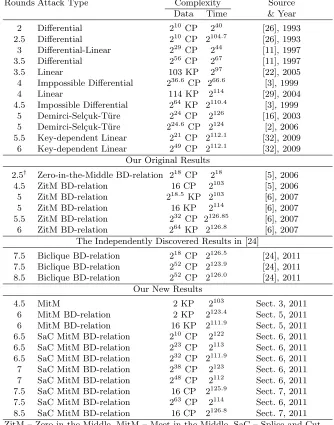
Table 1 summarizes all the major previously published attacks on reduced round IDEA, and compares them to the new attacks presented in this paper and to the unpublished Khovratovich et al. results [24]. The results in the table are divided into four groups. The first one contains previously published results obtained by other researchers, which are inferior to our results. The second group contains our original results from ASIACRYPT 2006 [5] and FSE 2007 [6]. The third group describes the Khovratovich et al. results [24], and the last group contains all the new results announced in this paper.
Rounds Attack Type Complexity Source Data Time & Year
2 Differential 210
CP 240
[26], 1993
2.5 Differential 210
CP 2104.7
[26], 1993 3 Differential-Linear 229
CP 244
[11], 1997
3.5 Differential 256
CP 267
[11], 1997
3.5 Linear 103 KP 297
[22], 2005 4 Imppossible Differential 236.6
CP 266.6
[3], 1999
4 Linear 114 KP 2114
[29], 2004 4.5 Impossible Differential 264
KP 2110.4
[3], 1999 5 Demirci-Sel¸cuk-T¨ure 224
CP 2126
[16], 2003 5 Demirci-Sel¸cuk-T¨ure 224.6
CP 2124
[2], 2006 5.5 Key-dependent Linear 221
CP 2112.1
[32], 2009 6 Key-dependent Linear 249
CP 2112.1
[32], 2009 Our Original Results
2.5† Zero-in-the-Middle BD-relation 218
CP 218
[5], 2006
4.5 ZitM BD-relation 16 CP 2103
[5], 2006
5 ZitM BD-relation 218.5
KP 2103
[6], 2007
5 ZitM BD-relation 16 KP 2114
[6], 2007
5.5 ZitM BD-relation 232
CP 2126.85
[6], 2007
6 ZitM BD-relation 264
KP 2126.8
[6], 2007 The Independently Discovered Results in [24]
7.5 Biclique BD-relation 218
CP 2126.5
[24], 2011 7.5 Biclique BD-relation 252
CP 2123.9
[24], 2011 8.5 Biclique BD-relation 252
CP 2126.0
[24], 2011 Our New Results
4.5 MitM 2 KP 2103
Sect. 3, 2011
6 MitM BD-relation 2 KP 2123.4
Sect. 5, 2011
6 MitM BD-relation 16 KP 2111.9
Sect. 5, 2011 6.5 SaC MitM BD-relation 210
CP 2122
Sect. 6, 2011 6.5 SaC MitM BD-relation 223
CP 2113
Sect. 6, 2011 6.5 SaC MitM BD-relation 232
CP 2111.9
Sect. 6, 2011 7 SaC MitM BD-relation 238
CP 2123
Sect. 6, 2011 7 SaC MitM BD-relation 248
CP 2112
Sect. 6, 2011 7.5 SaC MitM BD-relation 16 CP 2125.9
Sect. 7, 2011 7.5 SaC MitM BD-relation 263
CP 2114
Sect. 6, 2011 8.5 SaC MitM BD-relation 16 CP 2126.8
Sect. 7, 2011 ZitM – Zero in the Middle, MitM – Meet in the Middle, SaC – Splice and Cut. KP/CP – Known/Chosen plaintext. Time complexity is measured in encryptions
† – This attack is a distinguishing attack
Table 1.Comparing Other Single-Key Attacks on IDEA with our New Results
expense of increasing the data complexity, using the splice-and-cut technique. In Section 7 we show how to use our techniques to speed up exhaustive search on the full IDEA (as well as discuss the applicability of such speed ups to other cryptosystems). In Section 8 we introduce a different technique called zero-in-the-middle, and show how to use it to devise a related-key attack on 7.5 rounds of IDEA with a practical data complexity. We conclude with a short summary and discussion in Section 9.
2
Description of IDEA and the Notations Used in the
Paper
IDEA [25] is a 64-bit, 8.5-round block cipher with 128-bit keys. It uses a com-position of XOR operations, additions modulo 216, and multiplications over
GF(216+ 1).
Every round of IDEA is the concatenation of two layers. The input of round
i, denoted byXi, consists of four 16-bit words, denoted by (Xi
1, X2i, X3i, X4i). In the first layer (denoted byKAfor Key Addition), the first and the fourth words are multiplied by subkey words (mod 216+ 1) where a 0 operand is replaced by 216, and an outcome of 216 is replaced by 0, and the second and the third words are added to subkey words (mod 216). The intermediate value after this half-round is denoted by Yi= (Yi
1, Y2i, Y3i, Y4i). Formally, letZ1i, Z2i, Z3i, andZ4i be the four subkey words, let⊞denote addition modulo 216and let⊙be IDEA’s special multiplication, i.e.,
Y1i=Z i 1⊙X
i 1; Y
i 2 =Z
i 2⊞X
i 2; Y
i 3 =Z
i 3⊞X
i 3; Y
i 4 =Z
i 4⊙X
i 4
Then, (pi, qi) = (Yi
1⊕Y3i, Y2i⊕Y4i) enters the second layer, a structure composed of multiplications and additions denoted by M A. Denoting the subkey words that enter the M A function by Zi
5 and Z6i, the computation is performed as follows:
si=pi⊙Zi 5;
ti= (qi⊞si)⊙Zi 6;
ui=ti⊞si;
The output of the M A function is (ui, ti), which we note are related through
ui=ti⊞si, a fact which is later used.
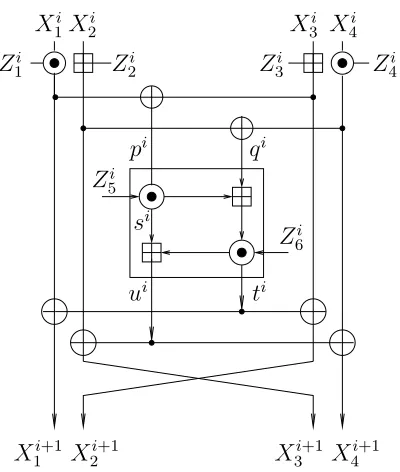
The structure of a single round of IDEA is shown in Figure 1. The output of thei-th round isXi+1= (Yi
1⊕ti, Y3i⊕ti, Y2i⊕ui, Y4i⊕ui). In the last round the
M A layer is removed (i.e., the ciphertext is Y9 = (Y9
1||Y29||Y39||Y49)), and thus we refer to the full IDEA as an 8.5-round rather than as a 9-round scheme.
0 0 0 0 0 1 1 1 1 1 0 0 0 0 0 0 0 0 0 0 0 0 0 1 1 1 1 1 1 1 1 1 1 1 1 1 0 0 0 0 0 0 0 0 0 0 1 1 1 1 1 1 1 1 1 1 0 0 0 0 0 1 1 1 1 1 0 0 0 0 0 0 0 0 1 1 1 1 1 1 1 1
X
1i+1X
i+1 2
X
i+1 3X
i+1 4X
i 1X
i 2X
i 3X
i 4Z
i 1Z
i 2Z
i 3Z
i 4Z
i 5Z
6ip
iq
it
iu
is
iFig. 1.One Round of IDEA
Round Zi
1 Z i 2 Z i 3 Z i 4 Z i 5 Z i 6
i= 1 0–15 16–31 32–47 48–63 64–79 80–95
i= 2 96–111 112–127 25–40 41–56 57–72 73–88
i= 3 89–104 105–120 121–8 9–24 50–65 66–81
i= 4 82–97 98–113 114–1 2–17 18–33 34–49
i= 5 75–90 91–106 107–122 123–10 11–26 27–42
i= 6 43–58 59–74 100–115 116–3 4–19 20–35
i= 7 36–51 52–67 68–83 84–99 125–12 13–28
i= 8 29–44 45–60 61–76 77–92 93–108 109–124
i= 9 22–37 38–53 54–69 70–85
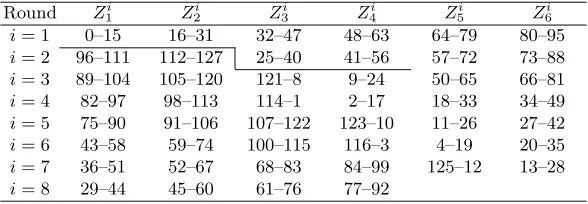
Table 2. The Key Schedule Algorithm of IDEA. Each cell describes the bits of the secret key used in the corresponding subkey.
3
Meet-in-the-Middle Attacks on IDEA
data-efficient attack possible, since the unicity distance of a 64-bit block cipher with a 128-bit key is 2. We were surprised by the fact that this extremely simple attack breaks more rounds of IDEA with so little data compared with numer-ous previnumer-ously published sophisticated attacks, including the differential [26], differential-linear [11], Square [22], and impossible differential [3]1 attacks. In Section 5 we show that the combination of the standard MitM technique with the keyless Biryukov-Demirci relation allows us to enhance the attack signifi-cantly, resulting in an attack on 6-round IDEA which requires only 16 known plaintexts.
3.1 Basic Meet-in-the-Middle Attack on 3.5-round IDEA
The standard MitM attack on a block cipher uses the observation that some intermediate value V can be computed from the plaintext given only part of the secret key material (denoted byKt, where t stands for “top”), and on the other hand, can also be computed from the ciphertext given a (possibly different) part of the key material (denoted byKb, whereb stands for “bottom”). In the attack, the adversary considers several known plaintext/ciphertext pairs and for each guess ofKt, she computes from the plaintexts the correspondingV values and stores them in a hash table. Then, for each guess of Kb, she computes the
V values from the ciphertexts, and searches for a match in the hash table. If
|Kt| > |Kb|, it is more efficient to swap the roles of Kt and Kb. The memory complexity of such a generic attack is 2min(|Kt|,|Kb|), where |K| is the size of
K in bits, and the time complexity is 2max(|Kt|,|Kb|). The data complexity is
D= (|Kt|+|Kb|)/|V|plaintext/ciphertext pairs, required for discarding all the wrong values of (Kt, Kb).2
Consider a reduced-round variant of IDEA which consists of its first 3.5 rounds. We concentrate on the intermediate value p2, i.e., the left input to the
M A layer of round 2. This p2 can be computed from the plaintext given only bits 0–111 of the secret key (the entire subkey of round 1, and the subkeysZ2
1 and
Z2
3), and thus,|Kt|= 112. On the other hand, by the structure of IDEA, we have
p2=X3
1 ⊕X23, and hence,p2 can be computed from the ciphertext given only bits 50–17 of the secret key (the entire subkeys of theKAlayer of round 4 and theM A layer of round 3, and the subkeysZ3
1 andZ23). Thus, |Kb|= 96. Since
|V|=|p2|= 16, one can mount a trivial MitM attack on 3.5-round IDEA with data complexity of (112 + 96)/16 = 13 known plaintexts, memory complexity of 296, and time complexity of 2112.
1
The impossible differential attack of [3] can break the same number of rounds, but with a significantly higher data, memory, and time complexities.
2
3.2 Several Improvements
In this subsection we show how to simultaneously reduce the time, memory, and data complexities of the basic MitM attack:
1. Reducing the memory complexity from 296 to 216. Note that the
“subkeys”Kt and Kb in the attack share 80 bits of the secret key (bits 0– 17 and 50–111). This makes it possible to reduce the memory complexity of the attack from the impractical value of 296 to a very practical value of 216, without increasing the time complexity. This is done as follows. The adversary starts with guessing these common 80 key bits, and for each guess, performs the MitM procedure assuming that these bits are known constants. Thus, in each such “inner loop”,|Kt|is reduced to 32, and|Kb|is reduced to 16. As a result, for each guess of these 80 key bits, the memory complexity of the attack is 216and the time complexity is 232. The total time complexity remains 280·232= 2112(as in the basic attack), but the memory complexity of the entire attack is reduced from 296 to 216 since the same memory slots can be re-used for constructing the hash tables for each application of the “inner loop” of the attack.
2. Reducing the time complexity from2112 to2103.Note that both
mod-ular addition (modulo 216) and bitwise XOR have the property that the k LSBs of the output depend only on the k LSBs of the inputs. This allows to reduce the size of|Kt| (and thus, the time complexity of the attack) by restricting our attention to thekLSBs of the valueV. First, we need to alter the attack procedure a little. Instead of takingV =p2, we considerV =q2 (i.e., the right input of theM Alayer of round 2). It turns out thatq2can be computed from the plaintext given bits 0–95 and 112–127 of the secret key, and from the ciphertext given bits 50–24 of the secret key. Thus,|Kt|= 112 and|Kb|= 103, which is inferior to the attack presented above. However, if we restrict our attention to thekLSBs ofq2 then we need only the kLSBs of the addition subkeyZ2
2 (composed of bits 112–127 of the secret key), and hence|Kt|is reduced to 96 +k. Takingk= 7, we obtain|Kt|=|Kb|= 103, and thus the time complexity of the attack is reduced to 2103. However, the memory complexity in this case is slightly increased to 225 (which is still completely practical), since Kt and Kb share only 78 secret key bits which can be enumerated in an external loop, and the data complexity is also slightly increased to⌈(103 + 103)/7⌉= 30 known plaintexts.
3. Reducing the Data Complexity to 4 known plaintexts. Note that
key that can be checked by a single trial encryption. Hence, the complexity of the second step of the attack (i.e., discarding the remaining suggestions) is 278·222 = 2100 encryptions, which is smaller than the complexity of the MitM phase of the attack.
By combining all the improvements described so far, we can get an attack on the first 3.5 rounds of IDEA which has data complexity of 4 known plaintexts, memory complexity of 225, and time complexity of 2103.3
4. Increasing the number of rounds of IDEA to 4.5. We can attack a
larger version of IDEA and get even better complexities by attacking some intermediate rounds instead of the initial rounds of IDEA.4Specifically, con-sider the 4.5-round variant of IDEA which starts at the beginning of round 4 and ends after theKAlayer of round 8. It turns out that the valueV =p5 can be computed from the “plaintext” (i.e., the input of round 4) given only bits 75–49 of the key, and from the “ciphertext” (i.e., the value afterKAof round 8) given only bits 125–99 of the key. Hence,|Kt|=|Kb|= 103, which allows us to attack this larger variant with the same time complexity of 2103. The memory complexity also remains 225, sinceK
tandKbshare 78 key bits. However, the data complexity is reduced to just 2 known plaintexts, since each value ofV = p5 supplies a 16-bit filtering, and thus for each 78-bit key guess, only 250·2−32 = 218 suggestions are left after the MitM phase. The total number of suggested keys is thus 278·218 = 296, and they can be checked via trial encryption in a small fraction of the total time of the attack.
It is interesting to note that two plaintexts is the information-theoretic lower bound for any key-recovery attack on IDEA, since each plaintext/ciphertext pair supplies only 64 bits of information, and hence at least two such pairs are needed in order to discard all the 2128−1 wrong key guesses.
The algorithm of the 4.5-round attack is presented in Figure 2.
For the sake of completeness, we considered other reduced-round variants of IDEA based on all the possible choices of consecutive intermediate rounds. We found two other 4.5-round variants that can be attacked using the standard MitM technique:
– A variant that starts after theKA layer of round 2 and ends at the end of round 6 — the complexity of the attack on this variant is identical to the complexity of the attack described above.
3
We note that the attack on the first 3.5 rounds of IDEA can be improved to use only 2 known plaintexts, by meeting in the middle on the value of the third and fourth words after theKAlayer of round 2. This follows from the fact that in the 103 bits guessed at the bottom half, cover the bits required for a full decryption of two rounds, including the M A layer of the second round. From the top side, it is sufficient to guess 96 bits to obtain the values of these words after theKAlayer of the second round.
4
Input:Two “plaintext”/“ciphertext” pairs (P1, C1), (P2, C2).
forany key guess of key bits 0–49, 75–99, 125–127do Initialize a empty hash tableH.
forany key guess of key bits 100–124do Computep51 andp
5
2 fromP1 and P2, respectively (and the known key), and
store inH the value (p5 1, p
5
2, K[100–124]).
end for
forany key guess of key bits 50–74do Computep′5
1 andp′ 5
2 fromC1 andC2, respectively (and the known key), and
check whether (p′5 1, p
′5
2) is inH.
If so, perform trial encryption under the key bits 0–49, 75–99, 125–127, the current guess of key bits 50–74, and the bits suggested in the corresponding entry ofH.
end for end for
Fig. 2.The Algorithm for Meet-in-the-Middle Attack on 4.5 Rounds of IDEA (starting at round 4)
– A variant that starts after theKA layer of round 1 and ends at the end of round 5 — the time complexity of the attack on this variant is increased to 2112encryptions, whereas the memory complexity is decreased to 215 64-bit blocks.
4
The Keyless Biryukov-Demirci Relation
In this section we present a keyless variant of the Biryukov-Demirci (BD) re-lation — a linear equation involving the plaintext, the ciphertext, and several intermediate values computed during the IDEA encryption process. In the fol-lowing sections we combine this keyless BD-relation with the MitM technique and with other techniques to mount improved attacks on larger reduced-round variants of IDEA.
We start with the basic observation made by Biryukov. Let us examine the second and the third words in all the intermediate stages of the encryption. There is a relation between the values of these words and the outputs of theM A
layers in the intermediate rounds, that uses only XOR and modular addition, but not multiplication. Let P = (P1, P2, P3, P4) be a plaintext and let C = (C1, C2, C3, C4) be its corresponding ciphertext. Then:
(((((((((((((((((P2⊞Z21)⊕u1)⊞Z32)⊕t2)⊞Z23)⊕u3)⊞Z34)⊕t4)⊞Z25)⊕u5)
⊞Z6
3)⊕t6)⊞Z27)⊕u7)⊞Z38)⊕t8)⊞Z29) =C2.
Similarly,
(((((((((((((((((P3⊞Z31)⊕t1)⊞Z22)⊕u2)⊞Z33)⊕t3)⊞Z24)⊕u4)⊞Z35)⊕t5)
⊞Z6
2)⊕u6)⊞Z37)⊕t7)⊞Z28)⊕u8)⊞Z39) =C3.
(2) If we restrict our interest to the values of the least significant bits (LSB) of the words, modular addition is equivalent to XOR and we can simplify the above equations into:
LSB(P2⊕Z21⊕u1⊕Z32⊕t2⊕Z23⊕u3⊕Z34⊕t4⊕Z25⊕u5⊕Z36⊕t6⊕Z27
⊕u7⊕Z8
3⊕t8⊕Z29) =LSB(C2),
(3) and
LSB(P3⊕Z31⊕t1⊕Z22⊕u2⊕Z33⊕t3⊕Z24⊕u4⊕Z35⊕t5⊕Z26⊕u6⊕Z37
⊕t7⊕Z8
2⊕u8⊕Z39) =LSB(C3).
(4) As observed by Demirci [15], ui = ti⊞si, thus, LSB(ui) = LSB(ti⊞si), which is equivalent to LSB(ui⊕ti) = LSB(si). Taking this into consideration and XORing the two above equations, we obtain:
LSB(P2⊕P3⊕Z21⊕Z31⊕s1⊕Z22⊕Z32⊕s2⊕Z23⊕Z33⊕s3⊕Z24⊕Z34⊕s4
⊕Z5
2⊕Z35⊕s5⊕Z26⊕Z36⊕s6⊕Z27⊕Z37⊕s7⊕Z28⊕Z38⊕s8⊕Z29⊕Z39) =LSB(C2⊕C3).
(5) This equation is called in [22] “the Biryukov-Demirci relation”, which we shall refer to as the BD-relation.
In this paper we introduce a new keyless variant of the BD-relation in which all the Zi
j subkeys are cancelled. Consider any pair of known plaintextsP1 and
P2. Denote the XOR difference between the encryptions of P1 and P2 (under the same secret key) in an intermediate value X by ∆X. Then, XORing the equations given byP1andP2 yields:
LSB(P1
2 ⊕P31⊕P22⊕P32⊕∆s1⊕∆s2⊕∆s3⊕∆s4⊕∆s5⊕∆s6⊕∆s7⊕
∆s8) =LSB(C1
2⊕C31⊕C22⊕C32).
(6) In the sequel, we refer to this equation as the “keyless BD-relation”.
5
Meet-in-the-Middle Biryukov-Demirci Attack on
6-round IDEA
improvement over the best previously known attack on 6-round IDEA [32], which required 249 chosen plaintexts and a slightly larger time complexity.
The 6-round variant we consider starts after the KA layer of round 2 and ends after theKAlayer of round 8. First we present the basic attack, and then we present a tradeoff that allows us to slightly reduce the high time complexity, at the expense of slightly increasing the low memory complexity.
5.1 The Basic Attack
In the attack combining the keyless BD-relation with the MitM technique, which we call in the sequel “MitM BD attack”, we divide the terms of Equation (6) into two sets, such that the terms in the first set are computed using the plaintexts and the subkey Kt (as defined in Section 3), and the terms in the second set are computed using the ciphertexts and the subkeyKb. In the attack, for each guess ofKb, the adversary computes the XOR of all terms of the equation that belong to the first set , and stores it in a hash table. Then, for each guess of the subkeyKt, she computes the XOR of all terms that belong to the second set, and searches for a match in the hash table. If the equation is satisfied (which is always the case for the correct guess of (Kt, Kb)), the XOR of all the terms in the equation is zero, which corresponds to a match in the hash table.
In the specific case of 6-round IDEA considered in this paper, Equation (6) is reduced to:
LSB(P1
2 ⊕P31⊕P22⊕P32⊕∆s2⊕∆s3⊕∆s4) =
LSB(C1
2⊕C31⊕C22⊕C32⊕∆s5⊕∆s6⊕∆s7). (7) We choose the sets as follows:
– The first set consists of the terms:P1
2, P31, P22, P32, ∆s2, ∆s3, ∆s4. – The second set consists of the terms:C1
2, C31, C22, C32, ∆s5, ∆s6, ∆s7.
This division emphasizes the advantage of the MitM BD attack over the stan-dard MitM attack. In the stanstan-dard MitM attack, the adversary has to compute values from both the plaintext and ciphertext sides until she reaches a common intermediate valueV. The use of the BD-relation allows us to “jump” over one round in the middle: the adversary computes only up to ∆s4 in the encryption direction and only up to∆s5 in the decryption direction, and the meet-in-the-middle effect is achieved using Equation (7) to bridge between these values. What makes the attack even better is that due to the special properties of the IDEA key schedule, this bridging in the middle allows us to gain 1.5 rounds in the attack for free, and extends our extremely data-efficient 4.5-round attack into a similarly efficient 6-round attack.
The details of the attack are as follows. The terms of the first set can be computed from the plaintexts given key bits 50–33 (i.e., the entire subkeys of theM A layer of round 2 and the entire round 3, and the subkeys Z4
round 7, plus the subkeysZ6
1, Z26, Z55). Hence, we have|Kt|= 112, |Kb|= 103, and|V|= 1 (since Equation (7) considers only the LSB of the word). Note that
Kt and Kb share 87 key bits (i.e., bits 125–33 and 50–99). Hence, using the improvements presented in Section 3.2, the data complexity of the attack is 16 known plaintexts (which suffice to construct the 15 independent message pairs required for Equation (7)), the memory complexity is 216 32-bit blocks (which are equivalent to 215 64-bit blocks), and the time complexity is 2112 partial encryptions of 16 plaintexts, which are roughly equivalent to 2115 encryptions.
5.2 A Time-Memory Tradeoff
In this subsection we show that the time complexity of the attack can be slightly reduced from 2115to less than 2112encryptions, at the expense of increasing the memory complexity from 215to 225 64-bit blocks. The tradeoff may seem to be unattractive, but in fact it reduces the largest complexity (time) while keeping the smaller complexities (memory and data) completely practical.
The most time-consuming part of the basic attack is computing the terms
∆s3 and ∆s4 for 16 plaintexts, which requires the knowledge of the 112 key bits 50–33. We observe that bits 25–33 are required only for the subkey Z4
5, which is used only in the last multiplication operation in the computation of
∆s4. Hence, at first glance it seems that the adversary can guess the 103 key bits 50–24 and perform all operations except for the last multiplication, and then guess the remaining 9 key bits and perform a single multiplication operation for the 16 plaintexts. However, this is impossible since key bits 25–33 are also part ofKb, and hence their value should be guessed and fixed in advance, before the beginning of the MitM phase.
This technical problem can be solved at the expense of enlarging the memory complexity. The adversary simply ignores the fact that bits 25–33 are shared by
KtandKb, and treats them as independent parts ofKtandKb. As a result, the number of shared key bits is reduced to 78, and thus the memory complexity is increased to 22540-bit blocks.5 On the other hand, this allows the adversary to reduce the time complexity of the computation of ∆s3 and ∆s4, since it is now possible to postpone the guess of bits 25–33 until the last multiplication operation, as described above. As a result, this phase of the attack requires 2112·16 = 2116 modular multiplications. Since each encryption with 6-round IDEA contains 24 modular multiplications (in addition to other operations), the time required is less than 2111.42 6-round encryptions.6
5
Note that the size of an entry in the table is 40 bits: 15 bits for the value of the evaluated keyless BD-relation in the 15 pairs, and 25 bits for the value of key bits 25–49.
6
pre-After reducing the time complexity of the MitM phase, the second phase of the attack (i.e., discarding the 2113 remaining subkey candidates), becomes the most time-consuming phase of the attack. However, this part can also be performed more efficiently, as follows: at the phase of generating the hash table, the adversary also computes the entire valuep5=X6
1⊕X26for one of the plain-text/ciphertext pairs and stores it in the hash table. Then, for a remaining subkey guess, the adversary only computes the value p5 for that plaintext/ciphertext pair from the plaintext side, and checks whether it matches the value in the corresponding entry of the hash table. As this is a 16-bit filtering, only 297 key candidates remain after this stage, and they can be easily checked by trial encryption. Since during the computation of ∆s3 and ∆s4, the adversary al-ready performs full encryption through round 3 and partial encryption through round 4, obtaining the value ofp5 requires only three modular multiplications, which are roughly equivalent to 1/8 encryption. Thus, the time complexity of this phase is (1/8)·2113= 2110 encryptions.
Therefore, the total time complexity of the attack is 2111.42+ 2110 = 2111.9 encryptions. The memory complexity is increased by a small factor (due to the need to store the p5 values) to 225 56-bit blocks, which are less than 225 64-bit blocks.
5.3 An Attack with Only Two Known Plaintexts
A variant of the attack described above can be used to attack the same 6-round variant of IDEA with only two known plaintexts and time complexity of 2123.4 encryptions. Note that this is the smallest possible number of 64-bit messages which can information-theoretically determine the 128-bit key, and thus it is surprising that even with so little data we can perform full key extraction by an algorithm which is considerably faster than exhaustive search.
First, the adversary constructs the tables and performs the MitM phase of the basic attack described above. Since the adversary has only two plaintexts in his disposition, he can check the validity of the keyless Biryukov-Demirci relation only once, and thus, 2127key suggestions remain after this stage.
As described in the previous subsection, most of these suggestions can be discarded efficiently by storing in the table also thep5 value in one of the en-cryptions and computing it from the plaintext side for each subkey suggestion. In order to make this step even more efficient, the adversary can make a small change in the MitM phase of the attack: In addition to computing∆s3and∆s4, she computes the intermediate values until the multiplication with the subkey
Z4
6 in theM Alayer of round 4. Given these intermediate values,p5can be com-puted with only 2 modular multiplications, 2 modular additions, and 2 XORs, which are less than 1/12 of a 6-round encryption.
The time complexity of the attack is dominated by the second phase (i.e., discarding the subkey suggestions), whose complexity is 2127·(1/12) = 2123.42 encryptions.
We note that a similar attack can be applied to any number 2≤k≤16 of plaintexts, with time complexity of 2107.42·k+ 2125.42−k encryptions.
5.4 Attacks on Other Reduced-Round Variants
Our analysis indicates that no other 6-round variant of IDEA (with a shifted starting position) can be attacked by this MitM technique.
If the reduced-round variant must start at the beginning of round 1 (as considered in [32]), then 5 rounds can be attacked, with data complexity of just 10 known plaintexts, memory complexity of 224 64-bit blocks, and time complexity of 2119 encryptions. For the sake of comparison, the best previous attack on the same variant which was presented in [32] requires either 217chosen plaintexts and 2125.5encryptions, or 264known plaintexts and 2115.5encryptions. Similarly, if the reduced-round variant must end at theKAlayer of round 9, then 5.5 rounds can be attacked, with data complexity of 10 known plaintexts, memory complexity of 22464-bit blocks, and time complexity of 2119encryptions.
6
Splice-and-Cut Meet-in-the-Middle Biryukov-Demirci
Attacks on Up to 7.5-Round IDEA
In this section we show that by increasing the data complexity and incorporating the splice-and-cut [1] variant of the meet-in-the-middle technique into the attack, we can increase the number of rounds we can target from 6 to 7.5, without affecting the time complexity of the attack.
The splice-and-cut technique was proposed by Aoki and Sasaki [1] for crypt-analysis of hash functions, and was recently adapted to block ciphers by Wei et al. [34]. The idea behind the technique is quite simple. We divide the cipher into two parts, just as in the basic meet-in-the-middle attack. However, in the splice-and-cut variant, one of the parts is not consecutive but rather consists of rounds at the top and at the bottom of the encryption. This enhancement allows us to increase the number of rounds covered by the meet-in-the-middle technique, at the expense of switching to the chosen plaintext model and requiring a larger number of plaintexts.
ciphertexts, and then guess key material at the bottom of the cipher to decrypt the ciphertexts until the checkpoint in the middle.
We refer the reader to [1, 34] for a full presentation of the splice-and-cut technique.
6.1 Attack on 6.5-round IDEA
We start by extending the 6-round attack to 6.5 rounds, starting at the beginning of round 2 and ending after theKAlayer of round 8. Its data complexity increases to 223chosen plaintexts, which is considerably higher than in the 6-round attack but still quite practical.
The key observation in the attack is a clever choice of the fixed intermediate values. In our choice we use a technique similar to the ladder switchpresented in [9]. Our chosen values do not consist of an entire intermediate state, but rather constitute a ladder-type structure: In the first two words, we simply choose the corresponding plaintext words, while in the last two words, we choose the values after the KAlayer of round 2. We outline the location of the chosen value and corresponding subkeys in Table 3.
Recall that in our 6-round attack,Ktconsists of all the key except for bits 34– 49, and Kb consists of all the key except for bits 100–124. Since key bits 34–49 are not used in the first two words of theKAlayer of round 2, we can encrypt our chosen intermediate values through this part of theKAlayer, and then continue like in the top part of the 6-round attack, to obtain the values ∆s2, ∆s3, and
∆s4.
On the other hand, since key bits 100-124 are not used in the last two words of theKAlayer of round 2, we can decrypt the chosen values through this part of the KA layer, without knowing these key bits, to obtain the corresponding plaintexts. Then, we can ask for the corresponding ciphertexts, and proceed as in the basic 6-round attack to obtain the values∆s7, ∆s6,and∆s5. The rest of the attack is similar to the basic 6-round attack and has the same time complexity. The time-memory tradeoff presented in Section 5.2 works without change as well, allowing us to reduce the time complexity to less than 2112encryptions.
The only remaining issue is to determine the data complexity of the 6.5-round attack. Since two of the four words in the chosen intermediate values are actually plaintext words, it is clear that the data complexity can be reduced to 232chosen plaintexts by fixing these two words to some fixed value (e.g., zero). We now show that the data complexity can be further reduced to 223 chosen plaintexts with only a small increase in the time complexity.
Note that the 9 most significant bits of the addition subkeyZ2
3 (i.e., bits 25– 33) are included among the bits that are shared by Kt and Kb in the basic 6-round attack. This allows us to choose the intermediate values in a more so-phisticated way. Recall that the inner loop of the basic 6-round attack is repeated for each possible value of the 87 shared bits. We suggest to choose a different set of intermediate values for each value of bits 25–33, as follows. Denote the value of bits 25–33 byv∈ {0,1}9. We choose the intermediate value of the third word after the addition withZ2
of bit strings. For this choice, the 27 corresponding values before the addition withZ2
3 (obtained for the 27possible values of the 7 least significant bits ofZ32) are the 27 values of the form 000000000||w, where w assumes all the possible values in{0,1}7. Since these values are the corresponding plaintext values, this assures that all the plaintexts required in the attack have zeros as the 9 most significant bits of the third word. As the values of the first two words can be easily fixed to zeros as described above, this reduces the data complexity to 223 chosen plaintexts.
The price of the significant data reduction (from 232 to 223) is a slightly increased time complexity (from 2112 to 2113), as the time-memory tradeoff de-scribed in Section 5.2 is not compatible with the sophisticated choice ofV sug-gested above. Indeed, in the attack presented in Section 5.2, key bits 25–33 are no longer part of the external loop, and thus, the value ofV cannot be chosen according to their value. To minimize the computation overhead, we note that the adversary can still perform part of the computation of∆s3 and∆s4 before guessing all the 25 key bits 100–124. Specifically, she can compute∆s3and per-form the multiplication with Z43 before guessing subkey bits 105–120, and only then guess these key bits and perform the rest of the computation of ∆s4. As a result, this phase of the attack is roughly equivalent to 2112·16·3 = 2117.6 modular multiplications. Since each encryption with 6.5-round IDEA contains 26 modular multiplications, this is roughly equivalent to 2112.9 6.5-round en-cryptions. The time complexity of the rest of the attack (which is equal to the complexity of the corresponding steps of the 6-round attack) is negligible, and hence, the overall time complexity of the attack is about 2113 encryptions.
The data complexity can be further reduced by another factor of 213to only 210 chosen plaintexts, at the expense of increasing the time complexity by a smaller factor of 29. Note that out of the 16 bits of the multiplication subkey
Z2
4, 7 bits are included in the 87 shared bits. If we guess the 9 remaining bits (i.e., bits 41–49) at the beginning of the attack, we can choose the intermediate values after the multiplication withZ2
4 in accordance with the value ofZ42, such that the corresponding values of the fourth plaintext word are fixed. Since the attack requires 8 intermediate values for performing the match in the middle (such that the remaining part of the attack has a smaller data complexity), the data complexity is reduced to 210 chosen plaintexts (27 possible values of the third word, and 8 possible values of the fourth word).
We note that various other tradeoffs between the data and the time com-plexities of the attack are possible as well.
6.2 Attack on 7-round IDEA
In this subsection we show that another half-round can be added to the attack, in exchange for increasing the data complexity to the non-practical value of 248 chosen plaintexts.
included in the bits shared by Kt and Kb in the 6-round attack, the attack described in the previous subsection extends without any change to the 7-round version we consider, with time complexity of less than 2112 encryptions.
The only remaining issue is the data complexity of the resulting attack. This time, all the words in the intermediate values are not taken from the plaintext. However, we observe that by the structure of theM A layer in IDEA, the XOR of words 1 and 2 before theKAlayer of round 2 is equal to the XOR of words 1 and 3 in the “plaintext” of our variant (i.e., before the M A layer of round 1). As the values of words 1 and 2 before the KA layer of round 2 are included in the intermediate values we fix, we can choose them in such a way that their XOR is always constant (e.g., zero), and thus, the XOR of words 1 and 3 in all the plaintext words required in the attack is constant. This reduces the data complexity to 248chosen plaintexts.
The data complexity can be reduced from 248to 239chosen plaintexts, at the expense of increasing the time complexity by factor of about 210. As described in the 6.5-round attack, if we guess the value of key bits 41–49 at the beginning of the attack, we can choose the intermediate values according to the value of the subkeyZ2
4. If we choose them such that the intermediate values before the multiplication withZ2
4 are equal to zero, then the XOR of words 2 and 4 of the plaintext is equal to the value of word 3 before the addition withZ2
3. This allows us to choose the intermediate values after this addition in such a way that the 9 most significant bits of the XOR of words 2 and 4 of the plaintext is equal to zero (like in the 6.5-round attack). This reduces the data complexity to 239 chosen plaintexts. On the other hand, the time complexity is increased by factor 210due to the guess of bits 41–49, and since this improvement is not compatible with the time-memory tradeoff presented in Section 5.2 (as in the data-reduced 6.5-round attack).
The data complexity can be reduced by another factor of 2 if we increase the time complexity by the same factor. Here we use the fact that by the BD-relation, the LSB of the XOR of words 2 and 3 in the input to round 2 is equal to the LSB of the XOR of words 2 and 3 in the “plaintext” (i.e., before theM A
layer of round 1) XORed with the LSB of s1. Note that since the left input to the M A layer of round 1 is the XOR of the two leftmost words ofV, and the subkeyZ1
5 is included among the 87 common bits, the value ofs1 can be fixed by choosing the first two words of the V values according to the value of Z1
5. Furthermore, if we guess the least significant bit of the subkeyZ2
3 (i.e., bit 40) in advance, we can choose the intermediate values such that the LSB of the XOR of words 2 and 3 in the input of round 2 is fixed. This allows us to choose the intermediate values in such a way that the LSB of the XOR of words 2 and 3 of the plaintexts is fixed (say, to zero), and thus to reduce the data complexity (while increasing the time complexity) by an additional factor of 2.
Round Zi
1 Z
i
2 Z
i
3 Z
i
4 Z
i
5 Z
i 6
i= 1 0–15 16–31 32–47 48–63 64–79 80–95
i= 2 96–111 112–127 25–40 41–56 57–72 73–88
i= 3 89–104 105–120 121–8 9–24 50–65 66–81
i= 4 82–97 98–113 114–1 2–17 18–33 34–49
i= 5 75–90 91–106 107–122 123–10 11–26 27–42
i= 6 43–58 59–74 100–115 116–3 4–19 20–35
i= 7 36–51 52–67 68–83 84–99 125–12 13–28
i= 8 29–44 45–60 61–76 77–92
The lines show the point where the fixed valueV is chosen, where range means that the valueV is set before the use of this subkey, and range stands for the valueV being chosen after the use of this subkey.
Table 3. The Splice-and-Cut Meet-in-the-Middle Biryukov-Demirci Attacks of Sec-tion 6.
6.3 Attack on 7.5-round IDEA
In this subsection we show how to add another half-round to the attack, but this time we have to use 263 chosen plaintexts, which is half of the entire codebook of IDEA.
The variant we attack starts at the plaintext and ends after theKAlayer of round 8. The intermediate values are chosen like in the previous attacks. Since the bits used in the entire round 1 (i.e., bits 0–95) are included in the bits ofKb in the 6-round attack, the attack described in the previous subsection extends without change to the 7.5-round variant we consider, with time complexity of less than 2112 encryptions.
The only remaining issue is the data complexity of the resulting attack. This time, all the words in the intermediate values are too far from the plaintext, and we did not find a way to choose the intermediate values in such a way that several plaintext bits will be fixed.
The only reduction we were able to obtain in the data complexity is by a factor of 2, using the second improvement of the 7-round attack described above. By guessing the least significant bits of the subkeys Z1
3 and Z32 (i.e., bits 40 and 47) in advance, we can choose the intermediate values so that the LSB of the XOR of words 2 and 3 of the plaintexts is fixed. This reduces the data complexity to 263 chosen plaintexts, while increasing the time complexity to slightly less than 2114 encryptions (which is still significantly faster than exhaustive key search).
7
Reducing the Time Complexity of Exhaustive Key
Search on the Full IDEA
techniques which were recently proposed by other researchers) can be viewed as speeding up exhaustive search rather than as “real attacks”, since they still go over all the possible keys, but perform less than a full encryption for each key. Such techniques are always limited in the speedup factor they can offer, since even in the best case the cryptanalyst has to perform at least one operation for each possible key.
First we recall two well known “folklore” techniques that allow us to slightly speed up exhaustive search for almost any block cipher. Afterwards, we show that in the special case of IDEA, we can get even better speedup factors by combining these techniques with the BD-relation.
7.1 Standard Techniques for Speeding up Exhaustive Search on
Block Ciphers
The standard ways to slightly speed up exhaustive key search on block ciphers are:
1. The distributive technique:Usually, several secret key bits are not used in the first few operations of the encryption process (for example, in IDEA, bits 96– 127 of the key are not used in round 1 of the encryption process). This allows us to perform these few operations only once for each choice of the other bits, and then guess the remaining bits and perform the rest of the encryption process. The same is possible (using the decryption direction) if several key bits are not used in the last few operations. We call it a distributive technique since it is similar to the algebraic idea of extracting common values out of the parenthesis (i.e., when we compute x followed by y and then x followed by z, we can computexonly once viaxy+xz=x(y+z)).
2. The early abort technique:To discard a possible key, it suffices to show that one of the ciphertext bits it produces is incorrect, and thus we can abort the evaluation for almost all the keys before we compute the full ciphertext. For example, in the case of IDEA, one can compute the 16 initial ciphertext bits without performing three of the four operations in the lastKAlayer, which allows us to discard most of the key guesses in a slightly more efficient way. The distributive technique can be further enhanced by using the meet-in-the-middle technique. If several key bits are not used both in the first and in the last few operations of the encryption process, the adversary can perform these operations before guessing the relevant key bits, and then perform the rest of the encryption (for all the key guesses) in a meet-in-the-middle fashion. For example, in the case of IDEA, bits 125–127 are not used in rounds 1,8,9 and part of round 2 of the encryption, which allows to reduce the complexity of exhaustive key search by more than 25% (by “saving” the computation of about 3 of the 8.5 rounds of IDEA).
operations. The adversary can perform the following algorithm (given a single known plaintext/ciphertext pair):
For each value of the bits in K\S1\S2 (i.e., the bits of K that are not included in eitherS1 orS2), perform the following:
1. For each value of the bits in S2\S1, perform the first few operations of the encryption process (that do not require the knowledge ofS1) for the given plaintext. Create a table that contains the intermediate values corresponding to the values of the bits inS2\S1.
2. For each value of the bits in S1\S2, perform the last few operations of the encryption process (that do not require the knowledge ofS2) in the de-cryption direction for the given ciphertext. After that, guess the value of the remaining bits inS2, compute the rest of the operations until the inter-mediate values, and check the match with the values in the pre-computed table.
This algorithm can be enhanced even further using the splice-and-cut tech-nique. Instead of starting from the plaintext and the ciphertext sides, we can start from a chosen intermediate value V. Assume that a subsetS′
1 of the key bits is not used in the operations between the plaintext and V and in the last few operations, and a (possibly different) subset S′
2 is not used in the first few operations afterV. Then, as in the attacks presented in Section 6, an adapted variant of the above algorithm applies when staring with V, at the expense of increasing the data complexity.
7.2 Speeding Up Exhaustive Key Search on the Full IDEA
While for many block ciphers, the speedup that can be obtained using the simple techniques described above is still a very small fraction of the time complexity of exhaustive key search, in the case of IDEA they already provide a considerable speedup. We can fix, as the intermediate value V, the following ladder-type structure in the KA layer of round 1: In all words except for the second one, we simply choose the corresponding plaintext words, while in the second word, we choose the value after the key addition with Z1
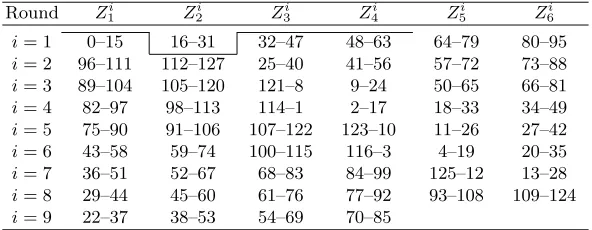
2. We observe that key bits 125–15 are not used at the beginning between the plaintext and V and at the end in rounds 8,9. On the other hand, key bits 16–24 are not used (afterV) in rounds 1,2, and in part of round 3. The location of V is described in Table 4. Using the algorithm described above, the complexity of exhaustive key search is reduced by almost 50% (by “saving” the computation of more than four of the 8.5 rounds).7
The speedup can be made even more significant by incorporating the BD-relation. Recall that the second basic observation presented above suggests to avoid the computation of several operations in the encryption process by checking only part of the ciphertext. In the case of IDEA, we can save even more by
7
checking instead whether the relation holds. We cannot use the keyless BD-relation since we want to use asingleplaintext/ciphertext pair. (Using two pairs will double the encryption time, which will eliminate most of the time saving). However, we can still use the original BD-relation.
The algorithm of the improved attack is as follows:
1. Choose an arbitrary valueV of ladder type, as described above.
2. For each value of bits 0–12 and 25–127 of the key, perform the following: (a) Compute the XOR of the LSBs of the subkeysZ1
2, Z22, . . . , Z29, Z31, Z32, . . . , Z39 (required for the BD-relation).
(b) For each value of bits 13–15 of the key, partially encrypt V through rounds 1,2,3 and compute the valuess1, s2, s3in the BD-relation. Store the XOR of the LSBs of these values, along with the intermediate value
p3, in a table entry corresponding to the value of bits 13–15. (c) For each value of bits 16–24 of the key, perform the following:
i. Decrypt V through the key addition with Z21 to obtain the cor-responding plaintext. Consider the corcor-responding ciphertext,8 and partially decrypt it through rounds 9,8,7 to obtain the valuess7, s8.9 ii. For each value of bits 13–15 of the key, continue the partial decryp-tion to compute the values s4, s5, s6, and check (using the corre-sponding entry in the table), whether the BD-relation holds. If not, discard the key guess.
iii. For the remaining keys, continue the partial decryption through rounds 5 and 4 and check whether the value of p3 (that is equal to the XOR of the first two words in the input to round 4) matches the corresponding value in the table. As this is a 16-bit filtering, most of the key guesses are discarded at this stage.
iv. Check the remaining key guesses by a trial encryption.
As we show below, this algorithm allows to speed-up exhaustive search by a factor of about 5/2. However, in a naive implementation, it increases the data complexity to 216 chosen plaintexts, since for different values of key bits 16–31, the intermediate valueV leads (by partial decryption) to 216different plaintexts. The data complexity can be reduced by choosing the valueV according to the value of (part of) bits 16–31. Specifically, we can reduce the complexity to 29 chosen plaintexts by setting the 7 LSBs of the second word inV to be equal to bits 25–31 of the key (that are guessed in the external loop of the attack), which assures that the 7 LSBs of the second plaintext word are zero in all plaintexts.
8
As shown below, the data complexity of the attack is only 16 chosen plaintexts. Hence, the plaintext/ciphertext pairs can be stored in a table of size 16, and the corresponding ciphertext can be retrieved by a single table lookup.
9
Note that this operation can be performed more efficiently using the fact that key bits 125–12 are not used in the decryption direction until the multiplication with the subkeyZ7
5. This allows us to perform all the operations in this step except for the last
Round Zi
1 Z
i
2 Z
i
3 Z
i
4 Z
i
5 Z
i 6
i= 1 0–15 16–31 32–47 48–63 64–79 80–95
i= 2 96–111 112–127 25–40 41–56 57–72 73–88
i= 3 89–104 105–120 121–8 9–24 50–65 66–81
i= 4 82–97 98–113 114–1 2–17 18–33 34–49
i= 5 75–90 91–106 107–122 123–10 11–26 27–42
i= 6 43–58 59–74 100–115 116–3 4–19 20–35
i= 7 36–51 52–67 68–83 84–99 125–12 13–28
i= 8 29–44 45–60 61–76 77–92 93–108 109–124
i= 9 22–37 38–53 54–69 70–85
The lines show the point where the fixed valueV is chosen, where range means that the valueV is set before the use of this subkey, and range stands for the valueV being chosen after the use of this subkey.
Table 4.Speeding up Exhaustive Search on the Full IDEA.
The complexity can be reduced even further by adding part of bits 16–24 to the external loop of the attack. For example, adding bits 20–24 to the external loop increases the time complexity of the attack by less than 5%, while reducing the data complexity to only 16 chosen plaintexts. The data complexity can be reduced even further, but at the expense of increasing the time complexity. We compute below the time complexity for the variant of the attack that requires 16 chosen plaintexts.
In order to determine the time complexity of the attack, we count the number of operations of each type (XORs, modular additions, modular multiplications, and table lookups) performed for each key guess. For the sake of clarity, we present the numbers for each step of the attack separately.
– Step 2(a): Negligible (performed only once every 212keys).
– Step 2(b): 10 multiplications, 8 additions, and 13 XORs, performed for 2−4 of the keys.
– Step 2(c)(i): Using the efficient implementation described in footnote 9, equivalent to 1 multiplication and 1 addition, performed for 2−3of the keys. – Step 2(c)(ii): 11 multiplications, 10 additions, 20 XORs, and 1 table lookup,
performed for all the keys.
– Step 2(c)(iii): 3 multiplications, 4 additions, 4 XORs, and 1 table lookup, performed for 2−1of the keys.
item Step 2(c)(iv): Negligible (performed only for 2−17 of the keys). Hence, the amortized number of operations for each key is 13.3 multiplica-tions, 12.6 addimultiplica-tions, 22.8 XORs, and 1.5 table lookups. For the sake of compar-ison, the number of operations in a full IDEA encryption are: 34 multiplications, 34 additions, and 48 XORs.
multiplications, and to compare the cost of a table lookup to that of these three operations. As these costs differ significantly on different platforms, we propose the two extremal measurements:
1. Assuming that the multiplications are much more time consuming than all the other operations, and thus, counting only multiplications and ta-ble lookups and assuming that they take the same amount of time. (This approach was taken in [24]).
2. Assuming that one multiplication is equivalent to one XOR/addition. (It is clear that on any platform, a multiplication modulo 216+ 1 does not take less than a modular addition or an XOR).
According to the first approach, a full IDEA encryption is equivalent to 34 multiplications. Our attack requires 14.75 multiplications for each key, which are equivalent to 0.4338·2128 IDEA encryptions.
According to the second approach, a full IDEA encryption is equivalent to 116 operations. Our attack requires 50.3 operations for each key, which are equivalent to 0.4336·2128 IDEA encryptions.
As can be seen, the two computations yield extremely close values of the complexity. It is thus reasonable to assume that a measurement using any other natural ratio will lead to a similar overall complexity. Therefore, the time com-plexity of our attack is close to 2126.8 encryptions.
We note that a similar attack can be applied to 7.5-round IDEA, starting at the plaintext. In this case,V is chosen as in the attack on the full IDEA, and the adversary uses the fact that key bits 100–124 are not used between the plaintext andV, in rounds 8,7, and in part of round 6. The data complexity of the attack is 16 chosen plaintexts, and its time complexity is
2128(10·2−4+ 10·2−25+ 4 + 1 + 3·2−1) = 2128·7.125
multiplications, that are equivalent to 2125.9 7.5-round encryptions. This attack has a higher time complexity than the 7.5-round attack presented in Section 6 (2125.9 vs 2114), but we mention it due to its greatly reduced data complexity (16 vs 263).
7.3 Speeding Up Exhaustive Key Search on Other Block Ciphers
The simple techniques for speeding up exhaustive search presented in Section 7.1 can be used to obtain considerable speedups not only for IDEA, but also for other well-known block ciphers. To give two quick examples, we consider the ciphers KASUMI [33] (used in GSM and 3G telephony) and GOST [17] (the former Soviet Union encryption standard). In order to save space, we refer the reader to [17, 33] for the notations used in the attacks.
In the case of KASUMI, the adversary can fixV to be the intermediate value before the third round of the F O function in round 1. The key wordK8 is not used beforeV and in most of round 8 (until theF Lfunction), and the key word
KL2,2). This allows the adversary to compute 16 bits in the left half of the output of round 2 (and thus, also of round 3, due to the Feistel structure) on the one side, and almost a full round on the other side, before guessing the entire key. The part of encryption performed until the full key guess is thus slightly more than 4 rounds, which means that the attack provides speedup by a factor of almost 2 over exhaustive key search.
In the case of GOST, the speedup is even more considerable due to its very weak key schedule. The adversary can fix V to be the intermediate value after round 31 (i.e., one round before the ciphertext). The key wordK1 is not used in rounds 18–31, and the key wordK8 is not used in round 32 and rounds 1–7. This allows to compute 22 of the 32 rounds before guessing the full key. The weak diffusion of a single GOST round allows to gain at least three more rounds for free easily, and hence, the attack provides a speedup by a factor of at least 32/7 over exhaustive key search.
It should be mentioned that recently, attacks faster than exhaustive key search were proposed against both KASUMI (by Jia et al. [21]) and GOST (by Isobe [20] and others). However, these are complex attacks making use of various subtle weaknesses of the ciphers. The speedups we sketched are much simpler and more generic, and can be viewed as suggesting one of the following:
– Using a simple key schedule (as in KASUMI, GOST, IDEA, and many other ciphers) leads in many cases to a true reduction in the cipher’s security, due to the ability to speed up exhaustive search in a non-negligible way. Hence, a linear key schedule should be avoided in the design of block ciphers, even if the rest of the design is conservative.
– Minor speedups of exhaustive key search, e.g., by a factor of 2 or 4, should not be considered a weakness of the design, since the key length is way too big to make such speedups a threat in any scenario. On the other hand, such speedups should be taken into consideration when the complexity of other attacks is compared to that of exhaustive key search. Instead of com-paring with the “theoretical” complexity of 2n trial encryptions for a cipher withn-bit keys, one should compare to the realistic complexity of optimized exhaustive key search.
8
Zero-in-the-Middle Biryukov-Demirci Attack on
Reduced-Round Variants of IDEA
efficient than the MitM BD technique. First, we survey the results of [5, 6, 32], and then we present two new ZitM BD attacks.
8.1 Previous Zero-in-the-Middle Keyless Biryukov-Demirci Attacks
The Zero-in-the-Middle Biryukov-Demirci attack was used in several papers to attack 5-round, 5.5-round, and 6-round variants of IDEA:
1. Differential BD attack on 5 rounds:The first attack that exploited the
keyless BD-relation is [5]. In the attack, the reduced-round variant starts after theKAlayer of round 3 and ends after theKAlayer of round 8, and a differential property is used to cancel the term ∆s4 in the BD-relation. The data complexity of the attack is 219 known plaintexts, and the time complexity is 2103encryptions. In [6] it was shown that the data complexity can be reduced to 16 known plaintexts, at the expense of increasing the time complexity to 2114encryptions (and a slightly improved variant of the attack of [5] which uses only 218.5known plaintexts was presented).
2. Square BD attack on 5.5 and 6 rounds:The next attack that exploited
the keyless BD-relation in larger versions of IDEA appeared in [6]. In this attack, the reduced-round variant starts either after theKAlayer of round 2 or at the beginning of round 3 and ends after theKAlayer of round 8, and a Square property is used to cancel the terms ∆s3 and ∆s4 in the BD-relation. The data complexity of the attack on 6-round IDEA is almost the entire codebook, and the time complexity is 2126.8 encryptions.
3. Key-Dependent Differential BD attack on 5.5 and 6 rounds:The
most recent attack that exploited the keyless BD-relation is [32]. The attack targets the same variant as [6] and uses a differential-type technique called
key-dependent attack to cancel the terms∆s3 and ∆s4 in the BD-relation (instead of the Square technique used in [6]). This allows to reduce the data and time complexities of the attack on 6-round IDEA to 249chosen plaintexts and 2112.1encryptions, respectively.
All these attacks are clearly inferior to the MitM BD attack on 6-round IDEA presented in Section 5, whose data complexity is just 16 known plaintexts, and whose time complexity is less than 2112 encryptions.
8.2 A Zero-in-the-Middle Biryukov-Demirci Distinguishing Attack
on 2.5-Round IDEA
For 2.5 rounds of IDEA, Equation (6) is reduced to:
LSB(P21⊕P31⊕P22⊕P32⊕∆s1⊕∆s2) =LSB(C21⊕C31⊕C22⊕C32). (8) Note that if for some round of IDEA,∆pr= 0, then∆sr= 0 as well. Hence, if the plaintexts and the ciphertexts are chosen such that ∆p1=∆p2= 0, then the terms∆s1and∆s2 in Equation (8) are cancelled, and the equation reduces to a simpler form:
LSB(P1
2 ⊕P31⊕P22⊕P32) =LSB(C21⊕C31⊕C22⊕C32), (9) whose validity can be checked using only the plaintexts and the ciphertexts, independently of the key.
In order to satisfy the relation ∆p1 = 0, we can consider pairs of chosen plaintexts (P1, P2) such that∆(X1
1, X21, X31, X41) = (0, β,0, γ) for arbitrary val-ues of β andγ. For such pairs,∆Y1
1 =∆Y31 = 0 (independent of the values of
Z1
1, Z31), and hence,∆p1= 0. We note that the same idea was used in [22]. Similarly, if we take only ciphertext pairs satisfying ∆(Y3
1, Y23, Y33, Y43) = (0,0, β′, γ′) for arbitrary values of β′ andγ′, then∆X3
1 =∆X23= 0, and thus,
∆p2= 0.
Based on these observations, we can mount a simple distinguishing attack on 2.5-round IDEA, using the following algorithm:
1. Ask for the encryption of 218 plaintexts of the form (A, Z, B, W), whereA andB are fixed andZ andW assume arbitrary random values.
2. Insert the ciphertexts into a hash table sorted by the first two words. 3. For every pair of ciphertexts in the same bin of the hash table, check whether
Equation (9) holds for the corresponding plaintext/ciphertext pair.
4. If there is a pair for which the equation does not hold, conclude that the cipher is not 2.5-round IDEA. If there is no such pair, conclude that the cipher is 2.5-round IDEA.
Due to the choice of the structure, for every pair of plaintexts in the structure we have∆p1= 0. Furthermore, for every pair of ciphertexts in the same bin of the hash table, we also have∆p2= 0. Hence, for all the checked pairs, Equation (9) must be satisfied.
The 218 plaintexts can be combined into about 235 possible pairs, and a fraction of 2−32 of them is expected to have ciphertext difference of the form (0,0, β′, γ′). Hence, the expected number of pairs analyzed in Step 3 is 8. If there
is a pair for which Equation (9) fails, we know for sure that the cipher is not 2.5-round IDEA. On the other hand, for a random permutation, the probability that the equation holds for all the eight pairs is 1/256. Hence, the distinguisher succeeds with probability greater than 99.5%.