Classification of Phishing Web Sites Features Based
on Extreme Learning Machine
Swathi Police Dr.R.Usharani
PG Scholar in CSE,CVRCE, Associate Professor in CSE,CVRCE,
Hyderabad, India, Hyderabad, India,
[email protected] [email protected]
Abstract: Phishing are one of the most
widely recognized and most perilous
assaults among cybercrimes. The point of
these assaults is to take the data utilized by
people and associations to lead exchanges.
Phishing sites contain different indications
among their substance and internet
browser-based data. The reason for this examination
is to perform Extreme Learning Machine
(ELM) based grouping for 30 highlights
incorporating Phishing Websites Data in UC
Irvine Machine Learning Repository
database. For results evaluation, ELM was
contrasted and other AI strategies, for
example, Support Vector Machine (SVM),
Naïve Bayes (NB) and identified to have the
most noteworthy precision of 95.34%
Keywords: Extreme Learning Machine,
Features Classification, Information
Security, Phishing.
I. Introduction: Web use has turned into a
basic piece of our everyday exercises
because of quickly developing innovation.
Because of this fast development of
innovation and escalated utilization of
advanced frameworks, information security
of these frameworks has increased
extraordinary significance. The essential
goal of keeping up security in data advances
is to guarantee that important insurances are
taken against dangers and risks liable to be
looked by clients during the utilization of
these innovations. Phishing is characterized
as impersonating solid sites so as to acquire
the exclusive data went into sites each day
for different purposes, for example,
usernames, passwords and citizenship
numbers. Phishing sites contain different
indications among their substance and
internet browser-based data. Individual(s)
phony site or email data to the objective
location as though it originates from an
association, bank or whatever other
dependable source that performs solid
exchanges. Substance of the site or the email
incorporate solicitations meaning to draw
the people to enter or refresh their own data
or to change their passwords just as
connections to sites that resemble precise of
the sites of the associations concerned.
Phishing Web locales Features Many
articles have been distributed about how to
foresee the phishing sites by utilizing
computerized reasoning procedures. We
analyzed phishing sites and extricated
highlights of these sites. Rules with respect
to the removed highlights of this database
are given underneath. In the main segment
we characterized principles and we gave
conditions of web highlights. We need these
conditions so as to clarify phishing assaults
portrayal.
II. Existing framework: The essential goal
of keeping up security in data advances is to
guarantee that important safety measures are
taken against dangers and threats prone to be
looked by clients during the utilization of
these advances. Phishing is characterized as
copying dependable sites so as to acquire the
exclusive data went into sites each day for
different purposes, for example, usernames,
passwords and citizenship numbers.
Phishing sites contain different clues among
their substance and internet browser-based
data. Individual(s) submitting the extortion
sends the phony site or email data to the
objective location as though it originates
from an association, bank or whatever other
solid source that performs dependable
exchanges. Substance of the site or the email
incorporate solicitations planning to draw
the people to enter or refresh their own data
or to change their passwords just as
connections to sites that resemble precise of
the sites of the associations concerned.
Impediments:
• Low execution
• Accuracy is less
• Detection is unpredictable
• Used ANN, Naive inlet's
III.SYSTEM ARCHITECTURE AND
DESIGN
For every project, the architecture of the project
is more important, it serves as blueprint for the
project implementation. In our project, we use
phishing websites features data set .
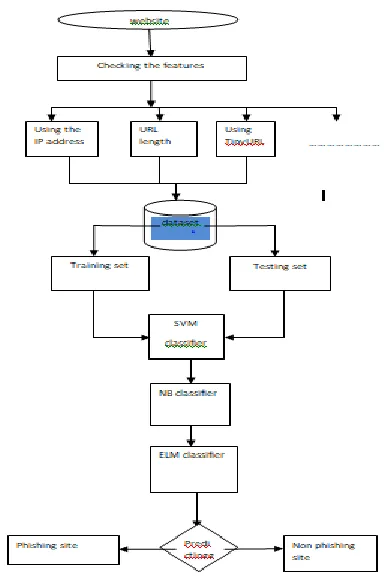
General system architecture for prediction of a
website is shown in below Fig 1. An ELM base
phishing website classification procedure can be
Step1.Visiting a website or a webpage.
Step 2.Checking the 30 input attributes
according to the features and their rules.
Step 3.Collecting samples to the dataset.
Step 4.Randomly chosen 90% training set
samples and 10% testing set samples of the
dataset.
Step 5.Classification by using ELM.
Step 6.Prediction for phishing site or non
phishing site.
Fig 1. System architecture for predicting a
phishing websites
IV. Proposed system: Extreme Learning
Machine (ELM) is a feed-forward
counterfeit neural system (ANN) model with
a solitary concealed layer. For the ANN to
guarantee a high-performing learning,
parameters, for example, limit worth, weight
and initiation capacity must have the fitting
qualities for the information framework to
be demonstrated. In inclination based
learning draws near, these parameters are
changed iteratively for suitable qualities.
Along these lines, they might be moderate
and produce low-performing results because
of the probability of stalling out in nearby
minima. In ELM Learning Processes,
uniquely in contrast to ANN that restores its
parameters as angle based, input loads are
arbitrarily chosen while yield loads are
systematically determined. As a diagnostic
learning process considerably diminishes
both the arrangement time and the
probability of blunder worth stalling out in
nearby minima, it builds the exhibition
proportion. So as to actuate the cells in the
shrouded layer of ELM, a straight capacity
just as non-direct (sigmoid, sinus, Gaussian),
non-logical or discrete enactment capacities
Advantages
Here utilizing further developed Extreme
learning calculation.
V. Modules:
A) Characterization: Characterization is to
decide the class to which every datum test of
the strategies has a place, which techniques
are utilized when the yields of info
information are subjective. The object is to
separate the entire issue space into a specific
number of classes. A wide scope of
arrangement techniques are available. This
is because of the way that distinctive
characterization strategies have been
developed for various information as there is
no ideal technique that deals with each
datum. The point of characterization is to
appoint the new examples to classes by
utilizing the pre-named tests. The most
regularly utilized order strategies are
depicted underneath.
• Artificial Neural Networks (ANN)
• Support Vector Machine (SVM)
• Naive Bayes (NB)
• Extreme Learning Machine (ELM)
VI. Experimental Results:
Implementation Details
Here, we present the implementation
details that were achieved with the the
dataset and get conclusions with applying
SVM, NAÏVE BAYES AND ELM
supervised algorithms. Above three
algorithms was developed using python
scripting language and applied on dataset. It
gives the phishing accuracy of 65.0%,
70.5%, 95.0% respectively. it says clearly
ELM algorithm achieves better accuracy
than other two classifier algorithms.
Methods Train
Accuracy
Test/True
Accuracy
ELM 100% 95.0%
NB 100% 70.5%
SVM 100% 65.0%
TABLE: ACCURACY OF MACHINE
LEARNING METHODS
VI. Conclusion: After study of different
research papers on phishing detection,
different methods are used to detect
phishing. We pre-identified feature based on
our requirement. there are many classifiers
available for detecting phishing. This
from sites and arrangement segment. In the
element extraction, we have unmistakably
characterized guidelines of phishing
highlight extraction and these standards
have been utilized for getting highlights. So
as to arrangement of these highlights, SVM,
NB and ELM were utilized. In the ELM, 6
distinctive enactment capacities were
utilized and ELM accomplished most
astounding precision score.
Vll . Future Work:
This phishing problem is seen in almost all
major websites features. Our proposed
method extended with some modifications.
In this approach, project is aimed at
classification of phishing websites based
on the features. For that we have taken
the phishing dataset which collected from
uci machine learning repository and built
our model with three different classifiers
like SVC, Naïve Bayes, ELM and we got
good accuracy scores. There is a scope to
enhance it further .if we can have more data
our project will be much more effective and
we can get very good results. For this we
need API integrations go get the data of
different websites.
References:
[1] T. S. Guzella and W. M. Caminhas, “A
review of machine learning approaches to
Spam filtering,” Expert Systems with
Applications, vol. 36, no. 7. pp. 10206–
10222, 2009.
[2] DATASET: Lichman, M. (2013). UCI
Machine Learning Repository
[http://archive.ics.uci.edu/ml]. Irvine, CA:
University of California, School of
Information and Computer Science
[3] G.-B. Huang et al., “Extreme learning
machine: Theory and applications,” Neuro
computing, vol. 70, no. 1–3, pp. 489–501,
2006.
[4] C. S. Guang-bin Huang, Qin-yu Zhu,
“Extreme learning machine: A new learning scheme of feedforward neural networks,”
Neurocomputing, vol. 70, pp. 489–501,
2006.
[5] Ö. Faruk Ertu÷rul and Y. Kaya, “A
detailed analysis on extreme learning
machine and novel approaches based on
ELM,” Am. J. Comput. Sci. Eng., vol. 1, no.
5, pp. 43–50, 2014.
[6] Ö. F. Ertugrul, “Forecasting electricity
load by a novel recurrent extreme learning
machines approach,” Int. J. Electr. Power
Energy Syst., vol. 78, pp. 429–435, 2016.
[7] G.-B. Huang, Q.-Y. Zhu, and C.-K.
Siew, “Extreme learning machine: Theory and applications,” Neurocomputing, vol. 70,
[8] G. Canbek and ù. Sa÷Õro÷lu, “A
Review on Information, Information
Security and Security Processes,” Politek.
Derg., vol. 9, no. 3, pp. 165– 174, 2006.
[9] L. McCluskey, F. Thabtah, and R. M.
Mohammad, “Intelligent rulebased phishing websites classification,” IET Inf. Secur., vol.
8, no. 3, pp. 153–160, 2014.
[10] R. M. Mohammad, F. Thabtah, and L.
McCluskey, “Predicting phishing websites
based on self-structuring neural network,”
Neural Comput. Appl., vol. 25, no. 2, pp.
443–458, 2014.
[11] R. M. Mohammad, F. Thabtah, and L.
McCluskey, “An assessment of features
related to phishing websites using an
automated technique,” Internet Technol. …,
pp. 492–497, 2012.
[12] W. Hadi, F. Aburub, and S. Alhawari,
“A new fast associative classification
algorithm for detecting phishing websites,”
Appl. Soft Comput. J., vol. 48, pp. 729–734,
2016.
[12] N. Abdelhamid, “Multi-label rules for
phishing classification,” Appl. Comput.
Informatics, vol. 11, no. 1, pp. 29–46, 2015.
About Authors:
Swathi Police is pursuing her Masters of
technology in CVR College of Engineering
Hyderabad, India in Computer Science and
Engineering specialization. She will
complete his PG in 2019.
Dr.R.UshaRani is working as Associate
Professor in Department of Computer
Science and Engineering at CVR College of