Available Online atwww.ijcsmc.com
International Journal of Computer Science and Mobile Computing
A Monthly Journal of Computer Science and Information Technology
ISSN 2320–088X
IMPACT FACTOR: 6.199
IJCSMC, Vol. 8, Issue. 7, July 2019, pg.65 – 70
Analysis of Various Plant
Disease Detection Techniques
Using KNN Classifier
RAKSHA
M.Tech Scholar
Rajasthan College of Engineering for a women's
Jaipur
MANJU MATHUR
Assistant Professor
Rajasthan College of Engineering for a women's
Jaipur
Abstract: The technique used for the processing of digital data obtained from pictures is identified as image processing. Plants and crops are ruining because of the excessive use of fertilizers and insecticides. The experts observe the plant disease with their naked eye and identify and detect the type of diseases plant is suffering from. In order to identify infections from input pictures, plant disease detection approach is implemented. An image processing approach is implemented in this research study. This approach is relied on the extraction of textural feature, segmentation and classification. The textural features are extracted from the picture with the help of GLCM algorithm. The input picture is segmented with the help of k-mean clustering algorithm. For classification, the KNN classification is used in this research. This leads to improve accuracy of detection and also leads to classify data into multiple classes. The results of the proposed algorithm are analyzed in terms of various parameters accuracy, precision, recall and execution time. The accuracy of proposed algorithm is increased upto 10 to 15 percent.
KEYWORDS: SVM, KNN, K-mean, GLCM
Introduction
Digital image acquisition is the very first step towards the designing of an image analysis system with the help of sensors in optical as well as thermal wavelengths. These sensors are used to record mapping of the three dimensional visual world. The images are captured in two dimensional forms; it is sampled and quantized in order to have digital images. Sometimes there is presence of background noises, which degrades the quality [3] of the images. One of the most common sources which degrade the images is the optical lens of the camera which acquires all the visual information about the image. If the camera is not properly focused then, the image obtained can be blurring. Blurring of images is the result of defocused camera. Sometimes, the images are captured in foggy environment, which is another reason of image degradation. Therefore, any image captured in foggy winter morning will lead to the blurriness of the images. In that case the image is degraded due to fog and mist in the surrounding and this type of degradation is called atmospheric degradation. There are relative motion between the object and the camera. There are certain applications of image processing that is image enhancement, filtering and restoration. These applications have their own advantages and disadvantages in different fields of technology. India is an agricultural country as about 70% of the population earning depends on the agriculture [4]. The agriculture is widely spread and the entire farmers’ families relay on their lands and crops for their economic growth. But the plants and the crops are affected by the disease which leads to the reduced amount of quality as well as volume of farming goods. The visible samples are described through the analysis of plant infections. It observes the shape and infections of plants. In previous time, this monitoring takes place manually by the person who is expert in that field. This needs a lot of hard work and time too. The plant infections are detected with the help of image processing approach. The indications are perceived on the leaf, stem and produce. Plants and the crops are ruining because of the excessive use of fertilizers and insecticides. The maximum population of India depends on the agriculture and hence the decline the economic growth. There are some basic steps to detect the diseases in plants. The first step is the image acquisition, in which the images are captured from the environment by using digital camera. The second step is the image pre-processing, in which the features are extracted from the [5] acquired images for further analysis. After, this many analytical differentiating techniques are employed for the classification of images as per the specific diseases. A deep learning algorithm is implemented which is used to classify the specific images into particular diseases. It makes easy to detect the diseases and finds the cure for the infected plants [6]. It determines the relevant count of the pixels by comparing the images with data sets. Recognition of infection is the last phase. The plants are classified according to the type of infection within the provided data suite. The deep learning approach is applied to detect and classify the infections. Working of ANN is shown with the help of the figure: once, the features are extracted the database images are classified on the basis of the neural networks. These are considered as the vectors in ANN. Support vector machine classifier is proposed for regression, classification and pattern recognition of the data. Because of its highly generalized results without getting any prior knowledge to add, this respective classifier is one of the best classifier proposed by the researchers [7]. It gives better performance when the dimension of the input space is very high. -Nearest neighbor depends on similarity knowledge. N-dimensional features are used for the generation of patterns. In any dimension, every pattern exhibits a point. The utmost part of training patterns is accumulated in n-dimensional prototype along with all these lines. The K-Nearest neighbor classifier searches pattern space for training samples placed closest to the anonymous sample in case of an unidentified pattern.
Literature Review
Hase et al.[8] proposed a system used for the detection of plant diseases and classifies them using image processing technique. The main issue which was resolved by using the proposed approach was the early detection of the diseases. The approach reimburses the huge grasslands crops. The perception of human eye is not much accurate for the detection of infected plants. The diagnosis of the diseases at right time and place is very important. An android application is introduced which tells the cause and the solution of the diseases. In this method, the farmer observes the plant with their naked eyes and detects the diseases. This method is very time consuming and very expensive also. It requires the supervision of experts and it is very difficult to observe the crops in large farming areas.
distorts the images so, the concept of denoising is also elaborated in this paper. The researchers concludes that the work done in this research shows that blight is very common diseases which is infecting many plants and crops.
Ranjith et al.[10] proposed a smart irrigation method which controls the irrigation supply automatically by using android application. Other than this the images are captured and forwarded to the cloud sever for further processing and compared with the infected plant images in the database. The diseases can be detected with the help of cloud server which helps the users to detect the diseases with the help of android phones from any desired location. One can control the entire irrigation system by a mobile application by using cloud server and solves the all the issues of irrigation. The irrigation system works according to the moisture content and the varying temperature. The application with the camera can be used to detect the affected part of the plant, by just capturing the photo of the affected portion and transferring them to the cloud server for further processing and detection of diseases.
Khan et al.[11] describes the machine vision framework and identifies the manifestation of plant diseases and analyzes the images in CIELab. The main objective of this purpose is to create a procedure for the detection of plant diseases by using cascading unsupervised image segmentation approaches. Additionally, RGB color model for digital images and CIELab color model for performing pre-processing step which increases the each channel timing. The researchers also introduced multilevel segmentation technique which uses expectation maximization with minimum constraint visual information loss. Various experiments were conducted and indicate that the new cascaded design outcomes a superior color segmentation with the confirmation of infected regions.
Dhaware et al.[12] proposed technique of image processing is used to discover and recognition of plant conditions. This approach provides a suggestion to the farmers for the improved framing techniques. Hence, the researchers concluded that the images of the infected plants should be captured by using mobile camera and forward it to the DSS without any additional modifications. Diseases are the major cause of reduction in agronomics in India. Farmers are facing many problems in controlling the diseases on crops and fruits. The detection of diseases at their early stages is very important task and it includes judicious diagnosis and appropriate supervision. In this paper, the researcher proposed a system which mainly focuses o the detection of plant diseases and recognition. It consists of four stages that is pre-processing, segmentation, feature extraction and classification. The researcher mainly focused on the image segmentation and classification of images.
Ashourloo et al.[13] presents a spectrum for the infected and non-infected leaves having different symptoms which were observed by using image processing spectro radiometer having 350 to 2500nm electromagnetic region. The ground trust dataset is produced by employing photos on a digital camera and compute the diseases and their symptoms. The paper mainly focuses on the use of machine learning techniques for the detection and classification of plant diseases. Thus, the research concludes that the proposed approach is very useful for the detection and the classification of the diseases.
Research Methodology
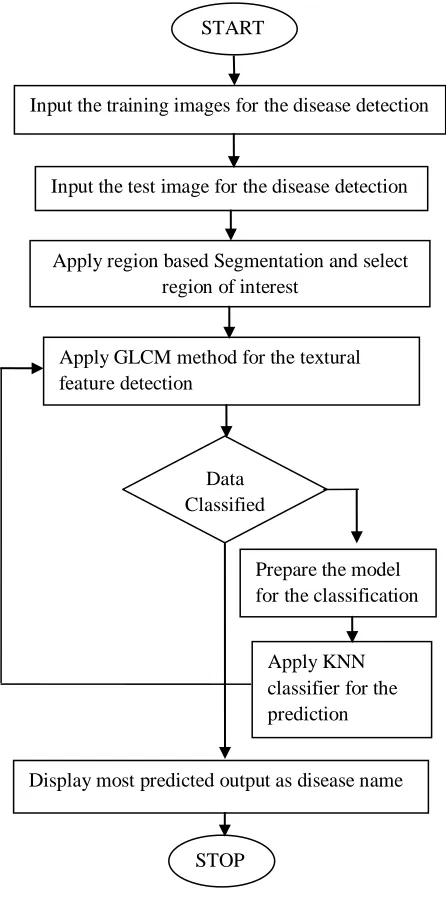
Figure 1: Proposed Flowchart
The stages depicted in the presented Flowchart are given below:
Stage 1: In the primary stage, the training pictures are used in the form of input for the identification of plant infection.
Stage 2: In the secondary stage, the characteristics of the training pictures are retrieved and amassed in the folder
Stage 3: The test picture is utilized as input and descriptions of the picture are retrieved by law texture algorithm in the third stage.
Stage 4: In the step four, the area based segmentation algorithm is implemented for the segmentation of test picture into definite domains.
START
Input the training images for the disease detection
Input the test image for the disease detection
Apply region based Segmentation and select region of interest
Apply GLCM method for the textural feature detection
Data Classified
Prepare the model for the classification
Apply KNN classifier for the prediction
Display most predicted output as disease name
Stage 5: In the last step, the KNN classifier is implemented in the final stage for the classification of the test picture into distinct classes in accordance with training set.
Experimental Results
The proposed technique is implemented in MATLAB and the results are evaluated by making comparisons against proposed and existing techniques in terms of different parameters.
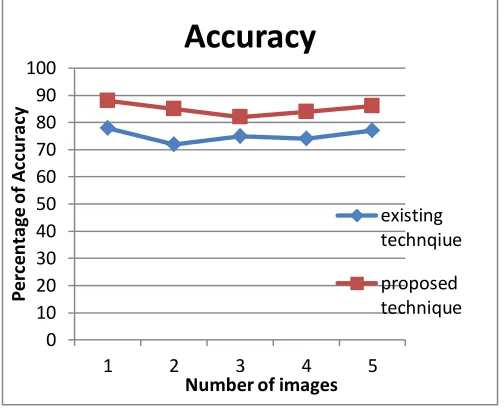
Fig 2: Accuracy Comparison
The correctness of the projected method is improved in comparison with the accessible system as demonstrated by the figure 2. The accurateness of accessible method is 95 percent while the projected method gives a correctness rate of around 97 percent
Fig 3: Execution Time Comparison
0 10 20 30 40 50 60 70 80 90 100
1 2 3 4 5
P e rc e n ta ge o f A cc u ra cy
Number of images
Accuracy
existing technqiue proposed technique 0 0.5 1 1.5 2 2.5 3 3.51 2 3 4 5
ti m e in s ec o n d s ->
Number of image ->
Execution Time
A comparison on the basis of implemented time duration of the projected and accessible algorithm is carried out for the presentation scrutiny. It is discovered that projected algorithm utilizes less implementation time than accessible algorithm.
Conclusion
In the proposed research study, it is analyzed that feature extraction, segmentation and classification are three essential phases of plant infection detection. The GLCM algorithm is applied for the extraction of textural features in the earlier approach. The input pictures are segmented with the help of k-mean clustering. In the proposed study, The KNN classifier is utilized in place of multi-class SVM classifier for the classification of information into numerous classes. The performance of the proposed algorithm is compared with existing in terms of accuracy and execution time. The proposed KNN algorithms has high accuracy and low execution time than SVM algorithm.
References
[1] Sanjay B. Patil et al. “LEAF DISEASE SEVERITY MEASUREMENT USING IMAGE PROCESSING”, International Journal of Engineering and Technology Vol.3 (5), 2011, 297-301, DOI: 10.1109/ECS.2011.7090754
[2] B. Bhanu, J. Peng, “Adaptive integrated image segmentation and object recognition”, In IEEE Transactions on Systems, Man and Cybernetics, Part C, volume 30, pages 427–441, November 2000, DOI: 10.1109/5326.897070
[3] Keri Woods. ”Genetic Algorithms: Colour Image Segmentation Literature Review”, July 24, 2007, DOI: 10.1109/I2CT.2007.8226184
[4] S.Beucher, F.Meyer. “The morphological approach to segmentation: The watershed transform”, in Mathematical Morphology Image Processing, E. R. Dougherty, Ed. New York Marcel Dekker, vol. 12, pp. 433–481, January 1993, DOI: 10.1109/ICOEI.1993.8300913
[5] Vijai singh,Varsha,Prof A K Misra, “Detection of unhealthy region of plant leaves using Image Processing and Genetic Algorithm” International Conference on Advances in Computer Engineering and Applications, March 2015, DOI:10.1109/ICACEA.2015.7164858
[6] Mrunalini R. Badnakhe and Prashant R. Deshmukh, “An Application of K-Means Clustering and Artificial Intelligence in Pattern Recognition for Crop Diseases”, International Conference on Advancements in Information Technology, IPCSIT vol.20, 2011, DOI: 10.1109/ICIIECS.2011.8275901
[7] Anand.H.Kulkarni, Ashwin Patil R. K., “Applying image processing technique to detect plant diseases”, International Journal of Modern Engineering Research, Vol.2, Issue.5, pp-3661-3664, Sep-Oct. 2012, DOI: 10.1109/ICCCI.2012.8117730 [8] Mr. Anand K. Hase, Ms. Priyanka S. Aher and Mr. Sudeep K. Hase, “Detection, Categorization and suggestion to cure infected plants of Tomato and Grapes by using OpenCV framework for Andriod Environment,” 2nd International Conference for Convergence in Technology (I2CT), April 2017, DOI: 10.1109/I2CT.2017.8226270
[9] Kawaljit kaur and Chetan Marwaha, “Analysis of Diseases in Fruits using Image Processing Techniques,” International Conference on Trends in Electronics and Informatics ICEI, May 2017, DOI: 10.1109/ICOEI.2017.8300913
[10] Ranjith, Saheer Anas, Ibrahim Badhusha, Zaheema OT, Faseela K, Minnuja Shelly, “Cloud Based Automated Irrigation And Plant Leaf Disease Detection System Using An Android Application,” International Conference on Electronics, Communication and Aerospace Technology ICECA, April 2017, DOI: 10.1109/ICECA.2017.8212798
[11] Zia Ullah Khan, Tallha Akram, Syed Rameez Naqvi, Sajjad Ali Haider, Muhammad Kamran, Nazeer Muhammad, “Automatic Detection of Plant Diseases; Utilizing an Unsupervised Cascaded Design,” International conference of Electronics, Communication and Aerospace Technology (ICECA), April 2018, DOI: 10.1109/ICECA.2017.8212798
[12] Chaitali G. Dhaware and Mrs. K.H. Wanjale, “A Modern Approach for Plant Leaf Disease Classification which Depends on Leaf Image Processing,” International Conference on Computer Communication and Informatics (ICCCI -2017), Jan. 2017, DOI: 10.1109/ICCCI.2017.8117733