Available online:
http://edupediapublications.org/journals/index.php/IJR/
P a g e | 25An Overview of Maximum Power Point
Tracking Methods under Partial Shading
Condition of Photovoltaic System
Shailendra Suthar
1, Durgesh Vishwakarma
21
M Tech. Scholar, EEE Department, REC Bhopal.
2
Assistant Professor, EEE Department, REC Bhopal.
Abstract:
Utilization of renewable energy is a prime requisite for increasing energy demand of today’s world. Solar energy is a paramount renewable energy source to gratify ever increasing energy demand. Photovoltaic (PV) system converts the solar energy into electricity. Efficiency of PV system is a focal concern for maximum utilization of solar energy and nonlinear characteristics of PV system is a major snag for it. Maximum power point tracing (MPPT) algorithms track the maximum power point (MPP) on nonlinear characteristics to transfer maximum power to the load. Non uniform irradiance on PV panels of PV array is termed as a partial shading condition. Under Partial shading condition non liner characteristics of PV array has many MPPs and one of them is global MPP (GMPP). Under partial shading condition tracking of GMPP is necessary to transfer maximum power to the load. Strategies used to track MPP under uniform irradiance are trapped at local MPP and thus inept to track GMPP. Power transfer to load with respect to the local MPP will result in significant power loss. Characteristics of PV array are nonlinear and erratic with respect to the dynamic solar irradiance and temperature and under partial shading condition it become more intricate to track the MPP. Aim of this paper is to scrutinize different MPPT approaches to track the GMPP under partial shading condition. Brief preamble of various MPPT approaches is avowed here. Exploration of these approaches is done based on imperative parameters to make a conclusion.
Keywords
Photovoltaic (PV) systems, Maximum Power Point Tracking (MPPT), Partial Shading Condition (PSC), Hot spot Detection, Global Maximum Power Point (GMPP).
1. INTRODUCTION
From last decade photovoltaic systems becomes a prime solution for renewable energy. PV systems
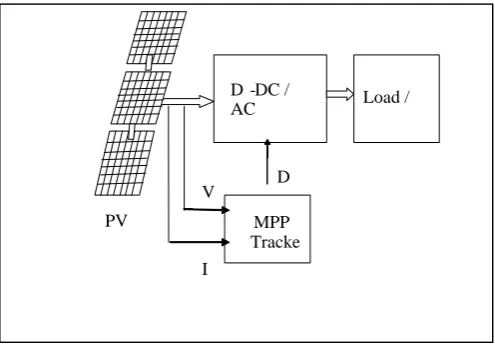
have been improving continuously to meet the today’s need. Basic components of Solar PV system is PV array, DC-DC or DC-AC converter circuit, MPPT Tracker & load /Grid as shown in Figure 1. PV array is composed of PV cells. PV cell has nonlinear I-V & P-V characteristics which changes with irradiance value & temperature. Power is maximum for a particular value of voltage & current and that point on I-V curve is Maximum power point (MPP) .The PV array output power is very much dependent on irradiance and temperature. These parameters are random because they depend on nature phenomena. Maximum power point (MPP) also changes according to these parameters. The impedance at the MPP will also vary under different irradiance. The aim of the impedance matching circuit is to adjust the internal impedance of the PV array according to MPP for random values of irradiance and temperature. MPPT tracker will sense the voltage & current from PV array and find the maximum power point (MPP) using maximum power point tracking (MPPT) algorithm [1-2].
Fig 1: Solar PV system with MPPT PV
Array
MPP T Tracke reRRr D C
-DC / DC AC Converter
Load / Grid
V
I
Available online:
http://edupediapublications.org/journals/index.php/IJR/
P a g e | 262. PARTIAL SHADING CONDITION
(PSC)
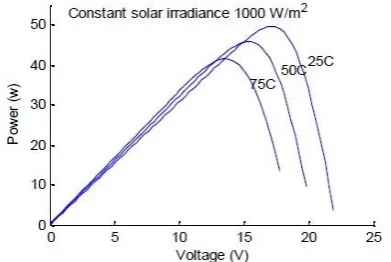
Characteristics of PV array is nonlinear with respect to irradiance and temperature. Figure 2 shows power verses voltage curve for constant temperature and variable irradiance. Figure 3 shows power verses voltage curve for constant irradiance and variable temperature. Maximum power point using maximum power point tracking (MPPT) algorithms has a prime function to locate dynamic Maximum Power Point (MPP) with respect to erratic irradiance and temperature. Without shading on PV array, Power vs. Curve has only one peak on a curve.
Fig 2: Power Vs. Voltage Curve of PV panel for Variable Irradiances
Perturb and observe (P & O) algorithm, Incremental conductance, Ripple correlation control (RCC) are the eminent conventional MPPT algorithm [3-4]. As per the strategies used in these algorithms, they are likely to locate the first peak on curve. Under partial shading condition there is difference in irradiance falling on PV panels which result in unequal output power of PV panels. PV array is composed of many PV panels and so under partial shading condition, Power vs. Curve of PV array has multiple peaks. Figure 4 shows the multiple peaks on power vs. voltage curve of the PV array under partial shading condition. The top most peak is called as global peak or global maxima and other small peaks are called as local peaks or local maxima. Tracking a global peak is tricky job. If MPPT algorithm traps at any one of local peak, it will be result in significant power loss.
Figure. 3: Power Vs. Voltage Curve of PV panel for Variable Temperatures
Fig 4: Power Vs. Voltage Curve of PV Array under partial shading condition
3. MPPT METHODS UNDER PARTIAL
SHADING CONDITION
To search the MPP on P-V curve under partial shading condition requires a rigorous and circumstantial examination of P-V curve. MPP tracking method under partial shading condition can be broadly classified based on their searching techniques. Here MPPT methods under partial shading condition are classified in to following categories
Method based on segmental search of P-V curve
Hot spot detection based methods
Optimization based methods
Methods based on hybrid approaches
3.1Method Based on Segmental Search of P-V Curve
Available online:
http://edupediapublications.org/journals/index.php/IJR/
P a g e | 27 segment and previous segment is compared andbased on that global maxima is decided
3.1.1 Extreme seeking control (esc) based global MPPT tracking method
Search is start from low to high voltage. Nominal turning point voltage minus maximum voltage variation is found. This value is used as starting voltage for every ESC search. A frame work for ESC is developed for MPPT scheme. The PV array power output is taken as cost function l(t,u). Input variations are deal with DCDC converter in cooperation with PI controller. After finding all maxima and minima, based on that global MPP is found and approximate shading distribution is estimated [5].
3.1.2 Three scanning and storing technique
In this method three techniques are proposed based on scanning and storing operation. In first technique, system is initialized with maximum duty cycle to scan the initial PV curve and then its global MPP is stored. In second technique, duty cycle is increased with fixed size and then global MPP is scanned and stored. In third techniques, a large perturbation step is taken to make a wide search of PV curve. This method can use any conventional MPPT algorithm for implementation, however fuzzy-logic-based MPPT is used here [6].
3.2 Hot Spot Detection Based Methods
PV array is composed of PV panels. Under partial shading some of the PV panels come under the shading and these shaded panels are called as hot spot.
Hot spot detection is useful to estimate shading pattern, to track the global MPP. Consistent shading on particular PV panels can physically damage the PV panel .Hot spot detection will help to take the remedial action to avoid the physical damage due to shading.
3.2.1 Novel two stage MPPT method
In this method two stages are used one is for detecting the partial shading and other to find the MPPT. In first stage, mathematical model of finding the partial shading index (PSI) is used to find PSI and then partial detection criteria is used to detect the partial shading. In second stage, ramp changes of the duty cycle and continuous sampling method is used with Perturb and observe algorithm to find the MPP [7].
3.2.2 Hot spot detection using AC parameter
Equivalent parallel capacitance Cp and equivalent parallel resistance Rp of PV panel is affected by illumination and temperature. Changing values of Cp
and Rp is used for hot spot detection. A two way frequency measurement technique is used for hot spot detection. High frequencies are used for capacitive region and low frequencies are used for DC impedance region [8].
3.2.3 Thermography Based Virtual MPPT Scheme
In this method thermal camera is used to take the thermal images of PV array .After conduction of data mining on thermal images, it helps to find the shaded module and faulty module. Also from thermal images virtual MPP is set which is used to find global MPP [9].
3.2.4 Power-Peaks estimator method
In this method three rules are developed to find the power peaks under partially shading. Series PV unit without bypass diode has a single MPP and first rule define the current at this single MPP. Second rule is used to determine the power peak of partially shaded PV units connected in series. Third rule is used to determine the power peak of partially shaded PV units connected in parallel. Combine three rules are used to find the power peak of partially shaded units which are connected in series and parallel [10]
3.3Optimization Based Methods
Optimization methods are applied to find the best optimal solution with respect to the some condition or set of alternatives. There are various optimization search methods are inspired by natural phenomena. These methods are adaptive and can find optimal solution for erratic data. Various optimization methods applied to track the MPP under partial shading condition are discussed here.
3.1.1 Particle swarm optimization (PSO) method
Particle Swarm Optimization optimal solution is searched by finding the global best position of the particle. Every particle move with some velocity, emulate the best position. It every iteration it changes the position based on its success of its neighbors success. In improved PSO, the significant feature of PSO is used that MPP associated velocity of particles becomes very low or zero. This method use PSO with adaptive form of hill climbing method to control duty cycle. It has removed steady-state oscillation at MPP. In other approach of PSO, strategy of variable size is used to vary the movement step of particles with iteration. In next approach of PSO, Eigen value based objective function is used to minimize the error in measured power [1113].
Available online:
http://edupediapublications.org/journals/index.php/IJR/
P a g e | 28 In this method simple Artificial Bee Colonyalgorithm is implemented. First employed bees scan the PV curve and then onlooker bees take the position as per the employed bee’s instruction. Annual energy saving can be done with this method. This work has not put a glance on computational complexity, computational time and number of iterations to find GMPP [14].
3.1.3 Gray wolf optimization (GWO)
It is based on hunting behavior of grey wolves. It has three stages 1-chasing and tracking prey, 2- encircling prey, 3-attacking prey. Under partial shading PV curve has multiple peaks and when wolves will find the MPP their correlated coefficient vector nearly become zero [15].
3.1.4 Genetic algorithm
In genetic algorithm (GA) population of randomly generated individuals are taken then crossover, mutation and fitness checking will be done and then fittest is selected. In this GA measured open circuit voltage and short circuit current is taken to find current and voltage at maximum power point [16].
3.1.5 Simulated annealing method
Simulated Annealing works to find an optimal solution using process of annealing in metals. In this process metal are heated up to a high temperature till it melt, then cooling metals in a controlled manner, the minimum energy state is found. This algorithm requires an initial temperature, final temperature and a cooling rate. At each temperature, the algorithm performs several perturbations in the operating point (voltage) and measures the corresponding energy (power). This measured energy is compared with the current reference energy. If the new operating point has greater energy then it will be accepted as the new operating point [17].
3.1.6 Fireflies algorithm
This algorithm is inspired by behavior of lighting bugs known as fireflies. These fireflies attract the matting partner and their pray based on their brightness. For maximization, brightness is propositional to value of objective function. Position of fireflies is taken as duty cycle of dc-dc converter and power for relevant position of fireflies is taken as brightness. Brightness evaluation of fireflies is done than there is position updates as per their neighbors brightness. This cycle is repeated till the displacement of all fireflies get to minimum value [18].
3.4Methods Based on Hybrid Approaches
Hybrid approaches basically based on combination of two or many approaches. In hybrid
approach drawback of one strategy is overcome by other one. These approaches are applied to achieve one or more objectives in one algorithm.
3.4.1 A hybrid approach MPPT algorithm
In this hybrid approach three approaches are combined Fractional open circuit voltage (FCV), variable step, and dP-P&O. Initially operating voltage is set 78% of open circuit voltage according to FCV then MPP tracking is done by P&O algorithm. In P&O algorithm difference in the proportional power is used. Variable step size is applied to track MPP speedily [19].
3.4.2 A Hybrid algorithm based on P&O and PSO
In this hybrid approach two noteworthy algorithms are combined to find the global MPP (GMPP) under partial shading condition. Under uniform irradiance P&O algorithm is used to find the MPP. When partial shading is detected PSO algorithm based on window method is applied. Local MPP (LMPP) is tracked by P&O and based on this PSO is applied for particular window to track the GMPP [20].
3.4.3 Hybrid DEPSO Method
In Hybrid DEPSO method two swarm based algorithms are combined i.e. differential evolutionary (DE) algorithm and particle swarm optimization (PSO). This system is not depending on output characteristics of PV array because of stochastic nature of PSO & DE algorithm. PSO algorithm is applied for odd iteration and DE for even iteration to ovoid trapping at local optima [21]
4. EXPLORATION OF MAXIMUM
POWER
POINT
TRACKING
APPROACHES
UNDER
PARTIAL
SHADING CONDITION
Available online:
http://edupediapublications.org/journals/index.php/IJR/
P a g e | 29 the characteristics of PV panel. Adaptability oftracking will help to locate the inconsistent global maximum power point under erratic atmospheric conditions. This will increase the tacking efficiency. The ratio of average output power obtained at steady state to maximum available power of the PV array under certain shading condition is referred as
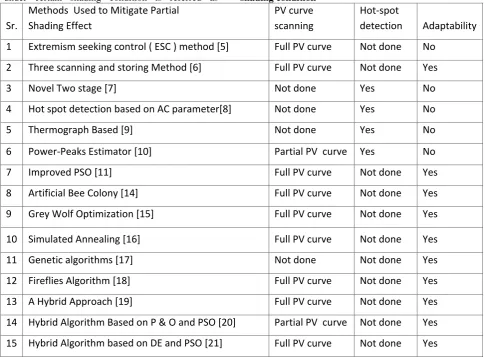
tracking efficiency. Various MPPT algorithms are analyzed based on way of PV curve .scanning method, hot spot detection and adaptability. Table 1.1 gives the analysis of MPPT methods.
Table 1: Sighting of MPPT methods under partial shading condition
Sr.
Methods Used to Mitigate Partial Shading Effect
PV curve scanning
Hot-spot
detection Adaptability
1 Extremism seeking control ( ESC ) method [5] Full PV curve Not done No
2 Three scanning and storing Method [6] Full PV curve Not done Yes
3 Novel Two stage [7] Not done Yes No
4 Hot spot detection based on AC parameter[8] Not done Yes No
5 Thermograph Based [9] Not done Yes No
6 Power-Peaks Estimator [10] Partial PV curve Yes No
7 Improved PSO [11] Full PV curve Not done Yes
8 Artificial Bee Colony [14] Full PV curve Not done Yes
9 Grey Wolf Optimization [15] Full PV curve Not done Yes
10 Simulated Annealing [16] Full PV curve Not done Yes
11 Genetic algorithms [17] Not done Not done Yes
12 Fireflies Algorithm [18] Full PV curve Not done Yes
13 A Hybrid Approach [19] Full PV curve Not done Yes
14 Hybrid Algorithm Based on P & O and PSO [20] Partial PV curve Not done Yes
15 Hybrid Algorithm based on DE and PSO [21] Full PV curve Not done Yes
5.
CONCLUSION
Segment based search methods require to scan the full PV curve and it will take more computational time. Defining the segments can add more delay to the process. Under fast varying atmospheric Conditions there may be an ambiguity in defining the segments. Random search methods are suitable for searching randomly distributed data. These methods need to scan the full PV curve and it will take more computational time. Random search methods are normally based on optimization techniques. Optimization techniques are mostly reliant on fitness function and population generation probability. Most precise fitness function and population generation probability will help to increase the accuracy. PV panel parameters affected by partial shading is not
considered in random search methods. Hot spot detection methods discover the hot spot .Based on hot spot detection global maximum power point is tracked. Adaptive optimization algorithm with hot spot detection is proposed here to increase the tracking speed and tracking efficiency.
6. REFERENCES
[1]. M. G. Villalva, J. R. Gazoli, and E. R. Filho (2009) Comprehensive approach to modeling and simulation of photovoltaic arrays IEEE Trans. Power Electron., vol. 24, no. 5, pp. 1198-1208.
Available online:
http://edupediapublications.org/journals/index.php/IJR/
P a g e | 30 Electronics, Signals, Communication andOptimization (EESCO),pp 1-6 .
[3]. M. D. Goudar, B. P. Patil, V. Kumar (2010) A Review of Improved Maximum Peak Power Tracking Algorithms for Photovoltaic Systems International Journal of Electrical Engineering and Technology (IJEET), Vol. 1, No. 1, pp. 72-94.
[4]. T. Esram and P. L. Chapman (2007) Comparison of Photovoltaic Array Maximum Power Point Tracking Techniques IEEE Trans. Energy Convers., vol. 22, no. 2, pp. 439–449.
[5]. P. Lei, Y. Li, and J. E. Seem (2011) Sequential ESC-based global MPPT control for photovoltaic array with variable shading IEEE Transactions on Sustainable Energy, vol. 2, no. 3, pp. 348–358.
[6]. N. Alajmi, K. H. Ahmed, S. J. Finney, B. W. Williams, and B. Wayne Williams (2011) A Maximum Power Point Tracking Technique for Partially Shaded Photovoltaic Systems in Micro grids” ,IEEE Transactions on Industrial Electronics, vol. 60, no. 4, pp. 1596–1606.
[7]. M. A. Ghasemi, H. M. Forushani, M. Parniani, and S. Member (2016) Partial Shading Detection and Smooth Maximum Power Point Tracking of PV Arrays Under PSC IEEE Transactions on Power Electronics, vol. 31, no. 9, pp. 6281–6292. [8]. P. T. K. Katherine A. Kim, Gab-Su
Seo,Bo-Hyung Cho (2016) Photovoltaic Hot-Spot Detection for Solar Panel Substrings Using AC Parameter Characterization”, IEEE Transactions on Power Electronics, vol. 31, no. 2, pp.1121–1130.
[9]. Y. Hu, W. Cao, S. Member, J. Wu, B. Ji, and D. Holliday (2014) Thermography-Based Virtual MPPT Scheme for Improving PV Energy Efficiency Under Partial Shading Conditions”, IEEE Transactions on Power Electronics, vol.29, no. 11, pp. 5667– 5672.
[10]. Y. Mahmoud and E. F. El-saadany (2016) Fast Power-Peaks Estimator for Partially Shaded PV Systems”, IEEE Transactions on Energy Conversion, vol. 31, no. 1, pp. 206– 217.
[11]. K. Ishaque, Z. Salam, M. Amjad, and S. Mekhilef (2012) An Improved Particle Swarm Optimization (PSO)-Based MPPT for PV With Reduced Steady-State Oscillation IEEE Transactions on Power Electronics, vol. 27, no. 8, pp. 3627–3638.
[12]. Liu, Yupeng, Dongwei Xia, and Zhanning He (2011) MPPT of a PV system based on the particle swarm optimizatioz 4th IEEE International Conference on In Electric Utility Deregulation and Restructuring and Power Technologies (DRPT), pp. 1094-1096.
[13]. M. A. Hassan and M. A. Abido (2011) Optimal design of microgrids in autonomous and grid-connected modes using particle swarm optimization IEEE Transactions on Power Electronics ,vol. 26, no. 3, pp. 755–769.
[14]. K. Sundareswaran, P. Sankar, P. S. R. Nayak, S. P. Simon, and S. Palani (2014) Enhanced Energy Output From a PV System Under Partial Shaded Conditions Through Artificial Bee Colony IEEE Transactions on Sustainable Energy, vol. PP, no. 99, pp. 1–12.
[15]. S. Mohanty, B. Subudhi, S. Member, and P. K. Ray (2016) A New MPPT Design Using Grey Wolf Optimization Technique for Photovoltaic System Under Partial Shading Conditions IEEE Transactions on Sustainable Energy, vol. 7, no. 1, pp. 181– 188.
[16]. Hadji, Slimane, J.Paul Gaubert, Fateh Krim(2015) Theoretical and experimental analysis of genetic algorithms based MMPT for PV systems Energy Procedia, vol. 74, pp. 772–787.
[17]. M.E. H. Lyden, Sarah (2016) A Simulated Annealing Global Maximum Power Point Tracking Approach for PV Modules Under Partial Shading Conditions IEEE Transactions on Power Electronics, vol. 31, no. 6, pp. 4171–4181.
[18]. K. Sundareswaran, S. Peddapati, and S. Palani (2014) MPPT of PV systems under partial shaded conditions through a colony of flashing fireflies IEEE Trans. Energy Convers., vol. 29, no. 2, pp. 463–472. [19]. M.D.Goudar, V. Kumar, Dr. B.P.Patil
(2012) Adaptive Based Approach for Single Phase AC Photovoltaic Modules under Partial Shading Condition International Journal of Electronics and Communication and Computer Engineering (IJECCE), vol. 3, no. 3, pp. 699-702.
Available online:
http://edupediapublications.org/journals/index.php/IJR/
P a g e | 31 Industrial Electronics, vol. 0046, no. 99,pp.1-10.