A preliminary study of the relationship between self-efficacy and cognitive load
on solving ill-structured problem
Shwu-Huey Wang
Department of Innovative Design and Entrepreneurship Management Far East University, Taiwan
*Correspondence to: [email protected]
Students often need to face a complicated case when trying to make a decision in the
class. Moreover, the related information that required solving the problem is usually
insufficient; meanwhile, the solutions of the problems are either multiple or not at all.
The study tries to explore the relationship between students’ self-efficacy and
cognitive load on solving ill-structured problems. A total of 90 questionnaires were
sent to undergraduate students to understand their attitude toward the issue. The
preliminary results indicated that there exists close relationship between students’
self-efficacy and cognitive load when solving ill-structured problemsABSTRACT
.
KEYWORDS: self-efficacy, cognitive load, solving ill-structured problem
Introduction
In the field of business education, students often need to face a complicated case
when trying to make a decision in the class. They have to choose a best alternative
among different situations. As researchers (Chi & Glaser, 1985) noted, ill-structured
problems are usually ill defined, open ended and connected with the real life. Moreover,
the related information that required solving the problem is usually insufficient;
meanwhile, the solutions of the problems are either multiple or not at all. For the
features stated above, students are all in a jumble and not knowing where or how to start
when solving ill-structured problems. Numerous researchers and educators were trying
hard to find out the way to help students on solving problems from the perspective of
instructional design in the past many decades.
Prior research(Shih,2006)reported that if students are confident in their learning,
they may perform as expected. In other words, if their self-efficacy is high, then their
ability of problem-solving may be increased simultaneously. Self-efficacy was defined
as:” People’s judgments of their capabilities to organize and execute courses of action
required to attain designated types of performance. It (self-efficacy) is concerned not
possesses. ” (Bandura, 1986: p. 193)It is a motivational factor that plays a critical role
on learning(McRobbie & Thomas, 2000; Roth & Tobin, 2001). Knowledge, skill, and
prior attainments are regarded as poor predictors of students’ subsequent achievements
because the beliefs that they hold toward their own ability to solve the problem can
powerfully influence their performance on problem-solving(Pajares, 1996).Therefore,
two students with the same ability and experiences , the one with higher self-efficacy
may outperform the other one.
On the other hand, as the prosperity of technology in the recent decades, computing
has become more and more prevalent in higher education, a lot of academic activities
(such as electronic database of library, courses related to computer, or the
accomplishments of assignments …, etc.)are facilitated through the device of computer.
Whether a student is skilled on using computer has become one of the important
criterions to evaluate his/her performance. According to Bandura’s work(1995), the
concept of self-efficacy can be applied in different domains. Computer self-efficacy can
be regarded as people’s judgment of their own abilities on computer. For dealing with
computer has become most of the students’ daily life, the higher the student’s computer
self-efficacy, the better the performance they may present.
Imagine a student is facing a complex problem with insufficient information and
the contents are highly interactive with other domain of knowledge, what kind of
procedure would the student adopt to facilitate him/her to reach the best solution?
Cognitive load theory provides a theoretical background for understanding the cognitive
process and instructional design, which may be helpful to answer the questions.
Cognitive load theory assumes that the processing ability of learner is limited; so it is
important to properly allocate the cognitive resource to enhance learning ability
otherwise too much mental burden may cause learning be hindered (Kalyuga, Chandler
& Sweller, 2001). Based on the statements above, one may wonder that what kind of
cognitive load does a student need to burden if s/he is with high self-efficacy when
solving ill-structured problem? Therefore, the objective of the study is to explore the
relationship between self-efficacy and cognitive load on solving ill-structured problems.
Self-efficacy
Self-efficacy means people’s judgment toward their ability to solve the problem, it
is an internal motivational factor that would have impacts on the problem-solving
performance. The belief of self-efficacy influences our daily lives in various domains
such as student’s learning outcomes(Pajares, 1996; Meece, Wigfield, and Eccles, 1990),
patient’s control over pain(Manning & Wright, 1983), and sportsman’s performance on
achievements because it can help to determine how much effort a man should spend on
the task and how long he should persist in doing the mission(Pajares, 1996). A man
with low self-efficacy would think that things are more difficult and complicated than
expected. In contrast, a man with high self-efficacy may usually perform than predicted.
In the past many years, self-efficacy has attached more and more attention on
evaluating academic achievements. Prior research (Lent, Brown, & Larkin, 1987;
Pintrich & De Groot, 1990)reported that self-efficacy is the most powerful factor in
forecasting students’ academic performance than any other internal motivation
component. As noted, students with high self-efficacy will tend to engage more energy
in a complicated case and hold on straight with it when they run into difficulties or
obstacles. In other words, students’ beliefs in efficacy can powerfully influence and
regulate their learning, control their academic activities, guide their level of motivation
and promote their academic accomplishments(Bandura, 1993).
Likewise, students with low sense of efficacy would be vulnerable to face
academic difficulties. Prior research (Meece, Wigfield, and Eccles, 1990) reported
that past academic experiences(no matter successes or failures)may produce anxiety
through their effects of self-efficacy. The unsatisfied achievements may decrease their
sense of efficacy and make them perturbed about academy. Therefore, students’
self-efficacy on academic program would effectively forecast their subsequent
academic performance, while the degree of anxiety does not have impacts on it.
Cognitive load and learning
Cognitive load theory emphasizes on the topics of learning contents and
instructional design on learner’s influence. Human’s working memory stores and
processes information. However, the capacity of working memory is limited, one can
process only two or three items of information at a time. Too much information may
cause the overburden of working memory and decrease its processing ability (Kalyuga,
Chandler & Sweller, 2001). Therefore, the design of instructional material should be
within the capacity of working memory to ensure the understanding by students. In
contrast, long-term memory, holds knowledge permanently and with unlimited capacity,
can overcome the limitations of working memory (Kirschner, 2002). The major function
of long-term memory is to store schemas, which can hold a vast amount of information. “Schemas are domain-specific knowledge structures that allow people to categorize multiple elements of information as a single element.” (Kalyuga, Chandler & Sweller,
2001:p.6) In other words, schema has the function of storing and organizing the
elements of information. The difference between expert and novice is that expert’s
of knowledge, whenever confronted with problems, expert can acquire solutions from
schemas right away (Sweller, Mawer, & Ward, 1983) and find out the best alternative
for solving the problem. Thus, the objective of instructional design is to build shema
and automation, and how to reduce the difficulty of information in working memory to
construct schemas is the critical issue of cognitive load theory.
From the perspective of instructional design, cognitive load theory provides
substantial theoretical framework to interpret the instructional structure. Intrinsic
cognitive load is one form of cognitive load and determined by the intrinsic character of
the instructional material or learning task itself. A very difficult material may
overburden learner’s intrinsic cognitive load and result in an inferior learning outcome.
Meanwhile, one cannot make changes in the degree of intrinsic cognitive load as “it is
determined by the interaction between the nature of the materials being learned and the
expertise of the learner” ( Merrienboer and Sweller, 2005, p.150). If the material is hard
to be understood depends on the amount of elements that need to be processed at the
same time and the interactivity among elements of the material. A material with high
element interactivity is difficult to understand and need to develop cognitive schemata
to integrate the high interacting elements. As ill-structured problems possess the
characteristics stated above, students usually have difficulties to deal with the
processing of ill-structured problem solving; therefore, the presentation of instructional
material would be a key factor to influence the students’ performance.
Extraneous load is another category of cognitive load; the unrelated information or
unnecessary load is the cause of extraneous load, which is alterable by the different
design of material. Conventional instructional design often imposes unrelated mental
load on students for it was not developed under the consideration of knowledge
structure or cognitive architecture(Paas, Renkl & Sweller, 2003). During the process of
problem-solving, students need to search for solutions or related information, so the
resources come from working memory have to be used. However, for the activity may
not be relevant to schema acquisition or automation, it may be the cause to overburden
of students’ extraneous cognitive load. In other words, instructional design should be
presented in a proper way to enhance learning but not add extra load on learners.
The other form of cognitive load is germane load or effective cognitive load.
Similar to extraneous load, germane load will also be influenced by instructional design;
it does not only increase learners’ cognitive load but also their learning efficiency. That
is, a designed instructional material will both increase student’s extraneous cognitive
load and germane load. However, extraneous cognitive load blocks students’ learning
while germane cognitive load facilitate learning(Paas, Renkl & Sweller, 2003).
Method
Participants
90 undergraduate students, who were registered in the course of Service
Marketing during a spring semester in last year at a university located in the south of
Taiwan were invited to participate the study.
Material and procedure
The participants were requested to fill out a self-reported questionnaire to
evaluate their self-efficacy and cognitive load toward the problem. The questionnaire
mainly consisted of two parts: Part one, the demographic part, recorded the subject’s
gender, age, and level of education; Part two measured the participant’s self-efficacy
and cognitive load.
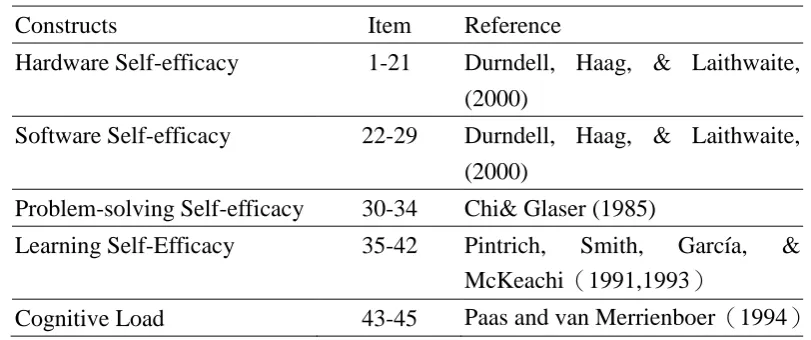
The questionnaire consisted of 45 items measuring the five different constructs,
which are presented in Table 1. The items of the first two constructs utilized the ones
developed by Durndell, Haag, & Laithwaite (2000) which was adapted from Torkzadeh
and Koufteros’s version of the Computer Self Efficacy scale(1994). Data of the first
two constructs were collected using a seven-point Likert-type scale, from 1 (not at all
true of me) to 7 (very true of me). The third construct was developed based on the
definition reported by Chi & Glaser (1985). The fourth construct was one of the
constructs that developed by Pintrich, Smith, García, & McKeachi(1991,1993). The
fifth construct was developed based on the model presented by Paas and van
Merrienboer(1994) to evaluate the participants’ mental load, mental effort and
performance. Data of the last three constructs were collected using a seven-point
Likert-type scale, from 1 (strongly disagree) to 7 (strongly agree). Then the instrument
was translated into Chinese by a bilingual professional to ensure its validity.
Table 1 Constructs of the scale
Constructs Item Reference
Hardware Self-efficacy 1-21 Durndell, Haag, & Laithwaite,
(2000)
Software Self-efficacy 22-29 Durndell, Haag, & Laithwaite,
(2000)
Problem-solving Self-efficacy 30-34 Chi& Glaser (1985)
Learning Self-Efficacy 35-42 Pintrich, Smith, García, &
McKeachi(1991,1993)
Operation measure
Hardware Self-efficacy: The participants were requested to answer the judgment of
their own abilities on computer hardware, such as how to initiate and operate computer
device and its peripheral equipment, the utilization of computer related information and
the understanding of computer language…etc. The higher the score, the higher the
respondents’ self-efficacy toward computer hardware.
Software Self-efficacy: The dimension measured the respondents’ personal evaluation
of their own capability on operating computer software, such as the organizing and
managing files, the using of computer program and the handling of minor trouble…etc.
The higher the score, the higher the respondents’ self-efficacy toward computer
software.
Problem-solving Self-efficacy: The participants were requested to express the
judgment of their own abilities on problem-solving. For the given problem is
ill-structured, the respondents were asked about their self-efficacy related to the
understanding of the problem and the certainty of problem-solving. The higher the score,
the higher the respondents’ self-efficacy toward problem-solving.
Learning Self-Efficacy: The construct was devised to evaluate the respondents’
self-evaluation toward the course. The higher the score, the higher the respondents’
self-efficacy toward the course.
Cognitive Load: The section measured the participants’ mental load, mental effort and
performance. The higher the score, the higher the respondents’ cognitive load toward
the given problem.
Conclusion
The preliminary results indicated that self-efficacy and cognitive load on solving
ill-structured problems are closely related. The higher the respondents’ self-efficacy, the
higher the cognitive load they hold. Future researchers may go further to explore and
References
Bandura, A. (1986). Social foundations of though and action. Englewood Cliffs, NJ:
Prentice-Hall.
Bandura, A. (1993). Perceived self-efficacy in cognitive development and functioning.
Educational Psychologist, 28(2), p.117-148.
Bandura, A. (1995).Self-efficacy in changing societies. Cambridge: Cambridge
University Press.
Barling, J., & Abel, M. (1983)Self-efficacy beliefs and tennis performance.
Cognitive Therapy and Research, 7, 265-272.
Chi, M.T.H.,& Glaser, R.(1985).Problem solving ability. In R.J.Stemberg (Ed.),
Human abilities: An information processing approach (pp. 227-250). New York: W.
H. Freeman and Company.
Duncan ,Teresa García; McKeachie ,Wilbert J. (2005)The Making of the
Motivated Strategies for Learning Questionnaire, Educational Psychologist, 40(2),
117–128
Durndell, A., Haag, Zsolt & Laithwaite, Heather(2000)Computer self efficacy and
gender: a cross cultural study of Scotland and Romania. Personality and Individual
Differences 28, P.1037–1044
Kalyuga, S., Chandler, P., & Sweller, J. (2001). Learner Experience and Efficiency of
Instructional Guidance. Educational Psychology, Vol. 21, No. 1, p5-23
Kirschner, Paul A.(2002). Cognitive load theory: implications of cognitive load theory
on the design of learning, Learning and Instruction 12, p1–10.
Lent, R. W., Brown, S. D., & Larkin, K. C. (1987). Comparison of three theoretically
derived variables in predicting career and academic behavior: Self-efficacy, interest
congruence, and consequence thinking. Journal of Counseling Psychology, 34 (3),
293–298.
Manning, M.M., & Wright, T.L.(1983)Self-efficacy expectancies, outcome
expectancies, and the persistence of pain control in childbirth. Journal of
Personality and Social Psychology, 45,421-431.
McRobbie, C. J., & Thomas, G. P. (2000). Changing the learning environment to
enhance explaining and understanding in a year 12 chemistry classroom. Learning
Environments Research, 3(3), 209–227.
Meece, J.L., Wigfield, A., & Eccles, J.S.(1990). Predictors of math anxiety and its
influence on young adolescents’ course enrollment intentions and performance in
mathematics. Journal of Educational Psychology, 82(1), 60-70.
Research, Vol.66, Iss.4, p.543-578.
Paas, Fred; Renkl, Alexander & Sweller, John(2003). Cognitive load theory and
instructional design: Recent developments, Educational Psychologist, 38(1), 1–4
Paas, F., & van Merriënboer, J. J. G. (1994). Instructional control of cognitive load in
the training of complex cognitive tasks. Educational Psychology Review, 6, 51–71.
Pintrich, P. R., & De Groot, E. (1990). Motivational and self-regulated learning
components of classroom academic performance. Journal of Educational
Psychology, 82(1), 33–40.
Pintrich, P. R., Smith, D. A. F., García, T., & McKeachie, W. J. (1991). A manual for
the use of the Motivated Strategies for Learning Questionnaire (MSLQ). Ann Arbor:
University of Michigan, National Center for Research to Improve Postsecondary
Teaching and Learning.
Pintrich, P. R., Smith, D. A. F., García, T., & McKeachie, W. J. (1993). Reliability and
predictive validity of the Motivated Strategies for Learning Questionnaire (MSLQ).
Educational and Psychological Measurement, 53, 801–813.
Roth, W., & Tobin, K. (2001). The implications of coteaching/cogenerative dialogue
for teacher evaluation: Learning from multiple perspectives of everyday practice.
Journal of Personnel Evaluation in Education, 15(1), 7–29.
Shih, Hung-Pin (2006) Assessing the effects of self-efficacy and competence on
individual satisfaction with computer use: an IT student perspective, Computers in
Human Behavior 22 (2006) 1012–1026
Sweller, J., Mawer, R., & Ward, M. (1983). Development of expertise in mathematical
problem solving. Journal of Experimental Psychology: General, 112 (4), 639–661.
Sweller, J., & Chandler, P.(1991). Evidence for cognitive load theory. Cognitive and
Instruction, 8(4), P.351-362
Torkzadeh,G., & Koufteros, X. (1994). Factoral validity of a computer self efficacy
scale and the impact of computer training. Educational and Psychological
Measurement, 54(3), 813–921.
Van Merri¨enboer, Jeroen J. G. and Sweller, John(2005)Cognitive Load Theory and
Complex Learning: Recent Developments and Future Directions, Educational