Available online:
https://edupediapublications.org/journals/index.php/IJR/
P a g e | 958Image Compression & Decompression using Discrete Wavelet
Transform (DWT) Approach
Amit Bhardwaj
& Ms. Mamta
1Department of Computer Science
South Point Institute of Technology and Management (SITM)
Deenbandhu Chhotu Ram University of Science & Technology (DCRUST), Sonepat
2Department of Computer Science
South Point Institute of Technology and Management (SITM)
Deenbandhu Chhotu Ram University of Science & Technology (DCRUST), Sonepat
Abstract— Image compression deals with reducing
the amount of data required to represent a digital image. Uncompressed multimedia (graphics, audio and video) data requires considerable storage capacity and transmission bandwidth. Despite rapid progress in mass-storage density, processor speeds, and digital communication system performance, demand for data storage capacity and data-transmission bandwidth continues to outstrip the capabilities of available technologies. The recent growth of data intensive multimedia-based web applications has not only sustained the need for more efficient ways to storage and communication technology. The problem inherent to any digital image is the large amount of bandwidth required for transmission or storage. Wavelets are becoming
attractive in image processing where high
computational performance and parallel architectures are required. In the research work, we are going to
implement 4-level wavelet based compression
algorithm.
Keywords— Discrete Wavelet Transform, Discrete
Cosine Transform, Haar wavelet.
I. INTRODUCTION
The amount of data associated with visual information is so large that its storage would require enormous storage capacity. Although the capacities of several storage media are substantial, their access speeds are usually inversely proportional to their capacity. Typical television images generate data rates exceeding 10 million bytes per second [1]. There are other image sources that generate even higher data rates. Storage and/or transmission of such data require large capacity and/or bandwidth, which could be very expensive. Image data compression techniques are concerned with reduction of the number of bits required to store or transmit images without any appreciable loss of information. Image transmission applications are in broadcast television; remote
sensing via satellite, aircraft, radar or sonar; teleconferencing; computer communications; and facsimile transmission. Image storage is required most commonly for educational and business documents, medical images used in patient monitoring systems, and the like. Because of their wide applications, data compression is of great importance in digital image processing.
For example, Frame with 352 x 288 contains 202,752 bytes of information. Recoding of uncompressed version of this video at 15 frames per second would require 3 MB, one minute 180 MB storage and 24-hours day 262 GB. Using compression, 15 frames/second for 24 hours 1.4 GB, 187 days of video could be stored using the same disk space that uncompressed video would use in one day. Transmission and storage of uncompressed video would be extremely costly and impractical [2].
In the research work, we are going to implement 4-level wavelet based compression algorithm. With wavelet image compression, parts of an image is described with reference to other parts of the same image and by doing so, the redundancy of piecewise self-similarity is exploited.
II. IMAGE COMPRESSION PRINCIPLES
Available online:
https://edupediapublications.org/journals/index.php/IJR/
P a g e | 959number of bits. The problem of transmitting or storing an image affects all of us daily. TV and fax machines are both examples of image transmission, and digital video players and web pictures are examples of image storage. Image compression is the process of reducing the amount of data required to represent an image. How to achieve compression means by removing the redundant information, we can achieve it. We have three types of redundancies [2]:
▪ Coding redundancy ▪ Inter pixel redundancy ▪ Psycho visual redundancy
1. Coding redundancy: Image is nothing but
combination of pixels and each pixel is represented in binary bits. The number of bits used to represent each pixel is based on number of gray levels used to represent the image.
2. Inter pixel redundancy: In an image each pixel depends on its neighbors. Information is unnecessarily replicates in the representations of the correlated pixels. Correlation of pixels means completely dependent on one another. Examples: In video, if frame rate is high then the successive frames contain almost same information. In still images, if spatial resolutions is high then inter pixel redundancy is high.
3. Psycho visual redundancy: Information that is ignored by human visual system or its extraneous to the intended use of an image are obvious candidates for omission. We can define compression ratio as ratio of original image size to the compressed image.
III. PROPOSED WORK
Image compression deals with reducing the amount of data required to represent a digital image. Uncompressed multimedia (graphics, audio and video) data requires considerable storage capacity and transmission bandwidth. Despite rapid progress in mass-storage density, processor speeds, and digital communication system performance, demand for data storage capacity and data-transmission bandwidth continues to outstrip the capabilities of available technologies. The recent growth of data intensive multimedia-based web applications has not only sustained the need for more efficient ways to storage and communication technology. The problem inherent to any digital image is the large amount of bandwidth required for transmission or storage. Wavelets [5] are becoming attractive in image processing where high computational performance and parallel architectures are required.
Image compression is a dynamically changing field with many different varieties of compression methods available. Images contain large amount of data hidden in them, which is highly correlated. A common characteristic of most images is that the neighboring pixels are correlated and therefore contain redundant information [6].
In this work we first study the existing image compression techniques. Next we present a new 4-level Discrete Wavelet Transform (DWT) for image compression. In wavelet image compression, parts of an image are described with reference to other parts of the same image. We can achieve high compression ratio in images using 4 level Wavelet Transform by applying different compression thresholds for the wavelet coefficients.
IV. DISCRETE WAVELET TRANSFORM
The wavelet transform (WT) has gained widespread acceptance in signal processing and image compression. Because of their inherent multi-resolution nature, wavelet-coding schemes are especially suitable for applications where scalability and tolerable degradation are important. Recently the JPEG committee has released its new image coding standard, JPEG-2000, which has been based upon DWT [7].
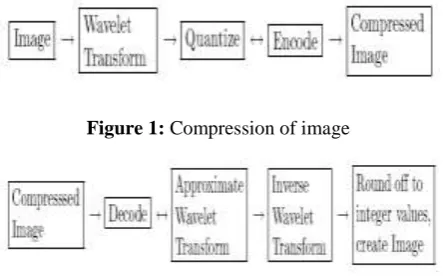
The basic structure of baseline wavelet based coder is illustrated in figure 1 and 2. This structure is the skeleton for all wavelet based algorithms. It consists of two parts, the encoder and decoder. The encoder consists of four processes: wavelet transform, quantization, and encoder. The decoder has the inverse operations of encoder.
Figure 1: Compression of image
Figure 2: De-Compression of image
Available online:
https://edupediapublications.org/journals/index.php/IJR/
P a g e | 960Despite all the advantages of JPEG compression schemes based on DCT namely simplicity, satisfactory performance, and availability of special purpose hardware for implementation; these are not without their shortcomings. Since the input image needs to be ``blocked,'' correlation across the block boundaries is not eliminated. This results in noticeable and annoying “blocking artifacts'' particularly at low bit rates. Lapped Orthogonal Transforms (LOT) attempt to solve this problem by using smoothly overlapping blocks. Although blocking effects are reduced in LOT compressed images, increased computational complexity of such algorithms do not justify wide replacement of DCT by LOT.
Over the past several years, the wavelet transform has gained widespread acceptance in signal processing in general and in image compression research in particular. In many applications wavelet-based [8] schemes (also referred as subband coding) outperform other coding schemes like the one based on DCT. Since there is no need to block the input image and its basis functions have variable length, wavelet coding schemes at higher compression avoid blocking artifacts. Wavelet-based coding is more robust under transmission and decoding errors, and also facilitates progressive transmission of images. In addition, they are better matched to the HVS characteristics. Because of their inherent multi resolution nature [6], wavelet coding schemes are especially suitable for applications where scalability & tolerable degradation are important.
B. Haar Wavelet Transform
Wavelets are mathematical functions that were developed by scientists working in several different fields for the purpose of sorting data by frequency. Translated data can then be sorted at a resolution which matches its scale. Studying data at different levels allows for the development of a more complete picture. Both small features and large features are discernable because they are studied separately. Unlike the Discrete Cosine Transform, the wavelet transform is not Fourier-based and therefore wavelets do a better job of handling discontinuities in data. In this thesis we would be employing Haar wavelet transform for image compression [10].
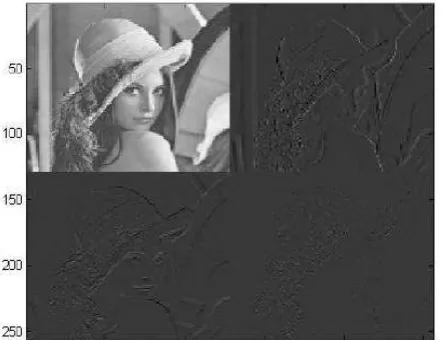
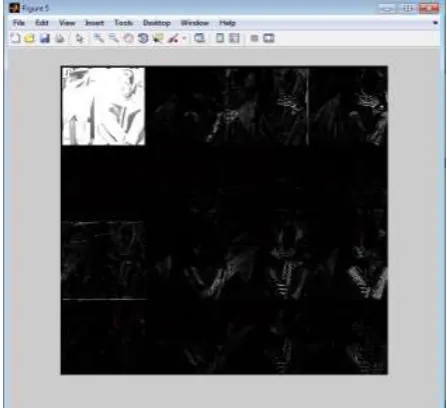
One nice feature of the Haar wavelet transform is that the transform is equal to its inverse. As each transform is computed the energy in the data in relocated to the top left hand corner; i.e. after each transform is performed the size of the square which contains the most important information is reduced by a factor of 4 (shown in figure 3, 4, 5 & 6).
Figure 3: The image “lena” after one Haar wavelet transform
Available online:
https://edupediapublications.org/journals/index.php/IJR/
P a g e | 961Figure 5: The image “lena” after three Haar wavelet transform
Figure 6: The image “lena” after fourth Haar wavelet transform
VI. RESULTS &DISCUSSION
The proposed algorithm is tested in MATLAB [11] for popular Internet image Barbara & following results are obtained. The figure 7 shows original Barbara.png image. The image size is 182kb & image dimensions are 512 x 512.
Figure 7: Original image of Barbara.png (182 kb)
Figure 8 shows the compressed image of Barbara after applying 1st discrete wavelet transform.
Figure 8: The compressed image of Barbara after applying discrete wavelet transform on columns.
Figure 9 shows the compressed image of Barbara after applying second haar discrete wavelet transform.
Figure 9: The compressed image of Barbara after applying 2nd haar discrete wavelet transform.
Available online:
https://edupediapublications.org/journals/index.php/IJR/
P a g e | 962Figure 10: The compressed image of Barbara after applying 3rd haar discrete wavelet transform.
Figure 11 shows the compressed image of Barbara after applying 4th haar discrete wavelet transform.
Figure 11: The compressed image of Barbara after applying 3rd haar discrete wavelet transform.
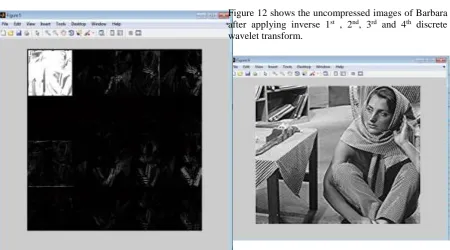
Figure 12 shows the uncompressed images of Barbara after applying inverse 1st , 2nd, 3rd and 4th discrete
wavelet transform.
Figure 12: The reconstructed uncompressed image of Barbara
V.CONCLUSION
Uncompressed graphics, audio and video data require considerable storage capacity and transmission bandwidth. In the work, we are going to implement 4-level wavelet based compression algorithm. Wavelet analysis is very powerful and extremely useful for compressing data such as images. Its Power comes from its multi-resolution. Although other transforms have been used, for example the DCT was used for the JPEG format to compress images; wavelet analysis can be seen to be far superior. This is because the wavelet analysis is done on the entire image rather than sections at a time. A well known application of wavelet analysis is the compression of fingerprint images by the FBI.
REFERENCES
[1] R. C. Gonzalez and R. E. Woods, “Digital Image Processing”, Addison Wesley, 2004.
[2] David Salomon, “Data Compression, The Complete Reference”, 2nd Edition, Springer-Verlag.
Available online:
https://edupediapublications.org/journals/index.php/IJR/
P a g e | 963[4] A. M. Raid, W. M. Khedr, M. A. El-dosuky and Wesam Ahmed, “Jpeg Image Compression Using Discrete Cosine Transform - A Survey”, International Journal of Computer Science & Engineering Survey (IJCSES) Vol.5, No.2, April 2014.
[5] Anuj Bhardwaj, Rashid Ali, “Image Compression Using Modified Fast Haar Wavelet Transform”, World Applied Sciences Journal, Vol. 7, No. 5, pp. 647-653, 2009.
[6] Bhawna Gupta Manju Gupta Banita Chadha “Image Compression Technique under JPEG by Wavelets Transformation”, International Journal of Advanced Research in Computer Science and Software Engineering, Volume 4, Issue 6, June 2014
[7] Bhonde Nilesh, Shinde Sachin, Nagmode Pradip, D.B. Rane, “Image Compression Using Discrete Wavelet Transform”, International Journal of Computer Technology and Electronics Engineering (IJCTEE) Volume 3, Special Issue, March-April 2013.
[8] K. Rajakumar and T. Arivoli, “Implementation of Multiwavelet Transform coding for lossless image compression”, IEEE, pp. 634-637, 2013.
[9] S. Dharanidharan , S. B. Manoj kumar and D. Senthil kumar, “Modified International Data Encryption Algorithm using in Image Compression Techniques”, IJESIT , pp. 186-191,2013.
[10] Zhang Ning and Zhu Jinfu “Study on Image Compression and Fusion Based on the Wavelet Transform Technology”, International Journal on Smart Sensing and Intelligent Systems Vol. 8, No. 1, March 2015.