CFD ANALYSIS OF SHELL AND TUBE HEAT
EXCHANGER FOR PRE-HEATING OF BIODIESEL
Araavind S
1, Adithya Suresh Athreya
21,2
UG Student, Mechanical Engineering, SRM University, Kattankulathur, Chennai (India)
ABSTRACT
The objective of this work is to improve the performance characteristics of a high viscous non-edible vegetable
oil as alternative fuel to diesel fuel. The pre-heating process of fuel is used to reduce the viscosity of high
viscous fuels. A double pipe heat exchanger is used to operate using the heat of engine exhaust. A bypass valve
is used to control the mass flow rate of exhaust gas to heat exchanger. A single cylinder diesel engine is used for
testing. The necessary arrangements are done to attach the heat exchanger to engine. The engine is tested with
biodiesel. The heat exchanger design is made using CATIA V5 software. The heat exchangers are analyzed
using ANSYS FLUENT. The results are compared and the suitable heat exchanger is proposed.
Keywords: Preheating, heat exchanger, CFD simulations, double pipe heat exchanger.
I. INTRODUCTION
The fossil fuels are our main source for producing energy. The rapid depletion of usage of fossil fuels has
initiated many to find other forms of sources. Not only that, the side effects of using fossil fuels like global
warming has also made us to look for an Eco-friendly source. There are lot of options to consider like solar,
wind, hydro, etc. But among, these one of the major source is bio fuels. These oils have similar properties to
diesel fuel and have high cetane value and produce low emissions compared to the traditional fuels. It can be
produced easily and relatively faster compared to the fossil fuels which take centuries to be produced.
Though bio fuel seems to be a viable replacement for the traditional fuels but there is a problem of high
viscosity when compared to that of diesel and petrol. Due to this high viscosity, the mixing of fuel and air
wouldn’t take place properly which results in improper combustion, ignition delay period and poor cold start-up
of the engine. The previous study on the increasing the temperature and its effect on the fuel properties and
II. DESIGN OF HEAT EXCHANGER
Preheating vegetable oil is done by using a shell and tube type heat exchanger. The exhaust of the engine is sent
into pre-heater where hot exhaust gases circulate around a tube containing no edible high viscous fuel. As
copper had thermal conductivity it is used for tube. The shell should be strong enough to withstand high
temperature and pressure of exhaust gases, and have strong sheet metals like stainless steel is used. We will
insulate the shell by air gap.To design heat exchange following data is required:Temperature of engine exhaust
which varies from 130 C to 470 C. Mass flow rate of fuel is 0.127 to 0.35 gm/sec. Exhaust flow rate 8 to 10
gm/sec. Temperature of oil heated is 30 C to 100C.Properties of neat oils such as viscosity, density and
calorific value are determined with the suitable tests.Tube material for oil is copper and heat exchanger is made
of 316 grade stainless steel.Based on the engine requirement the shell tube diameter was selected to be 38 mm,
the tube inner and outer diameter was taken as 5mm and 6mm. Shell material is stainless steel and tube material
is copper.Calculation of Reynolds number was carried out. But the Reynolds number is greater than 2300.
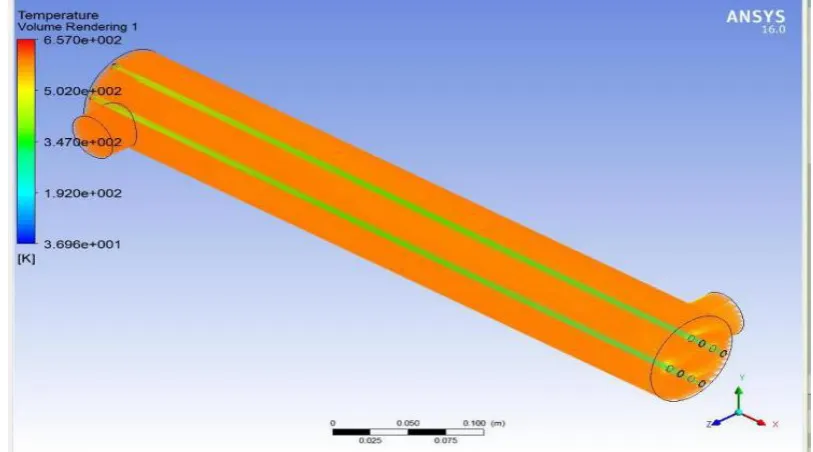
Hence, we used the Dittus-Boelter correlation. CFD Post Processing Result Heat Dissipation for the respective
heat exchangers are shown in Figures 1 – 5.
Fig.2.Heat Dissipation Single Pass Parallel Flow
The heat transfer coefficient was found to be 44.265 W/m2K.Tube side heat transfer coefficient is found
similarly. Since, the flow inside the tube is laminar, Nusselt number is fixed and as the heat transfer is assumed
to be constant heat flux, heat transfer coefficient from this is 131.76 W/m2K.The overall heat transfer coefficient
is 31.5428 W/m2K. The LMTD for this type comes out to be 252.65 C Then, the heat transfer rate q is found out
to be 72 W. Hence, the length of the tube is found out to be 53cm.The input conditions for each and every
design are same so that the different tubescan be studied and compared.The input conditions are inlet
Fig. 4. Heat Dissipation for Counter Flow Heat Exchanger
Table 1. Heat dissipation results of heat exchangers
Type of heat
exchangers
Point at which
temperature is
measured
Measured
temperature
Multi-pass
Cold inlet - outlet 305K -407 K
Hot inlet - outlet 600K – 492 K
Single pass
parallel flow
Cold inlet 1 -4 312K
Cold outlet 1 -4 340K
Hot inlet – outlet 600K -534 K
Single pass
counter flow
Cold inlet 1-4 303K
Cold outlet 1-4 341K
Hot inlet - outlet 600K -534 K
Counter flow Cold inlet 309K
Cold outlet 348K
Hot inlet - outlet 600K – 553 K
Parallel flow Cold inlet -outlet 313K -345 K
III. CONCLUSIONS
As the temperature of the bio diesel coming out is increased, the viscosity will be reduced and hence it’ll have
better combustion rate than bio diesel without any preheating.After performing many experiments on the heat
exchangers available, we have come to an understanding that the multi-pass shell and tube heat exchanger
shows comparatively better results. The maximum temperature difference observed in the bio diesel that flows
in the shell and tube heat exchanger. With maximum change in temperature, significant change in the viscosity
would occur. The pre-heated temperature and lower viscosity, the performance of engine is likely to improve.
This is observable only when steady state is reached, as the same fuel is used initially ready for the combustion
in the engine.
REFERENCES
[1] D. Agarwal, A.K. Agarwal, Performance and emissions characteristics of Jatropha oil (preheated and
blends) in a direct injection compression ignition engine. Appl. Therm. Eng. (2007), 27(13), pp. 2314–
2323.
[2] B. Esteban, J.R. Riba, G. Baquero, A. Rius, R. Puig, Temperature dependence of density and viscosity of
vegetable oils. Biomass Bioenergy (2012), 42, pp. 164–171.
[3] Praveena V, Senthil R, Prabhat Kumar, 'Optimization of lift to drag ratio in a horizontal axis wind turbine
Blade profile using CFD', Journal of Chemical and Pharmaceutical Sciences (2016), 9 (4), pp. 3076-3078.
[4] R Senthil, M Subramanian, P Sundaram, 'CFD Simulation of Phase Change Material in a Concentric
Thermal Storage', Journal of Advanced Research in Dynamical and Control Systems (2017), 9 (3), pp.
126-131.
[5] J Thavamani, R Senthil, V Rajasekar, 'Experimental and CFD analysis of Shell and tube heat exchanger',
Journal of Chemical and Pharmaceutical Sciences (2017), 10 (1), pp. 84 -86.
[6] Senthil, R., Cheralathan, M., ‘Effect of non-uniform temperature distribution on surface absorption
receiver in parabolic dish solar concentrator’, Thermal Science (2015) doi: 10.2298/TSCI150609169S.
[7] Senthil, R., Cheralathan, M., ‘Effect of PCM in a solar receiver on thermal performance of parabolic dish
collector’, Thermal Science (2016) doi: 10.2298/TSCI150730007S.
[8] Ramalingam Senthil, Marimuthu Cheralathan, ‘Effect of Once-Through and Recirculated Fluid Flow on
Thermal Performance of Parabolic Dish Solar Receiver’, Indian Journal of Science and Technology
(2016), 9 (33), doi: 10.17485/ijst/2016/v9i33/89084.
[9] Ramalingam Senthil, Marimuthu Cheralathan, ‘Natural heat transfer enhancement methods in phase
change material based thermal energy storage’, International Journal of ChemTech Research (2016), 9
(5), pp. 563-570.
[10] Ramalingam Senthil, Marimuthu Cheralathan, ‘Enhancement of heat absorption rate of direct absorption
solar collector using graphite nanofluid’, International Journal of ChemTech Research(2016), 9 (9), pp.
303-308.
[12] R Senthil, M Cheralathan, Thermal performance of solid and liquid energy storage materials in a
parabolic dish solar cooker, International Journal of Chemical Sciences 2016, 14 (4), pp. 1977-1983.
[13] R Senthil, M Cheralathan, Effect of container size on thermal performance of sugar alcohol (D-Mannitol)
in concentrated solar receiver, International Journal of Chemical Sciences (2016), 14 (4), pp. 2349-2357.
[14] P. Sundaram, R. Senthil, Thermal performance enhancement of solar parabolic trough collector using
secondary reflector, International Journal of Engineering and Technology (2016), 8 (6), pp. 2964-2969.
[15] Senthil R, Cheralathan M, Energy and exergy analysis of a parabolic dish concentrated solar receiver
with integrated PCM, International Journal of Advance Research in Science and Engineering (2016), 5
(10), pp. 117-121.
[16] A Sekharan, P Sundaram, R Senthil, 'Experimental Investigation on Latent Heat Storage for Space
Heating using Concentrated Solar Collectors, International Journal of Chemtech Research (2017), 10 (1),