1447 | P a g e
USING SWARM INTELLIGENCE TECHNIQUE IN
RZLEACH FOR WIRELESS SENSOR NETWORKS
Devender Kumar
1, Dr. Anil
2, Dr. Pankaj Kumar Verma
3 1Research Scholar, Department of Computer Science
23Associate Professor, Department of Computer Science
NIILM, Kaithal, Haryana, (India)
ABSTRACT
The WSN comprises of vast amount of sensor nodes and a Sink or Base Station (BS) situated under the area of examination. Sensors are placed in random fashion i.e. with no planning in the region under examination, so in this case to be able to communicate with entire network they must adjust themselves means they must configured themselves. Sensor nodes possess a negative characteristic of limited energy which pulls back the network from exploiting its peak capabilities. Hence, it is necessary to gather and transfer the information in an optimized way which reduces the energy dissipation. In this review paper we analyse the cluster head selection using neural network and routing is done via ant colony optimization technique.
Keywords: Wireless Sensor Networks, Base Station, Cluster Head Selection, Neural Network , Ant
Colony Optimization.
I. INTRODUCTION
1448 | P a g e
Figure1. Sensor network architectureA. Sensor Node
Sensor node is the important component of WSN because of its multiple role features. It senses data,
stores data, routes data and processes data.
B. Clusters
Clusters are small manageable units which simplify tasks such a communication
.
Figure2. Nodes are organized in independent clusters
C.
Cluster Heads
Cluster heads are the leader who organizes cluster activities. It collects data from several sensor nodes and then aggregates those data and also organizes the schedule of a cluster for communication with BS.
D. Base Station
Base station [5] is a central component which collects data from several nodes distributed at different locations. The deployment of base station is also a critical issue of WSN. It acts as an intermediate between the network and end-user.
E. End User
1449 | P a g e
II.
CLUSTERING
In clustering, groups are formed and each group has one leader called Cluster Head (CH).Group members or we can say cluster members sends their data to CH and then CH sends that data to BS. Various algorithms were proposed to reduce energy consumption of sensor. LEACH algorithm is an efficient clustering algorithm. It is one of the first and most popular clustering protocol proposed for WSNs. it s the dynamic clustering protocol based on the assumption that all the sensors are homogeneous.
2.1 Clustering Objectives
Various objectives have now been pursued by various literatures in developing clustering structure for WSN. Many objectives are set to meet the application constraints. This part provide three main objectives that are strongly related the focus with this thesis.
Maximizing network Life-time
Fault-tolerance
Fill handling
2.2 Cluster Homes
(i) Cluster Count: Cluster brains are prearranged in a number of the approaches. Therefore, the numbers of clusters are fixed. Cluster head collection formulas generally pick arbitrarily group brains from the implemented detectors ergo yields variable number of clusters.
(ii) Intra-cluster topology: Several clustering schemes derive from primary transmission between an alarm and its picked group head, but occasionally multi-hop sensor-to-cluster head connection is necessary.
(iii) Connectivity of group visit base stop: Cluster brains transmit the aggregated knowledge to the base stop immediately or ultimately with help of other group head nodes. It indicates there exists a primary url or a multi-hop link.
2.3 Cluster Head Variety Standards
i.
Original energy
To select the initial energy group head is a significant parameter. When
any algorithm begins it usually thinks the initial energy.
ii.
Recurring energy
after a number of the times are done, the group head collection must be
on the basis of the energy left out in the sensors.
iii.
Average energy of the network
: This energy is used whilst the guide energy for every
node. It's the ideal energy that all node must possess in current circular to help keep the
1450 | P a g e
III.CLUSTERING
TECHNIQUE
3.1 LOW ENERGY ADAPTIVE CLUSTERING HIERARCHY (LEACH)
LEACH (Low Energy Adaptive Clustering Hierarchy), the proposed algorithm[7,8] is split into two stages: Setup Stage and Steady State Stage. The setup phase consists of 3 stages: Task Ordination (TO), Cluster Setup, and Scheduling. In Task Ordination Stage: each node is assumed to be a NN (Normal Node). A node decides to become a CH based on the percentage of existing CHs (between 5% to 10%), the number of times that the node has been selected as CH and its level of energy. If the energy level of node is more than or equal to the average energy of all nodes, then that node can participate in CH selection. If the node does not have the required energy (means less energy) then it will cause a delay of 1/p (where p is the desired CH %) in rounds.
Set-up Phase
In Set up phase, each node selects an arbitrary number from the range of 0 to 1. If the selected number is less than the threshold criteria then that node is selected as Cluster head for that round and the criteria is represented by the equation 1.1 as
Here Econ = Node residual energy to become Cluster head
P = percentage of cluster nodes
r =Present round
After the selection of cluster heads nodes are attached to the nearby cluster heads and time slots are divided equally among the nodes using TDMA.
Steady state Phase
At the end of set up phase, when the CHs are chosen and TDMA slots are assigned to each node, steady state phase begins. In this phase each node start sensing the environment, capturing the events, and transmitting the data to the associated cluster heads. The cluster heads aggregates the data to remove the redundant bits and forward the data to the
distant base station. A new round begins after the completion of steady
state phase.
IV.
MOBILE
SINK
(MS)
1451 | P a g e
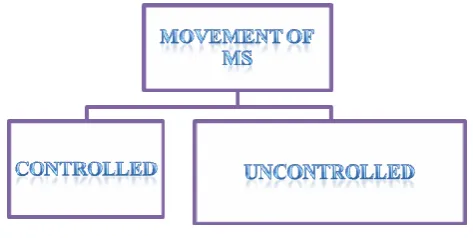
LEACH[1], decreases the transmission distance thus increases the lifetime of network. Sink movement may be controlled or un-controlled. In controlled MS, the MS trajectory is predefined while in uncontrolled MS, the sink moves randomly in a pre-determined environment.
Figure3. Types of mobile sink
V.
RENDEZVOUS
NODE
As MS cannot be closed to all the nodes for collecting data. So a new idea has been developed called Rendezvous Node (RNs) [4,6]or Rendezvous Point (RPs). The RP is a point near the trajectory of MS and a node located nearby. This node transmits data to MS as it passes nearby. The MS sends signals called beacons that notify the RNs of the MS arrival. The advantage of RZ is that it reduces the energy consumption to a great extent. The most important condition for RZ is the distance from the MS trajectory i.e.
If ym/2 (1+Rx) <= yi<= ym/2 (1-Rx)
Where ym = width of sampling region
yi = location of node in y-direction
Rx = constant related to the width of region <1
In order to reduce energy consumption and to increase the lifetime of sensor node or network, various routing techniques or optimization techniques have been developed based on nature inspired concepts i.e. Evolutionary (EA) and Swarm Optimization techniques.
1452 | P a g e
VI.
HOPFIELD
NEURAL
N/W
Hopfield Neural Network is proposed by John Hopfield in 1982.
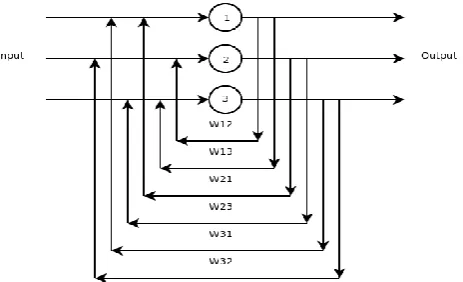
It is a fully connected, Single layer auto associative network.(Means it has only one layer , with each neuron connected to every other neuron).
All the neurons act as input and output.
The inputs to the neural network can either be -1 or 1 and the outputs will also be either one of those two values.
It will use to select the cluster head in WSN.
Figure 5. Structure of Neural Network
VII.
OPTIMIZATION
TECHNIQUES
7.1 ACO (Ant Colony Optimization)
ACO is a Member of swarm optimization technique, Developed by Marco Dorigo (1991 Phd thesis). It is basically a technique to find the shortest path between source and destination. It mimics the behaviour of natural ants.
Algorithm
At first ants moved randomly when food source is found ants walk back to the colony leaving markers (pheromones) that show the path has found when other ants come across these markers.
They are likely to follow the same path with certain probability. If they do then they populate the path with their own markers as they bring the food back. The path gets stronger as many ants follow the same path, as the ants drops pheromones every time they bring their food. In the mean time some ants are still randomly searching for closer food source. A similar approach can be used to find near optimal solution to the travelling salesman problem. Once the food source is depleted the root has no longer pheromones and slowly starts decaying
.
Advantages
1453 | P a g e
2. Used in various dynamic applications 3. Positive feedback leads to good solution. 4. React quickly
Disadvantage
1. quite slow
VIII.
CONCLUSION
In this paper, we have studied the ACO technique which is best for solving the path problem which enhances the performance of network. This work has focused on evaluating the performance of rendezvous nodes based LEACH protocol. The overall goal is to find the effectiveness of the rendezvous nodes based LEACH when ACO inter-cluster data aggregation is applied on it. In future work, we can implement some other optimization technique on cluster head selection and also work on WSN 3D environment.
REFERENCES
[1] Mottaghi, Saeid, and Mohammad Reza Zahabi. "Optimizing LEACH clustering algorithm with mobile sink and rendezvous nodes." AEU-International Journal of Electronics and Communications 69, no. 2 (2015): 507-514.
[2] Yu Gu; Inf. Syst. Archit. Sci. Res. Div., Nat. Inst. of Inf., Tokyo, Japan ; Yusheng Ji;Jie Li;Baohua Zhao. “Efficient Scheduling for the Mobile Sink in Wireless Sensor Networks with Delay Constraint”,IEEE Trans Parallel Distrib System 2013;24(july(7)):pp 1310-20.
[3] Wang Liu; Dept. of Comput. Sci., Univ. of Sci. & Technol. of China, Hefei, China ; Kejie Lu; Jianping Wang ; Guoliang Xing, “Performance Analysis of Wireless Sensor Networks With Mobile Sinks” IEEE Trans Veh Technol 2012;61(July(6)):2777-88.
[4] Konstantopoulos, C; Dept. of Inf., Univ. of Piraeus, Piraeus, Greece ; Pantziou, G.; Gavalas, Damianos; Mpitziopoulos, A. “A Rendezvous-Based Approach Enabling Energy-Efficient Sensory Data Collection with Mobile Sinks In:IEEE Trans Parallel Distrib System 2012;23(may(5)):pp 809-17.
[5] Weifa Liang; Sch. of Comput. Sci., Australian Nat. Univ., Canberra, ACT, Australia ; Jun Luo;Xu Xu. “Prolonging Network Lifetime via a Controlled Mobile Sink in Wireless Sensor Networks” In: Global telecommunication conference (IEEE GLOBECOM 2010),2010,December. pp.1-6
[6] Guoliang Xing;City Univ. of Hong Kong, Kowloon ; Tian Wang;Zhihui Xie;Weijia Jia.“Rendezvous Planning in Mobility-Assisted Wireless Sensor Networks” Trans Mob Comput 2008;7(December(12)):pp 1430-43.
[7] Kumar,G.S;Dept. of Comput. Sci., Cochin Univ. of Sci. & Technol., Cochin ; Vinu Paul,M.V;Jacob K.P. “Mobility Metric based LEACH-Mobile Protocol“ In:16th international conference on advanced computing
1454 | P a g e
[8] liu B ,Bras P,Dousse O,Nain P, “Mobility Improves Coverage of Sensor Networks” In:proceedings of the 6th ACM international symposium on mobile ad hoc networking and computing, 2005.pp.300-8
[9] Heinzelman,W.R;MIT,Cambridge,MA,USA;Chandrakasan,A;Balakrishnan,H. “Energy-efficient communication protocol for wireless microsensor networks” In:IEEE international conference on system sciences, 2000.pp10-20.