N T Rangari*1, T M Kalyankar2, P K Puranik3 and S R Chaudhari1
1. Amrutvahini College of Pharmacy, Sangamner, Ahmadnagar, Maharashtra, India. 2. School of Pharmacy, SRTM University, Nanded, Marathwada, India. 3. Government College of Pharmacy, Aurangabad, Marathwada, India. *Corresponding author’s E-mail: [email protected]
Accepted on: 29-06-2012; Finalized on: 31-08-2012. ABSTRACT
In pulsatile drug delivery system is rapid and transient release of active drug constituent from dosage form within a short time-period. Various techniques are available for the pulsatile delivery like time dependent, pH dependent, micro-flora activated systems etc. which is designed according to physiology of disease dosage required and properties of the drug molecule. The focus of this review is primarily on the pulsatile drug delivery methodologies and the upcoming technologies, which are being exploited on an industrial scale.
Keywords: Pulsatile drug delivery, Drug delivery systems.
INTRODUCTION
The emphasis of pharmaceutical research is going towards the development of more effective drug delivery systems using already existing molecule rather than going for new drug discovery. Traditionally drug delivery is utilized for getting a simple active content absorbed in predictable manner from the gut or site of injection. Efforts have been made to design the drug delivery system which will release the drug at constant rate. But still for many drugs, this system is not suitable because of a number of reasons for example due to metabolic degradation. First pass effect is responsible for reduction in the bioavailability of the drug. Gradual release results in more degradation. Secondly a drug with short half-life requires increased dosing frequency which results non-compliance by patient. While in case of chronic treatment, where the drug is given in sustained release dosage form, continuous exposure of the drug to body may lead to side effect. In case of diabetes mellitus chronic treatment is required which is given with sustained release formulations of drugs for e.g. sulfonylurea. Such drugs will damage the pancreas earlier than the similar immediate release dosage form. Drugs showing tolerance should not be delivered at a steady rate because the drug effect gets lowered with time at constant drug level. 1 Also drug toxicity increases with time when drug levels are constant. In such cases it is important to select such a dosage form which will provide required concentration of drug at fixed point of time only. Recent research is focused on design and evaluation of such drug delivery systems that release active constituent at a rhythm which ideally matches the biological requirement of a treatment.
DISEASES REQUIRING PULSATILE DRUG DELIVERY
Complete understanding of the disease physiology is first requirement before designing the pulsatile drug delivery system. Asthma is one such disease where pulsatile drug
delivery system can be helpful. Circadian changes are observed in normal lung function, which attains a low point in the morning hours. In cardiovascular diseases, several functions of the cardiovascular system play important role in circadian rhythms. Capillary resistance and vascular reactivity is increasing in morning and decrease later day. Agreeability of platelet is increased and fibrinolytic activity is getting lowered in morning. This results in state of relative hypercoagulability of the blood. Alteration in circadian of glucose and insulin in diabetes have been extensively studied and their clinical importance in case of insulin substitution in type 1 diabetes has been well exploited. Furthermore diverse directions of circadian changes in lipid fractions in patients and normal subjects may contribute to alteration in the rhythmcity of other metabolisms and in the blood coagulation system, thus leading to various complications. A circadian rhythm occurs during hepatic cholesterol synthesis.2
Diseases targeted for pulsatile technology
Now treatment of diseases presently targeted for chronopharmaceutical formulations those for which are enough scientific backgrounds to justify PDDS as compared to the conventional drug administration approach, these include: diabetes, neurological disorders, asthma, cancer, duodenal ulcer, arthritis, cardiovascular diseases hypercholesterolemia and colonic delivery. The rationale for chronotherapy of pulsatile release for each of these diseases will be briefly reviewed below.
Hypercholesterolemia
Diverse directions of circadian changes in lipid fractions in patients and normal subjects may contribute to alteration in the rhythm of other metabolisms and in the blood coagulation system, thus leading to various complications. A circadian rhythm occurs during hepatic cholesterol synthesis. Cholesterol synthesis is usually
PULSATILE DRUG DELIVERY SYSTEM: CURRENT SCENARIO
International Journal of Pharmaceutical Sciences Review and Research Page 61 larger during night than day. The production is maximum
in early morning, i.e. after 12 hours of the last meal. Asthma
Pathogenesis and treatment of asthma indicates that airway resistance is greater at night in asthmatic patients. Circadian changes are observed in normal lung function,
these changes reaches at lower point in the early morning hours. As broncho constriction and exacerbation of symptoms vary in a circadian fashion, asthma is well suited for chronotherapy. Chronotherapies have been studied for asthma with oral corticosteroids, theophylline, and B2-agonists.
Table 1: Diseases requiring pulsatile drug delivery
Disease Chronological behavior Drugs used
Peptic ulcer Acid secretion is high in the afternoon and at night H2 blockers
Asthma Precipitation of attacks during night or at early morning hours β2 agonist, Antihistaminics
Cardiovascular diseases
BP is at its lowest during sleep cycle and rises rapidly during the early morning awakening blocker, Period
Nitroglycerin, Calcium channel ACE inhibitors etc.
Arthritis Pain in the morning and more pain at night NSAIDs, Glucocorticoids
Cancer 3
Human and animal studies shown that chemotherapy is more effective and less toxic. If anti-cancer drugs are administered carefully at selected times then target is only tumor cell and not normal tissue. Daily blood flow to tumors was threefold greater during each daily activity phase of the circadian cycle than during the rest phase. The chronotherapy technique offers possibilities for improvement of current cancer-treatment options. It also helpful for optimizing the development of supportive or new anticancer agents.
Duodenal ulcer
Many of the functions of the gastrointestinal tract are subject to circadian rhythms: gastric acid secretion is highest at night, while gastric and small bowel motility and gastric emptying are all slower at night. During night time, when gastric motility and emptying are slower, drug disintegration, dissolution, and absorption may be slower. Gastric acid secretion is at highest point during the night in peptic ulcer patient. For treatment of duodenal ulcer suppression of gastric acid is an important factor.
Arthritis
The chronobiology, chronopharmacology and chronotherapeutics of pain have been extensively shown that there is a circadian rhythm in the plasma concentration of reactive protein and interleukin-6. Patients with osteoarthritis have less pain in the morning than at night; while patients with rheumatoid arthritis have more pain in morning and decreases as day rises. Chronotherapy for all forms of arthritis using NSAIDs such as highest blood levels Ibuprofen should match the time with peak pain.
Diabetes
The circadian variations of glucose and insulin in diabetes have been extensively studied and their clinical importance in case of insulin substitution in type I diabetes have been previously discussed. The aim of insulin therapy is to simulate normal physiologic circadian of endogenous insulin secretion in healthy individuals,
with continuous basal secretion as well as meal-stimulated secretion.
Neurological disorders
As an integrative discipline in physiology and medical research, chronobiology renders the discovery of new regulation processes regarding the central mechanisms of epilepsy. Chronophysiology investigations considered at a rhythmometric level of resolution suggest several neurotic perspectives regarding, the central pathophysiology of epilepsy and the behavioural classification of convulsive events.
Cardiovascular diseases
Several functions such as heart rate, Blood pressure, cardiac output, stroke volume, blood flow of the cardiovascular system is subject to circadian rhythms. Capillary resistance and vascular reactivity are greater in the morning and decrease in later day. In the morning platelet agreeability is increased and fibrinolytic activity is decreased, leads to a state of relative hypercoagulability of the blood. It was postulated that modification of these circadian triggers by pharmacologic agents may lead to the prevention of adverse cardiac events. BP is at lowest during the sleeping period and rises steeply during the early morning period. Most patients with essential hypertension have a similar circadian rhythm of BP as do normotensive persons, although hypertensive patients have an upward shift in the profile.
Colonic delivery
RECENT ADVANCES IN THE PULSATILE DRUG DELIVERY
Pulsatile drug delivery systems is now gaining importance in number of disease conditions specifically in diabetes where dose is required at varying time intervals. Among these systems, multi-particulate systems offer various advantages over single unit. Because it avoid risk of dose dumping, flexibility of blending units with different release patterns, and also short and reproducible gastric retention time. Multiparticulate systems consists of pellets with varying release profile which can be of any type like pH dependent, time dependent, micro flora activated system as discussed in the previous sections. Time and site specific oral drug delivery has great interest in pharmaceutical field to achieve improved therapeutic efficacy recently. Gastroretentive drug delivery system is strategy to increase gastric retention time. Floating drug delivery system (FDDS) and bioadhesive drug delivery are widely used techniques for gastro retention. Low density porous multiparticulate systems have been used by researchers for formulation of FDDS. Using porous calcium silicate and sodium alginate researchers
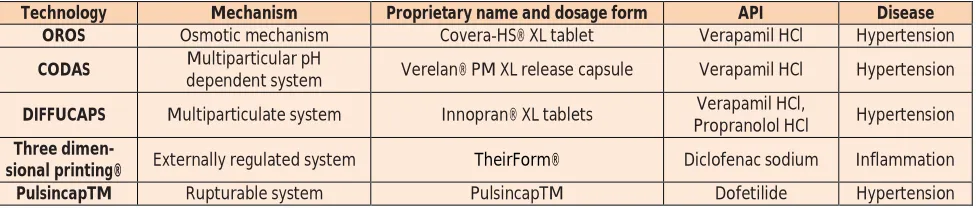
developed multiparticulate floating pulsatile drug delivery system for time and site specific drug release of meloxicam. Various pulsatile technologies have been developed on the basis of methodologies. These includes OROS® technology, CODAS® technology, CEFORM® technology, DIFFUCAPS® technology, Three-dimensional printing®, timerx® etc. Table 2 summarizes the technologies of pulsatile drug delivery. 4, 5
Figure 1: Drug release profile of pulsatile drug delivery systems
Table 2: Marketed technologies of pulsatile drug delivery
Technology Mechanism Proprietary name and dosage form API Disease
OROS Osmotic mechanism Covera-HS® XL tablet Verapamil HCl Hypertension
CODAS Multiparticular pH
dependent system Verelan® PM XL release capsule Verapamil HCl Hypertension
DIFFUCAPS Multiparticulate system Innopran® XL tablets Verapamil HCl,
Propranolol HCl Hypertension
Three dimen-
sional printing® Externally regulated system TheirForm® Diclofenac sodium Inflammation
PulsincapTM Rupturable system PulsincapTM Dofetilide Hypertension
METHODOLOGIES FOR PULSATILE DRUG DELIVERY SYSTEMS
Methodologies for the Pulsatile Drug Delivery systems can be broadly classified into four classes:6
Time controlled pulsatile release system
Time-dependent dosage forms are formulated for release their content after a predetermined time lag. To achieve a drug release that is independent of the environment and or other stimuli, the lag time prior to the release of the drug has to be controlled primarily by the delivery system. The drug release mechanisms utilized include bulk erosion of polymers. In this drug release is either by diffusion is restricted, surface erosion of layered devices composed of alternating drug-containing or drug-free layers, and osmotically controlled rupture.
Single unit systems
Capsular system
Single unit systems are developed majorly in capsule form. The time lag is continued by a plug, which is pushed away by swelling or erosion. The drug is released as a pulse from the insoluble capsule body. e.g.: In Pulsincap system, a water insoluble body enclosing the drug
formulation and system is closed with a swellable hydrogel. If this comes in contact with gastrointestinal fluid or dissolution medium then plug swells pushing itself outside of capsule after lag-time. Position & dimensions of plug, controls lag-time. When rapid release of drug requires then water insoluble drug effervescent or disintegrating agents are added. Plug material is generally consist of following: Swell able materials coated with but permeable polymer (polymethacrylates), Erodible compressed polymer (HPMC, polyvinyl alcohol), Congealed melted polymer (glycerylmonooleate), Enzymatically controlled erodible polymer (pectin). Pulsatile Delivery by Osmosis
International Journal of Pharmaceutical Sciences Review and Research Page 63 of a semi permeable capsule assisted by an expending
osmotic layer. The Port System (Port Systems, LLC) is a gelatin capsule having coating with a semi permeable membrane (e.g., cellulose acetate) contains an insoluble plug (e.g., lipidic) and an osmotically active agent with the drug formulation. When it comes in contact with the aqueous medium, water diffuses across the semi permeable membrane, and increasing inner pressure that ejects the plug after a lag time. The lag time is controlled by coating thickness.
Port systems
The Port Systems structure and function is as described in above paragraph. The system has given good correlation in lag times of in-vitro and in-vivo experiments in humans. To deliver drug in liquid form, an osmotically driven capsular system was developed. In this system, liquid drug is absorbed by highly porous particles. After the barrier layer is dissolved drug get release through orifice of a semi permeable capsule assisted by an expending osmotic layer. The capsular system drug delivery is by the capsule's osmotic infusion of moisture from the body. The capsule wall is composed up of an elastic material and having an orifice. As the osmosis proceeds, the pressure within the capsule increases. This causes the wall of capsule to stretch. The orifice is sufficient small so as to relax elastic wall. The flow of the drug through the orifice initially stop up till elastic wall is distended beyond threshold value then orifice expands sufficiently to allow drug release at a required rate. Elastomers such as styrene-butadiene copolymer are recommended for such systems.
Pulsatile Delivery by Solubilisation (or) Erosion of Membrane
These systems based on a drug reservoir which is surrounded with a soluble or erodible barrier layer. This dissolves with time and releases drug after the lag time. e.g. Time Clock system. The Time Clock system composed of solid dosage form coated with lipid barriers such as carnauba wax & beeswax with surfactants like polyoxyethylene sorbitan monooleate. This system after coming in contact with the aqueous medium the coat emulsifies or erodes. This occurs only after the lag-time depending on the thickness of coat. The lag time of system is independent of the gastrointestinal motility, PH, enzyme & gastric residence. 7
Pulsatile Delivery by Rupture of Membrane
These systems are based on a reservoir system coated with a rupturable membrane. The outer membrane gets ruptured by pressure developed due to effervescent agents (or) swelling agent Citric acid & sodium bicarbonate. This is incorporated as effervescent mixture in tablet core coated with ethyl cellulose. When such system comes in contact with water it produces carbon dioxide gas which creates pressure.8 After lag time membrane get ruptured releasing the drug. A reservoir system with a semi permeable coating is used particularly
for drugs with high first pass effect so as to obtain in-vivo drug pattern similar to the administration of several immediate release doses. Crosscarmellose sodium starch glycollate or low substituted hydroxy propyl cellulose were used as swelling substances. This results in complete film rupture followed by rapid drug release. The lag time can be controlled by composition of outer polymeric membrane.
Delivery by a series of stops
This is capsule composed a drug and a water-absorptive osmotic engine which are placed in compartments differentiated by a movable partition. The pulsatile delivery of drug is achieved by a series of stops along the inner wall of the capsule. These stops obstruct the movement of the partition. This overcomes in succession as the osmotic pressure increases above a threshold level. The number of stops and the longitudinal placements of stops along the length of the capsule dictate the number and frequency of pulses and the configuration of the partition control the pulse intensity. This system is utilised to deliver porcine somatotropin. 9, 10
Delivery by solubility modulation
This system consists of a solubility modulator for pulsed delivery of variety of drugs. The system is majorly utilized for delivery of salbutamol sulphate. The composition contains drug and a modulating agent. The amount of NaCl was such that it should be less than the amount needed to maintain saturation in a fluid that enters the osmotic device. The pulsed delivery is based on drug solubility. Salbutamol solubility in water is 275 mg/ml and 16 mg/ml in saturated solution of NaCl. While NaCl solubility is 321 mg/ml in water and its saturation solubility is 320 mg/ml. This value shows the solubility of drug is a function of the modulator concentration. While the modulators solubility is independent of drug concentration. The modulating agent can be a solid organic acid, inorganic salt, or organic salt.
Multiple Unit Systems
Multiparticulate systems are reservoir type devices with a coating. This either ruptures or changes its permeability. Drug is coated over sugar seeds. These granules are then packaged in a capsule or compressed with excipients to produce a tablet. The active pharmaceutical ingredient may also be blended or granulated with polymers before coating to provide an additional level of control. However, drug loading in this type of system is low due to higher need of excipients. 11, 12
Systems Based on Change in Membrane Permeability
the plasmatic rate to follow the metabolic rhythm and the specific needs of the patient during certain periods. For instance, in order to diminish the nocturnal symptoms or the symptoms upon awakening in the case of certain chronic diseases such as ischemic heart disease, asthma and arthritis, the drugs should be administered in such a way that the desired therapeutic plasma level is reached only at the desired moment, i.e. during sleep or at the moment of awakening. Researcher described multiparticulate formulation. This gives delayed and/or pulsed release. This enables to obtain the onset of availability of the active ingredient within 4 to 8 hours after the ingestion of the multiparticulate formulation. Then progressive release of the total active ingredient within the 8 to 20 hours occurs. The formulation is in form of spheroids consisting of neutral spherical core. This is composed of first coating which is based on mixture of at least one hydro soluble polymer and one non hydro soluble polymer through the constitutive particles of an active ingredient are uniformly distributed. A second coating is based on two pH independent polymers which presents rate of permeability different from each other with respect to the gastric and intestinal medium. The system utilizes drugs which cannot be released by diffusion through a porous coating. Such as water insoluble drugs. A plurality of populations of pellets is provided in capsule or tablet. The pellets are composed of a core. Core composed of drug and a swelling agent which expands in volume when exposed to water. Membrane or coating which is permeable to water encloses the core. The membrane is composed of a water insoluble and permeable film forming polymer, water soluble film forming polymer and permeability reducing agent. When the unit dose releases the pellets into the digestive tract then water diffuses through coating into core. As water is absorbed by the swelling agent, the core expands and exerts force on coating until it bursts for releasing the drug. The permeability reducing agent lowers the flow of water towards swelling agent. This delay release time of drug. The water soluble polymer gets dissolved causing weakening of the coating so that it bursts earlier. Altering proportions of the coating ingredients and/or coating thickness, from one pellet population to other, the release time of the pellets can be effectively controlled.
Systems with Rapturable Coating 13, 14
The controlled release oral dosage form of acetylsalicylic acid (aspirin) capable of delay in release of drug after ingestion. This is prepared in such way that, after ingestion there will not be release for a preset time interval (5-8 hours). If taken at bedtime optimal therapeutic blood levels reaches in early morning. These events results in to a vascular obstruction increasing risk of a heart attack or stroke after the drug is taken in the evening. The formulation comprises of an aspirin core together with a swelling agent and a frangible coating protecting aspirin from dissolution by gastrointestinal fluids having water soluble and insoluble properties.
Time controlled expulsion system
This is a combination of osmotic and swelling effects. The core is produced by drug and low bulk density solid and liquid lipid material and disintegrant. Cellulose acetate coating is given to core. On contact with aqueous medium, water get penetrated in core replacing lipid material. Internal pressure increases after depletion of lipid material. If critical stress is reached then rupture of the coating material occurs. Other system is based on a capsule or tablet prepared from large number of pellets which may be of two or more pellets or part.
Delivery systems with rupturable coating layer
This system consists of release controlling water insoluble but permeable coating at outer side, which is mechanically induced rupture phenomenon. Recently different systems based on hard gelatin capsules and tablet core were described. All coatings are swellable at inner layer and rupturable outer layer. The film rupture achieved by swelling, osmotic or effervescent additives in the reservoir. After optimizing the system, drug release can be obtained at specific time interval. Researcher developed tablet systems which consist of core having two layers of swelling and rupturable coatings. For this coatings spray dried lactose and microcrystalline cellulose used first and then with swelling polymer Crosscarmellose sodium and outer rupturable layer of ethyl cellulose. By using swellable core technology researchers also developed osmotic drug delivery. This consists of a core tablet containing the drug and a water swellable component, shows the schematic diagram of delivery systems with rupturable coating layer.
Delivery systems provided with erodible coating layers
In these systems the erosion or dissolution of the outer coat controls drug release which is applied to the core containing drug. By optimizing the thickness of the outer coat Time dependent release of the active ingredient can be obtained. Recently oral dosage form devised to release drugs following a programmed time period after ingestion based on this concept has been developed. System is composed of a drug-containing core along with hydrophilic swellable polymeric coating of HPMC. This is responsible for delaying the drug release by slow interaction with aqueous fluids.
Sigmoidal Release System
International Journal of Pharmaceutical Sciences Review and Research Page 65 Low density floating multiparticulate pulsatile systems
Conventional multiparticulate pulsatile release dosage forms mentioned above are having longer residence time in the gastrointestinal tract. In vivo variation and bioavailability problems are result of highly variable nature of gastric emptying process. In contrast, low density floating multiparticulate pulsatile dosage forms retains only in stomach and not affected by variation in gastric emptying rate, pH or local environment. These dosage forms are advantageous for drugs which either absorbed from the stomach or require local delivery in stomach. 15
Stimuli induced pulsatile release system
Various polymeric delivery systems undergo phase transitions and response to environmental changes show remarkable swelling-deswelling changes. These alterations include ionic strength, solvent composition, electric fields, light, and temperature. Stimuli-induced changes in the gels or in the micelles are responsible for drug release from these systems. Changes due to stimuli are deswell, swell, or erode. Ejection of drug from gel as the fluid phase synerges out is the effect of drug release mechanism. Drug diffusion is along a concentration gradient. Electrophoresis of charged drugs towards an oppositely charged electrode and liberation of the entrapped drug as the gel or micelle complex erodes. 16 Chemical stimuli induced pulsatile systems
Glucose-responsive insulin release devices
In Diabetes mellitus injection of the insulin at proper time controls the rhythmic increase in the levels of glucose in the body. Several systems are developed which controls the changes in glucose concentration, pH sensitive hydrogel is example of such system. This consists of glucose oxidase immobilized in the hydrogel. Glucose oxidase converts glucose into gluconic acid when blood glucose level increases. This changes the pH of the system. This change in pH results in swelling of the polymer which gives effect of insulin release. Insulin reduces blood glucose level this reduces gluconic acid level. This result in deswelling and insulin release gets decreased.
Inflammation-induced pulsatile release
Inflammation observed at the injured sites is after receiving any chemical or physical stress, such as injury, fractures etc.17 These inflammation-responsive cells produce hydroxyl radicals. Degradation via hydroxyl radicals is usually dominant and rapid when Hyaluronic Acid gel is injected at inflammatory sites. Inflammatory diseases like rheumatoid arthritis; can be treating using anti-inflammatory drug incorporated HA gels as new implantable drug delivery systems.
Drug release from intelligent gels responding to antibody concentration
In the body there are numerous kinds of bioactive compounds are present. For changing concentration of bioactive compounds to affect their swelling or deswelling characteristics now novel gels are developed which respond to these compound. To antigen-antibody complex formation much attention is given as the cross-linking units in the gel, since such interaction is very specific. Utilizing the difference in association constants between polymerized antibodies and naturally derived antibodies towards specific antigens, reversible gel swelling/deswelling and drug permeation changes occurs. pH sensitive drug delivery system
This type of PDDS prepared from two components. First component is fast release second component is pulsed release which releases the drug as pH changes. These system uses advantage of different pH environment in different parts of the gastrointestinal tract. Drug release at specific location can be obtained by using pH dependant polymers. Examples of pH dependent polymers include cellulose acetate phthalate, polyacrylates, and sodium carboxy methylcellulose. These polymers are used as enteric coating materials so as to provide release of drug in the small intestine.
External stimuli pulsatile release
This system was divided in to three subparts and is discussed below.18
Electro responsive pulsatile release
Electrically responsive delivery systems are produced using polyelectrolytes (polymers containing relatively high concentration of ionisable groups along the backbone chain) and pH-responsive as well as electro-responsive. Examples of naturally occurring polymers include chondroitin sulphate, hyaluronic acid, agarose, xanthan gum carbomer and calcium alginate. The synthetic polymers are generally acrylate and methacrylate derivatives such as partially hydrolyzed polydimethylaminopropyl polyacrylamide, acrylamide. Micro electro mechanical systems (MEMS)
mixtures in any form i.e. solid, liquid or gel. When release is desired, an electric potential is applied between an anode membrane and a cathode, the gold membrane anode dissolves within 10-20 seconds and allows the drug in the reservoir to be released. This electric potential causes oxidation of the anode material to form a soluble complex with the electrolytes which then dissolves allowing release of the drug. Complex release patterns such as simultaneous constant and pulsatile release can be achieved from the microchips. Microchip has the ability to control both release time and release rate.
Magnetically induced pulsatile release 21
The utilization of an oscillating magnetic field for modulating the rates of drug release from polymer matrix was one of the old methodologies. Magnetic carriers receive their magnetic response from magnetic field in which incorporated materials are Iron, Cobalt etc. Magnetic carriers should be water-based, biocompatible, non-toxic and non-immunogenic. Magnetic attraction slows down movement of oral drugs in the gastrointestinal tract. This is achieved by filling an additional magnetic component into capsules or tablets. The speed of movement through stomach and intestines can be slowed down at specific positions by using an external magnet. This changes the timing or extent of drug absorption into stomach or intestines.
Pulsatile release systems for vaccine and hormone products
Vaccines are traditionally administered as an initial shot of an antigen followed by repeated booster shots to produce protective immunity. The frequency of the booster shots, and hence the exact immunization schedule is antigen dependent. Also, co-administration of vaccine adjuvant is often required to enhance the immune response to achieve protective immunity. PDDS offer the possibility of single-shot vaccines if initial booster release of the antigen can be achieved from one system in which timing of booster release is controlled.
MISCELLANEOUS PULSATILE SYSTEMS22
Some really novel systems of pulsatile release have also been proposed. Researcher described a delayed release oral formulation composed of at least two different types of carrier particles where the first type comprises of a biologically active substance and a penetration enhancer, while the second type is consists of penetration enhancer and a delayed release coating or matrix. The first type particle is released from the formulation at first in the intestine and rapidly releases drug and penetration enhancer. The penetration enhancer increases absorption of drug. This is because of enhancer is quickly absorbed. Always insufficient amount of enhancer is added to promote absorption of the entire dose of biologically active substance.23 The second type of carrier particles consists of enteric outer coating. This resists degradation of drug in stomach and dissolves in intestinal lumen. This is effective in preventing the nucleic acid from pH
International Journal of Pharmaceutical Sciences Review and Research Page 67 the reservoir. It is preferred that when the pressure in the
pressurizing compartment increases, the barrier moves to decrease the volume of the reservoir, and molecules are released under pressure from the device. As discussed above, an example of such a pressure element is an osmotic pressure element. Such osmotic pressure element could be formed by a pressurizing compartment, the pressurizing compartment being arranged in the housing, the housing preferably having two openings: one opening for allowing release of the molecules, and one opening for allowing modulation of the pressurizing compartment. Modulation of the pressurizing compartment advantageously takes place by an influx of solution, preferably water, from the environment into the pressurizing compartment when the membrane is permeable. Therefore, the pressurizing compartment is at least partially formed by the thermo switchable membrane, the membrane being configured in such a way as to allow the influx of water from the environment upon permeable to the membrane. Upon increasing the permeability of the membrane, an influx of water takes place into the pressurizing compartment, causing a movement of the barrier into the direction of the reservoir. This causes release of the molecules from the reservoir via the opening in the housing and an outlet, the outlet for example being formed by a mechanical valve opening when pressurized or a porous membrane, flow restrictor, and the like. The macroscopic observation of the tablets during dissolution procedure showed that the coating layer swells and then erodes forming a sophisticated barrier. This complicated behavior is attributed to the different physicochemical properties of each one of the used polymers. HPMC is a water soluble polymer with the ability to swell when in contact with an aqueous solutions and thus HPMC is responsible for creating a hydrocolloid gel layer on the external surface of the tablet while PVP is responsible for regulating the erosion’s extent. 26, 27
RECENT TECHNIQUES OF ORAL TIME CONTROLLED PULSATILE TECHNOLOGY28
To fulfill unmet medical needs for the treatment of various diseases, pharmaceutical companies now focusing on developing and commercializing PDDS. Example of developed technologies are IPDAS Technology, SODAS Technology, PULSYS™ Technology, CODAS™ Technology, Chrono Release System and Eurand’s pulsatile, Magnetic Nanocomposite Hydrogel.
Spheroidal Oral Drug Absorption System (SODAS)
This technology is based on the production of controlled release beads. It is characterized by its inherent flexibility; this enables production of customized dosage forms which response to individual drug candidate needs. SODAS provides several number of tailored drug release profiles this includes immediate release of drug accompanied by sustained release to give fast onset of action and maintained for 24 hours.29, 30 Opposite to this scenario is drug release is delayed for a number of hours.
Another option is pulsatile release, in which once daily dosage form can maintain similar drug level as multiple daily doses throughout the day.
The Intestinal Protective Drug Absorption System (IPDAS)
This Technology is a high density multiparticulate tablet. This is intended for gastrointestinal irritant compounds. The IPDAS technology is consist of number of high density controlled release beads; these are compressed into a tablet form. After IPDAS tablet is ingested, it gets rapidly disintegrates and disperses in to beads containing a drug in the stomach. This subsequently passes into the duodenum through gastrointestinal tract in a controlled and gradual manner. This is independent of the feeding state. Active ingredient gets released from the multiparticulates through process of diffusion either through the polymeric membrane or the micro matrix of polymer/active ingredient. Multiparticulate nature of the formulation provides intestinal protection of IPDAS technology. This assures larger dispersion of irritant drug throughout the gastrointestinal tract.
Chronotherapeutic Oral Drug Absorption System (CODAS) 31
This technology was designed to release its drug component after a prolonged period of time after ingestion. Verapamil releases approximately four to five hours after ingestion. Such delay is introduced by the concentration of release-controlling polymer used in preparation of drug-loaded beads. The release-controlling polymer consists of two types of polymers which are water-soluble and water-insoluble polymers. When fluid from the gastrointestinal tract comes in contact of polymer coat beads then water-soluble polymer slowly dissolves, and results in drug diffusion through the resulting pores in coating. The water-insoluble polymers continuously act as a barrier, maintaining drugs controlled-release.32, 33
Geoclock Technology
Geoclock tablets incorporate drug inside an outer tablet layer. This is prepared from a mixture of hydrophobic wax and brittle material so as to obtain a pH-independent lag time prior to drug delivery of core at a predetermined release rate. 34 Such dry coating strategy is fabricated to allow the timed release of both fast release and slow release of active cores. This is done by releasing the inner tablet first and then outer shell gradually disintegrates. Pulsystem Technology
dosing interval. The transit properties of pellets enhance the overall absorption-time window and offer improved bioavailability compared to tablet matrix forms.
Eurand pulsatile and chrono release System
This system provides one or more rapid release pulses at predetermined time lag. This is helpful for optimization of efficacy and minimizes side-effects of a drug. For example, Eurand created a circadian rhythm release (CRR) dosage form for cardiovascular drug Propranolol hydrochloride with delay of four-hour in release after oral administration. When given at bedtime, Propranolol after the initial delay reaches to maximum plasma level in early morning hours, when the patient is at risk. 37
Magnetic Nanocomposite Hydrogel
Incorporation of super paramagnetic Ferric oxide particles in temperature sensitive poly (N-isopropylacrylamide) hydrogels synthesizes magnetic nanocomposite. Alternating high frequency magnetic field was applied to give pulsatile drug release from nanocomposite hydrogel. Nanocomposites hydrogel one of the on-off devices in which drug release can be turn on by alternative magnetic field application. 38
CONCLUSION
Pulsatile drug delivery is one such system which act by delivering drug at the right time, right place and in right amounts and which holds good beneficial results for patients suffering from chronic problems like arthritis, asthma, hypertension etc. Developing of proper pulsatile drug delivery definitely improve the patient compliance, optimum drug delivery to the target site and decreases the undesired effects. Sustained release formulations are not efficient for treating diseases chronological pathopysiology, for such pulsatile drug delivery is beneficial. Various methodologies are utilized for developing pulsatile drug delivery like time controlled PDDS, in which delivery systems with rupturable coating layer or with erodible coating layers or with release controlling plug, stimuli induced PDDS less temperature induced and chemical stimuli induced systems and externally regulated system. Multiparticulate systems are useful for treatment of patients due to their high efficiency and robustness results. The pulsatile release system is a promising in the body under physiological conditions, many vital functions are operated by pulsed or transient release of bioactive substances at a specific site and time. Development of new drug delivery devices to achieve pulsed delivery of a certain amount of a bioactive compound at predetermined time intervals is now much important. The ability of bioactive compounds and therapeutic agents to deliver pulsatile or staggered drug release profile has played a major role in drug delivery research over the last two decades. The plasma peak is obtained at an optimal time by timing the drug administration. The dose frequency per day can be minimized. Based on relation of potential therapeutic applications, a variety of design strategies have been
formulated with respect of pulsatile release. The approaches in this article represent attempts conducted over the past decade to achieve pulsatile release. It should be pointed that these drug delivery systems are still in the early developmental stage and much research will have to be conducted for these systems to become practical in clinical alternatives.
REFERENCES
1. Tolic IM, Mooskeilde E, Sturis J, Modeling the insulin-glucose feedback system: the significance of pulsatile insulin secretion, J Theor Biol, 207, 2000, 361-75.
2. Moroni A, Zema L, Cerea M, Sangalli ME , Oral pulsatile drug delivery systems, Expert Opin Drug Delivary, 2, 2005, 855-71.
3. Hori K, Zhang QH, Li HC, Saito S, Sato Y, Timing of cancer chemotherapy based on circadian variations in tumor tissue blood flow, Int J Cancer, 65, 1996, 360–364.
4. Yoshida R, Sakai K, Okano T, Sakurai Y, Pulsatile drug delivery systems using hydrogels, Adv Drug Del Rev, 11, 1993, 85-108.
5. Kikuchi A, Okano T, Pulsatile drug release control using hydrogels, Adv Drug Del Rev, 54, 2002, 53-77.
6. Arkinstall WW, Review of the North American experience with evening administration of Uniphyl tablets, a once-daily theophylline, 1994, 521–524.
7. Bodmeier R, Pulsatile drug release from an insoluble capsule body controlled by an erodible plug, Pharm Res 15, 1998, 474-481.
8. Krgel I, Bodmeier R, Evaluation of an enzyme-containing capsular shaped pulsatile drug delivery system, Pharm Res 16, 1999, 1424-1429.
9. Linkwitz A, Magruder JA, Merrill S, Osmotically Driven Delivery Device with Expandable Orifice for Pulsatile Delivery Effect, US Patent No 5221278 1993.
10. Balaban SM, Pike JB, Smith JP, Baile CA, Osmotically Driven Delivery Devices with Pulsatile Effect, US Patent No 5209746 1993.
11. Karavas E, Georgarakis E, Bikiaris D, Application of PVP/HPMC miscible blends with enhanced mucoadhesive properties for adjusting drug release in predictable pulsatile chronotherapeutics, Eur J Pharm Biopharm64, 2006, 115-126.
12. Roy, Shahiwala A, Multiparticulate formulation approach to pulsatile drug delivery, Current perspective,. J Control Rel 134, 2009, 74–80.
13. Conte U, Maggi LA, Flexible technology for the linear, pulsatile and delayed release of drugs allowing for easy accommodation of difficult in vitro targets, J Control Release 64, 2000, 263-68.
14. Bassemer T, Otto I, Bodmeier R, Pulsatile drug delivery systems, Crit Rev Ther Drug Carrier Syst 18, 2001, 433-58.
15. Medlicott NJ, Tucker IG, Pulsatile release from subcutaneous implants, Adv Drug Dev Rev 38, 1999, 139-49.
16. Krogel I, Bodmeier R, Floting or pulsatile drug delivery system based on coated effevesecnt cones, Int J Pharma 187, 1999, 175-84.
17. Bussemer T, Peppas NA, Bodmerier R, Evaluation of the swelling, hydration and rupturing properties of the swelling layer of a rupturable pulsatile drug delivary system, Eur J Pharma Biopharma56, 2003, 261-70.
18. Bussemer T, Peppas NA, Bodmerier R, Time dependent mechanical properties of polymeric coatings used in rupturable pulsatile release dosage forms, Drug Dev Ind Pharm 29, 2003, 623-30.
International Journal of Pharmaceutical Sciences Review and Research Page 69 20. Ross Ac Macrae RJ, Walther M, Chronopharmaceutical drug
delivary from a pulsatile capsule device based on programmable erosion, J Pharm Pharmcol 52, 2000, 903-909.
21. Jimho AG, Wise DL, Gresser JD, Trantolo DJ, Pulsed FSH release from an implantable capsule system J Control Release 34,1995, 87-95.
22. Krogel I, Bodmeier R, Pulsatile drug release from an insoluble capsule body controlled by an erodible plug, Pharm Res 15, 1997, 474-81.
23. Krogel I, Bodmeier R, Evaluation of an enzyme containing capsular shaped pulsatile drug delivary system, Pharm Res 16, 1999, 1424-1429.
24. Gohel MC, Sumitra M, Modulation of active pharmaceutical material release from a novel tablet in capsule system containing an effervescent blend, J Control Release 79, 2002, 157-64.
25. Humphries TJ, Root JK, Hufnagel K, Successful drug specific chronotherapy with the H2 blocker famotidine in the symptomatic relief of gastroesophageal reflux disease, Ann New York Acad Sci 1991, 517-518.
26. Sutch JCD, Ross AC, Kockenberger W, Investigating the coating-dependent release mechanism of a pulsatile capsule using NMR microscopy, J Control Release 92, 2003, 341-47.
27. Jiang HL, Zhu KJ, Preparation, characterization and degradation charecteristics of polyanhydrides containing polyethylene glycol, Polymer Int 48, 1999, 47-52
28. Jiang HL, Zhu KJ, Pulsatile protein release from a laminated device comprising of polyanhydriedb and pH sensitive complexes, 194, Int J Pharm 2000, 51-60.
29. Shepard RB, Kirklin JW, Relation of pulsatile flow to oxygen consumption and other variables during CPB, J Thorac Cardiovas Surg 58, 1969, 694-702.
30. Chiu IS, Chu SH, Hung CR, Pulsatile flow during routine cardiopulmonary bypass, J Cardiovas Surg 25, 1984, 530-536.
31. Dunn J, Krish MH, Harness J, Carrol M, Straker J, Sloan H, Hemodynamic Metabolic and hematologic effects of pulsatile cardiopulmonary bypass, J Thorac Cardiovas Surg, 68, 1974, 138-147.
32. Jacobs LA, Klopp EH, Scamone W, Topaz SR, Gott WL, Improved organ function during cardiac bypass with a roller pump modified to deliver pulsatile flow, J Thorac Cardiovas Surg 58, 1969, 703-12.
33. Taylor KM, Bain WH, Maxted KJ, Hutton MM, McNab WY, Caves PK, Comparative studies of pulsatile and nonpulsatile flow during cardiopulmonary bypass 1 pulsatile system employed and its hematologic effects, J Thorac Cardiovas Surg 75, 1978, 569-573.
34. Dunn J, Krish MM, Harness J, Hemodynamic, metabolic and heamatologic effect of pulsatile cardiopulmonary bypass, J Thorac Cardiovas Surg 68, 1974, 138-147.
35. Dalton ML, Jr. McCarty RT, Woodward KE, Barlia TG, The army artificial heart pump. II. Comparison of pulsatile and nonpulsatile flow, Surgery 58, 1965, 840.
36. Dalton ML, Jr. McCarty RT, Woodward KE, Barlia TG, The effect of pulsatile flow on renal blood flow during extracorporeal circulation, J Surg Res 5, 1965, 127.
37. MC Master PD, Parsons RJ: The effect of the pulse on the spread of substances through tissues. J Exper Med 68, 1938, 377.