Recent results from COMPASS on the GPD program
Andrzej Sandacz1,∗,∗∗, on behalf of the COMPASS Collaboration
1National Institute for Nuclear Research, Division of High Energy Physics, PL 00-681 Warsaw, Poland
Abstract. The dedicated COMPASS GPD program started in 2012 with a short
pilot ’DVCS run’ and the first results from this run on DVCS, exclusiveπ0and exclusiveωchannels have been obtained. From the sum of cross sections mea-sured with positive and negative beam polarities the DVCS cross-section and its dependence on the squared four-momentum transferthave been extracted. It allowed a first estimate of the transverse size of the partonic distribution of the nucleon r2
⊥in a range of intermediatexB jwith a meanxB jvalue of 0.056.
We report also on the absolute value of the cross section for exclusiveπ0 pro-duction and its dependence ontand azimuthal angleφbetween the scattering plane andπ0production plane. These measurements are aiming to constrain the GPDs, in particular chiral-odd (transversity) GPDs. Further, we present results on the spin density matrix elements for exclusiveωmeson production and dis-cuss the contributions from unnaturaly parity exchanges and from transitions that do not conserve helicity.
1 Introduction
The theoretical framework of General Parton Distributions (GPDs) [1–3] provides a novel description of the nucleon’s partonic structure and contains a wealth of new information. The GPDs provide a description of the nucleon as an extended object, sometimes referred to as a 3-dimensional ’nucleon tomography’ [4], which correlates (transverse) spatial and (longi-tudinal) momentum degrees of freedom. The GPDs also allow access to such a fundamental property of the nucleon as the orbital angular momentum of quarks [2]. The mapping of the nucleon GPDs requires a comprehensive program of measuring various hard processes in a broad kinematic range, in particular Deeply Virtual Compton Scattering (DVCS). In ad-dition, Hard Exclusive Meson Production (HEMP) is expected to add an independent and complementary information. A comprehensive experimental overview of DVCS is presented in Ref. [5] and results of a recent phenomenological studies and predictions for DVCS can be found in Ref. [6].
The GPD part of COMPASS-II proposal [7] is devoted to measurements of both DVCS and HEMP with polarisedµ+andµ−beams and a liquid hydrogen target. The new detec-tors, the recoil proton detector CAMERA and the large-angle electromagnetic calorimeter ECAL0, which are essential for measurements of exclusive processes, were constructed and incorporated into the COMPASS set-up in 2012. The commissioning of these new detectors was done in 2012 and was followed by a 4-week pilot run. The results on DVCS, exclusiveπ0
∗Work supported by the Polish NCN Grant 2017/26/M/ST2/00498.
production and exclusiveωproduction, which are presented in this contribution, have been
obtained from this pilot run.
2 Experimental set-up
COMPASS is a fixed-target experiment situated at the high-intensity M2 beam-line of the CERN SPS. It can deliver either hadron or naturally polarised muon beams of a given charge in the energy range between 50 and 280 GeV. For the GPD program the data are collected with the muon beam nominal energy of 160 GeV and with muons of both polarities:µ+(µ−) with polarisation of about -0.8 (+0.8).
The COMPASS apparatus [8] consists of a two-stage forward spectrometer comprising various tracking detectors, electromagnetic and hadronic calorimeters, muon identification detectors, and a ring imagining Cherenkov counter grouped around two dipole magnets SM1 and SM2. For the GPD program the set-up was complemented by installing the recoil proton detector CAMERA around the new 2.5 m long liquid hydrogen target and the large-angle electromagnetic calorimeter ECAL0. The 4-meter long CAMERA consists of two concentric barrels, each of 24 scintillator slats with a read out at both ends. The recoil proton detection is based on the ToF measurement between the two barrels. The calorimeter ECAL0 that is situated just downstream of CAMERA allows to extend the accessible kinematic domain for DVCS and exclusiveπ0production towards higherxB j, improve hermeticity for detection of exclusive events and reduce the background to single-photon events production, which origi-nates fromπ0and other decays. By adding these detectors COMPASS has been converted into a facility measuring exclusive reactions within kinematic domain fromx ∼0.01 to∼0.15, which cannot be explored at any other existing or planned facility in the near future.
3 Results on DVCS
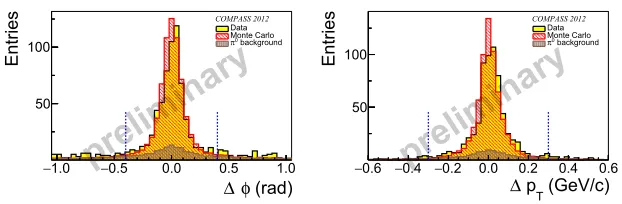
The event selection exploits the overconstrained kinematics for the measured exclusive pro-cessµp → µpγ. Events with a single outgoing muon and a single neutral cluster above the DVCS thresholds for the electromagnetic calorimeters are selected first. The muon and photon are then combined with all possible proton candidates reconstructed in CAMERA. The spectrometer information on incoming and scattered muons as well as on the positions and energy for the neutral cluster is used as a prediction to compare with kinematics of all track candidates that are found using the ToF system of the target recoil detector. Exemplary results of this comparison are displayed in Fig. 1 using two variables that characterize the kinematics of the recoiling target particle. Figure 1(left) shows the difference between the measured and the predicted azimuthal angle,∆φ, and Fig. 1(right) the difference between
the measured and the predicted transverse momentum,∆pT. Here,φandpT are given in the laboratory system. The combinatorial ambiguity is resolved by applying cuts on variables that are sensitive to the exclusivity.
The background is further reduced by applying a kinematic constrained fit. The input to the fit is supplied with all measured quantities, their uncertainties and correlations. The fit performs a chi-squared minimisation using constraints on the energy and momentum con-servation. In the following the kinematic variables determined by the kinematic fit are used since the fit offers their most precise determination.
In this analysis we determine the differential cross section d4σµp→µpγ
/dQ2dνdtdφfor
exclusive muoproduction of single photon. Here,Q2andνdenote the virtual photon virtuality
(rad)
φ ∆ 1.0
− −0.5 0.0 0.5 1.0
Entries
50 100
COMPASS 2012 Data Monte Carlo
background 0
π
preliminary
(GeV/c)
T
p
∆ 0.6
− −0.4 −0.2 0.0 0.2 0.4 0.6
Entries
50 100
COMPASS 2012 Data Monte Carlo
background 0
π
preliminary
Figure 1:Distributions of the difference between predicted and reconstructed values of the recoiling proton
can-didates. The dashes blue vertical lines indicate the applied cuts. Here, Monte Carlo also includesπ0background for the single photon sample.
the photon production plane. In order to extract the differential cross section as a function of Q2,ν,tandφthe data has been corrected for acceptance effects using bin-wise acceptance
correction factors.
This cross section was measured separately using either aµ+orµ−beam of 160 GeV/c
average momentum. The natural polarisation of the muon beam originates from the parity-violating deacy-in-flight of the parent meson, which implies opposite signs of the polarisation for the usedµ+andµ−beams. Denoting charge and helicity of the incident muon by+(−)
and←(→), the sum of the cross sections forµ+andµ−beams reads:
2dσ≡dσ
+
←+dσ→− =2(dσBH+dσDVCS
unpol − |Pµ|ImI), (1)
wherePµ denotes polarisation of the muon beam. The single-photon final state in lepton-nucleon scattering can also originate from the BH process (BH). Hence the DVCS and BH interfere, so that the above sum comprises also the contribution from the interference term denoted by ImI.
After subtracting the exactly calculable BH cross section from Eq. (1) and integrating the remainder overφthere remains only the dominant contribution from transversely polarised
virtual photons to the DVCS cross section d3σµp→µpγ
DVCS /dQ2dνdt.
A major background source for single photon production is the production ofπ0mesons, where one of the decay photons is undetected. The contamination arising fromπ0production was estimated and subtracted from the data inside each bin using LEPTO 6.5.1 together with an exclusiveπ0Monte Carlo based on a parameterisation from Goloskokov-Kroll model [9]. The goal of this measurement is to determine thet-dependence of the unpolarised (φ -integrated) DVCS cross section in virtual photon-proton scattering. Theγ∗pcross section is derived from the measured muon-proton cross section by taking into account the transverse virtual photon fluxΓ
dσγ∗p
dt = 1
Γ(Q2, ν,Eµ)
d3σµp DVCS
dQ2dνdt , (2)
where according to the Hand’s convention
Γ(Q2, ν,E
ν)=
αem(1−xB j)
2πQ2yE
µ
y2(1−
2m2
µ Q2 )+
2
1+Q2/ν2(1−y−
Q2
4E2
µ )
. (3)
2
|t| (GeV/c) 0.1 0.2 0.3 0.4 0.5 0.6
-2
nb (GeV/c)
d|t|
p)
γ
→
*p
γ
(
σ
d 1
10
2
10
-2
(GeV/c)
0.25 − 0.09 +
0.62
±
B = 4.31
2 < 5 (GeV/c) 2 < Q 2 1 (GeV/c)
< 32 GeV ν 10 GeV <
= 0.056
〉 Bj
x
〈 2
= 1.8 (GeV/c)
〉 2
Q
〈 2
= 5.8 GeV/c
〉
W
〈
COMPASS 2012
preliminary
Preliminary
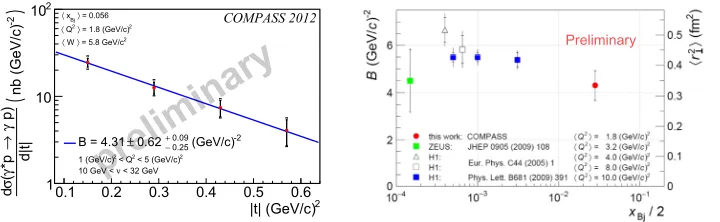
Figure 2:Left:The differential DVCS cross section as a function of|t|.Right:COMPASS results for the t-slope parameter compared to previous results from HERA.
Fig. 2 (left). They have been fitted with an exponential function in order to determine the t-slope parameterB. The value ofBis equal to (4.3±0.6+0.1
−0.3)(GeV/c)−2inside the kinematic
range that is indicated in the legend of Fig. 2 (left), and which corresponds toxB j=0.056,
Q2=1.8 (GeV/c)2andW=5.8 GeV. The extracted value ofBallows us to estimate the
transverse size of partonic distibution in the nucleonr⊥using the relation
r2
⊥(xB j)=2B(xB j), (4)
which for our measurement results in r2
⊥=(0.58±0.04±−+00..0102) fm at a meanxB jvalue of
0.056.
The main systematic error of the cross section is due to uncertainties of absolute normal-isation and determination of the amount ofπ0background. In case of parameterBthe error
from the absolute normalisation plays a minor role, while the main systematic uncertainty originates from the normalisation of theπ0background.
In Fig. 2 (right) the values of parameterBfrom COMPASS and HERA [10, 11] are plotted as a function ofxB j. As the slopeBis related to the transverse size of the partonic distribution
(see Eq. (4)), one may conclude that these model-independent results indicate a decrease of the transverse size of the proton with increasingxB j.
4 Results on exclusive
π
0production
For the selection of the sample of exclusiveπ0 production, µp → µpπ0, an analogous
procedure is used as described for the DVCS sample. In addition to the cuts on exclusivity variables, a cut on the invariant mass of two-photon system is applied. In order to determine background originating from non-exclusive events, the data are modeled with Monte Carlo in both kinematic regions where either the signal or the background dominates. Here, LEPTO 6.5.1 is used for a non-exclusive part. For the signal contribution a dedicated Monte Carlo generator [12] was used with the cross section parameterisation from the Goloskokov-Kroll model. The background is subtracted bin-wise from the data. Other sources of background, like misidentified exclusiveω→π0γ→ γγγevents, where one photon is lost, are found to be negligible.
First, we extract the four-fold differentialµpcross sections separately forµ+andµ−data.
γ∗pcross section we divide the former one by the tranasverse virtual photon flux (cf. Eq.
(3)).
The systematic uncertainty in this measurement is mostly due to scaling, which can be decomposed into effects depending on the absolute normalisation and background estimate, as well as to the threshold effects and kinematic uncertainties.
The unpolarisedγ∗pcross section for exclusiveπ0production reads
d2σγ∗p
dtdφ =
1 2π
d
σT
dt + dσL
dt +cos(2φ) dσTT
dt +
2(1+) cos(φ)dσLT
dt
, (5)
whereσT,σL,σTT,σLTare the structure functions,is the virtual photon polarisation param-eter andφrepresents the azimuthal angle between lepton scattering plane andπ0production plane. Here, the subscriptT(L) denotes the contribution from transversely (longitudinally) polarised virtual photons, while the subscripts TT andLT denote the contributions from the interference between transversely-transversely and longitudinally-transversely polarised photons.
0 0.1 0.2 0.3 0.4 0.5 0.6
2) c (GeV/ nb | t d| p) 0π → *p γ ( σ d 10 20 30 10 20 30 [0.08, 0.64] 2 | (GeV/c) t |
< 28 GeV ν 8.5 GeV <
2 < 5 (GeV/c) 2 Q < 2 1 (GeV/c) COMPASS 2012 preliminary Data Goloskokov&Krollbased on EPJ A47 (2011) 112
3
− −2 −1 0 1 2 3
2) c (GeV/ nb t
〉
0π φ d| t d| p) 0π → *p γ ( σ 2d〈
2 4 6 [rad] 0 π φ< 28 GeV ν 8.5 GeV <
2 < 5 (GeV/c) 2 Q < 2 1 (GeV/c) 2 < 0.64 (GeV/c) | t < | 2 0.08 (GeV/c) COMPASS 2012 preliminary 2 ) c (GeV/nb ) 1.0
− 1.1 + 0.9 ± 8.1 ( = t dσL d ε + t dσT d 2 ) c (GeV/nb ) 0.7
− 0.7 + 1.3 ± -6.0 ( = t dTT σ d 2 ) c (GeV/nb ) 0.2
− 0.3 + 0.5 ± 1.4 ( = t dLT σ d
Figure 3:Left:The exclusiveπ0cross section as a function of|t|. COMPASS results are compared to predictions of the GPD model of Ref. [13]. Right:The exclusiveπ0cross section as a function ofφ. Solid line indicates the result of the fit with the values of the fitted parameters shown in the legend.
After integration overφ, we extract the cross section in bins of|t|, which is displayed in Fig. 3 (left). It decreases exponentially with increasing|t|at values of|t|larger than about 0.25 (GeV/c)2, while at smaller|t|thet-dependence becomes weaker. Being the first measurement
at energies significantly higher than previous results, it is worth to compare it to the model prediction. The COMPASS result is compared to the prediction of the Goloskokov-Kroll model [13]. The blue curve represents the cross section from the model as a function oft, while the blue points correspond to the cross section averaged over|t|bins of the data. The mean cross sections for the fullt-range are compared at the rightmost part of the plot. We observe that the magnitude of the predicted cross section overshoots our measurement by approximately a factor of two.
Furthermore, we extract the cross section as a function ofφin the range of measuredtand
eight bins ofφof equal width. The red dots in Fig. 3 (right) show the measured cross section
for each bin and a fit of the function given by Eq. (5), which is represented by the red curve. The values of the fitted parameters are indicated in the legend of the plot. We observe a large contribution fromσTT and a smaller positive one fromσLT. This indicates a significant role of transversely polarised photons in exclusiveπ0production.
According to Refs. [13, 14] the structure functions for exclusive pseudo-scalar meson production, which appear in Eq. (5), depend on GPDs ˜Hq, ˜Eq,Hq
which is mainly generated by the chiral-odd (’transversity’) GPDs ¯EqT. It manifests itself in a large contribution fromσTT and a dip in the differential cross section dσ/dtas|t|decreases to zero. These features are in a qualitative agreement with our results, although the predicted values of cross section overshoot the measured ones by a factor of about 2.
5 Results on exclusive
ω
production
The considered process isµp →µpωwith subsequent decaysω→ π+π−π0andπ0 →γγ.
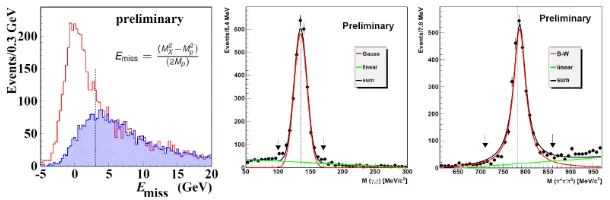
Therefore, the selected event should contain a track of scattered muon, two tracks of hadrons with opposite charges and two neutral clusters in an electromagnetic calorimeter. Because in this analysus the information from CAMERA is not used, in order to suppress non-exclusive background, the cut|Emiss|<3.0 GeV was applied, withEmiss=(MX2−M2p)/(2Mp). HereMp is the proton mass andM2
X=(p+q−pπ+−pπ−−pπ0)2is the missing mass squared, andp,q,
pπ+,pπ−andpπ0are the four-momenta of target nucleon, virtual photon and each of the three
pions.
Figure 4: Left:Emissdistribution. Shaded histogram corresponds to non-exclusive background estimated using
LEPTO Monte Carlo.Middle:Theγγinvariant mass distribution fitted by a sum of Gaussian function and a linear
dependence for background. Right:Theπ+π−π0invariant mass fitted by a sum of Breit-Wigner function and a
linear dependence for background. Dashed vertical lines denote the PDG values.
Selected kinematic distributions for the sample are shown in Fig. 4. These are Emiss
distribution, the invariant mass of two photons and the invariant mass ofπ+π−π0system. Clear
π0andωsignals are observed. In theEmissdistribution the data are shown as open histogram,
while the shaded one corresponds to the background evaluated using LEPTO Monte Carlo. The amount of background in the signal window|Emiss|<3.0 GeV depends onQ2,W and
p2
T, and when averaged over the whole sample it amounts to 28%.
The SDMEs describe the spin structure of the reaction. They are related to the bilinear combinations of helicity amplitudes that describe transitions between specified spin states of the virtual photon, target proton, produced vector meson and recoil proton. For an un-polarised nucleon target, after summing up over initial and final spin states of the proton, the SDMEs depend just on helicities of the virtual photon and produced meson. The values of SDMEs allow us to test the s-channel helicity conservation (SCHC) hypothesis, as well as to investigate the role of transversity (parton helicity-flip) GPDs and of unnatural parity exchange (UPE) mechanisms in exclusiveωproduction.
The SDMEs appear as parameters in the three dimensional angular distributions of the vector meson production and decay. Definitions of angles and reference frames are given
decay. The fitted distribution was a weighted superposition of the angular distributions for exclusive events and non-exclusive background. The fraction of background in the signal window was determined usingEmissdistribution as illustrated in Fig. 4.
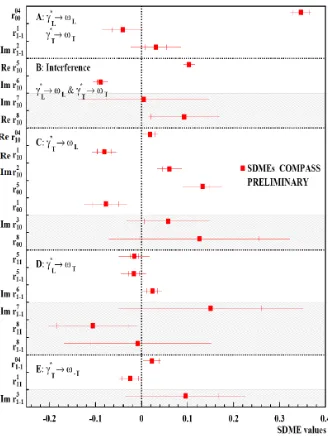
Figure 5: The 23 SDMEs for exclusiveωleptoproduction extracted in the entire COMPASS kinematic region. The inner error bars represent the statistical uncertainties, while the outer ones indicate the statistical and systematic uncertainties added in quadrature.
SDMEs for exclusiveωproduction extracted for the entire kinematic region are presented
in Fig. 5. The average values of kinematic variables are Q2 = 2.13 (GeV/c)2, W =
7.6 GeV andp2
T
=0.16 (GeV/c)2, wherepT denotes the transverse momentum ofωmeson relative to the direction of the virtual photon. The SDMEs are grouped in classes, each class corresponding to dominant transitions amplitudes with given helicities of the virtual photon andωmeson, as indicated in the figure.
In the case of SCHC, all SDMEs of classes C, D and E should be equal to zero. However, for the transitionsγ∗T → VL (class C) one observes a clear violation of SCHC. In the GK model [16] the SDMEs from this class are related to the contributions from transversity GPDs
¯
ETandHTcoupled with the higher-twist wave function of the meson. For instance the results for SDMEr5
00 are expected to be mostly affected by GPDs ¯ET. Kinematic dependences of these SDMEs on Q2, W, and p2
T, which were also extracted in this analysis, may help to further constrain the model.
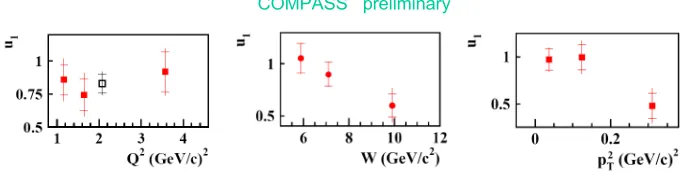
The existence of processes with unnatural parity exchange (UPE) inωproduction on the proton can be tested by examining linear combination of SDMEs such as
u1 =1−r0400+2r041−1−2r111−2r11−1. (6)
The quantityu1 can be expressed in terms of helicity amplitudes and is proportional to the
relative contribution of UPE processes to the cross section. Therefore, a different from zero value ofu1would indicate a conribution of UPE processes. The kinematic dependence ofu1
onQ2,W andp2
pole exchange [17], which implies a decrease ofu1withW. The data support the expected
decrease.
COMPASS preliminary
Figure 6: Dependence of quantityu1on kinematic variablesQ2,Wandp2T. The empty square respresents theu1
value for the entire kinematic region.
6 Outlook
In 2016 and 2017 the COMPASS Collaboration has collected a large data sample on the GPD program. An expected increase of the statistic is by a factor of about 10 compared to the 2012 data. An investigation of GPDs with DVCS and HEMP on unpolarised protons using the data from 2016-2017 will allow us to determine thexBj-dependence oft-slope of the
dif-ferential cross sections. That is related to the spatial transverse distribution of partons and the ’nucleon tomography’. Measurements of the beam charge and spin sum and difference of single-γcross sections will give access to the real and imaginary parts of the DVCS
ampli-tude, and will allow to further constrain GPDsH. Studies of exclusive production of vector mesons (ρ0,ω, φ) will lead to the quark flavour and gluon separation for GPDs H, while
that of exclusiveπ0production will provide constraints on chiral-odd GPDs. The projected
accuracies for measurements of various observables within the GPD program can be found in the COMPASS-II proposal [7].
References
[1] D. Muelleret al, Fortsch. Phys.42(1994) 101.
[2] X. Ji, Phys. Rev. Lett.78(1997) 610; Phys. Rev. D55(1997) 7114.
[3] A.V. Radyushkin, Phys. Lett. B385(1996) 333; Phys. Rev. D56(1997) 5524.
[4] M. Burkardt, Phys. Rev. D62(2000) 071503; erratum-ibid. D66(2002) 119903;
Int. J. Mod. Phys. A18(2003) 173; Phys. Lett. B595(2004) 245.
[5] N. d’Hose, S. Niccolai and A. Rostomyan, Eur. Phys. J. A52(2016) 157.
[6] K, Kumeri˘cki, S. Liuti and H. Moutarde, Eur. Phys. J. A52(2016) 151.
[7] F. Gautheronet al.[COMPASS Collaboration], CERN-SPSC-2010-014, SPSC-P-340, May 2010.
[8] COMPASS Collaboration, P. Abbonet al., Nucl. Instr. Meth. A577(2007) 455.
[9] S.V. Goloskokov and P. Kroll, Eur. Phys. J. C65(2010) 137.
[10] ZEUS Collaboration, S. Chekanovet al., JHEP0905(2009) 108.
[11] H1 Collaboration, F.D. Aaronet al.Phys. Lett. B681(2009) 391;
A. Aktaset al.Eur. Phys. J. C44(2005) 1.
[12] A. Sandacz and P. Sznajder, arXiv:1207.0333 [hep-ph].
[13] S.V. Goloskokov and P. Kroll, Eur. Phys. J. A47(2011) 112.
[14] CLAS Collaboration, l. Bedlinskyet al., Phys. Rev. C90(2014) 025205.
[15] K. Schilling and G. Wolf, Nucl. Phys. B61, 381 (1973).
[16] S.V. Goloskokov, P. Kroll, Eur. Phys. J. C742725 (2014).
![Figure 3: Left:of the GPD model of Ref. [13]. The exclusive π0 cross section as a function of |t|](https://thumb-us.123doks.com/thumbv2/123dok_us/8029281.1335979/5.482.71.409.271.374/figure-left-gpd-model-exclusive-cross-section-function.webp)