Norms and the Determination of Translation.
A Theoretical Framework
Theo Hermans
1
Although translation studies today constitutes anything but a unified field of study, some of its larger disciplinary shifts have been felt more or less across the entire range of the subject. At an early stage, for example, ‘fidelity’ was replaced by ‘equivalence’ as a theoretical and methodological concept in applied as well as in descriptive and theoretical approaches to translation. In the last ten years or so, ‘equivalence’ too has been progressively questioned and hollowed out, largely in favour of the concept of ‘norms’.
The first step in the direction of the current preoccupation with norms in translation was taken by Jiři Levý, whose 1967 essay on ‘Translation as a Decision Process’1 viewed translation in terms of game theory and the practical reasoning involved in decision-making. The concept itself was introduced into translation studies a decade later by Gideon Toury,2 who deployed it as an operational tool in his descriptive approach. For Toury, translational norms govern the decision-making process in translating, and hence they determine the type of equivalence that obtains between original and translation. He also distinguished different types of norms, and commented on ways of discovering them. In practice, Toury saw norms mostly as constraints on the translator’s behaviour,3 and he gave only a brief indication of their nature and broader social function.
Since then the concept has continued to receive attention in translation studies.4 At the same time, the nature and functioning of norms, rules and conventions have been highlighted in a number of publications covering a variety of other disciplines, from law and linguistics to ethics and international relations.5 The recent
1
Jiři Levý, ‘Translation as a Decision Process’, in To Honor Roman Jakobson, vol. 2 ( The Hague: Mouton, 1967), p. 1171-82.
2
Gideon Toury, In Search of a Theory of Translation (Tel Aviv: Porter Institute, 1980).
3
Ibid., p.51.
4
See, for example, Armin Paul Frank and Brigitte Schultze, ‘Normen in historisch-deskriptiven Übersetzungsstudien’ in Harald Kittel (ed.), Die literarische Übersetzung. Stand und Perspektiven ihrer Erforschung (Berlin: Erich Schmidt, 1988), p. 96-121; Mette Hjort, ‘Translation and the Consequences of Scepticism’ in Susan Bassnett and André Lefevere (eds.), Translation, History and Culture (London and New York: Pinter, 1990), p. 38-45; Christiane Nord, ‘Scopos, Loyalty and Translational
Conventions’, Target, iii, 1991, 1, p.91-110; Theo Hermans, ‘Translational Norms and Correct
Translations’ in Kitty van Leuven-Zwart & Ton Naaijkens (eds.), Translation Studies: The State of the Art (Amsterdam: Rodopi, 1991), p.155-69; Theo Hermans, ‘On Modelling Translation. Models, Norms and the Field of Translation’, Livius 4, 1993, p.69-88; Andrew Chesterman, ‘From ‘Is’ to ‘Ought’: Laws, Norms and Strategies in Translation Studies’, Target , v, 1993, 1, p.1-20.
5
See, among others, Ladislav Holy and Milan Stuchlik, Actions, Norms and Representations
(Cambridge: Cambridge University Press, 1983); Renate Bartsch, Norms of Language. Theoretical and Practical Aspects (London: Longman, 1987); Douwe Fokkema, ‘The Concept of Convention in Literary Theory and Empirical Research’, in Theo D’haen et al., (eds.) Convention and Innovation in Literature (Amsterdam: John Benjamins, 1989), p. 1-16; Friedrich Kratochwil, Rules, Norms and Decisions. On the Conditions of Practical and Legal Reasoning in International Relations and Domestic Affairs
collection Rules and Conventions, edited by Mette Hjort,6 ranges from philosophy and literature to social theory; in her introduction Hjort stresses precisely the interdisciplinary relevance and applicability of rules and conventions.7 Given the nature of translation and of Translation studies, an approach through these concepts may well be productive, especially if we wish to focus on the social dimension of translating and on the place of translation in relation to power and ideology.
Norms are psychological and social entities. They constitute an important factor in the interaction between people, and as such are part of every socialization process. In essence, norms, like rules and conventions (I will distinguish later), have a socially regulatory function. They help to bring about the coordination required for continued coexistence with other people. In doing so norms ‘safeguard the conditions of social coexistence’,8 for they usefully mediate between the individual and the collective sphere, between an individual’s intentions, choices and actions, and collectively held beliefs, values and preferences. Moreover, norms and conventions contribute to the stability of interpersonal relations, and hence of groups, communities and societies, by reducing contingency, unpredictability, and the uncertainty which springs from our inability to control time or to predict the actions of fellow human beings. The reduction of contingency brought about by norms and conventions is a matter of generalizing from past experience and of making reasonably reliable, more or less prescriptive projections concerning similar types of situations in the future.
2
Translation used to be regarded primarily in terms of relations between texts, or between language systems. Today it is increasingly seen as a complex transaction taking place in a communicative, socio-cultural context. This requires that we bring the translator as a social being fully into the picture.
Translation involves a network of active social agents, who may be individuals or groups, each with certain preconceptions and interests. The translative operation is a matter of transactions between parties that have an interest in these transactions taking place. For those involved in the transfer, the various modalities and procedures that go with it presuppose choices, alternatives, decisions, strategies, aims and goals. Norms play a crucial role in these processes. In what follows the emphasis will be on the agents involved in these processes rather than on the nature of the relation between source and target texts. I will refer to norms primarily as social and cultural realities, rather in the way that sociologists or anthropologists might use the term.
It is worth pointing out at the start that, as regards translation, norms are relevant to the entire transfer operation, not just the actual process of translating, if only because this latter process is necessarily preceded by a number of other decisions. Translation may be regarded as a particular mode of discursive transfer between cultural circuits or systems. It constitutes one among a number of possible modes of the intercultural movement of texts. Other modes include, for example, importing or exporting a text in untranslated form – although it might be noted that deploying materially the same text in a different linguistic and cultural environment will still lend that text a different ‘load’, for it is bound to be perceived differently;
6
Mette Hjort (ed.), Rules and Conventions. Literature, Philosophy, Social Theory (Baltimore: Johns Hopkins University Press, 1992).
7
Ibid., p. ix-xi.
8
Anthony Pym rightly speaks of ‘value transformation’9 in such cases of physical transfer. Summary, paraphrase, gloss, critical commentary and other forms of what André Lefevere broadly calls ‘rewriting’10constitute a further set of alternative modes, as do transformations into other semiotic media, and so on.
The choice of one or other mode of transfer is initially made by whoever is the prime mover instigating the process. This may be an agent in the source culture or, more usually, in the target culture. The initial choice may be delegated, and it may turn out to be impracticable. Whether the choice of a particular mode of transfer is practicable in a given situation, is largely determined by the situation and by the ‘rules of the game’ at that moment. The initial choice of a preferred or intended mode of import may be modified by the initiator’s assessment of what is materially possible in terms of various physical factors (technology, geography, etc.), and of what is socially, politically, culturally and/or ideologically feasible, i.e. what is likely to be tolerated, permitted, encouraged or demanded by those who control the means of production and distribution and by the relevant institutions and channels in economic, social, ideological and artistic terms.
Intercultural traffic, then, of whatever kind, takes place in a given social context, a context of complex structures, including power structures. It involves agents who are both conditioned by these power structures or at least entangled in them, and who exploit or attempt to exploit them to serve their own ends and interests, whether individual or collective. The power structures cover political and economic power but also, in the field of cultural production, those forms which Pierre Bourdieu calls ‘symbolic power’. The agents, faced with an array of possible options, have to make choices and decisions about how to proceed.
It is here that the concept of norms can be usefully brought in. They facilitate and guide the process of decision-making. Norms govern the mode of import of cultural products – for example, of the translation of literary texts – to a considerable extent, at virtually every stage and every level, whenever choices between alternative courses of action need to be made (to import or not import? to translate or to ‘rewrite’ in some other way? how to translate?) Of course, norms also govern the mode of export, if a culture, or a section of it, actively exports texts or other cultural goods. But whether a product will be imported by the intended receptor system, or imported in the way envisaged by the donor, depends partly on factors pertaining to the receptor system itself and partly on the nature of the relations between the two systems in question.
In practice, this means that norms play a significant part, firstly, in the decision by the relevant agent in the receptor system whether or not to import a foreign-language text, or allow it to be imported; secondly, if it is decided to import, whether to translate (whatever the term may mean in a given socio-cultural configuration) or to opt for some other mode of importation; and thirdly, if it is decided to translate, how to approach the task, and how to see it through.
This latter process is, of course, the translation process itself. I am not interested here in the mental reality – the ‘black box’ – of the translation process as such or in ways of reconstructing or representing it by means of diagrams and such like. I take it for granted, however, that translating requires constant decision-making by the translator on a number of levels, and over a period of time, since texts are made
9
Anthony Pym, ‘The Relations between Translation and Material Text Transfer’, Target, iv, 1992, 1, p. 171-90.
10
up of discrete units. This process of decision-making is in large measure, necessarily and beneficially, governed by norms. If it were not, translators faced with a source text, however short or simple, would either be unable to opt for one solution rather than another and throw up their hands in despair, or make entirely random decisions, like a computer gone haywire.
From the point of view of the study of translation it is important to bear in mind that this process of decision-making, and hence the operation of norms in it, takes place in the translator’s head and thus remains largely hidden from view. We have no direct access to it. We can speculate about it, and we can try to move closer to it through procedures like talk-aloud protocols, or through confronting the input of the process with its output, i.e. the source text with the target text, and then make retrospective inferences. In this latter course we are helped by the fact that translation, like any other use of language, is a communicative act. This means that it constitutes a more or less interactive form of social behaviour, involving a degree of ‘interpersonal coordination’ among those taking part (selecting and attuning an appropriate code, recognizing and interpreting the code, paying attention, eliminating ‘noise’, etc.). However, it depends for its success not only on solving the specific ‘coordination problems’ presented by the immediate situation, but also on the relative positions and qualities of the participants, and on the values and interests at stake. Since these involve issues of material and symbolic power, success too may have to be judged in terms of the interests of one party rather than the other being served. Once we have recognized this social dimension of the production and reception of translations, as distinct from the psychological reality of the translation process, we are in a position to appreciate the role of norms and models, as social realities, in these processes.
3
What exactly is this role?11 My basic assumption is translation, like any other use of language, is a communicative act. As was pointed out in the previous paragraph, communication constitutes a form of social behaviour and requires a degree of interpersonal coordination among the agents involved. It follows from this that communication problems can in principle be described in terms of so-called ‘interpersonal coordination problems’, which in turn are a subset of social interaction problems. Norms, like conventions, offer solutions to problems of this kind. It is this perspective which allows us to apply, or at least to transpose, what social scientists and anthropologists have to say about social conventions, norms, rules and models to the domain of language use and of translation, including the practice of translation as it takes place in a given historical context. In what follows a general term like ‘behaviour’ comprises such activities as ‘speaking’, ‘writing’ and ‘translating’.
This aspect of norms can be explained more fully by drawing first on the notion of convention, seen here also in general terms as social phenomenon with a regulatory function. In his highly influential Convention: A Philosophical Study, David Lewis gave a technical definition of convention which might be paraphrased as follows: conventions are regularities in behaviour which have emerged as arbitrary
11
but effective solutions to recurrent problems of interpersonal coordination. Because they have proved effective, these solutions become the preferred course of action for individuals in a given type of situation. Conventions grow out of precedent and social habit, and they presuppose common knowledge and acceptance. More precisely, they imply a set of mutual expectations: the expectation of others that, in a given situation, I will very probably adopt a certain course of action, and my expectation that others expect me to do just that. Conventions therefore are a matter of social expectations and of ‘expectations of expectations’, i.e. of reciprocal expectations, or, in Ullmann-Margalit’s words, of ‘convergent mutual expectations’.12
Conventions, in this sense, are not norms, or they are implicit norms at best.13 They depend on regularities and shared preferences, i.e. on interpersonal coordination within a given community. To the extent, however, that conventions imply acceptance, and the mutual recognition of acceptance, of ‘approximately the same preferences regarding all possible combinations of actions’,14 they usefully restrict the number of practically available options in recurrent situations of a given type, and thus make behaviour more predictable by reducing uncertainty and contingency.15 Although conventions do not presuppose explicit agreements between individuals, they still act as generally accepted social constraints on behaviour.
Over time, conventions may fall victim to their own success. If a convention has served its purpose of solving a recurrent coordination problem sufficiently well for long enough, the expectation, on all sides, that a certain course of action will be adopted in a certain type of situation may grow beyond a mere preference, i.e. beyond a preferential and probabilistic expectation, and acquire a binding character. At that point we can begin to speak of norms.
Norms, then, can be understood as stronger, more prescriptive versions of social conventions. Whereas conventions are a matter of precedent and shared expectation, norms have a directive character. Like conventions, norms derive their legitimacy from shared knowledge, a pattern of mutual expectation and acceptance, and the fact that, on the individual level, they are largely internalized. This is what allows us to speak of norms as both psychological and social entities. There are many social, moral and artistic norms and conventions that we constantly observe while hardly being aware of them.
Norms are prescriptive rules: they have a normative semantic load and are used to guide, control, or change the behaviour of agents with decision-making capacities.16 Norms differ from conventions in that they tell individual members of a community not just how everyone else expects them to behave in a given situation, but how they ought to behave. In other words, they imply that there is, among the array of possible options, a particular course of action which is more or less strongly preferred because the community has agreed to accept it as ‘proper’ or ‘correct’ or ‘appropriate’. This is the course of action which therefore should be adopted. The intersubjective sense of what is ‘correct’ constitutes the content of a norm. More about this below. First a few more words about the operative aspect of norms, their executive arm, as it were.
Since norms imply a degree of social and psychological pressure, they act as practical constraints on the individual’s behaviour by foreclosing certain options and
12
Edna Ullmann-Margalit, The Emergence of Norms (Oxford: Clarendon Press, 1977), p. 87.
13
Cf. Lewis, op. cit., p.97; and Hjort, art. cit., p. 43.
14
Lewis, op.cit., p. 78.
15
Bartsch, op. cit., p. 126.
16
choices, which however always remain available in principle. At the same time, and more positively, they single out and suggest, or prescribe more or less emphatically, a particular selection from among the range of possible courses of action. Ultimately, the directive or normative force of a norm stems either from some kind of social pressure, be it in the form of inducements and rewards or of the threat of sanctions, or from the consenting attitude of the individual addressed by the norm; or indeed from a combination of the two.17 Strong norms are strongly felt to be appropriate, or backed up by strong sanctions, often spelled out explicitly. But since all action within the scope of conventions and norms requires the individual’s consent to some degree, such action is always a form of cooperative action.
To the extent that norms grow out of conventions more or less spontaneously, they derive their legitimacy from the same patterns of mutual expectation characteristic of conventions, and they presuppose a similar degree of social acceptance and internalization on the individual’s part. Where norms most resemble conventions they are also at their most permissive. In any case, non-compliance with a norm does not usually result in drastic sanctions for the individual concerned, just as non-compliance with a norm in particular instances does not invalidate the norm. Provided the breaches doe not occur persistently and on a large scale without any effective sanction, norms are able to cope with a relatively large amount of discrepant behaviour. It is in this sense that Niklas Luhmann speaks of norms as ‘counterfactually stabilised behavioural expectations’.18 The conventions and norms of polite conversation at a dinner party, for example, are not invalidated because one of the guests fails or refuses to observe them. The same goes for, say, the highway code, which is a much stronger and more explicit norm (or rule, see below). In other words, norms can be broken. They do not preclude erratic or idiosyncratic behaviour. Which norms are broken by whom will depend on the nature and strength of the norm and on the individual’s motivation.
As the prescriptive force of norms increases from the permissive to the mandatory, from the preferred to the obligatory, they move away from conventions in relying less on mutual expectations and internalized acceptance, and more on rules and instructions, which are often formulated explicitly, i.e. codified and expressed as commands and commandments. The term ‘rule’ is used here as meaning a strong norm, which in many cases will have become institutionalized. When the pressure exerted by a rule becomes the only reason for behaving on one way rather than another, we can speak of decrees. In contrast to conventions, which are non-statutory and impersonal and do not carry institutionalized sanction, decrees are statutory, and they are issued by an identifiable authority, which has the power to impose sanctions for non-compliance. Here we recognize the hierarchical structure of most social and socio-cultural systems, and the overarching relations of power and authority prevailing within them. Of course, power relations are inscribed in the entire network of norms and conventions operative in societies and their socio-cultural systems; in the case of decrees they manifest themselves in their most naked form. Compare with conventions, therefore, decrees represent the opposite end of the normative scale: they spell out explicit orders, which may be codified positively or negatively, as obligations or as prohibitions.
Broadly speaking, then, norms and rules cover the entire range between conventions and decrees. This range could be set out in a continuum, as follows:
17
Ibid., p. 8.
18
Convention – norm – rule – decree
Conventions arise out of precedent and rely on shared habits and mutual expectations which are common knowledge. Norms differ from conventions in that they have a binding character, carry some form of sanction, and may either grow out of customs or be issued by an authorizing instance. Rules are strong norms, usually institutionalized and posited by an identifiable authority, with or without the full assent of the individual subjected to them. Decrees are specific directives issued as commands by a particular authority and backed up by drastic sanctions.19
4
Norms and rules, then, can be strong or weak. They may cover a narrow or a broad domain. They may or may not be explicitly posited. They may be positive or negative, i.e. tending towards obligations or towards prohibitions. The ‘modalities of normative force’, which indicate the relative strength of a norm, together with its positive or negative load, could be mapped diagrammatically in the form of a semiotic square,20 so that the interrelations between its various modes of operative force become clear (see Figure 1):
Figure 1 Modalities of normative force
19
The terminology is of little consequence here, and is not meant to imply rigid distinctions. As far as I can make out, writers on the theory of conventions, norms and rules do not use a uniform terminology. Individual terms derive their meaning from the accompanying terms being deployed. In what follows I will often use ‘norm’ and ‘rule’ more or less interchangeably. On the issue of terminology, and its relative unimportance, see Schauer, op. cit., p. 14-5.
20
See Algirdas Greimas, Du sens. Essais sémiotiques, Paris: Seuil, 1970, p 135ff. and especially Dirk de Geest, ‘The Notion of ‘System’: Its Theoretical Importance and Its Methodological Implications for a Functionalist Translation Theory’ in Harald Kittel (ed.), Geschichte, System, Literarische Übersetzung / Histories, Systems, Literary Translations, Berlin: Erich Schmidt, 1992, p.32-45, and also De Geest, Literatuur als systeem. Bouwstenen voor een systemisch-functionalistische benadering van literaire verschijnselen, Leuven: Katholieke Universiteit Leuven, 1993), for the use of semiotic squares of this kind in connection with norms; the terms ‘modalities of normative force’ and ‘modalities of normative control’ (below) are derived from Alf Ross, Directives and Norms, London: Routledge, 1968, p. 177ff., where they are discussed in a legal context and in a different form. The horizontal axes in the semiotic square indicate relations of opposition; the diagonal lines, relations of contradiction; and the vertical lines, relations of implication.
OBLIGATION (what is prescribed)
PROHIBITION (what is forbidden)
NON-OBLIGATION (what is not prescribed,
i.e. what is permitted) NON-PROHIBITION
Each of these four positions (obligation, negative obligation or prohibition, non-obligation, and non-prohibition) can be written out more fully. This shown in Figure 2, in which A = agent, C = course of action, and neg = negative:
Figure 2 Modalities of normative force – 2
In both cases the upper half of the square contains strong, clearly recognized and well-defined norms and rules, formulated as obligations and prohibitions, which may be backed up by sanctions or supported by strong attitudes and belief systems. The lower half indicates areas of permissiveness and of tolerated behaviour: that which one is not obliged to do or say and which therefore ‘may’ be done or said, and that which one is not obliged to refrain from doing or saying and which therefore ‘can’ be done or said. On the whole, more permissive norms are also more malleable and hence more open to re-interpretation and adjustment in response to changing circumstances, whereas stronger and more general norms tend to stabilize over time and become institutionalized and ‘entrenched’, so that they may even be felt to apply in cases where their original justification or rationale no longer holds.21
Since norms, as indicated above, may grow out of repeated occurrences falling into a pattern, they apply in a general manner to types of situations, i.e. they involve a degree of generalization and abstraction. When a new situation arises, an individual agent may have to make an interpretive judgement in deciding whether it falls within the scope of one norm rather than another. Indeed there may be more than one
possibility, and the agent may have a reason, or an ulterior motive, for referring to one norm rather than another, for example in deciding to translate a text as an historical document rather than as a piece of literature. More stable and entrenched norms and rules usually involve a larger degree of internalization and are more likely to be applied as a matter of course. Either way, the very act of observing a norm confirms
21
Schauer, op. cit., p.38ff., 165ff. PRESCRIBED
OBLIGATION
A(C)
A ought to (C)
A is obliged to (practise C)
FORBIDDEN NEGATIVE OBLIGATION
= PROHIBITION
A (neg-c) A ought to (neg-C) A obliged to (practise neg-C) A obliged to (abstain from C) A prohibited from (practise C)
NOT FORBIDDEN
NON-(NEGATIVE OBLIGATION) = ABSENCE OF PROHIBITION = TOLERATION
A not (neg-C)
A does not have to (neg-C) A not forbidden to (practise C) A not obliged to (practise neg-C) A permitted to (abstain from C)
NOT PRESCRIBED NON-OBLIGATION = ABSENCE OF OBLIGATION
= PERMISSION
and reinforces its validity and scope. This practical aspect is important, since the linguistic formulation of a norm, whether within the community in question or by an outside observer, is different from its directive force in effectively guiding actions in particular situations. In practice, following a given set of norms may be a matter of disposition, of acquired habit, indeed of ‘habitus’ in Bourdieu’s sense of a ‘durable, transposable disposition’, as Charles Taylor22 has also argued. Such dispositions are not inherited but inculcated. Learning to translate means learning to operate the norms of translation, i.e. to operate with them and within them.
5
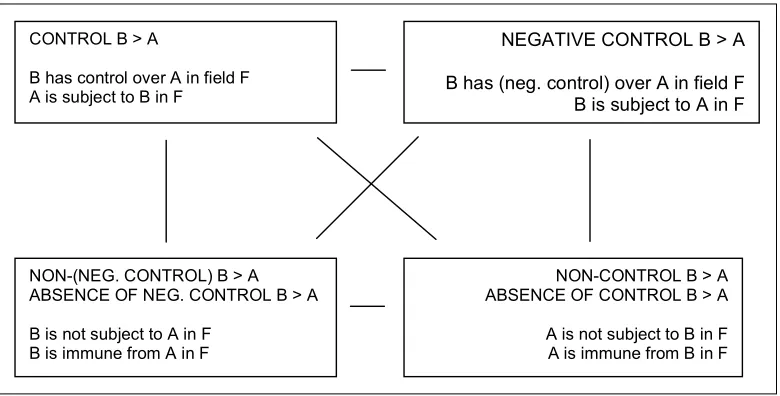
As suggested earlier, the operation of norms implies interaction between agents, and therefore a social context. If in a given field F, and in a given situation, agent A has an obligation to act in a certain way, this means he or she has this obligation towards another agent B, who may of course be a group of persons, a collective, a community. If A has an obligation towards B, it follows that B has a certain claim on A. This ‘claim’ means that B has the power to impose a norm on A and invoke sanctions in case of non-compliance by A, if B chooses to use that power.23 As in the case of the modalities of normative force, the modalities of normative control involve not only a set of clearly defined relations in which B controls A (expressed below as B > A), so that A has certain, mutually recognized obligations towards B to behave in a certain manner on certain occasions, but also a more uncertain area, where A is more or less immune from B and vice versa. In Figure 3 it is again the top half of the diagram which shows clearly defined relations, while the bottom half shows areas of diffuseness and uncertainty:
Figure 3 Modalities of normative control
A legal contract is more binding than a voluntary code of conduct or a gentleman’s agreement. An experienced and well-established poetry translator may feel more confident than the young aspiring novice in ignoring the wishes and
22
Charles Taylor, ‘To Follow a Rule…’, in Craig Calhoun, E. Lipuma and M. Postone (eds.), Bourdieu: Critical Perspectives (Cambridge: Polity Press, 1993), p. 45-60; the essay was first published in Mette Hjort (ed.), Rules and Conventions.
23
Ross, op. cit., p.127ff. CONTROL B > A
B has control over A in field F A is subject to B in F
NEGATIVE CONTROL B > A
B has (neg. control) over A in field F B is subject to A in F
NON-(NEG. CONTROL) B > A ABSENCE OF NEG. CONTROL B > A
B is not subject to A in F B is immune from A in F
NON-CONTROL B > A ABSENCE OF CONTROL B > A
suggestions of a particular editor or publisher. The point to stress, however, is that norms and rules are social realities, involving not just individuals, groups and communities but also the power relations within these communities, whether these relations are material (economic, legal, political) or ‘symbolic’. This is what gives the model its dynamic character. Norms operate in a complex and dynamic social context, which may be a cultural domain, such as the domain of literature. It does not greatly matter whether one thinks of this context in terms of a ‘system’, in the sense of systems theory or in terms of, say, a ‘field’, such as the field of cultural production in Bourdieu’s sense. What is important is the fact that norms are deeply implicated in the social and cultural life of a community. They involve different and often competing positions and possibilities, they point up various interests and stakes being pursued, defended, coveted, claimed – and the individual’s desires and strategies to further this or her own ends, whether as a result of rational choices and practical reasoning or of decisions grounded in entrenched norms and rules. In large, complexly structured and stratified societies, a multiplicity of different, overlapping and often conflicting norms coexist. This multiplicity is at the same time the main repository of the potential for change.
It is also the stratified social context, and the hierarchy of the power relations in it, which explains the greater prominence as well as the greater binding force of some norms as opposed to others. The institutions or agents who exercise normative control tend to occupy positions or relative power and dominance in the particular field where the norms apply, or indeed in higher-level fields, i.e. fields closer to the centres of power in a community. Generally speaking the possibility of effectively subverting norms only arises in conditions of weak normative control, when the norm subject is relatively immune to sanctions, or prepared to accept them.
The dominant norms of a community are usually those of the dominant sections of the community. They are also the sections which determine the content of the norms. In themselves, norms are neither true nor false. They do not represent assertions about existing states of affairs. Rather, they stipulate what ‘ought’ or ‘is to’ happen, how things ‘should’ be. The content of a norm is a notion of what is ‘proper’ or ‘correct’. This is a social, intersubjective notion, a conceptualization of patters of behaviour – including speaking, writing, translating – regarded as correct or at least legitimate, and therefore valued positively. What is ‘correct’ is established within the community, and within the community’s power structures and ideology, and mediated to its members. The directive force of norms, their executive arm, serves among other things to delimit and secure these notions of correctness. The notion of what
constitutes ‘correct’ behaviour, or ‘correct’ linguistic usage, or ‘correct’ translation, is a social and cultural construct.
The mere fact of entering a cultural system and learning to operate as a
participant in it, involves a process of familiarization with the relevant models. This is true whether we are speaking, say, of going to university, or of joining a translation agency, or of aspiring writers trying to get their poems or literary translations
accepted by a publisher. In fact, the process itself has directive and motivational force, as cultural models are internalized, and behaviour is adapted to conform to the models recognized as pertinent to the system.24 It remains possible, of course, to resist the process of adaptation, but at the cost of a failure to integrate into the system. Looking at it from a different angle, we can say that it is through the motivational force of models and norms that relations of obligation and claim are created between collectives and individuals. These relations are also relations of power.
6
If every stage in the transfer and translation of texts is governed by choices which require criteria to make more than wholly random decisions about which options to select, and to what end, then norms, rules and models supply these criteria and goals. Compliance with the set of translational norms regarded as pertinent in a given community or domain means that the product, i.e. the translation, is likely to conform to the relevant correctness notion, which means conformity with the model
embodying that correctness notion – behind which we can discern the dominant values and attitudes of the community or the domain in question. Translating ‘correctly’, in other words, amounts to translating according to the prevailing norm, and hence in accordance with the relevant, canonized models. The result can be expected to be another ‘model’ translation.
Learning to translate correctly means the acquisition of the relevant
competence, i.e. the set of dispositions required to select and apply those norms and rules that will produce legitimate translations, i.e. translations which conform to the legitimate models.25 In this way the translator training institute, or any other type of instruction performing the same function, continually reproduces the dominant norms and models, ensuring their canonization and entrenchment. The higher-level authority – a political entity, an economic class, a community – which attaches value to those norms and models, delegates its norm-setting power to the educational institute.
It will be clear that in the case of translating, as a form of textual production, the models being referred to are textual, discursive entities. They cover the substance of what is normally called a ‘poetics’ (including a ‘poetics of translation’), i.e. a set of principles and practical rules for ‘good writing’, and a set of examples of good
practice. But they appear here with a different emphasis, which allows us to appreciate more clearly their strategic role in the dynamics of culture. Particular groups or subgroups may adopt a certain configuration of translational models and prototypes in opposition to other groups, to compete with them and because there are certain material and symbolic stakes to be defended or claimed. As individuals weave
24
For exemplary case studies see Richard Shweder, ‘Ghost Busters in Anthropology’ in Roy D’Andrade and Claudia Strauss (eds.), Human Motives and Cultural Models (Cambridge: Cambridge University Press, 1992); and Dorothy Hollan, ‘How Cultural Systems Become Desire. A Case Study of American Romance’, in Roy D’Andrade and Claudia Strauss (eds.) Human Motives and Cultural Models, p. 61-89.
25
their way through and around these configurations, they take up positions and build alliances, so as to be able to achieve their own aims, goals and ambitions as well as those of the groups with which they have aligned themselves. The marked
intertextuality which results from these strategies has a social relevance. In translating detective novels or popular romances, for example, the choice of a particular textual model may well mark the translation as ‘literary’ but it may also spell the end of a lucrative contract. At the same time, the textual models in question are not only, and not necessarily, those of the receptor culture. The specificity of translation stems from the fact that it refers, expressly or tacitly, to an anterior discourse in another sign system which it claims to represent in one way or another. This is not only complicates the intertextual nature of the translated text, which always reaches beyond systemic borders, but it also emphasizes its hybridity, as the systemic ‘otherness’ of the source is unlikely to be wiped out altogether in translation.
Translated texts, we can say, always signal to textual models of at least two cultures. This context also helps us to appreciate the relative power which the translator has in principle, and may in certain circumstances be able to exploit. Translators normally cater for those who have no access to the other side of the language barrier themselves but require information from that source. The translator, as socially recognized expert, is acknowledged as possessing the special competence to convey information from one sign system to another. In conditions where individual
translators cannot easily be dispensed with, because alternatives are unavailable or too expensive, for example, the translator’s clients have no option but to trust not only the translator’s technical expertise but also his or her personal and ideological loyalty. The translator’s power in such cases is symbolic as well as material. Loyalty may have its price, and may depend on whose side the translator is ultimately on. No less importantly, unless the client can rely on an expert control mechanism, he or she is not in a position to challenge the image of the unknown as constructed by the
translator. The history of the role of interpreters in early European encounters with the New World (Columbus in the Caribbean, Cortés in Mexico, Jacques Cartier in
Canada) furnishes abundant illustrations of the interplay between power, loyalty and self-interest in the relations between translators and their clients.
7
One of the mayor tasks of the researcher wishing to account for translation as a social practice consists in identifying and interpreting the norms which governed the
translator’s choices and decisions. The task extends to accounting, in given communities, at certain times or over a period of time, for the system of norms governing particular domains of translation and the discursive models which inspired the norms. The adoption, in specific instances, of certain models in preference to others informs us about the motivation and strategy used by translators in negotiating existing norms, the kind of text they were aiming to produce, the goals they were trying to achieve, and the negative models they were presumably trying to avoid. The discourse about translation, whether by translators themselves or by others (clients, publishers, critics, readers), will also point up notions of correctness, operational aspects of norms and positive and negative models and prototypes. As was already pointed out by Toury,26 establishing the nature of the relation of this meta-discourse, i.e. the historical metalanguage of translation, to the contemporary production of
26
translations is a particularly delicate aspect of the researcher’s task. All this amounts to a comprehensive programme for historical research.
The task may still sound relatively simple. It is not, for obvious reasons. Norms are not directly observable, and there may be a gulf separating statements about norms from norm-governed behaviour. Tracing actual decisions and regularities does not tell us why the decisions were made and what induced the regularities. Moreover, cultural systems are extremely complex and perpetually changing entities, embedded in other social systems, each with a history of its own. Translation is necessarily anchored in several of these systems at once. We can therefore expect to find a variety of competing, conflicting and overlapping norms and models which pertain to a whole array of other social domains. Their directive force will in each case depend on their nature and scope, on their relative weight, their centrality or marginality, their relation to other canonical or non-canonical models and norms. This is what determines, for both collectives and individuals, the modalities of normative force: what must be said, what must not be said, what may be said, what can be said (see Figures 1 and 2 above). But these various obligations and prohibitions in turn correlate with modalities of normative control (Figure 3 above), which are based on relations of power. It is only within such complexes that we can begin to assess the role of norms and models as opportunities or constraints, and the translator’s activity as being both pressure-driven and goal-seeking at the same time.
The fact, moreover, that in certain domains, at certain times, certain models, rules and norms are more in evidence than others, is a reminder of the hierarchies of power and of the (real or symbolic) power struggles that run through human societies. As social and cultural hierarchies change, new values, ideologies and structures prevail, and new forms of control, competition or patronage emerge, the models, norms and rules of translation change as well. As a social and cultural activity, translation is part of these structures and constitutes an operative force in them. It is precisely through the specific orchestration of translations, through the models which individual translators choose to adopt, through their assessment and interpretation of norms and rules, that they take part in that dynamic. In other words, the identification of the translator’s models and norms and the appreciation of their relative strength provides access to, and insight into, strategies and motivations. It also makes of the translator an agent, an active participant in a complex exchange, a person with a particular expertise and hence a certain amount of power, and with all manner of private and public interests to look after.
8
The observation that translation is necessarily anchored in several of these systems at once, reflects the fact that translations are not normally produced for their own sake but for a purpose, and with reference to pre-existing texts and discourses. The normal mode of existence of a translation is not as ‘a translation’ or ‘a translated text’ per se, but as a translated legal document, a translated philosophical treatise, a translated work of literature. Rather than occurring in a self-contained universe, translations are inserted into – or sometimes between, or alongside – existing discursive forms and practices. In catering for the needs of the system recipient, translation cannot but defer to the prevailing discourses of that system. It is this aspect of translation which
economic discourses’, and consequently she regards the deployment of translation in a colonial context as part of the ‘technology of colonial domination’.27
Niranjana also takes the empirical study of translation to task for not thinking through the ideological and social force of translation, as in the case of its complicity in the European colonial project. This type of investigation, she charges, ‘seems to ignore not just the power relations informing translation but also the historicity or effective history of translated texts’.28 Criticizing in particular Gideon Toury’s insistence on systematic, empirical description she observes that ‘[t]he ‘empirical science ‘ of translation comes into being through the repression of the asymmetrical relations of power that inform the relations between languages’.29
The criticism has some substance to it, of only because, coming as it does from a politically committed position, it draws out the political and ideological implications of the academic and scholarly discourse on translation, indeed of any discourse. But surely the main issue is different, and it is not so much that in the last ten years or so empirical translation studies have, by and large, and increasingly so, begun to pay attention to the fact that translation is bound up in relations of power – witness, for example, the work of André Lefevere, José Lambert, Susan Bassnett, Maria Tymoczko, Theresa Hyun and others working within the so-called target-oriented paradigm. The point is, rather, that empirical studies have yet to develop a comprehensive theoretical and methodological framework that can encompass the social and ideological embedding and impact of translation. André Lefevere’s triad of ideology, poetics and patronage as determining factors in translation directly
addresses the problem.30 Niranjana’s notion of the overdetermination of translation is a particularly useful concept in this respect, even though her book as a whole is too much focused on the colonial and postcolonial conditions and on poststructuralist critiques to provide a general framework.
As being suggested here, an approach to translation via the issue of norms can furnish a key component of such a framework. It can cope with the overdetermination of translation precisely because the norm concept has its basis in social interaction, and therefore in questions of ideology, social complexity, shared values and the unequal distribution of power. Leaving aside the irony that it was, of all people, Gideon Toury who introduced the concept of norms into translation studies, it remains true that the broader theoretical and methodological implications of the norms
approach need developing. One aspect of this concerns the very determination of what constitutes translation, and for whom. The following pages are first, faltering step in that direction.
9
The complex of translational rules and norms operative in a particular community defines what is translation for that community, because it determines what is recognized as translation. The norms of translation broadly prescribe what can and should be selected, how the material is to be handled by individual translators, and
27
Siting Translation. History, Post-Structuralism and the Colonial Text (Berkeley and Los Angeles: University of California Press, 1992), p. 21.
28
Ibid, p.59.
29
Ibid., p.60.
30
how it is likely to be received. In this sense norms define the contours of translation as a recognized, social category.
It is useful to distinguish, as others have done,31 between ‘constitutive’ and ‘regulative’ norms and rules of translation. The distinction is certainly not absolute, as constitutive norms cannot do without regulative norms and vice versa.32 Nevertheless, we could say that, for a given community, the constitutive norms of translation mark the boundary between what is translation and what is not, i.e. between what a given community regards and accepts as translation and therefore agrees to call translation, and those modes of expression and of textual production or transformation which go by some other name (creative writing, imitation, adaptation, plagiarism, burlesque, etc.). Regulative norms of translation distinguish, within the domain called
translation, between optional forms of behaviour. Particular options may be regarded as appropriate in certain types of cases, and the translator’s perceived success or failure in adhering to this or that norm may be deemed to have resulted in ‘good’ or ‘bad’ translations. The regulative norms of translation are therefore subordinated to the constitutive norms. Regardless of whether a particular performance is judged good or bad, splendid or poor, it remains within the bounds of translation. Of course, serious or repeated breaches of strong regulative norms may still lead to the verdict that the product in question is ‘not a proper translation’, ‘not acceptable as a
translation’, ‘no longer translation’, and so on, but this mere indicates that as regards translation the distinction between constitutive and regulative norms is not hard and fast, or uniformly used in different sections of a community. But if the outer edges of the domain of translation are often frayed, its centre is usually much more stable, and governed by institutionalized norms and rules. The canonical models of translation, moreover, are likely to serve both as archetypal instances of translation as such (hence satisfying the constitutive norms), and as examples of translation deemed excellent (hence satisfying the dominant regulative norms).
Nevertheless, the distinction is still useful in a number of ways. In fact we constantly appeal, however indirectly, to a constitutive norm to determine what our culture understands as translation.
In 1959, in his famous essay ‘On Linguistic Aspects of Translation’, Roman Jakobson presented a tripartite division of different kinds of translation into what he termed intralingual translation or rewording, interlingual translation or translation proper, and intersemiotic translation or transmutation. In Jakobson’s own presentation of these different kinds, both intralingual and intersemiotic translation are ‘translated’ into other terms, ‘rewording’ and ‘transmutation’, respectively.33 The very fact that the middle term is given as ‘interlingual translation or translation proper’, without a ‘proper’ intralingual equivalent (i.e. without rewording), serves as an indication that this form is the one which, in our contemporary usage, is commonly understood as being ‘translation’ tout court. In other words, Jakobson’s extension of the term to intralingual and intersemiotic modes, accepted in academic circles as perfectly legitimate from a linguistic and semiotic point of view, acknowledges in its very designation of ‘translation proper’ for interlingual translation that as a social category this is what constitutes the entire concept of translation, to the exclusion of the other two forms. The formulation itself concedes that the extended meaning may claim
31
Nord, art. cit.; and Chesterman, art. cit. 32
Schauer, op. cit., p. 6-7; and Kratochwil, op. cit., p. 26.
33
See also Jacques Derrida’s shrewd and ironic comments on the terms and assumptions of
validity in the academic community, but that it does not coincide with common usage. At the same time, in extending the ‘commonsense’ concept of translation to
accommodate a number of related operations, the definition significantly
underdetermines that concept. But it is equally obvious that the commonsense notion of translation as restricted to interlingual operations rests on the application of a constitutive norm.
The boundaries of what is recognized as translation can also be illustrated with reference to ‘phonemic’ translations (or transpositions, or whatever) such as the Englishings of Catullus by Louis and Celia Zukofsky, or Ernst Jandl’s versions of Wordsworth.34 A good many readers and critics have hesitated to call these texts ‘translations’, even though at least the Zukofsky versions were presented as such. However, the privileging of sound over sense in such ‘phonemic’ renderings is so strong that most critics35 feel the result cannot be reconciled with our expectations of the kind of relation a translation should entertain with its original. The normative moment in this expectation is clear enough and appears in statements to the effect that translation should preserve such things as the ‘sense’, or the ‘pragmatic meaning’, or the ‘communicative value’ of the source text. At the same time, it is hardly a
coincidence that renderings with an ambivalent status occur precisely in the literary field, with its relatively weak modalities of normative force and normative control.
10
Can we determine what constitutes ‘translation’ in, say, the Western world? In this crude form the question is obviously unanswerable. It needs to be broken down into genres, cultural circuits, geographical areas, and historical periods. In principle, and with luck, empirical investigation may then come up with at least partial answers in the form of shared assumptions and expectations, and hence shared norms and conventions. This is the type of empirical approach which was adopted, for example, by Siegfried Schmidt in his enquiry into the ‘macro-conventions’ governing the concept of literature as a social construct in West Germany in 1980.36 As regards translation, certain intuitive formulations by seasoned observers may or may not come close to capturing a consensus in particular subdivisions, and could inform working hypotheses. With reference to modern professional interpreting, for instance, Brian Harris posits the existence of a ‘fundamental and universal’ norm,. which is
The ‘true interpreter’ norm, or … the norm of the ‘honest spokesperson’. This norm requires that people who speak on behalf of others, interpreters among them, re-express the original speakers’ ideas and manner of re-expressing them as accurately as possible and without significant omissions, and not mix them up with their own ideas and expressions. Occasionally this norm is made explicit, as in the oaths which court interpreters have to swear under some jurisdictions.37
Of course, just how’ fundamental and universal’ a norm of interpreting is formulated here remains to be seen. But the formulation itself also reminds us that interpreting, as a mode of translation, is enmeshed in other spheres of human activity, and in legal
34
Lefevere, Translating Poetry. Seven Strategies and a Blueprint (Assen and Amsterdam: Van Gorcum, 1975), p. 19-26; and Toury, op. cit., p. 43-55.
35
Including e.g. Lefevere, at least in Translating Poetry. 36
Siegfried Schmidt, ‘Conventions and Literature’, in Hjort, op. cit., p. 222-24.
37
and moral categories. They are part of the social construction of translation. At the same time, they mark the overdetermination of translation.
If this is true, it follows that decontextualized accounts of translation which describe the process without reference to its social environment, necessarily underdetermine translation. This was the case with Jakobson’s description. It also applies, for example, to the semiotic definition which Gideon Toury offers as part of his broad ‘cultural-semiotic perspective’ on translation in Thomas Sebeok’s
Encyclopedic Dictionary of Semiotics (1986):
Translating is an act (or a process) which is performed (or occurs) over and across systemic borders. In the widest of its possible senses it is a series of operations, or procedures, whereby one semiotic entity, which is a constituent (element) of a certain cultural (sub)system, is transformed into another semiotic entity, which forms at least a potential element of another cultural (sub)system, providing that some
informational core is retained ‘invariant under transformation’, and on its basis a relationship known as ‘equivalence’ is established between the resultant and initial entities.38
Like Jakobson’s, this definition presents a considerable extension of our ‘normal’, colloquial and/or intuitive use of the term ‘translation’ in much of the Western world today. In its attempt to extrapolate a minimal semiotic kernel from a large number of everyday, metaphoric and scholarly uses of the term ‘translation’, it clearly
underdetermines the concept, at least in comparison with the ‘commonsense’ notion of ‘translation proper’. Of course, it is the combination of modern academic
discourses on languages and sign systems together with existing ‘commonsense’ concepts and practices of translation which create the conditions for the definition in the first place, and for its acceptance in an academic milieu.
Insofar as the definition isolates the minimal or core features of a particular kind of semiotic operation, it also intends to name a universal category, presumably ‘translation’ unbound by socio-cultural and other conditioning factors. This would be the common denominator abstracted from all those practices termed ‘translation’ in one language, ‘traduction’ in another, ‘Übersetzung’ in a third, ‘vertaling’ in a fourth, etc. The definition is then the result of a progressive reduction to a minimal set of constitutive norms, i.e. the requirement concerning the retention ‘invariant under transformation’ of ‘some informational core’, and the consequent establishment of a relation of ‘equivalence’ (the terms are obviously problematical, as is the syntax of the definition as regards the ‘equivalence’ clause). Even if the ‘providing’ clause in the definition is read as a purely descriptive statement, the problem is only displaced, as in performing operations which might qualify as ‘translation’, cultures will still have to decide what they recognize as the valid retention ‘invariant under
transformation’ of an informational core.
Just how broad or universal is the definition then? Clearly, the reduction of the translative operation to a semiotic core puts it at some remove from particular socio-culturally determined ‘commonsense’ concepts of translation as they occur in individual languages. Its claim to universality could then mean one of two things.
Either all usages in all languages have a common core of meaning for their respective terms denoting ‘translation’, i.e. for whatever translates as ‘translation’ from and into the local idiom, although one must then wonder on the basis of what concept of
38
translation the terminological and conceptual equivalence is to be established. Or the definition identifies a universal non-linguistic category, an operation denoted by means of different terms in different languages. This presents problems of a different kind, among them the question of knowing how terms in individual languages correspond to this entity.
Neither interpretation looks convincing or even tenable. However, even if we reject the definition’s implicit – and never more than implicit – claim to universality, it will still be useful as a tool to explore other, and possibly very different concepts of translation in other cultures. Its virtue lies precisely in the fact that it clearly, and deliberately, underdetermines translation as it has been practised in much of the Western tradition. But it is worth remembering that in using the semiotic definition to approach concepts of translation in other cultures, the normative moment in the definition is retained. While this presents theoretical and philosophical problems, it is hard to envisage a practical alternative. When we attempt to grasp and circumscribe the concept of translation, and hence its constitutive norms, in other cultures, there is no safe, objective point from which to tackle the issue. In this respect the translation researcher’s operations are similar to, and as problematical as, the type of ‘cultural translation’ performed by anthropologists.39
In looking at the field of translation in a distant culture – distant in time, place or ideology – researchers project the concept of translation prevalent in their own time, place and language onto the new domain, and start from there. This happens in other domains as well. Our present-day cultural categories have no exact counterpart in, say, tenth-century European societies, or among the Nambikwara of the Amazon region. If we nevertheless wish to study cultural products which function in those communities in a manner comparable in one way or another with what we here and now call, for example, ‘literature’, or ‘art’, we have no other option except to explore the possibility that something resembling our known categories, however minimally defined, exists in those communities, and subsequently to proceed from this
assumption of commensurability to map and gloss the various practices in the other culture, together with their metalanguages, and together with related practices in the immediate vicinity. The exploration and delineation of the domain of translation in distant cultures is no different from this essentially ethnographic and heavily interpretive practice. The ethnocentric bias is undeniable.40 Of course, similar procedures are applied in most historical investigations, and they, too, invariably bring into play the researcher’s own preconceptions and historicity. The fact that, in the case of translation, the researcher’s concept of translation cannot help being determined by the prevailing translational norms in his or her own culture and milieu, can serve as a reminder that the separation between object-level and meta-level is rather less clear-cut than we might like to believe. Moreover, when we translate into
39
Talal Asad, ‘The Concept of Cultural Translation in British Social Anthropology’ in James Clifford and George Marcus (eds.), Writing Culture, The Poetics and the Politics of Ethnography (Berkeley: University of California Press, 1986), p. 141-64; and Stanley Jeyaraja Tambiah, Magic, Science, Religion, and the Scope of Rationality (Cambridge: Cambridge University Press, 1990).
40
our own terms a concept of translation radically different from ours, we inevitably do so by making use of our own categories of translation.41
The exploration begins, then by establishing a ‘base of agreement’ to make comparison and commensuration possible.42 In the case of translation there may be something to be said for taking Tour’s semiotic definition of translation as a starting point. Having grown out of the contemporary scholarly discourse of descriptive studies, it clearly underdetermines concepts of translation current in the Western tradition and may reasonably be expected also to underdetermine (many? Most?) concepts of translation likely to be encountered in other cultures, communities and/or periods. Precisely because it underdetermines the social practice of translation, the semiotic definition serves to counterbalance to some extent the fact that the researcher’s perspective is necessarily grounded in his or her own overdetermined ‘commonsense’ understanding of translation. This will facilitate the subsequent mapping and plotting of culturally different conceptions of translation as far as possible in their own terms and context.
What this amounts to, is an attempt to grasp and reconstruct the other community’s culture-specific field of translation in its relation to its immediate environment, i.e. in its social conditioning and overdetermination. This is rather more than a simple matter of fleshing out a clinically decontextualized semiotic skeleton. As, for example, Clifford Geertz demonstrates in his essay ‘Art as a Cultural System’, the practices encountered in one domain of culture can only be understood in the light of the practices which make up culture as a whole. As he puts it:
It is out of participation in the general system of symbolic forms we call culture that participation in the particular we call art, which is in fact but a sector of it, is possible. A theory of art is thus at the same time a theory of culture, not an autonomous enterprise. And if it is a semiotic theory of art it must trace the life of signs in society, not in an invented world of dualities, transformations, parallels and equivalences.
The references in Geertz’ article are to such art forms as Yoruba carvings, Abelam four-colour painting, European Renaissance painting, and Moroccan oral poetry. He might equally have been speaking of translation.43
Even so, the researcher’s description of the assumptions, conventions, norms and rules of what another culture understands by ‘translation’ remains itself,
necessarily, an interpretation, an attribution of meaning resulting in a textual
construct, a cultural translation into the terms and terminology of one form or another of translation studies. As a scholarly text, and as a translation into scholarly discourse, the description, like other forms of cultural translation, is ‘inevitably enmeshed in conditions of power – professional, national, international’.44 Just as the terms of the process of transcription are neither neutral nor transparent but part of a broader conceptual and discursive web, so the product of that process is entangled in pre-existing structures and institutions with their own status, role and functioning. In other
41
Matthijs Bakker (‘Metasprong en wetenschap: een kwestie van discipline’ in Dirk Delabastita and Theo Hermans, eds., Vertalen historisch bezien, The Hague: Stichting Bibliographia Neerlandica, 1995) offers an ingenious and pertinent discussion (in Dutch) of the problematical nature of the transition from object-level to meta-level in descriptive translation studies (an approach, that is, which does not wish to define translation a priori, yet needs to translate that which it observes into its own terms), and of the resulting complicity between the researcher and the normative structures of his or her object of study.
42
Tambiah, op. cit, p. 131ff.
43
Clifford Geertz, Local Knowledge. Further Essays in Interpretive Anthropology (London: Fontana, 1993 [1983]), p. 109.
44
words, our own descriptions, being also transcriptions, are shot through with