Western University Western University
Scholarship@Western
Scholarship@Western
Electronic Thesis and Dissertation Repository
8-1-2014 12:00 AM
Online Virtual Network Provisioning in Distributed Cloud
Online Virtual Network Provisioning in Distributed Cloud
Computing Data Centers
Computing Data Centers
Khaled Mefarh Alhazmi
The University of Western Ontario
Supervisor Abdallah Shami
The University of Western Ontario
Graduate Program in Electrical and Computer Engineering
A thesis submitted in partial fulfillment of the requirements for the degree in Master of Engineering Science
© Khaled Mefarh Alhazmi 2014
Follow this and additional works at: https://ir.lib.uwo.ca/etd
Part of the Electrical and Computer Engineering Commons
Recommended Citation Recommended Citation
Alhazmi, Khaled Mefarh, "Online Virtual Network Provisioning in Distributed Cloud Computing Data Centers" (2014). Electronic Thesis and Dissertation Repository. 2319.
https://ir.lib.uwo.ca/etd/2319
This Dissertation/Thesis is brought to you for free and open access by Scholarship@Western. It has been accepted for inclusion in Electronic Thesis and Dissertation Repository by an authorized administrator of
ONLINE VIRTUAL NETWORK PROVISIONING IN DISTRIBUTED
CLOUD COMPUTING DATA CENTERS
by
Khaled Mefarh Alhazmi
Graduate Program in Electrical and Computer Engineering
A thesis submitted in partial fulfillment
of the requirements for the degree of
Masters of Engineering Science
The School of Graduate and Postdoctoral Studies
Western University
London, Ontario, Canada
c
Abstract
Efficient virtualization methodologies constitute the core of cloud computing data center implementation. Clients are attracted to the cloud model by the ability to scale available re-sources dynamically and the flexibility in payment options. However, performance hiccups can push them to return to the buy-and-maintain model. Virtualization plays a key role in the syn-chronous management of the thousands of servers along with clients’ data residing on them. To achieve seamless virtualization, cloud providers require a system that performs the function of virtual network mapping. This includes receiving the cloud client requests and allocating computational and network resources in a way that guarantees the quality of service conditions for clients while maximizing the data center resource utilization and providers’ revenue. In this thesis, we introduce a comprehensive system to solve the problem of virtual network mapping for a set of connection requests sent by cloud clients. Connections are collected in time inter-vals called windows. Subsequently, node mapping and link mapping are performed. Different window size selection schemes are introduced and evaluated. Three schemes to prioritize con-nections are used and their effect is assessed. Moreover, a technique dealing with connections spanning over more than a window is introduced. Simulation results show that the dynamic window size algorithm achieves cloud service providers objectives in terms of generated rev-enue, served connections ratio, resource utilization and computational overhead. In addition, experimental results show that handling spanning connections independently improves the re-sults for the performance metrics measured.
Moreover, in a cloud infrastructure, handling all resources efficiently in their usage, man-agement and energy consumption is challenging. We propose an energy efficient technique for embedding online virtual network requests in cloud data centers. The core focus of this study is to manage energy efficiently in cloud environment. A fixed windowing technique with span-ning connections is used. Our algorithm, and a technique for randomly embedding nodes and links are also explained. The results clearly show that the algorithm used in this study generated better results in terms of energy consumption, served connections and revenue generation.
Keywords: Cloud computing, cloud data centers, virtual network requests, node and link mapping, window size decision, energy efficiency, power consumption
Acknowlegements
Alhamdulillah, all praise goes to Allah for the blessing of completing this thesis. It is
with pleasure that I write this page to express my joy and to acknowledge all those who have
supported me in successfully completing this thesis. It has been a journey of two years to
complete this work and I have no doubt that I could not have been able to do it without the love
and support of my family, friends, and colleagues.
First, I would like to express my appreciation to my supervisor Professor Abdallah Shami
for all the encouragement and precious guidance that I have received from him at every stage
of the research. The valuable discussions we had, both inside and outside campus, were always
a source of inspiration to me.
It is a wonderful feeling to express my thanks to my colleagues for their help in conducting
the research. I am grateful for their valuable advice which I implemented in my experiments.
I am also glad to extend my thanks to the Department of Electrical and Computer Engineering
at Western University for their assistance while conducting my studies in the lab.
I owe a special word of indebtedness to my father, mother, and brothers and sisters. My
heartfelt thanks go out to my beloved wife for her constant inspiration, encouragement,
sacri-fice, and tolerance during my research work. I am extremely thankful to my wife for taking
care of our sweet daughters during this journey. My family and wife’s prayers during this
period, I am sure, have helped tremendously in completing the research work successfully.
Last and not least, I would like to thank King Abdulaziz City for Science and Technology
(KACST) - Saudi Arabia - for providing me with the required support and financial means to
complete the program.
Contents
Abstract ii
Acknowlegements iii
List of Figures vii
List of Tables ix
Citations to Publications x
1 Introduction 1
1.1 Introduction . . . 1
1.2 Contributions . . . 2
1.3 Thesis Organization . . . 3
2 Virtualization and Virtualization platforms 4 2.1 Virtualization . . . 4
2.2 Virtualization Platforms . . . 5
2.2.1 Desktop Virtualization . . . 6
2.2.2 Server Virtualization . . . 6
2.2.3 Storage Virtualization . . . 7
2.2.4 Application Virtualization . . . 7
2.2.5 Network Virtualization . . . 8
The Key Principles of Network Virtualization: . . . 10
The Promising Characteristics of Virtual Networks: . . . 11
2.3 Data Centers . . . 12
2.3.1 Virtualization in Data Centers . . . 13
3 Resource Allocation in Cloud Computing Environment 14 3.1 Introduction . . . 14
3.2 Resource Allocation in Cloud Computing . . . 16
3.3 Cloud Computing: Its different components, advantages, weakness and types . 17 3.3.1 Cloud Computing Architectures . . . 17
3.3.2 The Evolution of the Cloud set up . . . 18
3.3.3 Technical and Economic Advantages of Cloud Computing Paradigm . . 19
3.3.4 Challenges . . . 20
3.3.5 Inherent Characteristics of Cloud Computing . . . 21
3.3.6 Current Trends and some Prominent Cloud Players . . . 22
3.3.7 Different Types of Clouds . . . 23
3.4 Resource Allocation Algorithms in Cloud Computing . . . 24
3.4.1 Resource Allocation in Public Cloud . . . 24
3.4.2 Virtual Network Mapping in Cloud Environment . . . 26
4 A Map of the Clouds 31 4.1 Introduction . . . 31
4.2 Model Description . . . 35
4.3 The Virtual Network Mapping Solution . . . 37
4.3.1 Virtual Network Mapping . . . 37
Node Mapping . . . 37
Link Mapping . . . 38
4.3.2 Time Window Selection Techniques . . . 38
Fixed Window Technique . . . 38
Dynamic Window Technique . . . 38
4.3.3 Spanning Connection Technique . . . 39
4.3.4 Revenue Objective Function . . . 43
4.4 Performance Evaluation . . . 43
4.5 Results and Analysis . . . 45
4.5.1 Effect of Window Size Decision . . . 45
4.5.2 Effect of Connections’ Order . . . 48
4.5.3 Effect of Maximum Allowed Tardiness on the VN Mapping Performance 52 4.5.4 Effect of Spanning Connection Technique . . . 53
5 A Greener Cloud 57 5.1 Introduction . . . 57
5.2 Related Work . . . 59
5.2.1 Power Efficient Provisioning for VN Embedding . . . 59
5.2.2 Energy Aware Data Centers . . . 60
5.2.3 Energy Conservation in Cloud Data Centers . . . 61
5.2.4 Energy Aware Virtaul Network Mapping . . . 62
5.3 System Model . . . 62
5.4 Power Efficient Virtual Network Embedding . . . 63
5.4.1 Network Model/Cloud Infrastructure . . . 63
5.4.2 Energy Aware Virtual Network Embedding . . . 64
Energy Aware Virtual Network Embedding: Node Embedding Stage . . 64
Energy Aware Virtual Network Embedding: Link Embedding Stage . . 64
5.4.3 Used Techniques . . . 65
Fixed Window Technique . . . 65
Spanning Connection Technique . . . 65
5.5 Performance Evaluation . . . 67
5.5.1 Evaluation Setup and Metrics . . . 67
5.5.2 Numerical Results and Comparison . . . 69
6 Conclusion and Future Work 72 6.1 Conclusion . . . 72 6.2 Future Research . . . 73
Bibliography 73
List of Figures
2.1 Traditional computing model. . . 6
2.2 Virtual machine model using hypervisor. . . 7
2.3 The virtual network environment [1]. . . 10
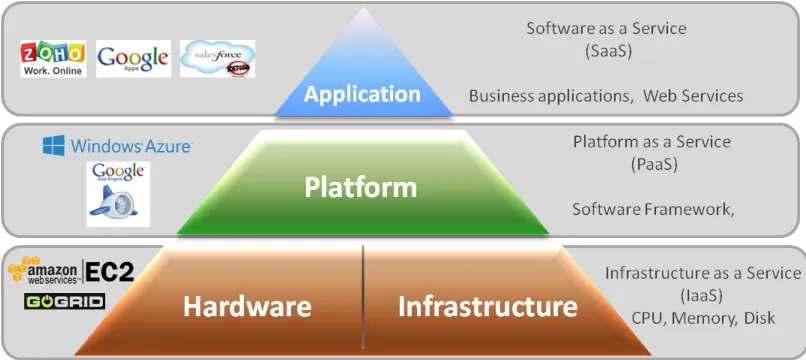
3.1 Layers of cloud computing architecture. . . 18
3.2 Evolution of cloud computing [2]. . . 19
4.1 Interval graph for 4 connections. . . 37
4.2 Dynamic Windows. . . 41
4.3 Node and Link mapping. . . 41
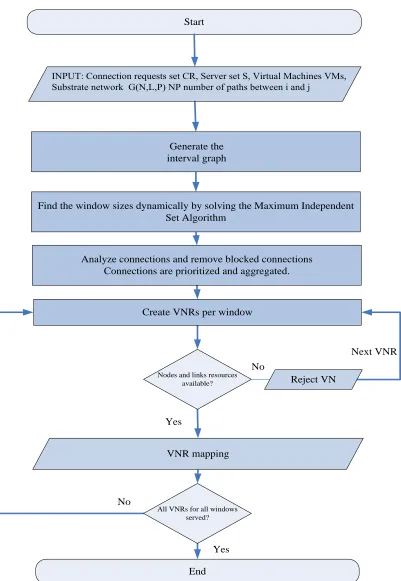
4.4 The virtual network mapping process. . . 42
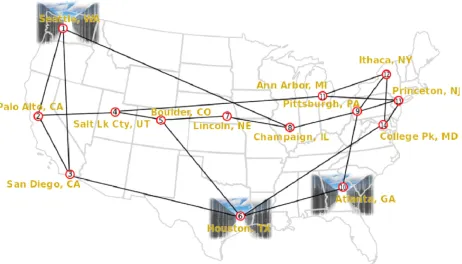
4.5 NSFNET network of 14 nodes. . . 44
4.6 Results showing average number of VNRs per window for different window decision techniques. . . 46
4.7 Results showing ratio of served connections for different window decision tech-niques. . . 46
4.8 Results showing ratio of blocked connections for different window decision techniques. . . 47
4.9 Results showing the number of rejected VNRs for different window decision techniques. . . 47
4.10 Results showing number of virtual network requests for different window de-cision techniques. . . 48
4.11 Results showing VNR acceptance ratio for different connections order schemes. 49 4.12 Results showing ratio of served connection for different connections order schemes. 49 4.13 Results showing CPU utilization for different connections order schemes. . . . 50
4.14 Results showing memory utilization for different connections order schemes. . . 50
4.15 Results showing storage utilization for different connections order schemes. . . 51
4.16 Results showing link utilization for different connections order schemes. . . 51
4.17 Results showing ratio of blocked connections for different allowed tardiness. . . 52
4.18 Results showing ratio of served connections for different allowed tardiness. . . 53
4.19 Results showing the ratio of served connections for different order schemes using spanning connection technique. . . 54
4.20 Results showing the generated revenue for different mapping schemes using spanning connection technique. . . 55
4.21 Results showing the ratio of blocked connections for different order schemes using spanning connection technique. . . 56
5.1 The energy efficient virtual network embedding process. . . 66
5.2 NSF Network of 14 nodes. . . 67
5.3 Real time energy consumption. . . 69
5.4 Energy gain using BestFit with windowing in cloud environment. . . 70
5.5 Number of served connections. . . 71
5.6 Generated Revenue. . . 71
List of Tables
3.1 Client and service provider input providers. . . 17
3.2 Commercial cloud utilities. . . 23
3.3 Client and service provider input providers. . . 30
4.1 An example of a set of connection requests . . . 36
4.2 Intersection table for connections in table 4.1 graph . . . 37
5.1 An example of a set of connection requests . . . 63
5.2 Substrate Network. . . 67
5.3 Server configuration . . . 68
5.4 Capacities of the requested virtual machine . . . 68
Citations to Publications
Large portions of this thesis appeared or will appear in the following publications:
• K. Alhazmi, M. Abusharkh, D. Ban, and A. Shami, “A map of the clouds: Virtual net-work mapping in cloud computing data centers,” inIEEE Canadian Conference on Elec-trical and Computer Engineering 2014 (CCECE 2014), (Published: May, 2014).
• K. Alhazmi, M. Abusharkh, D. Ban, and A. Shami, “Drawing the Cloud Map: Virtual network embedding in cloud computing Environment,” inIEEE Systems Journal, (Sub-mitted: June, 2014).
• K. Alhazmi, and A. Shami, “A Greener Cloud: Energy Efficient Provisioning for Online Virtual Network Requests in Cloud Data Centers,” inIEEE International Conference on Communications (ICC), (To be submitted: September, 2014).
Chapter 1
Introduction
1.1
Introduction
Cloud clients are attracted to the cloud model by the ability to scale the number and
capabil-ities of their rented machines dynamically as their business demands require. The flexibility
in payment options offered by providers is another attractive feature. However, performance
hiccups may force clients to either switch to other cloud providers or even return to the
buy-and-maintain model [3]. To maintain the performance in data centers at the level required by
clients, cloud providers need a thorough data center management system. This management
process includes synchronously handling the diverse resources of thousands of servers located
in the data center along with clients’ data residing on them [4]. Virtualization’s role is a key
in this process. Through virtualization, cloud service providers can offer computing power,
storage, platforms, and services in a commodity based design without the clients needing to
worry about low level implementation details. Clients can compute and connect without the
overhead of resource management or network routing and control [5].
To achieve seamless virtualization, cloud providers require an efficient framework to
com-prehensively perform the functions of resource virtualization, allocation and scheduling in their
geographically distributed network of data centers (public clouds). Cloud data centers
con-tain a large number of servers that store, process and exchange clients’ data. These systems
will receive clients’ network and computational resource reservation requests and perform the
mapping and scheduling of these requests. In the virtual network model adopted by many
2 Chapter1. Introduction
providers, clients are able to reserve Virtual Machines (VMs) of multiple types that have
dif-ferent resource configurations [6][7][8]. Clients can also make connection requests to connect
to their VMs residing in data centers. These connections will facilitate data exchange between
the client VMs or between a client VM and the client’s private cloud. The VMs can represent
the vertices of a virtual network where each client expects to maintain the agreed upon Quality
of Service (QoS) conditions, regardless of how many other clients are sharing the data center
resources at the same time. A key condition here is the system’s ability to allocate network
resources to VMs dynamically at any moment. This virtual network mapping scenario raises
certain questions: What is the optimal VM placement policy/method to serve client requests?
Which network connection assignment/mapping and scheduling policy should be used? How
often are arriving requests processed and mapped? How are these requests prioritized?
In this thesis, we tackle the problem of virtual network mapping in a cloud computing
data center environment. Virtual network mapping in this context means finding the optimal
technique/policy to serve/handle requests received continuously from clients by constructing
virtual networks that contain multiple VM instances running on servers in multiple
geograph-ically distributed data centers. Virtual machine instances can be connected through virtual
network links or edges that are mapped onto physical (substrate) network paths.
1.2
Contributions
In this thesis, we introduce a new virtual network mapping methodology for cloud computing
data centers. Our contribution can be summarized as follows:
• Introduce a comprehensive model that covers computational and network resource re-quests and supports performing node mapping and link mapping.
• Aggregate the connection requests into virtual network requests and process these re-quests in a time window based manner.
• Investigate the effect of fixed and dynamic window sizes and the aggregation factor com-bined with virtual network mapping in a networked cloud environment. The objective is
1.3. ThesisOrganization 3
• Investigate the effect of ordering connections on the performance of the system by testing multiple methods of prioritizing connections before processing.
• Investigate the effect of adding the spanning connections technique and show its effect on revenue and performance.
In addition, in this thesis, we introduces an energy-aware provisioning of online virtual
network requests in a cloud computing environment. Our contribution can be summarized as
follows:
• Investigate the effect of energy efficient node and link mapping strategies combined with window technique and spanning connections in energy consumption in a cloud
environ-ment.
1.3
Thesis Organization
The remainder of this thesis can be outlined as follows.
Chapter 2 provides a conceptual overview of virtualization and network virtualization.
Other virtualization platforms and virtualization in data centers are also presented in this
chap-ter. Chapter 3 presents a review of cloud computing, including definition, architecture,
ad-vantages, and challenges. Resource allocation in cloud environments is also presented in this
chapter. Related past research in virtual network mapping in cloud environment are presented.
Chapter 4 addresses the most prevalent resource allocation problem in the network
virtualiza-tion environment, virtual network embedding, and presents a comprehensive system to solve
the problem of virtual network mapping. Chapter 5 proposes an energy efficient technique for
embedding virtual network requests in cloud data centers. Finally, Chapter 6 concludes this
Chapter 2
Virtualization and Virtualization
platforms
2.1
Virtualization
As the use of computers grew, a number of operating systems have emerged. In addition, large
numbers of applications have been developed on these operating systems (OS). Processors have
become very powerful and their power is increasing with time [9]. The cost of IT hardware has
remained almost constant, even though the processing power and the size of other resources
such as memory, and hard disk, etc. have increased. In many cases the processing power of
computers remain unutilized as the architecture of X86 computers allows only one operating
system to run at a time [10]. In order to increase the resource utilization of computers, the
concept of virtualization was introduced. Virtualization allows multiple OSs to run on a single
machine by removing the traditional bond between hardware and software [10]. This is done
by using a software called hypervisor [11]. Each OS runs on a separate virtual machine created
by virtualization. The hypervisor, also called Virtual Machine Monitor (VMM), distributes
the various computing resources available such as computing power, memory, storage and
networking dynamically among the various virtual machines [12].
Network virtualization allows physically dispersed resources to be run and managed as
a single logical resource. The virtual networking software provides an abstraction layer for
deployment and management of network resources. The virtualization software partitions the
2.2. VirtualizationPlatforms 5
network into a number of isolated logical networks called Virtual Networks (VNs) with unique
attributes, including switching, routing, bandwidth, and security. This creates a logical partition
for users or applications across the network. These logical partitions then can be managed with
common attributes for each logical partition [13][14]. The most important challenge in network
virtualization is virtual network embedding that is inserting virtual network in both physical
side of nodes such as CPU, memory, and storage and links such as bandwidth on basic network
of infrastructure provider [15][16]. The main goal of this chapter is to introduce the concept of
network virtualization and discus other virtualization platforms.
The key benefits provided by virtualization are [17][18]:
• Allowing optimal utilization of computing resources by using capacities that may be wasted while using a single operating system.
• Minimizing the administration of infrastructure due to reduction in number of resources used.
• Creating scalable and flexible IT infrastructure.
• Allowing the virtual machines portability of data from one virtual machine to another in case of any problems in one machine.
• Sharing the resources to reduce operating costs as well as capital cost.
• Reducing the electrical power requirement of IT infrastructure by reducing the hardware resources.
• Increasing the availability of services by improving system maintenance and allowing quick recovery in case of disasters.
2.2
Virtualization Platforms
Virtualization solutions basically simulate the hardware platform with virtualization or
hyper-visor acting as a middle layer between the operating system and the hardware. The
6 Chapter2. Virtualization andVirtualization platforms
2.2.1
Desktop Virtualization
The desktop virtualization brings the desktop environment onto the user’s device and makes
him/her feel as if he/she is solely working on the desktop system. The system works like a
client-server computing model with virtualization software running on the centralized server
instead of the user’s computer [19]. The user can login to the system from any place but will
see the environment of normal desktop on his device. For providing desktop virtualization, the
hypervisor’s software is run on the base hardware. The hypervisor allows the deployment and
management of virtual machines [11]. Desktop virtualization has some limitations. It dose not
provide the flexibility of some OS like MS Windows that requires fast network connection with
servers [20].
2.2.2
Server Virtualization
The server virtualization enables the server to run different operating systems as well as diff
er-ent applications at the same time on a single server machine [12]. The advantage in this case is
that the client does not know that a virtual machine is being used for serving user requirement.
This scheme allows a number of different applications running on different OSs to run on
sin-gle server thereby saving on resources and providing optimum server resource utilization [21].
The comparison between traditional computing model and virtual machine model is depicted
in Figures 2.1 and 2.2 [18].
Figure 2.1: Traditional computing model.
The server virtualization software allows load balancing by moving virtual machines from
one physical machine to another without causing noticeable downtime. The use of server
2.2. VirtualizationPlatforms 7
Figure 2.2: Virtual machine model using hypervisor.
2.2.3
Storage Virtualization
The storage virtualization allows the system to see multiple storage media devices as a
sin-gle device [22]. As per Storage Networking Industry Association (SNIA), the storage
virtu-alization is defined as “The act of abstracting, hiding, or isolating the internal functions of
storage (sub) systems or service from applications, and host computers. Or general network
resources, for the purpose of enabling applications and network-independent management of
storage data” [23]. Thus virtualization provides simple interface for complex storage functions
associated with storage.
The storage virtualization provides following benefits [22][23]:
• Removes the single point failures in storage systems in a cost effective manner
• Improves utilization of storage systems
• Provides guaranteed QoS that can also be measured
• Simplifies data archival and disaster recovery
2.2.4
Application Virtualization
Traditionally, applications are run on dedicated OS and hardware. The application
virtualiza-tion allows the applicavirtualiza-tions to run on any platform. However, the applicavirtualiza-tion feels that it is
being run on the supported platform and gets access to all the resources required to function.
Virtual applications do not require installation in the traditional sense as the applications are
8 Chapter2. Virtualization andVirtualization platforms
application virtualization layer. However, they are executed on the virtual machine as if they
are installed in a traditional manner [18]. Microsoft’s Application Virtualization (App-V) is
one software that coverts the applications into central management of services [24][25].
2.2.5
Network Virtualization
Network virtualization allows physically dispersed resources to be run and managed as a single
logical resource. The virtual networking software provides an abstraction layer for deployment
and management of network resources. The virtualization software partitions the network into
a number of isolated logical networks with unique attributes, including switching, routing,
bandwidth, and security. This creates a logical partition for users or applications across the
network. These logical partitions then can be managed with common attributes for each logical
partition [13][14].
The virtualized network architecture consists of three main components: network access
control, path isolation and virtual services. The network access control grants the access rights
to the users for accessing the logical partitions. The path isolation provides routing of traffic
across the network for every logical partition. The virtual services provide network services
such as DNS, DHCP, and IP telephony management for each logical partition [13].
The network virtualization is aimed to decouple all the network services including
config-uration, and provisioning from physical layer to virtualization software layer so that they can
be managed centrally. The virtualization of a large network allows a network to be managed
centrally with less resources [26][27].
IT organizations have started realizing the advantages, the significance and the efficacy of
virtual networks over the traditional setup and are contemplating measures to migrate to this
new paradigm [28]. Although researchers argue over the significance of virtual networks, they
seem to agree on the advantages of virtual network over the rigidity of traditional setup [14].
Virtualization of the network involves separation or decoupling the role played by the
cur-rent network service providers into two separate segments. While one segment, called the
infrastructure providers, takes care of the network hardware, the other segment, called the
2.2. VirtualizationPlatforms 9
The infrastructure providers are the managers of the underlying physical hardware. They
follow a cost-effective business model where the hardware resources are offered to their clients.
The popularity of the infrastructure provider depends on the quality of resources they offer
and the flexibility they provide to their clients in terms of customization. The infrastructure
providers offer a highly intuitive and user friendly front-end or interface that can be used by
their clients to acquire a very holistic view of the available resources and manage them properly.
The service providers rent infrastructure from the infrastructure providers, create and
man-age the virtual network and provide service to the end-users. For example, in a mobile
com-munication paradigm, various physical hardware utilities such as the network servers, network
towers, switches, hubs, and routers. are provided by the infrastructure providers. The service
providers make use of the hardware utilities and implement the virtual networks on them and
provide mobile communication service to end-users. The end users pay a rent on a
pay-per-use basis to the service providers and the service providers pay their rents to the infrastructure
providers. The biggest incentive of this architecture comprising of multiple service providers
is flexibility. The end-users now have the opportunity to select a service provider that best meet
their demands and requirements.
The virtual network environment: The first major constituents of the virtual network
envi-ronment are the virtual networks managed by the service providers. Each virtual network
man-aged by individual service provider is made up of virtual network nodes that are closely
inter-connected by the virtual connections. The virtual networks are implemented on the underlying
physical hardware obtained from either one or multiple infrastructure providers. This flexibility
was absent in the traditional rigid network architecture. Figure 2.3 graphically demonstrates the
virtual network environment comprising of the virtual networks managed by service providers
and the network hardware managed by the infrastructure providers.
As shown in Figure 2.3, individual virtual networks VN1 and VN2 are managed by
individ-ual service providers SP1 and SP2 and they span over physical resources that are being offered
by the infrastructure providers InP1 and InP2. The end users depicted as U1, U2 and U3 can
10 Chapter2. Virtualization andVirtualization platforms
Figure 2.3: The virtual network environment [1].
The Key Principles of Network Virtualization:
As Chowdhury & Boutaba in [1] states, network virtualization stands on 4 major architectural
principles: coexistence, recursion, inheritance and revisitation. Coexistence is well depicted
in Figure 2.3 where the two virtual networks coexist on the common infrastructure provided
by the two infrastructure providers. Recursion occurs when a child parent hierarchy is created
between virtual networks. In Figure 2.3, virtual network 1 acts as a parent to virtual network
2 by allocating some of its resources to it. As a result of this recursion an inheritance is
established between the parent and the child. In Figure 2.3, SP2 inherits all the characteristics
from SP1 along withe the constraints that SP1 might have acquired from its infrastructure
providers InP1 and InP2. Revisitation happens when a single physical node of the infrastructure
providers hosts and manages more than one virtual node within a single virtual network. This
possibility helps the service providers to manage highly complex tasks and streamline virtual
2.2. VirtualizationPlatforms 11
nodes in the virtual network 2.
The Promising Characteristics of Virtual Networks:
Virtualization of the networks was conceptualized with certain objectives in mind. Diff
er-ent researchers and study groups have studied the characteristics of an ideal virtual network.
Chowdhury & Boutaba in [1] highlights the following traits that must be present in an ideal
virtual network.
• Flexibility: The ablity of the service providers to implement diverse network topologies that best suits their business needs is an absolute requirement for any virtual network
framework. The service providers must have the capability to define their network
char-acteristics without having to face any hardware constraints. The arrangement should be
such that the service providers are independent to offer highly customized products and
services to their end users.
• Manageability: Virtual networks adopt a segmented architecture where the physical layer is separated from the network layer. This set up is much easier to maintain. In ideal
vir-tual network, the service providers should have complete power to manage their virvir-tual
networks.
• Scalability: A virtual network environment must be scalable. Hardware infrastructure provided by the infrastructure providers should be competent and robust enough to
ac-commodate multiple virtual networks with any trade-offs in performance and quality of
service [30].
• Isolation and Stability: The multiple virtual networks’ operation on the hardware layers should be able to operate independently. A standalone virtual network should be able to
avoid interference from or dependence on the neighboring networks. This will ensure
clients’ privacy and will prevent complete network collapse due to any breakdown in a
single network. However, if there is a breakdown in the hardware layer hosting multiple
12 Chapter2. Virtualization andVirtualization platforms
should be such that in the given scenario, the individual virtual networks should be able
to recover on their own and get back to the last ideal state.
• Support to legacy networks setup: While implementing a virtual network, it may be necessary to integrate the established traditional setup with the virtual architecture. This
could be critical from different perspectives such as stability, and disruption prevention.
2.3
Data Centers
A data center is a place where large number of servers are installed along with associated
net-working equipment to provide computing services to large number of clients. With the growth
of Internet and the use of Internet for e-commerce applications, the demand for large scale
and reliable hosting of web pages has brought out the large scale Internet data centers. The
Internet data center traditionally provides hosting services to large number of clients. These
centers are equipped with high speed Internet connectivity and reliable hardware and software.
Google, Facebook, Yahoo, and Amazon store large amount of data and provide services from
data centers [31][32][33]. Data centers may be owned and operated by large businesses such as
Facebook, yahoo, Google or by service providers. The data center operator’s business model
revolves around efficient sharing of data center resources among large number of clients or
applications[34]. The infrastructure facilities required for operating large scale data centers
are quite large and require substantial investment as well as operating expenditure. The use
of 1000’s of servers in large scale data center requires large amount of space as well as
elec-tric power and air conditioning to cool down the servers. For example, a data center having
1,000 racks requires 10MW of power [35]. In order to bring down the cost of power and
air-conditioning, it is necessary to optimize the resource requirement in data centers [36][37][38].
This requires optimizing the use of equipment, space utilization, power management, thermal
management. The concept of “green computing” has evolved and is being researched heavily
to improve power and cooling system in large scale data centers [39][40].
The key requirements of a data center are efficient utilization of resources, high availability
with operations running on 24/7 basis, fault tolerance, and security. In order to provide these
2.3. DataCenters 13
geographical redundancy. The technologies such as data replication, and disaster recovery.
provide necessary redundancies for mission critical applications [41].
2.3.1
Virtualization in Data Centers
Data center houses thousands of servers to provide services to clients. Each client has
applica-tions that are built on various OS platforms. In order to utilize servers efficiently, servers should
be able to run applications on various platforms. In order to achieve this, server virtualization
is the key technology used in data centers. Virtualization provides multiple platforms on single
powerful machine to optimize resources. In addition, a data center needs to optimize all
avail-able resources to provide the customers the services required using various platforms. The data
center virtualization basically involves the use of all virtualization technologies such as server
virtualization, storage virtualization, network virtualization and application virtualization [42].
The advent and popularity of cloud computing has made the number of data centers grow
ex-ponentially. The use of virtualization technologies is the key to efficient utilization of resources
Chapter 3
Resource Allocation in Cloud Computing
Environment
3.1
Introduction
The 21st century has witnessed tremendous growth in data generation, data sharing and
in-formation technology in general. Computer hardware and software have become extremely
affordable and with the advent of the World Wide Web, information dissemination and
knowl-edge sharing have become virtually seamless. This technological advancement in the IT sector
has been extremely instrumental in the development of the modern cloud computing paradigm,
where the typical IT infrastructure, such as the central processing unit or the data storage
util-ity, is maintained at data centers in distributed locations. Its services are commercially leased
to different organizations and service providers over the Internet, on an on-demand basis. In
essence, cloud computing relieves many organizations from investing in expensive IT
infras-tructure, virtually making computational resources available for use in different geographical
locations. This may make the business models of small and medium size corporates highly
cost effective [43]. In today’s fast paced working environment, there is a growing expectation
for the availability of resources on the go. Instead of continuing to use a fixed computer
sys-tem with enough processing capabilities, modern day corporate executives would prefer light
systems with Internet capabilities through which they could access the same or even more
pow-erful computing resources hosted in the cloud. Cloud, in a true sense, provides independence
3.1. Introduction 15
and assures support in the face of changing demands. If demands are high, more
computa-tional power could be acquired and if demands are low, operacomputa-tional costs could be reduced by
releasing computational resources back to the cloud. Therefore, the very philosophy of cloud
computing epitomizes mobility, flexibility and adaptability, traits that are extremely relevant to
modern day businesses.
The cloud computing model adopts a two tier structure where the first tier is made up of
organizations who manage the cloud computing infrastructure. The second tier is made up
of the service providers who rent the cloud computing infrastructure to provide service to the
target customers [43][44]. The infrastructure providers (IPs), who rent out computing resources
to the service providers, give them the flexibility and independence to operate without having
to invest in expensive computational resources. The infrastructure providers rent out their IT
resources to the service providers in different ways and scenarios as enumerated below:
• Infrastructure as a Service scenario (IaaS).
The computational resources maintained by the infrastructure providers are virtually
al-located into different segments or virtual systems, which are then rented out to the service
providers. The software utilities that are required to provide the services to the end user
are being managed by the service providers in the allocated spaces.
• Platform as a Service scenario (PaaS).
In this scenario, the infrastructure providers lease the software platform to service providers
instead of the virtual infrastructure.
• Software as a service scenario (SaaS).
In this scenario, the end users are offered various software services that are based on
the cloud infrastructure. The end-users can make full use of different software utilities
without having to install them locally in their machines. A good example of this scenario
is Google Docs [45].This offering is a shift from the traditional system of purchasing
computer softwares and installing them in a system, and then maintaining a never ending
process of updating and licensing. SaaS offers on demand pay-as-you-go service to the
16 Chapter3. ResourceAllocation inCloudComputingEnvironment
is highly cost effective; clients no longer have to invest in expensive hardware to fulfill
specific software requirements [46].
In essence, the cloud computing paradigm is about the migration of computing architecture
and hardware resources to the virtual space, maintained by the centralized unit and its
ser-vices made available to clients and end users over the network. This may reduce capital costs
associated with acquiring expensive hardware and software and make the business models of
numerous small and medium sized enterprises highly cost effective.
Cloud computing has been well received in the 21st century IT industry in general and
has found appeal even amongst the non-technical businesses and organizations. This clearly
demonstrates the significance and usability of the technology for a highly varied range of
re-quirements.
3.2
Resource Allocation in Cloud Computing
One of the biggest advantages of cloud computing architecture is that it is highly scalable. In
other words, computational resources could be added or released based on the changing market
demands. Consequently, it seems evident that the way the computational resources are
allo-cated by cloud providers determines their profitability in the business and completion of tasks
within specified deadlines. In the present market scenario, the demand for cloud computing
solutions is high and efficient resource allocation is extremely crucial and challenging to
prof-itably fulfill the requirement of clients. Resource allocation becomes even more critical when
the client enters into a Service Level Agreement (SLA) with the cloud provider, and it becomes
imperative for the provider to honor the agreement in totality.
There have been numerous studies to define efficient resource allocation algorithms. The
major cloud providers operating today give many options to the clients to acquire resource
allocation for their tasks. Previous studies on resource allocation have focused on
capabili-ties of cloud infrastructure or virtual machines to efficiently complete real time jobs and ideal
virtual machines for optimal energy usage in the cloud facilities. However, there is not much
information or guidance to help the clients choose a scalable cloud computing package that is
3.3. CloudComputing: Its different components,advantages,weakness and types 17
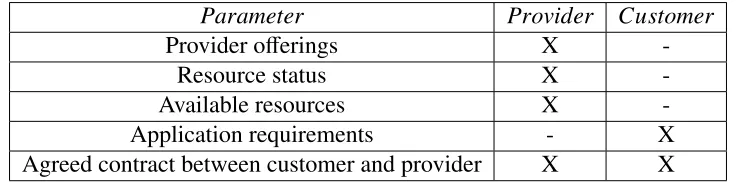
Infrastructure as a Service scenario in the cloud computing setup, Table 3.1 below illustrates
the different virtual machine renting options offered by Amazon EC2 cloud services [31].
Table 3.1: Client and service provider input providers.
Virtual Machines type Compute Units Memory S torage Cost per hour
High Memory 6.5 17.1 GB 420 GB $ 0.69
Standard 8.0 15.0 GB 1690 GB $ 1.04
High CPU 20.0 7.0 GB 1690 GB $ 1.24
3.3
Cloud Computing: Its di
ff
erent components, advantages,
weakness and types
3.3.1
Cloud Computing Architectures
The general architecture of a typical cloud computing setup is composed of four primary layers.
Figure 3.1 is a schematic representation of the different layers of the cloud computing setup
[43].
• The hardware or data centre layer.
As the name suggests, this layer is composed of hardware resources such as servers,
hubs, routers and server cooling utilities.
• The infrastructure layer.
The infrastructure layer is composed of the virtual segments of storage and
computa-tional resources that are offered to service providers. The infrastructure layer is created
by virtually partitioning the physical hardware resources.
• The platform layer.
The platform layer is where the operating system resides and houses different application
18 Chapter3. ResourceAllocation inCloudComputingEnvironment
• The application layer.
The application layer resides at the top of the cloud computing architecture and offers
the clients with the actual software and storage utilities that can be used for processing,
disseminating and storing data.
Figure 3.1: Layers of cloud computing architecture.
3.3.2
The Evolution of the Cloud set up
The concept of the cloud first appeared in the form of TCP/IP enabled networks, which were set
up in institutions and laboratories to exchange information and resources in-house. As science
progressed and collaborations increased, networks of different organizations started
commu-nicating between themselves, and this marked the emergence of the World Wide Web. Hyper
Text Markup Language (HTML) became the new paradigm to facilitate sharing of information
over the network. As the Internet became the new order of information sharing in the 21st
century, the concept of grid computing slowly emanated from the increasing needs of modern
businesses. Grid computing is all about sharing high performance computing resources and
services across the network to perform specialized tasks. The paradigm of cloud computing
is the latest offering of this development trend and is being hailed as a revolutionary concept,
which might change the way people utilize modern IT resources. Figure 3.2 illustrates the
3.3. CloudComputing: Its different components,advantages,weakness and types 19
Figure 3.2: Evolution of cloud computing [2].
3.3.3
Technical and Economic Advantages of Cloud Computing Paradigm
Even though cloud computing developed late compared to the emergence of Information
Tech-nology in general, it has attained significant heights and revolutionized the business models of
major corporates such as Google and Amazon [43].
According to [43], cloud computing solutions not only reduce business capital costs, but
helps to reduce the issues experienced by clients when using computational processing
ser-vices. The critical benefits and advantages associated with cloud computing are shown below
[43]:
• There is no capital investment in IT hardware and software. Services offered by the cloud can be procured instantly with an upfront payment when there is an urgent need.
• Cloud services and utilities are easily accessible because they are available on the Inter-net and can be utilized from different geographical locations 24/7. The cloud services
are also highly compatible with different electronic devices such as laptops, notebooks,
PDAs and even mobile smart phones.
• Since the service providers and clients using cloud services do not have to maintain hardware resources, they do not face the risk of hardware failures, and they do not need
20 Chapter3. ResourceAllocation inCloudComputingEnvironment
3.3.4
Challenges
However, there are some potential drawbacks that enterprises might have to deal with when
they shift from the traditional IT setup to the cloud. These drawbacks are described below:
• Data Integrity, Privacy and Security issues.
Data associated with strategic business vision and business logic are highly sensitive for
any organization. Similarly, there is a huge responsibility for the business organizations
to maintain privacy and the integrity of their customer data. When an organization
main-tains its own IT system, they can be more certain about the security of their data as they
are able to monitor and update their security protocols from a close proximity. On the
other hand, when they use cloud services they are delegating the job of maintaining the
security and privacy of their data to a third party organization, which they cannot monitor
themselves. That is why data security is a major issue, especially with large
organiza-tions who deal with highly sensitive data such as customer information, business secrets,
and patent details. It has been observed that present cloud computing solutions do not
have all the means to comply with all the security and privacy requirements associated
with such type of data [48].
• Compatibility issues.
Software and data compatibility are common in modern organizations when they try to
upgrade their legacy systems. However, in a cloud environment, the scale of the problem
gets highly inflated. This is mainly because of the fact that service providers and clients
have no control whatsoever to resolve the compatibility issues, and they are required
to rely on the third party cloud vendors. Every prominent cloud service provider has
its unique format of storing and managing data, and in the event of a client wishing
to migrate from one cloud system to another, data compatibility is a major issue. The
problem is further aggravated by the data transfer limitations with regards to speed [48].
• Lack of robust contractual agreements.
In the present market scenario, there are not any effective service level agreements
safe-3.3. CloudComputing: Its different components,advantages,weakness and types 21
guards to ensure that the clients exactly get what they are promised. Even when a
ser-vice level agreement exists, it is not very effective to guarantee the service that is being
promised. Furthermore, given the commercialization of the cloud services, it has been
observed that cloud service providers fail to properly appreciate the vital requirements
such as continued high computing performance, responsiveness and pro-activeness that
are paramount for any organization. It has also been observed that some well-established
cloud providers promise a certain level of performance to attract clients, and
subse-quently offer discounts in their services to compensate for their inability to fulfill the
promised level of service. If the promised level of performance is actually a vital
re-quirement for the business model of the client, they are bound to lose revenue and market
credibility, which might even lead to complete collapse of their business model [48].
• Cloud performance instability: Even though cloud computing services are being hailed by small and medium sized enterprises for meeting their changing IT demand with
agility, issues related to the stability and performance of the cloud systems during peak
demand hours vary considerably. Studies carried out in Australia have demonstrated that
performance and stability of the cloud systems offered by software giants such as Google
and Microsoft show significant variation during peak hours. If the cloud systems fail to
handle the peak load and goes down, many enterprises who are completely dependent on
the cloud for their entire IT needs will suffer considerably [48].
3.3.5
Inherent Characteristics of Cloud Computing
Some aspects of cloud computing that sets it apart from traditional computing services are
discussed below [43][44]. These features are highly instrumental in imparting the technical
advantage to the cloud services.
• Multi-tenancy.
A cloud provider rents computational or storage services to multiple clients. These
ser-vices can be maintained in a single data center. The different services are managed
together by the cloud infrastructure providers and clients, and given the layered
22 Chapter3. ResourceAllocation inCloudComputingEnvironment
infrastructure providers and the clients only need to concentrate on the layer where the
service is located.
• Shared resource pooling.
The cloud services utilize a pool of computational resources that are dynamically
allo-cated to different clients based on specific requirements. That way the cloud
infrastruc-ture providers are able to efficiently utilize their resources in a cost-effective manner and
curtail management and operational costs.
• Wide geo-distribution of data centers, and network access.
Data centers that offer cloud services are widely distributed across different
geographi-cal locations. Through such a diversified distribution, cloud service providers are able
to offer agile and efficient services to the clients. For example, a client located in
Seat-tle would be best served by a data center located in SeatSeat-tle or even California instead
of a center located in Europe. Furthermore, modern cloud services are almost entirely
accessible through the Internet and can be utilized by any electronic device that can go
online.
• Dynamic resource provisioning or allocation.
Modern cloud computing solutions allow instant dynamic allocation and withdrawal of
computational resources to the clients based on the changing requirements. This also
makes the cloud model highly cost effective and cuts down operational costs. In essence,
a modern cloud computing environment is extremely dynamic and flexible and is highly
suitable for modern businesses in today’s volatile market spaces.
3.3.6
Current Trends and some Prominent Cloud Players
Cloud computing has widely been implemented and adopted by big corporates such as
Mi-crosoft and Google. Cloud computing has also improved the way computational resources and
services are managed, utilized and offered to clients over the network. It has given a brand
new shape to the business models of thousands of enterprises across the globe and also enabled
3.3. CloudComputing: Its different components,advantages,weakness and types 23
and reduce operational costs. However, there is still much scope for progress, and some
per-taining issues associated with data privacy, data security, computational and network resources
management and power management.
Some currently available commercial cloud services are illustrated in Table 3.2 below [43].
Table 3.2: Commercial cloud utilities.
Cloud Provider Amazon EC2 Windows Azure
Google App Engine
Google Apps Saleforce.com Type of service provide Infrastructure service Platform service Software service
3.3.7
Di
ff
erent Types of Clouds
The decision of an organization to migrate to a cloud setup is influenced by different factors.
Every organization has different reasons to move their IT infrastructure to a cloud environment.
While some clients might be looking to cut down on their day to day IT operational costs, others
might like to project high quality and security as their unique selling points. To cater to these
diverse demands and requirements, there exist four different kinds of cloud setup as described
below [49][43][50][51]:
• Public clouds.
In this type of clouds, the client or the service provider does not need to invest anything
to create a capital infrastructure base and the responsibility to deal with the risk factors
associated with any modern IT setup is entirely transferred to the infrastructure provider.
The service providers offer their resources as service to the general public over the
In-ternet. However, this type of cloud is too general and is incapable of catering to niche
requirements. The data security in this type of cloud is not very robust as well.
• Private clouds.
This type of cloud architecture, as the name suggests, caters to an exclusive group of
clients mostly within a single organization. The qualities associated with this type of
cloud include safety, reliability and high performance. However this type of cloud might
24 Chapter3. ResourceAllocation inCloudComputingEnvironment
• Hybrid clouds.
This type of cloud brings together the best of public and private clouds. While they
promise robust data security like private clouds, they also retain the high level of
flexi-bility and adaptaflexi-bility of public clouds. However, defining the architecture of a hybrid
cloud is quite tricky with regards to the maintenance of an ideal ratio between public and
private virtues.
• Community cloud.
This type of cloud caters to a group of organizations that share similar values and
vi-sions. Community clouds are constructed and used by a community of organizations and
the cloud service provider could be either a commercial one or even a member of the
community.
3.4
Resource Allocation Algorithms in Cloud Computing
When an organization migrates to a cloud environment, its entire IT setup is transferred to the
cloud. On one hand, it significantly reduces the time, effort and cost involved with maintaining
a complete IT infrastructure, but on the other hand the organization becomes entirely dependent
on a third party vendor.
Efficient allocation of cloud resources (computational and network) shape the profitability
and cost-effectiveness of the business models of both the clients and the cloud service providers
alike. While proper resource allocation and management at the cloud infrastructure with
re-gards to issues such as power management and ventilation is highly beneficial for them,
ap-propriate acquisition of cloud computational and network resources by a client makes all the
difference between profit and loss.
3.4.1
Resource Allocation in Public Cloud
Earlier studies that focused on the resource allocation in multi-core or multi-processor CPUs
did not correlate well with the issues of resource allocation in highly scalable cloud systems
3.4. ResourceAllocationAlgorithms inCloudComputing 25
services could provide numerous instances of virtual machines to deal with a particular task,
depending on the need.
In the absence of proper selection guidance, if a user purchases more virtual machine
in-stances than required and the task is completed earlier than expected, the idle virtual machines
could have been used to do other tasks for the remaining period of rent time. As a result, it
is very obvious in this situation that proper resource allocation will make all the difference
between success and failure. To help clients choose the most profitable combination of virtual
machine instances, authors in [47] proposed a resource allocation algorithm applicable in the
Infrastructure as a Service scenario of cloud setup, where clients get the opportunity to make
the resource selection.
The proposed polynomial time algorithm first identifies future tasks that might overlap
with the current task before it is over and then allocates resources in such a manner that all
the tasks can be finished on time through the use of adequate virtual machine instances. The
algorithm starts by allocating a virtual machine with the lowest speed for a particular task
and then determines if a virtual machine with a higher processing speed could benefit future
overlapping tasks. While high speed virtual machines are being considered, the overlap time
between the current task and future tasks is computed. This overlap period is defined as the
time period for which the virtual machine assigned to the current task is available for use to
the future tasks. This algorithm is designed from the perspective of the cloud user. It seeks
to assist them in making the most ideal or appropriate resource allocation, for not just their
current real-time task, but also the future tasks that might overlap during the period for which
cloud resources are being rented.
On similar lines, Kim et al. [52] studied the scheduling of jobs in the cloud that have real
time constraints. In their study, the real time constraints are mentioned in the service level
agreements between the cloud providers and the clients. In this kind of scenario, clients do
not get the opportunity to decide on the number of virtual machines that needs to be selected
for the given tasks, but the cloud service providers who makes the virtual machine selection.
The study focused on the aspect of efficient power management while the virtual machines are
being allocated to different tasks as per service level agreements. Consequently, it could be
26 Chapter3. ResourceAllocation inCloudComputingEnvironment
3.4.2
Virtual Network Mapping in Cloud Environment
Massive data centers where the IT infrastructure is located, forms the heart of modern day
cloud computing services. Furthermore, the data center being centrally located the cost of
services in terms of money and time is high for those clients who are located far away. This
led to the development of the concept of distributed data centers that are spread across different
geographical locations. These distributed data centers are interconnected with the use of a
physical network to create infrastructure of cloud. The physical network is used in order to
get high speed and bandwidth resources [53]. This model makes full use of its diversity, with
regards to the distribution of data centers across different regions, to offer highly cost effective
services to its clients.
Virtual network mapping is the main resources allocation problem in the domain of network
virtualization. In network virtualization, the inherent resource allocation challenge involves
cost effective allocation of a virtual network over the physical network in such a manner that
all the client requirements are met with minimum resource usage.
To realize the potential of network virtualization it is important that virtual network
em-bedding techniques are exploited to accurately map every virtual network to the physical nodes
and links.
Endo et al. [54] proposed the concept of distributed cloud where the data centers are located
in diverse geographical locations and cloud providers hire the services of dedicated
commu-nication providers to facilitate commucommu-nication between the data centers and the clients. The
researchers anticipate that the diversely located data centers will immensely benefit Network
Virtualization, which essentially is a system that supports “multiple coexisting heterogeneous
network architecture from different service providers, sharing a common physical substrate.”
[54].
The authors addressed the issue of resource allocation in distributed cloud as follows [54]:
• Resource modeling.
Cloud resource modeling (resource description) enables cloud providers to efficiently
manage the cloud IT infrastructure. Different optimization algorithms and operations
3.4. ResourceAllocationAlgorithms inCloudComputing 27
resource modeling.
• Resource offering and treatment.
Once resource modeling is complete and the cloud infrastructures are properly managed,
the cloud services providers can provide an interface in the form of a resource allocation
system to the user. It is the resource allocation system that ensures that all the client
requirements are properly addressed as per the conditions defined in the service level
agreements between clients and cloud service providers.
• Resource discovery and monitoring.
Resource discovery and monitoring constitutes the third pillar through which efficient
resource allocation is achieved in a distributed cloud environment. Resource discovery
involves identification and localization of ideal cloud resources from different available
sources through the use of a discovery framework to meet the demands of the clients
within a specified time constraint. Resource monitoring, on the other hand, is
instrumen-tal in ensuring that cloud resources are continuously available to the clients on demand
anytime anywhere. This necessitates resource monitoring to run as a continuous
pro-cess, and assist in the overall resource optimization process of the cloud setup through
intelligent decisions with regards to allocation and de-allocation of available resources.
Resource monitoring also helps identify the advantages and the disadvantages of a
dis-covered resource and its applicability to fulfill specific client requirements.
• Resource selection.
Once appropriate and cost effective resources are identified, the most ideal resource may
be selected. Resource selection endeavours to find a resource that completely fulfils
all the client requirements in a timely manner. However, the selection of the most ideal
resource from a list of discovered resources is very complex and is influenced by different
aspects of a cloud computing setup. Therefore, service providers should use optimization
algorithms to select the resources that will provide maximum optimization of the cloud
infrastructure functioning.
The steps described above help cloud providers allocate resources in a distributed cloud
28 Chapter3. ResourceAllocation inCloudComputingEnvironment
efficiency and allows cloud providers to monitor and manage allocation in a more effective
manner.
Cloud computing is attracting more and more attention recently, resulting in a large amount
of research on techniques of network virtualization for virtual network embeddings. The larger
part of the research deals with efficient resource embedding of virtual network requests on
resources that are physically available. The problem of efficient virtual network embedding
is currently modeled as a question of mathematical optimization, dealing with minimizing
resource cost during the implementation of virtual network embedding [53].
In [55], optimal networked cloud mapping is formulated as a Mixed Integer Programming
(MIP) problem, with the objective focusing on cost efficiency, whereas the constraints focus
on maintaining the quality of service conditions. A method is subsequently proposed for the
efficient mapping of resource requests onto a shared substrate network connecting various
is-lands of computing resources. A heuristic algorithm is adopted to address the problem. A
Java-based simulator is also introduced to evaluate the performance of the solution. Moreover,
a proof-of-concept realization of the proposed schema, is deployed over the European future
Internet test-bed FEDERICA.
Two algorithms are proposed in [9] that offer better correlation between the phases of node
mapping and link mapping. These algorithms are D-ViNE, or Deterministic Virtual Network
Embedding, and R-ViNE, or Randomized Virtual Network Embedding. In these algorithms,
the virtual nodes are mapped to substrate nodes, allowing virtual link mapping to physical
paths in the succeeding phase. In the physical network graph, a corresponding meta-node is
extended for every virtual node, while each meta-node is also connected to a specific physical
node subset [56].
Mixed-integer programming formulation is used for solving embedding problems with
con-straints on meta-edges, as well as for linear concon-straints on substrate network edges. Using
mixed-integer programming for optimal virtual network embedding, it also becomes an NP
hard problem. This approach is used to relax the integer program in order to obtain a linear
programming formulation, solved in polynomial time. Rounding techniques, deterministic and
randomized on the solution of linear program, are used to approximate the binary variable
3.4. ResourceAllocationAlgorithms inCloudComputing 29
multi-commodity flow algorithm is used for mapping virtual links on substrate networks among
mapped virtual nodes. This process is solved in polynomial time, assuming that path splitting
is already supported by the substrate network [56]. Along with bandwidth constraints, each
virtual link is treated as a commodity, which consists of a pair of meta-nodes. This mapping
results in an optimal flow for commodities that is equal to virtual link mapping in an optimal
way [56].
Virtual network embedding is a key issue in network virtualization, and can be divided into
two categories: intra-domain virtual network embedding, and inter-domain virtual network
embedding. An efficient algorithm for intra-domain virtual network embedding is proposed
in [15], that increases the utilization of resources through permission for path splitting and
immigration in the substrate network.
Some topology-aware designs for node ranking, as well as meta-heuristic based algorithms
of virtual network embedding, were presented for revenue-maximization of large numbers of
virtual network requests. In inter-domain virtual network embedding, used for enabling virtual
network provisioning over a large area, a framework for inter-domain virtual network
embed-ding in a decentralized manner was presented. In order to accommodate a high range of virtual
network requests, an approach named Max-flow/Min-cut was used to split the virtual network
requests into sub-requests, with these used in turn exact mapping with processes [15].
Vinothina et al. [57] proposed the following set of factors that should be avoided by an
efficient resource allocation strategy:
• Resource contention.
There is resource contention when a single resource or cloud utility is being accessed
by two different applications at the same time. This can occur when there is no proper
scheduling or allocation of resources and can lead to the slowing down of cloud services.
• Scarcity of resources.
There is scarcity of resources when the cloud setup dose not have enough resources to
deal with the workload.
• Resource fragmentation.
![Figure 2.3: The virtual network environment [1].](https://thumb-us.123doks.com/thumbv2/123dok_us/7770575.1279277/21.612.93.501.71.383/figure-the-virtual-network-environment.webp)
![Figure 3.2: Evolution of cloud computing [2].](https://thumb-us.123doks.com/thumbv2/123dok_us/7770575.1279277/30.612.136.506.86.235/figure-evolution-of-cloud-computing.webp)