International Journal of COPD 2018:13 2551–2555
International Journal of COPD
Dove
press
submit your manuscript | www.dovepress.com 2551
O r I g I n a l r e s e a r C h
open access to scientific and medical research
Open access Full Text article
Influence of body mass on predicted values of
static hyperinflation in COPD
Peter alter1
Klaus F Rabe2,3
holger schulz4
Claus F Vogelmeier1
rudolf a Jörres5
1Department of Medicine, Pulmonary and Critical Care Medicine, Philipps University of Marburg, Member of the german Center for lung Research (DZL), Marburg, Germany; 2lungenClinic grosshansdorf, Member of the German Center for Lung Research (DZL), Airway research Center north (arCn), Grosshansdorf, Germany; 3 Christian-Albrechts University, Airway research Center north (arCn), Kiel, Germany; 4helmholtz-Zentrum München, Institute of Epidemiology, german research Center for environmental health, Comprehensive Pneumology Center Munich
(CPC-M), Member of the German Center for lung research (DZl), Munich, Germany; 5Institute and Outpatient Clinic for Occupational, social and environmental Medicine, University Hospital, LMU Munich, Comprehensive Pneumology Center Munich (CPC-M), Member of the german Center for lung research (DZL), Munich, Germany
Introduction: For interpretation of body plethysmographic static hyperinflation, reference values are of crucial importance. Earliest reference values have been published by the European Coal and Steel Community (ECSC) and are based on sex, body height and age as predictors. As obesity can lead to a reduction of functional residual capacity (FRC) in lung-healthy subjects, more recent approaches included body weight or body surface area. This raises the question whether these models are appropriate in patients with COPD-induced hyperinflation.
Method: Several FRC prediction models and their relation to body weight were analyzed in 1513 patients with stable COPD (mean [SD] age: 64.5 [8.2] years; GOLD grades 1–4: 219/722/484/88), a subset of the multicenter COPD and Systemic Consequences – Comorbidities Network cohort.
Results: Absolute values of FRC were inversely related to body mass index ( p,0.001). Apply-ing the ECSC equations to calculate predicted values, this pattern was maintained ( p,0.001). By contrast, an inverted, ie, positive, relation occurred when using equations that include body weight or surface area ( p,0.001). The present analysis confirmed the inverse relation of body mass and FRC in COPD, resulting from a restrictive ventilatory pattern by diaphragm elevation and decreased chest wall compliance in obesity. The weight influence in the prediction models, as obtained from lung-healthy controls, appears to lead to an overcorrection and consequently to an inappropriate overestimation of hyperinflation as indicated by FRC %predicted in COPD.
Conclusion: It is concluded that models not including body weight as predictor, like the clas-sical ECSC equations, could be superior in the interpretation of FRC in COPD.
Keywords: static hyperinflation, body plethysmography, functional residual capacity, COPD, body mass
Introduction
Reference values are crucial for the interpretation of lung function impairments in patients with airway disorders including COPD. While body plethysmography is not widely used in academic research, it appears to be established in clinical practice in various countries,1 as judged from the numbers of equipment sold. The first
refer-ence values to be used for body plethysmographic measures were published by the European Coal and Steel Community (ECSC) and are based on sex, height and age as predictors.2 More recent approaches include body weight or body surface area3–5
as obesity can lead to a reduction of functional residual capacity (FRC) in lung-healthy subjects. This raises the question whether these weight-including models are appropriate in patients in whom COPD induces lung hyperinflation,6 which may
counteract effects of obesity on FRC. This would crucially affect the clinical inter-pretation of FRC measurements.
We therefore analyzed various FRC prediction models and their relation to body weight in patients with stable COPD using data from the German COPD cohort
Correspondence: Peter alter Department of Medicine, Pulmonary and Critical Care Medicine, Philipps University of Marburg, Member of the german Center for lung research (DZL), Baldingerstrasse, Marburg 35033, Germany
Tel +49 6421 586 6140 Fax +49 6421 586 6149 email [email protected]
Journal name: International Journal of COPD Article Designation: Original Research Year: 2018
Volume: 13
Running head verso: Alter et al
Running head recto: Influence of body mass on FRC %predicted values DOI: 164096
International Journal of Chronic Obstructive Pulmonary Disease downloaded from https://www.dovepress.com/ by 118.70.13.36 on 22-Aug-2020
For personal use only.
Dovepress
alter et al
COSYCONET (COPD and Systemic Consequences – Comorbidities Network).
Methods
In COSYCONET, 2,741 patients with stable COPD were enrolled.7 The study was approved by the Ethics Committee
of the University of Marburg as coordinating center and by the ethics committees of all study centers; it is registered on
ClinicalTrials.gov (registration number NCT01245933). All
study participants provided written informed consent. For the present analysis, data from Visit 1 (recruitment), Visit 2 (6-month follow-up) and Visit 3 (18-month follow-up) were used. Spirometry and body plethysmography was performed after inhalation of 400 µg salbutamol and 80 µg ipratropium bromide7 following the recommendations by the American
Thoracic Society (ATS)/European Respiratory Society (ERS)8 and Deutsche Gesellschaft für Pneumologie und
Beatmungsmedizin (DGP).1,9 In 28 out of 31 study centers,
the same equipment and software were used. All measure-ments were performed by experienced personnel following detailed written SOPs, and the data collected were sub-jected to careful quality control.
In patients with a ratio of forced expiratory volume in 1 second (FEV1) to forced vital capacity ,0.70, airway obstruction was quantified via FEV1 %predicted10 according
to the GOLD criteria.11 Only patients with spirometric GOLD
grades 1–4 at Visit 1 were included into the present analysis. Static lung hyperinflation was measured as body plethysmo-graphic FRC (intrathoracic gas volume).1
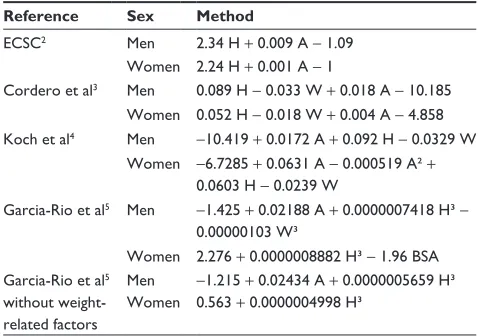
Five different reference equations were used to calculate %predicted values of FRC: ECSC as referenced by Quanjer et al,2 Cordero et al,3 Koch et al4 and Garcia-Rio et al.5 Except
for ECSC, all equations include body weight or surface area (calculated according to DuBois) as predictor but Garcia-Rio et al5 provided an additional equation without weight-related
predictors (Table 1). Only patients with body mass index (BMI) ,40 kg/m² and plausible data on predicted FRC for all methods (,300 %predicted) at all visits were included. For terms of a sensitivity analysis, patients with BMI $40 kg/m² were included. Linear regression analysis was applied using FRC measured or predicted value as dependent variable and BMI as independent variable.
Results
Data from 1,513 patients of GOLD grades 1–4 (n=219/ 722/484/88) were analyzed. Details of the baseline character-istics at Visit 1 are shown in Table 2. The mean (SD) duration from Visit 1 to Visit 2 was 196 (33) days and from Visit 2 to
Visit 3 was 377 (55) days. The mean decline of FEV1 between the visits (1 vs 2 and 2 vs 3) was 0.022 L (95% confidence interval [CI] 0.010 to 0.033 L) and 0.070 L (0.058 to 0.082 L), respectively. The mean change of FRC was −0.007 L (−0.039 to 0.025 L) and 0.111 L (0.078 to 0.144 L), respectively. Despite the small changes during the follow-up, mean values of FRC and BMI from three visits were used in the correlation analyses to improve the signal-to-noise ratio. Correction for the trend did not lead to any qualitatively different results.
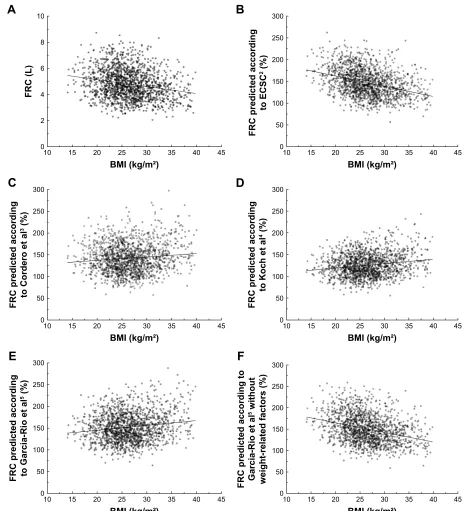
Absolute values of FRC were inversely related to BMI ( p,0.001; Figure 1). Applying the ECSC equations, the pattern was maintained, ie, an increased BMI was related
Table 1 regression equations for calculation of FrC %predicted Reference Sex Method
eCsC2 Men 2.34 h + 0.009 a − 1.09 Women 2.24 h + 0.001 a − 1
Cordero et al3 Men 0.089 h − 0.033 W + 0.018 a − 10.185 Women 0.052 h − 0.018 W + 0.004 a − 4.858 Koch et al4 Men −10.419 + 0.0172 a + 0.092 h − 0.0329 W
Women −6.7285 + 0.0631 a − 0.000519 a² + 0.0603 h − 0.0239 W
garcia-rio et al5 Men −1.425 + 0.02188 a + 0.0000007418 h³ − 0.00000103 W³
Women 2.276 + 0.0000008882 h³ − 1.96 Bsa garcia-rio et al5
without weight-related factors
Men Women
−1.215 + 0.02434 a + 0.0000005659 h³ 0.563 + 0.0000004998 h³
Abbreviations: A, age (yr); BSA, body surface area (m2); ECSC, European Coal
and Steel Community; FRC, functional residual capacity; H, standing height (m); W, weight (kg).
Table 2 Baseline characteristics of the study cohort at Visit 1 (n=1,513)
Parameter Mean values (SD)
or n (%) Anthropometry
Age, years 64.5 (8.2)
sex, m/f 928/585
BMI, kg/m² 26.4 (4.7)
Lung function and body plethysmography
gOlD 1/2/3/4 219/722/484/88
FeV1 %predicted 54.97% (18.26%)
FrC, l 4.79 (1.17)
FrC %predicted, eCsC 147.0% (33.3%)
FrC %predicted, Cordero et al3 143.5% (34.6%)
FrC %predicted, Koch et al4 125.4% (28.8%)
FrC %predicted, garcia-rio et al5 152.6% (34.3%) FrC %predicted, garcia-rio et al5
without weight-related factors
150.7% (35.0%)
Note: The table shows mean values (±standard deviations), except for sex and gOlD grade. FrC %predicted following several methods.
Abbreviations: BMI, body mass index; ECSC, European Coal and Steel Community; FeV1 %predicted, forced expiratory volume in 1 second predicted according to GLI;
FRC, functional residual capacity.
International Journal of Chronic Obstructive Pulmonary Disease downloaded from https://www.dovepress.com/ by 118.70.13.36 on 22-Aug-2020
Dovepress Influence of body mass on FRC %predicted values
to a decreased FRC %predicted ( p,0.001). By contrast, FRC %predicted increased with BMI when using equations from Cordero et al,3 Koch et al4 and Garcia-Rio et al,5 which
include body weight or surface area. Using the equations from Garcia-Rio et al5 without weight-related terms, a similar
pat-tern as for the ECSC equations was observed (p,0.001 each). The slope of the corresponding regression equation (−2.257;
95% CI: −2.598 to −1.915) did not significantly differ from that of ECSC values (−2.356; −2.675 to −2.038), but these slopes were clearly different from those of the other approaches (Cordero et al: 0.779; 0.428–1.129; Koch et al: 1.001; 0.722–1.280; Garcia-Rio et al: 1.113; 0.765–1.460). When indi-viduals with BMI $40 kg/m² were included for the purpose of a sensitivity analysis, the observed effects were pronounced.
Figure 1 scatter diagrams and regression lines (p,0.001 each) of static lung volume (FRC) versus BMI in terms of absolute values (A) and %predicted by ECSC2 (B) based
on body height and age, as %predicted by Cordero et al3 (C), Koch et al4 (D) and garcia-rio et al5 (E) including body weight as predictor; in addition, as %predicted by
garcia-rio et al5 without weight-related factors (F).
Abbreviations: BMI, body mass index; ECSC, European Coal and Steel Community; FRC, functional residual capacity.
%0,NJPð
)5&/
)5&SUHGLFWHGDFFRUGLQJ
WR(&6&
%0,NJPð
%0,NJPð
%0,NJPð
)5&SUHGLFWHGDFFRUGLQJ WR*DUFLD5LRHWDO
)5&SUHGLFWHGDFFRUGLQJW
R
*DUFLD5LRHWDO
ZLWKRXW
ZHLJKWUHODWHGIDFWRUV
%0,NJPð
%0,NJPð
)5&SUHGLFWHGDFFRUGLQJ WR&RUGHURHWD
O
)5&SUHGLFWHGDFFRUGLQJ
WR.RFKHWDO
$
%
&
'
(
)
International Journal of Chronic Obstructive Pulmonary Disease downloaded from https://www.dovepress.com/ by 118.70.13.36 on 22-Aug-2020
Dovepress
alter et al
Discussion
The analysis confirmed that static lung volume in terms of body plethysmographic FRC is inversely related to BMI, in line with pathophysiologic evidence. An increased adipose mass is known to cause elevation of the diaphragm, in addi-tion to effects exerted by decreased chest wall compliance and inducing a restrictive ventilatory pattern.12 This relationship
also occurred in patients with stable COPD when using the absolute values of FRC.
In clinical practice, FRC is evaluated relative to refer-ence values derived from healthy individuals. Various regression equations have been published, which include sex, age and height as determinants. The ECSC equations are limited to these predictors.2 They yielded an inverse
relationship between FRC %predicted and BMI, just as the absolute values of FRC, thereby matching expectations from pathophysiology. The other equations included body weight or body surface area as predictors3–5 and resulted in
an increase of FRC %predicted with increasing BMI, which appears implausible. The most likely explanation is that in obese patients with COPD the negative weight term in the equations, as derived from lung-healthy subjects, leads to an overcorrection for weight in the predicted values and con-sequently to an overestimation of hyperinflation in terms of %predicted. Conversely, if correct, it would suggest that lung volume in COPD patients with hyperinflation is, on average, less affected by obesity than in lung-healthy subjects.
Recognizing the potential problems in obese, lung-healthy subjects, Garcia-Rio et al already proposed a model without weight or weight-related predictors.5 In our COPD
population, it yielded the same picture as the ECSC equations, suggesting that our findings are not due to the possibility that the ECSC equations13 are outdated. Moreover,
the qualitative pattern of correlations was maintained when the range of BMI was limited to values ,30 kg/m2, and
therefore, our observations were also not due to unwarranted extrapolation of the prediction equations.
The comparison of methods for calculation of normal values is limited by the fact that different approaches for the assessment of hyperinflation have been used. The COSYCONET study as well as Koch et al4 used body
plethysmography, whereas Cordero et al3 used
multiple-breath helium washout. Although these differences limit comparability, they do not appear to bias the findings, as has been previously discussed.2,4,5 In healthy subjects, ie, those
used for reference populations, FRC values derived by gas washout and body plethysmography are in parallel, whereas in COPD larger differences can occur. This, however, does not affect the application of the reference values in the
quantification of deviations from normal, as underlined by the consistency of our findings.
Conclusion
Prediction equations for FRC that include body mass appear to favor an overestimation of the degree of hyperinflation in obese patients with COPD. Therefore, models without body weight, like the classical ECSC equations, could be superior in the evaluation of FRC in COPD. We believe that research groups and clinicians who use body plethysmography as a diagnostic tool should be aware of this finding and that the com-bined effects of COPD-related hyperinflation and BMI on lung volume measurements should be studied more thoroughly.
Acknowledgments
This work was supported by the German Federal Ministry of Education and Research (BMBF) Competence Network Asthma and COPD (ASCONET) and performed in collabo-ration with the German Center for Lung Research (DZL). The project was funded by the BMBF with grant number 01 GI 0881 and was supported by unrestricted grants from AstraZeneca GmbH, Bayer Schering Pharma AG, Boehringer Ingelheim Pharma GmbH & Co. KG, Chiesi GmbH, Glaxo-SmithKline, Grifols Deutschland GmbH, MSD Sharp & Dohme GmbH, Mundipharma GmbH, Novartis Deutschland GmbH, Pfizer Pharma GmbH, Takeda Pharma Vertrieb GmbH & Co. KG and TEVA GmbH for patient investiga-tions and laboratory measurements. The funding bodies had no involvement in the design of the study, or the collection, analysis or interpretation of the data.
Disclosure
The authors report no conflicts of interest in this work.
References
1. Criée CP, Sorichter S, Smith HJ, et al. Body plethysmography – its principles and clinical use. Respir Med. 2011;105(7):959–971. 2. Quanjer PH, Tammeling GJ, Cotes JE, Pedersen OF, Peslin R,
Yernault JC. Lung volumes and forced ventilatory flows. Eur Respir J. 1993;6(Suppl 16):5–40.
3. Cordero PJ, Morales P, Benlloch E, Miravet L, Cebrian J. Static lung volumes: reference values from a Latin population of Spanish descent.
Respiration. 1999;66(3):242–250.
4. Koch B, Friedrich N, Völzke H, et al. Static lung volumes and air-way resistance reference values in healthy adults. Respirology. 2013; 18(1):170–178.
5. Garcia-Rio F, Dorgham A, Pino JM, Villasante C, Garcia-Quero C, Alvarez-Sala R. Lung volume reference values for women and men 65 to 85 years of age. Am J Respir Crit Care Med. 2009;180(11):1083–1091. 6. Langer D, Ciavaglia CE, Neder JA, Webb KA, O’Donnell DE. Lung
hyperinflation in chronic obstructive pulmonary disease: mechanisms, clinical implications and treatment. Expert Rev Respir Med. 2014;8(6): 731–749.
International Journal of Chronic Obstructive Pulmonary Disease downloaded from https://www.dovepress.com/ by 118.70.13.36 on 22-Aug-2020
International Journal of COPD
Publish your work in this journal
Submit your manuscript here: http://www.dovepress.com/international-journal-of-chronic-obstructive-pulmonary-disease-journal
The International Journal of COPD is an international, peer-reviewed journal of therapeutics and pharmacology focusing on concise rapid reporting of clinical studies and reviews in COPD. Special focus is given to the pathophysiological processes underlying the disease, intervention programs, patient focused education, and self management protocols.
This journal is indexed on PubMed Central, MedLine and CAS. The manuscript management system is completely online and includes a very quick and fair peer-review system, which is all easy to use. Visit http://www.dovepress.com/testimonials.php to read real quotes from published authors.
Dovepress
Dove
press
Influence of body mass on FRC %predicted values
7. Karch A, Vogelmeier C, Welte T, et al. The German COPD cohort COSYCONET: aims, methods and descriptive analysis of the study population at baseline. Respir Med. 2016;114:27–37.
8. Wanger J, Clausen JL, Coates A, et al. Standardisation of the measure-ment of lung volumes. Eur Respir J. 2005;26(3):511–522.
9. Vogelmeier C, Buhl R, Criée CP, et al. Leitlinie zur Diagnostik und Therapie von Patienten mit chronisch obstruktiver Bronchitis und Lungenemphysem (COPD) [Guidelines for the diagnosis and therapy of COPD issued by Deutsche Atemwegsliga and Deutsche Gesellschaft fur Pneumologie und Beatmungsmedizin]. Pneumologie. 2007;61(5):e1–e40. German.
10. Quanjer PH, Stanojevic S, Cole TJ, et al; ERS Global Lung Function Initiative. Multi-ethnic reference values for spirometry for the 3–95-yr age range: the global lung function 2012 equations. Eur Respir J. 2012; 40(6):1324–1343.
11. Vogelmeier CF, Criner GJ, Martinez FJ, et al. Global strategy for the diagnosis, management, and prevention of chronic obstructive lung disease 2017 report: GOLD executive summary. Eur Respir J. 2017; 49(3):pii:1700214.
12. Ladosky W, Botelho MA, Albuquerque JP Jr. Chest mechanics in morbidly obese non-hypoventilated patients. Respir Med. 2001;95(4): 281–286.
13. Standardized lung function testing. Report working party. Bull Eur
Physiopathol Respir. 1983;19(Suppl 5):1–95.
International Journal of Chronic Obstructive Pulmonary Disease downloaded from https://www.dovepress.com/ by 118.70.13.36 on 22-Aug-2020