260 | P a g e
Effective prediction of dynamic bandwidth for exchange
of Variable bit rate Video Traffic
Mrs. Ch.Devi
1, Mr. N.Mahendra
21,2
Assistant Professor,Dept.of CSE
WISTM, Pendurthy, Visakhapatnam,A.P (India)
ABSTRACT
The effective and efficient transfer of real-time variable bit rate (VBR) video traffic in high-speed networks is
currently an area of major research. The capability to predict VBR video traffic can significantly improve the
effectiveness of numerous management tasks, including dynamic bandwidth allocation and congestion control.
Video traffic statistics are measured in the frequency domain in terms of the low-frequency signal captures, the
slow time-variation of consecutive scene changes while the high-frequency signal exhibits the feature of strong
frame autocorrelation. Here we propose the paper to for an adaptive traffic prediction method for MPEG
videos. Our queuing study indicates that the video transmission bandwidth in a high buffer system is essentially
characterized by the low-frequency signal. We further observe in typical MPEG video sequences that the time
scale of video scene changes is in the range of a second or longer, which localizes the low frequency video
signal in a well defined low frequency band. Hence, in a network design it is feasible to implement dynamic
allocation of video transmission bandwidth using on-line observation and prediction of scene changes. The
proposed dynamic bandwidth allocation scheme is shown to be promising and practically feasible in obtaining
efficient transmission of real-time video traffic with guaranteed quality of services.
Key Words: ATM, MPEG, multiplexing, Prediction, scene change, VBR, video traffic.
I.INTRODUCTION
A computer network, a wireless communication and an ATM are to provide high speed transmissions for a wide
range of Quality of Service (QoS). Video has now become one of the major components of broadband
multimedia services, therefore, an efficient video traffic transmission mechanism is important to a network
operation. ATM technology offers a great flexibility of transmission bandwidth allocation to accommodate
diverse demands of individual connections. One major application in ATM networks is to provide real-time loss
free transmission of variable-bit-rate (VBR) video. By stochastic modeling, video traffic is represented by a
stationary random process. The notion of effective bandwidth, measured in cells per unit time, is equivalent to
the minimum transmission bandwidth allocated to the input traffic subject to quality of service requirements.
Conventional traffic management schemes use a model-and parameter approach [2,3,4] to provide QoS
guarantees while maintaining a high utilization of network resources. At the call setup, the call admission
control (CAC) is performed based on the traffic descriptors declared by the user and QoS requests. After
261 | P a g e
control (UPC) monitors the user traffic to ensure the agreed traffic parameters are not violated. Accuratereal-time prediction of the future bandwidth process is very important in many aspects: fair bandwidth utilization,
dynamic bandwidth allocation, end-to-end QoS control of real-time multimedia streams, etc. All these issues are
critical in cell/packet-based B-ISDN (e.g., ATM), best effort Internet [5], [6] or in circumstances where per-flow
QoS management is enabled [7]. Furthermore, recent deployment of wireless networks calls for more efficient
use of network bandwidth.
A good bandwidth prediction scheme should address many issues. Firstly, the prediction schemes should exploit
the sample correlation structures in predicting the future frame size. Secondly, it should be robust against noise
and should converge fast. There are three, I, B, and P, frame types in MPEG coding scheme. I frame, which is
also known as intra coded frames, is coded as a single frame, without references to any other frames.
Predictive coded frame or P frame contains the difference of earlier I or P frames in the Group of Pictures
(GOP). And B frame or bidirectional coded frame contains the difference from earlier and later I or P frames in
the sequence. The first frame in the new scene is compressed via intra-coding regardless of the frame type.
Among the three frames, intra-coded B type frames are typical noisy input. This may result in an exceptionally
large B-type frame. A good prediction model should be able to properly filter out noisy samples in predicting
the future frame size. Simple linear prediction is vulnerable to noisy input. A neural network-based learner
cannot quickly adapt to short term structure changes in the underlying sequence. Third, the prediction scheme
should be able to detect the structural changes in the underlying sequence, e.g., scene change, and should be able
to update the prediction model accordingly.
We use the GOP ARIMA (ARIMA for Group of Pictures) model as a base stochastic model for the underlying
sequence [8]. Our prediction framework consists of two major components: frame size prediction and model
update. For accurate and robust prediction, we deploy a Kalman filter over the base stochastic model, GOP
ARIMA. An advantage in using GOP ARIMA as the base stochastic model over other models is that GOP
ARIMA is designed to preserve correlations among different types of frames.
II.METHODOLOGY
In this study, we develop an efficient statistical hypothesis test technique to determine the validity of prediction
model. We model the confidence interval of the frame size estimation in terms of the Kalman filter components,
i.e., process matrix, measurement matrix, state and error covariance. Our confidence interval-based analysis not
only effectively detects scene change but also provides rigorous ground on prediction accuracy. The proposed
model-based prediction method significantly improves the prediction accuracy and prediction responsiveness
compared to existing linear prediction-based methods and neural network based methods. The proposed
prediction algorithm predicts the future frame size solely based upon underlying frame size sequence and GOP
structure. It does not require any knowledge on source coding algorithm and/or rate control algorithm at the
source end. We analyze the effectiveness of the proposed prediction algorithm via examining the prediction
accuracy of three different prediction schemes on total of six video traces (three MPEG-2 video traces and three
MPEG-4 video traces). These video traces are chosen to represent different degrees of motion dynamics in
262 | P a g e
were available and details of source coding algorithms were not available to public [9, 11]. In all cases, theproposed algorithm (GOP ARIMA-based prediction) outperforms the existing prediction algorithms proposed
by Yoo [12], Adas [13].
GOP ARIMA model
The GOP ARIMA model is represented as GOP ARIMA (p,d,q)s x (P,D,Q)S. s and Sand denote the length of seasonal lags, i.e., P-to-(P or I) frame distance and I-to-I frame distance. In case of GOP(15,3), and corresponds
to 3 and 15, respectively. p and P denote the autoregressive orders, d and D denote the difference orders, q and
Q denote the moving average orders for modeling the intra- and inter GOP correlations. Let be a frame size
sequence of VBR compressed video with GOP(S,s). Since this time series consists of the sizes of I, P, and B
frames, we decompose the sample process Xt as follows:
Xt = xts + xtS + t (1)
where xtS and xts denote the seasonal components which appear in every and samples, respectively, and is stochastic components of the sample sequence.
Kalman Filter Components
The State Vector Ft (M x 1) is the minimal set of data to describe the dynamic behavior of the system. In other words, the state is the least amount of data about the past behavior of the system that is needed to predict its
future behavior. The measurement vector Xt (N x 1) is the measurement of time t. Kalman filter uses two equations the process Equation and the Measurement Equation. The process Equation is used to predict the state
of the system at t+1 for a given Ft and is defined as
Ft + 1 = At Ft+ Wt ( 2 )
The matrix in (2) is called the process matrix. The process noise, Wt is assumed to be a zero-mean, additive, white Gaussian process with the process noise covariance matrix Qt defined by
.
The Measurement Equation derives the measurement from the state. Equation (3) is the definition of the
measurement equation
263 | P a g e
The matrix Ht is called the measurement matrix. The measurement noise is assumed to be a zero-mean, additive, white Gaussian process with measurement noise covariance matrix defined byRt for n = t E[Vn Vt
T ] =
0 for n ≠ t
The Process noiseWt and the measurement noiseVt are uncorrelated with each other. Let the state error vector be the difference between the state Ft and the estimated state Ft, i.e., Ft -Ft. We define the error covariance matrix Pt as [( )( ) ] , for simplicity we will put it as E[ ]. Kalman filtering operates by predicting and correcting recursively. In the Kalman filtering algorithm we use a pair of time points priori and
posteriori. At time , we already have an estimate of state Ft predicted at time t. We call this priori estimate of the state, (a „ ‟ symbol over F means a priori estimate). We call this process predicting. In a similar manner,
priori error covariance matrix P at time t is defined as P = E[(Ft – Ft )(Ft – Ft T
] .
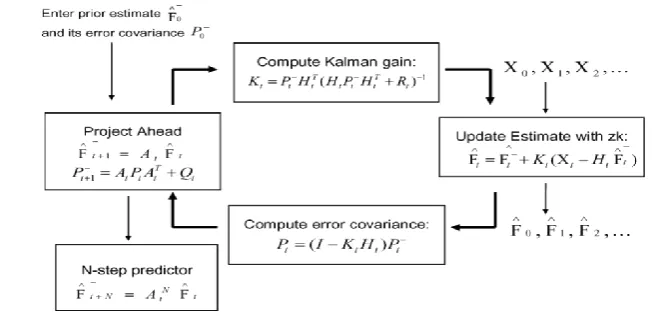
Fig. 1 illustrates the Kalman filter algorithm. First, the Kalman filter derives one-step ahead forecast from
Fig 1. Kalman Filtering Algorithm
Predictions :
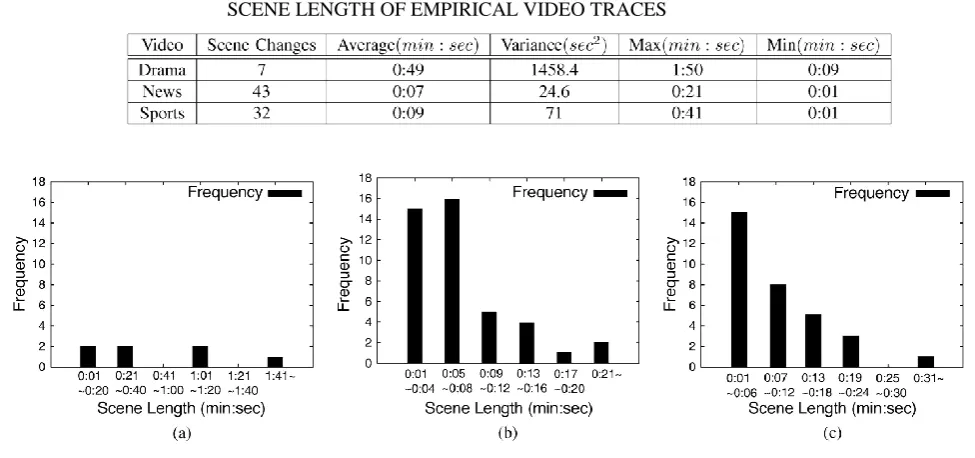
We visually inspect three video clips, Drama, News, and Sports, each of which is approximately 6 min. long.
Table I summarizes the statistics of each clip, and Fig. 2 shows the scene length distribution of each empirical
video trace. News video clips have the most frequent scene changes with an average scene length of 7s. Drama
video clip has the least frequent scene changes with an average scene length of 49s. News usually has frequent
scene changes. In drama sequence, scene changes occurs less frequently. If we properly exploit the categorical
264 | P a g e
Table 1SCENE LENGTH OF EMPIRICAL VIDEO TRACES
Fig.2. Scene length distribution of empirical video traces (5 min each). (a) Drama. (b) News. (c) Sports.
Experiments
We perform comprehensive experiments to examine various aspect of the proposed prediction scheme. In this
experiment, we use total of twelve frame size sequences. We use two different compression methods: MPEG - 2
and MPEG - 4. We use three different GOP structures: GOP(15,3), GOP(12, 3), and GOP(9,3). This
comprehensive test enables us to verify the effectiveness of the proposed prediction scheme under various
settings. There are three MPEG2 - GOP(15,3) sequences, three MPEG4-GOP(15,3), three MPEG2 - GOP(12,3),
and three MPEG2 - GOP(9,3). MPEG-2 traces are in-house generated, with 4 Mbits/s playback rate (DVD
quality). Bandwidths of MPEG-4 traces ranges from 250 to 600 Kbits/s. Under these two compression scheme,
we can evaluate the effectiveness of prediction methods under HD quality video streaming as well as video
streaming in a mobile wireless environment.
Table 2
265 | P a g e
III.RESULTS AND DISCUSSIONS
Fig 3. Prediction step versus prediction error for GOP ARIMA, double exponential smoothing and ALP,
GOP(15,3), 30 frames/s, 4 Mbits/s. (a) Drama. (b) News (c) Sports.
We compare the prediction accuracy of the three prediction schemes: GOP ARIMA-based prediction, ALP [14]
and Double Exponential Smoothing-based Prediction (DESP) [68]. In this experiment, we consider prediction
within a scene having 60, 90, and 120 prediction steps. We use MPEG-2 traces with GOP(15,3) in Table 2.
Results of only one GOP structure can obscure view on other perspectives on different GOP structures. In order
to overcome the limitation, GOP(9,3) and GOP(12,3) are also used in our experiment to generalize the
performance of GOP ARIMA. Fig. 3 quantifies the prediction error for the three prediction schemes, and
illustrates NMSE under varying prediction steps.
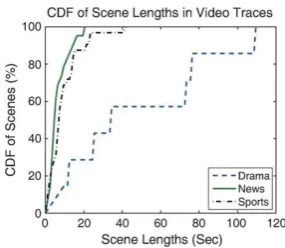
Fig. 4 Cumulative distribution of video traces.
In all three prediction schemes, prediction error tends to increase with the prediction step. Recall that we are
using a 30 frames/s frame sequence. 90 step prediction, for example, estimates the frame size in 3 s interval. As
can be seen in Fig.3, GOP ARIMA-based prediction exhibits superior accuracy compared to DESP and ALP.
266 | P a g e
Fig. 5. NMSE of prediction steps of GOP(9,3) and GOP(12,3). (a) GOP(9,3). (b) GOP(12,3).In addition, prediction error is much larger in the Sports clip than in the other two video clips. We suspect that
this is partly due to the scene length distribution of the Sports clip and the dynamic nature of the video scene.
Table V illustrates the scene length statistics. Drama has the longest scene length with an average of 49s and
median of 34s. For News, the average and median value of scene length are 7 and 5s, respectively. For the
Sports video clip, the average and median scene length are 9 and 7s, respectively. Fig. 4 illustrates the CDF of
scene length distributions of three video clips. We compare the prediction accu-racy of GOP ARIMA, Adas, and
Yoo‟s methods for GOP(12,3) and GOP(9,3) video traces. Table VI illustrates GOP ARIMA model of three
video traces for 60 step prediction. Fig. 5 illustrates the results of our experiment. We examine NMSE of 30, 60,
and 90 steps prediction under two different GOP structures. Fig. 5(a) and (b) illustrates the experiment results
for GOP (9,3) and GOP (12,3), respectively. In both of GOP structures, prediction with GOP ARIMA with
Kalman filter and Yoo yields lower NMSE score than the prediction based upon Adas‟s scheme. In News and
267 | P a g e
Fig. 6. Prediction accuracy in MPEG-4 compressed movie clips: GOP ARIMA, Yoo, Adas, NMSE,and SNR_1 (a) Jurassic Park:NMSE. (b) Mr.Bean:NMSE. (c) Star Wars:NMSE. (d) Jurassic
Park:SNR. (e) Mr.Bean:SNR. (f) Star Wars:SNR.
We examine the prediction accuracy of the proposed model under publicly available MPEG-4 traces (Jurassic
Park, Mr. Bean, Star Wars [11]) with varying prediction steps. In this prediction, Kalman filter dynamically
updates the model based upon its scene change detection mechanism. We use predictors developed by Adas [14]
and Yoo [13] for comparison. Fig. 6 illustrates the results in normalized mean square error (NMSE) and SNR.
The proposed scheme yields more accurate prediction results to the other two models for both metrics.
IV.CONCLUSION
In this paper, we develop a novel bandwidth prediction scheme for VBR compressed video with regular GOP
pattern. We use GOP ARIMA as the base stochastic model for the underlying time series. We deploy a Kalman
filter in GOP ARIMA and for more accurate prediction we update the prediction model based upon a statistical
hypothesis test. Our prediction scheme successfully addresses a number of challenging issues. The prediction
scheme preserves the correlation structure of the frame size sequence. Our prediction scheme does not require a
separate prediction model for individual type frames and therefore makes more accurate predictions. Since
Kalman filter based recursive error adjustment maintains “state” across the prediction rounds, the proposed
prediction scheme becomes more robust against noisy input than stateless prediction schemes. Our prediction
model effectively copes with structural changes in the underlying sequence. It performs statistical hypothesis
testing and determines the need for model update. Since we represent the confidence interval of a given
prediction with Kalman filter components, the hypothesis test can be seamlessly embedded into the prediction
model. Confidence interval analysis provides rigorous measure on its detection accuracy. The results of the
performance study show that our prediction scheme significantly improves the prediction accuracy and
prediction responsiveness compared to existing linear prediction-based methods and neural net-work-based
methods. We also examined the performance of the prediction algorithm from the bandwidth‟s perspective. We
compare the bandwidth prediction accuracy of three prediction schemes: {GOP} {ARIMA} with Kalman filter,
Adas [14], and Yoo [13], using number of publicly available MPEG-2 and MPEG-4-based video traces [9],
[10]. We quantify the prediction accuracy using normalized mean square error (NMSE) and SNR_1. According
to our experiment, GOP ARIMA-based prediction algorithm makes more accurate prediction. This can
significantly improve the QoS to bandwidth ratio. By properly updating the model based upon the confidence
interval analysis, we can significantly improve the accuracy of prediction. The Kalman filter–based prediction
scheme proposed in this work makes significant contributions to various aspects of network traffic engineering
268 | P a g e
REFERENCES
[1]. Sungjoo Kang, Seongjin Lee, Youjip Won, and Byeongchan Seong, “On-Line Prediction of Nonstationary
Variable-Bit-Rate Video Traffic”, IEEE Transactions On Signal Processing, Vol 58, No.3, March 2010.
[2]. S. Ma and C. Ji, “Modeling video traffic using wavelets,” IEEE Commun. Lett., vol. 2, pp. 100–103, 1998.
[3]. A. M. Dawood and M. Ghanbari, “Content-based MPEG video traffic modeling,” IEEE Trans.
Multimedia, vol. 1, pp. 77–87, 2000.
[4]. S. J. Yoo and S. D. Kim, “A newmulti-level statistical model for variable bit rate MPEG sources over
ATM networks and its performance study,” Computer Commun., vol. 24, pp. 296–307, 2001.
[5]. Y. Liang, “Real-time VBR video traffic prediction for dynamic bandwidth allocation,” IEEE Trans. Syst.,
Man Cybern.- Part C: Appl. Rev.,vol. 34, no. 1, pp. 32–47, Feb. 2004.
[6]. A. F. Atiya, M. A. Aly, and A. G. Parlos, “Sparse basis selection: New results and application to adaptive
prediction of video source traffic,” IEEE Trans. Neural Netw., vol. 16, no. 5, pp. 1136–1146, Sep. 2005.
[7]. CaspianNetworks [Online]. Available: http://www.caspiannetworks.com
[8]. Y. Won and S. Ahn, “GOP ARIMA: Modeling the non-stationarity of VBR process,” ACM/Springer
Multimedia Syst. J., vol. 10, no. 5, pp. 359–378, Aug. 2005.
[9]. MPEG4Trace [Online]. Available: http://www-tkn.ee.tu-berlin.de/research/ trace/trace.html
[10]. MPEG2Trace [Online]. Available: http://www.dmclab.hanyang.ac.kr/ mpeg2data/video_traces.htm
[11]. Video Traces Research Group, Arizona State University [Online]. Available: http://trace.eas.asu.edu/
[12] S.-J. Yoo, “Efficient traffic prediction scheme for real-time VBR MPEG video transmission over
high-speed networks,” IEEE Trans.
[13] Broadcasting, vol. 48, no. 1, pp. 10–18, 2002.
[14] A. Adas, “Using adaptive linear prediction to support real-time VBR video under RCBR network service