433 | P a g e
Prioritize Agile Software Development Factors Using
Analytical Hierarchy Process Approach
Vinay Kukreja
1, Sachin Ahuja
2, Amitoj Singh
31,2
Department of Computer Science and Engineering, Chitkara University, (India)
3
Maharaja Ranjit Singh Punjab Technical University, (India)
ABSTRACT
Software projects are considered to be successful, if they are completed in time and within budget. But, in traditional methodologies, a lot of projects got over budget and take more time for completion than required. To overcome these challenges, agile software methodologies came into market formally in 2001 and there is enough evidence in the market to say that agile methodologies are performing better than traditional. Now the need arises to know the factors which were making it successful and out of these factors, which one are the most important. Firstly, after reviewing the literature, five factors have been found which are responsible for success of agile projects (organization, people, process, project and technical factor) and took the four different criteria’s (time, cost, scope and quality) to measure the success of software projects. An expert questionnaire
method was used to find the significant factors. Analytical hierarchy process was used and project factor came out to be the most important factor.
Keywords
Agile software development, Analytical hierarchy process, Extreme programming,
Success factors, Scrum.
I. INTRODUCTION
Agile software development (ASD) was an outcome of a huge number of project failures in traditional software
development even though companies have having vast experience in implementing traditional approach. Agile
development came in 2001 when many practitioners sat together and named it as an umbrella term for various
customized software methodologies.Agile development focused and committed to faster development of
product, better quality, building customer relationship and welcome changes in the project at any time. Agile
increasing feat was revealed in various reports, survey results, experiments and case studies [1]. The 98%
respondents of 11th annual report survey conducted by versiononestated that their organizations have recognized
the achievement of agile while doing projects and the most used agile methodologies were Scrum and hybrid of
Scrum/Extreme Programming (XP)[2]. Scrum approach was basically used to cope with the software projects
whereas XP was used to accomplish project level activities for software development. The survey results by [3]
showed that agile teams were more dedicatedon business value and improving the productivity rather than
traditional teams. When traditional development used, the results showed that it mostly upset the morale of
teams severely. Now the questions arises, “which are important factors for ASD projects success and which
434 | P a g e
not only used in software development but also used in textile industry, automotive industry, mobile
applications and robots development[4]. This paper is structured as follows: Introduction section explained the
importance of ASD. Section 2 provided an overview about the literature associated with ASD, section 3
described about the research methodology, section 4 explained about the AHP, section 5 discussed results and
calculation and last section 6 mentioned about the conclusion of the paper.
II. RELATED WORK
In year 2006, the authors [5] have discussed about agility drivers, agility abilities and agility criteria for success
of ASD. The criteria on which project was measured whether it was successful were cost, time, quality and
scope. The authors [6] have studies various articles till year 2005 and have included only 36 articles for the
review. These 36 articles were also grouped into four different aspects which were related with adoption, people
factors, perception about agile and benefits & limitations of agile with other methodologies. The authors
[7]explored and found five factors which were directly or indirectly related with agile projects. These were
named as process, project, technical, organization and people factors which were further comprised of different
variables. Projects were considered to be successful if they were completed within cost, time, scope and quality.
The authors [8] have revealed about the importance of organization factor in the agile usage methods.The results
indicated a significant association between agile usage methods and organization culture. The authors [9]
explained in detailed about organization dimension and people dimension and used survey method to
statistically proofthe success factors required for the software project. The authors [10] have discussed and
proposed project factors and people factors that impact the efforts, time and cost of software projects. This study
showed that project factors were of very high importance and cost, time and effort for medium sized companies
can be estimated efficiently. The authors [11] have done a qualitative approach and grouped eight factors into
four dimensions named as people, project, organization and methods and proper understanding of these factors
have indicated an increase in value of software and success rate of software projects. In this study, [12]authors
have explored the literature and suggested a conceptual framework. The framework comprised of four factors
and these were organization, process, people and technology. This framework was not validated using
confirmatory factor analysis. The authors [13] have identified critical factors of Scrum methodology in
Srilankaand they were named as people, communication, process and organization. All these four factors were
found significantly related to success of software projects. This same study can be conducted and validated in
different countries.In year 2015, authors [14]have proposed a contingency fit model and have found three
factors for success of software projects. These were organization, team and customer related factors. This
contingency fit model indicated to match project characteristics and methodology with these three factors to
make project successful. This model was conceptual and validation of this model was not performed using
empirical data. The authors in their study [15] have also identified six dimensions for the software projects,
these were process, project, product, technical, organization and project dimensions and gave a conceptual
framework. From the literature review, it was found that many authors have cited enough these five main factors
435 | P a g e
(cost, time, scope and quality) for measuring project success. These factors and criteria for project study has
been taken in the present study.
III. RESEARCH METHODOLOGY
The factors were mainly adapted from the study [7], [9], [16]. The drive of this investigation was to rank the
important factors for the software project so that it helps project managers for effective decision making on the
basis of criteria like time, cost, quality and scope. Five factors were adapted from literature and the expert
opinions and help project managers in decision making. After adaptation of these factors, a survey was
conducted from agile field experts and each expert has been asked to rate the factors and criteria’s in pairwise
matrix with the scale of 1 to 9. 1 was used for equally preferred, 3 for moderately preferred, 5 for strongly
preferred, 7 for very strongly preferred and 2,4,6,8 were used for intermediate values[17]. The experts were
from industry and academia and they were total 30 in number. All the experts were having more than 3 years of
experience and have handled more than one agile project. These experts have filled pairwise comparison matrix
for five factors and criteria’s individually. Then, average score of all experts were taken in the comparison
matrix table. Analytical hierarchy process (AHP) was performed on this table to calculate prioritize vector,
composite index (CI) and composite ratio using excel for factors and criteria’s.At the end combined composite
weight was calculated and on the basis of this combined composite weight, the factors were ranked from 1 to 5.
IV. ANALYTICAL HIERARCHY PROCESS
AHP technique was widely accepted and used in decision making in case of multi criteria but with a common
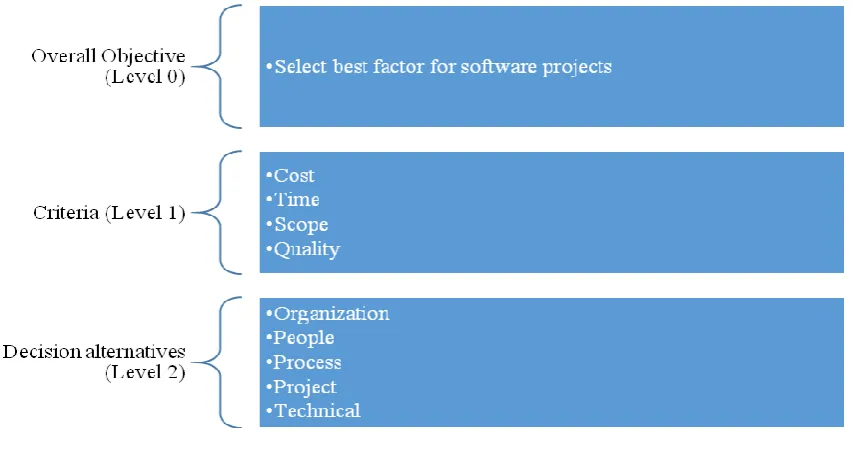
objective.AHP was used in ASD after defining overall objective, criteria and decision alternatives [18]as shown
in Fig 1.
436 | P a g e
In AHP, firstly find the decision alternatives and make the pairwise comparison wise chart of decision
alternatives and calculate the prioritize vector and Eigen vector so that ranking of factors can be done and
Consistency Ratio (CR) should be less than 0.1 so that it shows that results were consistent [19].
V. RESULT & DISCUSSION
To calculate the weights for criteria or priority vector, take combined average for comparison matrix or priority
matrix which was given by experts’ opinions. Comparison matrix was of size 4*4 as there are four criteria’s.
Now, divide each column entry in matrix by the sum of the column and then take the average of each row.To
know whether results were consistent or not, calculate CR and it should be less than 0.10. All the pair wise
results for all criteria’s were shown in Table 1.
CR= (Consistency Index) /(Random Index)
(1)
Consistency Index = (λ
max-t)/ (t-1)
(2)
wherematrix size denoted by and highest eigen value denoted by λ
maxTable 1: Criteria (level 1) based paired comparison matrix with respect to overall objective
Cost Time Scope Quality Priority Vector λ (Eigen value) Results
Cost 1.00 0.33 0.33 0.33 0.10 4.00 λmax= 4.15
CI = 0.05
RI = 0.90
CR = 0.05
(Acceptable)
Time
3.00
1.00
3.00
1.00
0.37 4.19Scope
3.00
0.33
1.00
0.33
0.17 4.20Quality
3.00
1.00
3.00
1.00
0.37 4.19
Table 2: RI (Random index)
n 1 2 3 4 5 6 7 8 9 10
RI 0.00 0.00 0.58 0.90 1.12 1.24 1.32 1.41 1.45 1.45
Source: [18]
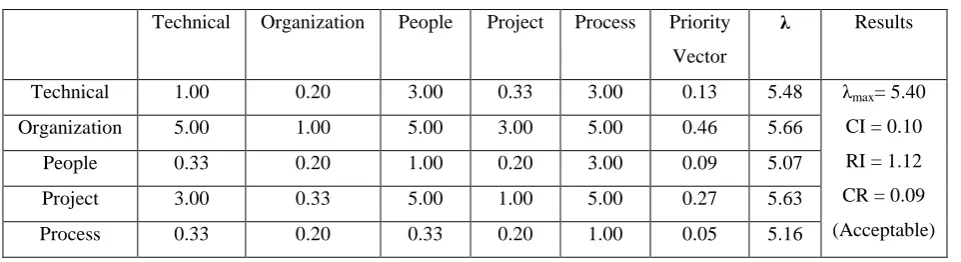
The paired comparison matrix was performed for factors with cost, time, scope and quality respectively. Table
3, Table 4, Table 5 and Table 6 showed paired matrix respectively. All the results were found consistent as CR
of all factors with respective criteria’s found below 0.10.
Table 3: Paired comparison matrix of factors (level 2) with respect to cost
Technical Organization People Project Process Priority
Vector
λ Results
Technical 1.00 0.33 0.33 0.14 5.00 0.09 5.36 λmax= 5.36
CI = 0.09
437 | P a g e
People 3.00 0.33 1.00 0.33 3.00 0.14 5.48 RI = 1.12
CR = 0.08
(Acceptable)
Project 7.00 3.00 3.00 1.00 9.00 0.48 5.44
Process 0.20 0.20 0.33 0.11 1.00 0.04 5.14
Table 4: Paired comparison matrix of factors (level 2) with respect to time
Technical Organization People Project Process Priority
Vector
λ Results
Technical 1.00 0.50 3.00 0.14 5.00 0.16 5.48 λmax= 5.41
CI = 0.10
RI = 1.12
CR = 0.09
(Acceptable)
Organization 2.00 1.00 3.00 0.33 3.00 0.20 5.73
People 0.33 0.33 1.00 0.33 5.00 0.12 4.93
Project 7.00 3.00 3.00 1.00 9.00 0.49 5.77
Process 0.20 0.20 0.20 0.11 1.00 0.04 5.14
Table 5: Paired comparison matrix of factors (level 2) with respect to scope
Technical Organization People Project Process Priority
Vector
λ Results
Technical 1.00 0.20 3.00 0.33 3.00 0.13 5.44 λmax= 5.36
CI = 0.09
RI = 1.12
CR = 0.08
(Acceptable)
Organization 5.00 1.00 7.00 3.00 5.00 0.49 5.57
People 0.33 0.14 1.00 0.33 3.00 0.08 5.14
Project 3.00 0.33 3.00 1.00 5.00 0.24 5.51
Process 0.33 0.20 0.33 0.20 1.00 0.05 5.13
Table 6: Paired comparison matrix of factors (level 2) with respect to quality
Technical Organization People Project Process Priority
Vector
λ Results
Technical 1.00 0.20 3.00 0.33 3.00 0.13 5.48 λmax= 5.40
CI = 0.10
RI = 1.12
CR = 0.09
(Acceptable)
Organization 5.00 1.00 5.00 3.00 5.00 0.46 5.66
People 0.33 0.20 1.00 0.20 3.00 0.09 5.07
Project 3.00 0.33 5.00 1.00 5.00 0.27 5.63
Process 0.33 0.20 0.33 0.20 1.00 0.05 5.16
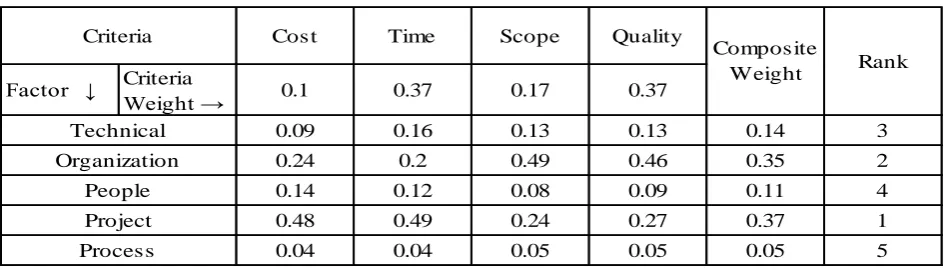
After performing pair comparison matrix of factors separately, the most important was to find out the composite
weight for the factors with overall objective. After receiving composite weight,rank factors according to the
438 | P a g e
has the least importance among all five factors. Project factor were related with the aspects of project like
project size, project complexity. The process factors were related with process tools and techniques required for
project management, planning and monitoring. The results were shown in Table 7.
Table 7: Overall composite weights for the factors
Factor ↓ Criteria
Weight → 0.1 0.37 0.17 0.37
0.09 0.16 0.13 0.13 0.14 3
0.24 0.2 0.49 0.46 0.35 2
0.14 0.12 0.08 0.09 0.11 4
0.48 0.49 0.24 0.27 0.37 1
0.04 0.04 0.05 0.05 0.05 5
Process Criteria
Composite
Weight Rank
Technical
Organization
People
Project
Cost Time Scope Quality
Combined CR= ∑w
iCI
i/∑w
iRI
i(3)
Combined CR = (1 * 0.05 + 0.10 * 0.09 + 0.37 *0.10 + 0.17 * 0.09 + 0.37 * 0.10)/ (1* 0.9 + 0.10 * 1.12 + 0.37
*1.12 + 0.17 * 1.12 + 0.37 * 1.12)
Combined CR = 0.07 which is less then < 0.10 and results were consistent with evaluations.
VI. CONCLUSION
AHP method was used to evaluate the importance of agile factors. AHP was used when number of criteria’s and
alternatives were less than 7 unless it was not as much effective technique. AHP was a choice making method
and used to evaluate the alternatives and choose the best alternative. An adapted scale was used in the study to
know the important factor for agile projects. In this study, survey was collected from experts and priority vector,
CI, RI, highest eigen valuewere calculated after making paired comparison matrix tables and results were
checked to know the consistency of evaluations by looking at values of CRs.The factors were ranked according
to their composite weight. On the top of list project factor followed by organization, technical, people and
process factor respectively. The composite weight lied in the range of 0.05 to 0.37 and its CR was also found to
be appropriate. This ranking will help project managers to concentrate on the most important factors first, so that
project success can be achieved.
REFERENCES
[1] O. Salo and P. Abrahamsson, “Agile methods in European embedded software development
organisations: a survey on the actual use and usefulness of Extreme Programming and Scrum,” IET Softw., vol. 2, no. 1, p. 58, 2008.
439 | P a g e
[3] S. Ambler, “2017 Agile Governance Survey Results,” Ambysoft, 2017. [Online]. Available: http://www.ambysoft.com/surveys/agileGovernance2017.html. [Accessed: 06-Mar-2018].
[4] V. Kukreja and A. Singh, “Agile Enablers and Adoption Scenario in Industry Context,” in Achieving Enterprise Agility through Innovative Software Development., IGI Global, 2015, pp. 157–178.
[5] C.-T. Lin, H. Chiu, and Y.-H. Tseng, “Agility evaluation using fuzzy logic,” Int. J. Prod. Econ., vol. 101, no. 2, pp. 353–368, 2006.
[6] T. Dybå and T. Dingsøyr, “Empirical studies of agile software development: A systematic review,” Inf. Softw. Technol., vol. 50, no. 9–10, pp. 833–859, 2008.
[7] T. Chow and D. B. Cao, “A survey study of critical success factors in agile software projects,” J. Syst. Softw., vol. 81, no. 6, pp. 961–971, 2008.
[8] D. E. Strode, S. L. Huff, and A. Tretiakov, “The Impact of Organizational Culture on Agile Method
Use,” in 42nd Hawaii International Conference on System Sciences, 2009, pp. 1–9.
[9] S. C. Misra, V. Kumar, and U. Kumar, “Identifying some important success factors in adopting agile
software development practices,” J. Syst. Softw., vol. 82, no. 11, pp. 1869–1890, 2009.
[10] R. Popli and N. Chauhan, “Agile estimation using people and project related factors,” in IEEE International Conference on Computing for Sustainable Global Development, INDIACom 2014, 2014, pp. 564–569.
[11] S. Matook and R. Vidgen, “Harmonizing critical success factors in agile ISD projects,” in 20th Americas Conference on Information Systems, (AMCIS), 2014, pp. 1–10.
[12] D. Shahane, P. Jamsandekar, and D. Shahane, “Factors influencing the agile methods in practice -
Literature survey &amp; review,” 2014 Int. Conf. Comput. Sustain. Glob. Dev., pp. 556–560, 2014.
[13] R. K. C. Ranasinghe and I. Perera, “Effectiveness of scrum for offshore software development in Sri
Lanka,” MERCon 2015 - Moratuwa Eng. Res. Conf., pp. 306–311, 2015.
[14] A. Ahimbisibwe, R. Y. Cavana, and U. Daellenbach, “A contingency fit model of critical success factors
for software development projects: A comparison o f agile and traditional plan-based methodologies,” J. Enterp. Inf. Manag., vol. 28, no. 5, pp. 7–33, 2015.
[15] T. A. El Hameed, M. A. El Latif, and S. Kholief, “Identify and Classify Critical Success Factor of Agile
Software Development Methodology Using Mind Map,” Int. J. Adv. Comput. Sci. Appl., vol. 7, no. 5, pp. 83–92, 2016.
[16] D. Stankovic, V. Nikolic, M. Djordjevic, and D. B. Cao, “A survey study of critical success factors in
440 | P a g e
1678, 2013.
[17] E. Eroglu, “Factors affecting consumer preferences for retail industry and retailer selection using anality
hierarchy process,” J. Econ. Adm. Sci., vol. 4, no. 6, pp. 43–57, 2013.
[18] A. Kumar, M. K. Dash, A. Kumar, and M. K. Dash, “Factor exploration and multi-criteria assessment
method (AHP) of multi-generational consumer in electronic commerce,” Int. J. Bus. Excell. J. Bus. Excell., vol. 7, no. 2, pp. 213–236, 2014.
[19] V. S. Lai, R. P. Trueblood, and B. K. Wong, “Software selection: A case study of the application of the
analytical hierarchical process to the selection of a multimedia authoring system,” Inf. Manag., vol. 36,