Learning Sequence-to-Sequence Correspondences from Parallel Corpora
via Sequential Pattern Mining
Kaoru Yamamoto
†
and Taku Kudo‡
and Yuta Tsuboi§
and Yuji Matsumoto‡
†Genomic Sciences Center, The Institute of Physical and Chemical Research
1-7-22-E209, Suehiro-cho, Tsurumi-ku, Yokohama, 230-0045 Japan
[email protected]
‡Graduate School of Information Science, Nara Institute of Science and Technology
8916-5 Takayama, Ikoma, Nara, 630-0192 Japan
[email protected], [email protected]
§Tokyo Research Laboratory, IBM Japan, Ltd.
1623-14 Shimotsuruma, Yamato-shi, Kanagawa-ken, 242-8502 Japan
[email protected]
Abstract
We present an unsupervised extraction of sequence-to-sequence correspondences from parallel corpora by sequential pattern mining. The main characteristics of our method are two-fold. First, we propose a systematic way to enumerate all possible translation pair can-didates of rigid and gapped sequences without falling into combinatorial explosion. Second, our method uses an efficient data structure and algorithm for calculating frequencies in a con-tingency table for each translation pair candi-date. Our method is empirically evaluated us-ing English-Japanese parallel corpora of 6 mil-lion words. Results indicate that it works well for multi-word translations, giving 56-84% ac-curacy at 19% token coverage and 11% type coverage.
1
Introduction
This paper addresses the problem of identifying “multi-word” (sequence-to-sequence) translation correspon-dences from parallel corpora. It is well-known that trans-lation does not always proceed by word-for-word. This highlights the need for finding multi-word translation cor-respondences.
Previous works that focus on multi-word transla-tion correspondences from parallel corpora include noun phrase correspondences (Kupiec, 1993), fixed/flexible collocations (Smadja et al., 1996), n-gram word se-quences of arbitrary length (Kitamura and Matsumoto, 1996), non-compositional compounds (Melamed, 2001),
captoids (Moore, 2001), and named entities1.
In all of these approaches, a common problem seems to be an identification of meaningful multi-word translation units. There are a number of factors which make han-dling of multi-word units more complicated than it ap-pears. First, it is a many-to-many mapping which poten-tially leads to a combinatorial explosion. Second, multi-word translation units are not necessarily contiguous, so an algorithm should not be hampered by the word adja-cency constraint. Third, word segmentation itself is am-biguous for non-segmented languages such as Chinese or Japanese. We need to resolve such ambiguity as well.
In this paper, we apply sequential pattern mining to solve the problem. First, the method effectively avoids an inherent combinatorial explosion by concatenating pairs of parallel sentences into single bilingual sequences and applying a pattern mining algorithm on those sequences. Second, it covers both rigid (gap-less) and gapped se-quences. Third, it achieves a systematic way of enumer-ating all possible translation pair candidates, single- or multi-word. Note that some are overlapped to account for word segmentation ambiguity. Our method is bal-anced by a conservative discovery of translation corre-spondences with the rationale that direct associations will win over indirect ones, thereby resolving the ambiguity.
2
Our Basic Idea
Our approach is illustrated in Figure 1. We concatenate corresponding parallel sentences into bilingual sequences to which sequential pattern mining is applied. By doing so, we obtain the following effects:
• It exhaustively generates all possible translation can-1
Parallel Corpus
Monolingual Patterns with Independet Frequency Bilingual Patterns with Co-occurrence Frequency
Sequence-to-Sequence Correspondence Discovery
Bilingual Expressions
Concatenate
Figure 1: Our Approach
didates, both rigid and gapped sequences, yet
avoid-ing combinatorial explosion.
• It achieves an efficient calculation of a contingency table in a single running of sequential pattern min-ing.
In what follows, we describe sequential pattern mining and each module in Figure 1.
2.1 Sequential Pattern Mining
Sequential pattern mining discovers frequent subse-quences as patterns in a sequence database (Agrawal and Srikant, 1995). Here, a subsequence is an order-preserving item sequence where some gaps between items are allowed. In this paper, we write the support of subsequencesin sequence databaseS as supportS(s), meaning the occurrence frequency ofsinS. The prob-lem is defined as follows:
Given a set of sequencesS, where each sequence con-sists of items, and a given a user-specified minimum sup-port ξ, sequential pattern mining is to find all of the subsequences whose occurrence frequency in the setSis no less thanξ.
A sequential pattern is different from N-gram pattern in that the former includes a pattern with and without gaps and does not impose any limit on its length. These characteristics in sequential pattern mining leads us to the idea of concatenating corresponding parallel sentences into a bilingual sequence database from which bilingual sequential patterns are mined efficiently.
minsup = 2
sequence db pattern projected db pattern projected db
pattern projected db
Figure 2: A Sample Execution of PrefixSpan
2.2 Bilingual Lexicon Extraction
2.2.1 Bilingual Sequence Database
For each parallel sentence, we undergo language-dependent preprocessing, such as word segmentation and part-of-speech tagging. Then we concatenate the mono-lingual sequences into a single bimono-lingual sequence, and a collection of bilingual sequences becomes a sequence databaseS.
2.2.2 Sequential Pattern Mining
A single run of sequential pattern mining takes care of identifying and counting translation candidate patterns – rigid and gapped, some of which are overlapped – in the bilingual sequence database. All English subsequences satisfying the minimum supportξwill be generated (e.g., “e1”, “e1e2”, “e1e3”· · ·, indicated byEi). Similarly, all Japanese and bilingual subsequences with support ≥ ξ will be generated (indicated byJjandEiJjrespectively). It is important to point out that for any bilingual pattern EiJj, corresponding English pattern Ei and Japanese patternJj that form constituents of the bilingual pattern are always recognized and counted.
PrefixSpan
In order to realize sequential pattern mining, we use PrefixSpan algorithm (Pei et al., 2001). The general idea is to divide the sequence database by frequent prefix and to grow the prefix-spanning patterns in depth-first search fashion.
We introduce some concepts. Let αbe a sequential pattern in the sequence databaseS. Then, we refer to the α-projected database,S|α, as the collection of postfixes of sequences inSw.r.t prefixα.
se-functionPrefixSpan(α, S|α) begin
B← {b|(s∈S|α, b∈s) ∧(supportS|α(hbi)≥ξ) ∧(projectable(α, b))} foreachb∈B
begin
(S|α)|b← {hi, s0i|(hi, si ∈S|α) ∧(s0=postf ix(s, b))}
callPrefixSpan(αb,(S|α)|b) end
end
Figure 3: Pseudo Code of PrefixSpan
quence database is indicated byeij wheree is an item, iis a sequence id, j is the offset for thepostf ixof se-quence idi. First, frequent sequential patterns with length 1 are selected. This givesA, B andC. The support of D is less than the minimum support 2, so D-projected database will not be created. For projections drawn with bold lines in Figure 2, we proceed with a frequent prefix A. SinceAsatisfies the minimum support2, it creates a A-projected database derived from the sequence database S (S|A). FromS|A, frequent itemsB, C are identified, subsequently forming prefix patternsAB andAC, and corresponding projected databases of the postfixesS|AB, S|AC. We continue with projection recursively to mine all sequential patterns satisfying the minimum support count2.
PrefixSpan is described in Figure 3. The predicate pro-jectable is designed to encode if a projection is feasible in an application domain. The original PrefixSpan gives a predicate that always returns true.
There are a number of possibilities for projectable to reflect linguistic constraints. A default projectable pred-icate covers both rigid and gapped sequences satisfying the minimum support. If we care for word adjacency, the projectable should return true only when the last item of the mined pattern and the first item of a postfix sequence in the projected database are contiguous. Another possi-bility is to prevent a certain class of words from being an item of a sequence. For example, we may wish to find a sequence consisting only of content words. In such a case, we should disallow projections involving functional word item.
2.2.3 Sequence-to-Sequence Correspondence
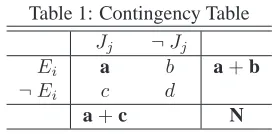
The effect of sequential pattern mining from bilingual sequence database can better be seen in a contingency table shown in Table 1. Frequencies of a bilingual pattern EiJj, an English patternEi, and a Japanese patternJj correspond to a, a+b, anda+c respectively. Since we know the total number of bilingual sequencesN = a+b+c+d, values of b, c and dcan be calculated immediately.
Table 1: Contingency Table
Jj ¬Jj
Ei a b a+b
¬Ei c d
a+c N
The contingency table is used for calculating a sim-ilarity (or association) score between Ei and Jj. For this present work, we use Dunning’s log-likelihood ratio statistics (Dunning, 1993) defined as follows:
sim = aloga+blogb+clogc+dlogd
−(a+b) log (a+b)−(a+c) log (a+c)
−(b+d) log (b+d)−(c+d) log (c+d) +(a+b+c+d) log (a+b+c+d)
For each bilingual patternEiJj, we compute its similarity score and qualify it as a bilingual sequence-to-sequence correspondence if no equally strong or stronger associ-ation for monolingual constituent is found. This step is conservative and the same as step 5 in Moore (2001) or step 6(b) in Kitamura and Matsumoto (1996). Our im-plementation uses a digital trie structure called Double Array for efficient storage and retrieval of sequential pat-terns (Aoe, 1989).
For non-segmented language, a word unit depends on results of morphological analysis. In case of Japanese morphological analysis, ChaSen (Matsumoto et al., 2000) tends to over-segment words, while JUMAN (Kurohashi et al., 1994) tends to under-segment words. It is diffi-cult to define units of correspondences only consulting the Japanese half of parallel corpora. A parallel sentence-pair may resolve some Japanese word segmentation am-biguity, however, we have no way to rank for word units with the same degree of segmentation ambiguity. In-stead, we assume that frequently co-occurred sequence-to-sequence pairs in the entire parallel corpora are trans-lation pairs. Using the global frequency of monolingual and bilingual sequences in the entire parallel corpora, we have better chance to rank for the ties, thereby resolv-ing ambiguity in the monolresolv-ingual half. To follow this intuition, we generate overlapped translation candidates where ambiguity exists, and extract ones with high asso-ciation scores.
3
Experimental Results
3.1 Data
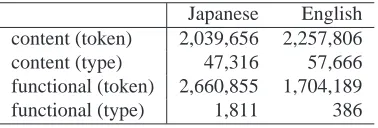
We use the English-Japanese parallel corpora that are automatically aligned from comparable corpora of the news wires (Utiyama and Isahara, 2002). There are 150,000 parallel sentences which satisfy their proposed sentence similarity. We use TnT (Brants, 2000) for En-glish POS tagging and ChaSen (Matsumoto et al., 2000) for Japanese morphological analysis, and label each to-ken to either content or functional depending on its part-of-speech.
Table 2: Statistics of 150,000 parallel sentences
Japanese English content (token) 2,039,656 2,257,806
content (type) 47,316 57,666
functional (token) 2,660,855 1,704,189
functional (type) 1,811 386
3.2 Evaluation Criteria
We evaluate our sequence-to-sequence correspondence by accuracy and coverage, which we believe, similar cri-teria to (Moore, 2001) and (Melamed, 2001)2. LetCseq be the set of correct bilingual sequences by a human judge, Sseq be the set of bilingual sequences identified by our system, Ctoken be the multiset of items covered byCseq,Ttokenbe the multiset of items in the bilingual sequence database,Ctypebe the set of items covered by Cseq, andTtype be the set of items in the bilingual se-quence database. Then, our evaluation metrics are given by:
accuracy = |Cseq|
|Sseq|
token coverage = |Ctoken|
|Ttoken| 2
We would like to examine how many distinct translation pairs are correctly identified (accuracy) and how well the iden-tified subsequences can be used for partial sequence alignment in the original parallel corpora (coverage). Since all the correct translation pairs in our parallel corpora are not annotated, the sum of true positives and false negatives remain unknown. For this reason, we avoid to use evaluation terms precision and re-call to emphasize the difference. There are many variations of evaluation criteria used in the literature. At first, we try to use Moore’s criteria to present a direct comparison. Unfortunately, we are unclear about frequency for multi-words in the parallel corpora, which seems to require for the denominator of his cov-erage formula. Further, we also did not split train/test corpus for cross-validation. Our method is an unsupervised learning, and the learning does not involve tuning parameters of a prob-abilistic model for unseen events. So we believe results using entire parallel corpora give indicative material for evaluation.
type coverage = |Ctype|
|Ttype|
In order to calculate accuracy, each translation pair is compared against the EDR (Dictionary, 1995). All the entries appeared in the dictionary were assumed to be correct. The remaining list was checked by hand. A human judge was asked to decide “correct”, “nearmiss”, or “incorrect” for each proposed translation pair with-out any reference to the surrounding context. Distinc-tion between “nearmiss” and “incorrect” is that the for-mer includes translation pairs that are partially correct3. In Tables 3, 4, and 5, accuracy is given as a range from a combination of “correct” and “nearmiss” to a combi-nation of “nearmiss” and “incorrect”. Having calculated the total accuracy, accuracies for single-word translation pairs only and for multi-word translation pairs only are calculated accordingly.
3.3 Results
Our method is implemented in C++, and executed on a 2.20 GHz Penntium IV processor with 2GB mem-ory. For each experiment, we set the minimum support (minsup) and the maximum length (maxpat) of pat-terns. All experiments target bilingual sequences of con-tent words only, since we feel that functional word cor-respondences are better dealt with by consulting the sur-rounding contexts in the parallel corpora4. An execution
of bilingual sequence databases compiled from 150,000 sentences, takes less than 5 mins withminsup= 3and maxpat= 3, inferring 14312 translation pairs.
Given different language pair, different genre of text, different evaluation criteria, we find it difficult to di-rectly compare our result with previous high-accuracy proaches such as (Moore, 2001). Below, we give an ap-proximate comparison of our empirical results.
3.3.1 Rigid Sequences
Table 3 shows a detailed result of rigid sequences with minsup = 3,maxpat = 3. In total, we obtain 14312 translation pairs, out of which we have 6567 single-word
3We include “not sure” ones for a single-word translation. Those are entries which are correct in some context, but debat-able to include in a dictionary by itself. As for multi-word trans-lation, we include pairs that can become “correct” in at most 2 rewriting steps.
4Inclusion of functional word items in bilingual sequences is debatable. We have conducted an preliminary experiment of approx 10,000 sentences taken from a English–Japanese dic-tionary. As sentences are shorter and more instructive, we get grammatical collocations such as “impressed with / ni kanmei ” and “apologize for / koto owabi” or phrasal expressions such as “for your information / go sanko” and “on behalf of / wo
daihyo shi”. However, we felt that it was not practical to
Table 3: Result of Rigid Sequence Only with minsup = 3, maxpat = 3. Accuracy is given as a range from a combination of “correct” and “nearmiss” to a combination of “nearmiss” and “incorrect”. The left side of slash gives a tigher evaluation and the right side of slash gives a looser evaluation.
minsup maxpat extracted correct total single-word multi-word token type sequence sequence accuracy accuracy accuracy coverage coverage 3 3 1000 927 / 988 0.927 / 0.988 0.942 / 0.988 0.824 / 0.984 0.142 0.018 3 3 2000 1836 / 1969 0.918 / 0.986 0.953 / 0.992 0.742 / 0.945 0.164 0.035 3 3 3000 2723 / 2932 0.908 / 0.977 0.951 / 0.991 0.732 / 0.923 0.174 0.050 3 3 4000 3563 / 3882 0.891 / 0.971 0.951 / 0.990 0.695 / 0.909 0.179 0.064 3 3 5000 4330 / 4825 0.866 / 0.965 0.948 / 0.989 0.656 / 0.903 0.182 0.076 3 3 6000 5052 / 5752 0.842 / 0.959 0.945 / 0.990 0.618 / 0.891 0.184 0.087 3 3 7000 5776 / 6656 0.825 / 0.951 0.941 / 0.989 0.607 / 0.879 0.186 0.098 3 3 8000 6350 / 7463 0.794 / 0.933 0.938 / 0.987 0.568 / 0.848 0.187 0.104 3 3 9000 7034 / 8345 0.782 / 0.927 0.935 / 0.985 0.562 / 0.844 0.188 0.113
Table 4: Result of Rigid Sequences Only with minsup = 10 and minsup = 5.
minsup maxpat extracted correct total single-word multi-word token type sequence sequence accuracy accuracy accuracy coverage coverage 10 3 4467 3989 / 4341 0.893 / 0.972 0.946 / 0.988 0.712 / 0.918 0.085 0.011 5 3 7654 6325 / 7271 0.826 / 0.950 0.937 / 0.986 0.618 / 0.882 0.188 0.106
10 10 4518 4002 / 4392 0.886 / 0.972 0.947 / 0.988 0.690 / 0.921 0.183 0.073 5 10 8007 6383 / 7387 0.797 / 0.922 0.938 / 0.986 0.563 / 0.817 0.188 0.106
Table 5: Result of Rigid and Gapped Sequences with minsup = 10. A default projectable constraint in Figure 3 is used.
minsup maxpat extracted correct total single-word multi-word token type sequence sequence accuracy accuracy accuracy coverage coverage 10 3 5792 4503 / 4979 0.777 / 0.860 0.950 / 0.989 0.530 / 0.674 0.085 0.012
Table 6: Comparison between Table 4 and Table 5 with minsup = 10, maxpat = 3
single-word single-word single-word multi-word multi-word multi-word
correct wrong all correct wrong all
Both 3239 167 3406 554 181 735
Rigid only 25 18 43 171 112 283
Gapped only 0 2 2 710 937 1649
Table 7: Length Distribution of 171 correct Rigid multi-word Sequences Only (left) vs. Length Distribution of 112 wrong Rigid multi-word Sequences Only (right)
HH HH E
J
1 2 3
1 n/a 16 0
2 15 110 6
3 5 7 12
HH HH E
J
1 2 3
1 n/a 11 0
2 19 29 19
3 3 24 7
Table 8: Length Distribution of 710 correct Rigid and Gapped multi-word Sequences (left) vs. Length Distribution of 937 wrong Rigid and Gapped multi-word Sequences (right)
HH HH E
J
1 2 3
1 n/a 17 0
2 45 546 15
3 9 43 35
HH HH E
J
1 2 3
1 n/a 30 2
2 36 229 239
translation pairs and 7745 multi-word translation pairs. In this paper, we evaluate only the top 9000 pairs sorted by the similarity score.
For single-word translation, we get 93-99% accuracy at 19% token coverage and 11% type coverage. This im-plies that about 1/5 of content word tokens in the paral-lel corpora can find their correspondence with high ac-curacy. We cannot compare our word alignment result to (Moore, 2001), since the real rate of tokens that can be aligned by single-word translation pairs is not explic-itly mentioned. Although our main focus is sequence-to-sequence correspondences, the critical question remains as to what level of accuracy can be obtained when ex-tending coverage rate, for example to 36%, 46% and 90%. Our result appears much inferior to Moore (2001) and Melamed (2001) in this respect and may not reach 36% type coverage. A possible explanation for the poor performance is that our algorithm has no mechanism to check mutually exclusive constraints between translation candidates derived from the same paired parallel sen-tence.
For general multi-word translation, our method seems more comparable to Moore (2001). Our method performs 56-84% accuracy at 11% type coverage. It seems bet-ter than “compound accuracy” which is his proposal of hypothesizing multi-word occurrences, being 45-54% at 12% type coverage. However it is less favorable to “mul-tiword accuracy” provided by Microsoft parsers, being 73-76% accuracy at 12% type coverage (Moore, 2001). The better performance could be attributed to our redun-dant generation of overlapped translation candidates in order to account for ambiguity. Although redundancy introduces noisier indirect associations than one-to-one mapping, our empirical result suggests that there is still a good chance of direct associations being selected.
Table 4 shows results of rigid sequences with a higher minimum support and a longer maximum length. Com-paring with Table 3, setting a higher minimum support produces a slightly more cost-effective results. For ex-ample,minsup= 10, maxpat= 3, there are 4467 pairs extracted with 89.3-97.1% accuracy, while the top 4000 pairs inminsup = 3, maxpat = 3are extracted with 89.1-97.1% accuracy. Table 4 reveals a drop in multi-word accuracy when extendingminpat, indicating that care should be given to the length of a pattern as well as a cutoff threshold.
Our analysis suggests that an iterative method by con-trolling minsup andmaxpat appropriately seems bet-ter than a single execution cycle of finding correspon-dences. It can take mutually exclusive constraints into account more easily which will improve the overall per-formance. Another interesting extension is to incorporate more linguistically motivated constraints in generation of sequences. Yamamoto et al. (2001) reports that N-gram
translation candidates that do not go beyond the chunk boundary boosts performance. Had we performed a lan-guage dependent chunking in preparation of bilingual se-quences, such a chunk boundary constraint could be sim-ply represented in the projectable predicate. The issues are left for future research.
3.3.2 Gapped Sequences
One of advantages in our method is a uniform genera-tion of both rigid and gapped sequences simultaneously. Gapped sequences are generated and extracted without recording offset and without distinguisting compositional compounds from non-compositional compounds. Al-though non-compositional compounds are rare and more difficult to extract, compositional compounds are still useful as collocational entires in bilingual dictionary.
There are positive and negarive effects in our gapped sequences using sequential pattern mining. Suppose we have English sequences of “My best friend wishes your father to visit · · ·” and “· · · best wishes for success”. Then, we obtain a pattern “best wishes” that should be counted separately. However, if we have sequences of “staying at Hilton hotel” and “staying at Kyoto Miyako hotel”, then we will obtain a kind of a phrasal template “staying at hotel” where the individual name of hotel, Hilton or Kyoto Miyako, is abstracted. Usefulness of such gapped sequences is still open, but we emperically evaluate the result of gapped sequences withminsup= 10andmaxpat= 3shown in Table 5.
Comparing Table 4 and 5, we lose the multi-word ac-curacy substantially. Table 6 is a breakdown of rigid and gapped sequences with minsup = 10, maxpat = 3. The “Both” row lists the number of pairs found, under a category described in the column head, in both rigid and gapped sequences. The “Rigid only” row counts for those only found in rigid sequences, while the “Gapped only” row counts for those only found in gapped sequence. We learn that the decrease in multi-word accuracy is due to an increase in the portion of wrong pairs in sequences; 57% (937 / 1649) in gapped sequences whilst 40% (112 / 283) in rigid sequences.
Admittedly, we still require further analysis as to searching a break-even point of rigid/gapped sequences. Our preliminary finding supports the work on collocation by Smadja et al. (1996) in that gapped sequences are also an important class of multi-word translations.
4
Related Work
Moore (2001) presents insightful work which is closest to ours. His method first computes an initial association score, hypothesizes an occurrence of compounds, fuses it to a single token, recomputes association scores as if all translations are one-to-one mapping, and returns the highest association pairs. As for captoids, he also com-putes association of an inferred compound and its con-stituent words. He also uses language-specific features (e.g. capital letters, punctuation symbols) to identify likely compound candidates.
Our method is quite different in dealing with pounds. First, we outsource a step of hypothesizing com-pounds to language-dependent preprocessors. The reason is that an algorithm will become complicated if language-specific features are directly embedded. Instead, we pro-vide an abstract interface, namely the projectable predi-cate in sequential pattern mining, to deal with language-specific constraints. Second, we allow items being re-dundantly counted and translation pair candidates being overlapped. This sharply contrasts with Moore’s method of replacing an identified compound to a single token for each sentence pair. In his method, word segmentation ambiguity must be resolved before hypothesizing com-pounds. Our method reserves a possibility for word seg-mentation ambiguity and resolves only when frequently co-occured sequence-to-sequence pairs are identified.
Since we compute association scores independently, it is difficult to impose mutually exclusive constraints be-tween translation candidates derived from a paired par-allel sentence. Hence, our method tends to suffer from indirect association when the association score is low, as pointed out by Melamed (2001). Although our method relies on an empirical observation that “direct associa-tions are usually stronger than indirect association”, it seems effective enough for multi-word translation. bal-anced by a
As far as we know, our method is the first attempt to make an exhaustive enumeration of rigid and gapped translation candidates of both languages possible, yet avoiding combinatorial explosion. Previous approaches effectively narrow down its search space by some heuris-tics. Kupiec (1993) focuses on noun-phrase translations only, Smadja et al. (1996) limits to find French transla-tion of English collocatransla-tion identified by his Xtract sys-tem, and Kitamura and Matsumoto (1996) can exhaus-tively enumerate only rigid word sequences.
Many of works mentioned in the last paragraph as
well as ours extract non-probabilistic translation lexicons. However, there are research works which go beyond word-level translations in statistical machine translation. One notable work is that of Marcu and Wong (2002), which is based on a joint probability model for statistical machine translation where word equivalents and phrase (rigid sequence) equivalents are automatically learned form bilingual corpora.
Our method does not iterate an extraction process as shown in Figure 1. This could be a cause of poor perfor-mance in single-word translation pairs, since there is no mechanism for imposing mutually exclusion constrains. An interesting question then is what kind of iteration should be performed to improve performance. Prob-abilistic translation lexicon acquisition often uses EM training on Viterbi alignments, e.g. (Marcu and Wong, 2002), while non-probabilistic ones employ a greedy al-gorithm that extracts translation pairs that give higher as-sociation scores than a predefined threshold where the threshold is monotonically decreasing as the algorithm proceeds, e.g. (Kitamura and Matsumoto, 1996). The issue is left for future work.
Last but not least, no previous works give an explicit mention to an efficient calculation of each cell in a con-tingency table. Our approach completes the process by a single run of sequential pattern mining. Since speed does not affect results of accuracy and coverage, its sig-nificance is often ignored. However, it will be important when we handle with corpora of large size.
5
Conclusions
We have proposed an effective method to find sequence-to-sequence correspondences from parallel corpora by se-quential pattern mining. As far as multi-word translation is concerned, our method seems to work well, giving 56-84% accuracy at 19% token coverage and 11% type cov-erage.
Acknowledgement
We would like to thank Masao Utiyama of CRL for creating a large-scale English-Japanese parallel corpora, Thorsten Brants and ChaSen development team for mak-ing NLP tools publicly available. In addition, we would like to thank anonymous reviewers for useful comments that have helped preparation of this paper.
References
R. Agrawal and R. Srikant. 1995. Mining sequential patterns. Proc. 1995 International Conference of Very
Large DataBases (VLDB’95), pages 3–14.
J. Aoe. 1989. An Efficient Digital Search Algorithm by Using a Double-Array Structure. IEEE Transactions
on Software Engineering Vol. 15, 9, pages 1066–1077.
T. Brants. 2000. TnT – A Statistical Part-of-Speech Tag-ger. 6th Applied Natural Language Processing
Con-ference, pages 224–231.
EDR Electronic Dictionary. 1995. http://www.iijnet.or.jp/edr.
T. Dunning. 1993. Accurate Methods for the Statistics of Surprise and Coincidence. Computational Linguistics,
Vol.19, No.1, pages 61–74.
M. Kitamura and Y. Matsumoto. 1996. Automatic Ex-traction of Word Sequence Correspondences in Paral-lel Corpora. Proc. of the 4th Annual Workshop on Very
Large Corpora (WVLC-4), pages 79–87.
J. Kupiec. 1993. An Algorithm for Finding Noun Phrase Correspondences in Bilingual Corpora. 31st Annual
Meeting of the Association for Computational Linguis-tics, pages 23–30.
S. Kurohashi, T. Nakamura, Y. Matsumoto, and M. Na-gao. 1994. Improvements of japanese morphological analyzer juman. SNLR: Proceedings of the
Interna-tional Workshop on Sharable Natural Language Re-sources, pages 22–28.
D. Marcu and W. Wong. 2002. A Phrase-Based, Joint Probability Model for Statistical Machine Translation.
Proceedings of the 2002 Conference on Empirical Methods in Natural Language Processing, pages 133–
139.
Y. Matsumoto, A. Kitamuchi, T. Yamashita, H. Matsuda, K. Takaoka, and M. Asahara. 2000. Morphological analysis system chasen version 2.2.1 manual. Nara
In-stitute of Science and Technology.
I.D. Melamed. 2001. Empirical Methods for Exploiting
Parallel Texts. MIT Press.
R.C. Moore. 2001. Towards a Simple and Accurate Statistical Approach to Learning Translation Relation-ships among Words. ACL Workshop on Data-Driven
Machine Translation, pages 79–86.
J. Pei, B. Han, J. Mortazavi-Asl, H. Pinto, Q. Chen, U. Dayal, and M. Hau. 2001. Prefixspan: Mining se-quential patterns efficiently by prefix-projected pattern growth. Proc. of International Conference of Data
En-gineering (ICDE2001), pages 215–224.
F. Smadja, K.R. McKeown, and V. Hatzuvassiloglou. 1996. Translating Collocations for Bilingual Lexi-cons: A Statistical Approach. Computational
Linguis-tics, 22(1):1–38.
M. Utiyama and H. Isahara. 2002. Alingment of Japanese–English News Articles and Sentences (in Japanese). IPSJ SIG-NL 151, pages 15–21.
K. Yamamoto, Y. Matsumoto, and Kitamura M. 2001. A Comparative Study on Translation Units for Bilingual Lexicon Extraction. ACL Workshop on Data-Driven