Increasing the quality and quantity of source language data for
unsupervised cross-lingual POS tagging
Long Duong1,2, Paul Cook2, Steven Bird2and Pavel Pecina1
1Faculty of Mathematics and Physics, Charles University in Prague
2Department of Computing and Information Systems, University of Melbourne
[email protected], [email protected], [email protected], [email protected]
Abstract
Bilingual corpora offer a promising bridge between resource-rich and resource-poor languages, enabling the development of natural language processing systems for the latter. English is often selected as the resource-rich language, but another choice might give better performance. In this pa-per, we consider the task of unsupervised cross-lingual POS tagging, and construct a model that predicts the best source lan-guage for a given target lanlan-guage. In ex-periments on 9 languages, this model im-proves on using a single fixed source lan-guage. We then show that further improve-ments can be made by combining informa-tion from multiple source languages.
1 Introduction
Supervised part-of-speech (POS) taggers perform very well in cases where substantial manually-annotated data is available, as is the case for languages such as English, Portuguese, German, French and Arabic. For example, Petrov et al. (2012) built supervised POS taggers for 22 Eu-ropean languages using the TNT tagger (Brants, 2000), with an average accuracy of 95.2%. How-ever, creating annotated linguistic resources is expensive and time-consuming. Many widely-spoken languages, such as Vietnamese, Javanese, and Lahnda have little or no manually annotated data, making a supervised approach impossible.
However, parallel texts are becoming increas-ingly available through sources such as multilin-gual websites and documents, and large archives of translation memory from books, news, etc. Moreover, the number of languages with paral-lel data is increasing. The era of English dom-inating one side of parallel texts is shifting to a far wider range of languages. Parallel data can
be exploited to bridge languages, and to trans-fer annotated information from a highly-resourced
source language to a lesser-resourcedtarget lan-guage, to build unsupervised POS taggers (e.g., Das and Petrov, 2011; Duong et al., 2013).
One issue in building such a tagger is choosing the source language. English is commonly used, because parallel data which has English on one side is often most readily available. However, the appropriate source language might depend on the target language. For example, Snyder et al. (2008) found that a better tagger for Slovene could be built by using data from Serbian – a closely re-lated language – than from English. Moreover, if parallel data for a target language with more than one source language is available, it might be possi-ble to exploit this additional information; however, this issue has not been explored to date.
In this paper we build unsupervised POS tag-gers for 72 language pairs. We identify features based on monolingual and parallel corpora that we use to predict the best source language to build a tagger for a given target language. We show that choosing an appropriate source language can im-prove the accuracy of a state-of-the-art unsuper-vised POS tagging methodology, compared to us-ing a sus-ingle fixed source language. This prediction can be done based on features of the source and target language derived from monolingual corpora – important if parallel data is not available for our target language, and we need to choose which data to collect – although further improvements can be obtained using features based on parallel corpora. We then show that if multiple source languages are available, even better accuracy can be obtained by combining information from them.
2 Related work
One approach to build an unsupervised POS tag-ger is toprojecttag information from a resource-rich source language to a resource-poor target
guage. Das and Petrov (2011) and Duong et al. (2013) both achieve state-of-the-art performance on eight European languages using this cross-lingual approach. The two approaches are similar in the following respects. First, both project tag information from source to target language, apply-ing some kind of noise reduction along the way: Das and Petrov use high confidence alignments, while Duong et al. use high confidence sentences. Second, both use a semi-supervised method to ob-tain more labeled data: Das and Petrov use graph based label propagation, while Duong et al. use self-training. Finally, both apply noise reduc-tion/filtering on the (automatically) labeled data: Das and Petrov only extract the tag dictionary from labeled data, while Duong et al. heuristically revise tags after each self-training step. Crucially, in both of these approaches, once a tagger is built from parallel data, it can be used to tag monolin-gual text. The method of Duong et al. is less com-putationally intensive than that of Das and Petrov, as the graph-based propagation algorithm used by the latter requires convex optimisation. Because of its relative simplicity, yet comparable accuracy, in this paper we extend the method of Duong et al. Both Das and Petrov and Duong et al. exploit the Europarl Corpus with English as the source language (Koehn, 2005).1 However, as recent work has shown, it is worth considering other choices of source language. For example, Snyder et al. (2008) found that the accuracy of a Slovene tagger improved by 7.7% when paired with Ser-bian, a closely related language, but only 1.3 per-centage points when paired with English. Reddy and Sharoff (2011) and Hana et al. (2004) showed that for closely related languages, transition prob-abilities for an HMM tagger can be used inter-changeably. This suggests that the source lan-guage might have a drastic effect on tagger perfor-mance. In this paper we investigate the problem of making a good choice of source language(s).
3 Parallel data
We would like to conduct experiments on a resource-poor target language, however, it would be much harder to evaluate. We instead ex-periment with nine languages: English, Danish, Dutch, Portuguese, Swedish, Greek, Italian, Span-ish, and German. We use the JRC-Acquis corpus which provides parallel data for every pair of 22
1Das and Petrov also use the ODS United Nations dataset.
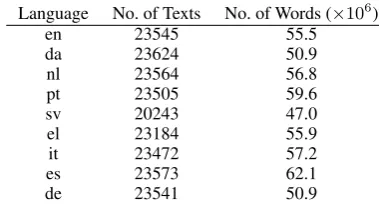
Language No. of Texts No. of Words (×106
Table 1: The number of texts and words for each language considered in the JRC-Acquis corpus.
Language Corpus Size Voc. Size JRC-Acquis Europarl
en - - 14810
da 1000785 1968800 29867
nl 1132352 1997775 21316
pt 1121460 1960407 19333
sv 1061156 1862234 29403
el 792732 1235976 34992
it 1122016 1909115 19310
es 1117322 1965734 18496
de 1136452 1920209 29860
Table 2: Corpus size (number of tokens) for each language, with English as the source language. The vocabulary size for a 1M word sample from JRC-Acquis for each language is also shown.
European languages (Steinberger et al., 2006). We thus, extract a subset of 72 language pairs. It’s worth nothing that we consider (x–y) and (y–x) to be distinct language pairs. To the best of our knowledge, JRC-Acquis is the biggest corpus pro-viding parallel data for all language pairs we con-sider. Table 1 shows some statistics about the data.
4 Features
In this section, we consider factors that influence the choice of source language. We divide the fea-tures into two categories: monolingual features
which exploit only monolingual data, and bilin-gual featureswhich exploit parallel data.
4.1 Monolingual features
million word sample from JRC-Acquis (although any monolingual corpus could be used).
Language relatedness. Our nine languages be-long to three language families: Germanic (En-glish, Danish, Dutch, Swedish, German); Ro-mance (Portuguese, Italian, Spanish), and Baltic (Greek). Duong et al. (2013) note that their tagger performs better on Germanic languages than that of Das and Petrov (2011), which might be because this is the same family as the source language used (English). Thus, language relatedness is an impor-tant factor to consider.
We quantify language relatedness using lexi-costatistics on the Swadesh 200 Wordlist (Dyen et al., 1992). Lexicostatistics involves the judg-ment of a linguist about whether a given pair of words are cognates. The relatedness of two lan-guages is just the percentage of cognates in the wordlist. Dyen et al. provides a table showing this number for all 84 Indo-European languages. We thus, extract a subset of 36 language pairs from this list.2 Note that this measure is symmetric.
4.2 Bilingual features
Corpus size. The most obvious factor is corpus size. The more data we have, the better. We count the number of parallel sentences in the corpus. Ta-ble 2 shows the corpus size for each language pair with English as the source side.
One-to-One alignment proportion. We believe that one-to-one mappings are more meaningful for this task than many-to-one mappings. The intu-ition is that, if there is only one possible way to copy a tag from the source language to the tar-get language, we can be more confident about the mapping. The proportion of 1–1 mappings is cal-culated using a fixed number of parallel sentences (800k sentences) for all language pairs.
Sentence alignment score. Sentence alignment scores are provided by the aligner for IBM Model 3. Duong et al. (2013) used these scores to rank sentences in building their tagger, show-ing this to be effective in choosshow-ing high quality sentences. Higher alignment scores might there-fore correspond to a more accurate tagger. We use the average sentence alignment score for each lan-guage pair as a feature.
Lexical translation entropy. We adopt the idea of translation model entropy from Koehn et al.
2This estimate of language relatedness is not based on
par-allel text, and is therefore considered a monolingual feature.
(2009). However, instead of scanning all pos-sible sentence segmentations and calculating the phrase-based entropy, we use a simpler method based on the lexical translation table. That is, the entropy for each lexical entry is calculated as
H(s) =−X
t∈T
p(t|s)×log2p(t|s)
whereT is the set of possible translations of word
s, and t is a translation. For each language, we pick a fixed amount of text (1 million words) and calculate the average entropy for all words.
5 Build taggers
In this section we construct 72 taggers, using par-allel data for 72 language pairs, and then eval-uate the performance of each pair. We use an open source unsupervised cross-lingual POS tag-ger (UMPOS) from Duong et al. (2013), a state-of-the-art system. UMPOS employs the consen-sus 12 Universal Tagset (Petrov et al., 2012),3 to avoid the problem of transliterating between dif-ferent tagsets for difdif-ferent languages, and to en-able comparison across languages.
The input for UMPOS is a tagger for the source language, T agger(s), along with parallel data
(s–t). The source language s is tagged using
T agger(s), and then the tagged labels are
pro-jected to the target language t. Sentences are then ranked, and a seed model tagger T0 is built
on just the high scoring sentences. By applying self-training with revision, a series of new models
T1, T2, . . . , Tm is constructed whereTi is the
tag-ger afteriiterations. The target language tagger,
T agger(t), is then the last model,Tm.
T agger(s)is trained from manually annotated
data Data(s) which is mainly derived from the
CoNLL 2006 and CoNLL 2007 Shared Tasks. Us-ing the matchUs-ing provided by Petrov et al., we map the individual tagsets to the Universal Tagset. We train a supervised POS taggerT agger(s) on the annotated data using the TNT tagger (Brants, 2000). Table 3 shows the source and size of anno-tated data, and the 5 fold cross-validation accuracy
ofT agger(s), for each language.
We evaluate eachT agger(t)usingData(t); re-sults are shown in Table 4. The average tagger
per-3
Target language
en da nl pt sv el it es de Average
Source
language
en - 76.17 72.97 79.57 73.83 50.38 72.20 75.37 73.95 71.81 da 55.73 - 53.28 50.53 66.08 34.13 46.03 50.34 53.90 51.25 nl 75.70 76.31 - 78.92 70.24 54.22 70.49 76.90 79.47 72.78 pt 72.40 69.49 63.07 - 66.67 61.82 74.23 80.50 64.70 69.11 sv 66.56 75.82 61.20 65.51 - 52.74 58.93 63.88 64.48 63.64 el 47.67 49.50 49.75 57.11 46.64 - 47.33 62.29 55.16 51.93 it 74.50 71.60 68.19 84.50 67.92 47.33 - 81.80 68.28 70.52 es 68.76 68.83 66.34 80.72 68.83 62.29 74.07 - 70.36 70.03 de 72.24 74.48 76.54 70.87 66.56 55.16 56.98 70.84 - 67.96 Baseline 30.28 23.27 24.28 24.53 26.35 24.00 25.09 21.98 26.50 25.14
Table 4: Percentage accuracy for the tagger for each source–target language pair. The best tagger for each target language is shown in bold.
Language Source No. of Words % accuracy
en WSJ/PennTB 1289k 96.74
da DDT/CoNLL06 94k 96.20
nl Alpino/CoNLL06 203k 96.42
pt Floresta/CoNLL06 206k 96.38
sv Talbanken/CoNLL06 191k 93.95
el GDT/CoNLL07 65k 97.68
it ISST/CoNLL07 76k 94.48
es Cast3LB/CoNLL06 89k 95.36
de Tiger/CoNLL06 712k 97.79
Table 3: Source and size of annotated data for each language. The accuracy of each source language tagger is also shown.
formance for each source language is also given. It turns out that choosing Dutch instead of English as the source language gives the best average accu-racy. The tagger performance on each target lan-guage is much better than the baseline that always picks the most frequent tag for each word.
The Greek tagger performs poorly. From Ta-ble 2, Greek is the most morphologically complex language in this set, and has the smallest corpus size, two factors which partially explain why tag-ger performance for Greek is low whether Greek occupies either the source or target language role. From Table 4, it seems that taggers perform bet-ter if the source and target language are in the same language family. For example, the top four source languages for Danish are Dutch, English, Swedish, and German, and the top two source languages for Portuguese are Italian and Spanish. This confirms the intuition in adding language re-latedness features in section 4.
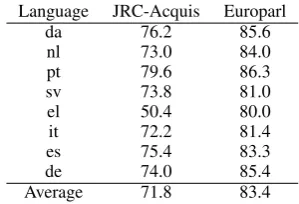
Duong et al. (2013) used English as the source language to build taggers for the same eight other languages. The only difference between these two experiments is that Duong et al. used Europarl (Koehn, 2005) data instead of JRC-Acquis. Ta-ble 2 also compares the size of parallel data with
Language JRC-Acquis Europarl
da 76.2 85.6
nl 73.0 84.0
pt 79.6 86.3
sv 73.8 81.0
el 50.4 80.0
it 72.2 81.4
es 75.4 83.3
de 74.0 85.4
Average 71.8 83.4
Table 5: Accuracy on JRC-Acquis and Europarl using English as the source language.
English as the source language for JRC-Acquis and Europarl. Given that Europarl is larger, higher performance is expected. Table 5 compares the tagger accuracy for each target language using En-glish as the source language, for the two datasets. As expected, the accuracies are higher for Eu-roparl. However, there is a strong correlation be-tween the results for the two experiments (Pear-son’s r = 0.7). This suggests that, if we had as much data as Europarl for every language pair (not just English), we would expect all numbers in Ta-ble 4 to improve substantially (not only the first row where English is the source language).
6 Source language selection
In this section, using features defined in section 4 and tagger performance in Table 4, we build a model that can predict the performance of the tar-get language tagger given a source language.
6.1 Individual feature correlation
Table 6 shows the Pearson’s correlation (r) and co-efficient of determination (r2) of each feature with tagger accuracy.
Features r r2
Source vocabulary size -0.613 0.376 Target vocabulary size -0.202 0.041 Language relatedness 0.497 0.247
Corpus size 0.620 0.385
One-to-one alignment proportion 0.745 0.556 Sentence alignment score 0.492 0.242 Lexical translation entropy -0.590 0.348
Table 6: Pearson’srandr2for each feature.
has a negative correlation, as expected, because lower entropy leads to a better alignment and therefore better tagger performance. The source language vocabulary size is highly negatively cor-related, but that strong relationship is not found for the target language. This suggests that the model is not affected much by the target language, but prefers a morphologically simple source language. Corpus size also has a high positive correlation, confirming the intuition that more data is better. This strong relationship, together with the negative correlation for morphological complexity, consol-idates the explanation above about the poor perfor-mance of the tagger for Greek, where the availabil-ity of data is very limited, and where Greek has the richest morphology of any language considered.
6.2 Building a predictive model
In this experiment we build a model to predict the performance of a target language tagger given a source language. We fit all features into a multiple linear regression model. The r2 value improved greatly to 0.74, compared to 0.556 for one-to-one alignment proportion, the best individual feature.
We evaluate our model in a leave-one-out cross validation experiment. To build a predictive model for language t, we remove data in Table 4 asso-ciated withtand train the multiple linear regres-sion modelmodel(t) on the remaining data. So, given source language s and (s–t) parallel data,
model(t)outputs the predicted performance of the
tagger trained on (s–t) parallel data. The correla-tion of the predicted value with the original value (Table 4) is very high (r= 0.81).
We also build another predictive model based solely on monolingual features (morphology com-plexity and language relatedness). The intuition here is that, if we want to build a tagger for a tar-get language, but only have monolingual data for that language, what parallel data would we want to collect first? This monolingual model also shows a high correlation with the original table (r= 0.74). If we only use language relatedness, the
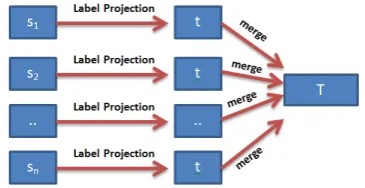
correla-Figure 1: Combining multiple source languages to produce a single file.
tion is very weak (r = 0.13), showing that lan-guage relatedness on its own is not effective at pre-dicting the best source language.
The predicted best source language for each tar-get language is the language predicted to produce the highest accuracy tagger. Table 7 shows the source language prediction from models exploit-ing all features, and only monolexploit-ingual features. The Fixed model always chooses Dutch (nl) as the source language, because Dutch gives the highest average accuracy (Table 4). The Oracle model al-ways picks the best language, and gives the up-perbound for the predictive model as a point of comparison. As expected, the model exploiting all features achieves a higher average accuracy than the monolingual model, which nevertheless still outperforms Fixed (although there is some varia-tion for individual languages). With respect to the Oracle upperbound, and Fixed baseline, the error rate reduction for the monolingual and all features models is 10.9% and 52.3%, respectively, showing the effectiveness of using a predictive model.
7 Multiple Source Languages
In this section, we combine information from mul-tiple source languages to build a single target lan-guage tagger. We take a simple approach to doing so, as shown in Figure 1. Eachsi is a tagged
cor-pus for source languagei. POS tags are then pro-jected to the target language side t for each cor-pus. We merge all of these partially-tagged target language corpora (in which unaligned words are untagged) to form T.4 We build the target
lan-4
Target language All features Monolingual features Fixed Oracle
en pt (72.40) nl (75.70) nl (75.70) nl (75.70)
da sv (75.82) en (76.17) nl (76.31) nl (76.31)
nl en (72.97) en (72.97) - de (76.54)
pt it (84.50) es (80.72) nl (78.92 ) it (84.50) sv en (73.83) en (73.83) nl (70.24) en (73.83) el es (62.29) en (50.38) nl (54.22) es (62.29) it pt (74.23) es (74.07) nl (70.49) pt (74.23) es pt (80.50) pt (80.50) nl (76.90) it (81.80)
de en (73.95) en (73.95) nl (79.47) nl (79.47)
Average 74.50 73.14 72.78 76.07
Table 7: Best source language prediction (and % accuracy of the corresponding tagger) for models exploiting all features, only monolingual features, and a fixed source language, as well as an oracle model that always picks the best language. The best (non-oracle) source language and accuracy for each target language is shown in bold.
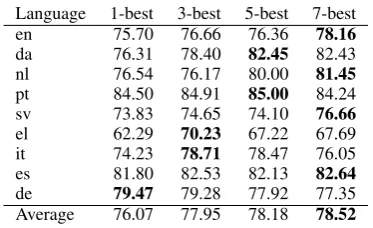
Language 1-best 3-best 5-best 7-best
en 75.70 76.66 76.36 78.16
da 76.31 78.40 82.45 82.43
nl 76.54 76.17 80.00 81.45
pt 84.50 84.91 85.00 84.24
sv 73.83 74.65 74.10 76.66
el 62.29 70.23 67.22 67.69
it 74.23 78.71 78.47 76.05
es 81.80 82.53 82.13 82.64
de 79.47 79.28 77.92 77.35 Average 76.07 77.95 78.18 78.52
Table 8: Tagger accuracy when combining the 1-, 3-, 5-, and 7-best source languages. The best sys-tem for each target language is shown in bold.
guage tagger fromT by adapting the method from Section 5. The typical steps for this method are (1) tag the source language, (2) project labels from the source to target language, (3) build the seed model, and (4) apply self-training with revision to produce the final model. Here we simply start from step (3) and build the seed model fromT.
In these experiments we assume that when building a tagger for a target language we have ac-cess to all other source languages. Table 8 shows accuracy when combining information from the 1-, 3-, 5-, and 7-best source languages, as deter-mined by an oracle. As more source languages are added, average accuracy increases, demonstrating that the method of Duong et al. (2013) can be substantially improved by combining information from multiple source languages. Having estab-lished this, in future work we will consider us-ing the best languages as identified by the various feature sets. Moreover, for individual target lan-guages, the best accuracy is not always achieved using the most source languages, suggesting that further work could be done to identify the best set of source languages. There is also a trade-off
be-tween accuracy and efficiency; taggers built from more source languages are generally slower.
8 Conclusions
In this paper, we have investigated the problem of choosing the best source language(s) to use in un-supervised cross-lingual POS tagging based on tag projection in parallel corpora. We have shown that our predictive model can select a source language – based on only monolingual features of the source and target languages – that improves tagger accu-racy compared to choosing the single, best-overall source language. However, if parallel data is avail-able, our predictive model is able to leverage this to select a more appropriate source language and obtain further improvements in accuracy. Finally, we showed that if multiple source languages are available, even better accuracy can be obtained by combining information from them.
Based on these findings, a synopsis for build-ing a tagger for a resource-poor target languaget
is as follows: (1) if parallel data fortis unavail-able, use monolingual features to predict the best source languagesand collect (s–t) parallel data; (2) if there are multiple parallel corpora fort, and there is sufficient time, combine all the corpora to produce a tagger with the best expected accuracy; (3) if time is limited, use all features to identify the
n-best source languages.
9 Acknowledgements
This work is funded by Erasmus Mundus European Masters Program in Language and Communication Technologies (EM-LCT) and by the Czech Science Foundation (grant no. P103/12/G084).
References
Thorsten Brants. 2000. TnT – A statistical part-of-speech tagger. InProceedings of the Sixth Con-ference on Applied Natural Language Process-ing (ANLP ’00), pages 224–231. Seattle, Wash-ington, USA.
Dipanjan Das and Slav Petrov. 2011. Unsu-pervised part-of-speech tagging with bilingual graph-based projections. In Proceedings of the 49th Annual Meeting of the Association for Computational Linguistics: Human Language Technologies, pages 600–609. Portland, Ore-gon, USA.
Long Duong, Paul Cook, Steven Bird, and Pavel Pecina. 2013. Simpler unsupervised POS tag-ging with bilingual projections. InProceedings of the 51st Annual Meeting of the Association for Computational Linguistics (Volume 2: Short Papers), pages 634–639. Sofia, Bulgaria. Isidore Dyen, Joseph B. Kruskal, and Paul Black.
1992. An Indoeuropean classification: A lexicostatistical experiment. Transactions of the American Philosophical Society, 82(5):iii– iv+1–132.
Jiri Hana, Anna Feldman, and Chris Brew. 2004. A resource-light approach to Russian morphol-ogy: Tagging Russian using Czech resources. InProceedings of the 2004 Conference on Em-pirical Methods in Natural Language Process-ing (EMNLP ’04), pages 222–229. Barcelona, Spain.
Philipp Koehn. 2005. Europarl: A Parallel Corpus for Statistical Machine Translation. In Proceed-ings of the Tenth Machine Translation Summit (MT Summit X), pages 79–86. Phuket, Thailand.
Philipp Koehn, Alexandra Birch, and Ralf Stein-berger. 2009. 462 machine translation systems for Europe. InProceedings of the Twelfth Ma-chine Translation Summit (MT Summit XII). Ot-tawa, Canada.
Slav Petrov, Dipanjan Das, and Ryan McDonald. 2012. A universal part-of-speech tagset. In
Pro-ceedings of the Eighth International Conference on Language Resources and Evaluation (LREC 2012), pages 2089–2096. Istanbul, Turkey.
Siva Reddy and Serge Sharoff. 2011. Cross lan-guage POS taggers (and other tools) for Indian languages: An experiment with Kannada using Telugu resources. In Proceedings of the Fifth International Workshop on Cross Lingual Infor-mation Access (CLIA 2011). Chiang Mai, Thai-land.
Benjamin Snyder, Tahira Naseem, Jacob Eisen-stein, and Regina Barzilay. 2008. Unsuper-vised multilingual learning for POS tagging. In
Proceedings of the 2008 Conference on Em-pirical Methods in Natural Language Process-ing (EMNLP ’08), pages 1041–1050. Honolulu, Hawaii.