Weakly supervised supertagging with grammar-informed initialization
Jason Baldridge Department of Linguistics The University of Texas at Austin [email protected]
Abstract
Much previous work has investigated weak supervision with HMMs and tag dictionar-ies for part-of-speech tagging, but there have been no similar investigations for the harder problem of supertagging. Here, I show that weak supervision for supertag-ging does work, but that it is subject to severe performance degradation when the tag dictionary is highly ambiguous. I show that lexical category complexity and infor-mation about how supertags may combine syntactically can be used to initialize the transition distributions of a first-order Hid-den Markov Model for weakly supervised learning. This initialization proves more effective than starting with uniform tran-sitions, especially when the tag dictionary is highly ambiguous.
1 Introduction
Supertagging involves assigning words lexical en-tries based on a lexicalized grammatical theory, such as Combinatory Categorial Grammar (CCG) (Steedman, 2000) Tree-adjoining Grammar (Joshi, 1988), or Head-driven Phrase Structure Grammar (Pollard and Sag, 1994). Supertag sets are larger than part-of-speech (POS) tag sets and their ele-ments are generally far more articulated. For ex-ample, the English verbjoinhas the POSVBand the CCG category ((Sb\NP)/PP)/NP in CCG-bank (Hockenmaier and Steedman, 2007). This category indicates thatjoinrequires a noun phrase
c
2008. Licensed under the Creative Commons Attribution-Noncommercial-Share Alike 3.0 Unported li-cense (http://creativecommons.org/licenses/by-nc-sa/3.0/). Some rights reserved.
to its left, another to its right, and a prepositional phrase to the right of that.
Supertags convey such detailed syntactic sub-categorization information that supertag disam-biguation is referred to asalmost parsing (Banga-lore and Joshi, 1999). Standard sequence predic-tion models are highly effective for supertagging, including Hidden Markov Models (Bangalore and Joshi, 1999; Nielsen, 2002), Maximum Entropy Markov Models (Clark, 2002; Hockenmaier et al., 2004; Clark and Curran, 2007), and Conditional Random Fields (Blunsom and Baldwin, 2006). The original motivation for supertags–parse pre-filtering for lexicalized grammars–of Bangalore and Joshi (1999) has been realized to good effect: the supertagger of Clark and Curran (2007) pro-vides stagedn-best lists of multi-tags that dramat-ically improve parsing speed and coverage without much loss in accuracy. Espinosa et al. (2008) have shown that hypertagging (predicting the supertag associated with a logical form) can improve both speed and accuracy of wide-coverage sentence re-alization with CCG. Supertags have gained fur-ther relevance as they are increasingly used as fea-tures for other tasks, including machine translation (Birch et al., 2007; Hassan et al., 2007).
Supertaggers typically rely on a significant amount of carefully annotated sentences. As with many problems, there is pressing need to find strategies for reducing the amount of supervision required for producing accurate supertaggers, but as yet, no one has explored the use of weak super-vision for the task. In particular, there are many di-alog systems which rely on hand-crafted lexicons that both provide a starting point for bootstrapping a supertagger and which could benefit greatly from supertag pre-parse filter. For example, the dialog system used by Kruijff et al. (2007) uses a
crafted CCG grammar for OpenCCG (White and Baldridge, 2003). It is important to stress that there are many such uses of CCG and related frame-works which donotrely on first annotating (even a small number of) sentences in a corpus: these de-fine a lexicon that maps from words to categories (supertags) for a particular domain/application.
This scenario is a natural fit for learning taggers from tag dictionaries using hidden Markov mod-els with Expectation-Maximization (EM). Here, I investigate such weakly supervised learning for supertagging and demonstrate the importance of proper initialization of the tag transition distribu-tions of the HMM. In particular, such initializa-tion can be done using inherent properties of the CCG formalism itself regarding how categories1
may combine. Informed initialization should help with supertagging for two reasons. First, cate-gories have structure–lacking in POS tags–waiting to be exploited. For example, it is far more likely
a priorito see the category sequence(S\NP)/NP NP/Nthan the sequenceS/S NP\NP. Given the categories for a word, this information can be used to influence our expectations about categories for adjacent words. Second, this kind of information truly matters for the task: a key aspect of supertag-ging that differentiates it from POS tagsupertag-ging is that the contextual information is much more important for the former. Lexical probabilities handle most of the ambiguity for POS tagging, but supertags areinherentlyabout context and, furthermore, lex-ical ambiguity is much greater for supertagging, making lexical probabilities less effective.
I start by defining a distribution over lexical categories and then use this distribution as part of creating a CCG-informed transition distribution that appropriately breaks the symmetry of uniform HMM initialization. After describing how these components are included in the HMM, I describe experiments with CCGbank varying the ambiguity of the lexicon provided. I show that using knowl-edge about the formalism consistently improves performance, and is especially important as cate-gorial ambiguity increases.
2 Lexical category distribution
The categories of CCG are an inductively defined set containing elements that are either atomic ele-ments or (curried) functions specifying the
canon-1For the rest of the paper, I will refer tocategoriesrather
supertags, but will still refer to the task as supertagging.
ical linear direction in which they seek their argu-ments. Some example entries from CCGbank are:
the:=NPnb/N
of := (NP\NP)/NP
of := ((S\NP)\(S\NP)/NP were:= (Sdcl\NP)/(Spss\NP)
buy:= (Sdcl\NP)/NP
buy:= ((((Sb\NP)/PP)/PP)/(Sadj\NP))/NP Words can be associated with multiple categories; the distribution over these categories is typically quite skewed. For example, the first entry forbuy
occurs 33 times in CCGbank, compared with just once for the second. That the simpler category is more prevalent is unsurprising: a general strategy when creating CCG lexicons is to use simpler cate-gories whenever possible. This points to the possi-bility of defining distributions over CCG lexicons based on measures of the complexity of categories. I use a simple distribution here: given a lexiconL, the probability of a categoryiis inversely propor-tional to its complexity:
Λi=
1 complexity(ci) P
j∈Lcomplexity(cj)1
(1)
Here, a very simple complexity measure is assumed: the number of subcategories (to-kens) contained in a category.2 For example,
((S\NP)\(S\NP)/NPcontains 9: S (twice), NP
(thrice), S\NP (twice), (S\NP)\(S\NP), and
((S\NP)\(S\NP)/NP.
The tag transition distribution defined in the next section uses Λ to bias transitions toward simpler categories, e.g., preferring the first category for
buy over the second. Performance when usingΛ
is compared to using a uniform distribution. Other distributions could be given, e.g., one which gives more mass to adjunct categories such as (S\NP)\(S\NP) than to ones which are oth-erwise similar but do not display such symmetry, like(S/NP)\(NP\S). However, the most impor-tant thing for present purposes is that simpler cate-gories are more likely than more complex ones.
This distribution imposes no internal struc-ture on the likelihood of a lexicon. As far as Λ is concerned, lexicons can as well have the category(S\NP)\NP for transitive verbs and
((S/NP)/NP)/NP for ditransitive verbs, even though this is a highly unlikely pattern since we
2This worked better than using category arity or number
Vinken will join the board as non−executive director
S/(S\NP) (S\NP)/(S\NP) ((S\NP)/PP)/NP NP/N N PP/NP NP/N N
> >
NP NP
> >
(S\NP)/PP PP
> S\NP
> S\NP
[image:3.595.69.485.68.158.2]> S
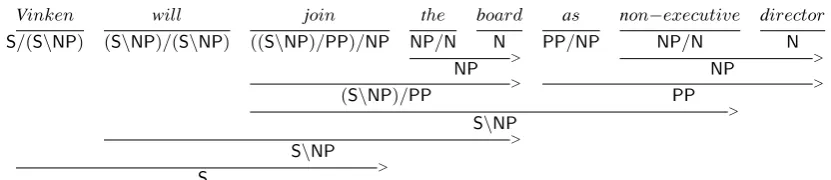
Figure 1: Normal form CCG derivation, using only application rules.
would expect both types of verbs to seek their ar-guments in the same direction. Languages also tend to prefer lexicons with one or the other slash direction predominating (Villavicencio, 2002). In the future, it would be interesting to consider Bayesian approaches that could encode more com-plex structure and assign priors over distributions over lexicons, building on these observations.
An aspect of CCGbank that relevant for Λi is that some categories actually are not true cate-gories. For example, many punctuation “cate-gories” are given as LRB, ., :, etc. In most grammars, the category of ‘.’ is usually assumed to be S\S. The grammatical behavior of such pseudo-categories is handled via special rules in the parsers of Hockenmaier and Steedman (2007) and Clark and Curran (2007). I relabeled three of these: ,toNP\NP,.toS\Sand;to(S\S)/S. A single best change was not clear for others such as
LRBand:, so they were left as is.
3 Category transition distribution
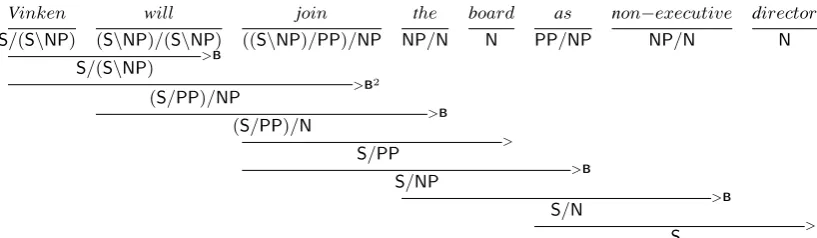
CCG analyses of sentences are built up from lex-ical categories combining to form derived cate-gories, until an entire sentence is reduced to a sin-gle derived category with corresponding depen-dencies. One of CCG’s most interesting linguis-tic properties is it allows alternative constituents. Consider the derivations in Figures 1 and 2, which show a normal form derivation (Eisner, 1996) and fully incremental derivation, respectively. Both produce the same dependencies, guaranteed by the semantic consistency of CCG’s rules (Steedman, 2000). This property of CCG of supporting mul-tiple derivations of the same analysis has been termed spurious ambiguity. However, the extra constituents are anything but spurious: they are implicated in a range of CCG (along with other forms of categorial grammar) linguistic analyses, including coordination, long-distance extraction, intonation, and incremental processing.
This all boils down to associativity: just as
(1 + (4 + 2)) = ((1 + 4) + 2) = 7, CCG ensures that (Ed·(saw·Ted)) = ((Ed·saw)·Ted) = S Such multiple derivations arise when adjacent categories can combine through either application or compo-sition. Thus, we would expect that the lexical cat-egories needed to analyze an entire sentence will more often than not be able to combine with their immediate neighbors. For example, six of seven pairs of adjacent lexical categories in the sentence in Figure 1 can combine. OnlyN PP/NPofboard ascannot.3
This observation can be used in different ways by different models for CCG supertagging. For example, discriminative tagging models could in-clude features that capture whether or not the cur-rent supertag can combine with the previous one and possibly via which CCG rule. Here, I show how it can be used to provide a non-uniform start-ing point for the transition distributions θj|i in a first-order Hidden Markov Model. This is similar to how Grenager et al. (2005) use diagonal initial-ization in an HMM for field segmentation to en-courage the model to remain in the same state (and thus predict the same label for adjacent words). For CCG supertagging, the initialization should discourage diagonalization and establish a prefer-ence for some transitions over others.
There are many ways to define such a starting point. The simplest would be to reserve a small part of the mass spread uniformly over category pairs which cannot combine and then spread the rest of the mass uniformly over those which can. However, we can provide a more refined distri-bution,Ψj|i, by incorporating the lexical category distribution Λi defined in the previous section to weight these transitions according to this further information. In a similar manner to Grenager et al. (2005), I defineΨas follows:
3I make the standard assumption that type-raising is
Vinken will join the board as non−executive director
S/(S\NP) (S\NP)/(S\NP) ((S\NP)/PP)/NP NP/N N PP/NP NP/N N >B
S/(S\NP)
>B2
(S/PP)/NP
>B (S/PP)/N
> S/PP
>B
S/NP
>B
S/N
[image:4.595.73.482.69.188.2]> S
Figure 2: Incremental CCG derivation, using both application and composition (B) rules.
Ψj|i= (1−σ)Λj +σ×κ(i, j)×P Λj k∈L|κ(i,k)Λk
(2) whereκ(i, j) is an indicator function that returns
1if categoriesci andcj can combine whenci im-mediately precedescj,σis a global parameter that specifying the total probability of transitions that are combinable fromi. Eachj receives a propor-tion ofσ according to its lexical prior probability over the sum of the lexical prior probabilities for all categories that combine withi. For the experi-ments in this paper,σwas set to.95. For the mod-els referred to asΨU andΨU-EM in section 5, the uniform lexical probability1/|C|is used forΛi.
For κ(i, j), I use the standard rules assumed for CCGbank parsers: forward and backward application (>, <), order-preserving com-position (>B, <B), and backward crossed composition (<B×) for S-rooted categories. Thus, κ(NP,S\NP)=1, κ(S/NP,NP/N)=1,
κ((S\NP)/NP,(S\NP)\(S\NP))=1 and
κ(S/NP,NP\NP)=0. For application, left-ward and rightleft-ward arguments are handled separately by assuming that it would be possi-ble to consume all preceding arguments of the first category and all following arguments of the second. So, κ((S/NP)\S,NP/N)=1 and
κ(NP,(S\NP)/NP)=1. Unification on categories is standard (so κ(NP[nb],S\NP)=1), except that
Nunifies with NP only whenNis the argument:
κ(N,S\NP)=1, but κ(NP/N,NP)=0. This is to deal with the fact that CCGbank represents many words with N (e.g., Mr.|N/N Vinken|N is|(S[dcl]\NP)/NP) and assumes that a parser will include the unary type changing ruleN→NP.
The HMM also has initial and final probabili-ties; distributions can be defined based on which categories are likely to start or end a sentence. For
this, I assume only that categories which seek ar-guments to the left (e.g., S\NP) are less likely at the beginning of a sentence and those which seek rightward arguments are less likely at the end. The initializations for these are defined similarly to the transition distribution, substituting functions
noLeftArgs(i)andnoRightArgs(i)forκ(i, j). 4 Model
A first-order Hidden Markov Model (bitag HMM) is used for bootstrapping a supertagger from a lex-icon. See Rabiner (1989) for an extensive intro-duction to and discussion of HMMs. There are several reasons why this is an attractive tagging model here. First, though extra context in the form of tritag transition distributions or other tech-niques can improve supervised POS tagging accu-racy, the accuracy of bitag HMMs is not far behind. The goal here is to investigate the relative gains of using CCG-based information in weakly super-vised HMM learning. Second, the expectation-maximization algorithm for bitag HMMs is effi-cient and has been shown to be quite effective for acquiring accurate POS taggers given only a lex-icon (tag dictionary) and certain favorable condi-tions (Banko and Moore, 2004). Third, the model’s simplicity makes it straightforward to test the idea of CCG-initialization on tag transitions.
Dirichlet priors can be used to bias HMMs to-ward more skewed distributions (Goldwater and Griffiths, 2007; Johnson, 2007), which is espe-cially useful in the weakly supervised setting con-sidered here. Following Johnson (2007), I use vari-ational Bayes EM (Beal, 2003) during the M-step for the transition distribution:
θl+1
j|i = f(fE([Eni[] +ni,j|C| ×] +αiα)i) (3)
ψ(v) =
(
g(v− 12) ifv >7 ψ(v+ 1)−1
v o.w.
(5)
g(x) ≈ log(x) +241x2 −9607x4
+806431x6 − 30720127x8 (6)
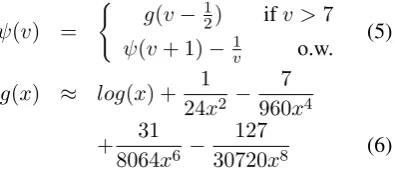
whereVis the set of word types,φis thedigamma
function (which is approximated by g), and αi is the hyperparameter of the Dirichlet priors. In all experiments, theαi parameters were set symmet-rically to.005.
For experiments using the transition priorΨj|i, the initial expectations of the model were set as
E[ni,j] = |Ei| ×Ψj|i andE[ni] = |Ei|, whereEi is the set of emissions for category ci. The uni-form probability 1
|C| was used in place ofΨj|i for standard HMM initialization.
The emission distributions use standard EM ex-pectations with more mass reserved for unknowns for tags with more emissions as follows:4
φl+1k|i = E[ni,k] +|Ei| ×
1
|V|
E[ni] +|Ei| (7) The Viterbi algorithm is used for decoding. 5 Experiments
CCGbank (Hockenmaier and Steedman, 2007) is a translation of phrase structure analyses of the Penn Treebank into CCG analyses. Here, I consider only the lexical category annotations and ignore derivations. The standard split used for weakly su-pervised HMM tagging experiments (Banko and Moore, 2004; Wang and Schuurmans, 2005) is used: sections 0-18 for training (train), 19-21 for development (dev), and 22-24 for testing (test). All parameters and models were developed usingdev. The test set was used only once to obtain the per-formance figures reported here.
Counts for word types, word tokens and sen-tences for each data set are given in Table 1. In
train, there are 1241 distinct categories, the am-biguity per word type is 1.69, and the maximum number of categories for a single word type is 126. This is much greater than for POS tags in CCG-bank, for which there are 48 POS tags with an
av-4I also experimented with a Dirichlet prior on the
emis-sions, but it performed worse. Using a symmetric prior was actually detrimental, while performance within a percent of those achieved with the above update was achieved with Dirichlet hyperparameters set relative to|Ei|/|V|.
Dataset Types Tokens Sentences
train 43063 893k 38,015
dev 14961 128k 5484
[image:5.595.95.293.71.156.2]test 13898 127k 5435
Table 1: Basic statistics for the datasets.
erage ambiguity of 1.17 per word and a maximum of 7 tags intrain.5
The set of supertags was not reduced: any cat-egory found in the data used to initialize a lexi-con was lexi-considered. This is one of the advan-tages of the HMM over using discriminative mod-els, where typically only supertags seen at least 10 times in the training material are utilized for effi-ciency (Clark and Curran, 2007). Ignoring some supertags makes sense when building supervised supertaggers for pre-parse filtering, but not for learning from lexicons, where we cannot assume we have such frequencies.
For supervised training with the HMM ontrain, the performance is 87.6%. This compares to 91.4% for theC&Csupertagger. The accuracy of the HMM, though quite a bit lower than that of C&C, is still quite good, indicating that it is an ad-equate model for the task. Note also that it uses only the words themselves and does not rely on POS tags. The performance of the C&C tagger was obtained by training the C&CPOS tagger on the given dataset and tagging the evaluation mate-rial with it. Finally, the HMM trains in just a few seconds as opposed to over an hour.6
Five different weakly supervised scenarios are evaluated: (1) standard EM with 50 iterations (EM), (2) Ψ initialization with uniform lexical probabilities w/o EM (ΨU), (3)Ψ with Λ proba-bilities w/o EM (ΨΛ), (4)Ψ with uniform lexical probabilities and 10 EM iterations, and (5)Ψwith
Λ and 10 EM iterations.7 These scenarios
com-pare the effectiveness of standard EM with the use of grammar informed transitions; these in turn are of two varieties – one using a uniform lexical prior or one that is biased in favor of less complex cate-gories according toΛ.
As Banko and Moore (2004) discovered when
5Note that the POS tag information is not used in these
experiments, except for by theC&Ctagger.
6It should be stressed that the goal of this paper isnotto
compete on supervised performance withC&C; instead, this comparison shows that the HMM supervised performance is reasonable and is thus relevant for bootstrapping.
7The number of iterations for standard and grammar
reimplementing several previous HMMs for POS tagging, the lexicons had been limited to contain only tags occurring above a particular frequency. For POS tagging, this keeps a cleaner lexicon that avoids errors in annotated data (such asthetagged asVB) and rare tags (such as atagged as SYM). When learning from a lexicon alone, such elements receive the same weight as their other (correct or more fundamental) tags in initializing the HMM. The problem of rare tags turns out to be very im-portant for weakly supervised CCG supertagging.8
To consider the effect of the CCG-based initial-ization for lexicons with differing ambiguity, I use tag cutoffs that remove any lexical entry containing a category that appears with a particular word less than X% of the time (Banko and Moore, 2004), as well as using no cutoffs at all. Recall that the goal of these experiments is to investigate the rela-tive difference in performance between using the grammar-based initialization or not, given some (possibly hand-crafted) lexicon. Lexicon cutoffs actually constitute a strong source of supervision because they use tag frequencies (which would not be known for a hand-crafted lexicon), so it should be stressed that they are used here only so that this relative performance can be measured for different ambiguity levels.
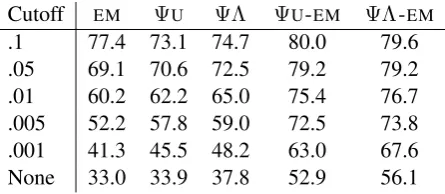
Table 2 provides accuracy forambiguouswords (and not including punctuation) for the five scenar-ios, varying the cutoff to measure the effect of pro-gressively allowing more lexical ambiguity (and much rarer categories). The number of ambiguous, non-punctuation tokens is 101,167.
The first thing to note is performance given only the lexicon and the ΨU or ΨΛ initialization of the transitions. These correspond to taggers which have only been given the lexicon and have not uti-lized any data to improve their estimates of the transition and emission probabilities. Interestingly, both do quite well with a clean lexicon: see the columns under ΨU and ΨΛ. These indicate that initializing the transitions based on whether cate-gories can combine does indeed appropriately cap-ture key aspects of category transitions. Further-more, using the lexical category distribution (ΨΛ) to create the transition initialization provides a bet-ter starting point than the uniform one (ΨU),
espe-8CCGbank actually corrects many errors in the Penn
Tree-bank, and does not suffer as much from mistagged examples. However, there were two instances of an ill-formed category
((S[b]\NP)/NP)/inwsj 0595for the wordsownandkeep. These were corrected to(S[b]\NP)/NP.
Cutoff EM ΨU ΨΛ ΨU-EM ΨΛ-EM
.1 77.4 73.1 74.7 80.0 79.6
.05 69.1 70.6 72.5 79.2 79.2
.01 60.2 62.2 65.0 75.4 76.7
.005 52.2 57.8 59.0 72.5 73.8
.001 41.3 45.5 48.2 63.0 67.6
[image:6.595.308.531.72.169.2]None 33.0 33.9 37.8 52.9 56.1
Table 2: Performance on ambiguous word types of the HMM with standard EM (uniform starting transitions), just the initialΨtransitions (ΨU and
ΨΛ), and EM initialized with ΨU and ΨΛ, for lexicons with varied cutoffs. Note also that these scores do not include punctuation.
cially as lexical ambiguity increases.
Next, note that both ΨU-EM and ΨΛ-EM beat the randomly initialized EM for all cutoff levels. For the 10% tag cutoff (the first row), there is an absolute difference of over 2% for both.9 As the
ambiguity increases, the grammar-informed ini-tialization has a much stronger effect. In the ex-treme case of using no cutoff at all (theNonerow of Table 2),ΨU-EMandΨΛ-EMbeatEMby 19.9% and 23.1%, respectively. Finally, using the lexical category distribution Λ instead of a uniform one is much more effective when there is more lexi-cal ambiguity (e.g., compare the .01 through None rows of the ΨU-EM and ΨΛ-EM columns), but has a negligible effect with less ambiguity (rows .05 and .01). This demonstrates that the grammar-based initialization can be effectively exploited – it is in fact crucial for improving performance when we are given much more ambiguous lexicons.
The majority of errors with ΨΛ-EM involve marking adjectives (N/N) as nouns (N) or vice versa, and assigning the wrong prepositional cat-egory (usually the simpler noun phrase post-modifier(NP\NP)/NPinstead of the verb phrase modifier ((S\NP)\(S\NP))/NP. Both of these kinds of errors, and others, could potentially be corrected if the categories proposed by the tagger were further filtered by an attempt to parse each sentence with the categories.
6 Related work
The idea of using knowledge from the formalism for constraining supertagging originates with
Ban-9For comparison with the performance of 87.6% for the
galore and Joshi (1999). They used constraints based on how elementary trees of Tree-Adjoining Grammar could or could not combine as filters to block out tags that do not fit in certain locations in the string. My approach is different is sev-eral ways. First, they dealt with fully supervised supertagging; here I show that using this knowl-edge is important for weakly supervised supertag-ging where we are given only a tag dictionary (lex-icon). Second, my approach encodes grammar-based cues only as an initial bias, so categories are never explicitly filtered. Finally, I use CCG rather than TAG, which makes it possible to exploit a much higher degree of associativity in derivations. This in turn makes it easier to utilize prior knowl-edge about adjacent contexts – precisely what is needed for using the grammar to influence the tran-sition probabilities of a bigram HMM.
On the other hand, Bangalore and Joshi (1999) use constraints that act at greater distances than I have considered here. For example, if one wishes to provide a word with the category
((S\NP)/PP)/NP, then there should be a word with a category which results in aPPtwo or more words to its right – this is something which the bigram transitions considered here cannot capture. An interesting way to extend the present approach would be to enforce such patterns as posterior con-straints during EM (Graca et al., 2007).
Recent work considers a damaged tag dictionary by assuming that tags are known only for words that occur more than once or twice (Toutanova and Johnson, 2007). A very interesting aspect of this work is that they explicitly model ambiguity classes to exploit commonality in the lexicon be-tween different word forms, which could be even more useful for supertagging.
In a grammar development context, it is often the case that only some of the categories for a word have been assigned. This is the scenario consid-ered by Haghighi and Klein (2006) for POS tag-ging: how to construct an accurate tagger given a set of tags and a few example words for each of those tags. They use distributional similarity of words to define features for tagging that effectively allow such prototype words to stand in for others. This idea could be used with my approach as well; the most obvious way would be to use prototype words to suggest extra categories (beyond the tag dictionary) for known words and a reduced set of categories for unknown words.
Other work aims to do truly unsupervised learn-ing of taggers, such as Goldwater and Griffiths (2007) and Johnson (2007). No tag dictionaries are assumed, and the models are parametrized with Dirichlet priors. The states of these models implic-itly represent tags; however, it actually is not clear what the states in such models truly represent: they are (probably interesting) clusters that may or may not correspond to what we normally think of as parts-of-speech. POS tags are relatively inert, pas-sive elements in a grammar, whereas CCG cate-gories are the very drivers of grammatical analy-sis. That is, syntax is projected, quite locally, by lexical categories. It would thus be interesting to consider the induction of categories with grammar-based priors with such models.
7 Conclusion
I have shown that weakly supervised learning can indeed be used to induce supertaggers from a lex-icon mapping words to their possible categories, but that the extra ambiguity in the supertagging task over that of POS tagging makes performance much more sensitive to rare categories that occur in larger, more ambiguous lexicons. However, I have also shown that the CCG formalism itself can provide the basis for useful distributions over lexi-cal categories and tag transitions in a bitag HMM. By using these distributions to initialize the HMM, it is possible to improve performance regardless of the underlying ambiguity. This is especially im-portant for reducing error when the lexicon used for bootstrapping is highly ambiguous and con-tains very rare categories.
Acknowledgments
Thanks to the UT Austin Natural Language Learn-ing group and three anonymous reviewers for use-ful comments and feedback. This work was sup-ported by NSF grant BCS-0651988 and a Faculty Research Assignment from UT Austin.
References
Bangalore, Srinivas and Aravind K. Joshi. 1999. Su-pertagging: an approach to almost parsing. Compu-tational Linguistics, 25(2):237–265.
Beal, Matthew. 2003. Variational Algorithms for Ap-proximate Inference. Ph.D. thesis, University of Cambridge.
Birch, Alexandra, Miles Osborne, and Philipp Koehn. 2007. CCG supertags in factored statistical machine translation. InProceedings of the 2nd Workshop on Statistical Machine Translation.
Blunsom, Phil and Timothy Baldwin. 2006. Multi-lingual deep lexical acquisition for HPSGs via su-pertagging. In Proceedings of EMNLP 06, pages 164–171.
Clark, Stephen and James Curran. 2007. Wide-coverage efficient statistical parsing with CCG and log-linear models. Computational Linguistics, 33(4).
Clark, Stephen. 2002. Supertagging for combina-tory categorial grammar. InProceedings of TAG+6, pages 19–24, Venice, Italy.
Eisner, Jason. 1996. Efficient normal-form parsing for combinatory categorial grammars. InProceedings of the 35th ACL.
Espinosa, Dominic, Michael White, and Dennis Mehay. 2008. Hypertagging: Supertagging for surface real-ization with CCG. InProceedings of ACL-08: HLT, pages 183–191, Columbus, Ohio, June.
Goldwater, Sharon and Tom Griffiths. 2007. A fully Bayesian approach to unsupervised part-of-speech tagging. InProceedings of the 45th ACL.
Graca, Joao, Kuzman Ganchev, and Ben Taskar. 2007. Expectation maximization, posterior constraints, and statistical alignment. InProceedings of NIPS07. Grenager, Trond, Dan Klein, and Christopher D.
Man-ning. 2005. Unsupervised learning of field segmen-tation models for information extraction. In Pro-ceedings of the 43rd ACL, pages 371–378.
Haghighi, Aria and Dan Klein. 2006. Prototype-driven learning for sequence models. In Proceedings of HLT-NAACL 2006.
Hassan, Hany, Khalil Sima’an, and Andy Way. 2007. Supertagged phrase-based statistical machine trans-lation. InProceedings of the 45th ACL.
Hockenmaier, Julia and Mark Steedman. 2007. CCG-bank: A corpus of CCG derivations and dependency structures extracted from the Penn Treebank. Com-putational Linguistics, 33(3):355–396.
Hockenmaier, Julia, Gann Bierner, and Jason Baldridge. 2004. Extending the coverage of a CCG system. Research in Language and Computa-tion, 2:165–208.
Johnson, Mark. 2007. Why doesn’t EM find good HMM POS-taggers? InProceedings of the EMNLP-CoNLL 2007.
Joshi, Aravind. 1988. Tree Adjoining Grammars. In Dowty, David, Lauri Karttunen, and Arnold Zwicky, editors,Natural Language Parsing, pages 206–250. Cambridge University Press, Cambridge.
Kruijff, Geert-Jan M., Hendrik Zender, Patric Jensfelt, and Henrik I. Christensen. 2007. Situated dialogue and spacial organization: What, where,...and why?
International Journal of Advanced Robotic Systems, 4(1):125–138.
Nielsen, Leif. 2002. Supertagging with combinatory categorial grammar. InProceedings of the Seventh ESSLLI Student Session, pages 209–220.
Pollard, Carl and Ivan Sag. 1994. Head Driven Phrase Structure Grammar. CSLI/Chicago Univer-sity Press, Chicago.
Rabiner, Lawrence. 1989. A tutorial on Hidden Markov Models and selected applications in speech recognition. Proceedings of the IEEE, 77(2):257– 286.
Steedman, Mark. 2000. The Syntactic Process. The MIT Press, Cambridge Mass.
Toutanova, Kristina and Mark Johnson. 2007. A Bayesian LDA-based model for semi-supervised part-of-speech tagging. InProceedings of NIPS 20. Villavicencio, Aline. 2002. The Acquisition of
a Unification-Based Generalised Categorial Gram-mar. Ph.D. thesis, University of Cambridge. Wang, Qin Iris and Dal Schuurmans. 2005. Improved
estimation for unsupervised part-of-speech tagging. In EEE International Conference on Natural Lan-guage Processing and Knowledge Engineering. White, Michael and Jason Baldridge. 2003. Adapting