Sentence Type Based Reordering Model for Statistical Machine
Translation
Jiajun Zhang, Chengqing Zong, Shoushan Li
National Laboratory of Pattern Recognition
Institute of Automation, Chinese Academy of Sciences, Beijing 100190, China
{jjzhang, cqzong, sshanli}@nlpr.ia.ac.cn
Abstract
Many reordering approaches have been proposed for the statistical machine translation (SMT) system. However, the information about the type of source sentence is ignored in the previous works. In this paper, we propose a group of novel reordering models based on the source sentence type for Chinese-to-English translation. In our approach, an SVM-based classifier is employed to classify the given Chinese sentences into three types: special interrogative sen-tences, other interrogative sensen-tences, and non-question sentences. The different reordering models are developed ori-ented to the different sentence types. Our experiments show that the novel re-ordering models have obtained an im-provement of more than 2.65% in BLEU for a phrase-based spoken language translation system.
1
Introduction
The phrase-based translation approach has been the popular and widely used strategy to the sta-tistical machine translation (SMT) since Och, et al. (2002) proposed the log-linear model. How-ever, reordering is always a key issue in the de-coding process. A number of models have been developed to deal with the problem of reorder-ing. The existing reordering approaches could be divided into two categories: one is integrated into the decoder and the other is employed as a preprocessing module.
© 2008. Licensed under the Creative Commons Attribu-tion-Noncommercial-Share Alike 3.0 Unported license (http://creativecommons.org/licenses/by-nc-sa/3.0/). Some rights reserved.
Many reordering methods belong to the for-mer category. Distortion model was first em-ployed by Koehn et al. (2003); a lexicalized re-ordering model was proposed by Och et al. (2004) and Koehn et al. (2005); and the formal syntax-based reordering models were proposed by Chiang (2005) and Xiong et al. (2006). It is worthy to note that little syntactic knowledge is used in the models mentioned above.
Compared to the reordering models that are integrated into the decoder, the reordering at the source side can utilize more syntactic knowl-edge, with the goal of adjusting the source lan-guage sentence to make its word order closer to that of the target language. The most notable models are given by Xia and McCord (2004), Collins et al. (2005), Li et al. (2007) and Wang
et al. (2007). Xia and McCord (2004) parsed the source and target sides of the training data and then automatically extracted the rewriting pat-terns. The rewriting patterns are employed on the input source sentence to make the word or-der more accordant to target language. Collins et al. (2005) described an approach to reorder Ger-man in GerGer-man-to-English translation. The method concentrates on the German clauses and six types of transforming rules are applied to the parsed source sentence. However, all the rules are manually built. Li et al. (2007) used a parser to get the syntactic tree of the source language sentence. In this method, a maximum entropy model is developed to determine how probable the children of a node are to be reordered. Obvi-ously, there is also disadvantage in this method because the parsing tree is obtained by a full parser and contains too many nodes that are not involved in desired reorderings. Wang et al. (2007) discussed three categories which are con-sidered to be the most prominent candidates for reordering in Chinese-to-English translation, including verb phrases (VPs), noun phrases (NPs), and localizer phrases (LCPs). The
method deals with some special modifiers of VPs and NPs because they have the property that some specific modifiers appear before VPs or NPs in Chinese but occur after VPs or NPs in its English translation. We observe that all the transformation rules in this method are hard crafted. Furthermore, there are some other re-lated works, such as Costa-jussa and Fonollosa’s work (2006) and Zhang et al.’s work (2007). Costa-jussa and Fonollosa (2006) considered the source reordering as a translation task which translates the source sentence into reordered source sentence. A chunk-level reordering model was first proposed by Zhang et al. (2007).
However, all the existing models make no distinction between the different types of the source sentence. Intuitively, we have different reordering information in different sentence type. Taking Chinese special interrogative sentence as an example, there is a fixed phrase that usually occurs at the end of Chinese sentence but ap-pears at the beginning part of its English transla-tion. See the following Chinese to English trans-lation:
Chinese: 你想要什么样的座位? English: What kind of seats do you like ?
Obviously, the Chinese question phrase “什
么样 的 座位 (What kind of seats)” should be put at the beginning of its English translation. However, many phrase-based systems fail to do this.
In this paper, we are interested in investigat-ing the value of Chinese sentence types in reor-dering for Chinese-to-English spoken language translation. Due to the syntactic difference be-tween Chinese and English, different sentence type provides different reordering information. A phrase-ahead model is developed to exploit and utilize the reordering information of special interrogative sentences. A phrase-back model is employed to catch and make use of the reorder-ing information of other sentence types. How-ever, the sentence type should be first identified by an SVM-based classifier before reordering the source sentence. The method overall is used as a preprocessing module for translation. We will introduce our method in detail later.
The remainder of this paper is organized as follows: Section 2 introduces our motivations; Section 3 gives the details on the implementa-tion of our approach; the experiments are shown in Section 4; and the final concluding remarks are given in Section 5.
2
Our Motivations
In this section, before we analyze the Chinese-to-English spoken language translation corpus, some definitions are given first.
2.1 Definitions
z Special interrogative sentence / other inter-rogative sentence / non-question sentence Chinese sentence can be divided into question sentence and non-question sentence. If a Chi-nese question sentence is translated into the English sentence of wh-questions, the sentence is named as a Chinese special interrogative sen-tence; otherwise, it is called the Chinese other interrogative sentence. Figure 1-3 show some examples for the three sentence types respec-tively.
z SQP / TP / SP
In Chinese special interrogative sentence, the question phrase is always moved ahead while it is translated into English. Correspondingly, the question phrase is named as the special question phrase (SQP). For example, the question phrase “什么样 的 座位 (What kind of seats)” in the example mentioned above is an SQP.
A few quantifier phrases (QPs) like “多 次 (many times)”, “很多年 (many years)” in Chi-nese and some LCPs like “事故 发生 后 (after the accident happened)”, “会议结束前 (before the meeting ends)” together with some NPs like temporal phrases are named temporal phrase (TP) in our model. Some LCPs like “宾馆前 (at the front of the hotel)”, “桌子 旁 (near the ta-ble)” and a few NPs like spatial phrases are called spatial phrase (SP) in our model. As PPs1, TPs and SPs are the most prominent candidates for reordering in Chinese other interrogative sentences and non-question sentences, they will be handled in the phrase-back reordering model.
Figure 1. An example of Chinese special inter-rogative sentence with its English translation.
Figure 2. An example of Chinese other inter-rogative sentence with its English translation.
1
PPs here mean prepositional phrases 您 会 说 日语 吗 ?
Can you speak Japanese ? 你 想 要 什么样 的 座位 ?
My wallet was stolen in the subway .
Figure 3. An example of Chinese non-question sentence with its English translation.
2.2 Analysis of Corpus and Our Motivations
In order to have an overview of the distribution of the Chinese sentence types, we have made a survey based on our training set for translation, which contains about 277k Chinese and English sentence pairs. We found that about 17.2% of the sentences are special interrogative sentences, about 25.5% of sentences are other interrogative sentences and the remainders are all non-question sentences.
Each sentence type has its own reordering strategy, as demonstrated in Figures 1-3. There is a settled phrase (SQP) in Chinese special in-terrogative sentence which usually appears at the end but will be translated first in English, just as Figure 1 illustrates. For other interroga-tive sentences, some specific Chinese words like “会 、 能 、 可 以” will just be translated into “Can” or “Do” and come first in English. At present, this information is not used in our ap-proach. Figure 2 gives an example. For non-questions, the reordering candidates usually need to be moved back during translation. An example is shown in Figure 3.
According to the analysis above, it is mean-ingful to develop reordering models based on the source sentence types.
2.3 Framework
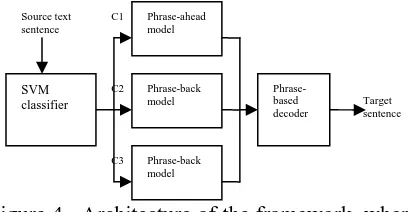
As we mentioned above, our framework is illus-trated as follows:
Figure 4. Architecture of the framework, where C1 means the special interrogative sentence, C2 is other interrogative sentence and C3 is non-question sentence.
Conventional preprocessing approaches di-vide the translation into two phases:
S→S'→T (1)
'
'
' c
S→S →S →T
c
c
S
'
S
Reordering is first done in the source side which changes the source sentence S into reor-dered one S , and then a standard phrase-based translation engine is used to translate the reor-dered source sentence S into target language sentence T.
我钱包 在地铁里被 偷了。
In our method, to utilize the information of sentence types, a new approach is proposed to improve the translation performance by devel-oping a hybrid model as follows:
(2) Before the source sentence is reordered, an SVM-based classifier is first employed to de-termine its sentence type S , then, different re-ordering model is used to reorder the source sentence with the specific sentence type . Af-ter getting the reordered source sentence , we use our phrase-based SMT to obtain the optimal target language sentence.
The contribution of this paper is embodied in the first two steps of our method.
In the first step, an SVM classifier is used to identify the type of source sentence2.
In the second step, two reordering models are built according to the different sentence types. A phrase-ahead reordering model is developed for the special interrogative sentences which uses shallow parsing technology to recognize the most prominent candidates for reordering (spe-cial question phrase) and extracts reordering templates from bilingual corpus. For other sen-tence types, we build a phrase-back reordering model which uses shallow parsing technology to identify the phrases that are almost always moved back during translation and applies maximum entropy algorithm to determine whether we should reorder them.
Source text
sentence
3
Models and Algorithms
In this section, we first introduce the sentence type classifier model, and then we describe in detail the two reordering models, phrase-ahead reordering model and phrase-back reordering model.
3.1 Sentence Type Identification
Many models are used for classification such as Naïve Bayes, decision tree and maximum en-tropy. In our approach, we use an SVM-based classifier to classify the sentence types. SVM
2
There are three sentence types: special interrogative tence, other interrogative sentence and non-question sen-tence, which are defined in sub-section 2.1.
Target sentence C1
C3 C2
Phrase-ahead model
Phrase-back model
Phrase-based decoder
SVM classifier
has been shown to be highly effective at tradi-tional text categorization. For our problem, we regard a sentence as a text. The decision bound-ary in SVM is a hyperplane, represented by vec-tor , which separates the two classes, leaving the largest margin between the vectors of the two classes (Vapnik, 1998). The search of mar-gin corresponds to a constrained optimization problem. Suppose
wG
{1, 1} j
c ∈ − (positive and
negative) be the correct class of sentencesj, the
solution can be formalized as: : j j j
j
wG =
∑
α c sG αj≥0 (3)Where the sGj is feature vector of our
sen-tencesj. We get αjs through solving a dual
optimization problem. Identifying the type of a sentence is just to determine which side of wG ’s hyperplane it will fall in.
Feature selection is an important issue. We directly use all the words occurring in the sen-tence as features.
Some readers may argue that the features to distinguish the sentence types are very obvious in Chinese. For example, “?” can easily sepa-rate the interrogative sentences from non-question sentences. In this case, a simple classi-fier like decision tree will work. It is true when the punctuation always appears in the sentence. However, sometimes there is no punctuation in the spoken language text. Under this situation, the decision tree will lose the most powerful features, but the performance of SVM is not af-fected by the punctuations. The experimental results verifying this will be given in Section4.
3.2 Phrase-ahead Reordering Model
As we mentioned above, about 17.2% of the spoken language sentences are special interroga-tive sentences. Furthermore, we note that each Chinese special interrogative sentence has one or more special question phrases (SQP) that we defined in section 2.1. Due to the difference be-tween Chinese and English word order, the SQP needs to be moved ahead3 when it is translated into English.
Let S be a Chinese special interrogative sen-tence, our first problem is to recognize the SQPs
in S. If we have known the SQP, namely S be-comes S SQP S0 ( is the left part of the
1 0
S
1 S
0 S
3
There is a specific situation that the SQP don’t have to be moved. In this case, we suppose it needs to be moved, but the distance is 0.
sentence before SQP, and is the right part of the sentence after SQP), our second problem is to find the correct position in where SQP will be moved to.
For the first problem, because each syntactic component is possible a SQP, for example, “什
么样 的 座位” in Figure 1 is NP, “在 哪里 (Where)” in Chinese sentence “我 在 哪里 能
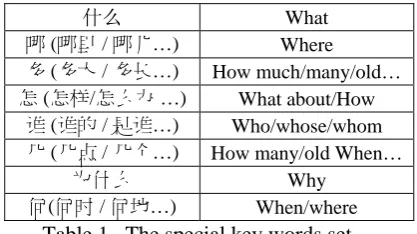
买 到 票 ?(Where can I buy the ticket?)” is PP (also a VP modifier), “怎么 走 (How to go)” in “去海滨怎么走?(How to go to the beach?)” is VP, it is very difficult to find the SQP by syntax. In our model, we first find out all the key words, which we list below, in the special interrogative sentences through mutual information. Then, we define the syntactic com-ponent containing the key word as an SQP. In-stead of full syntactic parser, we utilize a CRF toolkit named FlexCrfs4 to train, test and predict the SQPs chunking.
什么 What
哪 (哪里 / 哪儿…) Where
多 (多大 / 多长…) How much/many/old…
怎 (怎样/怎么办 …) What about/How
谁 (谁的 / 是谁…) Who/whose/whom
几 (几点 / 几个…) How many/old When…
为什么 Why
何(何时 / 何地…) When/where
Table 1. The special key words set
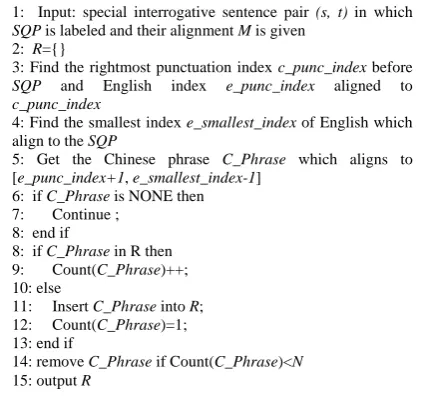
For the second problem, we note that there are only three positions where the SQP will be moved to: (1) the beginning of the sentence; (2) just after the rightmost punctuation (“,”, “;” or “:”) before the SQP; (3) or after a regular phrase such as “请 问 (May I ask)” and “告 诉 我 (Please tell me)”. Therefore, we can learn the reordering templates from bilingual corpus5. The simple algorithm is illustrated in Figure 5, and some reordering templates are shown in Ta-bl
e 2.
On the whole, When we reorder the special interrogative sentence, we first identify the SQP, then we find out whether there are punctuations (“,” , “;” or “:”) before SQP; if any, we keep the rightmost punctuation index, otherwise we keep the index 0 (beginning of sentence). In the third
4
See http://flexCRF.sourceforge.net 5
step, if we find that a reordering template like some one given in Table 2 can match the sen-tence, we just apply the template, otherwise we just move the SQP after the index that we kept
efore (0 or punctuation index).
empirical value N is 10 in our ex-eriment.
b
Figure 5. Reordering template extraction algo-rithm. The
Table 2. Some reordering templates
3.3 Phrase-back Reordering Model
In this paper, we employ the phrase-back reor-dering model for Chinese other interrogative
posi-tio
makes our model suitable for m e
“签名 (sign your name)”
identified as a NP.
z The form of phrase-back reordering rules:
sentences and non-question sentences.
Inspired by the work of Wang et al. (2007), we only consider the most prominent candidates for reordering. The VP modifiers like PP, TP, and SP which we defined in sub-section 2.1 are typically in pre-verb position in Chinese but al-most always appear after the verb in its corre-sponding English translation. Wang et al. (2007) concentrate on VP, NP, then determine whether their modifiers should be moved back. Instead, our interests are focused on the modifiers: PP, TP and SP; namely, we consider the modifiers PP, TP and SP as triggers, and the first VP oc-curring after triggers will be the candidate
n where the triggers may be moved to.
Changing the focus gives us the ability to handle a specific situation that there is no VP after the triggers for recognition error or other
reasons. As the example in Figure 6, there is no VP after PP (“在 这里”) because the phrase “签
名” next to PP is wrongly recognized to be a NP. To deal with the case, we will further define a fake verb phrase (FVP): the phrase after PP (TP or SP) until the punctuation (“,”, ”;” or “.”). The phrase “签名 (sign your name)” in Figure 6 is an FVP. Here, FVP is given the same function with VP, thus it
or situations.
Figure 6. An example of FVP. In our model the whole sentence is recognized as a VP, “在这里 (here)” is a PP, and
is
Unlike hard reordering rules of Wang et al.
(2007), we develop a probabilistic reordering model to alleviate the impact of the errors caused by the parser when recognizing PPs, TPs, SPs and VPs. We believe that no reordering is better than bad reordering. The rule forms and 1: Input: special interrogative sentence pair (s, t) in which
se which aligns to
ndex-1] NONE then
;
_Phrase if Count(C_Phrase)<N SQP is labeled and their alignment M is given 2: R={}
3: Find the rightmost punctuation index c_punc_index before
SQP and English index e_punc_index aligned to
c_punc_index
4: Find the smallest index e_smallest_index of English which align to the SQP
C_Phra
5: Get the Chinese phrase
[e_punc_index+1, e_smallest_i
6: if C_Phrase is
the probabilistic model will be given as follows:
A
: 2 1 2z We use the Maximum Entropy Model which is implemented by Zhang6. The model is trained from bilingual spoken language corpus
determine whether A1 should be moved after
2
A . The features that we investigated include the leftmost, rightmost, and their POSs to
When app the rules, we first identify pairs like ( A XA1 2) in the sentence, and then
m beginning t
1
A behind A2 if (P inverted A| )>P straight A( | ). After all the pairs are pr
lying
fro o end of the sentence, we move
ocessed, we will get the reordered source result.
6
http://homepages.inf.ed.ac.uk/s0450736/maxent_too lkit.html
4
Experiments
We have conducted several experiments to evaluate the models. In this section, we first introduce the corpora, and then we discuss the performance of the SVM-based classifier, chunking and reordering models respectively.
4.1 Corpora
We perform our experiments on Chinese-to-English speech translation task. The statistics of the corpus is given in Table 3 where CE_train means the Chinese-to-English training data re-leased by IWSLT 2007; CE_sent_filtered means the bilingual sentence pairs filtered from the open resources of the bilingual sentences on the website; CE_dict_filtered means the bilingual dictionary filtered from the open resources of the bilingual dictionaries on the website; CE_dev123 denotes the bilingual sentence pairs obtained by the combination of the development data IWSLT07_CE_devset1, IWSLT07_CE_devset2
and IWSLT07_CE_devset3 which are released by the IWSLT 2007; CE_dev4 and CE_dev5 are the remainder of development data released by IWSLT 2007; CE_test means the final test set released by IWSLT 2007.
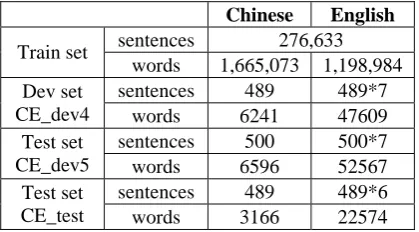
We combine the data from the top four rows as our training set. We use CE_dev4 as our de-velopment set. CE_dev5 and CE_test are our two test data. The test data released by IWSLT 2007 is based on the clean text with punctuation information, so we add the punctuation informa-tion on the Chinese sentences of CE_dev4 and CE_dev5 by our SVM sentence type classifier to form the final development set. The detailed statistics are given in Table 4.
4.2 Classification Result
To evaluate the performance of SVM-based classifier on classifying the sentence types, we first use a simple decision tree to divide the Chinese sentences of our training data for trans-lation into three sentence types. Then we clean them by hand in order to remove the errors. At last, 10k sentences for each sentence type are randomly selected as the experiment data. For each sentence type, 80% of the data are used as training data, 20% as test data. Table 5 gives the classification results.
Punctuation in Table 5 means the punctuation which occurs at the end of the sentence such as “。” and “?”. We can see from the table that SVM classifier performs very well even if we remove the punctuations at the end of every
sen-tence. Therefore, almost no errors will be passed to the reordering stage.
Data Chinese English
CE_train 39,953 39,953
CE_sent_filtered 188,282 188,282
CE_dict_filtered 31,132 31,132
CE_dev123 24,192 24,192 CE_dev4 489 3,423 CE_dev5 500 3,500 CE_test 489 2,934
Table 3. Statistics of training data, development data and test data
Chinese English
sentences 276,633
Train set
words 1,665,073 1,198,984
sentences 489 489*7
Dev set
CE_dev4 words 6241 47609
sentences 500 500*7
Test set
CE_dev5 words 6596 52567
sentences 489 489*6
Test set
CE_test words 3166 22574
Table 4. Detailed statistics of training data on development set
Accuracy (%)
With punctuation 99.80
Without punctuation 98.00
Table 5. The accuracy of SVM classifier
4.3 Chunking Results
In our experiment, except that VPs are obtained by a syntactic parser (Klein and Manning, 2003), SQPs, PPs, TPs, SPs are all chunked by the FlexCrfs.
The chunking data used for training and test in Table 6 are annotated by ourselves. Every chunk is annotated according to the definition that we define in sub-section 2.1. The raw ing and test data are all extracted from our train-ing set for translation. TPs, SPs are annotated together; SQPs, PPs are annotated respectively. The statistics of the training and test data are shown in Table 6. Table 7 gives the chunking results.
The precision, recall and F-Measure are met-rics for the chunking results. F-Measure follows the criteria of CoNLL-20007.
2 * (precision recall* )
F Measure
precision recall
− =
+
7
Because the SQPs have the regularity that each one contains a key word listed in Table 1, the result of SQPs chunking is quite good. Moreover, the chunking of PPs, TPs and SPs also performs well.
Train Test
sentences 10,000 500 SQP
chunks 10030 501
sentences 10,000 500
PP
chunks 10106 512
sentences 11,000 500
SP and TP
chunks 10342 523
Table 6. Statistics of train and test data
Precision
(%)
Recall
(%)
F-Measure
(%)
SQP 95.52 95.52 95.52
PP 94.65 93.31 93.98
SP and TP 93.92 92.68 93.25
Table 7. Chunking results on test set
4.4 Translation Results
For the translation experiments, BLEU-4 and NIST are used as the evaluation metric. The baseline SMT uses the standard phrase-based decoder that applies the log-linear model (Och and Ney, 2002).
In the preprocessing module, all the Chinese words are segmented by the free software toolkit ICTCLAS3.08, and the POS tags are obtained by using the Stanford parser with its POS pars-ing function. For the decoder, the phrase table is obtained as described in (Koehn et al., 2005), and our 4-gram language model is trained by the open SRILM9 toolkit. It should be noted that we use monotone decoding in translation.
We have done three groups of experiments for translation. The first one is to test the effect of phrase-ahead reordering model, the result of which is shown in Table 8. Compared to the baseline system, phrase-ahead reordering model improves the results of the two test sets by 0.41% and 1.87% in BLEU respectively. The difference in the performance gains can be at-tributed to the fact that there are 100 Chinese special interrogative sentences in Test 2, while only 30 are found in Test 1. Accordingly, the reordering candidates of Test 1 are much fewer than that of Test 2. Thus, we can conclude that the more special interrogative sentences the bet-ter performance of the translation. Furthermore,
8
See http://www.nlp.org.cn 9
See http://www.speech.sri.com/projects/srilm
the results show that the reordering on special interrogative sentences is a good try.
The second experiment is conducted to test the effect of phrase-back reordering model. Ta-ble 8 gives the results. For the two test sets, the model brings an improvement to the baseline by 2.24% and 0.93% in BLEU respectively. How-ever, the difference between them is still very big. We think there are two reasons: firstly, there are much more special interrogative sen-tences in Test 2 than in Test 1, so the sensen-tences of other sentence types in Test 2 are much fewer than that in Test 1. Thus, fewer candidates are found in Test 2 than in Test 1. Secondly, the average sentence length of Test 2 (6.5 words) is much shorter than that of Test 1 (13.2 words). We know that if the sentence is very short, the PP, TP, and SP will seldom occur. Naturally, only 89 candidates are found in Test 2 but 366 in Test 1. Regardless of the difference, the phrase-back reordering model indeed improves the translation quality significantly.
The last experiment merges the two reorder-ing model together. The results in Table 8 show that the overall reordering model has done very well in both test sets: it improves the two test sets by 2.65% and 2.78% in BLEU score respec-tively. It demonstrates that every reordering model has a positive effect on translation. Therefore, our reordering model based on the sentence type is quite successful.
5
Conclusions and Future Work
In this paper, we have investigated the effect of the Chinese sentence types on reordering prob-lem for Chinese-to-English statistical machine translation. We have succeeded in applying a phrase-ahead reordering model to process the special interrogative sentences and a phrase-back reordering model to deal with other sen-tence types. Experiments show that our reorder-ing model obtains a significant improvement in BLEU score on the IWSLT-07 task.
Table 8. Statistics of translation results
Notes: candidates here mean how many candidate reordering phrases are recognized for each model. Sentences mean the number of sentences belonging to the specific sentence type, i.e. for phrase-ahead reordering in Test 1, 31 special question phrases (SQP) are recognized in 30 Chinese special interrogative sentences.
Acknowledgments
The research work described in this paper has been partially supported by the Natural Science Foundation of China under Grant No. 60575043 and 60736014, the National High-Tech Research and Development Program (863 Program) of China under Grant No. 2006AA01Z194 and 2006AA010108, the National Key Technologies R&D Program of China under Grant No. 2006BAH03B02, and Nokia (China) Co. Ltd as well.
References
Cao Wang, Michael Collins and Philipp Koehn. 2007. Chinese syntactic reordering for statistical machine translation. In Proceedings of joint Conference on Empirical Methods in Natural Language Process-ing and Computational Natural Language Learn-ing, 2007.
Chi-Ho Li, Dongdong Zhang, Mu Li, Ming Zhou Minghui Li and Yi Guan. 2007. A probabilistic ap-proach to syntax-based reordering for statistical machine translation. In Proceedings of 45th Meet-ing of the Association for Computational LMeet-inguis- Linguis-tics .
Dan Klein and Christopher D. manning. 2003. Accu-rate unlexicalized parsing. In Proceedings of 41st Meeting of the Association for Computational Lin-guistics.
David Chiang. 2005. A hierarchical phrase-based model for statistical machine translation. In Pro-ceedings of 43rd Meeting of Association for Com-putational Linguistics.
Deyi Xiong, Qun Liu and Shouxun Lin. 2006. maxi-mum entropy based phrase reordering model for statistical machine translation. In Proceedings of the joint conference of the International Committee
on Computational Linguistics and the Association for Computational Linguistics 2006.
Fei Xia and Michael McCord. 2004. Improving a Sta-tistical MT system with automatically learned re-write patterns. In Proceedings of 20th International Conference on Computational Linguistics.
Franz Josef Och and Hermann Ney. 2002. Discrimi-native training and maximum entropy models for statistical machine translation. In Proceedings of 40th Meeting of Association for Computational Linguistics.
Franz Josef Och and Hermann Ney. 2004. The align-ment template approach to statistical machine translation. Computational Linguistics, 30:417-449
Marta R. Costa-jussa and Jose A.R. Fonollosa. 2006. Statistical machine reordering. In proceedings of Conference on Empirical Methods in Natural Lan-guage Processing 2006.
Michael Collins, Philipp Koehn, and Ivona Kucerova. 2005. Clause restructuring for statistical machine translation. In proceedings of 43rd Meeting of the Association for Computational Linguistics.
Philipp Koehn, Franz J. Och. and Daniel Marcu. 2003. Statistical Phrase-based Translation. In proceed-ings of HLT-NAACL 2003.
Philipp Koehn, Amittai Axelrod, Alexandra Birch Mayne, Chris Callison-Burch, Miles Osborne and David Talbot. 2005. Edinburgn System Description for the 2005 IWSLT Speech Translation Evalua-tion. In International Workshp on Spoken Lan-guage Translation.
Yuqi Zhang, Richard Zens and Hermann Ney. 2007. Chunk-level reordering of source language sen-tence with automatically learned rules for statistical machine translation. In Proceedings of SSST, NAACL-HLT 2007/AMTA Workshop on Syntax and Structure in Statistical Translation.
Vladimir Naumovich Vapnik. 1998. Statistical Learn-ing Theory. John Wiley and Sons, Inc.
BLEU (%) NIST Sentences Candidates
Baseline 32.16 6.4844 500
Phrase-ahead reordering 32.57 6.5579 30 31
Phrase-back reordering 34.40 6.6857 470 366
Test 1 CE_dev5
Phrase-ahead+phrase-back 34.81 6.7584 500 397
Baseline 34.04 5.8340 489
Phrase-ahead reordering 35.91 6.0693 100 97
Phrase-back reordering 34.97 5.9172 389 89
Test 2 CE_test