R. Dale et al. (Eds.): IJCNLP 2005, LNAI 3651, pp. 414–425, 2005. © Springer-Verlag Berlin Heidelberg 2005
of Temporal Questions
Wei Li1, Wenjie Li1, Qin Lu1, and Kam-Fai Wong2 1
Department of Computing, The Hong Kong Polytechnic University, Hung Hom, Hong Kong
{cswli, cswjli, csluqin}@comp.polyu.edu.hk
2
Department of Systems Engineering, the Chinese University of Hong Kong, Shatin, Hong Kong
Abstract. Temporal question classification assigns time granularities to
tempo-ral questions ac-cording to their anticipated answers. It is very important for an-swer extraction and verification in the literature of temporal question anan-swer- answer-ing. Other than simply distinguishing between "date" and "period", a more fine-grained classification hierarchy scaling down from "millions of years" to "sec-ond" is proposed in this paper. Based on it, a SNoW-based classifier, combining user preference, word N-grams, granularity of time expressions, special patterns as well as event types, is built to choose appropriate time granularities for the ambiguous temporal questions, such as When- and How long-like questions. Evaluation on 194 such questions achieves 83.5% accuracy, almost close to manually tagging accuracy 86.2%. Experiments reveal that user preferences make significant contributions to time granularity classification.
1 Introduction
Temporal questions, such as the questions with the interrogatives “when”, “how long” and “which year”, seek for the occurrence time of the events or the temporal attributes of the entities. Temporal question classification plays an important role in the litera-ture of question answering and temporal information processing. In the evaluation of TREC 10 Question-Answering (QA) track [1], more than 10% of questions in the test question corpus are temporal questions. Different from TREC QA track, Workshop TERQAS (http://www.timeml.org/terqas/) particularly investigated on temporal ques-tion answering instead of a general one. It focused on temporal and event recogniques-tion in question answering systems and paid great attention to temporal relations among states, events and time expressions in temporal questions. TimeML (
http://www.ti-meml.org), a temporal information (e.g. time expression, tense & aspect) annotation
standard, has also been used for temporal question answering in this workshop [2]. Correct understanding of a temporal question will greatly help extracting and verify-ing its answers and certainly improve the performance of any question answerverify-ing system. Look at the following examples.
In a general question answering system, the question classifier commonly classifies temporal questions into two classes, i.e. “date” and “period”. With such a system, the above two questions are both assigned a “date”. Whereas it is natural for the question [Ea] to be answered with a particular data (e.g. “12/02/1809”), it is not the case for question [Eb], because a proper answer could be “35,000 years ago”. However, if it is known that the time granularity concerned is “thousands of years”, answer extraction turn to be more targeted. The need for a more fine-grained classification is obvious. Although there were different question classification hierarchies, as reported [3,4,12,13,14], few inclined to introducing the classification hierarchy (e.g. “year”, “month” and “day”) which could give a clearer direction to guide answer extraction and verification of temporal questions. In the following, we try to find out whether temporal questions can be further classified into finer time granularity and how to classify them.
By examining a temporal question corpus consisting of 348 questions, 293 of which are gathered from UIUC question answering labelled data (http://l2r.cs.
uiuc.edu/~cogcomp/Data/QA/QC), and the rest 55 from TREC 10 test corpus, we find
two different cases. On the one hand, some questions are very straightforward in ex-pressing the time granularities of the answers expected, e.g. the questions beginning with “which year” or “for how many years”. On the other hand, some questions are not so obvious, e.g. the questions headed by “when” or “for how long”. We call such questions ambiguous questions. Not surprisingly, the ambiguous When- and How long-like questions account for a large proportion in this temporal question corpus, i.e. 197 from 348 in total.
We further investigate on those 197 ambiguous questions in order to find out whether they can be classified into finer time granularity. Three experimenters are requested to tag a time granularity to each question independently1. Answers are not provided. The tag with two agreements is taken as the time granularity class of the corresponding temporal question. Otherwise the tag “UNKNOWN” is assigned. Ref-erence answers for the questions are extracted from AltaVista Web Search
(http://www.altavista.com). Comparing the time granularities tagged manually with
those provided by the reference answers, we find that only 27 out of 197 questions are incorrectly tagged, in other words, the manually tagging accuracy is 86.2%. Errors exist though, the relatively high agreement between users’ tagging and reference answers lights the hope of automatically determining the time granularities of tempo-ral questions.
Analysing the tagging results, it is revealed that the tagging errors arouse from three sources: insufficient world knowledge, different speaking habits and different expected information granularity among human. See the following examples:
[Ec]. When did the Neanderthal man live? User: year; Ref.: thousands of years [Ed]. How long is human gestation?
User: month; Ref.: week
[Ee]. When was the first Wall Street Journal published? User: year; Ref.: day
1
For question [Ec], the time granularity should be “thousands of years”, rather than “year”. This error could be corrected if one knows that Neanderthal man existed 35,000 years ago. The time granularity of question [Ed] should be “week”, but not “month” in accordance with the habit. For question [Ee], users’ tag is “year”, different from the reference answer’s tag “day”. However, both granularities are acceptable in commonsense, because the different users may want coarser or finer information. This observation suggests that incorporating question context, world knowledge, and speaking habits would help determine the time granularities of temporal questions.
In this paper, we propose a fine-grained temporal question classification scheme, i.e. time granularity hierarchy, consisting of sixteen non-exclusive classes and scaling down from “millions of years” to “second”. The SNoW-based classifier is then built to combine linguistic features (including word N-grams, granularity of time expres-sions and special patterns), user preferences and event types, and assign one of the sixteen classes to each temporal question. In our work, user preference, which charac-terizes world knowledge and speaking habits, is estimated by means of the time granularities of the entities and/or events involved. The SNoW-based classifier achieves 83.5% accuracy, almost close to 86.2% of manually tagging accuracy. Ex-periments also show that user preference makes a great contribution to time granular-ity classification.
The rest of this paper is organized as follows. In the next section various related works in this literature are introduced. In Sect. 3, we demonstrate the time granularity hierarchy and principles. User preference is fully investigated in Sect. 4. Feature de-sign is depicted in Sect. 5. Time granularity classifiers are introduced in Sect. 6 and the experiment results are presented in Sect. 7. We finally conclude this paper in the last section.
2 Related Works
It is an extension of two classes “date” and “period” and includes sixteen non-exclusive classes scaling down from “millions of years” to “second”.
Related to the work of features design, Li et al. [3] built the question classifier based on three types of features, including surface text (e.g. N-grams), syntactic fea-tures (e.g. part-of-speech and name entity tags), and semantic related words (words that often occur with a specific question class). Later works of Li et al. [10] intro-duced semantic information and world knowledge from external resources such as WordNet. In this paper, we introduce a new feature, user preference, which is ex-pected to imply the world knowledge in time granularity in the experiment. User preference is estimated from statistics with which Diaz F. et al. [6] determine whether a question is temporal ambiguous or not. E. Saquete et al. [5] suggested that questions had different structures, i.e. non-temporal, simple and complex, which is helpful to handle questions more orderly. It gives us inspiration to use question focus, i.e. whether a question is event-based or entity-based.
Many machine-learning methods have been used in question classification, such as language model [7], SNoW [3,10], maximum entropy [15] and support vector ma-chine [8,9]. In our experiments, language model is selected as the baseline model, and SNoW is selected to tackle to the large feature space and build the classifier. In fact, SNoW has already been used in many other fields, such as text categorization, word sense disambiguation and even facial feature detection.
3 Time Granularity Hierarchy and Tagging Principles
In traditional question answering systems, only two question types are time-related, i.e. “date” and “period”. For the reasons explained in Sect. 1, we propose a more detailed temporal question classification scheme, namely time granularity hierarchy scaling down from “millions of years” to “second” in order to facilitate answer extraction and verification. The initial time granularity hierarchy includes the following twelve classes: “second”, “minute”, “hour”, “day”, “week”, “month”, “season”, “year”, “dec-ade”, “century”, “thousands of years” and “millions of years”.
Granularity “weekday” is added to the initial hierarchy because some temporal questions favor “weekday” instead of “day”, although both of them indicate one day. Some questions favour a region of time granularity. Look at the following examples.
[Ef]. What time of year has the most air travel? [Eg]. What time of day did Emperor Hirohito die?
For [Ef] question, its time granularity could be “season”, “month” or even “day”; and for question [Eg], the time granularity could be “hour” or “minute”. We can only determine that their time granularities are less than “year” or “day” respectively, but cannot go any further. Such situations only occur to time granularity “year” and “day”, so we expand the original classification hierarchy by adding another two types: “less than day”, “less than year”. Besides, the questions asking for festivals are classi-fied into “special date”.
In reality, some temporal questions can be answered in several different time granularities. For example, question “when was Abraham Lincoln born?”, its answers can be a “day” (“12/02/1809”) or a “year” (“1809”). To resolve this confliction, we adopt two principles for time granularity annotation.
[Pa].Assign the minimum time granularity we can determine to a given temporal question if several time granularities are applicable.
[Pb].Select the time granularity with regard to speaking habits or user preferences. When the two principles conflict to each other, principle [Pb] takes the priority. With principle [Pa], time granularity of the above question can only be “day”.
4 User Preference
In general, temporal questions have two different focuses: entity-based and event-based. [a]. Entity-based question: temporal interrogative words + (be) + entity, e.g.
“When was the World War II?”
[b]. Event-based question: temporal interrogatives + event, e.g. “When did Mount St. Helen last have a significant eruption?”
Time granularities of entities (or events) have great significance to those of entity-based (or event-entity-based) temporal questions. So, in the following, we make estimation of the time granularities of entities and events from statistics, based on the intuition that some entities or events may favor certain types of time granularities, which is called user preference here.
4.1 Estimation of Time Granularities of Entities and Events
4.1.1 Time Granularity of Entities
The time granularity of the entity is derived by counting the co-occurrences of the entity and time granularities. The statistics is gathered from AltaVista Web Search. The sentences containing both the entity and time expressions are extracted from the first one hundred results returned by AltaVista with the entity as the searching key-word. The probability P of a time granularity class tgion the occurrence of the entity is calculated as the following Equation (1).
) ( #
) (
# ) | (
entity entity tg
entity tg
P i
i
∩
= TG(entity)=Argmaxtgi P(tgi |entity) (1)
#( ) is the number of the sentences containing the expressions between the parenthe-sis. TG(entity) represents the time granularity of the entity.
4.1.2 Time Granularity of Events
“verb” for “entity”. We choose two strategies for the estimation: maximum product and one-win-all.
Maximum product: ( | ) 1P(tg |entity)P(tg |verb)P(tg |entity')
Z event tg
P i i i
i =
TG(event) Argmaxtg P(tgi|event) i
= (2)
TG(event) represents time granularity of event. Z is used for normalization.
One-win-all: TG(event) Argmaxtg{P(tgi|entity),P(tgi|verb),P(tgi|entity')}
i
= (3)
Equation (1) is smoothed in order to avoid 0 values in Equation (2).
i i
i t tg
t w w tg w tg P = + + ∩ = ) ( # 1 ) ( # ) |
( (4)
t is the number of the time granularity classes, w is either an entity or a verb.
4.1.3 Experiment: Evaluating the Estimation
In the 197 ambiguous questions, 12 questions are entity-based, and the rest 185 ques-tions are event-based. If all the 197 quesques-tions are arbitrarily assigned a tag “year”, the tagging accuracy is 48.2%.
For each entity-based or event-based question, the time granularity of the entity or event within it are assumed as the time granularity of the question. Compared with the time granularity of the reference answer, for the entity-based questions, we achieve 75% accuracy; for the event-based question, the accuracy of maximum product strat-egy and one-win-all stratstrat-egy are 67.0% and 64.3% respectively. It seems that maxi-mum product strategy is more effective than one-win-all strategy in this application. With maximum product strategy, the overall accuracy on all the 197 ambiguous ques-tions is 67.4%. Notice that the accuracy of arbitrarily tagging is only 48.2%, so the estimation of the time granularities of the entities and the events is useful for deter-mining the time granularities of temporal questions.
4.2 Distribution of the Time Granularity of Entities and Events
4.2.1 Observation of Distribution
In the experiments of estimation, we find that some entities or events tend to favor only one certain time granularity, some others tend to favor several time granularities, and the rest may have a uniform distribution almost on every time granularity.
-1 0 1 2 3 4 5 6 7 8 9 0 20 40 60 80 100 Season Week P rop or ti o n( % )
Time Granularity of "gestation"
-1 0 1 2 3 4 5 6 7 8 9 0 10 20 30 40 50 60 Century Decade Year Month Day P ropor ti on (% )
Time Granularity of "Lincoln born"
-1 0 1 2 3 4 5 6 7 8 9 0 10 20 30 40 50 Year Month Weekday Day Hour P rop or ti o n( % )
Time Granularity of "take place"
[image:6.512.68.363.491.583.2](a) (b) (c)
In Fig. 1(a), time granularity “day” takes a preponderant proportion, i.e. more than 80%, in the distribution of “gestation”, which is called single-peak-distribution. In Fig. 1(b), both “day” and “year” take a large proportion, so “Lincoln born” is multi-peak-distributed. In Fig. 1(c), for “take place”, all the time granularities almost take a similar proportion and it is a uniform distribution.
4.2.2 Experiments on Distribution
Assume an entity (or event) E, its possible time granularities {tgi, i=1,…t} and the corresponding probabilities {Pi, i=1,…t} (calculated by Equation 1 and 2).
=
∑
iPi
t
1
µ ; =
∑
iI Pi
d ( ,µ);
µ µ µ
≤ >
⎩ ⎨ ⎧
= i i i
P P P
I
0 1 ) ,
( (5)
d is the number of time granularities tgi with higher probability Pi than average prob-ability µ . For simplicity, distribution DE of the time granularity of E is determined as follows,
3 3 1
1
> ≤ <
=
⎪ ⎩ ⎪ ⎨ ⎧
=
d d d
Uniform Multi Single DE
(6)
Observing the experiment results in Sect. 4.1.3, 88.7%, 56.3% and 18.9% accuracy are achieved on the questions within which the time granularities of the entities or events are estimated to be single-peak-, multi-peak-, and uniform-distributed respec-tively. So whether the estimated time granularity of the entity or event is single-peak-, multi-peak-, or uniform-distributed highlights the confidence on the estimation, which can be taken as a feature associated with the estimation of the time granularities.
5 Feature Design
As described in the above section, estimation of the time granularities of the entities and the events is useful for determining the time granularities of temporal questions; whether a question is entity-based or not and the distribution of time granularities of the entities and events within the questions will also be taken as associated features. These three features are named user preference feature in total. Besides, another four types of features are considered.
Word N-grams
Word N-grams feature, e.g. unigram and bigram is the most straightforward feature and commonly used in question classification. In general question classification, gram “when” indicates a temporal question. In temporal question classification, uni-gram “birthday” always implies a “day” while biuni-gram “when … born” is a strong evidence of the time granularity “day”. From this aspect, word N-grams also reflect user preference on time granularity.
Granularity of Time Expressions
Time expressions are common in temporal questions, e.g. “July 11, 1998” and date modifier “1998” in “1998 Superbowl”. We take the granularities of time expressions as features, for example,
Granularities of time expressions impose the constraints on the time granularities of temporal questions. If there is a time expression whose time granularity is tg in a temporal question, time granularity of this question can not be tg. For example, ques-tion “When is the 1998 SuperBowl?”, its time granularity can not be “Year”, i.e. the time granularity of “1998”.
Special Patterns
In word N-gram features, words are equally processed, however, some special words combining with the verbs or the temporal connectives (e.g. “when”, “before” and “since”) will produce special patterns and affect the time granularities of temporal questions. Look at the following examples.
[Eh].Since when hasn’t John Sununu been able to fly on government planes for personal business?
[Ei].What time of the day does Michael Milken typically wake up?
For question [Eh], the temporal preposition “since” combined with “when” highlights that this question is seeking for a beginning point time, which implies a finer time granularity; for question [Ei], “typically” combined with verb “wake up” indicates a generally occurred event, and implies that its time granularity could be “less than day” or “less than year”.
Event Types
In general, there are four event types: states, activities, accomplishments, and achievements. States and activities favour larger time granularities, while accom-plishments and achievements favour smaller ones. For example, the activity “stay” will favour larger time granularity than the accomplishment event “take place”.
6 Classifier Building
In this work, we choose the Sparse Network of Winnow (SNoW) model as the time granularity classifier and compare it with a commonly used Language Model (LM) classifier.
6.1 Language Model (LM)
As language model has already been used in question classification [7], it is taken as the baseline model in the experiments. Language model mainly combines two types of features, i.e. unigram and bigram. Given a temporal question Q, its time granularity
TG(Q) is calculated by Equation (7).
∏
∏
== +
=
= + −
= j n
j i j j
m j
j i j
tg Ptg w Ptg ww
Arg Q TG
i 1 ( | ) (1 ) 1 ( | 1)
max )
( λ λ (7)
w represents words. m and n are the numbers of unigrams and bigrams in questions respectively.
λ
assigns different weights to unigrams and bigrams. In the experiment, best accuracy is achieved whenλ
=
0
.
7
(see Sect. 7.3.1).6.2 Sparse Network of Winnow (SNoW)
linear function from a corpus consisting of positive and negative examples. Let
Ac={i1, …, im} be the set of features that are active and linked to target class c. Let si
be the real valued strength associated with feature in the example. Then the example’s class is c if and only if,
∑
∈ ≥ Ac i c i i c sw, θ (8)
i c
w
, is weight of feature i connected with class c, which is learned from the training corpus. SNoW has already been used in question classification [3,10] and good results are reported. As mentioned in Sect. 5, five types of features are selected for our task. They are altogether counted to more than ten thousand features. Since it is a large feature set, SNoW is a good choice.7 Experiments
7.1 Setup
In this 348-question-corpus (see Sect. 1), time granularities of 151 questions are straightforward, while those of the rest 197 questions are ambiguous. For the sixteen time granularity classes, we only consider ten classes including more than four ques-tions. Questions with unconsidered time granularity classes excluded, the question cor-pus has 339 questions in total, 145 for training and 194 for testing. As a result, the task is to learn a model from the 145-question training corpus and classify questions in the 194-question test corpus into ten classes: “second”, “minute”, “hour”, “day”, “week-day”, “week”, “month”, “season”, “year” and “century”. The SNoW classifier is downloaded from UIUC (http://l2r.cs.uiuc.edu/~cogcomp/download.php?key=SNOW).
7.2 Evaluation Criteria
The primary evaluation standard is accuracy1, i.e. the proportion of the correct
classi-fied questions out of the test questions (see Equation 9). However, if a question seek-ing for a finer time granularity, e.g. “day”, has been incorrectly determined as a coarser one, e.g. “year”, it should also be taken as partly correct, which is reflected in accuracy2 (see Equation 10).
) ( # ) ( # 1 test correct
Accuracy = (9)
#( ) is number of questions.
) ( # ) ( 2 test Q RR
Accuracy =
∑
i i⎪ ⎩ ⎪ ⎨ ⎧ > < = + − = ) ( ) ' ( ) ( ) ' ( ) ( ) ' ( ) 1 ) ( ) ' ( ( 1 0 1 ) ( Q Q Q Q Q Q Q
Q Rtg Rtg
tg R tg R tg R tg R tg R tg R Q RR (10) Q
tg
andtg
Q'
are the reference and classification result respectively.R
(
tg
Q)
is therank of the time granularity class
tg
Q, scaling down from “millions of years” totime granularities, i.e. “special date”, “less than day” and “less than year” are 14, 15 and 16 respectively. Likewise, R(tgQ')is the rank of
tg
Q'
.7.3 Experimental Results and Analysis
In the experiments, language model is taken as the baseline model. Performance of SNoW-based classifier will be compared with that of language model. Different com-binations of features are tested in SNoW-based classifier and their performances are investigated.
7.3.1 LM Classifier
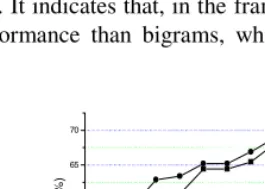
The LM classifier takes two types of features: unigram and bigram. Experiment re-sults are presented in Fig. 2.
Accuracy varies with different feature weight
λ
and best accuracy (accuracy168.0% and accuracy2 68.9%) achieves when
λ
=0.7. Accuracy whenλ
=1.0 is higherthan that when
λ
=0. It indicates that, in the framework of language model, unigrams achieves better performance than bigrams, which accounts from the sparseness of bigram features.-0.1 0.0 0.1 0.2 0.3 0.4 0.5 0.6 0.7 0.8 0.9 1.0 1.1 45
50 55 60 65 70
Accuracy1 Accuracy2
A
ccu
ra
cy(
%)
[image:10.512.149.282.287.382.2]λ
Fig. 2. Accuracy of LM classifier. Data in circle is the best performance achieved.
7.3.2 SNOW Classifier
Our SNoW classifier requires binary features. We then encode each feature with an integer label. When a feature is observed in a question, its label will appear in the extracted feature set of this question. There are six types of features: 15 user prefer-ences (10 for the estimation of time granularities, 3 for the estimation distributions, and 2 for question focuses) (F1), 951 unigrams (F2), 9277 bigrams (F3), 10 granularity
of time expressions (F4), 14 special patterns (F5), and 4 event types (F6). Although the
number of all features is more than ten thousand, the features in one question are no more than twenty in general. Accuracies of SNoW classifier on 194 test questions are presented in Table 1. It shows that simply using unigram features, SNoW classifier has already achieved better accuracy than LM classifier (accuracy1: 69.5% vs. 68.0%;
accuracy2: 70.3% vs. 68.9%). From this view, SNoW classifier outperforms LM
clas-sifier in handling sparse features. When all the six types of features are used, SNoW classifier achieves 83.5% in accuracy1 and 83.9% in accuracy2, almost close to the
Table 1. Accuracy (%) of SNoW classifier
Feature Set F2 F2, 3 F1~6
Accuracy1 69.5 72.1 83.5
[image:11.512.44.387.155.209.2]Accuracy2 70.3 72.7 83.9
Table 2. Accuracy1 (%) on different types of time granularities
TG second minute hour day weekday
Accuracy1 100 100 100 64.2 100
TG week month season year century
Accuracy1 100 60 100 90.5 66.7
Table 3. Accuracy (%) on combination of different types of features
Feature Set F2,3 F1,2,3 F2,3,4 F2,3,5 F2,3,6
Accuracy1 72.1 79.8 73.7 74.7 72.6
Accuracy2 72.7 80.6 74.7 75.2 73.1
With all the six types of features, accuracy1 on the questions with different types of
time granularity is illustrated in Table 2. It reveals that the classification errors mainly come from time granularity of “month”, “day” and “century”. Low accuracy on “month” and “century” accounts from absence of enough examples, i.e. examples for training and testing both less than five. Many “day” questions are incorrectly classi-fied into “year”, which accounts for the low accuracy on “day”. The reason lies in that there are more “year” questions than “day” questions in the training question corpus (116 vs. 56).
In general, we can extract three F1 features, one F4 feature, less than two F5
fea-tures, and one F6 feature from one question. It is hard for SNoW classifier to train and
test independently on each of these types of the features because of the small feature number in one example question. However, the numbers of F2 and F3 features in a
question are normally more than ten. So we take unigrams (F2) and bigrams (F3) as
the basic feature set. Table 3 presents the accuracy when the rest four types of fea-tures are added into the basic feature set respectively. As expected user preference makes the most significant improvement, 7.82% in accuracy1 and 7.90% in accuracy2.
Special patterns also play an important role, which makes 2.6% accuracy1
improve-ment. It is strange that event type makes such a modest improvement (0.5%). After analyzing the experimental results, we find that as there are only four event types, it makes limited contribution to 10-class time granularity classification.
8 Conclusion
[image:11.512.44.389.246.284.2]N-grams, granularity of time expressions, special patterns and event types, achieves 83.5% accuracy in classification, close to manually tagging accuracy 86.2%.
Acknowledgement
This project is partially supported by Hong Kong RGC CERG (Grant No: PolyU5181/03E), and partially by CUHK Direct Grant (No: 2050330).
References
1) TREC (ed.): The TREC-8 Question Answering Track Evaluation. Text Retrieval Confer-ence TREC-8, Gaithersburg, MD (1999)
2) Radev D. and Sundheim B.: Using TimeML in Question Answering.
http://www.cs.brandeis.edu/~jamesp/arda/time/documentation/TimeML-use-in-qa-v1.0.pdf, (2002)
3) Li, X. and Roth, D.: Learning Question Classifiers. Proceedings of the 19th International Conference on Computational Linguistics (2002) 556-562
4) S. Abney, M. Collins, and A. Singhal: Answer Extraction. Proceedings of the 6th ANLP Conference (2000) 296-301
5) Saquete E., Martínez-Barco P., Muñoz R.: Splitting Complex Temporal Questions for Question Answering Systems. Proceedings of the 42nd Annual Meeting of the Association for Computational Linguistics (2004) 567-574
6) Diaz, F. and Jones, R.: Temporal Profiles of Queries. Yahoo! Research Labs Technical Report YRL-2004-022 (2004)
7) Wei Li: Question Classification Using Language Modeling. CIIR Technical Report (2002) 8) Dell Zhang and Wee Sun Lee: Question Classification Using Support Vector Machines.
Proceedings of the 26th Annual International ACM SIGIR Conference on Research and Development in Information Retrieval (2003) 26-32
9) Jun Suzuki, Hirotoshi Taira, Yutaka Sasaki, and Eisaku Maeda: Question Classification Using HDAG Kernel. Proceedings of Workshop on Multilingual Summarization and Question Answering (2003) 61-68
10) Li X., Roth D., and Small K.: The Role of Semantic Information in Learning Question Classifiers. Proceedings of the International Joint Conference on Natural Language Proc-essing (2004)
11) Schilder, Frank & Habel, Christopher: Temporal Information Extraction for Temporal Question Answering. In New Directions in Question Answering. Papers from the 2003 AAAI Spring Symposium TR SS-03-07 (2003) 34-44
12) Rohini K. Srihari, Wei Li: A Question Answering System Supported by Information Ex-traction. Proceedings of Association for Computational Linguistics (2000) 166-172 13) Eduard Hovy, Laurie Geber, Ulf Hermjakob, Chin-Yew Lin, and Deepak Ravichandran:
Towards Semantics-Based Answer Pinpointing. Proceedings of the DARPA Human Lan-guage Technology Conference (2001)
14) Hermjacob U.: Parsing and Question Classification for Question Answering. Proceedings of the Association for Computational Linguists Workshop on Open-Domain Question An-swering (2001) 17-22