Translation by Machine of Complex Nominals: Getting it Right
Timothy Baldwin CSLI Stanford University Stanford, CA 94305 USA [email protected]
Takaaki Tanaka
Communication Science Laboratories Nippon Telephone and Telegraph Corporation
Kyoto, Japan
Abstract
We present a method for compositionally translating noun-noun (NN) compounds, using a word-level bilingual dictionary and syntactic templates for can-didate generation, and corpus and dictionary
statis-tics for selection. We propose a support vector
learning-based method employing target language corpus and bilingual dictionary data, and evaluate it
over a English Japanese machine translation task.
We show the proposed method to be superior to pre-vious methods and also robust over low-frequency NN compounds.
1 Introduction
Noun-noun (NN) compounds (e.g. web server,
kikai
hoNyaku “machine translation”,1the
elements of which we will refer to as N and N in
linear order of occurrence) are a very real problem for both machine translation (MT) systems and hu-man translators due to:
constructional variability in the translations:
kikai
hoNyaku “machine
transla-tion” (N-N) vs.
miNkaN
kigyou
“private company” (Adj-N) vs.
kaNkei
kaizeN “improvement in relations” (N
in N);
lexical divergences in Japanese and English: haifu
keikaku “distribution
schedule” vs. "!
keizai
keikaku
“economic plan/programme” vs. #$
shuyou
keikaku “major project”;
semantic underspecification: compounds
gener-ally have multiple interpretations, and can only be reliably interpreted in context (Levi, 1978);
the existence of non-compositional NN compounds:%&(')*(+ idobata
kaigi “(lit.) well-side
meeting”, which translates most naturally into English as “idle gossip”;
high productivity and frequency
In order to quantify the high productivity and frequency of NN compounds, we carried out a
1
With all Japanese NN compound examples, we segment the compound into its component nouns through the use of the “,” symbol. No such segmentation boundary is indicated in the original Japanese.
BNC Reuters Mainichi
Token coverage 2.6% 3.9% 2.9% Total no. types 265K 166K 889K Ave. token freq. 4.2 12.7 11.1 Singletons 60.3% 44.9% 45.9%
Table 1: Corpus occurrence of NN compounds
basic study of corpus occurrence in English and
Japanese. For English, we based our analysis
over: (1) the written portion of the British Na-tional Corpus (BNC, 84M words: Burnard (2000)), and (2) the Reuters corpus (108M words: Rose et al. (2002)). For Japanese, we focused exclusively on the Mainichi Shimbun Corpus (340M words: Mainichi Newspaper Co. (2001)). We identified NN compounds in each corpus using the method
de-scribed in - 2.2 below, and from this, derived the
statistics of occurrence presented in Table 1. The token coverage of NN compounds in each corpus refers to the percentage of words which are con-tained in NN compounds; based on our corpora, we estimate this figure to be as high as 3-5%. If we then look at the average token frequency of each distinct NN compound type, we see that it is a rel-atively modest figure given the size of each of the corpora, the reason for which is seen in the huge number of distinct NN compound types. Combin-ing these observations, we see that a translator or MT system attempting to translate one of these cor-pora will run across NN compounds with high fre-quency, but that each individual NN compound will occur only a few times (with around 45-60% occur-ing only once). The upshot of this for MT systems and translators is that NN compounds are too var-ied to be able to pre-compile an exhaustive list of translated NN compounds, and must instead be able to deal with novel NN compounds on the fly. This claim is supported by Tanaka and Baldwin (2003a), who found that static bilingual dictionaries had a type coverage of around 84% and 94% over the top-250 most frequent English and Japanese NN com-pounds, respectively, but only 27% and 60%, re-spectively, over a random sample of NN compounds occurring more than 10 times in the corpus.
We develop and test a method for translating NN
compounds based on Japanese English MT. The
method can act as a standalone module in an MT
system, translating NN compounds according to the best-scoring translation candidate produced by the method, and it is primarly in this context that we present and evaluate the method. This is congruent with the findings of Koehn and Knight (2003) that, in the context of statistical MT, overall translation performance improves when source language noun phrases are prescriptively translated as noun phrases in the target language. Alternatively, the proposed method can be used to generate a list of plausible translation candidates for each NN compound, for a human translator or MT system to select between based on the full translation context.
In the remainder of the paper, we describe the translation procedure and resources used in this re-search (- 2), and outline the translation candidate
se-lection method, a benchmark sese-lection method and
pre-processors our method relies on (- 3). We then
evaluate the method using a variety of data sources
(- 4), and finally compare our method to related
re-search (- 5).
2 Preliminaries
2.1 Translation procedure
We translate NN compounds by way of a two-phase procedure, incorporating generation and selection (similarly to Cao and Li (2002) and Langkilde and Knight (1998)).
Generation consists of looking up word-level
translations for each word in the NN compound to be translated, and running them through a set of constructional translation templates to generate
translation candidates. In order to translate
kaNkei
kaizeN “improvement in relations”, for
example, possible word-level translations for
are relation, connection and relationship, and trans-lations for
are improvement and betterment. Constructional templates are of the form [N
in N
] (where N
indicates that the word is a noun (N) in
English (
) and corresponds to the th-occurring
noun in the original Japanese; see Table 3 for fur-ther example templates and Kageura et al. (2004) for discussion of templates of this type). Each slot in the translation template is indexed for part of speech (POS), and derivational morphology is optionally used to convert a given word-level translation into a form appropriate for a given template. Example
translation candidates for
, therefore, are
relation improvement, betterment of relationship, improvement connection and relational betterment.
Generation fails in the instance that we are unable
to find a word-level translation for N and/or N .
Selection consists of selecting the most likely
translation for the original NN compound from the generated translation candidates. Selection is per-formed based on a combination of monolingual tar-get language and crosslingual evidence, obtained
from corpus or web data.
Ignoring the effects of POS constraints for the moment, the number of generated translations is
where
and
are the fertility of Japanese
nouns N and N
, respectively, and
is the number of translation templates. As a result, there is often a large number of translation candidates to select between, and the selection method crucially deter-mines the efficacy of the method.
This translation procedure has the obvious advan-tage that it can generate a translation for any NN compound input assuming that there are word-level translations for each of the component nouns; that is it has high coverage. It is based on the assump-tion that NN compounds translate composiassump-tional- compositional-ity between Japanese and English, which Tanaka and Baldwin (2003a) found to be the case 43.1% of the time for Japanese–English (JE) MT and 48.7% of the time for English–Japanese (EJ) MT. In this paper, we focus primarily on selecting the cor-rect translation for those NN compounds which can be translated compositionally, but we also inves-tigate what happens when non-compositional NN compounds are translated using a compositional method.
2.2 Translation data
In order to generate English and Japanese NN com-pound testdata, we first extracted out all NN bi-grams from the Reuters Corpus and Mainichi Shim-bun Corpus. The Reuters Copus was first tagged and chunked using fnTBL (Ngai and Florian, 2001), and lemmatised using morph (Minnen et al., 2001), while the Mainichi Shimbun was segmented and tagged using ChaSen (Matsumoto et al., 1999). For both English and Japanese, we took only those NN bigrams adjoined by non-nouns to ensure that they were not part of a larger compound nominal. We ad-ditionally measured the entropy of the left and right contexts for each NN type, and filtered out all
com-pounds where either entropy value was .
2 This
was done in an attempt to, once again, exclude NNs which were embedded in larger MWEs, such as
ser-vice department in social serser-vice department.
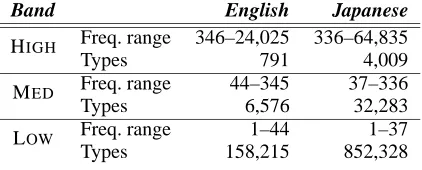
We next calculated the frequency of occurrence of each NN compound type identified in the English and Japanese corpora, and ranked the NN com-pound types in order of corpus frequency. Based on this ranking, we split the NN compound types into three partitions of equal token frequency, and from each partition, randomly selected 250 NN com-pounds. In doing so, we produced NN compound
2
Band English Japanese
Freq. range 346–24,025 336–64,835 HIGH
Types 791 4,009
Freq. range 44–345 37–336 MED
Types 6,576 32,283 Freq. range 1–44 1–37 LOW
Types 158,215 852,328
Table 2: Frequency bands
data representative of three disjoint frequency bands of equal token size, as detailed in Table 2. This al-lows us to analyse the robustness of our method over data of different frequencies.
Our motivation in testing the proposed method over NN compounds according to the three
fre-quency bands is to empirically determine: (a)
whether there is any difference in translation-compositionality for NN compounds of different frequency, and (b) whether our method is robust over NN compounds of different frequency. We
re-turn to these questions in- 4.1.
In order to evaluate basic translation accuracy over the test data, we generated a unique
gold-standard translation for each NN compound to
represent its optimally-general default translation. This was done with reference to two bilingual Japanese-English dictionaries: the ALTDIC dictio-nary and the on-line EDICT dictiodictio-nary. The
ALT-DIC dictionary was compiled from the ALT-J/E
MT system (Ikehara et al., 1991), and has approxi-mately 400,000 entries including more than 200,000 proper nouns; EDICT (Breen, 1995) has approxi-mately 150,000 entries. The existence of a trans-lation for a given NN compound in one of the dictionaries does not guarantee that we used it as our gold-standard, and 35% of JE translations and 25% of EJ translations were rejected in favour of a manually-generated translation. In generating the gold-standard translation data, we checked the va-lidity of each of the randomly-extracted NN com-pounds, and rejected a total of 0.5% of the initial random sample of Japanese strings, and 6.6% of the English strings, on the grounds of: (1) not being NN compounds, (2) being proper nouns, or (3) be-ing part of a larger MWE. In each case, the rejected string was replaced with an alternate randomly-selected NN compound.
2.3 Translation templates
The generation phase of translation relies on trans-lation templates to recast the source language NN compound into the target language. The transla-tion templates were obtained by way of word align-ment over the JE and EJ gold-standard translation datasets, generating a total of 28 templates for the JE task and 4 templates for the EJ task. The rea-son for the large number of templates in the JE task
is that they are used to introduce prepositions and possessive markers, as well as indicating word class conversions (see Table 3).
3 Selection methodology
In this section, we describe a benchmark selection method based on monoligual corpus data, and a novel selection method combining monolingual cor-pus data and crosslingual data derived from bilin-gual dictionaries. Each method takes the list of gen-erated translation candidates and scores each, re-turning the highest-scoring translation candidate as our final translation.
3.1 Benchmark monolingual method
The monolingual selection method we benchmark ourselves against is the corpus-based
transla-tion quality (CTQ) method of Tanaka and Bald-win (2003b). It rates a given translation candidate according to corpus evidence for both the fully-specified translation and its parts in the context of the translation template in question. This is calcu-lated as:3
are the word-level translations
of the source language N# and N#
, respectively,
and
is the translation template.4 Each
probabil-ity is calculated according to a maximum likelihood estimate based on relative corpus occurrence. The
formulation ofCTQis based on linear interpolation
over& and' , where()*&,+-'.) and&0/1'32 .
We set& to(546 and' to(74 throughout evaluation.
The basic intuition behind decomposing the translation candidate into its two parts within the
context of the translation template (8
) is to capture the subcategorisation prop-erties of" #
were Bandersnatch and relation,
respectively, and 8 would hope to score relation to (the) Bandersnatch as being more likely than relation on (the)
Bander-snatch. We could hope to achieve this by virtue of
the fact that relation occurs in the form relation to
... much more frequently than relation on ...,
mak-ing the value of8
greater for the template [N
In evaluation, Tanaka and Baldwin (2003b) found the principal failing of this method to be its treat-ment of all translations contained in the transfer dictionary as being equally likely, where in fact
3
In the original formulation, the product :<;>=
was included as a third term, but Tanaka and Baldwin (2003b) found it to have negligible impact on translation accuracy, so we omit it here.
4= and
=
are assumed to be POS-compatible with
A
Template (JE) Example
koutai “change of government”
Template (EJ) Example
Table 3: Example translation templates (N = noun and Adj = adjective)
there is considerable variability in their
applicatil-ity. One example of this is the simplex *,+ kiji
which is translated as either article or item (in the sense of a newspaper) in ALTDIC, of which the for-mer is clearly the more general translation. Lack-ing knowledge of this conditional probability, the method considers the two translations to be equally probable, giving rise to the preferred translation of
related item for
*/+ kaNreN
kiji “related
ar-ticle” due to the markedly greater corpus occurrence of related item over related article. It is this as-pect of selection that we focus on in our proposed method.
3.2 Proposed selection method
The proposed method uses the corpus-based
mono-lingual probability terms of CTQ above, but also
mono- and crosslingual terms derived from bilin-gual dictionary data. In doing so, it attempts to
pre-serve the ability of CTQ to model target language
expressional preferences, while incorporating more direct translation preferences at various levels of lexical specification. For ease of feature expandabil-ity, and to avoid interpolation over excessively many terms, the backbone of the method is the TinySVM
support vector machine (SVM) learner.5
The way we use TinySVM is to take all source language inputs where the gold-standard translation is included among the generated translation candi-dates, and construct a single feature vector for each translation candidate. We treat those feature vec-tors which correspond to the (unique) gold-standard translation as positive exemplars, and all other fea-ture vectors as negative exemplars. We then run TinySVM over the training exemplars using the ANOVA kernel (the only kernel which was found to converge). Strictly speaking, SVMs produce a bi-nary classification, by returning a continuous value
and determining whether it is closest to/ (the
pos-itive class) or 0 (the negative class). We treat
this value as a translation quality rating, and rank the translation candidates accordingly. To select the best translation candidate, we simply take the best-scoring exemplar, breaking ties through random se-lection.
5
http://chasen.aist-nara.ac.jp/˜taku/ software/TinySVM/
The selection method makes use of three basic feature types in generating a feature vector for each source language–translation candidate pair: corpus-based features, bilingual dictionary-corpus-based features and template-based features.
Corpus-based features
Each source language–translation pair is mapped onto a total of 8 corpus-based feature types, in line
with theCTQformulation above:
132 46587:9<;
is a normalisation parameter used to estimate the frequency of occurrence of mul-tiword expression (MWE) translations from that of
the head. E.g., in generating translations forX?Y
Z *?[
fudousaN
gaisha “real estate company”,
we get two word-level translations forX/Y
Z
: real
estate and real property. In each case, we identify
the final word as the head, and calculate the num-ber of times the MWEs (i.e. real estate and real
property) occur in the overall corpus as compared
to the head (i.e. estate and property, respectively). In calculating the values of each of the frequency-based features involving these translations, we de-termine the frequency of the head in the given con-text, and multiply this by the normalisation param-eter. The reason for doing this is for ease of cal-culation and, wherever possible, to avoid zero val-ues for frequencies involving MWEs. The feature
SUTWV
is generated by multiplying the
MWE parameters for each of"%#
and"$#
(which
are set to 1.0 in the case that the translation is sim-plex) and intended to model the tendency to pre-fer simplex translations over MWEs when given a choice.
We construct an additional feature from each of these values, by normalising (by simple division to generate a value in the range \(7+ ^]) relative to the
maximum value for that feature among the trans-lation candidates generated for a given source lan-guage input. For each corpus, therefore, the total
In EJ translation, the corpus-based feature values were derived from the Mainichi Shimbun Corpus, whereas in JE translation, we used the BNC and Reuters Corpus, and concatenated the feature val-ues from each.
Bilingual dictionary-based features
Bilingual dictionary data is used to generate 6 fea-tures: number of times the given translation candidate oc-curs as a translation for the source language NN compound across all dictionaries. While this fea-ture may seem to give our method an unfair
ad-vantage over CTQ, it is important to realise that
only limited numbers of NN compounds are listed in the dictionaries (12% for English and 28% for Japanese), and that the gold-standard accuracy when the dictionary translation is selected is not as high as one would expect (65% for English and 75%
for Japanese). the total occurrences of the translation candidate across all dictionaries (irrespective of the source language expression it translates), and is considered to be an indication of conventionalisation of the can-didate.
The remaining features are intended to capture word-level translation probabilities, optionally in the context of the template used in the translation
candidate. Returning to our
*/+ kaNreN
kiji
“related article” example from above, of the
transla-tions article and item for*/+ , article occurs as the
translation of*/+ for 42% of NN entries with*3+
as the N , and within 18% of translations for
com-plex entries involving*/+ (irrespective of the form
or alignment between article and*?+ ). For item,
the respective statistics are 9% and 4%. From this, we can conclude that article is the more appropri-ate translation, particularly for the given translation template.
As with the corpus-based features, we addition-ally construct a normalised variant of each fea-ture value, such that the total number of bilingual
dictionary-based features is! ` a 2 _ .
In both JE and EJ translation, we derived bilin-gual dictionary-based features from the EDICT and ALTDIC dictionaries independently, and concate-nated the features derived from each.
Template-based features
We use a total of two template-based features: the
template type and the target language head (N1 or
N2). For template [N N ]J
" [N
N ]E(see - 2.3),
e.g., the template type is N-N and the target
lan-guage head isN1.
3.3 Corpus data
The corpus frequencies were extracted from the
same three corpora as were described in - 1: the
BNC and Reuters Corpus for English, and Mainichi Shimbun Corpus for Japanese. We chose to use the BNC and Reuters Corpus because of their comple-mentary nature: the BNC is a balanced corpus and hence has a rounded coverage of NN compounds (see Table 1), whereas the Reuters Corpus contains newswire data which aligns relatively well in con-tent with the newspaper articles in the Mainichi Shimbun Corpus.
We calculated the corpus frequencies based on the tag and dependency output of RASP (Briscoe and Carroll, 2002) for English, and CaboCha (Kudo and Matsumoto, 2002) for Japanese. RASP is a tag sequence grammar-based stochastic parser which attempts to exhaustively resolve inter-word depen-dencies in the input. CaboCha, on the other hand, chunks the input into head-annotated “bunsetsu” or base phrases, and resolves only inter-phrase
depen-dencies. We thus independently determined the
intra-phrasal structure from the CaboCha output based on POS-conditioned templates.
4 Evaluation
We evaluate the method over both JE and EJ trans-lation selection, using the two sets of 750 NN
com-pounds described in - 2.2. In each case, we first
evaluate system performance according to gold-standard accuracy, i.e. the proportion of inputs for which the (unique) gold-standard translation is ranked top amongst the translation candidates. For the method to have a chance at selecting the gold-standard translation, we clearly must be able to generate it. The first step is thus to identify in-puts which have translation-compositional gold-standard translations, and generate the translation candidates for each. The translation-compositional data has the distribution given in Table 4. The over-all proportion of translation-compositional inputs is somewhat lower than suggested by Tanaka and Baldwin (2003a), although this is conditional on the coverage of the particular dictionaries we use. The degree of translation-compositionality appears to be relatively constant across the three frequency bands, a somewhat surprising finding as we had expected the lower frequency NN compounds to be less con-ventionalised and therefore have more straightfor-wardly compositional translations.
We use the translation-compositional test data to
evaluate the proposed method (SVM#
%$& ) against
CTQand a simple baseline derived fromCTQ, which
JE EJ ALL 297/750 272/750 HIGH 99/250 108/250 MED 98/250 81/250 LOW 100/250 83/250
Table 4: Analysis of translation compositionality
Baseline CTQ SVM SVM SVM
JE .317 .367 .390 .382 .434
EJ .400 .416 .441 .296 .514
Table 5: Gold-standard translation accuracies
candidate (i.e. is equivalent to setting & 2 and
' 2 ( ). We additionally tested the proposed method
using just corpus-based features (SVM#
) and
bilin-gual dictionary-based features (SVM& ) to get a
bet-ter sense for the relative impact of each on overall performance. In the case of the proposed method and its derivants, evaluation is according to 10-fold stratified cross-validation, with stratification taking place across the three frequency bands. The average number of translations generated for the JE dataset was 205.6, and that for the EJ dataset was 847.5. We were unable to generate any translations for 17 (2.3%) and 57 (7.6%) of the NN compounds in the JE and EJ datasets, respectively, due to there being
no word-level translations for N and/or N in the
combined ALTDIC/EDICT dictionaries.
The gold-standard accuracies are presented in Ta-ble 5, with figures in boldface indicating a
statis-tically significant improvement over bothCTQ and
the baseline.6 Except for SVM& in the EJ task, all
evaluated methods surpass the baseline, and all
vari-ants of SVM surpassed CTQ. SVM#
$& appears to
successfully consolidate on SVM#
and SVM& ,
in-dicating that our modelling of target language cor-pus and crosslingual data is complementary. Over-all, the results for the EJ task are higher than those for the JE task. Part of the reason for this is that Japanese has less translation variability for a given pair of word translations, as discussed below.
In looking through the examples where a gold-standard translation was not returned by the dif-ferent methods, we often find that the unique-ness of gold-standard translation has meant that equally good translations (e.g. dollar note vs. the gold-standard translation dollar bill for
doru
shihei) or marginally lower-quality but
per-fectly acceptable translations (e.g. territorial issue vs. the gold-standard translation of territorial
dis-pute for
ryoudo
moNdai) are adjudged
incorrect. To rate the utility of these near-miss
translations, we rated each non-gold-standard first-ranking translation according to source
language-recoverability (L1-language-recoverability). L1-recoverable
6Based on the pairedA
test,:
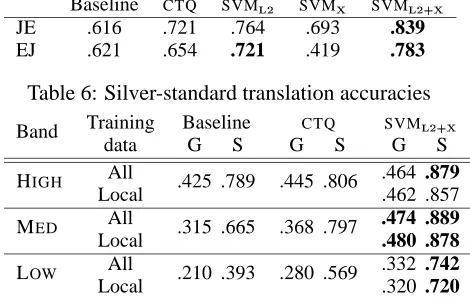
Baseline CTQ SVM SVM SVM
JE .616 .721 .764 .693 .839
EJ .621 .654 .721 .419 .783
Table 6: Silver-standard translation accuracies
Training Baseline CTQ SVM
Band
data G S G S G S
All .464 .879
HIGH
Local .425 .789 .445 .806 .462 .857
All .474 .889
MED
Local .315 .665 .368 .797 .480 .878
All .332 .742
LOW
Local .210 .393 .280 .569 .320 .720
Table 7: JE translation accuracies across different frequency bands
translations are defined to be syntactically un-marked, capture the basic semantics of the source language expression and allow the source language expression to be recovered with reasonable confi-dence. While evaluation of L1-recoverability is in-evitably subjective, we minimise bias towards any given system by performing the L1-recoverability annotation for all methods in a single batch, without giving the annotator any indication of which method
selected which translation. The average number
of English and Japanese L1-recoverable translations were 1.9 and 0.94, respectively. The principle rea-son for the English data being more forgiving is the existence of possessive- and PP-based paraphrases of NN gold-standard translations (e.g. ammendment
of rule(s) as an L1-recoverable paraphrase of rule ammendment).
We combine the gold-standard data and L1-recoverable translation data together into a sin-gle silver standard translation dataset, based upon which we calculate silver-standard translation accu-racy. The results for the translation-compositional
data are given in Table 6. Once again, we find
that the proposed method is superior to the
base-line andCTQ, and that the combination of
crosslin-gual and target language corpus data is superior
to the individual data sources. SVM& fares
par-ticularly badly under silver-standard evaluation as it is unable to capture the target language lexi-cal and constructional preferences as are needed to generate syntactically-unmarked, natural-sounding translations. Unsurprisingly, the increment between gold-standard accuracy and silver-standard accu-racy is greater for English than Japanese.
4.1 Accuracy over each frequency band
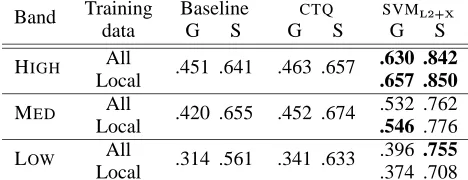
Training Baseline CTQ SVM
Band
data G S G S G S
All .630 .842
HIGH
Local .451 .641 .463 .657 .657 .850
All .532 .762
MED
Local .420 .655 .452 .674 .546 .776
All .396 .755
LOW
Local .314 .561 .341 .633 .374 .708
Table 8: EJ translation accuracies across different frequency bands
Baseline CTQ SVM SVM SVM
JE .358 .515 .490 .308 .549
EJ .208 .285 .350 .162 .277
Table 9: Silver-standard translation accuracies over non-translation-compositional data
training over all the translation data. The results for the JE and EJ translation tasks are presented in Tables 7 and 8, respectively. The results based on training over data from all frequency bands are labelled All and those based on training over data from only the same frequency band are labelled
Lo-cal; G is the gold-standard accuracy and S is the
silver-standard accuracy.
For each of the methods tested, we find that the gold- and silver-standard accuracies drop as we go down through the frequency bands, although the drop off is markedly greater for gold-standard
ac-curacy. Indeed, silver-standard accuracy is
con-stant between the high and medium bands for the JE task, and the medium and low frequency bands
for the EJ task. SVM#
%$& appears to be robust over
low-frequency data for both tasks, with the abso-lute difference in silver-standard accuracy between the high and low frequency bands around only 0.10, and never dropping below 0.70 for either the EJ or JE task. There was very little difference between training over data from all frequency bands as com-pared to only the local frequency band, suggesting that there is little to be gained from conditioning training data on the relative frequency of the NN compound we are seeking to translate.
4.2 Accuracy over non-translation-compositional data
Finally, we evaluate the performance of the meth-ods over the non-translation compositional data. We are unable to give gold-standard accuracies here as, by definition, the gold-standard translation is not amongst the translation candidates generated
for any of the inputs. We are, however, able
to evaluate according to silver-standard accuracy, constructing L1-recoverable translation data as for the translation-compositional case described above. The classifier is learned from all the translation-compositional data, treating the gold-standard
trans-lations as positive exemplars as before.
The results are presented in Table 9. A large disparity is observable here between the JE and EJ accuracies, which is, once again, a direct re-sult of Japanese being less forgiving when it comes to L1-recoverable translations. For the translation-compositional data, the EJ task displayed a simi-larly diminished accuracy increment when the L1-recoverable translation data was incorporated, but this was masked by the higher gold-standard
ac-curacy for the task. The relative results for the
JE task largely mirror those for the
translation-compositonal data. In contrast, SVM#
$ & actually
performs marginally worse than CTQ over the EJ
task, despite SVM#
performing above CTQ. That
is, the addition of dictionary data diminishes overall accuracy, a slightly surprising result given the com-plementary of corpus and dictionary data in all other aspects of evaluation. It is possible that we could get better results by treating both L1-recoverable and gold-standard translations in the training data as positive exemplars, which we leave as an item for future research.
Combining the results from Table 9 with those from Table 6, the overall silver-standard accuracy
over the JE data is 0.671 forSVM#
%$& (compared to
0.602 for CTQ), and that over the EJ data is 0.461
(compared to 0.419 forCTQ).
In summary, we have shown our method to be
su-perior to both the baseline andCTQover EJ and JE
translation tasks in terms of both gold- and silver-standard accuracy. We also demonstrated that the method successfully combines crosslingual and tar-get language corpus data, and is relatively robust over low frequency inputs.
5 Related work
One piece of research relatively closely related to our method is that of Cao and Li (2002), who use bilingual bootstrapping over Chinese and English web data in various forms to translate Chinese NN compounds into English. While we rely on bilin-gual dictionaries to determine crosslinbilin-gual similar-ity, their method is based on contextual similarity in the two languages, without assuming parallelism or comparability in the corpus data. They report an impressive F-score of 0.73 over a dataset of 1000 instances, although they also cite a prior-based F-score (equivalent to our Baseline) of 0.70 for the task, such that the particular data set they are deal-ing with would appear to be less complex than that which we have targeted. Having said this, contex-tual similarity is an orthogonal data source to those used in this research, and has the potential to further improve the accuracy of our method.
pages, that is web pages which are predominantly Japanese, say, but interspersed with English words, to extract translation pairs. They do this by access-ing web pages containaccess-ing a given Japanese expres-sion, and looking for the English expression which occurs most reliably in its immediate vicinity. The method achieves an impressive gold-standard accu-racy of 0.62, at a recall of 0.68, over a combination of simplex nouns and compound nominals.
Grefenstette (1999) uses web data to select En-glish translations for compositional German and Spanish noun compounds, and achieves an impres-sive accuracy of 0.86–0.87. The translation task Grefenstette targets is intrinsically simpler than that described in this paper, however, in that he consid-ers only those compounds which translate into NN compounds in English. It is also possible that the historical relatedness of languages has an effect on the difficulty of the translation task, although fur-ther research would be required to confirm this pre-diction. Having said this, the successful use of web data by a variety of researchers suggests an avenue for future research in comparing our results with those obtained using web data.
6 Conclusion and future work
We have proposed a method for translating NN compounds which compositionally generates trans-lation candidates and selects among them using a target language model based on corpus statistics and a translation model based on bilingual dictionaries. Our SVM-based implementation was shown to out-perform previous methods and be robust over low-frequency NN compounds for JE and EJ translation tasks.
Acknowledgements
This material is based upon work supported by the National Science Foundation under Grant No. BCS-0094638 and also the Research Collaboration between NTT Communication Science Laboratories, Nippon Telegraph and Telephone Corporation and CSLI, Stan-ford University. We would like to thank Emily Bender, Francis Bond, Dan Flickinger, Stephan Oepen, Ivan Sag and the anonymous reviewers for their valuable input on this research.
References
Jim Breen. 1995. Building an electronic Japanese-English
dic-tionary. Japanese Studies Association of Australia
Confer-ence.
Ted Briscoe and John Carroll. 2002. Robust accurate statistical annotation of general text. In Proc. of the 3rd International
Conference on Language Resources and Evaluation (LREC 2002), pages 1499–1504, Las Palmas, Canary Islands.
Lou Burnard. 2000. User Reference Guide for the British
Na-tional Corpus. Technical report, Oxford University
Com-puting Services.
Yunbo Cao and Hang Li. 2002. Base noun phrase transla-tion using Web data and the EM algorithm. In Proc. of the
19th International Conference on Computational Linguis-tics (COLING 2002), Taipei, Taiwan.
Gregory Grefenstette. 1999. The World Wide Web as a re-source for example-based machine translation tasks. In
Translating and the Computer 21: ASLIB’99, London, UK.
Satoru Ikehara, Satoshi Shirai, Akio Yokoo, and Hiromi Nakaiwa. 1991. Toward an MT system without pre-editing – effects of new methods in ALT-J/E–. In Proc. of the Third
Machine Translation Summit (MT Summit III), pages 101–
106, Washington DC, USA.
Kyo Kageura, Fuyuki Yoshikane, and Takayuki Nozawa. 2004. Parallel bilingual paraphrase rules for noun compounds: Concepts and rules for exploring Web language resources. In Proc. of the Fourth Workshop on Asian Language
Re-sources, pages 54–61, Sanya, China.
Philipp Koehn and Kevin Knight. 2003. Feature-rich statisti-cal translation of noun phrases. In Proc. of the 41st Annual
Meeting of the ACL, Sapporo, Japan.
Taku Kudo and Yuji Matsumoto. 2002. Japanese dependency analysis using cascaded chunking. In Proc. of the 6th
Conference on Natural Language Learning (CoNLL-2002),
pages 63–9, Taipei, Taiwan.
Irene Langkilde and Kevin Knight. 1998. Generation that ex-ploits corpus-based statistical knowledge. In Proc. of the
36th Annual Meeting of the ACL and 17th International Conference on Computational Linguistics (COLING/ACL-98), pages 704–710, Montreal, Canada.
Judith N. Levi. 1978. The Syntax and Semantics of Complex
Nominals. Academic Press, New York, USA.
Mainichi Newspaper Co. 2001. Mainichi Shimbun CD-ROM 2001.
Yuji Matsumoto, Akira Kitauchi, Tatsuo Yamashita, and Yoshi-taka Hirano. 1999. Japanese Morphological Analysis
Sys-tem ChaSen Version 2.0 Manual. Technical Report
NAIST-IS-TR99009, NAIST.
Guido Minnen, John Carroll, and Darren Pearce. 2001. Ap-plied morphological processing of English. Natural
Lan-guage Engineering, 7(3):207–23.
Masaaki Nagata, Teruka Saito, and Kenji Suzuki. 2001. Using the Web as a bilingual dictionary. In Proc. of the ACL/EACL
2001 Workshop on Data-Driven Methods in Machine Trans-lation, pages 95–102, Toulouse, France.
Grace Ngai and Radu Florian. 2001. Transformation-based learning in the fast lane. In Proc. of the 2nd Annual Meeting
of the North American Chapter of Association for Compu-tational Linguistics (NAACL2001), pages 40–7, Pittsburgh,
USA.
Tony Rose, Mark Stevenson, and Miles Whitehead. 2002. The Reuters Corpus volume 1 – from yesterday’s news to tomor-row’s language resources. In Proc. of the 3rd International
Conference on Language Resources and Evaluation (LREC 2002), pages 827–33, Las Palmas, Canary Islands.
Takaaki Tanaka and Timothy Baldwin. 2003a. Noun-noun compound machine translation: A feasibility study on shal-low processing. In Proc. of the ACL-2003 Workshop on
Multiword Expressions: Analysis, Acquisition and Treat-ment, pages 17–24, Sapporo, Japan.
Takaaki Tanaka and Timothy Baldwin. 2003b. Translation selection for Japanese-English noun-noun compounds. In