Annotating Discourse Relations in Spoken Language: A Comparison of the
PDTB and CCR Frameworks
Ines Rehbein, Merel Scholman, Vera Demberg
Saarland UniversityCampus C7.4, 66123, Saarbr¨ucken
{rehbein, m.c.j.scholman, vera}@coli.uni-saarland.de
Abstract
In discourse relation annotation, there is currently a variety of different frameworks being used, and most of them have been developed and employed mostly on written data. This raises a number of questions regarding interoperability of discourse relation annotation schemes, as well as regarding differences in discourse annotation for written vs. spoken domains. In this paper, we describe our work on annotating two spoken domains from the SPICE Ireland corpus (telephone conversations and broadcast interviews) according to two different discourse annotation schemes, PDTB 3.0 and CCR. We show that annotations in the two schemes can largely be mapped onto one another, and discuss differences in operationalisations of discourse relation schemes which present a challenge to automatic mapping. We also observe systematic differences in the prevalence of implicit discourse relations in spoken data compared to written texts, and find that there are also differences in the types of causal relations between the domains. Finally, we find that PDTB 3.0 addresses many shortcomings of PDTB 2.0 wrt. the annotation of spoken discourse, and suggest further extensions. The new corpus has roughly the size of the CoNLL 2015 Shared Task test set, and we hence hope that it will be a valuable resource for the evaluation of automatic discourse relation labellers.
Keywords:Annotation of discourse relations (DRs), interoperability of annotation schemes, DRs in spoken and written genres
1.
Introduction
Over the last decade, research in NLP has widened its scope, moving beyond the sentence level to analysing the discourse structure of a text. This has resulted in the cre-ation of discourse-annotated corpora, such as the Penn Dis-course Treebank (PDTB) (Prasad et al., 2008), the Rhetori-cal Structure Theory (RST) Treebank (Carlson et al., 2002), and the Annodis corpus (Segmented Discourse Represen-tation Theory, SDRT) (Afantenos et al., 2012), to name a few. However, as of yet, the different frameworks are not inter-operable, nor is there a unified scheme for dis-course annotation (but see the proposals by Benamara and Taboada (2015), Chiarcos (2014), Bunt et al. (2012), and Sanders et al. (In preparation)).
Most discourse-annotated corpora are based on written rather than spoken text. This point is crucial, as spoken and written texts are produced and processed differently (Cuenca, 2015): Spoken communication is characterised by a high degree of interactivity that requires turn-taking devices for discourse management; sentence length on av-erage is shorter, and the pressure of rapid online processing often leads to disfluent structures. In contrast to written communication, the speaker and the hearer have access to additional channels of communication, such as visual in-formation or, at least, audio cues such as pitch and sentence stress, and we observe many elliptical structures and omis-sions. We expect that these differences will be reflected in the use of discourse relations (DRs) in the spoken domain. The above considerations raise the question whether an-notation schemes developed for written language are ad-equate for describing coherence relations in spoken lan-guage. Even for written text, there is no consensus on which and how many categories of coherence relations should be distinguished. Most proposals agree that coher-ence relations are binary relations between two discourse
elements, but they differ in their operationalisation of how to annotate these relations. RST, for example, assumes that the appropriate representation for discourse relations is a tree, while other frameworks do not make the same assump-tion.
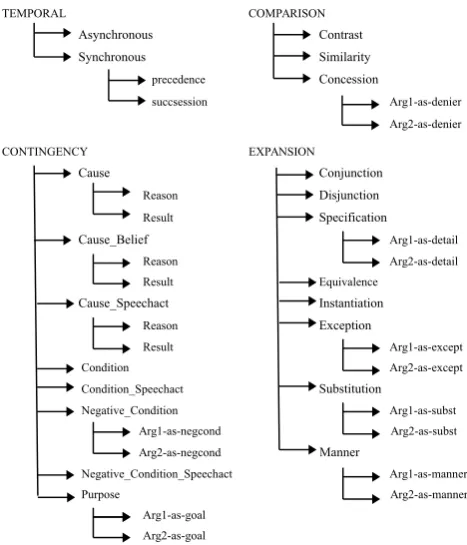
The present paper focusses on two annotation frame-works, namely PDTB 3.0 (Prasad et al., In preparation) and the Cognitive approach to Coherence Relations (CCR; Sanders et al. (1992)). These schemes differ greatly in how they describe and annotate coherence relations: PDTB distinguishes end labels (Figure 1), i.e. Contin-gency.Cause.Result, whereas CCR describes relations ac-cording to four cognitive dimensions (polarity, basic op-eration, source of coherence, order), i.e. a positive causal objective forward relation (Example 1).1
(1) Her flight was late, soshe missed her connection. a. PDTB: CONTINGENCY.CAUSE.RESULT b. CCR: positive causal objective forward
We present an annotation experiment where the two frame-works are applied to English data from the spoken domain. We are interested in the following questions:
1. In what sense are annotations dependent on the for-malism chosen? Do we obtain equivalent informa-tion? What possible biases are introduced by the an-notation guidelines? (Section 5.)
2. What are the differences between discourse relations in the spoken and in the written domain? (Section 6.) 3. Can the two frameworks adequately describe
coher-ence relations in spoken language, or do we need ad-ditional categories? (Section 7.)
1
TEMPORAL COMPARISON Asynchronous Contrast Synchronous Similarity
precedence Concession
succsession Arg1-as-denier Arg2-as-denier
CONTINGENCY EXPANSION
Cause Conjunction Reason Disjunction
Result Specification
Cause_Belief Arg1-as-detail Reason Arg2-as-detail Result Equivalence
Cause_Speechact Instantiation Reason Exception
Result Arg1-as-except Condition Arg2-as-except Condition_Speechact Substitution
Negative_Condition Arg1-as-subst Arg1-as-negcond Arg2-as-subst Arg2-as-negcond Manner
Negative_Condition_Speechact Arg1-as-manner Purpose Arg2-as-manner
Arg1-as-goal Arg2-as-goal
Figure 1: PDTB 3.0 sense hierarchy
2.
Discourse annotation frameworks
2.1.
PDTB
The Penn Discourse Treebank 2.0 (Prasad et al., 2008) is a resource of discourse relation annotations on texts from the Wall Street Journal corpus. The PDTB framework aims at describing local links between arguments, rather than build-ing up a full tree as a representation of the entire text. Each relation is therefore analysed independently of other rela-tions. The PDTB taxonomy was originally developed for written language, but PDTB 2.0 has also been applied to spoken data. This will be discussed further in Section 3. The segments that make up a discourse relation are labeled Arg1 and Arg2 in PDTB. These labels are assigned based on syntactic restrictions: Arg2 is the argument that appears in the clause that is syntactically bound to the connective. Each relation is assigned an end label based on a three-tiered hierarchy of relation senses. The top-level, orclass, consists of four major semantic classes, namely TEMPO -RAL, CONTINGENCY, COMPARISON, and EXPANSION. Each level has been divided into multiple sublevels named
types, which in turn can be divided intosubtypes. Annota-tors can choose to annotate only at coarse-grained senses if they have low confidence on the fine-grained senses such as the subtype.
In the current study, spoken discourse has been analysed according to the PDTB 3.0 sense hierarchy (Figure 1), a revised version of PDTB 2.0. For an overview of changes in the framework, see Prasad et al. (In preparation).
2.2.
CCR
The annotation framework of CCR is based on a cognitive theory of coherence relations, proposed by Sanders et al. (1992). The theory has since been used to annotate var-ious types of discourse, including spoken text, chat
frag-ments, and children’s language use (see Sanders, Vis & Broeder, (2012) and Sanders et al., (In preparation), for an overview). CCR differs from other annotation frame-works in that coherence relations are not assigned a specific end label, but rather are defined by their characteristics. In CCR, four cognitive dimensions are distinguished that ap-ply to every relation. These dimensions are polarity, basic operation, source of coherence, and order of the segments. They will be explained shortly in the next paragraphs, but for a more detailed explanation, see Sanders et al. (1992) and Scholman et al. (2016).
The polarity of a relation refers to the positive or negative character of a segment. A relation is positive if the propo-sitions P and Q, expressed in the two discourse segments S1 and S2, are linked directly, without a negation of one of these propositions. A relation with a positive polarity is typically connected by connectives such asandorbecause. A relation is negative if the negative counterpart of either P or Q functions in the relation. A relation with a negative polarity is typically connected by connectives such asbut
andalthough.
The basic operation distinguishes between causal and ad-ditive relations. A relation is causal if an implication rela-tion (P→Q) can be deduced between the two segments. Causal relations are typically connected bybecauseandso. The category of causal relations also comprises conditional relations (cf. Scholman et al., 2016). A relation is additive if the segments are connected as a conjunction (P & Q). Temporal relations are considered a subclass of additive re-lations, in which their segments are ordered in time. The third dimension, the Source of Coherence, distin-guishes between objective and subjective relations. A rela-tion is subjective if the author or speaker is actively engaged in the construction of the relation. Subjective relations ex-press the speaker’s opinion, argument, claim, or conclusion. Objective relations, on the other hand, consist of segments that describe situations that occur in the real world. The fourth dimension is the order of the segments. This dimension applies to causal, conditional and temporal re-lations. In a coherence relation with a basic order, the an-tecedent (P) is S1, followed by the consequent (Q) as S2. In a relation with a non-basic order, P maps onto S2 and Q onto S1. For causal and conditional relations, P is the cause, condition or argument, and Q is the consequence or the claim. For temporal relations, P is the first event, and Q is the second event.
3.
Related Work
Two different strands of research are relevant to our work. The first one focusses on the unification of different anno-tation schemes for the annoanno-tation of discourse relations, the second is on developing or adapting discourse annotation schemes for spoken language.
3.1.
Mapping annotations across frameworks
discourse relations (Prasad and Bunt, 2015) that they con-sider to be indispensible for the annotation of DRs, together with clear definitions and examples for each relation. In fu-ture work, they plan to provide mappings from their core set to the annotation labels in different DR frameworks such as the PDTB, RST, SDRT and CCR.
Such an ambitious enterprise raises questions about the inter-operability of existing annotation frameworks for dis-course. Chiarcos (2014) explores the inter-operability of the RST and PDTB frameworks, with the goal of extend-ing the Ontologies of Lextend-inguistic Annotation (OLiA) (Chiar-cos and Sukhareva, 2012) with discourse features. With that aim in view, the labels in the different frameworks are mapped onto each other. However, the mapping does not include the structures (i.e. the arguments) of the annotated relations, and no claim is made about the completeness of this endeavour. Chiarcos observes that in order to fully map the annotations from the RST and PDTB corpora, structural transformations are necessary, e.g. a conversion of the an-notations to dependency DAGs.
Benamara and Taboada (2015) propose a taxonomy for mapping discourse relations across two different frame-works,Rhetorical Structure Theory(RST) andSegmented Discourse Representation Theory (SDRT), and use it to map the annotations in three resources (the RST-DT En-glish corpus (Carlson et al., 2002), the SDRT Annodis French corpus (Afantenos et al., 2012), and the RST Span-ish Treebank (da Cunha et al., 2011)). The authors claim that their taxonomy is robust across theoretical frameworks and can be applied to corpora from different languages. However, they identify some problems for the mapping, e.g. SDRT does not distinguish between causal and epis-temic uses of causal relations, and the CAUSE-RESULTand CONSEQUENCErelations in the RST-DT corpus are similar and can correspond to either REASONor RESULT. Sanders et al. (In preparation) propose to use unifying di-mensions to be able to ‘translate’ annotations from one framework to another. In their proposal, they extend the dimensions distinguished by CCR with additional criteria needed to capture more fine-grained relation senses. They then decompose the relation labels distinguished in the PDTB 2.0, PDTB 3.0, RST and SDRT frameworks accord-ing to these dimensions. Many of the relation labels can be mapped onto the dimensions automatically, but manual annotation will also be required for certain labels or dimen-sions.
The approaches above are similar in their aim to define a mapping between existing annotation frameworks. What is missing so far is a validation of the proposed mappings in terms of an annotation experiment. The proposed mapping can be used to predict annotations carried out on the same data. Let’s assume that we have a mapping M between re-lation A in framework F1 and rere-lation B in framework F2. Every time one annotator assigns label A from framework F1 to a data point in the corpus, we predict that the second annotator assigns label B from framework F2. The map-ping, that was created based on theoretical assumptions, can be considered as verified if a substantial part of the an-notations in the two frameworks can be translated into each other, using the mapping.
In Section 4., we present such a validation experiment, us-ing the CCR and PDTB 3.0 frameworks, and analyse the results with respect to the predictions made by our map-ping.
3.2.
Annotating DRs in spoken language
While most annotation projects have focussed on annotat-ing discourse relations in written text, there are some stud-ies on annotating discourse-relational devices in the spoken domain.
Tonelli et al. (2010) adapt the PDTB 2.0 annotation scheme to make it more suitable for annotating spoken data from the LUNA Corpus, which is a language resource with help-desk dialogues on the topic of software/hardware trou-bleshooting. The special properties of spoken conversa-tion caused them to change the PDTB sense hierarchy and include new relations. The most important change is the addition of speechact relations in the sense of Sweetser (1990). Other changes include the GOALrelation, likely motivated by the peculiarities of the task-oriented help-desk dialogues. They also discarded the LISTrelation, as it never occurred in their corpus of conversational speech.
These changes to the PDTB hierarchy are also reflected in the revised hierarchy of the PDTB 3.0 (Prasad et al., In preparation) (i.e. the addition of the level-2 sense PURPOSE with level-3 subsenses ARG1-AS-GOAL, ARG2-AS-GOAL, as well as the distinction between BELIEFand SPEECHACT readings).
Other studies that have used the PDTB framework to an-notate spoken data are Demirs¸ahin and Zeyrek (2014) and Stoyanchev and Bangalore (2015). However, they have not made any further changes to the PDTB framework.
4.
Data & Method
The data we use in our annotation experiment comes from the SPICE-Ireland corpus (Kallen and Kirk, 2012), a cor-pus of spoken Irish English containing a variety of differ-ent genres, from which we selected broadcast interviews
andtelephone conversationsfor discourse relation annota-tion. The PDTB corpus also includes texts from different genres:essays, summaries, newsandletters, as described in Webber (2009). This will allow us to investigate the differ-ences in the use of DRs in different genres from the spoken and written domain.
SPICE-Ireland corpus The corpus includes the spoken
part of the ICE-Ireland corpus (Kallen and Kirk, 2008), with texts ranging over 15 different discourse settings (e.g. broadcast discussions, broadcast news, classroom discus-sions, private telephone conversations, or parliamentary de-bates, amongst others). SPICE-Ireland comprises prag-matic annotations on top of the transcriptions from the ICE-Ireland corpus, including mark-up for speech-act functions and discourse markers. The annotation of discourse mark-ers is restricted to modulating devices such aswell, you-know, sure, kind-of and does not consider discourse con-nectives and coherence relations.
Annotation procedure Two linguistically trained coders
written(PDTB) spoken(SPICE)
genre essays summ. letters news broadc. teleph.
no. sent 6,517 1,667 911 38,963 1,507 2,717
no. words 139,445 31,316 18,207 821,104 20,801 20,239
no. DRs 6,468 933 750 32,018 1,244 1,201
explicit 45.8 17.5 37.5 37.8 44.0 25.5
implicit 42.9 15.1 33.5 32.3 27.2 12.6
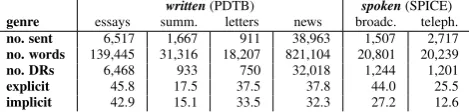
Table 1: Distribution of explicit and implicit coherence re-lations across different genres, normalised frequencies per 100 sentences/speech units. The total number of DRs in-cludes Explicit, Implicit, AltLex and EntRel,implicitonly refers to the number of implicit relations, without EntRel and AltLex.
the PDTB guidelines, and by the second coder according to CCR. A subset of the data was annotated by both annotators with both frameworks, in order to determine inter-annotator agreement. In each file, all explicit discourse connectors as well as all implicit coherence relations have been en-coded. We follow Tonelli et al. (2010) in not restricting ourselves to annotating implicit relations between adjacent speech units only. However, we did not annotate implicit relations between arguments uttered by different speakers.
The annotated subcorpus includes the private telephone conversation and the public broadcast interview subsections of the SPICE-Ireland corpus. Table 1 shows the size of the subcorpora from four different genres from the Penn Tree-bank (Webber, 2009) (left four columns) and our newly an-notated data from the SPICE corpus (right two columns). Overall, 2,445 discourse relations have been annotated ac-cording to the PDTB 3.0 framework, and 2,069 discourse relations have been encoded with CCR dimensions. The lower number of CCR dimensions is due to theoretical dif-ferences between the two frameworks. Consider, for exam-ple, the case of multiple connectives such asbut then. Ac-cording to the PDTB scheme, each connective receives a label, while in the CCR framework those cases obtain only one label. Another example are the PDTB labels ENTREL and NOREL, which are not annotated in CCR.
Inter-annotator agreement (IAA) Table 2 shows the
inter-annotator agreement for discourse relation annota-tions in CRR and PDTB for a subset of the data double-annotated with both frameworks. In the evaluation, we only consider the senses/dimensions for instances that have re-ceived an annotation in both frameworks. For CCR, this amounts to 289 annotated discourse relations (explicit and implicit) in 4 different texts of broadcast interviews, and for the PDTB framework, we compared 175 explicit anno-tations on the same texts.
CCR PDTB 3.0
dimension % agr. κ % agr. κ
polarity 92.0 .802 -
-basic operation 81.3 .717 - -source of coherence 81.3 .631 -
-order 86.2 .867 -
-all 61.9 0.555 84.6 .797
Table 2: Inter-annotator agreement for coherence relations in CCR and PDTB
For the CCR framework, we observe a percentage agree-ment ranging between 81.3% and 92% for the individual dimensions. The source of coherence dimension shows the
lowest IAA; a result that has been found in other stud-ies as well (e.g., Scholman et al. (2016) and Sanders et al. (1992)). The IAA for the combined dimensions (exact match: an instance counts as correct only if the annotators assigned the same values for all four dimensions) is around 62%, with aκof 0.555.
For the PDTB framework, we achieved a percentage agree-ment of 84.6% for the most fine-grained sense distinctions for explicit relations. A comparison of our results to the ones for the English PDTB corpus is not straightforward as we annotated according to the revised PDTB 3.0 sense hier-archy while the agreements reported in the literature for the English Penn Discourse treebank refer to PDTB 2.0-style annotations. However, our IAA seems to be roughly in the same range as the one of Prasad et al. (2008), who report a percentage agreement of 84% for level-2 senses and of 80% for level-3 senses (for all discourse relations). Tonelli et al. (2010) do not report IAA for their corpus of spoken Italian.
5.
Comparison of PDTB and CCR
The relevant questions for this section are whether the la-bels of the frameworks can be mapped onto each other without loss of information, and how the two frameworks influence the annotation process and the result.
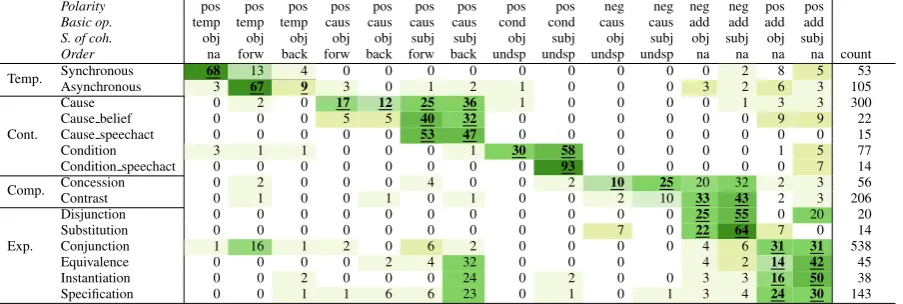
Sanders et al. (In preparation) created a mapping between PDTB 3.0 and CCR, for which they decomposed every PDTB relation into a specific combination of values for CCR dimensions. This decomposition allows us to test whether coherence relations annotated according to the PDTB framework by one annotator fall into corresponding categories when analysed by another annotator using CCR. In order to test this, all PDTB annotations and CCR annota-tions of the SPICE-Ireland corpus have been mapped onto each other. This has resulted in the correspondence matrix shown in Table 3.2 The cells with the bold-font, underlined numbers indicate the predicted mapping as proposed in the decomposition created by Sanders et al. (In preparation). Looking at the PDTB relations in Table 3 first, it can be noted that many labels in the EXPANSION class fall into the same CCR categories: positive, additive, ob-jective/subjective. Further distinctions will be necessary to create more fine-grained differences between these lations, for example to account for a specification re-lation relative to other additive rere-lations. Sanders et al. (In preparation) have proposed several additional fea-tures that should capture these more fine-grained distinc-tions, such as a feature for the specificity of the rela-tion. An additional distinction that is made in PDTB 3.0 but not in CCR is the speechact reading. In PDTB 3.0, there are separate labels for this class of relations (CONTINGENCY.CAUSE SPEECHACT and CON -TINGENCY.CONDITION SPEECHACT), whereas in CCR, speechact relations are classified as subjective relations. A further distinction in the source of coherence would thus account for speechact relations.
2
For a complete version of the table, including level-three distinctions, see http://www.sfb1102.uni-saarland.
Polarity pos pos pos pos pos pos pos pos pos neg neg neg neg pos pos
Basic op. temp temp temp caus caus caus caus cond cond caus caus add add add add
S. of coh. obj obj obj obj obj subj subj obj subj obj subj obj subj obj subj
Order na forw back forw back forw back undsp undsp undsp undsp na na na na count
Temp. Synchronous 68 13 4 0 0 0 0 0 0 0 0 0 2 8 5 53
Asynchronous 3 67 9 3 0 1 2 1 0 0 0 3 2 6 3 105
Cont.
Cause 0 2 0 17 12 25 36 1 0 0 0 0 1 3 3 300
Cause belief 0 0 0 5 5 40 32 0 0 0 0 0 0 9 9 22
Cause speechact 0 0 0 0 0 53 47 0 0 0 0 0 0 0 0 15
Condition 3 1 1 0 0 0 1 30 58 0 0 0 0 1 5 77
Condition speechact 0 0 0 0 0 0 0 0 93 0 0 0 0 0 7 14
Comp. Concession 0 2 0 0 0 4 0 0 2 10 25 20 32 2 3 56
Exp.
Contrast 0 1 0 0 1 0 1 0 0 2 10 33 43 2 3 206
Disjunction 0 0 0 0 0 0 0 0 0 0 0 25 55 0 20 20
Substitution 0 0 0 0 0 0 0 0 0 7 0 22 64 7 0 14
Conjunction 1 16 1 2 0 6 2 0 0 0 0 4 6 31 31 538
Equivalence 0 0 0 0 2 4 32 0 0 0 4 2 14 42 45
Instantiation 0 0 2 0 0 0 24 0 2 0 0 3 3 16 50 38
Specification 0 0 1 1 6 6 23 0 1 0 1 3 4 24 30 143
Table 3: Distribution (%) of explicit and implicit relations, only labels and categories wheren >10 (undsp: underspecified, na: not applicable, nra: no relation annotated) and raw counts
Even though the PDTB 3.0 sets apart speechact relations from other relations more clearly than CCR, it does not seem to set apart other subjective relations from objective relations in a similar manner as CCR. Looking at the cat-egories that CCR distinguishes but the PDTB doesn’t, it is revealed that the PDTB often does not distinguish be-tween the source of coherence in its relation labels. As a result, most relation labels are still underspecified regard-ing their source of coherence. The same goes for CCR’s order: PDTB has encoded Arg1-Arg2 order in their labels, but does not take into account the surface order of their ar-guments. As a result, the order of the segments remains underspecified for most PDTB labels.
Ideally, each type of relation distinguished in one frame-work would be annotated as a similar type in the other framework; i.e. all relations with the PDTB label CONTIN -GENCY.CAUSEshould be annotated as positive causal rela-tions according to the CCR dimensions. A look at Table 3 reveals that this is not always the case for every relation. Overall, 70% of the PDTB relations were consistently cat-egorised as belonging to the target CCR class. For relations where the PDTB label does not map to the predicted CCR categories, the mismatch could be due to different factors. It could be due to different interpretations by the annotators (as reflected also in interannotator agreement when anno-tating within a single framework), or it might be caused by differences in the annotation process and discourse rela-tion definirela-tions of the two frameworks. For example, CCR advises annotators to use connective substitution and para-phrase tests (cf. Knott and Sanders (1998), Scholman et al. (2016)), whereas PDTB does not make use of such tests to determine the label for an explicit relation.
The issues described above, and especially the fact that the frameworks differ in granularity of distinctions between discourse relations, constitute challenges for the goal of achieving a one-to-one mapping. Our suggested mapping is therefore a many-to-many mapping between DRs from the PDTB and CCR frameworks. Finally, there can be dif-ferences between the frameworks in what is annotated as a relation. For example, PDTB annotates ENTRELrelations, whereas CCR does not annotate such cases. In the current mapping, we therefore only consider relations other than ENTRELand NOREL.
To determine whether the cases in which the label in one
framework did not map onto the predicted label in another framework are due to differences between the frameworks (e.g. one theory having a more restricted definition of a spe-cific label) or are caused by other factors, a random sample of 50 disagreements was analysed. 19 disagreements of the 50 were due to annotation errors, i.e. after discussing the re-lation, one annotator agreed that another label was more ap-propriate, and 7 disagreements were caused by differences in segmentation or interpretation. For example, the anno-tators had annotated a different relation and could agree to both values according to a different interpretation. The re-maining 24 cases of the sample of 50 disagreements were in fact caused by differences in operationalisation of the frameworks. This means that the agreement in PDTB 3.0 and CCR annotations for the many-to-many mapping used here may be even higher than the 70%.
Most of the mismatches due to annotation operationalisa-tions can be classified as one of three categories. The first category of disagreements focusses on the definition of CONCESSION in PDTB and negative causals in CCR. CONCESSIONSare mapped as negative causal relations, but in our experiment, the relations that one annotator classified as COMPARISON.CONCESSIONin PDTB were often clas-sified as negative additive by the other annotator (in 52% of the cases). In PDTB, the class CONCESSIONis described as containing relations for which one argument creates an expectation that the other denies. The annotator needs to decide what constitutes an expectation. In CCR, negative causals are described as relations between P and the nega-tive counterpart of Q. A suggested substitution test to de-termine whether a negative relation is additive or causal, is to reverse the polarity and then determine the basic opera-tion. This is illustrated in Example 2, which is taken from a fragment of a speaker who wants to go to a party, but needs to work in a shop instead.
(2) Original:
Cos I wouldn’t mind going down. However the shop won’t be closed I’d say until about seven.
(And that’s a bit too late really to go to Derry.)
Substitution:
In PDTB terms, the first argument leads to the expectation that the speaker will go to the party, which is then denied in the second argument. This would therefore be labeled as a CONCESSION.CONTRA-EXPECTATION. The substitu-tion version is however not the same relasubstitu-tion as the original relation: it becomes clear that the second argument of the relation is not the true cause or the result of the first argu-ment. It would therefore not be labeled as a causal nega-tive relation according to CCR. The substitution test could thus result in a stricter definition of what can be consid-ered a negative causal relation, which in turn causes dis-agreement between the frameworks. It is unclear, however, whether this is really a difference between the frameworks, or whether it is due to annotator bias.
The second category of disagreements revolves around ar-gumentative relations. The CCR dimension source of co-herence distinguishes between objective and subjective lations, such as cause-consequence (objective causal re-lations) and argument-claim (subjective causal rere-lations). Hence, in CCR, if an implicit relation in which one segment provides an argument for the other can be connected by be-cause, the relation can be classified as a causal subjective relation. In PDTB, however, such relations can be classi-fied as additive EXPANSIONrelations, mainly belonging to the types INSTANTIATION, SPECIFICATIONand EQUIVA -LENCE. Example 3 illustrates this issue.
(3) I used the weight room facility for exercising. (im-plicit because)I exercise from physiotherapy that I had to do.
a. PDTB: EXPANSION.SPECIFICATION b. CCR: positive causal subjective backward
The third category of disagreements centers around additive negative relations. In order to determine whether a coher-ence relation is negative, CCR makes use of a substitution test: if the two arguments of a relation can be connected by
but, this indicates that the relation is negative. PDTB does not follow a similar guideline, thereby not automatically classifying these relations as belonging to the COMPARI -SONclass. Example 4 illustrates this issue.
(4) She’s by a Northern-based sire, (implicit but) I think he’s dead now perhaps.
a. PDTB: Expansion.Specification
b. CCR: negative additive subjective (order not applicable)
The main cause of disagreements for these last two cate-gories thus seems to be the relative importance of connec-tives: CCR relies on specific connectives in a specific order of importance (withbutbeing the strongest andandbeing the weakest indicator) to determine the values of the di-mensions, whereas PDTB does not rely on connectives as heavily to determine the end labels.
In sum, the mapping of PDTB and CCR annotations has shown that PDTB relations fall into the target CCR class relatively often (70% of the cases). When a relation does not fall into the target CCR class, the disagreement is of-ten due to (a) annotator errors, irrespective of the frame-works, (b) differences in the definition of what constitutes
a negative causal relation, (c) the operationalisation of the annotation process leading to different annotations, or (d) differences in the segmentation rules leading to the annota-tion of relaannota-tions in one framework that the other does not allow (ENTRREL ANDNOREL).
6.
Genre differences
As pointed out by Webber (2009) based on a discourse ana-lysis of different newspaper genres from the Wall Street Journal, text genre crucially affects the distribution of dis-course relations. For our corpus, we observe a substantial difference in the frequency of coherence relations between the spoken and written genres, as well as between the two spoken genres (Table 1). In this section, we will therefore focus on both comparisons respectively.
6.1.
Spoken vs. written genres
Comparing the spoken to the written genres, the most strik-ing difference is the proportion of implicit to explicit dis-course relations. In the written genres, we have roughly the same proportion (with slightly more explicit relations). In the spoken language data, explicit relations are about twice as frequent as the implicit ones (Table 1). This observation is consistent with Tonelli et al. (2010) who report that ex-plicit relations were more than twice as frequent as imex-plicit ones in the spoken LUNA corpus.
Another difference concerns the use of causal relations in the data. In written genres, situations described in the first segment are oftentimes direct causes of situations described in the second segment, see e.g. Example (5). In spoken language however we find many examples where the causal link between the two arguments is not very strong. Instead,
sooften marks a conclusion based on the information in the first segment (Example 6).
(5) but times have changed, even in UtahsoMr. Red-ford no longer stands out as an extremist
(6) I ’ve already had a meeting uhm an update meeting
sothe place hasn’t burnt down or anything
We annotated those instances as CAUSE BELIEF, follow-ing the revised version of the PDTB 3.0 (PRAGMATIC CAUSE in PDTB 2.0). However, in the PDTB 2.0 corpus no instances have been found for the subtype PRAGMATIC CAUSE.JUSTIFICATION, where the second argument ex-presses the claim and the first argument the justification, as in example (6) above. In our corpus of spoken data, we found 13 instances of this particular type.
6.2.
Broadcast interviews vs. telephone
conversations
Broadcast Telephone
exp imp exp imp Temporal.Asynchronous 7.4 1.5 11.3 3.2 Temporal.Synchronous 5.3 0.2 3.9 0.0 Contingency.Cause 13.0 12.5 21.1 33.8 Contingency.Cause Belief 2.0 1.0 1.3 0.0 Contingency.Cause Sp.act 0.0 0.7 1.1 3.2 Contingency.Cond 7.8 0.0 7.1 0.0 Contingency.Cond Sp.act 3.0 0.0 0.5 0.0 Comparison.Concession 4.5 2.0 4.5 1.6 Comparison.Contrast 13.7 8.3 12.3 11.4 Expansion.Conjunction 32.3 29.8 32.9 13.9 Expansion.Equivalence 0.9 11.5 0.2 10.4 Expansion.Instantiation 1.7 7.3 0.3 0.9 Expansion.Specification 4.7 23.5 0.3 19.9
Other 3.8 1.7 3.2 1.9
total (%) 100.0 100.0 100.0 100.0
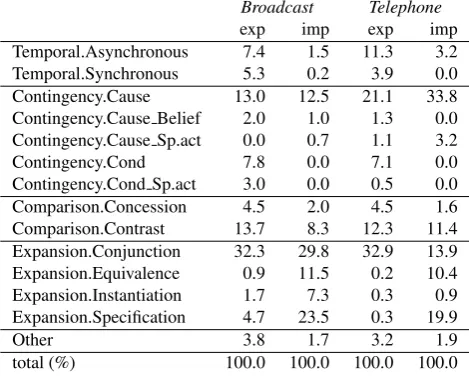
Table 4: Distribution of the most frequent coherence rela-tions across the spoken genres
(BC) versus 14.9% (TEL) are annotated as CONTIN -GENCY.CAUSE.RESULT. Despite this striking difference, in both genres the majority of explicit causal relations are marked by the same connectives,becauseandso.
7.
Challenges for the annotation of DRs in
spoken language
Next, we will discuss challenges for the annotation of dis-course relations in spoken language. Example (6) illus-trates a Conclusion relation that is rare in written lan-guage. While no annotated instances have been found in the PDTB 2.0 corpus, the PDTB 3.0 annotation scheme does provide the labels to deal with those cases (CONTIN -GENCY.CAUSE BELIEF.RESULT). In CCR, on the other hand, examples like this would be annotated as positive causal objective forwardand thus would not be distinguish-able from other subjective causal relations such as Exam-ples (1) or (5). Further distinctions would be necessary to account for such relations.
Spoken language also provides additional means to express contrast, e.g. through topicalisation and sentence stress (see Example (7)), that are not easily accessible in the written medium.3 These instances are comparable to the ones an-notated as AltLex in the PDTB, where the existence of an alternative lexicalisation blocks the insertion of an implicit connective (compare 8a, 8b). One solution is to introduce new categories similar to AltLex, e.g. AltTop and AltStress (Alternative Topicalisation, Alternative Stress).
(7) Context: Are you busy over Haloween?
Uhm I’m not actually becauseoh-wellTHAT week you mean
(8) I’m not busy in the first week of October
a. butyou mean THAT week
b. *butTHAT week you mean
Another phenomenon typical for spoken discourse is the repetition of identical or near-identical sequences, often used for reinforcement or intensification (examples (9) and
3In computer-mediated communication, capitalisation can be
used to mark stress.
(10)). We annotated those cases as EQUIVALENCE. How-ever, this might be in contrast to the originally intended meaning of the label in the PDTB, where EQUIVALENCE was used when the same situation is described from differ-ent perspectives (Prasad et al., In preparation).
(9) SPK1: He ’s okay SPK1: he ’s okay
(10) SPK1: That ’s brilliant SPK1: Oh fantastic news SPK1: Well done Rachel-Anne SPK1: That ’s brilliant
Similar to Tonelli et al. (2010), we decided against limit-ing the annotation of implicit DRs to adjacent sentences, as done for the English PDTB corpus, as in spoken course arguments are often separated by fragments or dis-fluent segments (e.g. unfinished utterances, backchannel signals, exclamations; see example (11)).
(11) SPK1: I ’m on email every dayARG1 SPK1: you know
SPK1: I can
SPK1: I ’ve access to it nowARG2
Overall, the issues discussed here need to be addressed in the annotation guidelines of the two frameworks. The re-vised version of the PDTB (Prasad et al., In preparation) already addresses some properties of spoken language. For example, in our data we found frequent uses of pragmatic discourse relations, both epistemic and speechact, thus con-firming the usefulness of the revised PDTB 3.0 hierarchy.
8.
Conclusions
In the present paper, we described our annotation of coher-ence relations with respect to two frameworks, PDTB 3.0 and CCR, on two spoken domains, private telephone con-versations and public broadcast interviews. The contribu-tions of this paper are three-fold.
Secondly, we have identified differences in distribution of discourse relations between genres. Most strikingly, we ob-served a higher proportion of explicit to implicit relations in spoken data compared to written data: explicit relations are approximately twice as frequent as implicit relations in spoken data. In written genres, on the other hand, the pro-portion is roughly the same.
Finally, we have discussed challenges for applying the an-notation schemes to spoken language. PDTB 3.0 has ad-dressed many issues that were present in PDTB 2.0, for example by adding separate labels for speechact relations. CCR does not distinguish between speechact relations and other subjective relations. We argue that this could be a useful distinction for the analysis of spoken data. We also identified two additional categories of relations that could be added to PDTB 3.0 for spoken data, namely Alternative Topicalisation and Alternative Stress.
9.
Acknowledgements
This research was funded by the German Research Founda-tion (DFG) as part of SFB 1102 “InformaFounda-tion Density and Linguistic Encoding” and the Cluster of Excellence EXC 284 “Multimodal Computing and Interaction”.
10.
References
Afantenos, S., Asher, N., Benamara, F., Bras, M., Fabre, C., Ho-Dac, M., Draoulec, A. L., Muller, P., Pery-Woodley, M.-P., Prevot, L., Rebeyrolles, J., Tanguy, L., Vergez-Couret, M., and Vieu, L. (2012). An empirical resource for discovering cognitive principles of discourse organ-isation: the ANNODIS corpus. In Proceedings of the Eight International Conference on Language Resources and Evaluation, LREC’12.
Benamara, F. and Taboada, M. (2015). Mapping different rhetorical relation annotations: A proposal. In Proceed-ings of the 4th Joint Conference on Lexical and Compu-tational Semantics, *SEM.
Bunt, H., Prasad, R., and Joshi, A. (2012). First steps towards an ISO standard for annotating discourse rela-tions. In Proceedings of the Joint ISA-7, SRSL-3, and I2MRT LREC 2012 Workshop on Semantic Annotation and the Integration and Interoperability of Multimodal Resources and Tools.
Carlson, L., Marcu, D., and Okurowski, M. E. (2002). RST discourse treebank, ldc2002t07. Web Download. Philadelphia: Linguistic Data Consortium.
Chiarcos, C. and Sukhareva, M. (2012). Ontologies of lin-guistic annotation. Semantic Web, 1(0).
Chiarcos, C. (2014). Towards interoperable discourse an-notation. discourse features in the ontologies of linguis-tic annotation. In Proceedings of the Ninth Interna-tional Conference on Language Resources and Evalua-tion, LREC’14, Reykjavik, Iceland.
da Cunha, I., Torres-Moreno, J., and Sierra, G. (2011). On the development of the RST spanish treebank. In Pro-ceedings of the Fifth Linguistic Annotation Workshop, LAW 2011, pages 1–10, Portland, Oregon.
Demirs¸ahin, I. and Zeyrek, D. (2014). Annotating dis-course connectives in spoken Turkish. In Proceedings
of LAW VIII - The 8th Linguistic Annotation Workshop, pages 105–109, Dublin, Ireland, August. Association for Computational Linguistics and Dublin City University. Kallen, J. L. and Kirk, J. M., (2008). ICE-Guide. Belfast:
Cl´o Ollscoil na Banr´ıona.
Kallen, J. and Kirk, J., (2012). SPICE-Ireland: A User’s Guide. Belfast: Cl´o Ollscoil na Banr´ıona.
Knott, A. and Sanders, T. (1998). The classification of coherence relations and their linguistic markers: An exploration of two languages. Journal of pragmatics, 30(2):135–175.
Prasad, R. and Bunt, H. (2015). From semantic relations in discourse: The current state of iso 24617-8. In Pro-ceedings of the Eleventh Joint ACL - ISO Workshop on Interoperable Semantic Annotation.
Prasad, R., Dinesh, N., Lee, A., Miltsakaki, E., Robaldo, L., Joshi, A., and Webber, B. (2008). The penn dis-course treebank 2.0. In Proceedings of the 6 Interna-tional Conference on Language Resources and Evalua-tion, LREC’08. European Language Resources Associa-tion.
Prasad, R., Webber, B., Lee, A., and Joshi, A. (In prepara-tion). Discourse relations in the pdtb 3.0.
Sanders, T., Spooren, W., and Noordman, L. (1992). To-ward a taxonomy of coherence relations. Discourse Pro-cesses, 15:1–35.
Sanders, T., Vis, K., and Broeder, D. (2012). Project notes on the dutch project discan. InEighth Joint ACL - ISO Workshop on Interoperable Semantic Annotation. Sanders, T., Demberg, V., Evers-Vermeul, J., Hoek, J.,
Scholman, M., and Zufferey, S. (In preparation). Uni-fying dimensions in discourse annotation.
Scholman, M. C., Evers-Vermeul, J., and Sanders, T. J. (2016). A step-wise approach to discourse annotation: Towards a reliable categorisation of coherence relations.
Dialogue and Discourse, 2(7).
Stoyanchev, S. and Bangalore, S. (2015). Discourse in cus-tomer care dialogues. Poster presented at the DiSpoL 2015 workshop ”Identification and Annotation of Dis-course Relations in Spoken Language”, October 2015 in Saarbr¨ucken, Germany.
Sweetser, E. (1990). From Etymology to Pragmatics: Metaphorical and Cultural Aspects of Semantic Struc-ture. Cambridge University Press.
Tonelli, S., Prasad, R., and Joshi, A. (2010). Annotation of discourse relations for conversational spoken dialogs. In
Proceedings of the 7 International Conference on Lan-guage Resources and Evaluation, LREC’10.