2019 International Conference on Computer Intelligent Systems and Network Remote Control (CISNRC 2019) ISBN: 978-1-60595-651-0
Modulation Characteristics of Active Frequency
Selective Surface Trihedral Corner Reflector
Lei Liu, Dejun Feng, Junjie Wang, Kunpeng Song and Longfei Shi
ABSTRACT
The conventional passive jamming devices such as corner reflectors and chaffs cannot achieve the flexible modulation of radar signal for their fixed scattering cross section. As a passive material, active frequency selective surface (FSS) can dynamically control their electromagnetic characteristics and has been widely applied in the radar target stealth field. In this paper, a radar signal modulation method is proposed based on active FSS trihedral corner reflector. The scattering characteristics and modulation principle of active FSS trihedral corner reflector are analyzed in detail. The effectiveness of the design is demonstrated by simulation results. This design provides a new and efficient method of radar signal modulation.
KEYWORDS
Active Frequency Selective Surface, Modulation Characteristics, Trihedral Corner Reflector.
INTRODUCTION
A corner reflector is a dihedral or trihedral structure composed of two or three mutually perpendicular metal plates. Due to its special geometry, it produces multiple internal reflections on incident electromagnetic waves and has a strong backward radar cross section (RCS). It is often used to constitute a false target for false falsehood. The geometry of the trihedral reflector is stable. When the plates are orthogonal to each other, it can generate strong scattering over a wide-angle range. This means it has a large RCS, so the trihedral corner reflector is used widely. However, the traditional corner reflector has obvious defects. Because its RCS strongly depends on the incident wavelength. In addition, its scattering characteristics is fixed once it is fabricated.
This paper proposes a method of radar signal modulation based on active frequency selective surface (FSS) trihedral corner reflector. The active FSS realizes the dynamic real-time regulation of its electromagnetic scattering characteristics by introducing an external excitation term into the artificial electromagnetic material. The basic design principle is to cover the trihedral reflector with active FSS components and control the scattering characteristics of the trihedral reflector by
__________________________________________
Lei Liu, Dejun Feng, Junjie Wang, Kunpeng Song, Longfei Shi
adjusting the voltage of the diode to achieve the amplitude modulation effect on the radar signal.
In this paper, a method of radar signal modulation is proposed based on active FSS trihedral corner reflector. In Section II, the active FSS trihedral corner reflector’s structure is analyzed. In Section III, the modulation effect of the active FSS trihedral reflector on the signal is simulated. Finally, conclusions are drawn in Section IV.
ACTIVE FSS AND TRIHEDRAL CORNER REFLECTOR MODEL
Active FSS Unit Cell
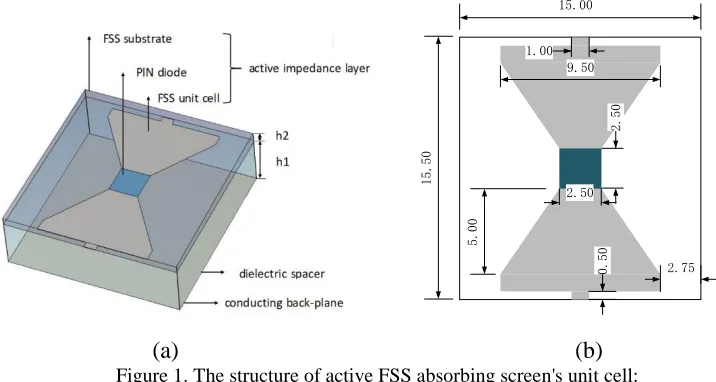
The bow-tie dipole is selected as the basic unit cell model of active FSS absorber due to strong absorbing efficiency, wide absorption bandwidth and simple construction. The geometry of the active FSS is illustrated in Figure 1. The active FSS consists of periodic patterns of conducting metal back-plane, dielectric spacer and the active impedance layer. The active impedance layer includes FSS substrate, FSS unit cell and PIN diodes. The PIN diodes act as current controlled variable resistors in the structure.
The planar size of the unit cell of the active FSS is 1515.5mm². The conducting back-plane is a metal plate. The dielectric spacer has a relative permittivity of =4.4 and a thickness of h1=4.2 mm. The thickness of each active impedance layer is h2=0.8 mm and the whole thickness of the active FSS is H=5.0 mm. The FSS circuit board was arranged ‘face downwards’ in the assembly and the PIN diode is embedded into the dielectric foam spacer. In this way, the FSS substrate could act as a protective outer skin.
15.00 15 . 50 2.50 1.00 9.50 2.75 5 . 00 0 . 50 2 . 50
[image:2.612.122.480.459.650.2](a) (b)
Active FSS Structure
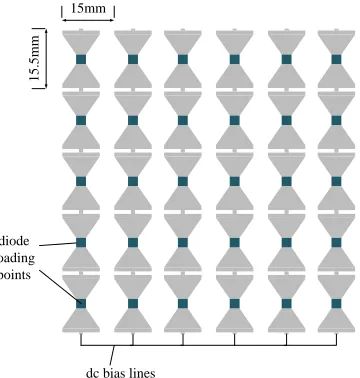
In its basic form an active FSS consists of a two-dimensional, planar periodic grid of conducting patches, or elements, supported on a dielectric substrate. The board measures 236 mm by 236 mm and contains 256 (16 by 16) dipole elements. An active absorber was constructed using the assembly details shown in Figure 2 by mounting the FSS above a conducting back-plane using a 4.2 mm thick, low-loss, foam dielectric spacer (Rhocell 51, εr = 1.05, tan = 0.0017).
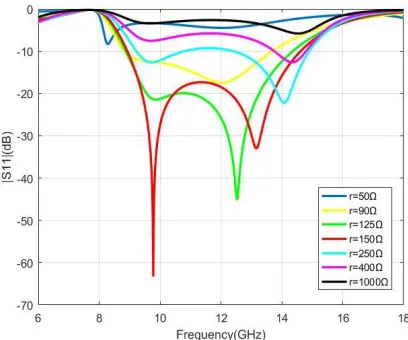
The principal characteristic of the bow-tie dipole patch is the resonant behavior of its transmission coefficient. To better understand the performance of the proposed bow-tie dipole active FSS, initially full wave electromagnetic simulations were conducted using CST Microwave Studio™. Considering the external excitations mainly affects PIN diode's impedance value, the lumped element can be used to take place of the PIN diode. In the CST simulation, the variation of the voltage applied to the diode is simulated by setting a series of different impedance values of lumped elements. So the dynamic performance of the active FSS absorbing screen can be simulated. The results of the reflection (S11) responses of the active FSS is provided in Figure 3.
15mm
15
.5
mm
dc bias lines diode
[image:3.612.221.401.358.547.2]loading points
Figure 3. The reflection (S11) responses of the active FSS.
Active FSS Trihedral Corner Reflector Model
SIMULATION AND RESULTS
The foregoing analysis shows that the active FSS trihedral corner reflector can realize the radar signal amplitude modulation. Since PIN diodes can work as variable resistors at microwave frequencies, the dynamic performance of the active FSS absorbing screen can be simulated by setting a series of different impedance values of lumped elements in the CST simulation.
The modulation properties of the bow-tie shaped active FSS trihedral corner reflector are simulated by CST over the frequency range from 8 to 12 GHz. It was
excited by a uniform plane wave for the incident angle: =45°, φ=45°. The
background material is vacuum. All the boundaries are set to be open boundaries. Resistors are loaded into the FSS unit cell to model the variation in PIN diode resistance, and its value varies from 100 to 3100 Ω.
Figure 5. The RCS of the active FSS trihedral corner reflector.
Figure 5 demonstrates the RCS of the active FSS trihedral corner reflector. It has an absorption peak appear at 8.5 GHz. The bandwidth of the absorption peak can reach 400 MHz. The RCS is approximately -20 dBsm, when the resistance value is 1300 Ω, showing a low-scattering state. While the RCS is approximately -1 dBsm when the resistance value is 100 Ω, showing a high-scattering state. Therefore, this frequency band can be defined as a tunable area between the high-scattering state and low-high-scattering state. When the band of radar transmitting signal is within the tunable area of the active FSS trihedral corner reflector, the active FSS trihedral corner reflector can realize the modulation switching between high-scattering and low-high-scattering to the transmitting signal by regulating the impedance values of lumped elements, and the absorption attenuation can reach 20 dBsm.
When the radar transmits the LFM signal to the active FSS absorption screen, the spectrum of the echo signal R(f) can be expressed as
R f S f A f (a)
S(f) represents the spectrum of the incident LFM signal. A(f) represents the
frequency response of the active FSS absorbing screen. LA represents the degree of
the bandwidth of the absorption peak. fA represents the center frequency of
absorption peak.
f
fA
BA
LA
[image:6.612.223.388.111.225.2]A
Figure 6. Amplitude modulation by active FSS trihedral corner reflector.
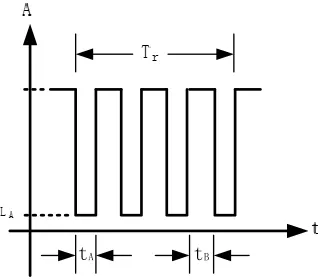
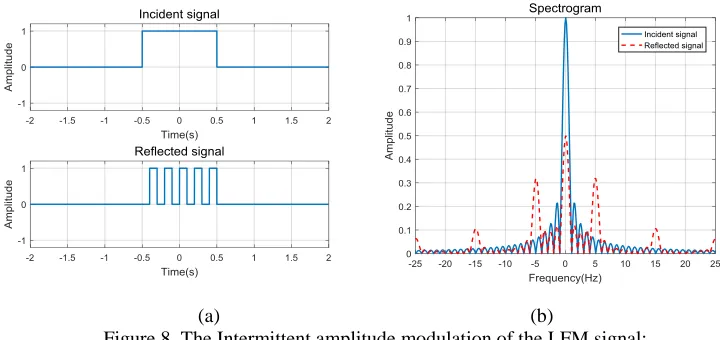
When the active FSS is controlled by a fixed bias current, its frequency response A(f) remains the same, and the signal characteristics of the intermittent modulation by the active FSS absorbing screen can be simply obtained by the formula (a). Assuming that the active FSS exhibits a maximum absorption amplitude, the control bias current is Imax. As shown in Figure 7, when the bias
current is continuously switched between the zero and Imax states throughout the incident pulse time, the active FSS absorber screen operates in an intermittent scattering state. The frequency response function of the active FSS absorbing screen A(f) changes continuously with the change of the control current during the pulse irradiation, and the effect on the reflected signal appears as the effect of the amplitude modulation. A variety of modulation patterns can be realized based on the principle of intermittent sampling.
tA tB
Figure 7. Intermittent amplitude modulation of the LFM signal.
[image:6.612.227.388.459.599.2](a) (b)
Figure 8. The Intermittent amplitude modulation of the LFM signal: (a) time spectrum; (b) frequency spectrum.
CONCLUSION
The main novelty of this paper is to propose a radar signal modulation method based on the active frequency selective surface trihedral corner reflector. In this paper, the active FSS trihedral corner reflector is modeled and its scattering properties are simulated. The result shows that the active FSS trihedral corner reflector can obtain the flexible switching between high-scattering and low-scattering states by adjusting the voltage of the bias circuit, and it can also achieve wave beam backtracking, demonstrating that the active FSS trihedral reflector could achieve dynamically adjustable amplitude modulation.
ACKNOWLEDGEMENTS
Corresponding author: Dejun Feng
REFERENCES
1. A. Tennant and B. Chambers, “A single-layer tunable microwave absorber using an active FSS,” IEEE Microw. Wirel. Compon. Lett., vol. 14, no. 1, pp. 46–47, 2004.
2. John Baldauf, S W Lee, Luke Lin, Shyhkang Jeng, Steven M Scarborough, C L Yu, “High frequency scattering from trihedral corner reflectors and other benchmark targets: SBR versus experiment,” IEEE Transactions on Antennas and Propagation, vol. 9, no. 39, pp. 1345-1351, 1991.
3. Liang Z, Yang G, Wu Q, et al. A Novel Active Frequency Selective Surface With Wideband Tuning Range for EMC Purpose[J]. IEEE Transactions on Magnetics, 2012, 48(11):4534-4537. 4. Jialin Li, Jianjun Jiang, Yun He, Wenhua Xu, Mi Chen, Ling Miao, Shaowei Bie, “Design of a
Tunable Low-Frequency and Broadband Radar Absorber Based on Active Frequency Selective Surface,” IEEE Antennas & Wireless Propagation Letters., vol. 15, pp. 774-777, 2016.
5. S. Ghosh and K. Srivastava, “Polarization-Insensitive Single-/Dual-Tunable Absorber With Independent Tuning in Wide Frequency Range,” IEEE Trans. Anten. Prop., vol. 65, no. 9, pp. 4903-4908, Sep. 2017.
7. Q. Chen, S. Yang, J. Yang, J. Bai and Y. Fu, “Design of Absorptive/Transmissive Frequency-Selective Surface Based on Parallel Resonance,” IEEE Trans. Anten. Prop., vol. 65, no. 9, pp. 4897-4902, Sep. 2017.
8. H. Li, Q. Cao, L. Liu and Y. Wang, “An Improved Multifunctional Active Frequency Selective Surface,” IEEE Trans. Anten. Prop., vol. 66, no. 4, pp. 1854-1862, Apr. 2018.