4-Couv
: A New Treebank for French
Philippe Blache, Gr´egoire Montcheuil, Laurent Pr´evot, St´ephane Rauzy
Laboratoire Parole et Langage - UMR 73095 avenue Pasteur, 13100 Aix-en-Provence, France [email protected]
Abstract
The question of the type of text used as primary data in treebanks is of certain importance. First, it has an influence at the discourse level: an article is not organized in the same way as a novel or a technical document. Moreover, it also has consequences in terms of semantic interpretation: some types of texts can be easier to interpret than others. We present in this paper a new type of treebank which presents the particularity to answer to specific needs of experimental linguistic. It is made of short texts (book backcovers) that presents a strong coherence in their organization and can be rapidly interpreted. This type of text is adapted to short reading sessions, making it easy to acquire physiological data (e.g. eye movement, electroencepholagraphy). Such a resource offers reliable data when looking for correlations between computational models and human language processing.
Keywords:Treebank, French, Constituency, Treebanking Tools, Experimental Linguistic
1.
Introduction
Several treebanks already exist for French. The most pop-ular one is theFrench Treebank(Abeill´e et al., 2003,FTB) and its different evolutions or enrichments (Schluter and van Genabith, 2007; Candito et al., 2010). Other French de-pendency treebanks are also available, for example through theSequoia project(Candito and Seddah, 2012; Candito et al., 2014) or theUniversal Dependenciesproject (Nivre et al., 2015). However, and this constitutes the first motivation for developing a new treebank, it still remains necessary to develop other resources in order to increase the size and the variety of available material. A second and even more important reason to build specific treebanks is the type of application it can be used for. More precisely, classical tree-banks are usually made of newspaper articles, rather long, and which interest when reading can be poor. This can con-stitute a drawback (or even a bias) when using such texts in human experimentation (in particular reading). In such cases, short, semantically coherent and self-contained texts are preferable for the acquisition of physiological responses from reading subjects.
The solution we propose in this perspective consists in building a corpus of book backcovers1, that are short texts, easily available and frequently used. We present in this pa-per the corpus2, its annotation and first results.
2.
Corpus description
Backcovers are short texts of different genres: extract, syn-opsis, genesis of the book, comment about the work, or a combination of them. Each text is semantically self-contained, and interesting (minimizing attention and com-prehension drops). A text contains between 4-10 sentences and 80-200 tokens (80% having at most 30 tokens). We have build such a corpus, which is still under evolution. At this stage, it consists in 8,000 texts from different pub-lishers (from Pocket and Gallimard pubpub-lishers, with their agreement). These texts have been selected manually by
1The French appellation of a backcover is “
4`eme de couver-ture”, leading to the treebank acronym:4-Couv.
2
Available on the ORTOLANG platform, hdl:11403/4-couv
three experts, according to a set of criteria among which interest when reading and semantic coherence. A subset of 500 texts, representing 3,500 sentences, has been annotated at morpho-syntactic, syntactic and to some extent discourse levels.
3.
Annotations
4-Couv is a long-term project, that will be enriched pro-gressively. The annotation process has then to be carefully documented. We present in this section the main features of the annotation guide and its application. We have decided to use a constituency-based representation first because we already have developed a parser in this format, second be-cause we already did several experiment with the FTB, us-ing different complexity indexes based on such format. An hybrid version of our treebank, integrating a dependency version, is planned.
3.1.
Annotation guide
Most of the works in French parsing being done starting from theFTB, we decided to stay as close as possible with theFTBformat. So the treebank is constituency-based and syntactic relations are represented by means of trees. How-ever, theFTBcontains several specific annotations, aiming at reducing the embedding of the trees (limitation of the projections, suppression of the VP level, affixation of cli-tics, etc.). In order to be compatible with more standard for-mats used in other treebanking projects, we slightly modi-fied the initialFTBannotation guide. More generally, we apply the following formal constraints:
• no empty category is inserted in the trees (e.g. in the case of an elliptical construction), each node is instan-tiated by a lexical or a phrase-level unit.
(1) “il est ici question d’amours ´eph´em`eres”
(it is here an issue of ephemeral loves)
Sint
• no discontinuous constituent or unbounded dependen-cies directly encoded, such as in (2).
(2) “Ce film, Paul et moi on a ador´e.”
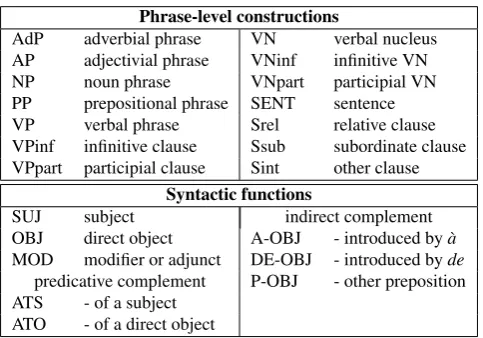
• the phrase-level tagset (see figure 1) is reduced to clas-sical phrases, at the exclusion of other constructions such as coordination (at the difference with theFTB and its derivatives).
• coordinations are represented by a succession of bi-nary trees, as in (3).
(3) “il a connu la chute, le d´enuement, la torture”
(he known the fall, the deprivation, the torture)
Sint
• the same types of syntactic functions than those intro-duced for theFTB(see figure 1) are used. This annota-tion is less precise then other annotaannota-tion frameworks, such as (Gendner et al., 2009) where structural and functional informations were given independently.
Phrase-level constructions
AdP adverbial phrase VN verbal nucleus AP adjectivial phrase VNinf infinitive VN NP noun phrase VNpart participial VN PP prepositional phrase SENT sentence VP verbal phrase Srel relative clause VPinf infinitive clause Ssub subordinate clause VPpart participial clause Sint other clause
Syntactic functions
SUJ subject indirect complement OBJ direct object A-OBJ - introduced by`a
MOD modifier or adjunct DE-OBJ - introduced byde
predicative complement P-OBJ - other preposition ATS - of a subject
ATO - of a direct object
Figure 1: Syntactic tagset
3.2.
Morphosyntax
At the lexical level, the first step has concerned tokeniza-tion. It is based on theMarsaLexFrench lexicon3, contain-ing 595.000 entries with their frequencies. Tokenization is maximal in that even highly constrained forms are split into distinct lexical units provided they follow syntactic compo-sition rules. For example, constituents of semi-fixed ex-pressions such as“il ´etait une fois”(once upon a time) or “mettre `a nu”(lay bare) are decomposed, at the difference with other multiwords expressions as“d’autant plus”(all the more) or“tant mieux”(great) as they do not follow any syntactic composition.
Each lexical category has a specific features set (see fig-ure 2), although many featfig-ures are common to different cat-egories (typically the gender, number, person). The part-of-speech and feature sets are relatively standard and compat-ible with most of automatically tagged corpus, and enable to indicate a combination of lexical, morphologic, syntac-tic and occasionally semansyntac-tic informations that will have effect on the syntactic construction of upper levels, e.g. the number of a determiner, the subcategorization or the case of a clitic pronoun. We do not have discontinuous lexical constituent, and the tagging is disambiguated (i.e. each el-ement have one part-of-speech, whose sub-categories fea-tures could be underspecified when necessary). We do not modify the category of units that change their paradigm (“une tarte maison”(an home[made] pie),“il est tr`es zen” (he is very zen)).
The second step, POS-tagging, is done with theMarsaTag4 tagger (0.975 F-Measure on written texts), trained on the LPL-Grace corpus (700,000 tag manually corrected). It as-sociates each token with a list of possible tags with their probability, as described in figure 3.
The automatic POS tagging has been manually corrected thanks to a specific editing tool, making it possible to cor-rect labels as well as features (see section 4.2.). Among recurrent errors, several concern the agreement features, in particular determiner and adjective genders. Only few er-rors concern categorization itself, which confirms the
F-3
hdl:11041/sldr000850
4
Category features
Adjective nature, type, gender, number, position Adverb nature, type
Connector nature
Determiner nature, type, person, gender, number Interjection
Noun nature, type, gender, number, referent type Punctuation nature
Preposition type
Pronoun nature, type, person, gender, number, case, reflective, postposed
Verb nature, modality, tense, person, gender, number, auxiliary, pronominal, (im)personal, direct object, indirect complement
Figure 2: Lexical categories and features
Figure 3: POS tagging
score level of the tagger. Finally, many errors concern words with a high amount of possible tags (category and feature ambiguity) such as “comme” or “que”.
3.3.
Syntax
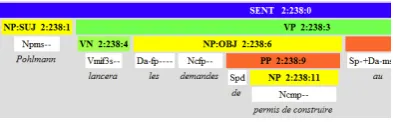
The generation of the treebank has been done automati-cally thanks to the MarsaTagparser, trained on a subset of 100,000 words of the FTB, manually corrected and la-belled following the 4-Couvannotation format (as shown in figure 4).
Figure 4: Output of the parser
Among the initial corpus of 500 texts, 200 have been man-ually corrected, representing 1,500 trees. The correction has been done thanks to a specific editor (see section 4.3.). Several recurrent types of errors has been identified and fixed, such as the coordination between conjuncts of dif-ferent types, as well as enumerations. Other kinds of errors come, classically, from ambiguous attachments. Some of the errors concern the labelling. For exampleVPinf intro-duced by aPrepshould be encoded as aPPplus aVPinf.
Finally, several errors concern function labels (clitics and subordinates, in particular).
3.4.
Discourse
Back covers naturally host interesting discourse structures. We consider them as a good starting point for applying eye-tracking methodology to discourse structure studies. As a pilot study (Pr´evot et al., 2015), we annotated 7 back covers selected for their interest followingAnnodis guide-lines (Muller et al., 2012). These guideguide-lines provide in-struction to segment a text intodiscourse unitsas well as to relate the units through discourse relations such as Nar-ration, Explanation, etc.. The annotation framework is grounded inSegmented Discourse Representation Theory (Asher and Lascarides, 2003). From the structures anno-tated we are able to extract a set of predictors for reading time corresponding to the main characteristics of the dis-course structures. The predictors extracted were, for each discourse unit: # relations involving the unit, # potential attachment points, distance to attachment point, length of furthest anaphoric, New topic , Position in the discourse. The pilot study involving only 16 subjects reading these 7 texts have not provided enough data to establish clear dis-course structure impact on reading time. The results how-ever validated our overall set-up since known effects about proper names, numbers and word size (at token level) tak-ing longer to read were replicated. The amount of data needed to establish subtle discourse constraints is too large5 given the costly discourse annotation process. However a solution of manipulating control ’original’ texts annotated to form hypotheses-driven modified text from an interme-diate size corpora seems to be a very promising option. It will allow to preserve all the good properties of back covers dataset while allow discourse experiements by direct com-parison of parallel texts.
4.
Treebanking tools
The4-Couvtreebank required the development of two dif-ferent types of tools, adapted to this project: corpus build-ing (selection, checkbuild-ing and rankbuild-ing of the texts) and tree edition for manual correction.
Annotation layer automatic tool manual (post-)edition Interestingness - Text selector
POS MarsaTag POS-tagging corrector
Syntax MarsaTag Tree editor
Discourse ? ???
Figure 5: Annotation layers and tools
4.1.
Text Selector
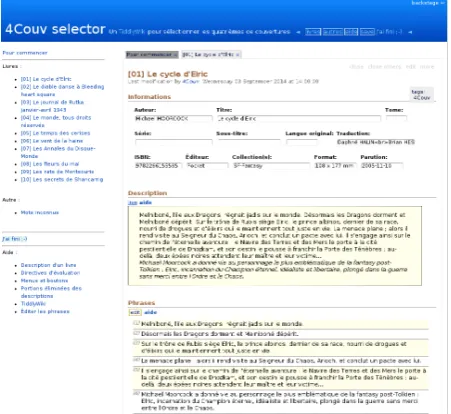
The Text Selector is a tool helping in the selection of the texts, on the form of HTML files each containing 10 texts to evaluate. Each unit presents the book description and the text, segmented into sentences. It also proposes an evalu-ation form (containing check boxes and drop-down lists),
5Our previous study on morpho-syntax effects (Blache and
and the list of unknown words, to be manually tagged. This interface (see figure 6) makes it possible to easily correct different types of errors, including sentence segmentation as well as metadata.
Using autonomous HTML files makes easier the distribu-tion of the revision work between several annotators. It does not require any particular environment (files being edited directly in a browser), neither a connection to a server. The revision tool relies on an adaptation of a Tid-dlyWiki6enriched with scripts for adding extra information to the texts.
Figure 6: Selection tool: global view
4.2.
POS-tagging corrector
The morphosyntactic correction tool (see figure 7) presents one token per line, each line containing the form and the list of possible tags associated to the form, starting with the chosen one. All possible labels anf features are then proposed. Correcting a tag simply consists in chosing a new one in the list or manually editing it.
Figure 7: POS-tagging corrector
6http://classic.tiddlywiki.com/(version 2.8.1)
4.3.
Tree editor
The syntactic correction tool is a tree editor. Only few of them already exist such as WordFreak (Morton and LaCivita, 2003) orTrED 2.0 (Pajas and ˇStˇep´anek, 2008). More recently, some web-based annotation platforms have also been developed, offering an intuitive and fast annota-tion (brat(Stenetorp et al., 2012), as well as project man-agement facilities for example by specifying the roles such as annotator, curator or project manager (GATE Teamware (Bontcheva et al., 2013),WebAnno(Yimam et al., 2013)). However, if some of these platforms have been developed or adapted for dependency-based treebanks (see figure 8), none is suited for constituency-based treebanks (requiring therefore to deal with a potentially large number of levels, see figure 9).
Figure 8: a dependency tree withbrat
Figure 9: a constituent tree withbrat
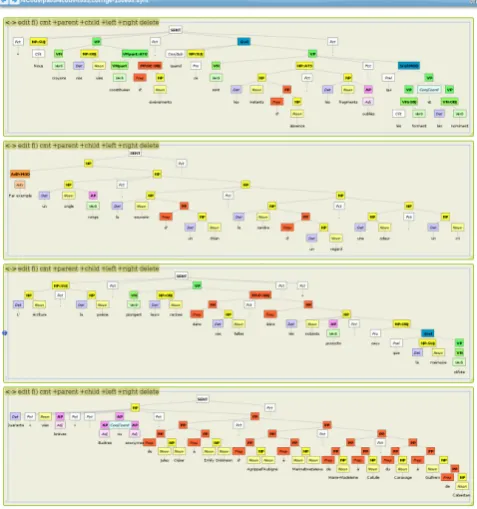
To take advantage of web-based platforms, we developed a specific editor javascript library, that could run in a single HTML or to be integrated into an annotation platform such asbrat(see figure 10) orWebAnno. The library shows each tree in a resizable and zoomable vectorial image (SVG), whose colors are customizable with CSS style sheets. Sub-trees could be moved by a simple drag and drop. A double-click on nodes allows to edit its tag, and buttons or con-textual menu offers other edition functionalities (insertion, deletion, etc., see figure 11).
5.
Perspectives
The4-Couvtreebank constitutes a new kind of resources, answering at the same time to the classical needs of lin-guistic description as well as experimental linlin-guistics. This treebank, because being made of short texts, can propose a complete annotation at both syntactic and discourse lev-els. Moreover, this characteristics also makes it possible to acquire physiological data such as eye movement or brain activity by controlling easily different parameters. A first eye-tracking experiment have been done, studying differ-ent effects of word categories.
Figure 10: the syntactic tree editor inbrat
Figure 11: editing a syntactic tree
6.
Acknowledgments
This work has benefited from the French State support via its “Investissements d’avenir” programs ORTOLANG (ANR-11-EQPX-0032), BLRI (ANR-11-LABX-0036) and A*MIDEX (ANR-11-IDEX-0001-02).
7.
Bibliographical References
Asher, N. and Lascarides, A. (2003). Logics of conversa-tion. Cambridge University Press.
Blache, P. and Rauzy, S. (2012). Robustness and process-ing difficulty models. a pilot study for eye-trackprocess-ing data on the french treebank. In24th International Conference on Computational Linguistics, page 21.
Bontcheva, K., Cunningham, H., Roberts, I., Roberts, A., Tablan, V., Aswani, N., and Gorrell, G. (2013). Gate teamware: a web-based, collaborative text anno-tation framework. Language Resources and Evaluation, 47(4):1007–1029.
Gendner, V., Vilnat, A., Monceaux, L., Paroubek, P., Robba, I., Francopoulo, G., and Gu´enot, M.-L. (2009). Les annotation syntaxiques de r´ef´erence PEAS. Techni-cal report, version 2.2.
Morton, T. and LaCivita, J. (2003). Wordfreak: An open tool for linguistic annotation. In Proceedings of NAACL-Demonstrations ’03, pages 17–18, Stroudsburg, PA, USA. Association for Computational Linguistics. Muller, P., Vergez-Couret, M., Pr´evot, L., Asher, N.,
Be-namara, F., Bras, M., Le Draoulec, A., Vieu, L., et al. (2012). Manuel d’annotation en relations de discours du projet annodis. Technical report, Toulouse University. Pajas, P. and ˇStˇep´anek, J. (2008). Recent advances in a
feature-rich framework for treebank annotation. In Pro-ceedings of the 22nd International Conference on Com-putational Linguistics (Coling 2008), pages 673–680, Manchester, UK, August. Coling 2008 Organizing Com-mittee.
Pr´evot, L., P´enault, A., Rauzy, S., de Montcheuil, G., and Blache, P. (2015). Discourse structure of back covers: A pilot study. InIn Proceedings of TextLink First Action Conference, page 54.
Stenetorp, P., Pyysalo, S., Topi´c, G., Ohta, T., Ananiadou, S., and Tsujii, J. (2012). brat: a web-based tool for nlp-assisted text annotation. In Proceedings of the Demon-strations at the 13th Conference of the European Chapter of the Association for Computational Linguistics, pages 102–107, Avignon, France, April. Association for Com-putational Linguistics.
Yimam, S. M., Gurevych, I., de Castilho, R. E., and Bie-mann, C. (2013). Webanno: A flexible,web-based and visually supported system for distributed annotations. In Proceedings of the 51st Annual Meeting of the Associa-tion for ComputaAssocia-tional Linguistics (System Demonstra-tions) (ACL 2013), pages 1–6, Stroudsburg, PA, USA, August. Association for Computational Linguistics.
8.
Language Resource References
Abeill´e, A., Cl´ement, L., and Toussenel, F. (2003).Corpus arbor´e pour le franc¸ais / French Tree-bank. Laboratoire de Linguistique Formelle.
URL: http://www.llf.cnrs.fr/fr/Gens/
Abeille/French-Treebank-fr.php.
Candito, M. and Seddah, D. (2012). Sequoia Treebank. INRIA - Alpage, Sequoia Treebank, 6.0. URL:https: //www.rocq.inria.fr/alpage-wiki/
tiki-index.php?page=CorpusSequoia.
Candito, M., Crabb´e, B., and Denis, P. (2010). French Converted Dependency Treebank. INRIA - Alpage.
URL: http://alpage.inria.fr/statgram/
frdep/fr_stat_dep_parsing.html.
Candito, M., Perrier, G., Guillaume, B., Ribeyre, C., Fort, K., Seddah, D., and Clergerie, E. D. L. (2014). Deep-Sequoia. INRIA - Alpage - LORIA, Sequoia Treebank, 7.0. URL:https://deep-sequoia.inria.fr. Nivre, J., Bosco, C., Choi, J., de Marneffe, M.-C., Dozat,
A., Tsarfaty, R., Vincze, V., and Zeman, D. (2015). Universal Dependencies 1.0. LINDAT/CLARIN digital library at Institute of Formal and Applied Linguistics, Charles University in Prague, Universal Dependencies, 1.0. Handle: hdl:11234/1-1464.
Schluter, N. and van Genabith, J. (2007). Modified French Treebank. National Centre for Language Technology.