69
HPLC Method Validation For The Estimation Of
Aspirin In Bulk And Tablet Dosage Form As Per USP
Ansari Yaasir Ahmed*
1, Zakariya Patel
2, Rahil Khan
3, Huzaifa Patel
4, Syed Abdul Azeem
5 1,4,5Lecturer at Jamia College of Pharmacy, Akkalkuwa, dist Nandurbar(M.S)-425415. 2,3Asst. Professor, Ali Allana College of Pharmacy, Akkalkuwa, North Maharashtra University, Jalgaon. Email: [email protected]1
Abstract-
A new HPLC method has been validated with different parameters for Aspirin in Bulk and Tablet dosage form. The chromatograms were developed using a mobile phase of Methanol: Glacial acetic acid: Water (28:3:69) with a flow rate of 2 ml/min. C18 Column of 4.6 x 10 cm dimension was used as a stationary phase, particle size 5µm. The detection was carried out at 275 nm. The method was validated according to ICH guidelines for linearity, Accuracy, precision (Intraday & Interday), Repeatability and Robustness. The response was found to be linear in concentration range of 87.5-262.5 mcg/ml for Aspirin. The validated method was simple, precise, accurate and reproducible and therefore suitable for routine analysis of drugs in tablet dosage form.Index Terms: HPLC; Aspirin; USP; Validation.
1. INTRODUCTION
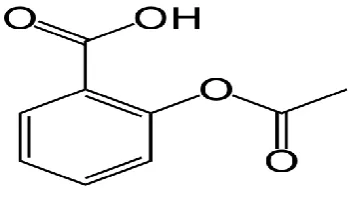
[image:1.595.318.534.333.502.2]Aspirin [Chemically 2-acetoxybenzoic acid] is also known as Acetyl Salicylic acid. It is a medication used to treat pain, fever, or inflammation. Different inflammatory conditions like Kawasaki disease, pericarditis, and rheumatic fever are treated by Aspirin. Aspirin is also used to prevent further heart attacks, ischaemic strokes, and blood clots in people at high risk. It may also decrease the risk of certain types of Carcinoma, particularly colorectal cancer. Aspirin is a non-steroidal anti-inflammatory drug (NSAID) and works similarly to other NSAIDs but also suppresses the normal functioning of platelets. It can be given by oral and rectal route. Lysine acetylsalicylate is given by IV and IM.
Fig. 1 Structure of Aspirin
2. MATERIAL AND METHOD
Chromatographic conditions:
The following chromatographic conditions were established by trial and error and were kept constant throughout the experimentation-
[image:1.595.74.249.521.620.2]Table No-1 Chromatographic Condition:
Table No-2 List of Reagents and Chemicals
Sr.
no
Name of Chemical Supplied by
1 Methanol, HPLC Grade
Research Lab Fine Chem Industry, Mumbai
2 Water, HPLC Grade
Rankem Industry
3 Glacial Acetic Acid, AR Grade
Research Lab Fine Chem Industry, Mumbai
4 Benzoic Acid, AR Grade
Research Lab Fine Chem Industry, Mumbai HPLC Shimadzu HPLC System Column id 4.6 x 10 cm length Detector SPD-M20A PDA Detector Particle size
packing
5 m
Stationary phase
C18
Mobile Phase
Methanol: Glacial acetic acid: Water (28:3:69) Detection
Wavelength
275 nm
Flow rate 2 ml/min
Temperature Ambient
70 Preparation Of Standard Solution:
Preparation Of Mobile Phase
The mobile phase was prepared by dissolve140 ml of methanol and 15 ml of glacial acetic acid in 345 ml of water. The flow rate of mobile phase was 2 ml/min.
Preparation Of Internal Standard Solution
The standard solution was prepared by dissolve 1.2 gm of benzoic acid in 20 ml of methanol.
Preparation Of Solvent Mixture
The solvent mixture was prepared by dissolving 15 ml of glacial acetic acid in 285 ml of methanol.
Preparation Of Standard Stock Solution
Dissolve accurately weighed quantity of Aspirin and Caffeine in solvent mixture to obtain the solution having concentration of about 0.25 mg of Aspirin per ml and 0.25J’ mg of Caffeine per ml,J being the ratio of Aspirin and Caffeine in mg of labeled amount per tablet.
Standard Preparation
Transferred 20 ml standard stock solution and 3 ml of internal standard solution to 50 ml of volumetric flask and diluted with solvent mixture upto volume and mixed.
Assay Preparation
Weighed and powdered 20 tablets and transferred the powder equivalent to 250 mg of Aspirin in 100 ml volumetric flask. Added 75 ml solvent mixture and shaken for 30 minutes. Diluted with solvent mixture upto volume and mixed it. Transferred 2 ml of this solution and 3 ml of internal standard solution to 50 ml volumetric flask, diluted with solvent mixture upto volume and mixed
.
Preparation Of Stock Solution For Aspirin: Dissolve 175.0 mg of Aspirin sample in 100 ml of diluent. This solution was of 1750 ppm. Pipette out 1.0 ml of above solution and make volume upto 10.0 ml by diluent for 175 ppm solution.
Preparation Of Solution:
Preparation of 87.5 mcg/ml solution: (For 50%) Pipette out 0.5 ml from above stock solution and volume made upto 10 ml by diluents to obtain the solution having final concentration 87.5 mcg/ml.
Preparation of 131.25 mcg/ml solution: (For 75%) Pipette out 0.75 ml from above stock solution and volume made upto 10 ml by diluents to obtain the solution having final concentration131.25 mcg/ml.
Preparation of 175.0 mcg/ml solution: (For 100%)
Pipette out 1ml from above stock solution and volume made upto 10 ml by diluent to obtain the solution having final concentration 175.0 mcg/ml.
Preparation of 218.75 mcg/ml solution: (For 125%) Pipette out 1.25 ml from above stock solution and volume made upto 10 ml by diluent to obtain the solution having final concentration 218.75 mcg/ml.
Preparation of 262.5 mcg/ml solution: (For 150%) Pipette out 1.5 ml from above stock solution and volume made upto 10 ml by diluent to obtain the solution having final concentration 262.5 mcg/ml.
3. RESULTS AND DISCUSSION:
Method Validation:
Studies Of Calibration Plots:
Linearity of the method was studied by preparing concentration of drugs in linear range and injecting each concentrations of the drug prepared in the Methanol, Water and Glacial Acetic Acid in the range of 87.5-262.5 μg/ml for Aspirin into the HPLC system. The injection volume was 10μg/ml with the help of manual injector for each sample is constant. The peak areas were plotted against the corresponding concentrations to obtain the calibration graphs.
Fig.2 Calibration curve of Aspirin
Table No-3 Linearity data of Aspirin
Sr. No Conc. Peak Area
1 87.5 1461.13
2 131.25 2096.12
3 175.5 2923.55
4 218.75 3654.36
5 262.5 4376.53
1) Accuracy (Recovery Study):
The accuracy of an analytical procedure expresses the closeness of agreement between the value which is accepted either as convential true
y = 16.889x - 53.276 R² = 0.9988
0 2000 4000 6000
0 100 200 300
a r e a
71 value or an accepted reference value and the value
found.
To study the reliability and suitability of standard method, recovery experiments were carried out. A known amount of solution of Aspirin Tablet was
subjected to the analysis. Lower the value of relative standard deviation indicates the accuracy of method. To find out the degree of accuracy of given standard method, recovery studies were performed at 80%, 100% and 120% of the label claim. At each level, three determinations were performed.
Table No-4 Result of % Accuracy Study of Aspirin
Table No-4 Displayed the % recovery study of Aspirin. For this, ASP is used in a concentration of 80%, 100% and 120%. The mean % of amount recovered of these concentrations was 99.93, 100.05 and 100.04 respectively.
2) Precision:
Precision is an analytical procedure expresses the closeness of agreement between a series of measurements obtained from multiple sampling of the same homogeneous sample under the prescribed conditions.
It was considered at three levels: repeatability, intermediate precision and reproducibility.
3.1 Repeatability-
It expresses the precision under same operating conditions over short interval of time. It is termed as intra-assay precision.
It was measured by multiple injections of a homogenous test sample that indicates the performance of the HPLC instrument under chromatographic conditions.
3.2 Interday Precision-
It was determined by multiple injections of homogeneous standard solution and test solution on two different days under the same operating conditions.
Table No- 5 Interday Precision of Aspirin
Table no- 5 displayed the data of Interday Precision of ASP. For this, ASP is used in a concentration of 50 µgm/ml 100 µgm/ml and 150 µgm/ml. The %RSD for these concentrations was 1.01, 0.56, and 0.93.
3.3 Intraday Precision-
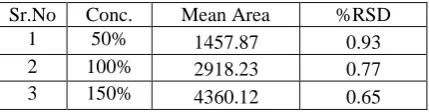
[image:3.595.47.277.263.690.2]The intraday precision of the standard method was evaluated by analyzing samples of different concentrations of Aspirin and Caffeine three times on the same day and % RSD was calculated.
Table No- 6 Intraday Precision of Aspirin
Table no- 6 displayed the data of Intraday Precision of ASP. For this, ASP is used in a concentration of 50 µgm/ml 100 µgm/ml and 150 µgm/ml. The %RSD for these concentrations was 0.93, 0.77, and 0.65. Co nc. % of spi ked leve l of sam ple Amount of Drug Added (µg/ml) Area Found Amo unt of pure drug foun d (pp m) % Recove ry Statistical Analy sis of % Recovery Pure For
mu-
latio
n
80
1
140 175 2327.
27 139.
44
99.60 Mean:
99.93
%RSD:
0.35 80
2
140 175 2343.
80 140. 43 100.3 1 80 3
140 175 2334.
08 139. 85 99.89 100 1
175 175 2900.
15 173.
77
99.29 Mean:
100.05
%RSD:
0.97 100
2
175 175 2911.
79 174. 46 99.69 100 3
175 175 2954.
40 177. 02 101.1 5 120 1
210 175 3471.
99 208.
03
99.06 Mean:
100.04
%RSD:
0.96 120
2
210 175 3539.
56 212. 08 100.9 9 120 3
210 175 3507.
49 210.
16
100.6
7
Day Conc. Mean Area %RSD
1 50% 1460.67 1.01
2 100% 2948.69 0.56
3 150% 4375.51 0.93
Sr.No Conc. Mean Area %RSD
1 50% 1457.87 0.93
2 100% 2918.23 0.77
[image:3.595.318.533.630.686.2]72 Robustness:
This parameter was studied to determine how far an analytical method can withstand with the stress condition. For this study the possible variation parameters were identified and they are willfully changed. The method parameters for HPLC include the variation in flow rate, mobile phase composition, pH, temperature, different column of same lot or same suppliers.
Variation in Flow Rate:
It was determined by multiple injections of homogeneous standard solution and test solution by changing the flow rate ± 0.2 ml/min i.e.1.8 ml/min to 2.2 ml/min on same instrument under the same operating conditions.
Variation in Mobile Phase Composition:
It was determined by multiple injections of homogeneous standard solution and test solution by changing the mobile phase composition i.e. 67:28:4 and 71:27:2 of water, methanol and glacial acetic acid on same instrument under the same operating conditions.
Variation in pH:
It was determined by multiple injections of homogeneous standard solution and test solution by changing the pH of the mobile phase i.e. ± 0.2 on same instrument under the same operating conditions.
Variation in Column Change:
[image:4.595.312.532.386.444.2]It was determined by multiple injections of homogeneous standard solution and test solution by changing the column of different lot of same supplier same instrument under the same operating conditions.
Table No- 7 Robustness study of Aspirin
Chromatographi c condition
Mean Area SD %RS D 1) Flow Rate
1.8 ml/min 3094.3 0
19.7 6
0.63
2.0 ml/min 2932.0 1
8.29 0.28
2.2 ml/min 2782.1 7
23.7 0.85
2) Mobile Phase (Water:Methanol:Glacial Acetic acid)
67:29: 4
2915.1 1
25.4 1
0.87
69:28: 3
2933.8 1
11.8 8
0.40
71:27: 2
2916.5 2
33.9 7
1.16
Table No-7 displayed the Robustness study of ASP. Robustness studies of System were performed by changing the flow rate and M.P concentration. The mean found were 3094.30 2932.01 and 2782.17 for the flow rate of 1.8 ml/min, 2 ml/min and 2.2 ml/min respectively. The %RSD found were 0.63, 0.28 and 0.85 for the flow rate of 1.8 ml/min, 2 ml/min and 2.2 ml/min respectively. The mean found were 2915.11, 2933.81 and 2916.52 for 3 given Mobile Phase Concentrations. The %RSD found were 0.87, 0.40 and 1.16 for Mobile Phase Concentration (67:29:4), Mobile Phase Concentration (69:28:3) and Mobile Phase Concentration (71:27:2) respectively.
System Suitability Test:
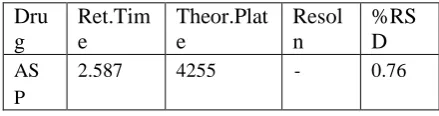
System suitability testing is essential for the assurance of the quality performance of the chromatographic system. Typical system suitability parameters should be within the limits like resolution, theoretical plates, tailing factor, relative standard deviation etc. Earlier prepared solutions for chromatographic conditions were tested for system suitability testing.
Table No- 8 SST of Aspirin
Dru
g
Ret.Tim
e
Theor.Plat
e
Resol
n
%RS
D
ASP
2.587 4255 - 0.76
REFERENCES
[1] R Vani, M Sunitha (2017): Analytical Method Development and Validation for the Determination of Omeprazole And Aspirin using Reverse Phase HPLC Method in Bulk and Dosage Form. Universal Journal of Pharmaceutical Research, 2(4), pp. 25-29. [2] Nariman A. El-Ragehy, Nagiba Y. Hassan,
Mahmoud A. Tantawy* and Mohamed Abdelkawy (2016): Simultaneous Determination of Aspirin, Dipyridamole and Two of Their Related Impurities in Capsules by Validated TLC-Densitometric and HPLC Methods, Journal of Chromatographic Science, 54(7): pp. 1120–1128.
[3] Md. Gousuddin*, Pinaki Sengupta, Vijaya Datt Tripathi, Arindam Das (2016): Stability Indicating RP-HPLC Method for Simultaneous Determination of Aspirin and Clopidogrel in Dosage Form. Malaysian Journal of Analytical Sciences, 20(2), pp. 247-257.
[image:4.595.66.288.531.764.2]73 Ondansetron. Asian Journal of Pharmaceutical
Technology & Innovation, 04(21), pp. 01–09. [5] Ansari Yaasir Ahmed*, Dr. Sumer Singh, Dr.
Majaz Quazi, Jameel Ahemad, Ansari Mohd. Razi (2019): Stability Indicating HPLC Method Development and Validation for Simultaneous Estimations of Atenolol and Nifedipine in Bulk and Tablet Dosage Form. Journal of Emerging Technologies and Innovative Research, 6(2), pp. 29-36.
[6] Dr. MS Kalshetti, * Supriya Kasabe, Neha Chauhan, Swami Dhanshri, Bharti Kale (2017): Development and validation of RP-HPLC method for simultaneous estimation of aspirin and omeprazole in dosage. International Journal of Research in Pharmacy and Pharmaceutical Sciences, 2(4), pp. 45-51. [7] S. M. Ashraful Islam et al. (2011): Validated
RP-HPLC Method for Estimation of Ranitidine Hydrochloride, Domperidone and Naproxen in Solid Dosage Form. Asian Journal of Pharmaceutical Analysis, 1(3), pp. 59-63.
[8] P.Satyanarayana et al (2015): Method Development and Validation for Simultaneous Estimation of Ranitidine, Domperidone and Simethiconein Bulk and Pharmaceutical Dosage Form by Using RP-HPLC Method. World Journal of Pharmacy and Pharmaceutical sciences, 4(11), pp. 1146-1158.
[9] United State Pharmacopoeia -30, National Formulary – 25 (2007). By Authority of the United State Pharmacopoeial Convention. Inc. Prepared by the Council of Experts and Published the Board of Trustees: pg. 1752.
[10] Instrumental methods of Analysis, by H. Willard, L. Merritt, J. Dean, F. Settle, CBS Publishers and Distributors Pvt. Ltd. 7th editioin: pp. 580-610.
[11] ‘Analytical chemistry’ by Gary Christian. 6th edition published by Wiley India pvt. Ltd. Pp. 604-615.
[12] Shefali Rana *, Jigar Pandya, Mr. Sagar Solanki, Dr. Mandev Patel (2012): Development and Validation of Spectrophotometric method for Simultaneous estimation of Lafutidine and Domperidone in combined dosage form by area under curve method. International Journal of Drug Development & Research, 4(1): pp. 257-262.