Selective Co-occurrences for Word-Emotion Association
Ameeta Agrawal and Aijun An
Department of Electrical Engineering and Computer Science York University, Toronto, Canada
{ameeta,aan}@cse.yorku.ca
Abstract
Emotion classification from text typically requires some degree of word-emotion association, either gathered from pre-existing emotion lexicons or calculated using some measure of semantic relatedness. Most emotion lexicons contain a fixed number of emotion categories and provide a rather limited coverage. Current measures of computing semantic relatedness, on the other hand, do not adapt well to the specific task of word-emotion association and therefore, yield average results. In this work, we propose an unsupervised method of learning word-emotion association from large text corpora, calledSelectiveCo-occurrences (SECO), by leveraging the property of mutual exclusivity generally exhibited by emotions. Extensive evaluation, using just one seed word per emotion category, indicates the effectiveness of the proposed approach over three emotion lexicons and two state-of-the-art models of word embeddings on three datasets from different domains.
1 Introduction
Emotion detection from text is the task of identifying emotions from natural language data such as user reviews, blogs, news articles, etc. (Alm et al., 2005; Aman and Szpakowicz, 2007). Although there is no strict definition for emotion, most researchers agree that it is a particular feeling that characterizes the state of mind such as happiness, anger, sadness and so on. Emotion analysis is extremely popular in the field of market research, where brands tap into their customer base by analyzing user-generated data, readily available nowadays due to the rapid growth of social media (De Bondt et al., 2013; Shrum et al., 2013). Mohammad and Turney (2013) present a more extensive list of applications.
Emotion detection from text typically requires some degree ofword-emotion association, i.e., knowing which words are more appropriately associated with which emotions. For example, the word“accident” can be considered associated with the emotionSADNESS. This association can be obtained from a pre-compiled emotion lexicon or calculated using some measure of semantic relatedness. The currently available manually annotated emotion lexicons tend to be restricted in size due to the expensive process of human annotation. This limited coverage leads to the undesirable effect of leaving too many words unassociated with any emotion category. Moreover, most lexicons contain a small fixed set of emotions which is unsuitable for a larger (Du et al., 2014) or a newly defined set of emotions (Facebook, 2016). On the other hand, while automatically computing word-emotion association scores from text corpora possibly provides a better coverage and more flexibility, the current techniques are ill-suited to the task of emotion detection and therefore, tend to yield average results.
To address these issues, in this work, we propose an unsupervised method of learning word-emotion association scores from text corpora, which we call Selective Co-occcurences (SECO). By modifying conventional co-occurrence-based methods, we compute a uni-directional asymmetric association be-tween a given word and an emotion seed word. The proposed approach is found to be better at capturing the association between words and emotions than general purpose measures. Extensive evaluation of word-emotion association scores derived from two large text corpora, Wikipedia and Amazon reviews, This work is licenced under a Creative Commons Attribution 4.0 International Licence. Licence details: http:// creativecommons.org/licenses/by/4.0/
on three emotion datasets from very diverse domains demonstrates the effectiveness of employing selec-tive co-occurrences. The proposed approach is particularly interesting as it requires no training data and can be applied to a flexible number of emotion categories.
The remainder of this paper is organized as follows. In Section 2, we survey the related work. In Section 3, we describe the learning of the word-emotion association scores and their use in the task of emotion classification. Section 4 describes the evaluation setup, while Section 5 analyzes the experimen-tal results. Lastly, Section 6 concludes the paper with a brief look at future work.
2 Related Work
In this section, we present the existing emotion lexicons, manually annotated as well as those created using supervised machine learning, and also discuss the measures of semantic relatedness that have been previously employed to derive word-emotion association for emotion classification.
2.1 Emotion Lexicons
2.1.1 Manually Annotated Lexicons
One of the earliest and most popular emotion resources is the WordNet Affect (Strapparava and Valitutti, 2004), developed by manually labelling about 1,314 synsets with one or more of Ekman’s (1992) six basic emotions. Using crowd-sourcing, one of the largest manually annotated emotion lexicons created to date is the NRC Emotion Lexicon (EmoLex) (Mohammad and Turney, 2010; Mohammad and Tur-ney, 2013). It contains about 14,200 unigrams annotated with one or more of Plutchik’s eight emotions (Plutchik, 2001). Another manually created lexicon, the Affect database (Neviarouskaya et al., 2007), contains a total of 2,440 entries (emoticons, acronyms, words and modifiers) annotated by three anno-tators using nine emotion labels as well as their intensities. Considering the fundamental role played by lexical resources in the task of emotion detection, the current options available due to manual lexicons seem rather limited in their coverage. Human annotation, including crowd-sourcing, requires consid-erable lexicographic expertise, time and effort. An alternative approach involves creating such lexical resources automatically.
2.1.2 Automatically Acquired Lexicons
More recently, DepecheMood (Staiano and Guerini, 2014), was created using supervised training by applying distributional semantics to a dataset of crowd-annotated news articles. This lexicon consists of 37,000 words and their emotion scores across seven emotions. A different approach of generating an emotion lexicon (18,000 words and 8 emotions) involves using the Google n-grams corpus to expand an existing, smaller human-annotated lexicon such as the EmoLex (Perrie et al., 2013). Although these approaches cover a larger vocabulary, they are limited to the emotion categories of the source corpus or the lexicon which they use for training.
2.2 Measures of Semantic Relatedness
Statistical approaches that leverage large text corpora provide an alternative way of acquiring word-emotion association scores, which can remedy the problem of unseen vocabulary to a large extent. As these approaches employ just a handful of emotion seed words to initialize the process, they are also applicable to a flexible number of emotion categories. Many models of computing word semantic relat-edness exist, from the traditional count-based methods such as Pointwise Mutual Information (PMI) to the more recent neural-network inspired models of word embeddings such as Continuous Bag of Words (CBOW). While the models differ in their algorithms, they are fundamentally based on the intuitive assumption that co-occurring words tend to be related to each other.
(Deerwester et al., 1990), which analyzes the statistical relationships among words in a corpus using Singular Value Decomposition (SVD) dimensionality reduction technique, was used to calculate word-emotion association scores to classify news headlines (Strapparava and Mihalcea, 2008).
Despite, and perhaps because of, its simplicity, PMI (Church and Hanks, 1990) has long been a popular measure of semantic relatedness. It estimates the similarity between two termsxandyasP MI(x, y) = logpp(x(x,y)p(y)), wherep(x, y)is the probability that wordsxandyco-occur within a window of specific length, and p(x) andp(y)are the individual probabilities of word x and wordy, respectively, in the corpus. To overcome a few well-known shortcomings of PMI (i.e., low frequency events receiving relatively high scores, lack of a fixed upper bound), Bouma (2009) proposed a normalized version of PMI (NPMI), whereNP MI(x, y) = −P MIlogp((x,yx,y)), with fixed orientation values: when two words only occur together, NPMI(x, y) = 1; when they are distributed as expected under independence, NPMI(x, y) = 0; and, when they occur separately but not together, NPMI(x, y) =−1.
More recently proposed neural-network based approaches, such as Continuous Bag-of-Words (CBOW) and Skip-Gram (SG) (Mikolov et al., 2013b; Mikolov et al., 2013a) output word embeddings which can then be used to compute the similarity between two words by calculating their cosine sim-ilarity. These methods implicitly factorize a word-context matrix whose cell values are in fact shifted PMI (Levy and Goldberg, 2014) and have outperformed traditional count-based methods such as PMI on many similarity-oriented tasks (Marco Baroni, Georgiana Dinu, 2014).
While these measures of semantic relatedness provide promising results on most word similarity tasks, they do not adapt well to emotion detection. We build upon these latest advancements by proposing a variant that is more suitable to the task at hand.
3 Word-emotion Association for Emotion Classification
Given a sentence sand a setE = {e1, e2, . . . , eg} ofgemotion categories, the objective is to label s
with the best possible emotione ∈ E. We first discuss our proposed method for deriving the word-emotion association scores between a word and an word-emotion category, and then use these scores to obtain an emotion label for each sentence.
3.1 Learning Word-emotion Association
LetW ={w1, w2, . . . , wn}be a set ofncue words in an input sentences, whereW ⊂s. A cue word
is defined as any word within a sentence that could have some emotional connotation. Usually, these are the nouns, adjectives, verbs and adverbs. LetE ={e1, e2, . . . , eg}be a set ofgemotion categories.
Each emotion categoryej ⊂E is represented by one or more emotion seed words. LetTbe the set of
all the seed words for all the emotion categories,Tj ⊂ TandTj = {tj1, tj2, . . . , tjm}be the set ofm
emotion seed words for each emotion categoryej ⊂E.
As an illustration, consider the sentence “We are going to a party tonight”. Here, the set of cue words includesW = {going, party, tonight}. If the classification scheme follows, for example, Ekman’s (1992) model of emotions, thenE ={anger, disgust, fear, happiness, sadness, surprise}. The set of seed words forHAPPINESS could beThappiness ={happy, joy, ...}andANGER’s seed words could beTanger={angry, mad, . . .}.
We adopt the →symbol to denote the association between a cue wordwand an emotion seed word
t. The first step is to derive the association scores between a cue word and every seed word, e.g.,
Assoc.(party→joy),Assoc.(party→angry). Since our main goal is to acquireassociation scores for emotion classification, the design choices for our proposed measure of learning word-emotion asso-ciation scores,SECO, are largely motivated by the following observations:
• The intrinsic process of annotating an emotion dataset as well as that of classifying it is uni-directional, i.e., given a word or a sentence, the task is to label it with the emotion it evokes the most.
In fact, in the emotion lexicon WordNet Affect (Strapparava and Valitutti, 2004), which has words annotated with more than one emotion, about 98.7% of the terms are labelled with just one emotion. • Most importantly, unlike other word relatedness tasks, the second half of the association pair (i.e.,
emotion seed words) in this particular task are known in advance.
These observations lead us to hypothesize that an asymmetric measure of association, where a word’s association with an emotion seed word (and therefore by extension, with an emotion category) may be more meaningful than trying to achieve a symmetric bi-directional association between the two. In fact, as Tversky (1977) notes, certain linguistic relationships are characteristically asymmetric . In one experiment to list the first meaningfully related word that comes to mind, for the cue wordfear, 24% of the participants answeredscared, while only 9% of them recalledfearwhen given the cue wordscared, suggesting an inherent asymmetry in word associations (Altarriba et al., 1999).
As noted earlier, traditional co-occurrence based models of semantic relatedness consider two words as co-occurring when both the words appear within a specific window of text, no matter how far they are from each other. In reality, nearer words have been found to exhibit stronger relationships (Beeferman et al., 1997).
In similar essence, emotions generally exhibit the property of mutual exclusivity and therefore, we propose the concept of selective co-occurrences (SECO), where a cue word is considered as co-occurring with only one emotion’s seed words within any particular window of text. Consider Fig. 1 containing an example window of text, the cue word “party”, and two seed words “angry” and “happy”, represent-ing the two different emotion categories respectively. To apply selective co-occurrences, the cue word “party” is considered co-occurring with either “angry” or “happy”, not both.
Theater critic Michael Riedel (playing himself) also shows up, uninvited. Ivy is put out by this and gets angry at Michael about it. We hear but don't see Ivy singing "Bittersweet Symphony" at her party. Derek then walks in and gives her a present and wishes herhappybirthday.
Figure 1: Sample window of text containing cue and seed words
When a context window contains multiple seed words from multiple emotion categories, three possible settings for selecting the most appropriate seed word as co-occurring with the cue word can be explored: • nearest(SECO-NEAR): This is the most intuitive option, where the nearest seed word to the cue word is selected. For example, “happy” is counted as co-occurring with “party”; “angry” is ignored. • preceding(SECO-PREC): To account for any positional predisposition, this variant considers only the closest preceding seed word to the cue word. For example, “angry” is considered as co-occurring with “party”; “happy” is ignored.
• following(SECO-FOLL): Similarly, this variant considers only the closest seed word that follows the cue word as co-occurring together. For example, “happy” is considered as co-occurring with “party”; “angry” is ignored.
The selective counting of the seed word’s co-occurrence frequency with the cue word is what essentially makes our association measure asymmetric and therefore, the order of the cue and seed word in the association equation cannot be interchanged. That is,Assoc.(w→t)denotes the association between a cue wordwand a seed wordt, andAssoc.(w→t)6=Assoc.(t→w). Technically,SECOis applicable to any traditional co-occurrence-based word association measure that estimates the relatedness between two words by computing some function of the words’ frequencies. To this end, we adopt three popular co-occurrence association measures, namely NPMI (Bouma, 2009), Dice (1945) and Jaccard (1912), into theirSECOcounterparts,SECO-NPMI,SECO-DiceandSECO-Jaccard, respectively.
When applying SECO, in a corpus ofMwords,# (w, t)denotes the number of times a cue wordw
k, wherekis the maximum distance between those two words;# (w)and# (t)denote the frequencies ofwandt, respectively.
SECO-NPMIThe normalizedSECO-NPMIbetweenwandt, within the range of[−1,1], is:
SECO-NP MI(w→t) = log
M#(#(ww,t)#()t)
log M
#(w,t)
. (1)
SECO-DiceSimilarly,SECO-Dicebetweenwandtis computed as:
SECO-Dice(w→t) = # (2×w) + # (# (w, t)t). (2)
SECO-Jaccard Lastly, one of the earliest co-occurrence associations measures, Jaccard, can be transformed as follows:
SECO-Jaccard(w→t) = # (w) + # (# (w, tt)−)# (w, t). (3)
Empirical data shows that the association between words decays exponentially (Beeferman et al., 1997) and this property has been successfully exploited by adding a decaying factor which allows words that co-occur nearer to each other to be more related (Gao et al., 2002; Sahlgren, 2006; Brosseau-Villeneuve et al., 2010; Mikolov et al., 2013a). Drawing from previous research, we also apply a context weighting scheme whereby a seed word is linearly weighted according to its distance from the cue word as follows: in a window of sizek, thenthword from the cue word is weighted by the function k−n+1
k .
For example, in a window of5, the first word next to the cue word is weighted by 5
5, while the fourth word away is of weight 2
5. In other words, as the distance between two words increases, their weighted association score decreases.
Finally, the word-emotion association betweenwand an emotion categoryejis obtained by calculating
the average mean of the association scores betweenwand all the seed words ofej as:
Assoc.(w→ej) = m1 m
X
k=1
Assoc.(w→tjk) (4)
whereAssoc.is any association measure such asSECO-NPMI. 3.2 Classifying Sentence Emotion
For each wordw, its emotion vectorφw is denoted as:
φw=hAssoc.(w→e1), Assoc.(w→e2), . . . , Assoc.(w→eg)i
and the emotion vectorφs of sentence sis obtained by averaging the emotion vectors of all itsn cue
words asφs = n1Pni=1φwi. Finally, the sentence is labelled with the emotion categorye⊂E with the
maximum value inφs.
4 Evaluation Setup
In this section we describe the evaluation datasets, the text corpus used for learning the word-emotion association scores and the evaluation metric for this task.
4.1 Evaluation Datasets
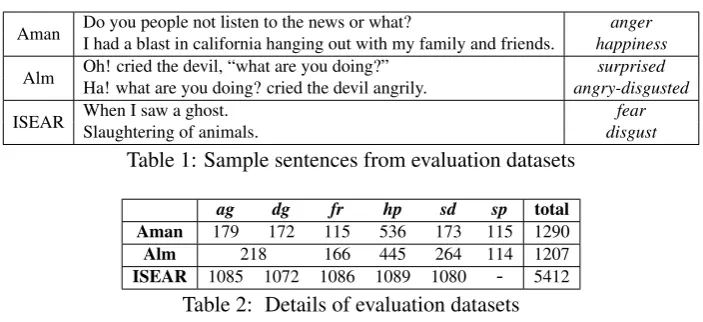
Below described are the three popular emotion evaluation datasets, with some sample sentences pre-sented in Table 1 and their summarized statistics in Table 2.
Aman: Consisting of highly informal blog data, this dataset includes1290sentences annotated with one of six emotions:anger, disgust, fear, joy, sadness and surprise(Aman and Szpakowicz, 2007).
Alm: Emotions are particularly significant in the literary genre of fairy tales and this dataset contains
Aman Do you people not listen to the news or what?I had a blast in california hanging out with my family and friends. happinessanger Alm Oh! cried the devil, “what are you doing?”Ha! what are you doing? cried the devil angrily. angry-disgustedsurprised ISEAR When I saw a ghost.Slaughtering of animals. disgustfear
Table 1: Sample sentences from evaluation datasets
ag dg fr hp sd sp total
Aman 179 172 115 536 173 115 1290
Alm 218 166 445 264 114 1207
ISEAR 1085 1072 1086 1089 1080 - 5412
Table 2: Details of evaluation datasets
ISEAR: Developed for studying the relationships among emotions and cultures, this corpus contains experiences evoking seven emotions: anger, disgust, fear, joy, sadness, shame and guilt, resulting in a total of5412sentences1. To the best of our knowledge, no existing lexicon containsshameorguilt
categories, and therefore methods that depend on emotion lexicons cannot correctly classify sentences belonging to these emotions. However, unsupervised approaches such as ours, which can be initialized with as little as one seed word per emotion category, are easily applicable to such datasets.
4.2 Text Corpora
We derive the word-emotion association scores from two large text corpora of different domains, which are pre-processed by: a) converting to lowercase; b) stripping off all non-alphanumeric characters; c) removing stopwords; d) stemming, and e) removing words that occur less than5times in the corpus.
Wikipedia2: The large publicly available corpus of Wikipedia mainly consists of formal language
structured text articles considered to be more “objective” in nature. Our clean corpus contains approxi-mately918.5million tokens, with each article on one line.
Amazon: The text of all the product reviews, mostly consisting of informal language makes up our second corpus, considered to be of more “emotional” type. This data was extracted from the aggressively deduplicated dataset (McAuley et al., 2015), which contains82.83million product reviews from Ama-zon, spanning May 1996 - July 2014. Our clean corpus contains more than3billion tokens (three times the size of Wikipedia corpus), with one review per line.
4.3 Evaluation Metric
Following prior studies, we calculate the F-score for each emotion classe, where F-score is the harmonic mean ofprecisionandrecall, defined as2precisionprecision+×recallrecall. Precisionis the number of sentences cor-rectly labeled as belonging to the classedivided by the total number of sentences labeled as belonging to
e, andrecallis the number of sentences correctly labeled as belonging toedivided by the total number of sentences that actually belong toe. We report the average F-score over all the classes.
5 Experiments and Analysis
In what follows, we evaluate the performance of the proposed approach in several experiments and discuss their results.
5.1 How effective is selective co-occurrence?
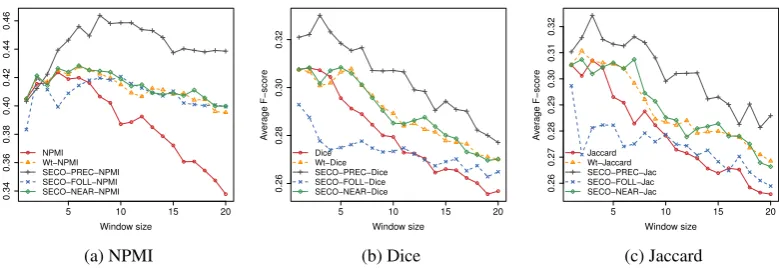
We test the performance of the three proposed variants,SECO-NEAR,SECO-PRECandSECO-FOLL, against regular as well as weighted versions (where the same context weighting scheme as described in Section 3.1 is applied to regular association measures) in order to analyze the effect of selective co-occurrence in particular, and not just the advantage obtained using weighted contexts.
5 10 15 20 Figure 2: Selective co-occurrences and regular co-occurrences on Alm dataset
As observed from Figure 2, tested for context window sizes 1 to 20 and trained on the Wikipedia corpus, our proposed approach,precedingselective co-occurrences (SECO-PREC), where only the near-est seed word that precedes a given cue word within a context window is considered, exhibits the bnear-est performance when applied to all the three association measures (NPMI, Dice and Jaccard), on the Alm dataset3. In fact, the best average F-score from SECO-NPMI-PREC is almost 10% better than that
of Wt-NPMI, leading us to conclude that the gain in performance is due to selective co-occurrences and not just weighted contexts. As expected, the weighted versions, NPMI, Dice and Wt-Jaccard perform much better than their regular unweighted counterparts, NPMI, Dice and Wt-Jaccard, re-spectively. SECO-NEAR has slight advantage over weighted association measures whileSECO-FOLL and regular association measures (i.e., NPMI, Dice, Jaccard) are nearly always the poorest perform-ing. SinceSECO-PREC-NPMI(Figure 2a) yielded better average F-score thanSECO-PREC-Diceor SECO-PREC-Jaccard, we further evaluate its performance in the next experiment.
5.2 How effective isSECO-PREC-NPMI?
In this experiment, we evaluate the performance of unsupervisedSECO-PREC-NPMIagainst five base-lines (inbold) described next.
5.2.1 Baselines
WordNet Affect (WNA), NRC Emotion Lexicon (EmoLex) and DepecheMood (DM) (Section 2.1) con-tain words and their association with various emotions. For each emotion category, WNA concon-tains a simple list of words, which we interpret as a binary association; if a word exists in an emotion cate-gory, we assign+1for that emotion. EmoLex and DM, on the other hand, contain association scores between a word and all the emotion categories. For instance, EmoLex lists the association between the word “awful” and 8 emotions (anger, anticipation, disgust, fear, joy, sadness, surprise, trust) as:
1,0,1,1,0,1,0,0. In DM, each word is associated with a different set of emotions by a real valued score, summing upto 1. For instance, the word “awe” and 8 emotions (afraid, amused, angry, annoyed, dont care, happy, inspired, sad) is listed as: 0.08,0.12,0.04,0.11,0.07,0.15,0.38,0.05. We use these emotion lexicons as a baseline by applying a keyword matching algorithm, to obtainAssoc.(w→e). For example,Assoc.(awe→sad) = 0.05from DM. Note that, since DM does not contain two of the emotions found in our evaluation datasets, i.e., disgust and surprise, we report its results on a subset of the datasets. Instead of directly comparing our word-emotion association scores with those of emo-tion lexicons, we extrinsically evaluate them in the task of emoemo-tion classificaemo-tion as there are significant differences between the various emotion lexicons and none can be considered to be a perfect benchmark. Semantic similarity computed from two state-of-the-art word embedding algorithms,CBOWandSG (Mikolov et al., 2013b; Mikolov et al., 2013a) (Section 2.2), provide another baseline as they can be used to obtain unsupervised word-emotion association scores, which is closer in spirit to our goal. We
used the algorithms’ recommended default parameter settings: dimension size of feature vectors= 300; negative sampling= 5. We present a comparison against only unsupervised methods as the focus of this paper is on unsupervised emotion detection methods.
Since the context window size can have a significant impact on the performance of an algorithm, we run each method of semantic relatedness on 20 different window sizes (1 to 20) on both the corpora (Wikipedia and Amazon) and report the average result with standard deviation for each setting in Table 3. To keep the process as unsupervised as possible, in this study only one seed word per emotion category is used to derive the association scores. The seed words “angry, disgust, happy, scared, sad, surprise” represent the six emotion categories “anger, disgust, happiness, fear, sadness, surprise”, respectively.
Aman Alm ISEAR
SGwiki 0.242 ± 0.04 0.209 ± 0.05 0.259 ± 0.08
CBOWwiki 0.382 ± 0.02 0.426 ± 0.03 0.446 ± 0.03
SECO-PREC-NPMIwiki 0.410± 0.01** 0.443± 0.01** 0.488 ± 0.02**
SGamazon 0.410± 0.02* 0.406 ± 0.02 0.438 ± 0.04
CBOWamazon 0.393 ± 0.02 0.373 ± 0.02 0.484 ± 0.03
SECO-PREC-NPMIamazon 0.403 ± 0.01 0.409 ± 0.01** 0.498± 0.02**
Table 3: Average F-scores (of windows 1 to 20) for three evaluation datasets. SG, CBOW and SECO-PREC-NPMI were run on Wikipedia and Amazon corpora for windows 1 to 20. The best av-erage result for each dataset is inbold. **p < .00001,*p < .01(one-way ANOVA test for each dataset
results using the same training corpus, i.e., wiki or amazon)
5.2.2 Results
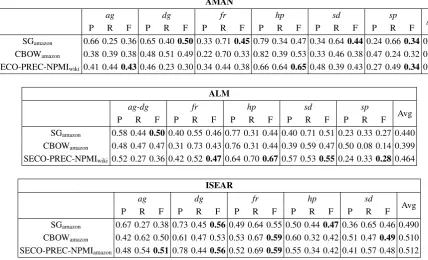
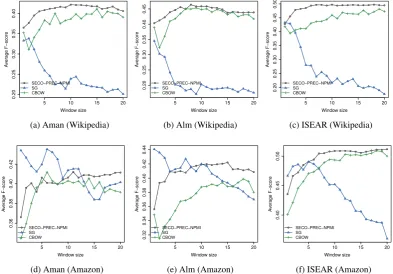
Usually it is difficult to determine the best window size in advance, and therefore, for window sizes 1 to 20, we summarize the average F-scores over all 20 window sizes in Table 3. The best results obtained using any particular window are presented in Table 4 and the details of different emotion category results are further shown in Table 5. Finally, Figure 3 presents the window sensitivity graphs.
i) The average F-score results summarized in Table 3 indicate that on average, SECO-PREC-NPMI yields better overall results, with SGamazonobtaining competitive results on one dataset (Aman),
suggest-ing the effectiveness of selective co-occurrences in this task. Interestsuggest-ingly, contrary to popular intuition, the “objective” text from Wikipedia training corpus yields better F-scores on average than the “subjec-tive” Amazon reviews corpus for two out of the three evaluation datasets.
Aman Alm ISEAR
WNA 0.286 0.362 0.343
EmoLex 0.316 0.341 0.318
DM 0.324 0.340 0.290
SGwiki 0.338 (2) 0.345 (1) 0.433 (1)
CBOWwiki 0.410 (15) 0.456 (11) 0.481 (19)
SECO-PREC-NPMIwiki 0.422 (10) 0.464(8) 0.497 (10)
SGamazon 0.435(6) 0.440 (1) 0.490 (5)
CBOWamazon 0.411 (6) 0.399 (18) 0.510 (19)
SECO-PREC-NPMIamazon 0.412 (11) 0.422 (15) 0.512(20)
Table 4: Details of best results for three evaluation datasets. The best result for each dataset is inbold. The window size is shown in parentheses.
of the three datasets despite being the smallest in size. Unsupervised association measures demonstrate two significant advantages over emotion lexicons: firstly, association measures are able to provide a wider coverage by exploiting the inherent associations between words that are present in text corpora; and secondly, while lexicons have fixed pre-determined emotion categories, association measures can be flexibly extended to any number and types of emotions. As for the recommended window settings for each approach, it seems that SG works well with window size= 1on Wikipedia corpus and around5on Amazon; CBOW usually does well on windows larger than15andSECO-PREC-NPMIis recommended to be used with window10on Wikipedia and larger than15on Amazon.
AMAN
ag dg fr hp sd sp Avg
P R F P R F P R F P R F P R F P R F
SGamazon 0.66 0.25 0.36 0.65 0.400.500.33 0.710.450.79 0.34 0.47 0.34 0.640.440.24 0.660.340.435
CBOWamazon 0.38 0.39 0.38 0.48 0.51 0.49 0.22 0.70 0.33 0.82 0.39 0.53 0.33 0.46 0.38 0.47 0.24 0.32 0.411
SECO-PREC-NPMIwiki 0.41 0.440.430.46 0.23 0.30 0.34 0.44 0.38 0.66 0.640.650.48 0.39 0.43 0.27 0.490.340.422
ALM
ag-dg fr hp sd sp
Avg
P R F P R F P R F P R F P R F
SGamazon 0.58 0.440.500.40 0.55 0.46 0.77 0.31 0.44 0.40 0.71 0.51 0.23 0.33 0.27 0.440
CBOWamazon 0.48 0.47 0.47 0.31 0.73 0.43 0.76 0.31 0.44 0.39 0.59 0.47 0.50 0.08 0.14 0.399
SECO-PREC-NPMIwiki 0.52 0.27 0.36 0.42 0.520.470.64 0.700.670.57 0.530.550.24 0.330.280.464
ISEAR
ag dg fr hp sd
Avg
P R F P R F P R F P R F P R F
SGamazon 0.67 0.27 0.38 0.73 0.450.560.49 0.64 0.55 0.50 0.440.470.36 0.65 0.46 0.490
CBOWamazon 0.42 0.62 0.50 0.61 0.47 0.53 0.53 0.670.590.60 0.32 0.42 0.51 0.470.490.510
SECO-PREC-NPMIamazon0.48 0.540.510.78 0.440.560.52 0.690.590.55 0.34 0.42 0.41 0.57 0.48 0.512
Table 5: Details of emotion category results for best window size/training corpus combination for three evaluation datasets.ag= anger,dg= disgust,fr= fear,hp= happy,sd= sad,sp= surprise. P = precision, R = recall, F = F-score.
iii) To analyze the individual emotion category results, we present the results of the best ap-proach/training corpus combination in Table 5. In general, thehappiness category obtains the highest results in two datasets whilefear does best on the third. On the other hand, the most difficult category to be classified correctly seems to besurprise. One avenue of future work could include experimenting with various seed words to increase the accuracy of such emotions.
iv) Figure 3 summarizes the results of sensitivity of the three algorithms, SG, CBOW and SECO-PREC-NPMI, to different window parameter settings. On Wikipedia corpus, SECO-PREC-NPMI is consistently better than the others, whereas SG takes better advantage of the Amazon corpus. While SECO-PREC-NPMIand CBOW get better with bigger context windows, SG depicts the opposite trend, best on windows less than 5.
To summarize the results:
• Initialized using one seed word per emotion category, the measures of semantic relatedness yield better results than the emotion lexicons.
• When the window size is not known, in general,SECO-PREC-NPMIyields consistent promising results on all the evaluation datasets, while SG provides competitive results on one dataset.
5 10 15 20 Figure 3: Parameter sensitivity results for 20 window sizes
6 Conclusion
Emotion detection from text requires the degree of word-emotion association which is generally obtained from emotion lexicons or measures of semantic relatedness. While manual lexicons require considerable human time and effort, automatic techinques provide average performance. In this paper, we described a novel approach to automatically learning word-emotion association scores. Using just one seed word per emotion category, our proposed approachSECO-PREC-NPMIsignificantly outperformed three emotion lexicons and two state-of-the-art word embeddings models when trained using the Wikipedia text corpus. As future work, we plan to further improve the accuracy of emotion classification by experimenting with a variety of seed words and also adaptSECO to other tasks that require association between two words.
Acknowledgements
We would like to thank the anonymous reviewers for their valuable feedback. This research is funded in part by the Big Data Research, Analytics and Information Network (BRAIN) Alliance established by the Ontario Research Fund - Research Excellence Program (ORF-RE), Natual Sciences and Engineering Research Council of Canada (NSERC), and Social Sciences and Humanities Research Council of Canada (SSHRC).
References
Ameeta Agrawal and Aijun An. 2012. Unsupervised emotion detection from text using semantic and syntactic relations. InProceedings of the The 2012 IEEE/WIC/ACM International Joint Conferences on Web Intelligence and Intelligent Agent Technology - Volume 01, WI-IAT ’12, pages 346–353, Washington, DC, USA. IEEE Computer Society.
text-based emotion prediction. InProceedings of the Conference on Human Language Technology and Empirical Methods in Natural Language Processing, HLT ’05, pages 579–586, Stroudsburg, PA, USA. ACL.
Ebba Cecilia Ovesdotter Alm. 2008. Affect in Text and Speech. Ph.D. thesis, University of Illinois at Urbana-Champaign.
Jeanette Altarriba, Lisa M. Bauer, and Claudia Benvenuto. 1999. Concreteness, context availability, and image-ability ratings and word associations for abstract, concrete, and emotion words. Behavior Research Methods, Instruments, & Computers, 31(4):578–602.
Saima Aman and Stan Szpakowicz. 2007. Identifying expressions of emotion in text. InProceedings of the 10th International Conference on Text, Speech and Dialogue, TSD’07, pages 196–205, Berlin, Heidelberg. Springer-Verlag.
Doug Beeferman, Adam Berger, and John Lafferty. 1997. A model of lexical attraction and repulsion. In Pro-ceedings of the 35th Annual Meeting of the Association for Computational Linguistics and Eighth Conference of the European Chapter of the Association for Computational Linguistics, ACL ’98, pages 373–380, Stroudsburg, PA, USA. Association for Computational Linguistics.
Gerlof Bouma. 2009. Normalized (pointwise) mutual information in collocation extraction. Proceedings of GSCL, pages 31–40.
Bernard Brosseau-Villeneuve, Jian-Yun Nie, and Noriko Kando. 2010. Towards an optimal weighting of context words based on distance. InProceedings of the 23rd International Conference on Computational Linguistics, pages 107–115. Association for Computational Linguistics.
Kenneth Ward Church and Patrick Hanks. 1990. Word association norms, mutual information, and lexicography.
Computational Linguistics, 16(1):22–29.
Werner De Bondt, Rosa M Mayoral, and Eleuterio Vallelado. 2013. Behavioral decision-making in finance: An overview and assessment of selected research. Spanish Journal of Finance and Accounting/Revista Espa˜nola de Financiaci´on y Contabilidad, 42(157):99–118.
Scott Deerwester, Susan T. Dumais, George W. Furnas, Thomas K. Landauer, and Richard Harshman. 1990. Indexing by latent semantic analysis. Journal of the American Society for Information Science, 41(6):391–407. Shichuan Du, Yong Tao, and Aleix M Martinez. 2014. Compound facial expressions of emotion. Proceedings of
the National Academy of Sciences, 111(15):E1454–E1462.
Facebook. 2016. Reactions now available globally. Accessed: 2016-03-05.
Jianfeng Gao, Ming Zhou, Jian-Yun Nie, Hongzhao He, and Weijun Chen. 2002. Resolving query translation ambiguity using a decaying co-occurrence model and syntactic dependence relations. InProceedings of the 25th Annual International ACM SIGIR Conference on Research and Development in Information Retrieval, SIGIR ’02, pages 183–190, New York, NY, USA. ACM.
Zornitsa Kozareva, Borja Navarro, Sonia Vazquez, and Andres Montoyo. 2007. Ua-zbsa: A headline emotion classification through web information. In Proceedings of the Fourth International Workshop on Semantic Evaluations (SemEval-2007), pages 334–337, Prague, Czech Republic, June. Association for Computational Linguistics.
Omer Levy and Yoav Goldberg. 2014. Neural word embedding as implicit matrix factorization. In Z. Ghahra-mani, M. Welling, C. Cortes, N. D. Lawrence, and K. Q. Weinberger, editors,Advances in Neural Information Processing Systems 27, pages 2177–2185. Curran Associates, Inc.
Germ ˜A¡n Kruszewski Marco Baroni, Georgiana Dinu. 2014. Don’t count, predict! a systematic comparison of context-counting vs. context-predicting semantic vectors. 52nd Annual Meeting of the Association for Compu-tational Linguistics, ACL 2014 - Proceedings of the Conference, 1:238–247.
Julian McAuley, Christopher Targett, Qinfeng Shi, and Anton van den Hengel. 2015. Image-based recommenda-tions on styles and substitutes. InProceedings of the 38th International ACM SIGIR Conference on Research and Development in Information Retrieval, SIGIR ’15, pages 43–52, New York, NY, USA. ACM.
Tomas Mikolov, Kai Chen, Greg Corrado, and Jeffrey Dean. 2013a. Efficient estimation of word representations in vector space. CoRR, abs/1301.3781.
Saif M. Mohammad and Peter D. Turney. 2010. Emotions evoked by common words and phrases: Using mechan-ical turk to create an emotion lexicon. InProceedings of the NAACL HLT 2010 Workshop on Computational Approaches to Analysis and Generation of Emotion in Text, CAAGET ’10, pages 26–34, Stroudsburg, PA, USA. Association for Computational Linguistics.
Saif M. Mohammad and Peter D. Turney. 2013. Crowdsourcing a word-emotion association lexicon. 29(3):436– 465.
Alena Neviarouskaya, Helmut Prendinger, and Mitsuru Ishizuka. 2007. Textual affect sensing for sociable and expressive online communication. InProceedings of the 2Nd International Conference on Affective Computing and Intelligent Interaction, ACII, pages 218–229, Berlin, Heidelberg. Springer-Verlag.
Jessica Perrie, Aminul Islam, Evangelos Milios, and Vlado Keselj. 2013. Using google n-grams to expand word-emotion association lexicon. InProceedings of the 14th International Conference on Computational Linguistics and Intelligent Text Processing - Volume 2, CICLing’13, pages 137–148, Berlin, Heidelberg. Springer-Verlag. Robert Plutchik. 2001. The nature of emotions human emotions have deep evolutionary roots, a fact that may
explain their complexity and provide tools for clinical practice.American Scientist, 89(4):344–350. Magnus Sahlgren. 2006.The Word-space model. Ph.D. thesis, University of Stockholm (Sweden).
LJ Shrum, Min Liu, Mark Nespoli, and Tina M Lowrey. 2013. Persuasion in the marketplace: How theories of persuasion apply to marketing and advertising. The Sage Handbook of Persuasion: Developments in Theory and Practice, pages 314–330.
Jacopo Staiano and Marco Guerini. 2014. Depechemood: a lexicon for emotion analysis from crowd-annotated news. CoRR, abs/1405.1605.
Carlo Strapparava and Rada Mihalcea. 2008. Learning to identify emotions in text. InProceedings of the 2008 ACM Symposium on Applied Computing, SAC ’08, pages 1556–1560, New York, NY, USA. ACM.
Carlo Strapparava and Alessandro Valitutti. 2004. WordNet-Affect: An affective extension of WordNet. In
Proceedings of the 4th International Conference on Language Resources and Evaluation, pages 1083–1086. ELRA.