© Associated Asia Research Foundation (AARF)
A Monthly Double-Blind Peer Reviewed Refereed Open Access International e-Journal - Included in the International Serial Directories.
Page | 7
EFFECTIVENESS OF A BALANCE RETRAINING PROGRAMME IN
IMPROVING FUNCTIONAL BALANCE OF MILD TO MODERATE
STROKE PATIENTS
Arun Thachil
Professor. College of Physiotherapy.
Medical Trust Institute Of Medical Sciences, Irimpanam ,Kochi-682309.
Sivaprasad G. Physiotherapist.
ESIC Model Hospital. Asramam, Kollam
ABSTRACT
Background : Balance is frequently disturbed following stroke. The balance retraining
programme with a structured and progressive level helps in early training in stroke patients that
improve the outcome and helps in recovery.
Aim: To study the effectiveness of balance retraining programme to improve balance in mild to
moderate stroke patients.
Methodology: Population includes mild to moderate stroke patients with right and left middle
cerebral artery involvement. A total of 30 patients, sampled into two groups of 15 each using
random sampling. Group A receives conventional physiotherapy and group B receives balance International Research Journal of Natural and Applied Sciences
ISSN: (2349-4077) Impact Factor- 5.46, Volume 5, Issue 6, June 2018
Website- www.aarf.asia, Email : [email protected] , [email protected]
© Associated Asia Research Foundation (AARF)
A Monthly Double-Blind Peer Reviewed Refereed Open Access International e-Journal - Included in the International Serial Directories.
Page | 8 retraining programme and conventional physiotherapy. Treatment was given once daily, six days
in a week for four weeks and each session lasted 40 minutes. The outcome measure used was
Berg balance scale. The pretest value (day 1) before the treatment commenced and post test
value after the last day of treatment (day 28).
Result: On BBS, Experimental group showed a significant gain of 20.59%( p<0.01). The control
group also showed a significant gain of 13.45% (p<0.01). Statistical analysis of the post test
mean values of BBS between the two groups showed that group received balance retraining
programme is having a significant high effect when compared to control.
Conclusion: BRP could be used as an adjunct to conventional physiotherapy, provides a
effective treatment for balance retraining in mild to moderate stroke patients. BRP also prevent
secondary problems due to balance impairments. BRP is simple to practice and is cost effective.
Keywords: Balance Retraining Programme, mild to moderate stroke patients, berg balance scale
© Associated Asia Research Foundation (AARF)
A Monthly Double-Blind Peer Reviewed Refereed Open Access International e-Journal - Included in the International Serial Directories.
Page | 9
difficult. The balance retraining programme helps to strengthen postural control mechanisms and early training in stroke patients that improve the outcome and helps in recovery.
METHODOLOGY
Study Approach: Experimental
Sampling method : Random Sampling
Study Settings:1. Mid Town Medical center, Kakkanad.
2. Upasana Hospital , kollam
Sample size:30
Duration of study : 6 months
Inclusion criteria: Diagnosis of first episode of stroke, in left and right middle cerebral artery territory resulting in left and right hemi paresis.
gender : both males and females. Age group : 50-65years.
Duration of condition : 2 to 8 weeks post stroke. Orpington Prognostic Scale Score-2.0 to 5.2. Berg balance Scale below 45.
Stroke – haemorrhagic or Infraction.
. Patient should be able to sit and stand with or without support.
. Patient with informed consent Exclusion criteria;
. Other vascular tertiary stroke- ACA,PCA.
© Associated Asia Research Foundation (AARF)
A Monthly Double-Blind Peer Reviewed Refereed Open Access International e-Journal - Included in the International Serial Directories.
Page | 10 PROCEDURE
Thirty patients who fulfill inclusion criteria were included. Purpose of study and procedure was explained to the patient. Ethical approval from ethical committee and written consent from patients was taken .Patients were randomly divided into two groups. Prior to the treatment all the patients were assessed using BBS to obtain the pre test value of the outcome measurement.
Group A; control group= Only conventional physiotherapy treatment
Group B ; Experimental group=Conventional physiotherapy treatment and Balance Retraining Programme.
Conventional physiotherapy treatment given to both groups Included- 1. Active Assisted range of motion exercise of right upper and lower extremity for left MCA stroke and left upper extremity and lower extremity for right MCA stroke, 2. Functional mobility exercises,3.Peg board activities for right and left upper limb, 4.Wooble board with support 5.Forward stepping, backward stepping, Braiding.6.Manual perturbations.
Experimental group treatment included –in addition to conventional physiotherapy ,Balance retraining programme was given.
Treatment was given once daily, six days in a week for four weeks and each session lasted 40 minutes.Prior to the treatment individuals were assessed using BBS to obtain the pretest value of the outcome measurement. Post test value for the outcome measurement was obtained in the 28 th day.
Tools and materials used:
Stop Watch
Ruler
Inch tape
Chalk
Recording sheet (for evaluation of subject)
Data collection sheet(to record score of BBS)
© Associated Asia Research Foundation (AARF)
A Monthly Double-Blind Peer Reviewed Refereed Open Access International e-Journal - Included in the International Serial Directories.
Page | 11 Step( stool 23cm, slipper 1inch height)
Consent form used
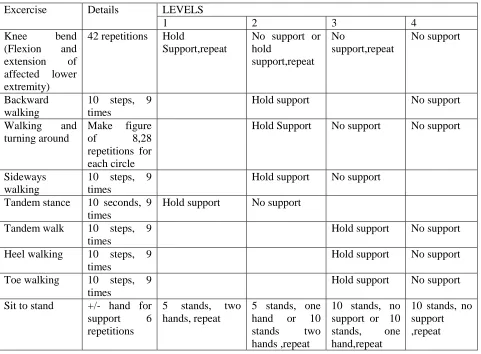
BRP- The BRP consists of four levels. Level one is administered to the patient during 1st week, level two is administered to the patients during 2nd week, level three is administered to the patient during the 3rd week and level 4 during 4th week. For each exercise give rest to the patients after 20 repetitions. Support is given to the patient by the therapist or the patient can hold the parallel bar while doing exercises as prescribed in BRP. Assistance were given to the patients to do exercises in the 1st and 2nd and 3rd levels of exercise programme. Approximately it will take 40 minutes to complete one level.
BALANCE RETRAINING PROGRAMME
Excercise Details LEVELS
1 2 3 4
Knee bend (Flexion and extension of affected lower extremity)
42 repetitions Hold
Support,repeat
No support or hold support,repeat No support,repeat No support Backward walking
10 steps, 9 times
Hold support No support
Walking and turning around
Make figure
of 8,28
repetitions for each circle
Hold Support No support No support
Sideways walking
10 steps, 9 times
Hold support No support Tandem stance 10 seconds, 9
times
Hold support No support Tandem walk 10 steps, 9
times
Hold support No support Heel walking 10 steps, 9
times
Hold support No support Toe walking 10 steps, 9
times
Hold support No support Sit to stand +/- hand for
support 6 repetitions
5 stands, two hands, repeat
5 stands, one hand or 10 stands two hands ,repeat
10 stands, no support or 10 stands, one hand,repeat
[image:5.612.68.549.272.626.2]© Associated Asia Research Foundation (AARF)
A Monthly Double-Blind Peer Reviewed Refereed Open Access International e-Journal - Included in the International Serial Directories.
Page | 12 Statistical analysis
Student` t‟ test was used to compare balance between the groups and with in groups.Control and Experimental groups responses to the treatment were analyzed using paired `t‟ test.
Presentation of clinical parameters of the stroke patients-Demographic presentation of Age,Sex,Side and Post stroke duration.
Control group % Experiment group
%
Age 50-55 3 20% 4 26.7%
55-60 5 33.3% 6 40%
60-65 7 46.7% 5 33.3%
Sex Male 8 53.3% 7 46.7%
Female 7 46.7% 8 53.3%
Side Right 6 40% 8 53.3%
Left 9 60% 7 46.7%
Duration in days
14-28 days 3 20% 4 26.7% 28-42 days 7 46.7% 6 40% 42-56 days 5 33.3% 5 33.3%
Analysis and interpretation.
a) BERG BALANCE SCALE.
Group Pre test mean
Independent „t‟ test value
Post tset mean
Independent „t‟ test value
Dependent „t‟ test value
% of increase in Balance from initial value Group A 41.53333 0.122NS 49.06667 8.32* 23.41713 13.45238 Group B 41.46667 53 45.1 20.59524 NS-Not Significant
* -Significant at p<0.01
© Associated Asia Research Foundation (AARF)
A Monthly Double-Blind Peer Reviewed Refereed Open Access International e-Journal - Included in the International Serial Directories.
Page | 13
When comparing the posttest mean values( 49.07 and 53) of the balance scores, it is found that there is significant difference between the two groups(p<0.01).
Using dependent `t‟ test.
Comparing 1st week and 4th week value of BBS in group A.
The mean pretest BBS value is 41.53333 and post test value is 49.06667.Using the paired t test , the mean change in balance score is found to be significant (p<0.01).
Comparing 1st week and 4th week values in group B
The mean pretest BBS value is 41.46667 and post test value is 53.B group found to be significant.(p<0.01).
Using independent `t‟ test.
Comparing pre test BBS values of group A and B.
Pre test mean BBS of group A is 41.53333 and group B IS 41.46667. using independent t test,The pre test mean balance scores showed no significant difference.(p>0.05). which shows patients in both groups were homogenous in the pre term test.
Comparing post test BBS values of group A and B.
Post test mean BBS of group A is 49.06667 and group B is 53. Using independent t test comparison of the mean post test BBS scores showed a significant difference (p<0.01), which shows that balance retraining program is having high effect when compared to control.
Discussion:
© Associated Asia Research Foundation (AARF)
A Monthly Double-Blind Peer Reviewed Refereed Open Access International e-Journal - Included in the International Serial Directories.
Page | 14
actually reflects the functional activity and is used, easy to administer and yield measurements that are reliable and valid. The total of BBS is 56.The control group was given conventional physiotherapy which consisted of active assisted range of motion exercises, functional mobility exercise, upper limb activities,Wooble board with support,Forward stepping, backward stepping, braiding and Manual perturbations. Experimental group was given BRP in addition to the treatment given to the control group. BRP uses balance exercise which are closely related to life style and function and repetitions was approximately thousand times. The significant improvement of balance in experimental group may be due to following factors.
Knee bends(ie knee flexion and extension) improves control of knee function and provides proprioceptive inputs.
Backward and sideways walking improves anticipatory postural control and weight bearing of affected side. .Combination of hip extension with knee flexion is useful for patients with hemiplegia. Walking and turning around stimulates and challenges vestibular system. Tandem stance improves weight distribution to the affected lower limb and reduces the centre of gravity with in the limited base of support. Tandem walking ability to walk with in the limited base of support and their by improving anticipatory postural control. Heel walking improves ankle strategy. Toe walking decreases the base of support and improves ankle strategy. Sit to stand ; In erect standing the base of support is small with high centre of gravity, requires maximum balance control. Initiates symmetrical weigh bearing and controlled response to trunk. Each exercises are repeated approximately thousand times. Studies suggested that thousands of repetitions are required to improve performance during neurological rehabilitation. Animal studies show that several thousand repetitions to middle three fingers to obtain food was followed by an expansion of the area of cortex that serves the middle finger. Studies found out that average stroke patients stood up and sat down approximately thousand times as they progressed from two on the standing up item of the motor assessment scale to 4,5,or 6 on the scale. .
LIMITATIONS
© Associated Asia Research Foundation (AARF)
A Monthly Double-Blind Peer Reviewed Refereed Open Access International e-Journal - Included in the International Serial Directories.
Page | 15
the patient from current status. The study was limited to mild to moderate stroke patients. Here the changes in the upper extremity is not included .Further study can be done which includes mobility as an outcome measure. In future balance impairment in severe stroke patients with BRP is also a research scope.
CONCLUSION
The study provides BRP as an effective treatment for balance retraining in mild to moderate stroke patients .It helps in improving functional balance by postural control mechanism.BRP is considered as an essential component in stroke rehabilitation and to prevent secondary problems due to balance impairements.BRP is simple to practice and is cost effective adjunct to physiotherapy treatment in stroke rehabilitation.
Conflict of interest; None.
Source of funding; self.
Ethical clearance; The procedure followed was in accordance with the ethical standards and after the attainment of informed consent from patients.
REFERENCE:
1. Ruth Ann Geiger et al: Limit of stability is defined at the maximum distance in shifting weight in any direction without loss of balance (2001).
2. Susan B.O Sullivan: The incidence of stroke increases dramatically with age doubling every decade after 55 years of age (2001).
3. Murry C.J. et al: In terms of disability adjusted life years (DALY) stroke ranks as the sixth higest cause of burden of disease worldwide and in accounting 52% of total death in which cerebro vascular disease include 4.4 million. Stroke in the single most important cause of severe disability in people living in their on homes (1997).
4. Shumway-Cook A, et al: In patients with hemplegia to corrective response perturbations or destabilizing forces are frequently inadequate and may result in loss of balance (2005). 5. Cambell A.J et al : The balance retaining uses progressions from level 1 the first or
© Associated Asia Research Foundation (AARF)
A Monthly Double-Blind Peer Reviewed Refereed Open Access International e-Journal - Included in the International Serial Directories.
Page | 16
6. Susan B.O‟ Sullivan: Guided and active assisted movement provides a good early base for learning postural control (2001).
7. Campbell A.J. et al : Exercise programs that have successfully reduced falls in older people have required the participant to carry out balancing exercise three days a week for six months (1997).
8. Nicholas D.S. et al : Balance retraining after stroke using force platform biofeedback systems provide visual or auditory biofeedback to patients regarding the locus of their center of force as well as training protocols to enhance stance, symmetry, steadiness and dynamic stability (1997).
9. Young A. et al : Balance excercises are closely related to life style and function foe e.g. moving from a sit to stand position, walking and turning around and knee bends (1994) 10.Jenkin S. et al: In an animal experiment, use of the middle three fingers to obtain food
was followed by an expansion of the area of cortex that serves the middle fingers and this had occurred with several thousands repetition (1990).
11.Canning : Found that an average stroke patient stood up and sat down and approximately 1000 times as they progressed from 2 on the standing up item of the motor assessment scale to 4, 5 or 6 on the scale (1987)
12.Kottle: Suggested that thousands of repetitions are required to improve performance during neurological rehabilitation (1974).
13.Bogle Thorbahn L.D. et al:Researchers have found that patients who score 45 or more out of 56 points on berg balance scale have a high probability of not falling and are less likely to use an assistive device than those who score below 45 points(1996).
14.Duncan et al: Mild to moderate stroke deficits defined by an orpington prognostic scale score of 2.0 to 5.2 (1998).
15.Cambell A.J et al : “Practical implementation of an exercise –based fall prevention programme” age and ageing30. PP 77-83 (2001).
© Associated Asia Research Foundation (AARF)
A Monthly Double-Blind Peer Reviewed Refereed Open Access International e-Journal - Included in the International Serial Directories.
Page | 17
18.Simmons R.W. et al “Balance retraining in a hemiparetic patients using center of gravity biofeedback”: a single-case study percept mot skill;PP 603-9(1998).