Optimizing Algorithms for Pronoun Resolution
Michael Schiehlen
Institute for Computational Linguistics University of Stuttgart
Azenbergstraße 12, D-70174 Stuttgart [email protected]
Abstract
The paper aims at a deeper understanding of sev-eral well-known algorithms and proposes ways to optimize them. It describes and discusses factors and strategies of factor interaction used in the algo-rithms. The factors used in the algorithms and the algorithms themselves are evaluated on a German corpus annotated with syntactic and coreference in-formation (Negra) (Skut et al., 1997). A common format for pronoun resolution algorithms with sev-eral open parameters is proposed, and the parameter settings optimal on the evaluation data are given.
1 Introduction
In recent years, a variety of approaches to pronoun resolution have been proposed. Some of them are based on centering theory (Strube, 1998; Strube and Hahn, 1999; Tetreault, 2001), others on Machine Learning (Aone and Bennett, 1995; Ge et al., 1998; Soon et al., 2001; Ng and Cardie, 2002; Yang et al., 2003). They supplement older heuristic approaches (Hobbs, 1978; Lappin and Leass, 1994). Unfortu-nately, most of these approaches were evaluated on different corpora making different assumptions so that direct comparison is not possible. Appreciation of the new insights is quite hard. Evaluation differs not only with regard to size and genre of corpora but also along the following lines.
Scope of application: Some approaches only deal with personal and possessive pronouns (centering and heuristic), while others consider coreference links in general (Soon et al., 2001; Ng and Cardie, 2002; Yang et al., 2003). A drawback of this lat-ter view is that it mixes problems on different lev-els of difficulty. It remains unclear how much of the success is due to the virtues of the approach and how much is due to the distribution of hard and easy problems in the corpus. In this paper, we will only deal with coreferential pronouns (i.e. possessive, demonstrative, and third person pronouns).
My thanks go to Melvin Wurster for help in annotation and to Ciprian Gerstenberger for discussion.
Quality of linguistic input: Some proposals were evaluated on hand annotated (Strube and Hahn, 1999) or tree bank input (Ge et al., 1998; Tetreault, 2001). Other proposals provide a more realistic picture in that they work as a backend to a parser (Lappin and Leass, 1994) or noun chunker (Mitkov, 1998; Soon et al., 2001; Ng and Cardie, 2002)). In evaluation of applications presupposing parsing, it is helpful to separate errors due to parsing from in-trinsic errors. On the other hand, one would also like to gauge the end-to-end performance of a sys-tem. Thus we will provide performance figures for both ideal (hand-annotated) input and realistic (au-tomatically generated) input.
Language: Most approaches were evaluated on English where large resources are available, both in terms of pre-annotated data (MUC-6 and MUC-7 data) and lexical information (WordNet). This paper deals with German. Arguably, the free word-order of German arguably leads to a clearer distinction be-tween grammatical function, surface order, and in-formation status (Strube and Hahn, 1999).
The paper is organized as follows. Section 2 de-scribes the evaluation corpus. Section 3 dede-scribes several factors relevant to pronoun resolution. It as-sesses these factors against the corpus, measuring their precision and restrictiveness. Section 4 de-scribes and evaluates six algorithms on the basis of these factors. It also captures the algorithms as para-metric systems and proposes parameter settings op-timal on the evaluation data. Section 5 concludes.
2 Evaluation Corpus
We chose as an evaluation base the NEGRA tree bank, which contains about 350,000 tokens of Ger-man newspaper text. The same corpus was also pro-cessed with a finite-state parser, performing at 80% dependency f-score (Schiehlen, 2003).
names were annotated automatically by a named entity recognizer. In a small portion of the corpus (6.7%), all coreference links were annotated. Thus the size of the annotated data (3,115 personal pro-nouns1, 2,198 possessive pronouns, 928 demonstra-tive pronouns) compares favourably with the size of evaluation data in other proposals (619 German pro-nouns in (Strube and Hahn, 1999), 2,477 English pronouns in (Ge et al., 1998), about 5,400 English coreferential expressions in (Ng and Cardie, 2002)). In the experiments, systems only looked for sin-gle NP antecedents. Hence, propositional or pred-icative antecedents (8.4% of the pronouns anno-tated) and split antecedents (0.2%) were inaccessi-ble, which reduced optimal success rate to 91.4%.
3 Factors in Pronoun Resolution
Pronoun resolution is conditioned by a wide range of factors. Two questions arise: Which factors are the most effective? How is interaction of the factors modelled? The present section deals with the first question, while the second question is postponed to section 4.
Many approaches distinguish two classes of res-olution factors: filters and preferences. Filters ex-press linguistic rules, while preferences are merely tendencies in interpretation. Logically, filters are monotonic inferences that select a certain subset of possible antecedents, while preferences are non-monotonic inferences that partition the set of an-tecedents and impose an order on the cells.
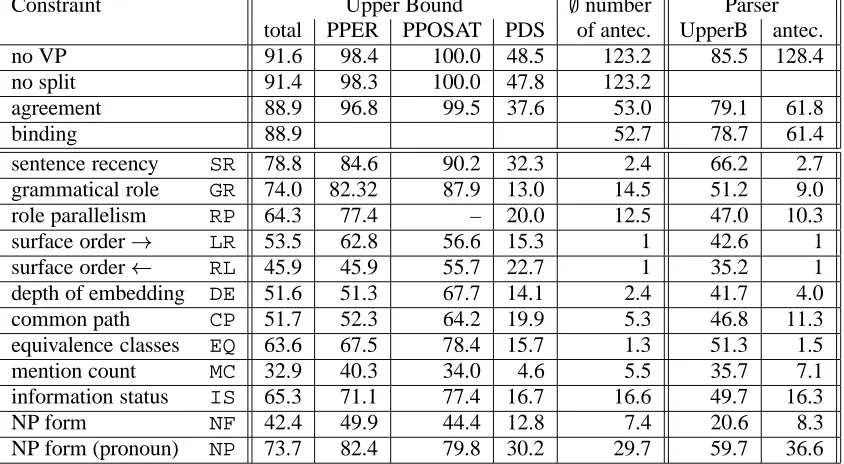
In the sequel, factors proposed in the literature are discussed and their value is appraised on evaluation data. Every factor narrows the set of antecedents and potentially discards correct antecedents. Ta-ble 1 lists both the success rate maximally achiev-able (broken down according to different types of pronouns) and the average number of antecedents remaining after applying each factor. Figures are also given for parsed input. Preferences are evalu-ated on filtered sets of antecedents.
3.1 Filters
Agreement. An important filter comes from mor-phology: Agreement in gender and number is gener-ally regarded as a prerequisite for coreference. Ex-ceptions are existant but few (2.5%): abstract pro-nouns (such as that in English) referring to non-neuter or plural NPs, plural pronouns co-referring with singular collective NPs (Ge et al., 1998), an-tecedent and anaphor matching in natural gender
1Here, we only count anaphoric pronouns, i.e. third person pronouns not used expletively.
rather than grammatical gender. All in all, a max-imal performance of 88.9% is maintained. The fil-ter is very restrictive, and cuts the set of possible antecedents in half. See Table 1 for details.
Binding. Binding constraints have been in the focus of linguistic research for more than thirty years. They provide restrictions on co-indexation of pronouns with clause siblings, and therefore can only be applied with systems that determine clause boundaries, i.e. parsers (Mitkov, 1998). Empiri-cally, binding constraints are rules without excep-tions, hence they do not lead to any loss in achiev-able performance. The downside is that their restric-tive power is quite bad as well (0.3% in our corpus, cf. Table 1).
Sortal Constraints. More controversial are sor-tal constraints. Intuitively, they also provide a hard filter: The correct antecedent must fit into the en-vironment of the pronoun (Carbonell and Brown, 1988). In general, however, the required knowledge sources are lacking, so they must be hand-coded and can only be applied in restricted domains (Strube and Hahn, 1999). Selectional restrictions can also be modelled by collocational data extracted by a parser, which have, however, only a very small im-pact on overall performance (Kehler et al., 2004). We will neglect sortal constraints in this paper.
3.2 Preferences
Preferences can be classified according to their re-quirements on linguistic processing. Sentence Re-cency and Surface Order can be read directly off the surface. NP Form presupposes at least tagging. A range of preferences (Grammatical Roles, Role Par-allelism, Depth of Embedding, Common Path), as well as all filters, presuppose full syntactic analysis. Mention Count and Information Status are based on previous decisions of the anaphora resolution mod-ule.
Sentence Recency (SR). The most important cri-terion in pronoun resolution (Lappin and Leass, 1994) is the textual distance between anaphor and antecedent measured in sentences. Lappin and Le-ass (1994) motivate this preference as a dynamic ex-pression of the attentional state of the human hearer: Memory capability for storage of discourse refer-ents degrades rapidly.
Constraint Upper Bound number Parser total PPER PPOSAT PDS of antec. UpperB antec. no VP 91.6 98.4 100.0 48.5 123.2 85.5 128.4 no split 91.4 98.3 100.0 47.8 123.2
agreement 88.9 96.8 99.5 37.6 53.0 79.1 61.8
binding 88.9 52.7 78.7 61.4
sentence recency SR 78.8 84.6 90.2 32.3 2.4 66.2 2.7 grammatical role GR 74.0 82.32 87.9 13.0 14.5 51.2 9.0 role parallelism RP 64.3 77.4 – 20.0 12.5 47.0 10.3 surface order LR 53.5 62.8 56.6 15.3 1 42.6 1
surface order RL 45.9 45.9 55.7 22.7 1 35.2 1
[image:3.612.96.518.25.257.2]depth of embedding DE 51.6 51.3 67.7 14.1 2.4 41.7 4.0 common path CP 51.7 52.3 64.2 19.9 5.3 46.8 11.3 equivalence classes EQ 63.6 67.5 78.4 15.7 1.3 51.3 1.5 mention count MC 32.9 40.3 34.0 4.6 5.5 35.7 7.1 information status IS 65.3 71.1 77.4 16.7 16.6 49.7 16.3 NP form NF 42.4 49.9 44.4 12.8 7.4 20.6 8.3 NP form (pronoun) NP 73.7 82.4 79.8 30.2 29.7 59.7 36.6
Table 1: Effect of Factors
antecedent is found in the previous context, subse-quent sentences are inspected (cataphora), also or-dered by proximity to the pronoun.
1 10 100 1000 10000
-2-1 0 1 2 3 4 5 6 7 8 9 12 19
[image:3.612.73.292.357.535.2]all PPER PPOSAT PDS
Figure 1: Sentence Recency
Figure 1 shows the absolute frequencies of sen-tence recency values when only the most recent an-tecedent (in the order just stated) is considered. In Negra, 55.3% of all pronominal anaphora can be re-solved intrasententially, and 97.6% within the last three sentences. Since only 1.6% of all pronouns are cataphoric, it seems reasonable to neglect cat-aphora, as is mostly done (Strube and Hahn, 1999; Hobbs, 1978). Table 1 underscores the virtues of Sentence Recency: In the most recent sentence with antecedents satisfying the filters, there are on
aver-age only 2.4 such antecedents. However, the benefit also comes at a cost: The upper ceiling of perfor-mance is lowered to 82.0% in our corpus: In many cases an incorrect antecedent is found in a more re-cent sentence.
Similarly, we can assess other strategies of sen-tence ordering that have been proposed in the litera-ture. Hard-core centering approaches only deal with the last sentence (Brennan et al., 1987). In Negra, these approaches can consequently have at most a success rate of 44.2%. Performance is particularly low with possessive pronouns which often only have antecedents in the current sentence. Strube (1998)’s centering approach (whose sentence ordering is des-ignated asSR2in Table 2) also deals with and even prefers intrasentential anaphora, which raises the upper limit to a more acceptable 80.2%. Strube and Hahn (1999) extend the context to more than the last sentence, but switch preference order between the last and the current sentence so that an antecedent is determined in the last sentence, whenever possi-ble. In Negra, this ordering imposes an upper limit of 51.2%.
their model express a preference of rhematic2 over thematic arguments: Existential subjects, which fol-low the verb, rank very high, between subjects and direct objects. Topic adjuncts in pre-subject posi-tion separated by a comma rank very low, between adjuncts and NP complements. Both positions are not clearly demarcated in German. When the Lap-pin&Leass hierarchy is adopted to German with-out changes, a small drop in performance results as compared with the obliqueness hierarchy used in centering. So we will use the centering hierarchy. Table 1 shows the effect of the role-based prefer-ence on our data. The factor is both less restrictive and less precise than sentence recency.
The definition of a grammatical role hierarchy is more involved in case of automatically derived in-put, as the parser cannot always decide on the gram-matical role (determining gramgram-matical roles in Ger-man may require world knowledge). It proposes a syntactically preferred role, however, which we will adopt.
Role Parallelism (RP). Carbonell and Brown (1988) argue that pronouns prefer antecedents in the same grammatical roles. Lappin and Leass (1994) also adopt such a principle. The factor is, however, not applicable to possessive pronouns.
Again, role ambiguities make this factor slightly problematic. Several approaches are conceivable: Antecedent and pronoun are required to have a com-mon role in one reading (weak match). Antecedent and pronoun are required to have the same role in the reading preferred by surface order (strong match). Antecedent and pronoun must display the same role ambiguity (strongest match). Weak match restricted performance to 49.9% with 12.1 antecedents on average. Strong match gave an up-per limit of 47.0% but with only 10.3 antecedents on average. Strongest match lowered the upper limit to 43.1% but yielded only 9.3 antecedents. In interac-tion, strong match performed best, so we adopt it.
Surface Order (LR, RL). Surface Order is usu-ally used to bring down the number of available antecedents to one, since it is the only factor that produces a unique discourse referent. There is less consensus on the preference order: (sentence-wise) left-to-right (Hobbs, 1978; Strube, 1998; Strube and Hahn, 1999; Tetreault, 1999) or right-to-left (recency) (Lappin and Leass, 1994). Furthermore, something has to be said about antecedents which embed other antecedents (e.g. conjoined NPs and their conjuncts). We registered performance gains
2Carbonell and Brown (1988) also argue that clefted or fronted arguments should be preferred.
(of up to 3%) by ranking embedding antecedents higher than embedded ones (Tetreault, 2001).
Left-to-right order is often used as a surrogate for grammatical role hierarchy in English. The most notable exception to this equivalence are fronting constructions, where grammatical roles outperform surface order (Tetreault, 2001). A comparison of the lines for grammatical roles and for surface order in Table 1 shows that the same is true in German.
Left-to-right order performs better (upper limit 56.8%) than right-to-left order (upper limit 49.2%). The gain is largely due to personal pronouns; demonstrative pronouns are better modelled by right-to-left order. It is well-known that German demonstrative pronouns contrast with personal pro-nouns in that they function as topic-shifting devices. Another effect of this phenomenon is the poor per-formance of the role preferences in connection with demonstrative pronouns.
Depth of Embedding (DE). A prominent factor in Hobbs (1978)’s algorithm is the level of phrasal embedding: Hobbs’s algorithm performs a breadth-first search, so antecedents at higher levels of em-bedding are preferred.
Common Path (CP). The syntactic version of Hobbs (1978)’s algorithm also assumes maximiza-tion of the common path between antecedents and anaphors as measured in NP and S nodes. Accord-ingly, intra-sentential antecedents that are syntacti-cally nearer to the pronoun are preferred. The factor only applies to intrasentential anaphora.
The anaphora resolution module itself generates potentially useful information when processing a text. Arguably, discourse entities that have been of-ten referred to in the previous context are topical and more likely to serve as antecedents again. This principle can be captured in different ways.
Mention Count (MC). Ge et al. (1998) try to fac-torize the same principle by counting the number of times a discourse entities has been mentioned in the discourse already. However, they do not only train but also test on the manually annotated counts, and hence presuppose an optimal anaphora resolution system. In our implementation, we did not bother with intrasentential mention count, which depends on the exact traversal. Rather, mention count was computed only from previous sentences.
Information Status (IS). Strube (1998) and Strube and Hahn (1999) argue that the informa-tion status of an antecedent is more important than the grammatical role in which it occurs. They dis-tinguish three levels of information status: entities known to the hearer (as expressed by coreferential NPs, unmodified proper names, appositions, rela-tive pronouns, and NPs in titles), entities related to such hearer-old entities (either overtly via modifiers or by bridging), and entities new to the hearer. Like (Ge et al., 1998), Strube (1998) evaluates on ideal hand annotated data.
NP Form (NF, NP). A cheap way to model in-formation status is to consider the form of an an-tecedent (Tetreault, 2001; Soon et al., 2001; Strube and Müller, 2003). Personal and demonstrative pronouns are necessarily context-dependent, and proper nouns are nearly always known to the hearer. Definite NPs may be coreferential or interpreted by bridging, while indefinite NPs are in their vast ma-jority new to the hearer. We considered two propos-als for orderings of form: preferring pronouns and proper names over other NPs over indefinite NPs (Tetreault, 2001) (NF) or preferring pronouns over all other NPs (Tetreault, 2001) (NP).
4 Algorithms and Evaluation
In this section, we consider the individual ap-proaches in more detail, in particular we will look at their choice of factors and their strategy to model factor interaction. According to interaction poten-tial, we distinguish three classes of approaches: Se-rialization, Weighting, and Machine Learning.
We re-implemented some of the algorithms de-scribed in the literature and evaluated them on syn-tactically ideal and realistic German3 input. Evalu-ation results are listed in Table 2.
With the ideal treebank input, we also assumed ideal input for the factors dependent on previous
3
A reviewer points out that most of the algorithms were pro-posed for English, where they most likely perform better. How-ever, the algorithms also incorporate a theory of saliency, which should be language-independent.
anaphora resolution results. With realistic parsed input, we fed the results of the actual system back into the computation of such factors.
4.1 Serialization Approaches
Algorithmical approaches first apply filters uncon-ditionally; possible exceptions are deemed non-existant or negligible. With regard to interaction of preferences, many algorithms (Hobbs, 1978; Strube, 1998; Tetreault, 2001) subscribe to a scheme, which, though completely rigid, performs surprisingly well: The chosen preferences are ap-plied one after the other in a certain pre-defined or-der. Application of a preference consists in select-ing those of the antecedents still available that are ranked highest in the preference order.
Hobbs (1978)’s algorithm essentially is a con-catenation of the preferences Sentence Recency (without cataphora), Common Path, Depth of Em-bedding, and left-to-right Surface Order. It also im-plements the binding constraints by disallowing sib-ling to the anaphor in a clause or NP as antecedents. Like Lappin and Leass (1994), we replaced this im-plementation by our own mechanism to check bind-ing constraints, which raised the success rate.
The Left-Right Centering algorithm of Tetreault (1999) is similar to Hobbs’s algorithm, and is com-posed of the preferences Sentence Recency (without cataphora), Depth of Embedding, and left-to-right Surface Order. Since it is a centering approach, it only inspects the current and last sentence.
Strube (1998)’s S-list algorithm is also restricted to the current and last sentence. Predicative com-plements and NPs in direct speech are excluded as antecedents. The primary ordering criterion is Information Status, followed by Sentence Recency (without cataphora) and left-to-right Surface Order. Since serialization provides a quite rigid frame, we conducted an experiment to find the best per-forming combination of pronoun resolution factors on the treebank and the best combination on the parsed input. For this purpose, we checked all per-mutations of preferences and subtracted preferences from the best-performing combinations until perfor-mance degraded (greedy descent). Greedy descent outperformed hill-climbing. The completely anno-tated 6.7% of the corpus were used as development set, the rest as test set.
4.2 Weighting Approaches
Algorithm Definition F-Scores – treebank F-Score total PPER PPOSAT PDS Parser (Hobbs, 1978) SR CP DE LR 59.9 65.1 70.5 17.4 45.4 (Tetreault, 1999) SR2 DE LR 57.0 64.1 61.9 17.2 43.3 (Strube, 1998) IS SR2 LR 57.9 65.9 63.7 12.0 39.1 optimal algor. (treebank) SR CP IS DE MC RP GR RL 70.4 75.6 82.0 22.7 43.7 optimal algor. (parsed) SR CP GR IS DE LR 67.7 74.3 82.0 10.6 50.6 (Lappin and Leass, 1994) EQ SR RL 65.4 71.0 78.0 16.6 50.8 (Ge et al., 1998) Hobbs+MC 43.4 45.7 53.6 12.1 36.3 (Soon et al., 2001) (SR+NP) RL 24.8 30.8 23.6 0.0 26.8 optimal algor. (C4.5) (SR/RL+GR+NF/IS) RL 71.1 78.2 79.0 9.8 51.7
Table 2: Performance of Algorithms
switch under different input data. In the actual real-ization, however, the weights of factors lie so much apart that in the majority of cases interaction boils down to serialization. The weighting scheme in-cludes Sentence Recency, Grammatical Roles, Role Parallelism, on the basis of the equivalence class ap-proach described in section 3.2. Final choice of an-tecedents is relegated to right-to-left Surface Order. Interestingly, the Lappin&Leass algorithm out-performs even the best serialization algorithm on parsed input.
4.3 Machine Learning Approaches
Machine Learning approaches (Ge et al., 1998; Soon et al., 2001; Ng and Cardie, 2002) do not dis-tinguish between filters and preferences. They sub-mit all factors as features to the learner. For every combination of feature values the learner has the freedom to choose different factors and to assign different strength to them.
Thus the main problem is not choice and in-teraction of factors, but rather the formulation of anaphora resolution as a classification problem. Two proposals emerge from the literature. (1) Given an anaphor and an antecedent, decide if the an-tecedent is the correct one (Ge et al., 1998; Soon et al., 2001; Ng and Cardie, 2002). (2) Given an anaphor and two antecedents, decide which an-tecedent is more likely to be the correct one (Yang et al., 2003). In case (1), the lopsidedness of the distribution is problematic: There are much more negative than positive training examples. Machine Learning tools have to surpass a very high baseline: The strategy of never proposing an antecedent typ-ically already yields an f-score of over 90%. In case (2), many more correct decisions have to be made before a correct antecedent is found. Thus it is important in this scenario, that the set of antecedents is subjected to a strict filtering process in advance so
that the system only has to choose among the best candidates and errors are less dangerous.
Ge et al. (1998)’s probabilistic approach com-bines three factors (aside from the agreement filter): the result of the Hobbs algorithm, Mention Count dependent on the position of the sentence in the ar-ticle, and the probability of the antecedent occur-ring in the local context of the pronoun. In our re-implementation, we neglected the last factor (see section 3.1). Evaluation was performed using 10-fold cross validation.
Other Machine Learning approaches (Soon et al., 2001; Ng and Cardie, 2002; Yang et al., 2003) make use of decision tree learning4; we used C4.5 (Quin-lan, 1993). To construct the training set, Soon et al. (2001) take the nearest correct antecedent in the pre-vious context as a positive example, while all pos-sible antecedents between this antecedent and the pronoun serve as negative examples. For testing, potential antecedents are presented to the classifier in Right-to-Left order; the first one classified posi-tive is chosen. Apart from agreement, only two of Soon et al. (2001)’s features apply to pronominal anaphora: Sentence Recency, and NP Form (with personal pronouns only). We used every 10th sen-tence in Negra for testing, all other sensen-tences for training. On parsed input, a very simple decision tree is generated: For every personal and posses-sive pronoun, the nearest agreeing pronoun is cho-sen as antecedent; demonstrative pronouns never get an antecedent. This tree performs better than the more complicated tree generated from treebank in-put, where also non-pronouns in previous sentences can serve as antecedents to a personal pronoun.
Soon et al. (2001)’s algorithm performs below its potential. We modified it somewhat to get better re-sults. For one, we used every possible antecedent
in the training set, which improved performance on the treebank set (by 1.8%) but degraded perfor-mance on the parsed data (by 2%). Furthermore, we used additional features, viz. the grammatical role of antecedent and pronoun, the NP form of the an-tecedent, and its information status. The latter two features were combined to a single feature with very many values, so that they were always chosen first in the decision tree. We also used fractional numbers to express intrasentential word distance in addition to Soon et al. (2001)’s sentential distance. Role Parallelism (Ng and Cardie, 2002) degraded perfor-mance (by 0.3% F-value). Introducing agreement as a feature had no effect, since the learner always determined that mismatches in agreement preclude coreference. Mention Count, Depth of Embedding, and Common Path did not affect performance either.
5 Conclusion
The paper has presented a survey of pronoun reso-lution factors and algorithms. Two questions were investigated: Which factors should be chosen, and how should they interact? Two types of factors, ‘filters’ and ‘preferences’, were discussed in detail. In particular, their restrictive potential and effect on success rate were assessed on the evaluation corpus. To address the second question, several well-known algorithms were grouped into three classes accord-ing to their solution to factor interaction: Serializa-tion, Weighting, and Machine Learning. Six algo-rithms were evaluated against a common evaluation set so as to facilitate direct comparison. Different algorithms have different strengths, in particular as regards their robustness to parsing errors. Two of the interaction strategies (Serialization and Machine Learning) allow data-driven optimization. Optimal algorithms could be proposed for these strategies.
References
Chinatsu Aone and Scott William Bennett. 1995. Evalu-ating automated and manual acquisition of anaphora resolution strategies. In ACL’95, pages 122–129, Cambridge, MA.
Susan E. Brennan, Marilyn W. Friedman, and Carl J. Pollard. 1987. A centering approach to pronouns. In ACL’87, pages 155–162, Stanford, CA.
Jaime G. Carbonell and Ralph D. Brown. 1988. Anaphora resolution: A multi-strategy approach. In COLING ’88, pages 96–101.
Niyu Ge, John Hale, and Eugene Charniak. 1998. A sta-tistical approach to anaphora resolution. In
Proceed-ings of the Sixth Workshop on Very Large Corpora,
pages 161–170.
Barbara J. Grosz, Aravind K. Joshi, and Scott Weinstein. 1995. Centering: A Framework for Modeling the
Lo-cal Coherence of Discourse. Computational
Linguis-tics, 21(2):203–225.
Jerry R. Hobbs. 1978. Resolving pronoun references.
Lingua, 44:311–338.
Andrew Kehler, Douglas Appelt, Lara Taylor, and Alek-sandr Simma. 2004. The (Non)Utility of Predicate-Argument Frequencies for Pronoun Interpretation. In
Proceedings of the 2nd HLT/NAACL, Boston, MA.
Shalom Lappin and Herbert J. Leass. 1994. An algo-rithm for pronominal anaphora resolution.
Computa-tional Linguistics, 20(4):535–561.
Ruslan Mitkov. 1998. Robust pronoun resolution with limited knowledge. In COLING ’98, pages 869–875, Montreal, Canada.
MUC-7. 1997. Coreference task definition. In
Proceed-ings of the Seventh Message Understanding Confer-ence (MUC-7).
Vincent Ng and Claire Cardie. 2002. Improving ma-chine learning approaches to coreference resolution. In ACL’02, pages 104–111, Philadelphia, PA. J. Ross Quinlan. 1993. C4.5: Programs for Machine
Learning. Morgan Kaufmann Publishers, San Mateo,
CA.
Michael Schiehlen. 2003. Combining Deep and Shallow Approaches in Parsing German. In ACL’03, pages 112–119, Sapporo, Japan.
Wojciech Skut, Brigitte Krenn, Thorsten Brants, and Hans Uszkoreit. 1997. An Annotation Scheme for Free Word Order Languages. In ANLP-97, Washing-ton, DC.
Wee Meng Soon, Hwee Tou Ng, and Daniel Chung Yong Lim. 2001. A Machine Learning Approach to Coref-erence Resolution of Noun Phrases. Computational
Linguistics, 27(4):521–544.
Michael Strube and Udo Hahn. 1999. Functional Centering – Grounding Referential Coherence in Information Structure. Computational Linguistics,
25(3):309–344.
Michael Strube and Christoph Müller. 2003. A Machine Learning Approach to Pronoun Resolution in Spo-ken Dialogue. In ACL’03, pages 168–175, Sapporo, Japan.
Michael Strube. 1998. Never look back: An alterna-tive to Centering. In COLING ’98, pages 1251–1257, Montreal, Canada.
Joel R. Tetreault. 1999. Analysis of Syntax-Based Pro-noun Resolution Methods. In ACL’99, pages 602– 605, College Park, MA.
Joel R. Tetreault. 2001. A corpus-based evaluation of centering and pronoun resolution. Computational
Linguistics, 27(4):507–520.