Readability Indices for Automatic Evaluation of Text Simplification
Systems: A Feasibility Study for Spanish
Sanja ˇStajner
Research Group in Computational Linguistics University of Wolverhampton, UK
Horacio Saggion
TALN Research Group Universitat Pompeu Fabra, Spain [email protected]
Abstract
This paper addresses the problem of automatic evaluation of text simplifica-tion systems for Spanish. We test whether already-existing readability for-mulae would be suitable for this task. We adapt three existing readability indices (two measuring lexical complexity and one measuring syntactic complexity) to be computed automatically, which are then applied to a corpus of original news texts and their manual simplifications aimed at people with cognitive disabilities. We show that there is a significant correlation between each of the three readability in-dices and several linguistically motivated features which might be seen as reading obstacles for various target populations. Furthermore, we show that there is a sig-nificant correlation between the two read-ability indices which measure lexical com-plexity.
1 Introduction
In recent years, there has been growing effort to simplify written material and make it equally ac-cessible to everyone. Various studies indicate that lexically and syntactically complex texts can be very difficult for non-native speakers and people with various reading impairments (e.g. autistic, aphasic, dyslexic or deaf people). Aphasic peo-ple, for instance, may encounter problems with less frequent words and some particular sentence constructions (Devlin, 1999). They also have problems in understanding syntactic constructions which do not follow the canonical subject-verb-object structure (e.g. passive constructions), and especially those sentences which are semantically reversible, e.g. “The boy was kissed by the girl” (Carroll et al., 1999). Additionally, apha-sic readers may have additional problems with
comprehending newswire texts which have some genre-specific characteristics. These types of texts tend to use long sentences, noun compounds and long sequences of adjectives, e.g. “Twenty-five-year-old blonde-haired mother-of-two Jane Smith”(Carroll et al., 1999). People with intellec-tual disabilities have problem with both lexically and syntactically complex texts, as well as with processing and loading large amounts of informa-tion (Feng, 2009).
Since the late nineties, several initiatives which proposed guidelines for producing plain, easy-to-read and more accessible documents have emerged, e.g. ”The Plain Language Action and Information Network (PLAIN)”1, “Make it Sim-ple, European Guidelines for the Production of Easy-to-Read Information for people with Learn-ing Disability” (Freyhoff et al., 1998), “Am I mak-ing myself clear? Mencap’s guidelines for ac-cessible writing”2, and “Web content accessibil-ity guidelines”3. All these guidelines share sim-ilar instructions for accessible writing, some of them more detailed than others. They all advise the writer to use the active voice instead of pas-sive, use the simplest form of a verb (present and not conditional or future), avoid hidden verbs (i.e. verbs converted into a noun), use short, simple words and omit unnecessary words, write short sentences and cover only one main idea per sen-tence, etc.
Armed with these guidelines and the aim of making written documents equally accessible to everyone, many attempts have been made to com-pletely or at least partially automate the process of text simplification, which is very expensive and time-consuming when performed manually. So far, text simplification systems have been
devel-1
http://www.plainlanguage.gov/ 2
http://november5th.net/resources/Mencap/Making-Myself-Clear.pdf
3http://www.w3.org/TR/WCAG20/
oped for English (Zhu et al., 2010; Coster and Kauchak, 2011; Woodsend and Lapata, 2011; Wubben et al., 2012), Spanish (Saggion et al., 2011), and Portuguese (Alu´ısio et al., 2008), with recent attempts at Basque (Aranzabe et al., 2012), Swedish (Rybing et al., 2010), and Dutch (Ruiter et al., 2010). With the emergence of these sys-tems, the question we are faced with is how to au-tomatically evaluate their performance given that the access to the target users might be difficult.
This study is an attempt to address this issue. We focus on text simplification systems for Span-ish and investigate whether some of the already ex-isting readability indices could be used for the au-tomatic evaluation of these systems. Using a cor-pus of original news texts and their manual sim-plifications which followed specific guidelines for writing for people with cognitive disabilities, we show that two lexical complexity indices – one suggested by Anula (2007), and other by Spauld-ing (1956) – are highly correlated in both these text sets. Furthermore, we show that both these indices and the third readability index concerned with syntactic complexity (Anula, 2007) could be used for automatic evaluation of text simplifica-tion systems, as each index is correlated with some subset of the linguistically motivated complexity features considered as obstacles for people with different reading impairments.
The remainder of the article is structured as fol-lows: Section 2 presents the most important pre-vious work on readability prediction and linguisti-cally motivated complexity features considered as obstacles for people with different reading diffi-culties; Section 3 describes the corpora, features, and readability indices used in this study; Section 4 presents and discusses the results of analysis of three chosen readability indices, twelve linguisti-cally motivated complexity features, and their mu-tual correlation; while Section 5 concludes the ar-ticle by summarising the main contributions and proposing possible directions for future work.
2 Related Work
Since the 1950s, over 200 readability formu-lae have been developed (for the English lan-guage), with over 1000 studies of their applica-tion (DuBay, 2004). Initially, they were used to assess the grade level of textbooks. Later, they were adapted to different domains and purposes, e.g. to measure readability of technical manuals
(Automated Readability Index (Smith and Senter, 1967)), or US healthcare documents intended for the general public (the SMOG grading (McLaugh-lin, 1969)). Some of these first readability formu-lae are still widely in use, given their simplicity (they require only the average sentence and word length) and good correlation with the reading tests. One of the most used readability formulae – the Flesch Reading Ease score (Flesch, 1949) – for example, “correlates .70 with the 1925 McCall-Crabbs reading test and .64 with the 1950 ver-sion of the same test” (DuBay, 2004). Another set of readability formulae are those which de-pend on average sentence length and the percent-age of words which cannot be found on a list of the “easiest” words, e.g. the Dale-Chall readabil-ity formulae (Dale and Chall, 1948). These for-mulae have been adapted to other languages by changing the coefficient before the factors (e.g. the Flesch-Douma (Douma, 1960) and Leesindex Brouwer (Brouwer, 1963) formulae for Dutch rep-resent the adaptations of the Flesch Reading Ease score, while Spaulding’s Spanish readability for-mula (Spaulding, 1956) could be seen as an adap-tation of the Dale-Chall formula (Dale and Chall, 1948)). Oosten et al. (2010) showed that read-ability formulae which are solely based on su-perficial text characteristics (average sentence and word length) seem to be strongly correlated even across different languages (English, Dutch, and Swedish).
With the recent advances of natural language processing (NLP) tools and techniques, new ap-proaches to readability assessment have emerged. Schwarm and Ostendorf (2005), and Petersen and Ostendorf (2009), used statistical language mod-eling and support vector machines to show that more complex features (e.g. average height of the parse tree, average number of noun and verb phrases, etc.) give better readability prediction than the traditional Flesch-Kincaid readability for-mula. They based their approach on the texts from Weekly Reader4, and two smaller corpora: En-cyclopedia Britannica and Britannica Elementary (Barzilay and Elhadad, 2003), and CNN news sto-ries and their abridged vesions5. Feng et al. (2009) introduced some new cognitively motivated fea-tures which should improve automatic readability assessment of texts for people with cognitive
dis-4
abilities. In addition to three previously used cor-pora (Weekly Reader, Britannica, and CNN news stories) aimed at second language learners or chil-dren, Feng et al. (2009) used a corpus of lo-cal news articles which were simplified by hu-man editors in order to make them more acces-sible for people with mild intellectual disabilities (MID). The texts were further rated for readabil-ity by people with MID. The study (Feng et al., 2009) showed that their newly introduced cogni-tively motivated features (e.g. entity mentions, lexical chains, etc.) are better correlated with the user-study comprehension than the Flesch-Kincaid Grade Level index (Flesch-Kincaid et al., 1975).
ˇStajner et al. (2012) stated that many features which could be automatically extracted from a parser’s output can indicate the occurrence of the obstacles to reading comprehension faced by peo-ple with autism. The authors referred to the syn-tactic concept of the projection principle (Chom-sky, 1986) that “lexical structure must be rep-resented categorically at every syntactic level” which implies “that the number of noun phrases in a sentence is proportional to the number of nouns in that sentence, the number of verbs in a sentence is related to the number of clauses and verb phrases, etc.” ( ˇStajner et al., 2012). Therefore, they automatically extracted nine fea-tures which account for indicators of structural complexity (nouns, adjectives, determiners, ad-verbs, ad-verbs, infinitive markers, coordinating con-junctions, subordinating concon-junctions, and prepo-sitions), and three which account for indicators of ambiguity in meaning (pronouns, definite descrip-tions, and word senses). ˇStajner et al. (2012) showed that many of these features are signifi-cantly correlated with the Flesch Reading Ease score (Flesch, 1949). Given that all of the read-ing obstacles for people with autism ( ˇStajner et al., 2012) would also be difficult to understand for people with cognitive disabilities (Freyhoff et al., 1998; Feng, 2009), we believe that these fea-tures (Section 3.3) could also be a good measure of complexity reduction achieved in a text simpli-fication system.
Motivated by the study of ˇStajner et al. (2012), we wanted to explore how these features are cor-related with the existing readability formulae (this time for Spanish instead of English). These for-mulae were not initially intended to be used for the evaluation of text simplification systems but
rather to measure the grade level necessary to un-derstand a given text. Therefore, we wanted to establish whether those readability indices could be used in an automatic evaluation of text simpli-fication systems. To the best of our knowledge, this is the first study of this type for Spanish. Un-like the study of ˇStajner et al. (2012) which uses the Simple Wikipedia6 as an example of simpli-fied texts (which do not comply totally with easy-to-read guidelines for people with cognitive dis-abilities, but are rather intended for a much wider audience), our study uses the original news texts and their manual simplifications aimed at people with cognitive disabilities, following specifically tailored easy-to-read guidelines for this target pop-ulation (Section 3).
3 Methodology
The corpora, readability indices and linguistically motivated complexity features used in this study are presented in the next three subsections.
3.1 Corpora
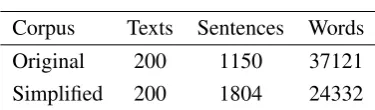
We first compared all features and readability measures on a parallel corpus of original and man-ually simplified texts (Table 1) in order to investi-gate whether these complexity measures differ sig-nificantly on these two types of texts, thus justify-ing the idea to use them to measure the degree of the performed simplification. The corpus contains 200 original news articles in Spanish (provided by the Spanish news agency Servimedia7) and their manually simplified versions. Simplification was done by trained human editors, familiar with the particular needs of a person with cognitive disabil-ities and following a series of easy-to-read guide-lines suggested by Anula (2007), as a part of the Simplext project8(Saggion et al., 2011).
Table 1: Corpora
Corpus Texts Sentences Words
Original 200 1150 37121 Simplified 200 1804 24332
The simplification operations applied by human editors could be classified in the following four categories (Drndarevic et al., 2013):
6
http://simple.wikipedia.org 7
1. Syntactic operations: changes applied at the sentence level, such as sentence splitting or quotation inversion.
2. Lexical operations: infrequent, long or tech-nical terms are substituted with their simpler synonyms, and certain expressions are para-phrased or otherwise modified.
3. Content reduction: a significant portion of original content is eliminated through sum-marisation and paraphrases, in accordance with the guidelines that indicate that only the most essential piece of information should be preserved.
4. Clarification: certain complex terms and concepts, for which no synonym can be found, are explained by means of a definition.
3.2 Readability Indices
In this study, we focused on three readability for-mulae for Spanish: two concerned with the lex-ical complexity of the text – LC (Anula, 2007) and SSR (Spaulding, 1956); and the third one con-cerned with the syntactic complexity of the given text – SCI (Anula, 2007).
The Spaulding’s Spanish Readability index (SSR) has been used for assessing the reading difficulty of fundamental education materials for Latin American adults of limited reading ability and for the evaluation of text passages of the for-eign language tests (Spaulding, 1956). It predicts the relative difficulty of reading material based on the vocabulary and sentence structure, using the following formula:
SSR= 1.609×|w|
|s| + 331.8× |rw|
|w| + 22.0
Here, |w| and |s| denote the number of words and sentences in the text, while |rw| denotes the number of rare words in the text. According to Spaulding (1956), rare words are those words which cannot be found on the list of 1500 most common Spanish words provided in the same study9. Given that the SSR index was used for assessing the reading difficulty of the materials
9
Detailed instructions on what should be considered as a rare word(e.g. special cases of numbers, names of months and days, proper and geographic names, initials, diminutives and augmentatives, etc.) can be found in (Spaulding, 1956). Here we do not apply rules (a)–(g) specified in (Spaulding, 1956).
aimed at adults of limited reading ability, it is reasonable to expect that this formula could be used for estimating the level of simplification per-formed by text simplification systems aimed at making texts more accessible for this target pop-ulation.
The Lexical Complexity index(LC) was sug-gested by Anula (2007) as a measure of lexical complexity of literary texts aimed at the second language learners. It is calculated using the fol-lowing formula:
LC = LDI+ILF W
2
whereLDI andILFW represent theLexical Den-sity IndexandIndex of Low-Frequency Words, re-spectively:
LDI = |dcw| |s| ,
ILF W = |lf w| |cw| ×100
Here, |dcw|, |s|, |lfw|, and |cw|denote the num-ber of distinct content words, sentences, low-frequency words, and content words (nouns, ad-jectives, verbs, and adverbs), respectively. An-ula (2007) considers aslow frequency wordsthose words whose frequency rank in the Referential Corpus of Contemporary Spanish10 is lower than 1,000.11
The Sentence Complexity Index (SCI) was proposed by Anula (2007) as a measure of sen-tence complexity in a literary text aimed at second language learners. It is calculated by the following formula:
SCI = ASL+ICS
2
where ASL denotes the average sentence length, andICSdenotes the index of complex sentences. They are calculated as follows:
ASL= |w|
|s|,
ICS= |cs| |s| ×100
10http://corpus.rae.es/lfrecuencias.html 11
Here,|w|,|s|, and|cs|denote the number of words, sentences and complex sentences in the text, re-spectively.12
3.3 Linguistically Motivated Complexity Features
Inspired by the work of ˇStajner et al. (2012), and easy-to-read guidelines for writing for people with cognitive disabilities (Freyhoff et al., 1998), this study employs twelve linguistically motivated complexity features (Table 2). The first nine fea-tures (1–9) are indicators of structural complexity and the final three features (10–12) are indicators of ambiguity in meaning.
Table 2: Linguistically motivated features
# Code Feature 1 N Noun 2 Det Determiner 3 Adj Adjective 4 V Verb 5 Inf Infinitive 6 Adv Adverb 7 Prep Preposition
8 CC Coordinating conjunction 9 CS Subordinating conjunction 10 Pron Pronoun
11 Sens Number of senses per word 12 Amb Percentage of ambiguous words
The corpora were parsed with the Connexor’s Machinese parser13 and the features 1–10 (Table 2) were automatically extracted using the parser’s output. Features 11 and 12 were extracted using two lexical resources – the Spanish Open The-saurus (version 2)14 and the Spanish EuroWord-Net (Vossen, 1998). The Spanish Open Thesaurus lists 21,831 target words (lemmas) and provides a list of word senses for each word. Each word sense is, in turn, a list of substitute words. There is a total of 44,353 such word senses. The Spanish part of EuroWordNet is far more exhaustive con-taining 50,526 word meanings and 23,370 synsets. For computation of measures related to word sen-tences we only considered the lemmas present in the lexical resources used. For each text we
com-12
We consider a complex sentence one that contains mul-tiple finite predicates according to the output of Connexor’s Machinese parser.
13
www.connexor.eu
14http://openthes-es.berlios.de/
pute the average number of senses per word (code Sens, Table 2) as well as the percentage of ambigu-ous words in the text (codeAmb, Table 2) produc-ing two measures for each lexical resource used (SensWN, SensOT, AmbWN,AmbOT, Section 4). In the computation we consider all occurrences of lemmas including repeated lemmas.
4 Results and Discussion
The results of the analysis of readability indices on the corpora and their mutual correlation are pre-sented in Section 4.1, and the results of the analy-sis of linguistically motivated complexity features are presented in Section 4.2, while their correla-tion with the readability indices is presented and discussed in Section 4.3.
4.1 Analysis of Readability Indices
The results of the comparison of readability in-dices across the corpora are given in Table 3. Columns ‘Original’ and ‘Simple’ contain the mean value of the corresponding readability in-dices in each of the two corpora, while the col-umn ‘Rel.diff.’ contain the mean value of the rel-ative differences between the text pairs (original and simplified). Column ‘Sign.’ presents the level of significance at which the differences between the two corpora are statistically significant. For the indices which follow approximately normal dis-tribution, this column contains the result of the paired t-test. For those which do not follow nor-mal distribution, it contains the result of the alter-native non-parametric test – the Wilcoxon signed-rank test. All tests of normality and statistical sig-nificance were performed in SPSS.
Table 3: Readability indices
Index Original Simple Rel.diff. Sign. LC 21.05 12.76 -39.06% 0.001 SSR 184.20 123.82 -32.60% 0.001 SCI 41.36 29.99 -27.43% 0.001
simplifica-Figure 1: Readability indices across the corpora
tion systems as a measure of the degree of simpli-fication. The distribution of the three readability indices (LC, SSR, and SCI) is presented in Fig-ure 1, which shows that the distribution of all three indices is shifted left in the case of the simplified texts, thus indicating lower level of complexity.
The correlations between each pair of readabil-ity indices (LC–SSR, LC–SCI, and SSR–SCI), calculated using both corpora, are given in Table 4. All correlations which were reported as statisti-cally significant at a 0.001 level of significance are presented in bold. As expected, the two readabil-ity indices concerned with the lexical complexreadabil-ity (LC and SSR) are significantly correlated, while the third one concerned with the syntactic com-plexity (SCI) is not significantly correlated with any of the other two (LC and SSR). The linear correlation between LC and SSR (measured by the Pearson’s coefficient) is, however, much less strong than the one among the four readability in-dices for English: Flesch Reading Ease, Flesch-Kincaid, Fog and SMOG, reported by ˇStajner et al. (2012).
Table 4: Correlation among readability indices
Corpus Indices Pearson Spearman
Original
LC–SSR 0.445 0.440
LC–SCI -0.075 -0.085 SSR–SCI 0.045 0.043
Simplified
LC–SSR 0.353 0.378 LC–SCI 0.093 -0.116
SSR–SCI -0.159 -0.136
4.2 Analysis of Linguistically Motivated Complexity Features
Occurrences of each feature which is an indicator of structural complexity, and prepositions (Prep)
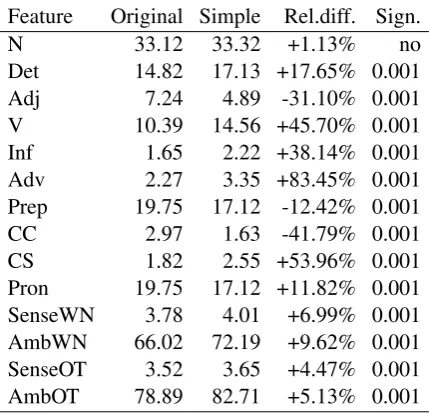
were calculated as number of occurrences per 100 words. Average number of senses per word and percentage of ambiguous words in text were cal-culated in two different ways – using the Spanish EuroWordNet (SenseWN and AmbWN) and using the Spanish Open Thesaurus (SenseOT and Am-bOT). The results of the analysis are presented in Table 5, using the same notation as in the case of readability indices in Table 3.
Table 5: Complexity Features
Feature Original Simple Rel.diff. Sign.
N 33.12 33.32 +1.13% no
Det 14.82 17.13 +17.65% 0.001 Adj 7.24 4.89 -31.10% 0.001 V 10.39 14.56 +45.70% 0.001 Inf 1.65 2.22 +38.14% 0.001 Adv 2.27 3.35 +83.45% 0.001 Prep 19.75 17.12 -12.42% 0.001 CC 2.97 1.63 -41.79% 0.001 CS 1.82 2.55 +53.96% 0.001 Pron 19.75 17.12 +11.82% 0.001 SenseWN 3.78 4.01 +6.99% 0.001 AmbWN 66.02 72.19 +9.62% 0.001 SenseOT 3.52 3.65 +4.47% 0.001 AmbOT 78.89 82.71 +5.13% 0.001
Table 6: Spearman’s correlation between readabil-ity indices and complexreadabil-ity features (Original)
Feature LC SSR SCI
V *-0.178 -0.192 0.423 Inf *-0.154 *-0.151 0.303 Adj *-0.159 0.137 -0.100 Adv -0.024 -0.047 0.123 Det -0.022 -0.243 -0.076 N *0.177 0.193 -0.433 Prep 0.088 0.049 -0.122 CC 0.065 0.116 -0.086 CS -0.092 *-0.150 0.459 Pron 0.072 -0.248 0.097 SensWN -0.285 -0.231 0.236 AmbWN -0.243 -0.080 *0.154 SensOT -0.077 -0.093 0.088 AmbOT -0.208 -0.083 0.099
the unnecessary words (e.g. adjectives, coordinat-ing conjunctions, prepositions) and leavcoordinat-ing only the main ideas expressed by verbs.
It is interesting to note that both the average number of senses per word and the percentage of ambiguous words are higher in simplified than in original texts, using both sources (EuroWordNet and Open Thesaurus). One possible explanation (which would have to be explored further) is that the shorter and more commonly used words are more ambiguous than the original words which they substituted in the process of simplification.
4.3 Correlation between Readability Indices and Complexity Features
The Spearman’s rho coefficient of correlation be-tween readability indices and the twelve linguis-tically motivated complexity features is given in Table 6 (for original texts) and in Table 7 (for sim-plified texts). Correlations which are significant at a 0.001 level of significance (2-tailed) are pre-sented in bold, while those which are significant at a 0.05 but not at a 0.001 level of significance are presented in bold with an ‘*’ preceding. Other correlations are not statistically significant.
From the results presented in Table 6 and Table 7 it can be noted that each of the readability indices is significantly correlated with several linguisti-cally motivated complexity features. LC is, for example, positively correlated with occurrences of nouns (N) and negatively correlated with occur-rences of adjectives (Adj) in both corpora. SSR
Table 7: Spearman’s correlation between readabil-ity indices and complexreadabil-ity features (Simplified)
Feature LC SSR SCI
V 0.000 -0.059 0.672 Inf -0.025 -0.074 0.573 Adj -0.241 0.086 *-0.145 Adv -0.113 -0.118 0.246 Det -0.086 -0.438 0.034 N *0.161 0.375 -0.606 Prep *0.156 0.088 *-0.153 CC 0.027 0.108 *-0.150 CS -0.030 *-0.159 * 0.595 Pron 0.002 -0.074 -0.186 SensWN -0.064 -0.070 0.225 AmbWN -0.110 -0.075 0.115 SensOT 0.053 0.025 0.113 AmbOT 0.110 0.113 0.045
is positively correlated with occurrences of nouns (N) and negatively correlated with occurrences of determiners (Det) and subordinating conjunctions (CS). SCI is, on the other hand, negatively corre-lated with the number of occurrences of nouns (N), and positively correlated with number of occur-rences of verbs (V), infinitive forms (Inf), subordi-nating conjunctions (CS), and average number of senses per word according to Spanish EuroWord-Net (SensWN).
These results indicate that there is no one read-ability index which correlates significantly with all of the linguistically motivated complexity fea-tures. However, it seems that they complement each other well as each one of them is significantly correlated with a different subset of features. Each of these three readability indices could, therefore, be seen as a measure of a different kind of com-plexity reduction performed by a text simplifica-tion system and thus be used in an automatic eval-uation of a text simplification system. That au-tomatic evaluation would, of course, account only for measuring the complexity reduction performed by the system, while a human-oriented evaluation would be needed for assessing the preservation of meaning and grammaticality of the simplified text generated by the system (Drndarevic et al., 2013).
5 Conclusions and Future Work
val-ues of the three readability indices (LC, SSR, and SCI) applied to the corpus of original news texts and the same applied to manually simplified ver-sions of those texts (aimed at people with cogni-tive disabilities). Another set of experiments indi-cated that the two corpora also significantly differ in all but one of the twelve linguistically motivated complexity features.
The study also revealed that the two readabil-ity indices which measure lexical complexreadabil-ity of a given text are highly correlated. It also showed that each of the three readability indices (LC, SSR and SCI) significantly correlates with several lin-guistically motivated complexity features in both corpora. Each of them could thus be used in an au-tomatic evaluation of a text simplification system, each measuring a different kind of complexity re-duction performed. Furthermore, it seems that those three readability indices complement each other very well in terms of their correlation with different complexity features. Therefore, it might be possible to find some combination of all three of them which could be used as a single measure in an automatic evaluation of text simplification sys-tems.
The search for this ideal combination will be one of the directions of our future work. We also plan to repeat all these experiments on a differ-ent set of texts, this time aimed at a differdiffer-ent tar-get population, in order to see whether these read-ability indices show the same properties for texts simplified in a different manner, i.e. whether they could be used in automatic evaluation of any text simplification system. Furthermore, we wish to apply these indices on texts which were automat-ically simplified. We would like to explore how well the conclusions drawn based on differences of readability indices between original and automat-ically simplified texts correlate with human judg-ments of the level of simplification performed.
Acknowledgements
This work is partially supported by an Ad-vanced Research Fellowship from Programa Ram´on y Cajal (RYC-2009-04291) and by the project SKATER: Scenario Knowledge Acqui-sition – Knowledge-based Concise Summariza-tion (TIN2012-38584-C06-03) , Ministerio de Econom´ıa y Competitividad, Secretaria de Estado de Investigaci´on, Desarrollo e Innovaci´on, Spain.
References
S. M. Alu´ısio, L. Specia, T. A. S. Pardo, E. G. Maziero, H. M. Caseli, and R. P. M. Fortes. 2008. A cor-pus analysis of simple account texts and the pro-posal of simplification strategies: first steps towards text simplification systems. In Proceedings of the 26th annual ACM international conference on De-sign of communication, SIGDOC ’08, pages 15–22, New York, NY, USA. ACM.
A. Anula. 2007. Tipos de textos, complejidad ling¨u´ıstica y facilicitaci´on lectora. InActas del Sexto Congreso de Hispanistas de Asia, pages 45–61.
M. J. Aranzabe, A. D´ıaz De Ilarraza, and I. Gonz´alez. 2012. First Approach to Automatic Text Simplifica-tion in Basque. InProceedings of the first Natural Language Processing for Improving Textual Acces-sibility Workshop (NLP4ITA).
R. Barzilay and N. Elhadad. 2003. Sentence align-ment for monolingual comparable corpora. In Pro-ceedings of the 2003 conference on Empirical
meth-ods in natural language processing, EMNLP ’03,
pages 25–32, Stroudsburg, PA, USA. Association for Computational Linguistics.
R. H. M. Brouwer. 1963. Onderzoek naar de leesmoeilijkheden van nederlands proza. Peda-gogische studi¨en, 40:454–464.
J. Carroll, G. Minnen, D. Pearce, Y. Canning, S. De-vlin, and J. Tait. 1999. Simplifying text for language-impaired readers. In Proceedings of the 9th Conference of the European Chapter of the ACL (EACL’99), pages 269–270.
N. Chomsky. 1986. Knowledge of language: its na-ture, origin, and use. Greenwood Publishing Group, Santa Barbara, California.
W. Coster and D. Kauchak. 2011. Learning to Sim-plify Sentences Using Wikipedia. In Proceedings of the 49th Annual Meeting of the Association for Computational Linguistics, pages 1–9.
E. Dale and J. S. Chall. 1948. A formula for predicting readability.Educational research bulletin, 27.
S. Devlin. 1999. Simplifying natural language text for aphasic readers. Ph.D. thesis, University of Sunder-land, UK.
W.H. Douma. 1960. De leesbaarheid van landbouw-bladen: een onderzoek naar en een toepassing van leesbaarheidsformules. Bulletin, 17.
W. H. DuBay. 2004. The Principles of Readability.
Impact Information.
L. Feng, N. Elhadad, and M. Huenerfauth. 2009. Cog-nitively motivated features for readability assess-ment. In Proceedings of the 12th Conference of the European Chapter of the Association for Com-putational Linguistics, EACL ’09, pages 229–237, Stroudsburg, PA, USA. Association for Computa-tional Linguistics.
L. Feng. 2009. Automatic readability assessment for people with intellectual disabilities. InSIGACCESS
Access. Comput., number 93, pages 84–91. ACM,
New York, NY, USA, jan.
R. Flesch. 1949. The art of readable writing. Harper, New York.
G. Freyhoff, G. Hess, L. Kerr, B. Tronbacke, and K. Van Der Veken, 1998. Make it Simple, European Guidelines for the Production of Easy-toRead Infor-mation for People with Learning Disability. ILSMH European Association, Brussels.
J. P. Kincaid, R. P. Fishburne, R. L. Rogers, and B. S. Chissom. 1975. Derivation of new readability for-mulas for navy enlisted personnel. Research Branch Report 8-75.
G. H. McLaughlin. 1969. SMOG grading – a new readability formula. Journal of Reading, 22:639– 646.
S. Petersen and M. Ostendorf. 2009. A machine learn-ing approach to readlearn-ing level assessment. Computer speech & language, 23(1):89–106.
M. B. Ruiter, T. C. M. Rietveld, C. Cucchiarini, E. J. Krahmer, and H. Strik. 2010. Human Language Technology and communicative disabilities: Re-quirements and possibilities for the future. In Pro-ceedings of the the seventh international conference on Language Resources and Evaluation (LREC).
J. Rybing, C. Smithr, and A. Silvervarg. 2010. To-wards a Rule Based System for Automatic Simpli-fication of Texts. In The Third Swedish Language Technology Conference.
H. Saggion, E. G´omez Mart´ınez, E. Etayo, A. An-ula, and L. Bourg. 2011. Text Simplification in Simplext: Making Text More Accessible. Revista de la Sociedad Espa˜nola para el Procesamiento del Lenguaje Natural.
S. E. Schwarm and M. Ostendorf. 2005. Reading Level Assessment Using Support Vector Machines and Statistical Language Models. InProceedings of the 43rd annual meeting of the Association of Com-putational Linguistics (ACL), pages 523–530.
E. A. Smith and R. J. Senter. 1967. Automated Read-ability Index. Technical report, Aerospace Medical Research Laboratories, Wright-Patterson Air Force Base, Ohio.
S. Spaulding. 1956. A Spanish Readability Formula.
Modern Language Journal.
P. van Oosten, D. Tanghe, and V. Hoste. 2010. To-wards an Improved Methodology for Automated Readability Prediction. In Proceedings of the sev-enth international conference on language resources and evaluation (LREC10). Valletta, Malta: Euro-pean Language Resources Association (ELRA).
P. Vossen, editor. 1998. EuroWordNet: A Multilingual Database with Lexical Semantic Networks. Kluwer Academic Publishers.
S. ˇStajner, R. Evans, C. Orasan, and R. Mitkov. 2012. What Can Readability Measures Really Tell Us About Text Complexity? In Proceedings of the LREC’12 Workshop: Natural Language Processing for Improving Textual Accessibility (NLP4ITA), Is-tanbul, Turkey.
K. Woodsend and M. Lapata. 2011. Learning to Sim-plify Sentences with Quasi-Synchronous Grammar and Integer Programming. In Proceedings of the 2011 Conference on Empirical Methods in Natural
Language Processing (EMNLP).
S. Wubben, A. van den Bosch, and E. Krahmer. 2012. Sentence simplification by monolingual machine translation. InProceedings of the 50th Annual Meet-ing of the Association for Computational LMeet-inguis- Linguis-tics: Long Papers - Volume 1, ACL ’12, pages 1015– 1024, Stroudsburg, PA, USA. Association for Com-putational Linguistics.