U s i n g N O M L E X to Produce Nominalization Patterns for
Information Extraction
A d a m M e y e r s , C a t h e r i n e M a c l e o d , R o m a n Y a n g a r b e r , R a l p h G r i s h m a n , L e s l i e B a r r e t t , R u t h R e e v e s
N e w York U n i v e r s i t y
715 B r o a d w a y , 7th Floor, NY, N Y 10003, U S A m e y e r s ~ c s , n y u . edu
A b s t r a c t
This paper describes how NOMLEX, a dictio- nary of nominalizations, can be used in Informa- tion Extraction (IE). This paper details a pro- cedure which maps syntactic and semantic infor- mation designed for writing an IE pattern for an active clause (IBM appointed Alice Smith as vice president) into a set of patterns for nominaliza- tions (e.g., IBM's appointment of Alice Smith as vice president and Alice Smith's appointment as vice president).
1 I n t r o d u c t i o n
Although, nominalizationQ are very common in written text, the computational linguistics liter- ature provides few systematic accounts of how to deal with phrases containing these words. This paper focuses on this problem in the context of Information Extraction (IE). 2 Many extraction systems use either parsing combined with some form of syntactic regularization, or a meta-rule mechanism to automatically match variants of clausal syntactic structures (active main clause, passive, relative clause etc.), e.g., FASTUS (Ap- pelt et al., 1995) and the Proteus Extraction System (Grishman, 1995). However, this mecha- nism does not extend to nominalization patterns, which must be coded separately from the clausal patterns. NOMLEX, a dictionary of nominal- izations currently under development at NYU, (Macleod et al., 1997) provides a way to handle nominalizations more automatically, and with
INominalizations are nouns which are related to words of another part of speech, most commonly verbs. In this paper, only verbal nominalizatious will be discussed.
2The Message Understanding Colfference Scenario Template Task (MUC, 1995), (MUC, 1998) is ore" model for the kind of information that we are attempting to ex- tract (who does what to whom, and when and where).
greater coverage. N O M L E X includes informa- tion about mappings between verbs and nomi- nalizations that will help generalize information from verbal patterns to create nominalization patterns. This paper describes the structure of the dictionary and a procedure for creating nominalization patterns. This procedure takes into account lexical information a b o u t nominal- izations which is encoded in NOMLEX.
The Proteus Extraction System starts with a semantic pattern for an active clause:
np(C-company) vg(appoint) np(C-person) "as" np(C-position)
which matches a clause beginning with a noun phrase headed by a noun of type C O M P A N Y , followed by a verb group (verb plus auxilliaries) headed by appoint, a noun phrase headed by a noun of type P E R S O N , the literal as, and a noun phrase headed by a noun of t y p e position, e.g., IBM appointed Alice Smith as vice presi- dent. Proteus applies meta-rules to this pattern to produce new patterns for other clausal types, e.g., a passive clause:
np(C-person) vg-pass(appoint) "as" np(C-position) "by" np(C-company)
(vg-pass is a passive verb group). This new pat- tern would match Alice Smith was appointed as vice president by IBM. When a pattern matches input text, the pieces of the text corresponding to the constituents of the pattern are used to build a semantic representation of the text.
generalized patterns to perform these mappings. This paper shows how P E T can use NOMLEX to create nominalization patterns as well. For ex- ample, given the sentence IBM appointed Alice Smith as vice president, human input and dictio- nary entries identify IBM as the employer, Alice Smith as the employee, and vice president as the position. The meta-rules add a slot for tempo- ral P P s which state the date (e.g., on June 1, 1998). P E T creates patterns to fill the seman- tic slots (employer, employee, position) from the gramatical roles (subject, object, NP following as, etc.) in the sentence. P E T generates pat- terns to cover passive sentences, active sentences and relative clauses. Enhanced with NOMLEX, P E T can also cover examples like Alice Smith's appointment as vice president; IBM's June 1, 1998 appointment of Alice Smith; and the June 1, 1998 appointment of Alice Smith by IBM. The correspondence between nominal and verbal po- sitions is determined by explicit information in the NOMLEX dictionary entry and by general linguistic constraints.
2 C o n s i d e r a t i o n s f o r C h o o s i n g a D i c t i o n a r y E n c o d i n g
The primary information in a NOMLEX en- try is a description of a nominalizatiou's ar- gument structure. This information can be quite complex. There are several potential ar- gument positions, including both pre-nominal (the bomb ezplosion, the bomb's explosion) and post-nominal (the ezplosion of the bomb), and a given verbal argument may appear in one of several positions. 3 In general, individual argu- ments may be omitted, although there are some co-occurrence constraints, which we shall con- sider below. Furthermore, vhether or not one position is filled may affect the interpretation of other positions; thus, in Rome's destruction, Rome is the object, whereas in Rome's destruc- tion of Carthage, Rome is the subject.
In seeking an appropriate representation for
SThese positions may be filled by non-arguments as well. For example, the prenominal positions may be filled by temporal NPs (NTIME1 and NTIME2 in COMLEX) like Yesterday(but not John), e.g., Yesterday's appoint- ment of the Prime Minister and The June I, 1987 ap- pointment of the Prime Minister. These positions corre- spond to temporal modifiers of clauses, e.g., .\" appointed the Prime Minister Yesterday/June I, 1987. For further discussion, see Section 5.
this information, one can compare the situation with that of English verbal complements, which have been extensively studied and recorded. In English, verbal complements are relatively fixed in composition and order. As a result, the com- mon practice (adopted, for example, in OALD (Hornby, 1980), L D O C E (Proctor, 1978), and COMLEX Syntax (Macleod et al., forthcoming) is to enumerate and name the possible subcat- egorizations, where in general each subcatego- rization represents a fixed sequence of syntactic elements. 4 For example, in C O M L E X (Wolff et al., 1994), N P - P P consists of a Noun Phrase fol- lowed by a Prepositional Phrase as in put the milk in the refrigerator, where *put the milk, *put in the refrigerator and *put in the refrig- erator the milk are not acceptable. Such an ap- proach would be unwieldy for nominalizations, where an argument may appear in several posi- tions and may also be omitted. As a result, even a simple nominatization may entail a large num- ber of subcategorization frames. If these were listed explicitly, the entry would be difficult to create and to read.
On the other hand, a representation which separately listed all the complement structures which could occur with a nominalization, as- suming they could freely co-occur, would fail to capture many crucial constraints between complements. For example, the nominaliza- tion confirmation has both THAT-S (His con- firmation T H A T HE WOULD GO) and WH-S complements (His confirmation of WHETHER
HE WOULD GO.). However, these com-
plements cannot co-occur (*His confirmation THAT HE WOULD GO of WHETHER HE IVOULD GO.). Also in the case where the asso- ciated verb has an N P - A S - N P complement (She treated them as inferiors) and no AS-NP comple- ment (She emerged as their main competitor) the nominalization cannot have a bare AS-NP. Thus we have The consideration of HIM A S A CAN- DIDATE and HIS consideration A S A CANDI- DATE but not *The consideration A S A CAN- DIDATE.
Guided by these considerations, we chose an approach in which we first determine which COMLEX verbal complements can correspond
to phrases containing nominalizations and then we specify how these complements can be mapped to arguments of the nominalizations. The resulting COMLEX-based encoding does not permit incompatible complement phrases to co-occur, e.g., confirmation would not simulta- neously take both THAT-S and WH-S comple- ments. Optionality, obligatoriness and alterna- tive positions of phrases is stated in a simple notation, e.g., it can be stated in the entry for consideration that the verbal object for the NP- AS-NP complement of consider maps to either the DET-POSS position (HIS consideration as a candidate) or the P P - O F position (The consid- eration OF HIM as a candidate) and that this object is obligatory for mappings of NP-AS-NP, i.e., if the object is not present in the phrase containing consideration, then the phrase can- not be mapped to the NP-AS-NP complement, although other complements are possible.
Our representation also accounts for the dif- ference in behavior of the core arguments (the subject, the object, and the indirect object) and the other arguments, which we shall refer to as oblique complements. The core arguments, as we have noted, can appear in several positions in the nominalization, and may be independently omitted or included. The oblique complements of the verb, on the other hand, generally translate directly into nominalization complements, either unchanged or occasionally with the addition of a preposition or a "that" complementizer.
3 W h a t is a N O M L E X E n t r y
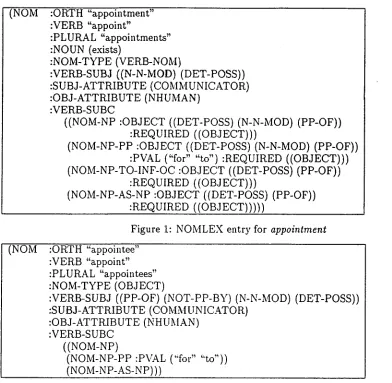
NOMLEX entries are organized as typed fea- ture structures and written in a Lisp-like no- tation (Figures 1 and 2). Each entry lists the nominalization (:ORTH) and the associated verb (:VERB). The :NOM-TYPE feature specifies the type of nominalization: VERB-NOM for nomi- nalizations which represent the action (destruc- tion) or state (knowledge) of the associated verb; VERB-PART for nominalizations which incor- porate a verbal particle (takeover); S U B J E C T for nominalizations which represent the subject of the verb (teacher), and O B J E C T for nom- inalizations which represent the object of the verb (appointee). The :NOUN keyword includes information about whether the word has non- nominalization noun senses (and may include some frequency information). For example, ap-
pointment has a sense which means something like "date to do something". We are only inter- ested in the nominalization sense in this paper. 5 The heart of the entry is a list of verb subcat- egorizations, :VERB-SUBC, taken from COM- LEX Syntax. The name for each subcatego- rization is prefixed by NOM- (such as NOM- NP or NOM-NP-AS-NP) and, for subcatego- rizations involving prepositions, :PVAL specifies those prepositions. The COMLEX complements in these lexical entries include:
• NP, a noun phrase complement, e.g., IBM appointed Mary
• NP-PP, a complement consisting of a noun
phrase and prepositional phrase, e.g., IBM appointed Mary for the vice presidency
• NP-TO-INF-OC, a complement consisting
of a noun phrase object and an infinitive clause, where the subject of the infinitive corresponds to the object of the main clause, e.g., IBM appointed Mary to do the job
• NP-AS-NP, a complement consisting of a noun phrase object, the word "as" and a second noun phrase, e.g., IBM appointed Mary as vice president
For each verb complement, the entry lists the as- sociated nominalized structure, if different from the verbal complement. The entry also lists the positions in which the object (:OBJECT) m a y appear. For appointment, these positions include the following for most complements:
• DET-POSS, a possessive determiner, e.g., Alice Smith's appointment as vice president
• N-N-MOD, a nominal prenominal modifier,
e.g., the Alice Smith appointment for vice president
• PP-OF, object of the preposition of, e.g., the appointment off Alice Smith
(NOM :ORTH "appointment" :VERB "appoint"
:PLURAL "appointments" :NOUN (exists)
:NOM-TYPE (VERB-NOM)
:VERB-SUBJ ((N-N-MOD) (DEW-BOSS))
:SUB J-ATTRIBUTE ( C O M M U N I C A T O R )
:OBJ-ATTRIBUTE ( N H U M A N )
:VERB-SUBC
((NOM-NP :OBJECT ((DEW-BOSS) (N-N-MOD) (PP-OF))
:REQUIRED ((OBJECT)))
(NOM-NP-PP :OBJECT ((DEW-BOSS) (N-N-MOD) (PP-OF))
:PVAL ("for" " t o " ) : R E Q U I R E D ((OBJECT))) (NOM-NP-TO-INF-OC : O B J E C T ((DEW-BOSS) (PP-OF)):REQUIRED ((OBJECT)))
(NOM-NP-AS-NP :OBJECT ((DEW-BOSS) (PP-OF))
:REQUIRED ((OBJECT)))})
Figure 1: NOMLEX entry for appointment
(NOM :ORTH "appointee" :VERB "appoint" :PLURAL "appointees" :NOM-TYPE (OBJECT)
:VERB-SUBJ ( ( P P - O F ) ( N O T - P P - B Y ) ( N - N - M O D ) (DEW-BOSS)) :SUB J - A T T R I B U T E (COMMUNICATOR)
:OBJ-ATTRIBUTE (NHUMAN) :VERB-SUBC
((NOM-NP)
(NOM-NP-PP :P\(A.L ("for" "to")) (NOM-NP-AS-NP)))
Figure 2: NOMLEX entry for appointee
However, NOM-NP-AS-NP does not allow tile N-N-MOD position (* the Alice Smith appoint- ment as vice president). The :OBJECT is not indicated for the :VERB-SUBC of appointee be- cause the nominalization itself corresponds to the verbal object (it is :NOM-TYPE ((OBJECT))). Because a subject argument can appear with any verbal complement, we include, at the top level, a list of positions for the subject (:VERB- SUB J). This list can be further restricted for a particular complement by including a :SUB- J E C T feature under that complement in the NOMLEX entry. As a default, it is assumed that subjects always can map to prepositional by phrases. Exceptions are marked with NOT-PP- BY, as in the entry for appointee ( *the appointee by IBM (for vice president)).
Typically, a nominalization will list multiple
positions for each core argument. This doesn't mean, however, that all combinations of the po- sitions are possible. Several constraints limit the possible role assignments; some of these con- straints are general, and some are based on par- ticular lists in each entry:
• The uniqueness constraint says that any verbal role may only be filled once. For ex- ample, in Leslie's appointment o/Alice, the P P - O F position filled by Alice must map into the object role. As a result, Leslie can- not fill the object role and therefore must fill the subject role. 6
[image:4.596.59.451.76.459.2]• The ordering constraint says that, if there are multiple pre-nominal modifiers, they must appear in the order subject, object, indirect object, and oblique; thus, for ex- ample, John Smith's school board appoint- ment cannot mean that the school board appointed John Smith to some position, z
• Some entries contain :SUB&ATTRIBUTE and : O B J - A T T R I B U T E features, selec- tional constraints which are useful in select- ing role assignments. In Figures 1 and 2, the attributes COMMUNICATOR (organi- zation, person, or other entity capable of communicating) and NHUMAN (a human) are used.
• Obligatoriness constraints are assumed for the mappings associated with each com- plement in each entry. As a default, it is assumed that only subject and object are optional. Therefore, Mary Smith's ap- pointment would be associated with the NOM-NP complement, but not the NOM- NP-AS-NP complement. Furthermore, ob- jects are obligatory for a particular com- plement N P - X for a particular nominal- ization N, if N takes both N P - X and X as complements, where N P - X includes all the phrases in X plus an object (e.g., NOM-NP vs. NOM-INTRANS, NOM-NP- P P vs. NOM-PP, NOM-NP-THAT-S vs. NOM-THAT-S, etc.). These defaults can be overridden in the dictionary with attributes on specific complements specifying which roles are :OPTIONAL or :REQUIRED. For example, appointment takes a NOM-NP complement, but no corresponding NOM- INTRANS. The object is obligatory con- trary to our defaults, e.g., John's appoint- merit must have the interpretation that John is the object of appoint. Thus, our en- try for appointment is marked :REQUIRED ((OBJECT)).s
4 O u r P r o c e d u r e f o r G e n e r a t i n g N o r n i n a l i z a t i o n P a t t e r n s
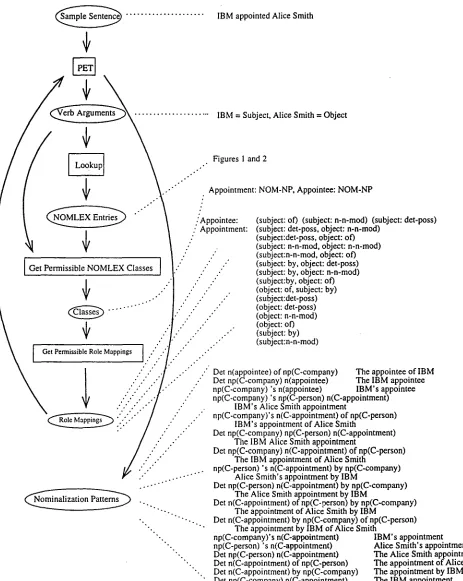
Figure 3 diagrams how nominalization patterns are derived. The rectangles are modules of our
~This ordering constraint is assumed to hold for all nominalizations in English.
8Our required/optional settings only apply where some argument is present in a nominalization.
algorithm, the ovals are data structures passed between modules and the dotted lines connect the ovals with examples of what the d a t a struc- tures might contain given the sample active clause IBM appointed Alice Smith. Due to space limitations, the figure does not include patterns with constituents for the tempOral adverbial NP positions (Section 5), e.g., Mary Smith's June 1, 1998 appointment by IBM and Yesterday's ap- pointment of Mary Smith by IBM. There are an additional five such mappings for appointee and an additional twenty-three for appointment.
First P E T analyzes the sample sentence and identifies the main verb and its arguments (e.g., subject, direct object, etc.). Then it searches NOMLEX for any nominalizations which cor- respond to the main verb. Our example verb appoint has at least two nominalizations: ap- pointment and appointee. Next the procedure examines the set of :VERB-SUBC classes in each nominalization entry (Figures 1 and 2) and iden- tifies the set of classes which are compatible with the set of arguments in the input. A class is compatible if it allows all the input arguments, and none of its required arguments are missing. For the example sentence, only NOM-NP is cho- sen for each nominalization. The other phrases all require some phrase in addition to the ob- ject, e.g., NOM-NP-AS-NP requires an AS-NP phrase (e.g., as vice president). Next the per- missible role mappings are generated. By de- fault, the subject and object are optional, but the object is obligatory for appointment due to the :REQUIRED feature of its NOMLEX en- try. Prepositional phrases are assumed to oc- cur ill all orders, so that both (object: of, sub- ject: by) and (subject: by, object: of) are listed in Figure 3. The uniqueness constraint must be obeyed (we cannot have two subjects or two objects). Finally, the syntax of noun phrases only permits the N-N-MOD slot to be filled more than once (The IBM Alice Smith Appointment), and ill that case our ordering constraint would have to be obeyed. This rules out an inter- pretation of The Alice Smith IBM Appointment where Alice Smith is the appointee and IBM is the appointer. 9
9Given a clausal pattern for an example sentence
like They appointed Alice Smith to IBM, the NOM-NP-
S
•
. . . IBM appointed Alice Smith. . . IBM = Subject, Alice Smith = Object
S
~
"'"" /
/AA pP ~inn tt ~ nt • I: ~ ~i:cCl:- ~e0t ° ~sb!e:l~j enct?~m. :.din) o(~ bJ ec t: det-p°s s'. (subject:by, object: of)
°°••
. . . . . ° - ' "
q/
"
o•
.°"
• • ' ° •• •°
• • • ••
° •
°° • •
°
(object: of, subject: by) (subject:det-poss) (object: det-poss) (object: n-n-mod) (object: of) (subject: by) (subject:n-n-mod) Get Permissible Role Mappings -'"'i'" "" -" "
\
i
..:
• . . .
. • - "
@ m i n a l i z a t i o n Pattems~ ....
° ' ' ' - . .
-° . .
*°
Det n(appointee) of np(C-company) The appointee of IBM Det np(C-company) n(appointee) The IBM appointee np(C-company) 's n(appointee) IBM's appointee np(C-company) 's np(C-person) n(C-appointment)
IBM's Alice Smith appointment
np(C-company)'s n(C-appointment) of np(C-person) IBM's appointment of Alice Smith
Det np(C-company) np(C-person) n(C-appointment) The IBM Alice Smith appointment
Det np(C-company) n(C-appointment) of np(C-person) The IBM appointment of Alice Smith
np(C-person) 's n(C-appointment) by np(C-company) Alice Smith's appointment by IBM
Det np(C-person) n(C-appointment) by np(C-company) The Alice Smith appointment by IBM
Det n(C-appointment) of np(C-person) by np(C-company) The appointment of Alice Smith by IBM
Det n(C-appointment) by np(C-company) of np(C-person) The appointment by IBM of Alice Smith
np(C-company)'s n(C-appointment) IBM's appointment rip(C-person) 's n(C-appointment) Alice Smith's appointment Det np(C-person) n(C-appointment) The Alice Smith appointment Det n(C-appointment) of np(C-person) The appointment of Alice Smith Det n(C-appointment) by np(C-company) The appointment by IBM Det rip(C-company) n(C-appointment) The IBM appointment
F i g u r e 3: Deriving Nominalization P a t t e r n s with P E T
[image:6.596.44.507.80.661.2]PET can then use these mappings to gener- ate patterns, as it does for the various types of clauses. Using pattern matching and dictionary look-up, PET associates the verbal arguments with semantic classes. In our example, the sub- ject is a company and the objec t is a person. This information can be applied to each map- ping to produce a pattern. The nominalization patterns in Figure 3 are generated from the role mappings listed using this semantic information and interpretting the nominal role labels. For example, the mapping (SUBJECT: DET-POSS, OBJECT: PP-OF) generates the nominalization pattern:
np(C-company) 's n(appointment)of np(C-person)
(IBM's appointment of Alice Smith).
5 A d j u n c t M a p p i n g s
The preceding section gave a simplified account of mapping nominalization patterns. We must also handle certain adjuncts. Temporal PPs that can occur in clauses can usually occur in nom- inalizations as well. The positions DET-POSS and N-N-MOD may be occupied by temporal NPs (Yesterday's appointment of Alice Smith by IBM, The January 3, 1998 appointment by IBM of Alice Smith). When an NP is temporal and occupies either of these positions it may fill a temporal slot in an IE pattern. Since temporal NPs are neither companies, nor people, they will not fill the object or subject slots in the IE pat- terns above. Therefore, the possibility of filling temporal slots from DET-POSS and N-N-MOD positions should cause no conflicts for appoint- ment.
6 R e l a t e d W o r k
Other computational linguistics work on decod- ing nominalizations includes (Hobbs and Grish- man, 1976), (DaM et al., 1987) and (Hull and Gomez, 1996). (Hull and Gomez, 1996) is the most similar to our own in that their ultimate goal is to extract information from the World Book Encyclopedia. That task is defined differ- ently than for our MUC-related work. The lex- ical entries created by Hull and Gomez include
would follow Afice Smith (the direct object). These pat- terns would match The Alice Smith IBM appointment (or
Alice Smith's I B M appointment) and give it a very sim- ilar interpretation to one in which IBM is the appointer.
selectional constraints tied to WordNet classes. Their procedure for converting nominalizations into predicate argument structure relies on this semantic information, which they use to distin- guish nominalizations from nouns and arguments from adjuncts. Their coverage of arguments is limited to subjects, objects, and prepositional phrases, whereas NOMLEX provides detailed coverage of all core and all oblique arguments.
7 C o n c l u d i n g R e m a r k s
We have been working on NOMLEX for one year with a staff of two part-time graduate students, one full-time staff member and one part-time staff member. We currently have 700 entries and expect to have 1000 entries by Fall of 1998. After testing, we intend to distribute an alpha version of NOMLEX via our FTP site. This pa- per describes one of the applications for which NOMLEX proves useful. Our hope is that other researchers will apply NOMLEX to new applica- tions. Furthermore, comments from users should prove helpful for updating and revising this re- source.
R e f e r e n c e s
Douglas Appelt, Jerry Hobbs, John Bear, David Israel, Megumi Kameyama, Andy Kehler, David Martin, Karen Meyers, and Mabry Tyson. 1995. SRI International FASTUS Sys- tem: MUC-6 Test Results and Analysis. In Proceedings of the Sixth Message Understand- ing Conference.
Debroah Dahl, Martha Palmer, and Rebecca Passonneau. 1987. Nominalizations in PUN- DIT. Ill Proceedings of the 25th Annual Meet- in 9 of the Association for Computational Lin- guistics.
Ralph Grishman. 1995. The NYU system for MUC-6 or where's the syntax? In Proceedings of the Sixth Message Understanding Confer- ence.
Jerry R. Hobbs and Ralph Grishman. 1976. The Automatic Transformational Analysis of En- glish Sentences: An Implementation. Inter- national Journal of Computer Mathematics, 5:267-283.
Richard D. Hull and Fernando Gomez. 1996. Semantic Interpretation of Nominalizations. In Proceedings of the Thirteenth National Conference on Artificial Intelligence and the Eighth Innovative Applications of Artificial Intelligence Conference.
David E. Johnson and Paul M. Postal. 1980. Arc
Pair Grammar. Princeton University Press, Princeton.
Catherine Macleod, Adam Meyers, Ralph Grish- man, Leslie Barrett, and Ruth Reeves. 1997. Designing a Dictionary of Derived Nominals. In Proceedings of Recent Advances in Natural Language Processing, Tzigov Chark, Bulgaria. Catherine Macleod, Ralph Grishman, and Adam Meyers. forthcoming. COMLEX Syntax: A Large Syntactic Dictionary for Natural Lan-
guage Processing. Computers and the Hu-
manities.
1995. Proceedings of the Sixth Message Un-
derstanding Conference. Morgan I(aufnmn. (MUC-6).
1998. Proceedings of the SeveT~th Message UI~-
derstanding Conference. Morgan Kaufman. (MUC-7).
P. Proctor, editor. 1978. Longman DictioT~ary
of Contemporary English. Harlow, Essex. Susanne Rohen Wolff, Catherine Macleod, and
Adam Meyers, 1994. Comlex IVord Classes
Manual. Proteus Project, New York Univer- sity.
Roman Yangarber and Ralph Grishman. 1997. Customization of Information Extraction Sys-
tems. In Proceedings of the International
Workshop on Lexically Driven I~formation Eztraction, Frascati, Italy.