ABSTRACT
GRADY, JAMES GEORGE. A Simulation Tool Utilizing Parametric Primitives for Climate-Based Dynamic Daylighting and Energy Analysis. (Under the direction of committee chair Dr. J. Wayne Place).
Daylighting design provides a natural link between architectural design and energy efficiency, and vast potential for energy conservation. Due to the
increasing need for energy-conscious design to avoid global warming, schematic design tools for integrated design, simulation, and analysis of daylighting design and energy performance are an important emerging computer aided design application. This dissertation researches, partially develops, and applies an easy-to-use, schematic design tool utilizing parametric shape descriptions of buildings and daylighting structures to simulate and analyze daylighting and energy performance, using climate-based, dynamic daylight simulation (DDS), integrated with whole-building energy performance analysis. A pilot version of the new design tool, HEED_DDS, developed for this dissertation, is applied to answer research questions comparing the integrated daylighting and energy performance of design variants including typical daylit classrooms based on the Smith Middle School, Chapel Hill-Carrboro, N.C. HEED_DDS adds parametric daylighting structure primitives (lightshelves, flat skylights, sawtooth and flat-roof monitors, shaped ceiling vaults, and daylight baffles), and climate-based, dynamic daylight simulation and analysis capabilities (utilizing the subprograms of Daysim) to HEED. HEED_DDS provides time / temporal maps and other graphic presentations of daylighting performance metrics, including daylight autonomy, useful daylight index (UDI), and daylight factor (metric for LEED daylighting credit), with thermal performance metrics, including hours of passive performance and yearly energy costs, used to compare the daylighting
energy use reductions per the 2030 Challenge. HEED is distributed gratis via the UCLA Energy Design Tools web site. HEED_DDS adds new parametric daylighting structure primitives, validated dynamic daylighting simulation and analysis, and graphic displays of performance metrics to HEED’s intuitive graphic user interface, intelligent systems generated defaults, parametric building
A Simulation Tool Utilizing Parametric Primitives For Climate-Based Dynamic Daylighting and Energy Analysis
by
James George Grady
A dissertation submitted to the Graduate Faculty of North Carolina State University
in partial fulfillment of the requirements for the Degree of
Doctor of Philosophy
Design
Raleigh, North Carolina 2012
APPROVED BY:
____________________________ _________________________ Dr. J. Wayne Place Dr. Herbert M. Eckerlin
Committee Chair
____________________________ _________________________ Dr. Ronald P. Endicott Dr. Jianxin Hu
DEDICATION
BIOGRAPHY
My previous educational experience includes an undergraduate architecture degree from NCSU and Master of Architecture from UCLA. I am a registered architect, specializing in green/sustainable design, especially the integration of daylighting design with passive solar design, energy-conscious design, and renewable energy systems. In 2005, I established my own firm, James Grady Architect, focused on environmentally responsive design.
My experience with digital computing, and my Master of Architecture research thesis at UCLA, 'A Basic Building Description System Utilizing a Parametric Modeling Technique for Describing Building Element Geometries', led to
experience as a software designer at Applied Research of Cambridge/ McDonnell Douglas Automation, Cambridge, England, where I designed and developed computer-aided design and visualization software for architects (GDS), including primary authorship of the GDS Scene Viewing System, SVS.
While working at Innovative Design, an architectural firm with a nationally recognized focus on daylighting and green/sustainable design, I was responsible for the integration of daylighting, renewable energy systems, and other
green/sustainable design strategies for many notable projects, including serving as the Project Architect for the R.D. and Euzelle P. Smith Middle School, in
Chapel Hill-Carrboro, North Carolina, a green, energy-efficient, daylit school with integrated rainwater collection & renewable energy systems.
Other architectural project experience has included daylit, green office buildings, utilizing solar power-roof systems that integrate daylighting with renewable energy systems, including the solar power roof and daylighting system demonstrator projects at the North Carolina Solar Center and Parker-Lincoln Building, Raleigh, NC.
I have experience as a green/sustainable design and daylighting consultant, reviewing projects for integration of green/sustainable design strategies utilizing natural energies and daylighting, and for compliance with green/sustainable design checklists. I’ve also worked on the development of sustainable design guidelines and checklists for county and federal agencies. My own office, James Grady Architect, has focused on the renovation and restoration of public
buildings, emphasizing daylighting and green/sustainable design strategies. Projects include renovation of the historic Seaboard Office Building, Raleigh, NC.
To further my interests in teaching and research in a research university environment, centered on the integration of daylighting design, design with natural energies, and other green/sustainable design strategies into the architectural design studio, and the related development of easy-to-use schematic design tools to evaluate the performance of proposed designs, I entered the PhD in Design program at NCSU in 2006, and have pursued studies, research, and teaching at the College of Design and School of Architecture, while maintaining my own architectural practice part time.
In the Fall and Spring Semester, 2008, I had the opportunity to assist my
ACKNOWLEDGMENTS
Heartfelt, special thanks go to my dissertation committee chair, Dr. Wayne Place, for his many hours of patient and thoughtful input and critique during the multi-year scope of work needed to complete this dissertation project. Special thanks also go to Wayne for his many hours of counsel, support, and advice concerning the development of my design and teaching portfolio, teaching philosophy, and teaching and research agenda, including his mentoring of my studio and lecture teaching and co-teaching experiences at the NCSU School of Architecture and my NCSU Certificate of Accomplishment in Teaching. Wayne has been an outstanding committee chair and valued mentor, and his many contributions to my educational experiences and my future plans for teaching and research are invaluable.
Special thanks also go to my “external” dissertation committee member, and therefore un-official co-chair, Prof. Murray Milne, of UCLA, for his many years of mentoring and encouragement of my teaching and research interests, and to Murray and the other members of the UCLA Energy Design Tools Group, Carlos Gomez, and Don Leeper, for providing me access to and guidance using the HEED kernel software, which allowed me to augment HEED with the new parametric daylighting structures, dynamic daylight simulation (DDS) and analysis capabilities, and graphic display capabilities of HEED_DDS, both as a research tool for this dissertation and as an intended primary component of my future research and teaching agenda.
Thanks to Dr. Denis Bourgeois, co-author of the proposed DDS standard, and leader of the integration of DDS into ESP-r, for his helpful advice on the
his many answers to my questions about the software and systems
environments in which HEED_DDS has been implemented for this dissertation.
TABLE OF CONTENTS
LIST OF TABLES ... xi
LIST OF FIGURES ... xii
GLOSSARY AND ABBREVIATIONS ... xx
CHAPTER 1: INTRODUCTION ... 1
1.1 PROBLEM CONTEXT AND PURPOSE OF THE DISSERTATION ... 1
1.1.1 Potential for Energy Savings Due to Daylighting ... 1
CHAPTER 2: REVIEW OF THE LITERATURE AND EXISTING DYNAMIC DAYLIGHT SIMULATION (DDS) SOFTWARE ... 5
2.1 CAPABILITIES AND LIMITATIONS OF CURRENT DYNAMIC DAYLIGHT SIMULATION (DDS) SOFTWARE, AND PROPOSED CAPABILITIES AND USEFULNESS OF THE NEW SCHEMATIC DESIGN TOOL ... 5
2.2 STATIC VS. DYNAMIC DAYLIGHT SIMULATION AND ANALYSIS METRICS ... 6
2.3 OVERALL PURPOSE OF THE DISSERTATION ... 10
2.4 HEED_DDS IMPLEMENTATION AND NEW CAPABILITIES ... 11
2.5 A SET OF PARAMETRIC PRIMITIVES FOR DAYLIGHTING DESIGN ... 12
2.5.1 Parametric Shape Descriptions of Daylighting Structures ... 13
CHAPTER 3: THEORETICAL PERSPECTIVE AND RESEARCH QUESTIONS ... 15
3.1THEORETICAL PERSPECTIVE AND NEW KNOWLEDGE GENERATED ... 15
3.2 RESEARCH QUESTIONS ... 16
3.2.1 Research Question 1 ... 16
3.2.2 Research Question 2 ... 16
CHAPTER 4: RESEARCH DESIGN AND METHODOLOGY ... 17
4.0 SUMMARY OF RESEARCH DESIGN AND METHODOLOGY ... 17
4.1 HEED AND HEED_DDS ... 17
4.2ADDING DDSCAPABILITIES TO HEED ... 18
4.2.1 Validation of the HEED_DDS Implementation of the Daysim Subprograms ... 19
4.2.2 Building a Radiance .rad File for the HEED_DDS Model ... 19
4.2.4 Displaying the DDS Metrics and Folding the DDS Illuminance Profile at the Dimming Sensor Point Back into HEED’s Whole-‐Building Energy Analysis Kernel ... 22
4.2.5 Daysim DDS Implementation Validation-‐ Demonstrating Equivalence of Daysim GUI Illuminance Output to HEED_DDS Illuminance Output Using the Daysim Subprograms ... 23
4.3 PARAMETRIC DESCRIPTION AND INPUT OF THE CASE STUDY CLASSROOM AND ITS DAYLIGHTING STRUCTURES ... 27
4.3.1 Building Description Input of Case Studies Using the HEED GUI, With New Daylighting Structure Parameters Input via HEED_DDS. ... 32
CHAPTER 5: RESEARCH FINDINGS ... 43
5.1 COMPARING THE CLASSROOM CASE STUDY VARIANTS USING HEED’S EXISTING DAYLIGHTING ALGORITHMS AND THERMAL ANALYSIS ... 43 5.2 DYNAMIC DAYLIGHTING SIMULATION VIA HEED_DDS FOR THE CASE STUDY
CLASSROOMS ... 56
5.2.1 HEED_DDS Simulation Metrics via Daysim Subprograms ... 58
5.3 INTEGRATING THE NEW DYNAMIC DAYLIGHTING SIMULATION CAPABILITIES WITH HEED’S ENERGY ANALYSIS KERNEL ... 60
5.3.1 Dimming of the Electric Lighting to Reduce Lighting and Cooling Costs ... 61
5.3.2 Continuous Dimming Strategy Used by the HEED Energy Analysis Kernel ... 63
5.3.3 Folding the Heat Gain Values for the Electric Lighting System, as Dimmed in Response to Illuminance Values Calculated by HEED_DDS Using the Daysim Subprograms, Back Into HEED’s Thermal Analysis Engine ... 68
5.4 DAYLIGHTING AND ENERGY PERFORMANCE ANALYSES OF NORTH MONITOR VARIANTS N = N-1 AND N-2 ... 69
5.4.1 DDS Metrics of North Monitor Variants N = N-‐1 and N-‐2, Compared to South Monitor ... 73
5.5RESEARCH FINDINGS COMPARING HEED TO HEED_DDS ... 76 5.6 PARAMETRIC SHAPE DESCRIPTION CASE STUDIES, ILLUSTRATING SOME OF THE
MODELING CAPABILITIES OF THE NEW HEED_DDS PARAMETRIC DAYLIGHTING
STRUCTURE PRIMITIVES ... 78
5.6.1 Sawtooth Monitors Based on the Mount Airy Library ... 79
5.6.3 Casa das Historias, Paulo Regio Museum ... 85
CHAPTER 6: DISCUSSION OF RESEARCH FINDINGS AND DIRECTIONS FOR FUTURE RESEARCH ... 90
6.1 RESEARCH FINDINGS ... 90
Research Question 1 ... 90
Research Question 2 ... 90
6.1.1 Discussion of Research Findings ... 90
6.2 DIRECTIONS FOR FUTURE HEED_DDS RESEARCH AND DEVELOPMENT ... 92
6.2.1 Some Suggestions for the Future HEED_DDS GUI. ... 92
6.2.2 Additional Building Types ... 95
6.2.3 More Parametric Daylighting Structures ... 96
6.2.4 Venetian Blind Models and Dynamic Shading ... 96
6.2.5 Using Radiance Version 4.1 for Dynamic Daylighting Simulation, as Compared to the Daysim Subprograms ... 97
6.2.6 Cognitive Science Application: A Special Version of HEED_DDS to Analyze Daylighting Designs for Sufficient Dosage Levels for Optimum Stimulation of the Circadian System. ... 97
LIST OF TABLES
LIST OF FIGURES
Figure 4.2.1. Simple rectangular classroom model in HEED, rm2016, used to validate the implementation of the Daysim subprograms in HEED_DDS, as input using the HEED GUI. ... 24 Figure 4.2.2. Classroom rm2016 in the Daysim GUI, used to show equivalence
of outputs for validation of the HEED_DDS implementation of the Daysim subprograms. ... 25 Figure 4.2.3. Identical hourly illuminance values are produced for the simple
classroom model, rm2016, at an identical sensor point, demonstrating the equivalence of HEED_DDS hourly illuminance values (illuminance profile), as calculated by calling the Daysim subprograms, with the Daysim GUI hourly illuminance values for the same model and sensor point. Reading the DDS values from left to right: Month Day Hour Illuminance (lux). ... 26 Figure 4.3.1. Typical case study classroom, showing the sawtooth rooftop
monitor with canvas baffles and one of the two windows with exterior lightshelf beyond at the R.D. and Euzelle P. Smith Middle School, Chapel Hill, NC. ... 27 Figure 4.3.2. Section at case study classroom, showing one of the south facing
windows with overhang, fins, and lightshelf, and the sawtooth South
Monitor with canvas baffles. ... 29
Figure 4.3.3. Section at case study classroom, showing the shape description
parameters for the classroom and daylighting structures for the South Monitor, Scheme 3. ... 30 Figure 4.3.4. Radiance visualization of HEED_DDS case study classroom interior, South Monitor, Scheme 3, showing the lightshelf at the south window and the canvas baffles at the sawtooth roof monitor. This is a static daylight simulation under a fixed and theoretical CIE overcast sky. ... 31 Figure 4.3.5. HEED plan input of classroom case studies, selecting 4x4 grid
Figure 4.3.6. Typical Smith Middle School classroom south window, showing the overhang, fins, and aluminum lightshelf, as modeled by the HEED_DDS shape parameters shown in figure 4.3.7. ... 34 Figure 4.3.7. Section at a typical classroom south window, showing the shape
parameters for the daylighting structures. The window opening, overhang, and fins are input using the existing HEED GUI. The lightshelf is a new daylighting structure, input via the HEED_DDS shape parameters shown. . 35 Figure 4.3.8. Input of HEED_DDS daylighting structure primitives using
parameters set in the HEED GUI. The HEED skylight parameter is presently used to place both flat skylights and flat roof and sawtooth rooftop monitors in HEED_DDS. Other parameters, as shown in figure 4.3.3, not yet
incorporated into the HEED GUI, are set by HEED_DDS, using keyboard input or program parameters. ... 36 Figure 4.3.9. A perspective view of the two south windows used by the
classroom model, rm3632, immediately after they were created based on parametric descriptions from the HEED GUI. New south windows modeled with the HEED_GUI are “delivered to the street” in front of the building model, ready for placement on the south elevation using the mouse. ... 37 Figure 4.3.10. Typical south-facing sawtooth roof monitors at the R.D. and
Euzelle P. Smith Middle School. Typical classroom monitors are in the
foreground, with similar monitors at the gymnasium beyond. ... 38
Figure 4.3.11. Section at the typical classroom sawtooth roof monitor, showing
the shape parameters and canvas baffles. ... 39 Figure 4.3.12. Input of glazing, overhangs, and fins using the existing HEED
GUI. The South Monitor was input as a skylight with a ninety (90) degree glazing tilt, and facing orientation angle of zero. Additional parameters describing the new HEED_DDS daylighting structures would be input to the future HEED_DDS GUI in a similar manner. ... 39 Figure 4.3.13. Placement of the sawtooth South Monitor using the current
roof, are presently specified with HEED_DDS. The resulting HEED_DDS rooftop monitor will actually be raised to the sill height specified by the rmon_sill parameter, as shown in figures 4.3.11 and 5.1.1. ... 40 Figure 4.3.14. Visible light reflectance values for the HEED_DDS materials used
in the case studies. ... 42 Figure 5.1.1. Radiance visualization of HEED_DDS classroom model, showing the
south elevation of the South Monitor- Scheme 3. This is a static
visualization under a CIE Overcast sky. ... 44 Figure 5.1.2. HEED monthly hourly average Heat Gain/Loss at South Monitor
glazing, Scheme 3. ... 45 Figure 5.1.3. Radiance visualization of HEED_DDS classroom model, showing the south elevation of Scheme 6- West Monitor. CIE Overcast sky. ... 47 Figure 5.1.4. Heat Gain/ Loss at West Monitor glazing, Scheme 6. ... 48 Figure 5.1.5. Radiance visualization of HEED_DDS classroom model, showing the south elevation of Scheme 7- North Monitor. CIE Overcast sky. ... 49 Figure 5.1.6. Heat Gain/ Loss at North Monitor glazing, Scheme 7. ... 50 Figure 5.1.7. Radiance visualization of HEED_DDS classroom model, showing the south elevation of Scheme 8- East Monitor. CIE Overcast sky. ... 51 Figure 5.1.8. Heat Gain/ Loss at East Monitor glazing, Scheme 8. ... 52
Figure 5.1.9. HEED Yearly Energy Costs Summary Graph, as displayed by the
HEED GUI. The two residential base case schemes at the left (labeled Meets Energy Code, and More Energy Efficient) are not being used, but cannot be omitted in the current implementation of the HEED GUI. ... 53 Figure 5.1.10. HEED Energy Cost Summary Table, displayed by the HEED GUI.
... 54 Figure 5.1.11. Validation of the HEED_DDS implementation of the HEED kernel:
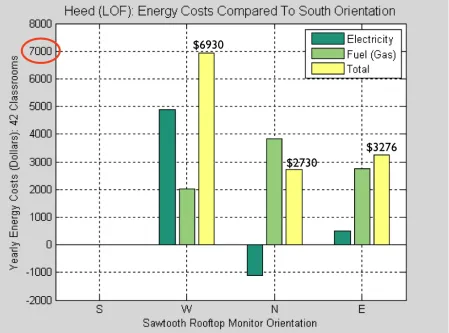
Figure 5.1.12. HEED (LOF), Yearly Energy Costs - 42 classrooms (Differences compared to South Monitor- Scheme 3). ... 55 Figure 5.2.1. Radiance visualization of HEED_DDS classroom model, showing
illuminance contours for South Monitor, Scheme 3. This is a static daylighting simulation using a fixed standard overcast sky that does not vary with climate or location. The CIE Overcast sky is also used to calculate the daylight factor (DF), which is therefore a static daylighting metric. ... 56 Figure 5.2.2. DDS metrics, South Monitor-Scheme 3 (via Daysim subprograms).
Highlighted circle shows daylight autonomy at sensor pt. 5, center of
classroom. ... 58 Figure 5.2.3. DDS metrics, West Monitor-Scheme 6 (via Daysim subprograms).
Highlighted circle shows daylight autonomy at sensor pt. 5, center of
classroom. ... 58 Figure 5.2.4. DDS metrics, North Monitor-Scheme 7 (via Daysim subprograms).
Highlighted circle shows daylight autonomy at sensor pt. 5, center of
classroom. ... 58 Figure 5.2.5. DDS metrics, East Monitor-Scheme 8 (via Daysim subprograms).
Highlighted circle shows daylight autonomy at sensor pt. 5, center of
classroom. ... 58
Figure 5.2.6. HEED_DDS temporal map of DDS illuminance values (lux) at
sensor point 5 (at the center of the room), South Monitor, Scheme 3. Yearly illuminance values (lux) via Daysim subprograms, using a five (5) minute sampling interval. ... 59 Figure 5.2.7. South Monitor: HEED_DDS illuminance temporal maps for each
sensor point in a 3x3 sensor point grid, located 1 ft from the classroom walls, showing the relative locations in plan, north up. Illuminance values (lux) are calculated by HEED_DDS using the Daysim subprograms. The temporal map display is generated by HEED_DDS using the display
Figure 5.3.1. HEED_DDS monthly average hourly illuminance values at the dimming sensor, point 5, South Monitor, illuminance values (lux) via
Daysim subprograms. ... 63 Figure 5.3.2 Heat gain from lights dimmed by daylighting, using a continuous
dimming strategy at a sensor point five (5) feet from the back center of the classroom, as modeled using the existing HEED daylighting algorithms. Design illuminance is 500 lux. This graph is the same with or without the roof monitors, and illustrates that the existing HEED daylight algorithms for the skylights, based on improved lumen methods (IESNA 1984) are not able to model the daylighting contribution of the daylight monitors, input into the HEED_GUI as vertical glass skylights. ... 66 Figure 5.3.3. HEED_DDS: Heat gain from lights dimmed by daylighting at the
South Monitor, using continuous dimming based on the illuminance values (lux) at sensor point 5, shown in figure 5.3.1. Design illuminance is 500 lux. Notice that the lighting system is completely dimmed from
approximately nine o’clock in the morning to four o’clock in the afternoon, which includes nearly all of the school day. ... 67 Figure 5.3.4. HEED_DDS, Yearly Energy Costs, 42 classrooms (Differences
compared to South Monitor, Scheme 3). ... 68
Figure 5.4.1. Shape parameters for North Monitor Variant N-2, no overhang,
fins, or baffles. ... 70
Figure 5.4.2. Radiance visualization, east elevation of HEED_DDS classroom
model for North Monitor Variant N-2, no overhang, fins, or baffles. Static daylight simulation under CIE Overcast Sky. ... 71 Figure 5.4.3. Radiance visualization of interior of HEED_DDS classroom model,
North Monitor Variant N-2, no overhang, fins, or baffles. Static daylight simulation under CIE Overcast Sky. ... 72 Figure 5.4.4. DDS metrics, North Monitor Variant N-2, no overhang, fins, or
Figure 5.4.5. DDS metrics, South Monitor, (metrics via Daysim subprograms). Highlighted circle shows daylight autonomy at sensor pt. 5, center of
classroom. ... 73 Figure 5.4.6. DDS metrics, North Monitor N = N-1, with overhang, fins, and
baffles (metrics via Daysim subprograms). Highlighted circle shows daylight autonomy at sensor pt. 5, center of classroom. ... 73
Figure 5.4.7. HEED_DDS: Yearly Energy Costs: N-2, North Monitor Variant:
no overhang, fins, or baffles, Scheme 7a. Total of 42 classrooms, compared to South Monitor. ... 74
Figure 5.4.8. HEED_DDS: Yearly Energy Costs Summary, per classroom, with
lights dimmed using monthly average hourly illuminance values calculated from the dynamic daylighting simulation produced by calling the Daysim subroutines. ... 76 Figure 5.6.1. Mount Airy Library, Mount Airy, NC. Daylighting design by Edward
Mazria Associates, drawings and images from (Moore 1985, 97), reproduced with the permission of the author (Fuller Moore). ... 79 Figure 5.6.2. Section at typical classroom, showing the HEED_DDS daylighting
structure shape parameters used to model sawtooth rooftop monitors similar to the monitors at the Mount Airy Library (see figure 5.6.1). Note that the ceiling vault base width, used to flare the base of the rooftop
monitor ceiling vaults in the typical Smith Middle School Classroom, is set to zero to model the straight-walled ceiling vaults presented here. ... 80 Figure 5.6.3. Radiance visualization of HEED_DDS classroom interior, showing
Figure 5.6.5. Radiance visualization of exterior of HEED_DDS classroom model of flat-roofed North/South Monitor shape parameters, with no overhang at the north glazing. Static daylighting simulation, CIE Overcast Sky. ... 83 Figure 5.6.6. Radiance visualization of HEED_DDS classroom interior of flat-
roofed North/South Monitor, with no overhang at north glazing. Shape parameters for the HEED_DDS daylighting structures are as shown in figure 5.6.4. Static daylighting simulation, CIE Overcast Sky. ... 84 Figure 5.6.7. Architect’s model of the Casa das Historias, Paulo Regio Museum,
Cascais, Portugal, Eduardo Souto de Moura, Architect. ... 85
Figure 5.6.8. HEED_DDS shape parameters (hand sketched in pencil by the
author) superimposed on the architect’s section of the Casa das Historias. 85 Figure 5.6.9. Using ceiling vault base parameters to make a pyramid shape.
Radiance visualization of the exterior front view of the HEED_DDS model of the Casa das Historias by architect Eduardo Souto DeMoura. CIE Overcast Sky. ... 86 Figure 5.6.10. Radiance visualization of HEED_DDS model interior of the Casa
das Historias, looking up at the skylight from the room below. CIE Overcast Sky. ... 87 Figure 5.6.11. Radiance visualization of HEED_DDS model of Casa das Historias,
looking across the room to the southwest corner window. CIE Overcast Sky. ... 88
Figure 5.6.12. Dynamic daylighting simulation and analysis metrics for the
HEED_DDS model of the Casa das Historias, produced by HEED_DDS using the Daysim subprograms. 3x3 sensor grid, one foot from walls. Note the glare condition at sensor point 1, beside the southwest corner windows. .. 88 Figure 5.6.13. HEED_DDS illuminance (lux) temporal maps of the dynamic
GLOSSARY AND ABBREVIATIONS
annual light exposure (luxh). The cumulative exposure to light falling on a surface (illuminance) for all hours of the year, as measured at a sensor point, in lux-hours. The annual light exposure is a particularly useful dynamic daylighting metric in the design of museums, where the exposure of paintings and other delicate artifacts to light exposure is carefully controlled (Reinhart, et. al. 2010, 11).
continuous daylight autonomy (DAcon). This is a variant of daylight autonomy. It is a dynamic daylighting metric that allows for a partial
interpolated credit when the amount of daylighting at the sensor point is below the design illuminance (Reinhart, Mardaljevic, and Rogers 2006, 10).
daylight autonomy (DA). The daylight autonomy at a sensor point is the ratio of the total number of hours in the year when the minimum design illuminance (DI) is provided by daylighting alone, to the total number of hours when the building is occupied per year, as determined by the building’s occupancy
schedule. Daylight autonomy is a dynamic daylighting performance metric, as opposed to the static daylight factor, because it is based on daylighting
illuminance levels derived from descriptions or models of real sky conditions at each sampling interval throughout the year, rather than on a fixed CIE Overcast sky, as is used for the daylight factor (Reinhart, et. al. 2010, 10).
of separate sky patch segments, each described by a location (altitude, azimuth) and size (solid angle), and to calculate and save the ratio of the luminance
emitted by the sky patch to the illuminance resulting at the sensor, saving the resulting daylight coefficient, as described in the following equation:
DCα(x) = Eα(x) / Lα ΔSα
Where the symbols are defined as follows: x a sensor point
Sα a sky segment
ΔSα the solid angular size of sky segment Sα
Eα(x) the illuminance at x contributed by sky segment Sα
Lα the luminance of sky segment Sα
The total illuminance, E (x), at the sensor point x is then found by summing the illuminance contributions for each sky segment, as described in the following:
E (x) = ∑ (α=1,n) DCα(x) Lα ΔSα
Because the daylight coefficient is a ratio of the amount of light emitted by a particular sky patch to the illuminance at a sensor point (a constant for a fixed building geometry), once a daylight coefficient has been calculated for a sensor point, it is possible to quickly calculate the illuminance at the sensor for any sky condition by using a set of sky patches describing the luminance distribution of the sky. The means of dividing the sky into segments has evolved from
Tregenza’s original 145 conical patches, through the rectangular layout used by Daysim, which adjusted the layout near the horizon line to accommodate the Perez All-Weather Sky Model, to the proposed DDS Standard definition
standard accumulates the illuminance contributions at the sensor point while dividing them into the following components and sky patches:
E = ∑ (α=1, 145) DCαsky Lαsky Sαsky (145 diffuse sky segments)
+ DCgr Lgr Sgr (1 diffuse ground segment)
+ ∑ (α=1, 145) wαisun DCαisun Lαisun Sαisun (145 indirect solar positions) + ∑ (α=1, 2305) wαisun DCαdsun Lαdsun Sαdsun (2305 direct solar positions)
Where wαisun and wαdsun are interpolation weights used to derive luminance values for precise sun positions by interpolating them from a quadrilateral of surrounding standard sun locations, 145 for the DDS standard vs. approximately 65 latitude-dependent positions for standard Daysim (Bourgeois and Reinhart 2006).
daylight factor (DF). The ratio of the indoor illuminance at a sensor point to the outdoor horizontal illuminance, measured under CIE overcast reference sky conditions. The daylight factor is a static daylight metric, because it is evaluated under a fixed sky condition that does not change with building location or
orientation (Reinhart, et. al. 2010, 9).
design illuminance. The minimum amount of light falling on a work plane surface needed to comfortably perform a given task, as established by lighting design standards organizations such as the Illumination Engineering Society of North America (IESNA). The design illuminance of a classroom or office is currently defined as 500 lux (IESNA 2011), as measured at the task surface (a desktop height of 30”).
4300 lux maximum. The DSP also penalizes illuminance values in the glare range above 4300 lux by subtracting them from the number of hours that are within the useful range.
dynamic daylight simulation (DDS). Equivalent to the term climate-based dynamic daylight(ing) simulation. In contrast to a static daylighting simulation, which uses a fixed sky condition, a dynamic daylighting simulation models daylighting responding to changing sky conditions at discrete time steps
throughout the year, based on real or modeled luminous distributions describing the sky conditions.
illuminance (lux). The amount of light (luminous flux, measured in lumens) divided by the area on which the light is falling (square meters). The standard international unit of measurement of illuminance is lux, where 1 lux = 1 lumen per square meter (Tregenza and Wilson 2011, 35).
irradiance (w/m2). The integrated amount of electro-magnetic radiation of all wavelengths arriving at a surface, measured in standard international units as watts per square meter (Ward and Shakespeare 1998).
maximum daylight autonomy (DAmax). This dynamic daylighting metric is a variant of the daylight autonomy that measures the percentage of occupied hours where glare conditions are found at the sensor point. The glare threshold is typically set to ten (10) times the design illuminance (Reinhart, Mardaljevic, and Rogers 2006, 11).
sensor point (pt). A point of interest, typically specified with Cartesian
coordinates (x, y, z) and a unit vector (such as 0, 0, 1) specifying the direction of measurement to which the sensor is pointed, where daylighting metrics, such as illuminance, are collected. For classrooms and offices, the sensor point is typically located at desktop height, 30 inches above the finished floor.
CHAPTER 1: INTRODUCTION
1.1 Problem Context and Purpose of the Dissertation
The intelligent use of daylighting provides an important opportunity for the integration of architectural design with energy-conserving performance. Before inexpensive electric lighting became the norm in the home and workplace during the last century, daylighting design that provided factories, offices, and schools with daylit spaces where it was possible to work and study comfortably without electric lighting (which was not yet available) was both necessary and
commonplace. Today, with both global temperatures and energy costs rising, the vital importance of daylighting design has again been made clear, not only due to the energy savings potential and associated positive environmental benefits, but also for the ability of daylighting design to provide healthy and more productive environments leading to increased well being.
1.1.1 Potential for Energy Savings Due to Daylighting
The use of intelligent, “high performance” architectural daylighting can produce energy savings and associated environmental benefits through a number of mechanisms:
1) Reduced electric lighting loads:
2) Reduced cooling loads:
The switching off or dimming of the electric lighting not only saves energy through reduced electric lighting usage, but also reduces cooling loads, due to the reduced heat output generated. The use of electric lighting directly accounts for about twenty to twenty-five percent (20%-25%) of the total electricity usage in the United States, with the amount increasing to approximately thirty-four percent (34%) for interior lighting in the commercial sector (Ander 2003, 1). In addition to the electricity used directly by electric lighting, each unit of electric lighting use contributes an additional amount of approximately one half unit of electricity use for cooling costs due to the heat emitted by the lighting (Ander 2003, 1). Because of the reduced heat output of the dimmed or switched-off electric lights, the energy savings due to daylighting from reduced lighting loads can then further reduce the energy costs for cooling by an additional ten to twenty percent (10%-20%), (Ander 2003, 1). It can be seen from these statistics that the potential for energy savings due to the use of daylighting to reduce the need for electric lighting and cooling is vast.
3) Integration of daylighting with passive solar design:
Daylighting design can be integrated with building and aperture
orientation, overhangs, shading design, etc., to attain significant savings through passive solar means. Passive design principles that allow direct sunlight to be controlled, while providing passive solar heating in winter and avoiding overheating in summer, can be integrated with the
daylighting design to achieve a synergy greater than the sum of the parts.
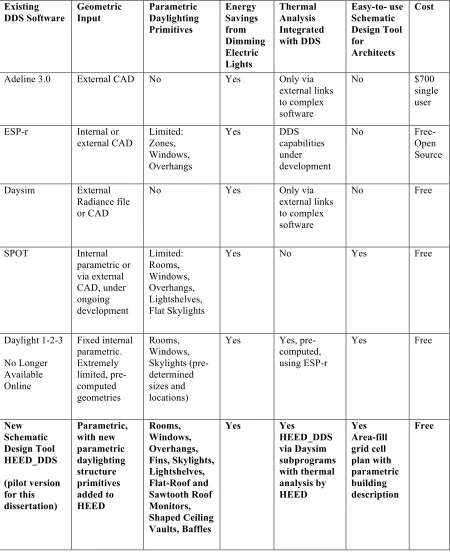
Table 1. Comparison of existing dynamic daylighting simulation (DDS) software to the new schematic design tool, HEED_DDS
Existing DDS Software Geometric Input Parametric Daylighting Primitives Energy Savings from Dimming Electric Lights Thermal Analysis Integrated with DDS Easy-to- use Schematic Design Tool for Architects Cost
Adeline 3.0 External CAD No Yes Only via external links to complex software
No $700
single user
ESP-r Internal or external CAD
Limited: Zones, Windows, Overhangs
Yes DDS
capabilities under development
No Free-
Open Source
Daysim External Radiance file or CAD
No Yes Only via
external links to complex software
No Free
SPOT Internal parametric or via external CAD, under ongoing development Limited: Rooms, Windows, Overhangs, Lightshelves, Flat Skylights
Yes No Yes Free
Daylight 1-2-3 No Longer Available Online Fixed internal parametric. Extremely limited, pre-computed geometries Rooms, Windows, Skylights (pre-determined sizes and locations)
Yes Yes, pre-computed, using ESP-r
Yes Free
New Schematic Design Tool HEED_DDS (pilot version for this dissertation) Parametric, with new parametric daylighting structure primitives added to HEED Rooms, Windows, Overhangs, Fins, Skylights, Lightshelves, Flat-Roof and Sawtooth Roof Monitors, Shaped Ceiling Vaults, Baffles
Yes Yes
CHAPTER 2: REVIEW OF THE LITERATURE AND EXISTING DYNAMIC DAYLIGHT SIMULATION (DDS) SOFTWARE
2.1 Capabilities and Limitations of Current Dynamic Daylight Simulation (DDS) Software, and Proposed Capabilities and Usefulness of the New Schematic Design Tool
In recent years, several of the newest software tools for daylighting design, such as Daysim (Reinhart, et al. 2011), SPOT Sensor Placement + Optimization Tool (Rogers, et. al. 2011), and Daylite 1-2-3 (Reinhart, et al. 2007), have
introduced the important ability to provide climate-based, dynamic daylight simulation (DDS) and analysis by using the subprograms of Radiance, a
software suite utilizing recursive, backward ray tracing and Monte Carlo method computing algorithms (Ward and Shakespeare 1998), as a physically accurate daylight simulation engine, in conjunction with models of dynamic sky
conditions.
Of these three software tools, only Daylite 1-2-3 includes a whole-building energy analysis, via ESP-r, that enables all three of the mechanisms listed in Chapter 1 for energy savings due to daylighting to be modeled without linkage to external energy modeling software (see table 1). However, Daylite 1-2-3 is only applicable to extremely limited, pre-computed, and fixed room geometries and daylighting structures (windows and flat skylights), and is accessible only via the World Wide Web. It is also, unfortunately, no longer available (March 2012), apparently due to loss of funding. Because of the severe limitations imposed by pre-set, pre-computed geometries, Daylite 1-2-3 may have been more useful as a demonstration tool than as a fully functional integrated
daylighting and energy design tool for the analysis of more general classrooms and offices.
thousands of sites around the world at online locations such as the EnergyPlus weather files web site, to produce daylighting analysis at discrete time steps throughout the year, based on descriptions of real sky conditions at the site. HEED_DDS uses the sub-programs of Daysim to produce dynamic daylight simulation and analysis, as well as an integrated energy analysis using HEED’s thermal analysis kernel.
Using solar insolation data extracted and/or extrapolated from weather files, specifically the direct normal and diffuse horizontal solar irradiances (watts/m2), Daysim uses the Perez All-Weather Sky Model, based on complex mathematical models derived from over 16,000 real sky luminance distribution scans (Perez, Seals, and Michalsky 1993), in conjunction with stochastic techniques to
extrapolate shorter time steps (Walkenhorst et al. 2002), (Olseth and Skartveit 1992), to model sky luminance distributions that simulate real sky conditions with continuous sky models.
Generating the Daysim sky models is a two-step process. In the first step, for the typical case where the hourly irradiance data in the weather file is the only data available, but a shorter simulation time step is needed, stochastic
techniques are used to generate sub-hourly irradiance data for each time step using the Daysim sub-program ds_shortterm. Sampling intervals available in Daysim are 60 min, 30 min, 15 min, 10 min, 5 min, and 1 min. In the second step, the Perez All-Weather Sky Model is used to generate a continuous sky luminance distribution model, closely approximating real sky conditions, as the daylight simulation using Daysim, with its subset of Radiance, is performed at each time step.
2.2 Static vs. Dynamic Daylight Simulation and Analysis Metrics
location or direction, climate-based dynamic daylight simulation (DDS) is based on dynamic models of changing, real sky conditions. Dynamic daylight
simulation (DDS) results in a set of normalized daylight coefficients for each sensor point, which, when combined with sky luminance distribution models derived from solar irradiance data in weather files (Perez, Seals, and Michalsky 1993), can be used to calculate daylight illuminance values for each sensor point at designated time intervals of analysis throughout the year. By comparing these time series of illuminance values against the daylighting design
illuminance goals for each sensor point, annual dynamic daylighting performance metrics, which quantify the effectiveness of the daylighting design, are derived (Bourgeois, Reinhart, and Ward 2008).
The most common dynamic daylighting analysis performance metric is the annual daylight autonomy (DA), which is defined, for each analysis point, as the percentage of the occupied, or workday hours of the year when the design illuminance is provided or exceeded by daylighting. This type of DDS analysis and metric is much more accurate and useful than a traditional static metric such as the daylight factor (DF) for predicting daylighting and energy
performance under real sky conditions (Reinhart, Mardaljevic, and Rogers 2006).
The daylight factor is the ratio between the amount of daylight illuminance at the sensor point and the corresponding global horizontal illuminance outside under the CIE overcast sky (Reinhart, Mardaljevic, and Rogers 2006, 4).
factor is a static metric based on a ‘worst case’ and theoretical uniformly cloudy sky model, it tends to over-estimate the amount of daylight glazing area
actually needed for daylighting under clear conditions (Reinhardt, et. al. 2010). This overestimate of needed glazing area for daylighting will tend to result in increased energy usage due to heat gain / loss through the increased glazing areas. Therefore, in order to predict real daylighting performance, as well as resulting energy savings and passive solar performance, under descriptions of dynamic sky conditions at real site locations, a climate based, dynamic
daylighting simulation tool with integrated energy analysis capabilities is needed.
Presently available dynamic daylighting simulation (DDS) software tools typically include analysis of daylighting levels at chosen sensor points, reporting dynamic daylighting performance metrics such as the daylight autonomy (DA) and useful daylight illuminance (UDI) and the associated direct electricity cost savings (mechanism 1, section 1.1.1) from the resultant dimming of the electric lighting system (see table 1). The presently available DDS tools have not, however, included both dynamic daylighting analysis and thermal analysis accounting for the savings in cooling costs from dimming the lights (mechanism 2) and the savings attributable to the integration of the daylighting design with passive solar design (mechanism 3), all within an easy-to-use schematic design tool, based on a conversational description of a full set of parametric daylighting structure primitives, such as rooms, partitions, windows, overhangs,
lightshelves, various types of rooftop monitors, etc.
Using Daysim, for example, it is necessary to import a geometric model
describing the scene into Daysim from a Radiance text file (.rad file). The scene (.rad) file describes the three dimensional scene as a collection of surface
building the scene file directly using a text editor is difficult for most users, a separate CAD program, such as Ecotect, Rhinoceros (Rhino), or SketchUp (another separate program that must also be learned), is typically used to generate the required .rad file from a CAD model of the scene. The conversion of the CAD model to the .rad file is a complex process that is hidden from the typical user and tends to be error prone and frustrating.
The climate-based dynamic daylighting simulation is then performed to produce a set of daylight coefficients, from which illuminance values are generated, for each time step, for each sensor point. An interesting, potentially useful property of daylight coefficients, is that once the daylight coefficients at each time step for a given building description have been computed (a relatively
time-consuming process), it is possible to use the daylight coefficients to very quickly calculate new illuminance values at each time step for that building under any sky conditions, giving the ability to quickly predict daylighting performance of the building at any location (given an .epw weather file) and orientation.
The computed illuminance values are next used to generate daylighting
performance metrics at each sensor point to complete the daylighting simulation and analysis within Daysim. Using this method, a full set of DDS metrics will be generated, but although the energy savings due to dimming the lights will be calculated, no thermal results will be included at this point.
building energy analysis of large buildings, and are overly complex and rather inaccessible programs for schematic design.
The need to follow such a cumbersome procedure, involving input from, and export to, complex external software packages, interrupts the continuity of the design process, and makes the use of integrated dynamic daylighting and energy analysis tools using such a method much less accessible during schematic design.
2.3 Overall Purpose of the Dissertation
The purpose of this dissertation is to research, partially develop, and apply (demonstrating proof of concept), an easy-to-use schematic design tool that will analyze daylighting designs using climate-based dynamic daylighting simulation (DDS) techniques and also analyze the energy performance of the design using a whole-building energy analysis engine. In this way, all three mechanisms for energy savings due to daylighting previously described, 1) Reduced electric lighting loads, 2) Reduced cooling loads, and 3) Integration of daylighting with passive solar design, will be modeled in a single package.
Ease-of-use of the software will be of fundamental importance, since any overly tedious input, such as the need to use a computer-aided drafting approach to describe the geometry, or the need to specify exacting detail for the building’s HVAC system, is likely to involve too much time for the tool to be useful during the early stages of design, at least for those designers who are either not fluent with the intricacies of a three dimensional modeling software package, or are not fluent with the implementation details of a whole-building energy modeling program.
windows, overhangs, fins, lightshelves, skylights, and rooftop monitors. The tool will present, both numerically and graphically, annual dynamic daylighting performance metrics, such as daylight autonomy, with integrated building energy performance metrics. This will include a model of the energy savings due to daylighting, using a whole-building thermal analysis engine, integrated with the dynamic daylight simulation. For this dissertation, a pilot version of the new design tool, called HEED_DDS, has been developed and applied as a
research tool to the integrated daylighting and energy design and analysis of typical classroom spaces taken from the author’s architectural practice
experience (R.D. and Euzelle P. Smith Middle School, Chapel Hill, NC).
2.4 HEED_DDS Implementation and New Capabilities
HEED_DDS uses a conversational user interface, based on the augmentation of HEED’s existing easy-to-use GUI, to describe whole-building geometry and performance parameters. HEED_DDS adds a set of new parametric daylighting structure primitives (lightshelves, flat skylights, and sawtooth or flat-roofed monitors with shaped ceiling vaults, including parametrically-described canvas baffle layouts for the rooftop monitor structures), in conjunction with new capabilities for climate-based dynamic daylight simulation (DDS) and analysis, using the subprograms of Daysim. The new DDS capabilities replace HEED’s existing daylight modeling algorithms based on improved lumen methods (IESNA 1984) and (Libbey-Owens-Ford 1976). HEED_DDS integrates the dynamic daylight simulation performance metrics (illuminance profile at the dimming sensor) with HEED’s validated energy / thermal analysis kernel, and includes new graphic output capabilities (presently implemented using MATLAB) to describe dynamic daylighting and energy performance metrics of individual spaces, such as daylit classrooms and offices. This type of design tool is
At present, daylighting design can be seen as being divided into various competing daylighting design "camps". Regarding the orientation of daylight apertures, for example, one camp prefers daylighting apertures face south for passive solar benefit, another north, to avoid glare, another east or west, to provide daylighting contrasts at various times of day. Each design team employs consulting engineers, as opposed to the architectural designers, each using different simulation tools, to analyze and justify the daylighting and associated energy performance of the whole-building design. Further, the analysis results are typically kept private and are only accessible to the design team and client. Due to the complexity of present methods, the infancy of dynamic daylight simulation, and the lack of integration of DDS with energy analysis, it is not easy to model the real world daylighting and associated thermal performance of design alternates to allow for comparison by the architect in a schematic design context.
An easy-to-use schematic design tool such as is proposed with HEED_DDS allows for comparison of integrated daylighting and thermal performance of different basic design alternatives, as well as for optimization of the daylighting design elements of the chosen alternates, in a schematic design context.
2.5 A Set of Parametric Primitives For Daylighting Design
The ability to describe daylighting designs by means of a conversational user interface (such as HEED now employs), utilizing a set of parametric daylighting structure primitives that allow established daylighting structures, as commonly used in daylighting design practice, to be manipulated as coherent objects, is proposed as a key to the ease-of-use of the proposed software tool for
standard drafting tools), have been efficiently and easily described
parametrically. As described previously, this type of parametric description can lend itself to a more natural, conversational, and integrated user-interface experience than the traditional computer-aided drafting input of the daylighting design.
2.5.1 Parametric Shape Descriptions of Daylighting Structures
The description of a rectangular space, such as a room or gymnasium, serves as a simple example of parametric description: the parameters for length, width, and height, along with the location of an origin in space and a pre-defined shape topology that describes the relationship of the geometric elements, are sufficient to completely describe the shape. By using shape parameters to generate the shape’s geometry from its topology, there is no need for the user to construct all the edges using a computer-aided drafting tool. Given the parameters and the inherent definition of the shape itself, the topology and geometry of the
bounding polygons describing the object, i.e. the vertices, edges, faces, and their connections to each other, can be procedurally generated by the computer software using algorithms derived from the definition of the shape (Grady
1980). This type of technique forms the basis for what has come to be known as procedural modeling, and the technique is a well proven and extensively used method for geometric modeling and shape description in computer graphics.
The review of the literature and the existing DDS software, however, has shown that while these well-known parametric description techniques have been
applied to some of the simplest parametric daylighting elements, such as rooms, windows, overhangs, fins, and horizontal skylights, and although the underlying principles of parametric description have been used to generate multi-variant, dynamic, parametric descriptions of complex surfaces (Iwamoto 2009) by the use of complex parametric modeling tools such as Rhino coupled with
been applied in a daylighting design practice context to provide for many of the comparatively simple but, nevertheless, fundamental and commonly used, daylighting structures, including lightshelves, sawtooth and flat-roof rooftop monitors with shaped ceiling vaults, and their corresponding baffle layouts (see table 1).
The same type of procedural technique that allows for the shape description of rectangular spaces, such as offices, classrooms, cafeterias, libraries,
CHAPTER 3: THEORETICAL PERSPECTIVE AND RESEARCH QUESTIONS
3.1 Theoretical Perspective and New Knowledge Generated
The theoretical perspective of this dissertation is one of praxis, the practical application of a branch of learning. This dissertation introduces, implements, and applies a new variant of an integrated daylighting and energy design and analysis tool which will be useful in the practice of energy-efficient, carbon-neutral architectural design (Milne 2007).
Past lack of attention to green/sustainable building performance has contributed to significant building performance inadequacies regarding the design of
ecologically responsive buildings. This is discussed in detail at the Architecture 2030 website, architecture2030.org, as illustrated by the US energy-use
statistics presented at the site. For example, nearly 49% of US energy usage is by the building sector (approximately 40% building operations, 9% embodied), with nearly 77% of total US electricity use due to building operations alone (Mazria, et. al. 2012). At the same time, design decisions made by architects, concerning design utilizing natural energies, daylighting design, design
conserving natural resources such as energy and water, building orientation, massing, glazing, shading, ventilation, etc., have lasting and permanent effects on the resulting building performance, including energy consumption and CO2 emissions.
Relative to buildings, there are a number of areas of knowledge that need to be accounted for in order to assess energy efficiency and carbon neutrality,
Dynamic daylighting simulation (DDS) is a new branch of learning that has emerged in the last decade. This technique has so far only been applied to a very limited set of architectural daylighting configurations. One of the goals of this dissertation is to extend the range of applicability of the DDS method by augmenting it with parametrically modeled daylighting primitives for efficiently describing daylighting designs and then integrating those capabilities into a proven thermal analysis tool. HEED represents a good point of departure for this research and development effort. It has been demonstrated to have ease of use in architectural design practice (Milne and Kohut 2002) and in design studio settings involving typical architectural design students (NCSU ARC 301 studio, Fall 2011, ‘Searching for an architectural aesthetic for a sustainable future’, and carbon-neutral design studios, Spring 2008 and Fall 2008). Also, the thermal engine in HEED has been validated (Milne, Morton, and Kohut 2006).
3.2 Research Questions
The feasibility and use of the new design/analysis tool, HEED_DDS, has been demonstrated by applying it to a series of case studies involving daylit
classrooms. HEED_DDS has been applied as a research tool to investigate the following research questions:
3.2.1 Research Question 1
Can dynamic daylighting simulation (DDS) techniques employing a set of parametric daylighting primitives be effectively integrated into a thermal analysis tool with the analytic engine and user interface typical of HEED?
3.2.2 Research Question 2
In a typical daylit school classroom, utilizing a rooftop monitor, which orientation of the daylight monitor (South, West, North, or East) will give the best
CHAPTER 4: RESEARCH DESIGN AND METHODOLOGY
4.0 Summary of Research Design and Methodology
The methodology of this dissertation is to research, develop, and demonstrate a new design and analysis tool integrating the application of the new branches of learning described in Chapter 3. The use of the new design and analysis tool will be demonstrated by applying it to a series of case studies involving typical daylit classrooms. A command line driven, pilot version of the design tool,
HEED_DDS, is used in this dissertation as a research tool to implement the methodology, using its simulation capabilities to answer a set of research questions. In this dissertation, the term ‘HEED’ will be used to denote the existing HEED software, while ‘HEED_DDS’ will denote the pilot version of the proposed new design tool developed for this dissertation.
4.1 HEED and HEED_DDS
HEED (Home Energy Efficient Design) is an easy-to-use schematic design tool that is capable of analyzing the energy performance of single zone buildings up to ten thousand square feet in size, available for free download via the UCLA Energy Design Tools website. It is presently oriented most directly to
homeowners, but is also used by architects & building designers for energy-conscious design. HEED is the result of many years of research and
development, growing from the SOLAR5 program at UCLA, under the
supervision of Prof. Murray Milne (Milne and Kohut 2002). HEED, and versions of it, can also be packaged to handle elements of other building types, including classrooms and offices. HEED presently includes very basic daylight simulation capabilities, based on improved versions of both the lumen method of side lighting, as described in the Libbey-Owens-Ford manual, ‘How to Predict Interior Daylight Illumination’ (Libbey-Owens-Ford 1976), and lumen methods described in (IESNA 1984) for skylights. As the research tool for this dissertation,
new DDS capabilities with HEED’s validated energy analysis kernel (Milne,
Morton and Kohut 2006). The HEED_DDS software utilizes the sub-programs of Daysim (Reinhart, et al. 2011), an open source, validated (Reinhart and Breton 2009), (Reinhart and Walkenhorst 2001) dynamic daylight simulation package, itself based on Radiance (Ward and Shakespeare 1998), an open source,
validated (Mardaljevic 2001), physically based, lighting visualization software package, as computational engines. HEED_DDS will currently provide integrated dynamic daylighting design and energy analysis of rectangular spaces with the opening types and daylighting elements already supported by HEED (windows, overhangs, fins, and skylights), as well as the new set of parametric daylighting structure primitives developed for this dissertation, including lightshelves, flat skylights, and flat-roof and sawtooth roof monitors with shaped ceiling vaults and baffle layouts. The new dynamic daylighting simulation capabilities have then been integrated with HEED’s validated energy / thermal analysis engine.
4.2 Adding DDS Capabilities to HEED
Considerable potential exists for the development of new schematic design tools by assembling elements of open or semi-open source software “objects”, such as the integration of the Daysim subprograms with the HEED thermal simulation kernel, as implemented in HEED_DDS. This section will briefly discuss the techniques used to call the Daysim DDS subprograms from HEED (or other
software), and describe the function of each Daysim sub-program in HEED_DDS. HEED presently uses parametric description techniques for basic daylighting elements (rooms, windows, overhangs, fins, clerestories, and skylights). This dissertation will illustrate the use of parametric modeling techniques to describe other, more complex daylighting design primitives, such as flat skylights and flat and sawtooth roof monitors with shaped ceiling vaults, which have been
4.2.1 Validation of the HEED_DDS Implementation of the Daysim Subprograms
Daysim is a validated (Reinhart and Breton 2009), (Reinhart and Walkenhorst 2001) open-source, software package for climate-based dynamic daylighting analysis (DDS), available for free download via the World Wide Web. Although Daysim is typically accessed via the Daysim graphical user interface (GUI), its full capabilities can also be invoked by calling its sub-programs directly from a software application, as is done from HEED_DDS.
4.2.2 Building a Radiance .rad File for the HEED_DDS Model
Before Daysim can be called, a Radiance scene file describing the HEED_DDS building model and surrounding scene is generated. The parametric building descriptions presently used by the existing HEED GUI (overall room shape, including doors, windows, overhangs, and fins) are combined with new
parametric daylighting structure primitives added by HEED_DDS (lightshelves, flat skylights and flat-roofed and sawtooth monitors with shaped ceiling vaults and automatically generated baffle layouts) to build a .rad file of the HEED_DDS building model and scene for use by the Daysim sub-programs. This is
performed by the HEED_DDS main routine heed2rad. The geometric description of the building from the HEED GUI is augmented by additional parametric
descriptions of new daylighting structures that are input into HEED_DDS. HEED_DDS then produces a corresponding .rad file that is used for both static visualizations of the model with Radiance and for the dynamic daylighting simulations produced by HEED_DDS by calling the Daysim subprograms.
4.2.3 Calling the Daysim Subprograms from HEED_DDS
the Daysim subprograms how to perform the dynamic daylighting simulation for the HEED_DDS scheme being modeled. Because the keywords and parameters needed to use the Daysim subprograms are not yet fully documented, and because Daysim is under ongoing development, causing periodic, publically undocumented, changes to be made to the header file format, it is easiest to implement the keywords correctly by first using the standard Daysim GUI release to create a sample header file for the project, then emulating the
keywords and data, as output by the Daysim GUI, in the new software (such as HEED_DDS), which will then directly call the Daysim subprograms.
The sequence of Daysim subprogram calls to generate a complete daylighting simulation and analysis is, briefly, as follows:
Step 1: epw2wea (weather file, Daysim weather file) is used to convert the TMY3 weather file input to the Daysim weather file format (.wea), containing the direct normal and diffuse horizontal solar irradiances (watts/m2), for each hour of the year. All other data in the weather file except for the hourly direct and diffuse irradiances extracted from the TMY3 file are unused by Daysim.
Step 2: ds_shortterm (header) is used to convert the hourly irradiance data from the weather file to shorter sampling intervals, using stochastic methods that extrapolate the hourly direct and diffuse irradiances from the weather file to match shorter time steps (Walkenhorst et al. 2002), (Olseth and Skartveit
1992), down to a minimum of 1 minute, as required. The Daysim default time step of five (5) minutes has been used for all case studies presented in this dissertation. Note that by choosing a sixty (60) minute time step, matching HEED’s hourly time step, the compute time for the dynamic daylighting
Step 3: radfiles2daysim (header, file parameters) is used to read the Radiance .rad files that were generated by HEED_DDS to describe the building model scene into the Radiance data structures (octree) used by the Daysim subprograms.
Step 4: gendc (header) is used to generate daylight coefficients (Bourgeois,
et. al. 2008, 69-74) for each time step throughout the year for each sensor point specified in the sensor file. This is the step that will take the most compute time by far. Using a sixty (60) minute time step corresponding to HEED’s hourly analysis, compute times have generally been kept within a range of approximately twenty (20) seconds for rooms with windows only, with
compute times increasing to over two (2) minutes for the classroom case studies based on the Smith Middle School investigated for this dissertation, using a five (5) minute sampling interval.
Step 5: ds_illum (header) is used to calculate the illuminance (lux) at each
sensor point specified in the sensor point file, for each time step throughout the year. The illuminance values are quickly generated by applying the daylight coefficients computed in the previous step to the luminous sky distribution generated for each time step (Bourgeois, et. al. 2008, 69-74). The luminous sky distribution is generated from the solar irradiance data for each time step using the Perez All-Weather Sky Model (Perez, Seals, and Michalsky 1993), (Perez, Ineichen, Seals, Michalsky, and Stewart 1990).
Step 6: gen_directsunlight (header) calculates Daysim sunlight files that are used for the daylighting analysis.
by Daysim are based on the illuminance values at each sensor point time step. The files containing the performance metrics produced by calling the Daysim subprograms directly are identical to those produced by the Daysim GUI.
Because HEED’s energy / thermal analysis kernel includes its own methods for calculating energy savings due to the dimming of the electric lighting using a continuous dimming strategy, the electric lighting dimming energy savings produced by Daysim (which is only the direct cost of the lighting) is not being used by HEED_DDS. HEED’s modeling of the savings due to daylighting is also superior to Daysim’s, because it includes the effect of the reduced heat output of the dimmed lights on the whole-building energy analysis performance, where Daysim does not. Therefore, only the dynamic daylighting simulation metrics produced by Daysim are being used by HEED_DDS.
4.2.4 Displaying the DDS Metrics and Folding the DDS Illuminance Profile at the Dimming Sensor Point Back into HEED’s Whole-Building Energy Analysis Kernel
HEED_DDS now accesses the daylighting simulation and analysis metrics produced by the Daysim subprograms, displaying them for the designer, and calculates monthly hourly averages of the illuminance values at the sensor point that are folded back into HEED’s energy / thermal analysis engine to produce an integrated daylighting and energy analysis that includes both the direct electrical and the thermal effects of dimming the electric lights in response to the design illuminance value and lighting power density as specified in the HEED GUI.
using the display capabilities of MATLAB. It is intended that future
implementations of the design tool will be fully integrated with the HEED GUI.
4.2.5 Daysim DDS Implementation Validation- Demonstrating Equivalence of Daysim GUI Illuminance Output to HEED_DDS Illuminance Output Using the Daysim Subprograms
Because the open-source Daysim release used by HEED_DDS has already been validated (Reinhart and Breton 2009), (Reinhart and Walkenhorst 2001), the process of validating the implementation of the Daysim subprograms within HEED_DDS becomes one of demonstrating equivalence, showing identical results for a sample problem are produced by the Daysim standard release, using its standard GUI, compared to the same problem simulated in HEED_DDS using the Daysim subprograms. Figure 4.2.1 shows the simple rectangular classroom, twenty (20) feet long and sixteen (16) feet wide, with a single
window, (5’-4” x 5’-8”), as modeled in the HEED GUI and input into HEED_DDS, used for the validation of the HEED_DDS implementation of the Daysim
Figure 4.2.1. Simple rectangular classroom model in HEED, rm2016, used to validate the implementation of the Daysim subprograms in HEED_DDS, as input using the HEED GUI.
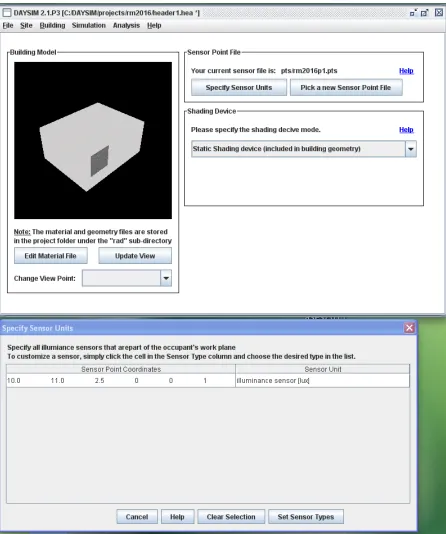
Figure 4.2.2 shows a classroom and window identical to rm2016 that has been input into the Daysim standard release’s GUI for modeling. Identical sensor points, each at the center of the room at desktop height, 2’-6’ above finished floor, with the sensor pointed up, have been used for the illuminance
4.3 Parametric Description and Input of the Case Study Classroom and its Daylighting Structures
To illustrate the application of HEED_DDS, a typical daylit classroom, based on the R.D. and Euzelle P. Smith Middle School, Chapel Hill, NC (see figure 4.3.1), a daylighting design project from the author’s architectural practice experience, has been modeled, analyzed, and used as a basis to answer the research questions investigated by this dissertation. For more information about the Smith Middle School, including the daylighting design, renewable energy
systems, rainwater collection system, and other green design features, see the Daylight Dividends Case Study, Lighting Research Center, Rensselaer
Polytechnic Institute, available on the World Wide Web (Morante 2004).