
Energy-Efficient Cluster Formation
Techniques: A Survey
Jigisha Patel
1, Achyut Sakadasariya
2P.G. Student, Dept. of Computer Engineering, C.G.P.I.T, Uka Tarasadia University, Bardoli, Gujarat, India1 Assistant Professor, Dept. of Computer Engineering, C.G.P.I.T, Uka Tarasadia University, Bardoli, Gujarat, India2
ABSTRACT: In wireless sensor network (WSN), many novel architectures, protocols, algorithms and applications have been proposed and implemented for energy efficiency. The efficiency of these networks is highly dependent on routing protocols which directly affecting the network life-time. Cluster formation in sensor network is one of the most popular technique for reducing the energy consumption and expand the lifetime of the sensor network. There are various cluster formation techniques used in wireless sensor network. In which, Particle Swarm Optimization (PSO) is simple and efficient optimization algorithm, which is used to form the energy efficient clusters with optimal selection of cluster head. The comparison is made with the well-known cluster based protocols developed for WSN, LEACH (Low Energy Adaptive Clustering Hierarchy) and LEACH-C as well as the traditional K-means clustering algorithm. A comparative analysis shown in the paper and come to the conclusion based on some parameters.
KEYWORDS: Wireless Sensor Network, Energy Efficient Clusters, LEACH, LEACH-C, K-Means, Optimization
algorithm, Particle Swarm Optimization.
I. INTRODUCTION
A Wireless Sensor Networkis a network with a collection of sensor nodes communicating with each other using radio signals with the purpose of collect, process and communicate data acquired from the physical environment to the external base station (BS).In WSNs, the sensors are available in large numbers, at low-cost and small in size so they are able to be employed in wide range of application like industry, science, health care, transportation, civil infrastructure, and security [5]. Sensor nodes have constrained like processing power, communication bandwidth, and storage space which required very efficient resource utilization. Sometimes, it is unpractical to frequently change the battery because the nodes are small in size and it may be deployed in wide areas. Therefore, it is required to save node energy and prolong the network lifetime by improving the algorithm.
Fig. 1. Clustering in wireless sensor network [7]
The fig.1 shows the basic structure of clustering in WSN. In which the cluster head of each group is transmits the data to the sink node or base station. Several cluster based protocol used for maximizing the sensor network lifetime. The LEACH (Low Energy Adaptive Clustering Hierarchy) protocol is a distributed cluster-based protocol which finds the optimal number of clusters in WSNs in order to save energy and enhance the network lifetime. The LEACH does not guarantee that the desired number of clusters heads is selected and the selected cluster heads are not evenly poisoned across the network. The LEACH-centralized (LEACH-C) protocol is the improvement of the LEACH protocol which uses the centralized approach for cluster formation. The K-Means is also one of the technique used for clustering which is known as unsupervised clustering algorithm.
The optimal selection of the cluster heads with high energy that scattered evenly in the area is the NP-hard problem (nondeterministic polynomial time) [3]. Hence, evolutionary algorithms is more suitable to solve this types of problems. The particle swarm optimization (PSO) is one of the evolutionary computing technique that is based on the behaviour of the social behaviour of a flock of birds. Thus PSO technique is also reduces the energy consumption in WSNs by selecting the cluster head in optimal way. The paper presents the overview of the LEACH, K-Means and PSO cluster formation techniques.
II. RELATED WORK
1. Low Energy Adaptive Clustering Hierarchy (LEACH)
LEACH is the distributed cluster-based protocol used for the clustering in WSNs. In LEACH, every sensor node elects itself with some probability. The algorithm is run periodically and the probability of becoming a cluster head for each period is chosen to ensure that every node becomes a cluster head at least once within 1/P rounds, where P is the predetermined percentage of cluster heads [1].
Fig. 2. LEACH operation [4]
The LEACH protocol operates in rounds in which each round consist two phases which are set-up phase and steady phase. Setup phase include advertisement phase and cluster set-up phase while steady phase include schedule creation and data transmission.
Setup Steady state Frame Round
2.LowEnergy Adaptive Clustering Hierarchy- Centralized (LEACH-C)
LEACH protocol provides the distributed cluster formation but it does not guarantee the number of cluster head nodes selected and the cluster head may be appear in the edge of the network [6]. So the centralized approach which is the improvement of the LEACH is used for produce better clusters in WSNs. The LEACH-C uses the centralized algorithm and the same steady state phase as LEACH. In set-up phase of LEACH-C, each node sends information about its current location and energy level to the base station. Then the base station computes the average node energy and the node whichever nodes have energy above average energy can be cluster head for the current round. The steady state phase is same as the LEACH protocol.
3. K-Means
K- Means is known as unsupervised clustering algorithm. Which is most widely used clustering approach that attempts to find the centre point of cluster by minimizing the distance between points assigned to be within a cluster and at the centre of that cluster [3].The K-Means applied to partition thenetwork into k-clusters based on the distance between an elected cluster head and the nodes belong to the same cluster.
Fig. 3. Flow of clustering in K-Means algorithm [5]
The fig. 3 shows the flowchart of K-Means clustering algorithm in which the arbitrarily k clusters are obtained from the sensor nodes.
Start
Arbitrary select the number of clusters k
Assign each sensor to the closest cluster center
Recalculate the location of each cluster
center
Is the position of
the center Changes?
4. Particle swarm Optimization (PSO)
The PSO is an evolutionary algorithm which is based on the behaviour of flock of birds and the set of potential solutions are called particles that are initialized randomly. In which each particles flown in multi-dimensional search space to find the global position. Each particle maintains the best individual position and global position and moves towards better solution space to result in best fitness value [8][9].
Fig. 4. Flow of PSO algorithm for Cluster setup [1]
The fig. 4 shows the PSO algorithm for cluster setup WSNs. In which each particles initialized with the position and velocity value and then according to find the best fitness value to find the optimal selection of cluster head and the sensor nodes related to that cluster.The operation of theprotocol is based on a centralized control algorithm that is implemented at the Base Station (BS), which is a node with a large amount of energy supply. This protocol operates in rounds, where each round begins with a setup phase at which clusters are formed and followed by a steady state. At the starting of each setup phase, all nodes send information about their current energy status and locations to the BS. Based
Initialization
Calculate fitness of each particle pbest, gbest
Iteration t=1, particle p=1, start loop
Update particle velocity & position
Map new position with the closest(x,y) coordinates
Evaluate fitness of each particle
Update pbest, gbest
Iteration=max? Increment p
P>No of particles Increment t, set
p=1 n
Output
Done y
y
on this information, the BS computes the average energy level of all nodes. The nodes with sufficient energy that are selected as cluster heads and the nodes with an energy level above the average are eligible to be a cluster head candidate for this round. Then, the BS runs the optimization algorithm to determine the best cluster heads that can minimize the cost function.
III. COMPARATIVE ANALYSIS
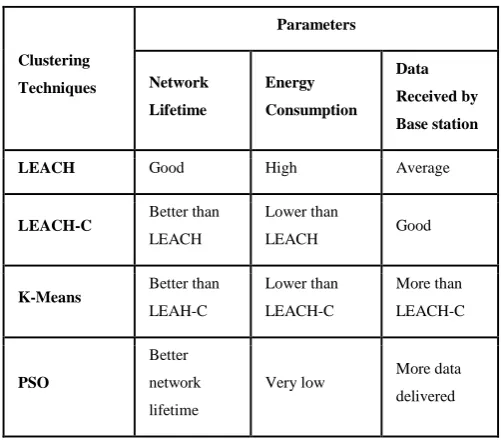
A comparative analysis of the LEACH, LEACH-C, K-Means and PSO is based on parameters like network lifetime, energy consumption of sensor nodes and delivery of data to the base station is shown in the table 1.The LEACH gives the less satisfieable network lifetime compared to the LEACH-C because the cluster head location is sometimes located nearer to the edge of the network while the LEACH-C gives the improved network lifetime as selection of the cluster head is performed in centralized manner by the base station. The K-means also gives the better network and less consumption of energy compared to the LEACH and LEACH-C. Where the PSO selects the location of cluster head in optimal way. So, it achieves all the parameters and gives the improved network lifetime and energy-efficient clustering in WSN.
Table 1. Comparison of cluster formation techniques
IV.CONCLUSION AND FUTURE SCOPE
There are various cluster formation techniques used in wireless sensor network. This Paper gives the overview of the several energy efficient cluster formation techniques like LEACH, LEACH-C, K-Means and PSO techniques. By means of comparative analysis based on parameters which shows that the PSO algorithms gives better network lifetime, less consumption of energy and more data delivered to the base station compared to the other techniques.The Performance of PSO search can suffer if the maximum velocity is inappropriately set, which can be improved in future.
Clustering
Techniques
Parameters
Network
Lifetime
Energy
Consumption
Data
Received by
Base station
LEACH Good High Average
LEACH-C Better than
LEACH
Lower than
LEACH Good
K-Means Better than
LEAH-C
Lower than
LEACH-C
More than
LEACH-C
PSO
Better
network
lifetime
REFERENCES
[1] Latiff, N. M., Charalampos C. Tsimenidis, and Bayan S. Sharif. "Energy-aware clustering for wireless sensor networks using particle swarm optimization." In Personal, Indoor and Mobile Radio Communications, 2007. PIMRC 2007. IEEE 18th International Symposium on, pp. 1-5. IEEE, 2007.
[2] Singh, Buddha, and D. K. Lobiyal. "Energy-aware cluster head selection using particle swarm optimization and analysis of packet retransmissions in WSN."Procedia Technology 4 (2012): 171-176.
[3] Latiff, NM Abdul, Charalampos C. Tsimenidis, and Bayan S. Sharif. "Performance comparison of optimization algorithms for clustering in wireless sensor networks." In Mobile Adhoc and Sensor Systems, 2007. MASS 2007. IEEE International Conference on, pp. 1-4. IEEE, 2007.
[4] Heinzelman, Wendi B., Anantha P. Chandrakasan, and Hari Balakrishnan. "An application-specific protocol architecture for wireless microsensor networks."Wireless Communications, IEEE Transactions on 1, no. 4 (2002): 660-670.
[5] Solaiman, B., and A. Sheta. "Energy optimization in wireless sensor networks using a hybrid k-means pso clustering algorithm." Turkish
Journal of Electric Engineering Computer Science, Accepted for publications (2015).
[6] Siew, Zhan Wei, Chen How Wong, Chia Seet Chin, Aroland Kiring, and Kenneth Tze Kin Teo."Cluster heads distribution of wireless sensor networks via adaptive Particle Swarm Optimization." In Computational Intelligence, Communication Systems and Networks (CICSyN), 2012
Fourth International Conference on, pp. 78-83. IEEE, 2012.
[7] Guru, S. M., S. K. Halgamuge, and S. Fernando. "Particle swarm optimisers for cluster formation in wireless sensor networks." In Intelligent
Sensors, Sensor Networks and Information Processing Conference, 2005. Proceedings of the 2005 International Conference on, pp. 319-324.
IEEE, 2005.
[8] Kulkarni, Raghavendra V., and Ganesh Kumar Venayagamoorthy. "Particle swarm optimization in wireless-sensor networks: A brief survey."
Systems, Man, and Cybernetics, Part C: Applications and Reviews, IEEE Transactions on 41, no. 2 (2011): 262-267.
[9] Kumar, Vinay, Sanjeev Jain, and Sudarshan Tiwari. "Energy efficient clustering algorithms in wireless sensor networks: A survey." IJCSI
International Journal of Computer Science Issues 8, no. 5 (2011).
![Fig. 2. LEACH operation [4]](https://thumb-us.123doks.com/thumbv2/123dok_us/1658501.1208030/2.595.186.427.194.327/fig-leach-operation.webp)
![Fig. 3. Flow of clustering in K-Means algorithm [5]](https://thumb-us.123doks.com/thumbv2/123dok_us/1658501.1208030/3.595.242.378.367.645/fig-flow-clustering-k-means-algorithm.webp)
![Design, Synthesis and Pharmacological Evaluation of Novel Annelated Pyrimido[2,1- c][1,2,4]triazolo[3,4-f ][1,2,4]Triazines as Antimicrobial Agents](data:image/gif;base64,R0lGODlhAQABAIAAAP///wAAACH5BAEAAAAALAAAAAABAAEAAAICRAEAOw==)