ABSTRACT
LI, JIAYIN. The Evaluation of a 2D Measuring Garment for Accuracy in a Size Range and Customer Acceptance. (Under the direction of Dr. Andre J. West and Dr. Cynthia L. Istook).
Body measurement plays an important role in the apparel industry. It is wildly used in apparel pattern making, sizing, and fitting for manufacturers. As for the consumer, they need body measurements to find the right size clothing. However, measuring their own body is not easy. The traditional one-dimensional manual measuring method takes a long time and has a low accuracy for people without training. The three-dimensional body scanning method is fast and relatively accurate, but the price and size of the body scanners are not suitable for daily home use. In this case, the two-dimensional image measuring system that can be used on a smartphone or smart pads is considered as a convenient and affordable way for human body measuring.
The purpose of this research is to develop a series of garments that can be used as a measuring apparatus in a developed 2D image body measuring system. Base on the basic
requirements of the 2D image body measuring system, a series of measuring garments, including three designs and five sizes, were developed for evaluation. To evaluate these developed
Four representative measurements as bust girth, waist girth, hip girth, and inseam length were selected to be compared between 3D vs. 3D, 2D vs. 2D, and 2D vs. 3D measurements. The 3D vs. 3D group compared extracted 3D body measurements among different fit of measuring garments on the same subject to evaluate the impact of garment fit. The paired t-test result suggested that the fit of measuring apparatuses has a statistically significant impact on body measurements but was acceptable in the apparel industry.
To extract the 2D measurements, the prediction models of these measurements were developed using the 2D images. Scikit-image, OpenCV-python, Scikit-learn, and TensorFlow application programming interface were referred. The least absolute shrinkage and selection operator (LASSO) method and Akaike information criterion (AIC) were used for model selection to narrow down the variable amount. The result of 2D vs. 3D measurements approved that
having both arms above head would be an acceptable pose for better 2D image body outline detection. The 2D vs. 2D group compared the prediction measurements among the three different designs. The result suggested that the design does not have a significant impact on prediction measurements.
As for the consumer acceptance level, the participants were mostly college students, and they were interested in using these measuring apparatuses for body measuring. The feedback from these participants also showed that the measuring garments have some potential to be gym suits for future product development.
Overall, this research has successfully developed a series of garments that work with the developed 2D image measuring system as a measuring apparatus. Representative body
The Evaluation of a 2D Measuring Garment for Accuracy in a Size Range and Customer Acceptance
by Jiayin Li
A dissertation submitted to the Graduate Faculty of North Carolina State University
in partial fulfillment of the requirements for the degree of
Doctor of Philosophy
Textile Technology Management
Raleigh, North Carolina 2020
APPROVED BY:
_______________________________ _______________________________ Andre J. West Cynthia L. Istook
Committee Co-Chair Committee Co-Chair
ii
DEDICATION
iii
BIOGRAPHY
iv
ACKNOWLEDGMENTS
First I would like to say thanks to my committee co-chair, Dr. Andre West and Dr. Istook for providing guidance and feedback throughout this research. Thank you for your patients and encouragement. I would also like to thank my other committee members, Dr. David Bruner, for providing supports on 3D body scanning and data extraction. And Dr. Michael Roe, for serving my committee and provide support to this research.
I would like to especially thank Dr. Sibei Xia, who has helped me so much throughout this research for helping me with data extraction and providing feedback. I cannot imagine finishing this research without your help. I would also like to express my appreciation to Mr. Pavel Litvinov from Miami Sublimation for printing the fabric of the apparatus and Hanes for sponsoring the T-shirts.
v
TABLE OF CONTENTS
LIST OF TABLES ... viii
LIST OF FIGURES ... ix
LIST OF EQUATIONS ... xiii
CHAPTER 1. INTRODUCTION ... 1
1.1. Purpose of Research ... 3
1.2. Rationale of Research ... 4
1.3. Research Questions ... 5
CHAPTER 2. LITERATURE REVIEW ... 6
2.1. Women Activewear Trends and Drivers ... 6
2.1.1. History of Women Sportswear in the U.S. ... 6
2.1.1.1. Victorian period (1840-1900). ... 6
2.1.1.2. The 1900s to the Second World War (1939). ... 10
2.1.1.3. Second World War and beyond (1939 -1960s). ... 13
2.1.1.4. 1960s-now. ... 14
2.1.2. Sportswear Design and Fashion. ... 17
2.1.3. Sportswear Market Dynamics. ... 18
2.1.4. Consumer Decision Making in Sportswear Purchasing... 19
2.2. Human Body Measurements ... 21
2.2.1. Application of Anthropometry in the Apparel Industry. ... 21
2.2.1.1. Apparel design and pattern making. ... 21
2.2.1.2. Sizing system development... 22
2.2.1.3. Mass customization. ... 23
2.2.1.4. 3D model recreation and virtualization. ... 24
2.2.1.5. Other uses... 26
2.2.2. Primary and Secondary Body Measurements. ... 26
2.2.3. Anthropometric Methods. ... 33
2.2.3.1. Hand measure (1D method). ... 33
2.2.3.2. 3D body scanning. ... 35
2.2.3.2.1. 3D laser scanning. ... 36
2.2.3.2.2. Projection of white light patterns. ... 36
vi
2.2.3.2.4. Depth sensor... 38
2.2.3.2.5. Other input devices. ... 38
2.2.3.3. Standard and measurement extraction for 3D scanning. ... 39
2.2.3.3. Concerns of 3D body scanning. ... 42
2.2.3.4. Measure through 2D images. ... 43
2.2.3.4.1. Measuring apparatus. ... 44
2.2.3.4.2. Current 2D measuring products in the market. ... 46
CHAPTER 3. METHODOLOGY ... 49
3.1. Step One: Prototype Design ... 54
3.2. Step Two: Data Collection and Measurements Extraction ... 55
3.3. Step Three: Data Analysis ... 58
CHAPTER 4. RESULTS AND DISCUSSION ... 60
4.1. Results and Discussions on Stage One ... 60
4.1.1. Generation 1 and 2 of Measuring Garment Prototype. ... 60
4.1.2. Final Prototype Design. ... 63
4.2. Data Collection and Measurements Extraction... 67
4.2.1. Data Collection. ... 67
4.2.2. 3D Measurements Extraction. ... 68
4.2.3. 2D Measurements Extraction ... 71
4.3. Data Analysis ... 75
4.3.1. 1D Data. ... 75
4.3.1.1. Demographic data. ... 75
4.3.1.2. Lifestyle and activewear shopping preference. ... 77
4.3.2. Evaluation of Measuring Garments Prototypes ... 82
4.3.3. 3D Body scanning data. ... 87
4.3.3.1. 3D vs. 3D: Compare measurements extracted from a different fit. ... 87
4.3.4. 3D Vs. 2D: Compare 2D Measurements with 3D. ... 88
4.3.5. 2D vs. 2D: Comparison of Measurements Extracted from Different Designs. ... 90
4.3.5.1. Bust girth prediction. ... 92
4.3.5.2. Waist girth prediction. ... 95
4.3.5.3. Hip girth prediction. ... 99
vii
CHAPTER 5. CONCLUSIONS AND FUTURE STUDIES ... 107
5.1 Conclusions ... 107
5.1.1. Research Question 1. ... 110
5.1.2. Research Question 2. ... 110
5.1.3. Research Question 3. ... 111
5.1.4. Research Question 4. ... 111
5.2. Limitations and Further Studies ... 112
REFERENCES ... 113
APPENDICES ... 119
Appendix A. IRB Approval ... 120
Appendix B. Online Survey ... 129
Appendix C. Histograms Q-Q plots of Difference between 2D and 3D Measurements ... 133
viii
LIST OF TABLES
Table 1. ISO and ASTM standards on body measuring technique ... 27
Table 2. Primary and Secondary measurements based on ISO 8559 and ASTM 5219 (ISO, 2017c; ASTM, 2015) ... 29
Table 3. ISO 7250-1 measurements by a 3D whole body scanner (ISO, 2018) ...41
Table 4. Definitions of selected representative measurements (ASTM International, 2015; ISO, 2017b;) ...60
Table 5. Final prototype sizes and corresponding standard body measurements from ASTM D5585-11e1, size 0-18 (ASTM, 2012) ... 67
Table 6. Methods of finding a waist level in a computer program. (Xia, 2018) ... 69
Table 7. Comments on design 1 ... 85
Table 8. Comments on design 2 ... 85
Table 9. Comments on design 3 ... 86
Table 10. Comments about the fit of the apparatus ... 86
Table 11. Results of the paired t-tests (smaller size vs. best-fitting size) ... 88
Table 12. Results of the paired t-tests (larger size vs. best fitting size).. ... 88
ix
LIST OF FIGURES
Figure 1. Victorian period attire for women (victorian-era.org, 2014) ...7
Figure 2. The corsetry during the Victorian period in 1831 (Tortora, & Eubank, 2015, p332). ...7
Figure 3. Dio Lewis’s gymnastic dress in 1862 (Lewis, 1862). ...9
Figure 4. Basketball gym suits from Smith College in 1895 (Warner, 2006). ...9
Figure 5. Bicycling Outfits in 1894. (The Delineator, 1894)...10
Figure 6. The first female Olympic champion Charlotte Cooper (BBC, 2017). ...11
Figure 7. The washable cotton romper suit from the 1930s (Warner, 2006). ...12
Figure 8. Bathing suit in 1871 (Peterson’s Magazine, 1882). ...13
Figure 9. Examples of sportswear outline. (a) tight type, (b) H type, (c) Y type, (d) X type. ...17
Figure 10. Projected sales of sportswear market in the United States from 2015 to 2020 (in billion U.S. dollars) (Statista, 2018). ...19
Figure 11. Customize 3D Avatar on My Virtual Model (myvirtualmodel.com, 2018). ...25
Figure 12. 3D virtual fitting application example (marvelousdesigner.com, 2018). ...26
Figure 13. Traditional instruments. (a) Anthropometer, (b) large sliding caliper, (c) sliding caliper, (d) spreading caliper, (e) tape measure (Kouchi, 2014). ...34
Figure 14. Example of a laser-based scanner (Daanen, & Ter Haar, 2013). ...36
Figure 15. (a): projection of light pattern as stripes. (b): scanning device. (c): a projected sequence of binary-coded stripes pattern (D'Apuzzo, 2007). ...37
Figure 16. Recommended standing and sitting positions for 3D body scanning (ISO, 2018). ...40
Figure 17. The stretch bodysuit developed for preparing custom-fitted clothing (US 2002/0166254 Al, 2002). ...45
Figure 18. The elastic measuring suit from elasizer (elasizer, 2017). ...45
Figure 19. The self-measuring garment using circuits (Likeaglove, 2015). ...45
x
Figure 21. Selfie mode photo instruction from 3DLOOK (3DLook.me, 2018). ...48
Figure 22. 1D, 2D, and 3D data content. ...51
Figure 23. Schematic of the developed body measuring system (Xia, 2018)...52
Figure 24. Summary of methodology. ...53
Figure 25. Example of 3 poses for 2D image data collection. (a) front view, (b) side view with arms down, (c) side view with arms above head. ...57
Figure 26. Measurement locations marked with colored bands. ...61
Figure 27. The first generation (a) and second-generation (b) of the measuring garment prototypes. ...62
Figure 28. Sleeve and legging design improvement (a) sleeve with new thumbhole design, (b) legging with new foot strap design. ...64
Figure 29. Examples of popular activewear color and pattern designs in current market. (a,b) leggings from Adidas, (c) leggings from Nike, (d,e) leggings from Fabletics. (Adidas.com, 2019; Nike.com, 2019; Fabletics, 2019) ...65
Figure 30. Three different textile patterns used in the final prototype design. (a) simple color blocks, (b) geometric-style pattern, (c) irregular abstract pattern. ...66
Figure 31. Technical drawing and real product of the final prototypes. ...66
Figure 32. Results of the best method of finding a waist level. (Xia, 2018) ...69
Figure 33. Representative measurement locations in the Size Stream Studio program. ...70
Figure 34. Examples of training images marked with Mask R-CNN for apparatus detection. (a) Method 1 only torso part marked, (b) method 2 torso and legs marked. ...73
Figure 35. Examples of resulting images marked for apparatus detection. (a) Method 1 only torso part marked, (b) method 2 torso and legs marked. ...74
Figure 36. Age distribution of the collected data. ...76
Figure 37. The Ethnicity of the collected data. ...76
Figure 38. Height distribution of the collected data. ...76
xi
Figure 40. Exercise frequency of participants. ...78
Figure 41. Popular exercise types among participants. ...78
Figure 42. Frequency of purchasing activewear. ...79
Figure 43. The popularity of activewear brands in the market. ...79
Figure 44. Activewear application. ...80
Figure 45. Elements that matter when making activewear purchasing decisions. ...80
Figure 46. The acceptable price range for an activewear top. ...81
Figure 47. The acceptable price range for an activewear bottom. ...81
Figure 48. General evaluation of 3 designs. ...82
Figure 49. How likely participants would be to use the apparatus for body measuring. ...83
Figure 50. How likely participants would wear the designs in the gym. ...83
Figure 51. How likely participants would wear the measuring garments as casualwear. ...84
Figure 52. Bust girth model prediction results of design 1. (a). Prediction results in the arms-down pose. (b). Predicted results in the arms-up pose...93
Figure 53. Bust girth model prediction results of design 2. (a). Prediction results in the arms-down pose. (b). Predicted results in the arms-up pose...94
Figure 54. Bust girth model prediction results of design 3. (a). Prediction results in the arms-down pose. (b). Predicted results in the arms-up pose...95
Figure 55. Waist girth model prediction results of design 1. (a). Prediction results in the arms-down pose. (b). Predicted results in the arms-up pose...96
Figure 56. Waist girth model prediction results of design 2. (a). Prediction results in the arms-down pose. (b). Predicted results in the arms-up pose...98
Figure 57. Waist girth model prediction results of design 3. (a). Prediction results in the arms-down pose. (b). Predicted results in the arms-up pose...99
xii Figure 59. Hip girth model prediction results of design 2. (a). Prediction results in the
arms-down pose. (b). Predicted results in the arms-up pose...101 Figure 60. Hip girth model prediction results of design 3. (a). Prediction results in the
arms-down pose. (b). Predicted results in the arms-up pose...103 Figure 61. Inseam length model prediction results of design 1. (a). Prediction results in the
arms-down pose. (b). Predicted results in the arms-up pose...104 Figure 62. Inseam length model prediction results of design 2. (a). Prediction results in the
arms-down pose. (b). Predicted results in the arms-up pose...105 Figure 63. Inseam length model prediction results of design 3. (a). Prediction results in the
xiii
LIST OF EQUATIONS
Equation (1) ...71
Equation (2) ... 71
Equation (3) ... 91
Equation (4) ... 92
Equation (5) ... 92
Equation (6) ... 93
Equation (7) ... 94
Equation (8) ... 94
Equation (9) ... 95
Equation (10) ... 96
Equation (11) ... 96
Equation (12) ... 97
Equation (13) ... 97
Equation (14) ... 98
Equation (15) ... 99
Equation (16) ... 99
Equation (17) ... 100
Equation (18) ... 101
Equation (19) ... 101
Equation (20) ... 102
Equation (21) ... 102
xiv
Equation (23) ... 104
Equation (24) ... 104
Equation (25) ... 105
Equation (26) ... 106
1
CHAPTER 1. INTRODUCTION
Clothing is a life necessity for human beings; it protects the human body, identifies job occupation, and represents the personal character. Sportswear, one of the most significant categories in the apparel industry, was first developed only for sports training and competition but has now become very common in daily life. In the past century, activewear has experienced revolutionary development, especially among women. From the cumbersome and inconvenient dresses to simple, lightweight sports bras and shorts, the development of women’s activewear reflects not only the changes among aesthetic and material technology but also the changes of female social status and the rise of women’s rights.
In modern society, sportswear has been widely accepted for casual/everyday use instead of limited to gyms and playgrounds (NPD Group, 2014; Rugolo, 2013). This change in consumer lifestyle has dramatically influenced the apparel market. Activewear has become a staple
primarily for the U.S. apparel market over the past ten years, and women’s spending has dramatically contributed to the sales growth of the sportswear market (NPD Group, 2013; O’Sullivan, Hanlon, Spaaij, & Westerbeek, 2017). Meanwhile, e-commerce has proliferated since the beginning of the 21st century, and the online sales of sporting goods have reached 13.4 billion U.S. dollars, up from 9.3 billion U.S. dollars in 2014 (Statista, 2018).
2 years, online sales of apparel, footwear, and accessories are predicted to continue to grow more than $40 billion, compounding the problem exponentially (Statista, 2018).
Combinations of strategic body measurements determine the size of clothing. Most consumers do not know their body measurements when attempting to determine the size of a garment they want to purchase when shopping online. Also, customers have significant difficulty in attempting to take their measurements. Many customers even buy a style in two sizes and return one adding to cost and waste. In 2015, $62.4 billion of returns were caused simply due to the wrong-size problem, occupying 0.5% of total sales (IHL Group, 2015). To cut costs and alleviate the headaches and frustrations of online shopping, a convenient, cost-efficient, and accurate body measuring tool is urgently needed for both consumers and apparel companies.
It is necessary to understand what to measure and how to measure the human body before developing this body measuring tool. Human body measurements are widely used in the apparel industry for designing, pattern making, sizing, grading, mass customization, 3D model
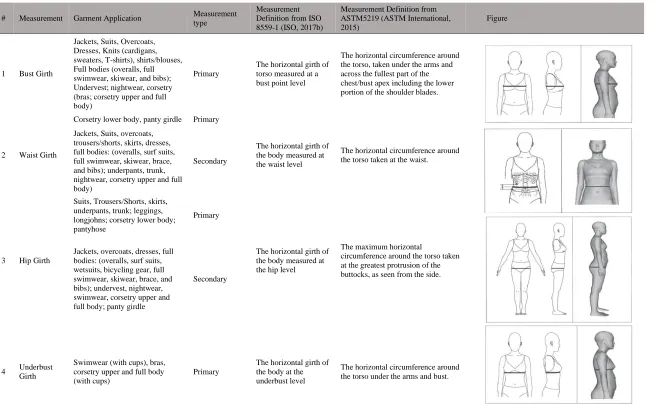
recreation, and virtualization (Gupta, 2014; Lu, Wang, Chen, & Wu, 2010; Schofield & LaBat, 2005;). For apparel design and sizing system development, the most important human body measurements are summarized as primary and secondary measurements and listed in global and national standards (ASTM International, 2015; ISO, 2017c).
There are several different ways to collect human body measurement data. The most traditional method is manual measuring with a weight scale, camera, measuring tape,
3 Three-dimensional body scanning technology has promoted the development of 3D modeling and virtualization technology, which primarily benefit designers and manufacturers. Compared to the traditional manual measuring method, the measurement collected by 3D body scanning is more accurate and takes much less time. However, the cost of 3D whole-body scanners is usually too expensive for consumers to afford for daily use, which limited the use of 3D body scanning in academic research and industry only (Xia, Guo, & Li, 2018).
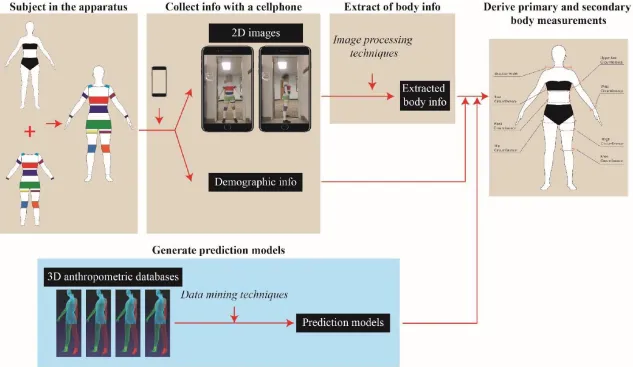
A 2D image body measuring method, in this case, is considered as a potential solution for low-cost and reliable human body measuring method. This human body measuring method uses 2D images collected by a standard camera or smartphone to rebuild the 3D model based on the silhouette information. To reduce the influencing factors and protect privacy for users, measuring garments are required for the 2D body measuring method (Grogan et al., 2017; Seo et al., 2006). With a potential market calling for a reliable and low-cost solution for human body measuring, it would be a valuable asset to develop an aesthetically acceptable measuring garment and 2D body measuring system for consumers to use in their daily life.
1.1. Purpose of Research
4 most popular categories in the apparel industry, was considered to be an appropriate option for this measuring apparatus as it tends to be a close fit and stretchy enough to fit more than one size. The measuring garments need to be aesthetically acceptable for consumers to wear and help locate the measuring area for body measurement collection. Primary and secondary
measurements for most apparel categories, including gloves, hats, and socks, could be covered in the design. The color palette of the garment needs to be identifiable compared to the daily
background environment for this method to work as the garment has to be an easily identifiable separate image.
1.2. Rationale of Research
The 2D image human body measurement system is a growing trend for home use body measuring methods. This could mostly benefit consumers and apparel retailers by helping conduct body measurements efficiently and accurately. Accurate body measurements could result in a lower return rate for online shopping. The 2D image measuring system used in this research has been tested and approved to be efficient and cost-effective for female body
5
1.3. Research Questions
To guide the study, the following questions were developed to evaluate the measuring garment from accuracy and consumer acceptance level.
RQ1: Does the design and fit of the measuring garment affect the accuracy of measurements obtained from the 2D images of the human body?
1a. How does the design impact measuring results?
1a1. What kinds of patterns, colors, and styles can be used to obtain accurate measurements?
1a2. What are the appropriate color-design locations and sizes for landmarks on the human body?
1b. How does fit affect measurement results? 1c What kind of accuracy can be achieved?
RQ2: Does the arm position impact the accuracy of measurements obtained from the 2D images of the human body?
RQ3: Does the fashion element of the measuring garment impact the attitude of the consumer to purchase the garments using the measuring app?
3a. Does the design relate to the consumer expectation for activewear? 3a1: What are their expectations?
3a2: Do they have any preferences on the fit or design?
6
CHAPTER 2. LITERATURE REVIEW
The measuring garment development focused on two main features: consumer acceptance and measurement accuracy. To achieve this goal, it is important to find an existing apparel category to fit this new product so it can be easily accepted by consumers. In this research, activewear was selected as the design style for the measuring garments based on concerns of two levels: function level and market level. In this chapter, the history, function, and market analysis of female activewear were reviewed for further product design. On the other hand, human body measuring methods were also reviewed to define and locate the most important measurements.
2.1. Women Activewear Trends and Drivers
2.1.1. History of Women Sportswear in the U.S.
In the past, the definition of activewear was narrowly limited as clothing for sports or exercise. This definition has now been broadened as transition clothing from leisure to casual wear or even evening wear (O’Sullivan, Hanlon, Spaaij, & Westerbeek, 2017). From university gyms to the streets, women’s activewear has undergone a long and complicated process of evolution, together with the awakening of female consciousness and the rise of feminism.
The evolution of women’s activewear can be divided into four different stages: before the 1890s, 1890s to Second World War (1945), Second World War (1945) to the 1960s and 1960s until today.
7 covered the whole bodice part from the bust to the lower hip, emphasized the curve of the waist (Banner, 1983). Figure 1. shows a representative image of women in the Victorian period (Victorian-era.org, 2014), and Figure 2. shows the image of women wearing corsetry in 1831(Tortora, & Eubank,2015).
Figure 1. Victorian period attire for women (victorian-era.org, 2014)
8 Under such morbid aesthetic, it would have been unlikely for women to participate in sports because the tight corsetry may have caused palpitations and swooning. The image of “true womanhood” also prohibited women from being seen under emotional excitement (Gerber, 1974; Kemper, 1977).
In the second half of the nineteenth century, the rise of women’s colleges brought more possibilities to women. These colleges bravely mixed traditional and experimental activities and offered women an education that comparable to their brothers. Entirely new educational
environments encouraged the growth of women and brought evolutionary thoughts into their lives (Warner, 2006). These schools for women helped to increase the acceptance of higher education in women, including physical education. Elizabeth Blackwell, the first American woman, trained as a doctor, was an early advocate of the idea that men and women have equally balanced bodies, minds, hearts, and souls. She published several articles arguing the necessity of physical education and exercises among women (National Library of Medicine, 2000). In the 1860s, calisthenics was promoted by the famous physical advocate Dio Lewis in the U.S, and it became a popular form of female physical education. Figure 3. shows the image of a gymnastic dress developed by Dio Lewis in 1862 for female calisthenics (Lewis, 1862).
In the early 1880s, Senda Berenson from Smith College designed an indoor women’s basketball game based on existing men’s game. This new game was more interesting than calisthenics and attracted more women to participate in sports. In order to adapt more
9 Figure 3. Dio Lewis’s gymnastic dress in 1862 (Lewis, 1862).
10 Bicycling was another favorite sport for American people in the 1890s. It quickly
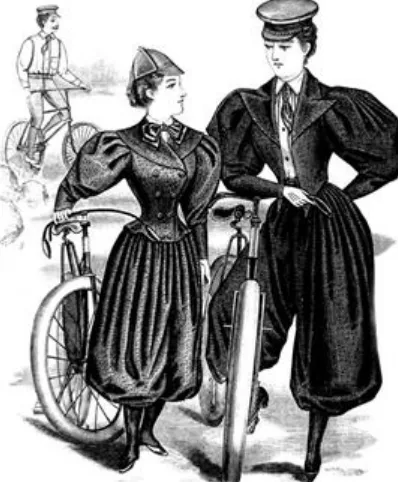
eclipsed horseback riding. This activity became popular because it was considered a cheap and convenient means of transportation as well as exercise. The popularity of bicycling has also influenced the clothing women wear to go outdoors. The combination of long skirts and bicycle spokes were found inconvenient for safe riding, so women started to wear bloomers under skirts or to wear bloomer style bicycling outfits instead of skirts (Warner, 2006). Figure 5. shows the image of two ladies wearing bicycling outfits in 1894. This was an early attempt of women wearing trousers in the history of female activewear development.
Figure 5. Bicycling Outfits in 1894. (The Delineator, 1894).
2.1.1.2. The 1900s to the Second World War (1939). During the period from 1900 to
11 evolution of women sportswear. The first breakthrough is that women started to participate in competitive sports in the Olympic games.
The first modern Olympic Games were held in Athens, Greece, in 1896. Over three hundred male athletes participated in this event. The second Olympic Games held in 1900 was the first time that women were allowed to participate. Among all athletes, only 2% of them were women, and they were not accorded any uniform or other possible recognition by the Olympic Committee (Welch & Costa, 1994). Female athletes were allowed to compete in only a few events, including tennis, golf, and archery. British tennis player Charlotte Cooper was the first female Olympic champion. As shown in Figure 6., she was wearing a stiff high collar shirt and a skirt that closely fitted on the hip and waist. Compared to male athletes wearing tank tops and above-knee shorts, her image was still limited by the elegant and pretty “womanhood” (BBC, 2017).
12 The second breakthrough is the uncovering of a women’s body. In the United States, before the mid-1920s, women were never seen swimming or bathing in public with their legs exposed. In many cities, the indecent exposure was considered a crime and may risk arrest. Stockings, in this case, were required for women who come to the public beach (Warner, 2006).
The reveal of women’s bodies stemmed from physical education in women’s colleges. Thus, the gym suit applied in physical education was the starting point for the female modern sportswear evolution. It allowed more freedom than outdoor sportswear because it was meant to be private clothing that should never be seen in public (Warner, 2006). By the 1920s, a new form of gym suit was needed to adapt to more competitive sports. As shown in Figure 7, a set of team uniforms, including a shirt and shorts, appeared in Rockford College in 1929, and it became popular in many schools in the 1930s.
Figure 7. The washable cotton romper suit from the 1930s (Warner, 2006).
13 bloomers, stockings, and a skirt. Figure 8 shows the image of a bathing dress in 1871. Male swimsuits, in the meantime, were much more straightforward. Men wore a one-piece knitted garment with or without sleeves, and the shorts stopped above their knee. This close fit style was accepted among English women but was considered shocking in the United States (Alison,1963).
The development of motor cars also helped promote the evolution of swimwear. The introduction of Henry Ford’s motor vehicle model T in 1908 made it easier for people to access public beaches and encouraged people to uncover under the sunshine. People outside the
competitive sports gradually became accustomed to bared arms, legs, and backs. The popularity of movies also helped audiences accept swimsuits in newer, barer, and more daring styles (Godey’s, 1864).
Figure 8. Bathing suit in 1871 (Peterson’s Magazine, 1882).
2.1.1.3. Second World War and beyond (1939 -1960s). During the war and post-war
14 apparel industry. The production capability of the apparel industry had significantly been honed during the war, allowing a much more full range of production activities and expanding women’s clothing options (Women’s Wear Daily, 1957). Many new synthetic blends were invented and improved during the war, which required less care than natural fiber made fabrics. Rayon was applied in many more categories of garments, and the color ranges were considerably broadened due to new design formulas (Women's Wear Daily, 1948).
At the social level, the booming middle class had optimistic expectations of their lives and were presenting a new positive attitude. Americans started moving to the newly developed suburbs to enjoy their family life instead of the hustle urban nightlife (Skorich,1997). From the year 1947 to 1953, over 1,200,000 Americans moved from cities to suburbs annually
(Seldin,1976). Moving to the suburbs helped the middle class shape a new set of values and a new pattern in the American lifestyle. More and more people spent their spare time in outdoor travels and sports, which help raise the acceptance of sportswear (Richard, 1985). Sportswear was no longer limited to specific sports but accepted as an association with sports. Unlike high fashion dresses, sportswear presented a healthy and casual lifestyle. With very few significant social class elements, sportswear became the uniform of the American middle class (Skorich, 1997).
2.1.1.4. 1960s-now. Although gym suits persevered in the early 1960s in some parts of the United States, it finally naturally disappeared. The extinction of these gym suits was very likely because of the vanish of female athletics in college and high school. T-shirts and non-regulation shorts have taken over (Warner, 2006).
15 discrimination based on sex in education programs or activities that receive Federal financial assistance. Title IX states that:
“No person in the United States shall, on the basis of sex,” be excluded from participation in, be denied the benefits of, or be subjected to discrimination under any education program or activity receiving Federal financial assistance” (ed.gov, 2019).
From 1972 to 1978, female athletic participation rates have highly increased in high school to comply with Title IX. In 2010, Stevenson and Betsey compared the outcomes in changes between pre- and post-cohorts across states. The result of their analysis reveals that at the state level, female sports participation raised by 10 percent, and female force participation raised by 1 to 2 percent. Thanks to Title IX, females had more opportunities to participate in athletic activities.
After decades of this development, sportswear has now been widely accepted as part of casual wear in American people’s lives, the idea of “activewear” has been expended as a combination of outdoor wear, performance wear, and sports-inspired wear (Shishoo, 2015). A survey in 1982 showed that around 60% of Americans wore running shoes and sweatsuits as their casual wear (Schwartz, 1986). The limitation from social classes and genders had been reduced while more attention had been put on the aesthetics and functions in the subsequent development of sportswear. Consumers are now expecting more possibilities for activewear beyond its original purposes as a combination of multifunctionality and fashion.
16 Olympics. The uniform of the Italian national football team designed by Dolce Gabbana and the British uniforms designed by Giorgio Armani showed the influence of fashion in activewear (Cao & Wang, 2017).
17 wearable fitness trackers have also been introduced to activewear products. Consumers are now expecting more possibilities for activewear beyond its original purposes.
2.1.2. Sportswear Design and Fashion
The outline design of sportswear can be divided into five kinds of structures: tight type, H type, Y type, and X type. Tight type sportswear includes swimwear, gym suits, and other close fit styles. This type of sportswear could help minimize the resistance during exercise and emphasize the beauty of body curves. H type stands for loose fit sportswear such as basketball vests, tennis T-shirts, and shorts. The simple design and relatively loose fit could provide adequate space for physical activities. Y types extend the shoulder outline to protect human bodies from collisions. The typical Y type sportswear includes football and hockey clothing. X type sportswear is relatively rare, mainly used for figure skating and some other sports clothing (Jiang et al., 2008). Figure 9 showed some examples of these sportswear outlines.
Figure 9. Examples of sportswear outline. (a) tight type, (b) H type, (c) Y type, (d) X type.
18 activities that require strong explosive power like weightlifting and sprints, sportswear is
typically designed in bright and light colors with a sharp contrast to make athletes feel excited and motivated. For activities like shooting and archery that require a calm psychological quality and a steady mindset, sportswear is usually cool colors like blue and white for steady
performance. The combination of personalized and eye-catching color selection is also critical in tough conflict situations like boxing or wrestling (Bo, 2017; Li, 1999).
2.1.3. Sportswear Market Dynamics
19 Figure 10. Projected sales of sportswear market in the United States from 2015 to 2020 (in
billion U.S. dollars) (Statista, 2018).
In these reports, it is suggested that females were the main contributors to the activewear sales growth. In the year 2012 to 2013, the U.S. women made up the 5% sales growth on August year-to-date figures (NPD Group, 2013). In 2014, the dollar sales of activewear among the U.S. female consumer increased by 8% compared to 2013. Sales among Sports bras, leggings, and sports jerseys also grew in line with the raised health and fitness consciousness and demand for comfort and versatility (NPD Group, 2014). In 2017, although the growth was not as steep as the growth in the past few years, women’s activewear sales still increased by about 4% compared to 2016, reaching $21.9 billion in sales (NPD Group, 2018). It is evident that in the U.S. activewear sales, the female consumer plays a significant role.
2.1.4. Consumer Decision Making in Sportswear Purchasing
20 services are the main factors influencing their decision making on sportswear purchases
(O’Sullivan, Hanlon, Spaaij, & Westerbeek, 2017).
A series of research conducted by Rahulan, Troynikov, Watson, Janta, and Senner in 2013 and 2015 compared sportswear consumption between the generations Y and Baby Boomer and found that the baby boomer generation pays more attention to the quality and size range of sportswear products and prefer to go to physical sports stores to try the garments on for fit. Female consumers in the age range of baby boomers have a relatively stable income, so the price becomes less important for them while making a purchase decision.
As for Generation Y consumers, they look more into the comfort, style, and sports performance of the garment, and the price is a big factor for them while making purchase decisions. They also prefer shopping online much more than baby boomer consumers. Another big difference between consumers in these two age ranges is that baby boomers take less time reading the product details while generation Y consumers are tech-savvy and knowledge-hungry, they are usually more interested to know the details about the product. We could assume from this that generation Y consumers are more functional driven and style sensitive, they are willing to learn and experience advanced technologies when a new product comes to the market.
21
2.2. Human Body Measurements
2.2.1. Application of Anthropometry in the Apparel Industry
Anthropometry, a branch of ergonomics, is defined as the study of human physical measurements and dimensions. Anthropometry focuses on analyzing the shape and size of
human bodies and apply the result into product design to meet consumer demands (Gupta, 2014). In the apparel industry, anthropometry is applied in apparel design, pattern making, sizing, grading, mass customization, 3D model recreation, and virtualization (Gupta, 2014; Schofield & LaBat, 2005; Lu, Wang, Chen, & Wu, 2010).
2.2.1.1. Apparel design and pattern making. Clothing is a life necessity for human beings. It forms a close shell around the human body and creates an intimate environment with the body. Clothes move and interact with the human body every day and carry the responsibility for providing comfort and protection (Gupta, 2014).
Several factors influence the pleasantness of clothing, and the fit of clothing is arguably the most important. The fit of clothing may affect the comfort and performance of the user, and it could lead to discomfort or even harm under extreme conditions. For example, the Occupational Safety and Health Administration (OSHA) has issued safety guidelines to control the fitness of modern clothing and avoid accidents caused by loose-fitting clothing (OSHA, 1992). A research made by Anders et al. in 2005 has shown that wearing overly tight pants can result in hip
22 2013). Therefore, it is essential to design apparel products using anthropometric data to find a good fit and eliminate hidden dangers.
Designers and pattern makers use anthropometric data for pattern drafting to develop basic patterns. The cardinal points on the patterns are matched to the body landmarks to extract the pattern based on body measurements. Landmarks are considered as the endpoints of
measurements on the body (Schofield & LaBat, 2005; Tylor & Shoben, 1993). The effectiveness of anthropometric data collection and translation influences the quality of the drafted pattern. The evaluation of consumer fit preference is also required to match the market demands (Gill, 2015; Gupta, 2014).
In the 21st century, designers are looking for more efficient drafting methods. Research by Jin Kang & Min Kim focused on directly using CAD design software to generate body model and draft patterns from three-dimensional measurements collected by three-dimensional body scanners. A body model was first generated using the three-dimensional anthropometric data and later transformed into a dummy model in a convex shape. Next, a typical garment model is created by measuring the dummy model surface using stereoscopy. Finally, the optimum fit garment patterns are obtained by adjusting the garment model shape, considering the geometrical constraints the underlying body model (Jin Kang & Min Kim, 2000).
2.2.1.2. Sizing system development. Sizing and grading were one of the earliest
commercial applications of anthropometry in the apparel industry (Gupta, 2014). Sizing refers to the process of setting up a size chart based on primary body measurements for a range of
23 produce garments in a range of sizes in the apparel industry; it is a standard method of changing the pattern size by applying increases or decreases at certain points. The sizing specifications are derived from anthropometric surveys, and the grading systems are developed based on the sizing specifications (Moore, Mullet, & Young, 2001; Schofield & LaBat, 2005).
Large scale anthropometric surveys have been conducted to collect a large number of human body measurements to provide the basis for research and facilitate creating the sizing system for mass production apparel products and equipment for military personnel (Gupta, 2014). The anthropometric data are statistically analyzed to export the standard body measurements (SBM) size charts of the target population. To develop an acceptable and satisfying sizing system, it requires a good understanding of the target population and variation of body dimensions and accurate body dimensions taken from the scientific anthropometric survey.
2.2.1.3. Mass customization. Although the development of sizing system and grading
24 Other consumers also complain that their perception of fit cannot be addressed and face
confusion brought by the size differences between different brands (Bickle, Burnsed, &
Edwards, 2015; Murray, 2016;). Therefore, mass customization could become an ideal solution to satisfy consumer demands.
Mass customization is a marketing and manufacturing technique that creates variety and customization through flexibility and quick response to the “voice of the consumer” (Little & Senanayake, 2010). Mass customization (MC) is characterized as a highly information sensitive way to maximize differentiation under a relatively low-cost level (Pine & Davis, 1993; Yeung & Ho-Ting, 2010). The process of apparel mass customization can be defined in five steps: collect anthropometric data, select fabric, and style, generate clothing patterns, cut the fabric,
manufacture and conduct final adjustment (Lu, Wang, Chen, & Wu, 2010). Compared to traditional mass production, mass customization has advantages in innovative design and consumer-centric fit, which allow it to achieve a higher individual consumer satisfaction (Yang, Kincade, & Chen-Yu, 2015).
2.2.1.4. 3D model recreation and virtualization. Online shopping has been a growing
25 The virtualization technologies help deliver product information that is close enough to real products. During the past few years, research has been focused on 3D model recreation, clothing fit evaluation, and fabric model performance improvement (Cichocka, Bruniaux, & Frydrych, 2014; Kim & Forsythe, 2008; Zhang, Lin, Pan, & Xiang, 2015). Three-dimensional body scanning technology has provided significant help for the anthropometric data collection and 3D model recreation using a set of point-cloud data.
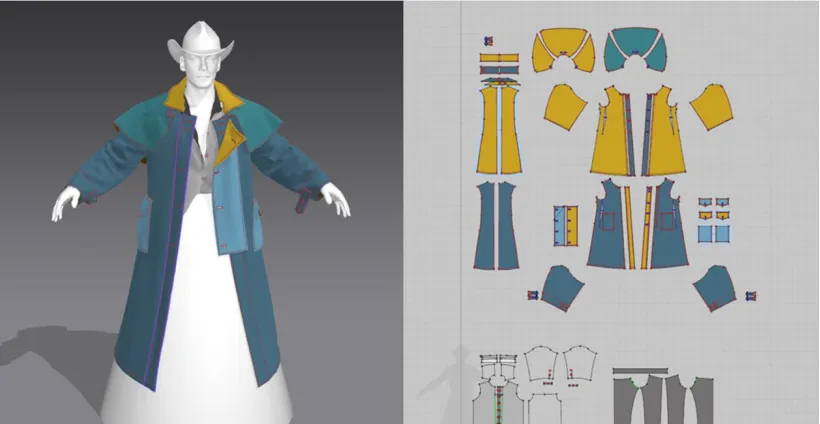
Some commercial virtualization applications are now open to the market to allow consumers to predict garment fit. My Virtual Model website is one example, consumers can customize the body shape and some basic facial features to create a 3D avatar to get a preview of how they will look like wearing the garments (myvirtualmodel.com, 2018). Figure 11 shows the customized 3D avatar options on My Virtual Model website. Other virtualization applications like Marvelous Designer, Tri Mirror, Gerber 3D, Lectra 3D, EFI Optitex also help designers and apparel manufacturers in creating and adjusting patterns from 2D to 3D and from 3D to 2D (Figure 12).
26 Figure 12. 3D virtual fitting application example (marvelousdesigner.com, 2018).
2.2.1.5. Other uses. Anthropometric data is also used in fields like health evaluation and product development. With the development of 3D body scanning technology, researchers have used 3D scanning data for shape and motion capturing in 3D printing and animation (Razzaq, Wu, Zhou, Ali, & Iqbal, 2015; Sturm, Bylow, Kahl, & Cremers, 2013).
2.2.2. Primary and Secondary Body Measurements
27 Standards, provided guidelines and specifications for different products and services (ISO, 2018).
In the apparel industry, ISO standards are universally accepted by designers,
manufacturers, and researchers. On the other hand, the ASTM standards that are widely accepted in the United States were made by ASTM International, known as the American Society for Testing and Materials. This nonprofit organization has developed around 12,000 technical standards focusing on testing procedures and material classification
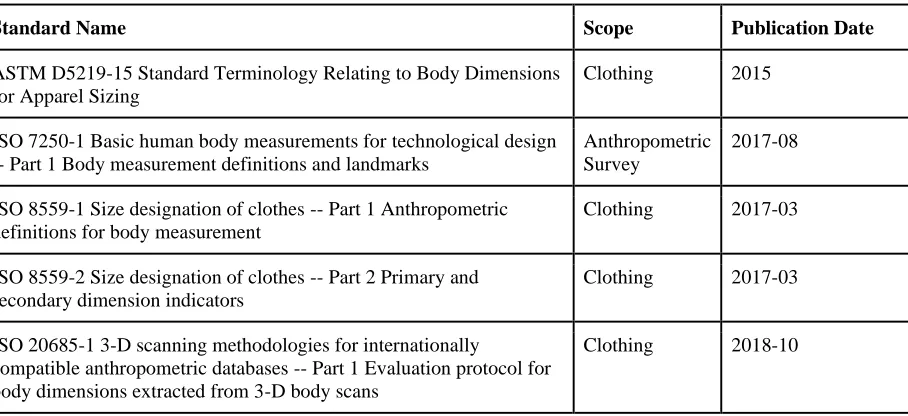
(https://webstore.ansi.org/SDO/ASTM). To cover the national and international requirements on body measuring techniques, standard ISO 7250, ISO 8559, ASTM 5219 are selected for
definition and landmark discussion. Standard ISO 20685 will also be covered, considering a discussion on 3D body scanning. Details of the standards are listed in Table 1.
Table 1
ISO And ASTM Standards on Body Measuring Technique
Standard Name Scope Publication Date
ASTM D5219-15 Standard Terminology Relating to Body Dimensions for Apparel Sizing
Clothing 2015
ISO 7250-1 Basic human body measurements for technological design -- Part 1 Body measurement definitions and landmarks
Anthropometric Survey
2017-08
ISO 8559-1 Size designation of clothes -- Part 1 Anthropometric definitions for body measurement
Clothing 2017-03
ISO 8559-2 Size designation of clothes -- Part 2 Primary and secondary dimension indicators
Clothing 2017-03
ISO 20685-1 3-D scanning methodologies for internationally
compatible anthropometric databases -- Part 1 Evaluation protocol for body dimensions extracted from 3-D body scans
29 Table 2
Primary and Secondary Measurements Based on ISO 8559 nd ASTM 5219 (ISO, 2017c; ASTM, 2015)
# Measurement Garment Application Measurement type
Measurement Definition from ISO 8559-1 (ISO, 2017b)
Measurement Definition from ASTM5219 (ASTM International, 2015)
Figure
1 Bust Girth
Jackets, Suits, Overcoats, Dresses, Knits (cardigans, sweaters, T-shirts), shirts/blouses, Full bodies (overalls, full swimwear, skiwear, and bibs); Undervest; nightwear, corsetry (bras; corsetry upper and full body)
Primary
The horizontal girth of torso measured at a bust point level
The horizontal circumference around the torso, taken under the arms and across the fullest part of the chest/bust apex including the lower portion of the shoulder blades.
2 Waist Girth
Corsetry lower body, panty girdle Primary
The horizontal girth of the body measured at the waist level
The horizontal circumference around the torso taken at the waist. Jackets, Suits, overcoats,
trousers/shorts, skirts, dresses, full bodies: (overalls, surf suits, full swimwear, skiwear, brace, and bibs); underpants, trunk, nightwear, corsetry upper and full body)
Secondary
3 Hip Girth
Suits, Trousers/Shorts, skirts, underpants, trunk; leggings, longjohns; corsetry lower body; pantyhose
Primary
The horizontal girth of the body measured at the hip level
The maximum horizontal
circumference around the torso taken at the greatest protrusion of the buttocks, as seen from the side.
Jackets, overcoats, dresses, full bodies: (overalls, surf suits, wetsuits, bicycling gear, full swimwear, skiwear, brace, and bibs); undervest, nightwear, swimwear, corsetry upper and full body; panty girdle
Secondary
4 Underbust Girth
Swimwear (with cups), bras, corsetry upper and full body (with cups)
Primary
The horizontal girth of the body at the underbust level
30 Table 2
Primary and Secondary Measurements Based on ISO 8559 and ASTM 5219 (ISO, 2017c; ASTM, 2015) Continued
# Measurement Garment Application Measurement type
Measurement Definition from ISO 8559-1 (ISO, 2017b)
Measurement Definition from ASTM5219 (ASTM International, 2015)
Figure
5 Foot Length Socks, Stocking, knee-highs Primary
Distance from rear of the heel to the tip of the longest (first or second) toe, measured parallel to the longitudinal axis of the foot.
The straight distance from the prominence of the back of the heel to the prominence of the longest toe, taken with the foot on a flat surface without shoes (use stable, flat ruler).
6 Hand Girth Gloves Primary Maximum girth over the knuckles.
The maximum
circumference of the hand around the knuckles excluding the thumb, taken with the fingers together.
7 Head Girth Headwear Primary
Maximum, approximately horizontal, the girth of the head measured above the centre point of brow ridge and crossing the rearmost point of the head. Hair shall be included in the measurement.
The maximum horizontal circumference of the head above the ears.
8 Height
Jackets, Suits, overcoats, trousers/shorts, skirts, dresses, knits: (cardigans, sweaters, T-shirts); shirts/blouses, full bodies: (overalls, surf suits, full swimwear, skiwear and bibs); undervest, underpants, trunk, leggings, , swimwear; corsetry upper and full-body, corsetry lower body
Secondary
The vertical distance from the highest point of the head in the median line to the ground.
The vertical distance from the crown of the head to the floor, taken with subject standing and without shoes
31 Table 2
Primary and Secondary Measurements Based on ISO 8559 and ASTM 5219 (ISO, 2017c; ASTM, 2015) Continued
# Measurement Garment Application Measurement type Measurement Definition from ISO 8559-1 (ISO, 2017b)
Measurement Definition from ASTM5219 (ASTM International, 2015) Figure 10 Inside Leg Length/ Crotch height
Suits (set of jacket and trouser together); trousers/shorts, leggings, longjohns;
Secondary
The vertical distance between the inside leg level and outer ankle point.
The vertical distance from the midpoint of the crotch to the floor, taken with the subject standing and without shoes.
11
Neck Girth/ Mid-neck Girth
Shirts/blouses Secondary
The girth of the neck at a point just below the bulge at the thyroid cartilage (Adam's apple) and measured perpendicular to the longitudinal axis of the neck.
The horizontal
circumference of the neck, taken approximately 25 mm (1 inch) above the neck base level.
12 Underarm Length Shirts/blouses Secondary
The distance between the armpit front fold point and palm side of the wrist at a level of the wrist point.
The distance from the mid-underarm point of the armscye to the inner wrist bone, taken with the arm down.
13
Arm Length/ Outer Arm Length
Shirts/blouses Secondary Distance from shoulder point to wrist point.
32 Table 2
Primary and Secondary Measurements Based on ISO 8559 and ASTM 5219 (ISO, 2017c; ASTM, 2015) Continued
# Measurement Garment Application Measurement type
Measurement Definition from ISO 8559-1 (ISO, 2017b)
Measurement Definition from ASTM5219 (ASTM International, 2015)
Figure
14
Back neck point (Cervicale) to wrist length
Shirts/blouses Secondary
The distance across the shoulder and down the arm from the back neck point over the shoulder point and the elbow point to the wrist point.
The distance from the cervical over the top of the shoulder joint, along with the outside of the arm, over the elbow to the prominent wrist bone, taken with the arm bent 1.57 rad (90°) and the hand placed on the hip.
15 Calf girth Socks Secondary The maximum horizontal girth of the calf.
The maximum horizontal
circumference of the lower leg, taken between the knee and the ankle.
16 Ankle Girth Socks Secondary
The horizontal girth of the leg measured at the level of the outer ankle point.
The vertical distance from the prominence of the outer ankle bone to the floor, taken with subject standing and without shoes.
17 Hand Length Gloves Secondary
Distance from the tip of the middle finger to the most distal wrist crease.
33
2.2.3. Anthropometric Methods
The purpose of anthropometric methods is to ensure the comparability of human body measurements made by different operators and repeated measurements made by the same
operator (Kouchi, 2014). The traditional anthropometric method can be traced back to more than one hundred years ago using simple tools like a tape measure and calipers to manually measure the human body. With the development of technology, three-dimensional body scanners became available as a new non-contact body measuring method.
2.2.3.1. Hand measure (1D method). The traditional anthropometric measurement uses
simple, quick, non -invasive tools, including a weight scale, camera, measuring tape,
34 Figure 13. Traditional instruments. (a) Anthropometer, (b) large sliding caliper, (c) sliding
caliper, (d) spreading caliper, (e) tape measure (Kouchi, 2014).
Due to the low-cost measuring tools, the traditional hand measuring method became the most commonly used method for a long time in the apparel industry. However, this method has disadvantages as time-costing and relatively low comparability between different operators. Related studies have pointed out that 3D body scanning takes much less time than
35 imprecision in a landmark location, subject positioning, and instrument applications (Simmons, & Istook, 2003). The result of measurement may vary from each measurer even when they are trained similarly.
2.2.3.2. 3D body scanning. According to the standard ISO 20685, the three-dimensional (3D) scanner is an instrument with a relatively new application to anthropometry. 3D body scanners include hardware and software that creates digital data representing a human form or a part of the human body in three dimensions; the digital data generates the human form into a 3D point cloud that can be applied in clothing, automotive design, engineering, and medical fields. Users are allowed to extract one-dimensional (1D) measurement data from the 3D point clouds and use this anthropometric data for design application. Several companies have been
researching this technology for over 30 years; the most well-known ones are (TC2), Cyberware,
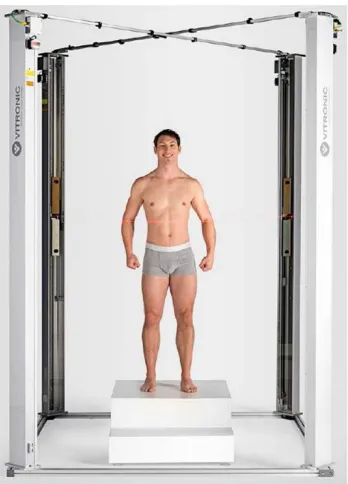
SYMCAD, and Vitronic. Their 3D scanning products have been widely used in movies, games, and the apparel industry. Some well-known apparel companies like Nike, Wrangler, Kohl’s, and Levi’s are currently applying 3D body measurement and simulation technology in their product development process. This is used to evaluate product fitness, design new products, and cut the cost of time and money in designing and prototyping stage of product development (Song, & Ashdown, 2015).
36 2.2.3.2.1. 3D Laser scanning. Laser scanning technology use lasers to project onto the human body with one or more thin light stripes. The laser scanner unit, which is composed of the laser, the light sensor, and the optical system, is moved across the human body to digitize the surface. The number of laser sensors in the unit is usually determined by the body part to be scanned. The advantage of this scanning technology is the high accuracy, low measurement noise, and high resolution. However, the laser scanner is known to have a higher cost on hardware compared to other scanners, and it requires a longer time digitizing large surface (D'Apuzzo, 2007). The examples of these products are Cyberware’s WBX, WB4, and Voxelan.
Figure 14. Example of a laser-based scanner (Daanen, & Ter Haar, 2013).
37 process happens in a concise time frame, within one second, so that any uncontrollable body movement can be successfully avoided during scanning. The disadvantage is the limitation of the scanning area; usually, one device is not enough to scan the whole human body, so various equipment needs to be used serially, which may extend the time of scanning and increase the cost (D'Apuzzo, 2007). Companies like (TC2) and Vitronic have been developing the white light scanner and use them for whole body scanning.
(a) (b) (c) Figure 15. (a): projection of light pattern as stripes. (b): scanning device. (c): a projected sequence of binary-coded stripes pattern (D'Apuzzo, 2007).
38 2.2.3.2.4. Depth sensor. Depth sensors like Kinect and Time-of-Flight (ToF) cameras are considered to be a good choice of lower cost for body measurement currently. These sensors recover measure the time-of-flight of a light signal between the camera and the subject for each point of the image based on the known speed of light. The advantage of this new scanning technology is a much lower cost than other scanning sensors, but it comes with the price of high noise level, lower resolution, and significant systematic measurement bias. Recently several studies have pointed out that combining specific algorithms can help increase the resolution and accuracy of a depth camera in a limited range (Tong, Zhou, Liu, Pan, & Yan, 2012; Lee,
Damhorst, Lee, Kozar, & Martin, 2012).
2.2.3.2.5. Other input devices. As mentioned above, due to the features of optical 3D body scanners like laser scanners and white light scanners, the limitation of the scanning area needs to be created by adding the number of sensors. To avoid extra cost, companies producing specific products like footwear, gloves, and helmets are looking into scanners dedicated to specific body parts. Foot scanners, hand scanners, head scanners, and whole-body scanners are developed to target specific products.
Foot scanners are mainly used for the footwear industry for customized footwear products and sports shoes comfort improvement. The measurement includes foot length, ball girth circumference, foot breadth, instep circumference, heel breadth, instep length, fibular instep length, the height of the top of ball girth, the height of instep, height of navicular, toe #1 angle, and toe #5 angle, arch length, and angle of heel bone using multiple laser beams (Park, 2012).
39 length of the root of thumb to the inner wrist, and length of the root of the little finger to the outer wrist are measured. To improve the accuracy, 3D hand scanning should be combined with 2D hand scanning to reduce the errors on edge. (Yu, Yick, Ng, & Yip, 2013)
Head scanners are mostly used to develop helmets for sports or scanning face data. In this case, the 3D scanner is mainly used to capture the head shape for digital output, and product developers can create landmarks on the 3D model to better analyze head measurement data and develop user-centered products accordingly (Mustafa, Pang, Perret-Ellena, & Subic, 2015).
Whole-body scanners are widely used to collect data from the whole body for apparel product development. White light scanners are more commonly used in this area to avoid unnecessary body movement by completing a scan in seconds.
2.2.3.3. Standard and measurement extraction for 3D scanning. Standard ISO 20685
is specifically designed to ensure the comparability of body measurement data collected through 3D body scanners. The definition of measurements is based on the definitions from ISO 7250-1. During the 3D scanning process, the position of the subject is crucial. Subjects should breathe normally, keep shoulders straight without being stiff, and keep muscles relaxed. Figure 16 shows the four recommended positions for 3D body scanning.
40 Figure 16. Recommended standing and sitting positions for 3D body scanning (ISO, 2018).
41 Table 3
ISO 7250-1 Measurements by a 3D Whole Body Scanner (ISO, 2018)
# Measurement Position Type The definition in ISO 20685-1 (ISO 20685, 2018)
1 Stature (body height) B The vertical distance from the floor to the highest point of the head (vertex)
2 Eye height B (standing)/ D (sitting) The vertical distance from the floor to the outer corner of the eye 3 Shoulder height B (standing)/ D (sitting) The vertical distance from the floor to the acromion
4 Elbow height C (standing)/ D (sitting) The vertical distance from the floor to the lowest bony point of the bent elbow
5 Iliac spine height,
standing B
The vertical distance from the floor to the anterosuperior iliac spine (the most downward-directed point of the iliac crest)
6 Crotch height B The vertical distance from the floor to the distal part of the inferior ramus of the pubic bone
7 Tibial height B The vertical distance from the floor to the tibiale
8 Chest depth, standing A, B The depth of the torso measured in the midsagittal plane at the mesosternal level
9 Body depth, standing A, B Maximum depth of the body
10 Chest breadth, standing A The breadth of the torso measured at the mesosternal level
11 Hip breadth, standing A The maximum horizontal distance across the hips
12 Sitting height (erect) D The vertical distance from a horizontal sitting surface to the highest point of the head (vertex)
13 Cervicale height, sitting D The vertical distance from a horizontal sitting surface to the cervicale.
14 Shoulder-elbow length C The vertical distance from acromion to the bottom of the elbow bent at a right angle with the forearm horizontal
15 Shoulder (biacromial)
breadth A, B The distance along a straight line from acromion to the acromion
16 shoulder (deltoid)
breadth A, B
The distance across the maximum lateral protrusions of the right and left deltoid muscles
17 Elbow-to-elbow breadth D The maximum horizontal distance between the lateral surfaces of the elbow region.
18 Hip breadth, sitting D The breadth of the body measured across the widest portion of the hips.
19 Thigh clearance D The vertical distance from the sitting surface to the highest point on the thigh.
20 Knee height, sitting D The vertical distance from the floor to the highest point of the superior border of the patella (suprapatella, sitting).
21 Abdominal depth,
sitting D Maximum depth of the abdomen while sitting.
22 Buttock-abdomen
depth, sitting D
Projected maximum horizontal depth of the lower torso between the maximum anterior protrusion of the abdomen and the maximum posterior protrusion of the buttock.
23 Elbow-wrist length C The horizontal distance from the wall to wrist (ulnar styloid process)
24 Forearm-fingertip length C The horizontal distance from the back of the upper arm (at the elbow) to the fingertips, with the elbow, bent at right angles
25 Buttock-popliteal length (seat depth) D
The horizontal distance from the hollow of the knee to the rearmost point of the buttock
26 Buttock-knee length D The horizontal distance from the foremost point of the knee-cap to the rearmost point of the buttock.
27 Neck circumference A, B The circumference of the neck at a point just below the bulge at the thyroid cartilage
28 Chest circumference A The circumference of the torso measured at nipple level
29 Waist circumference A The circumference of the trunk at a level midway between the lowest ribs and the upper iliac crest
30 Wrist circumference A The circumference of the wrist at the level of the styloid processes of the radius and ulna, with the hand outstretched
31 Thigh circumference A The maximum circumference of the thigh
42 Currently, the most commonly used automatic body measurement extraction systems are the Size Stream and [TC]2 scanners and software programs. These two programs have been
referring to standard ISO 7250 and ISO 8559, which both offer more measurements than listed in ISO 20685 (Size Stream, 2017; ISO, 2010). The difference is that the [TC]2 programs allow users
to set customize parameters like bust, waist, and hips while Size Stream only allows the definition of waist parameter. Other customize parameters must be created as new parameters.
43
2.2.3.4. Measure through 2D images. Two-dimensional (2D) imaging techniques have
been explored as an alternative for body measuring in both academic research and commercial applications (H. A. Daanen & Ter Haar, 2013). Different from one-dimensional manual
measurement methods and the relatively advanced three-dimensional body scanning technology, the two-dimensional body measuring method is commonly considered as a relatively low-cost substitute for three-dimensional body scanning. This method uses 2D images without depth information to rebuild three-dimensional models based on silhouette information. Usually, the front and side images will be used as references.
To find the best solution for rebuilding the three-dimensional models and extract measurement results, research has been conducted. In 2006, Seo, Yeo, and Wohn released a method of mapping two-dimensional images to a parameterized deformable model based on 40 3D body scans. By 2012, Saito et al. developed a simple model to construct 3D shapes using a parameterized model. Additional research in 2013 made by Watson and Evans used a different method by partitioning the 2D images into segmentations and producing a probability map representing the subject. It then finds the closest 3D body model from a database based on the probability map and extracts body measurements from the 3D model. Other research explores the possibility of finding key points and measuring from the front and side image using extracted measurements to predict non-measurable measurements like circumferences using a simple linear model (Gazzuolo et al., 1992; Lin & Wang, 2011; Meunier & Yin, 2000).
The two-dimensional body measuring method provides a low-cost solution for non-contact human body measurement, and the measurement output is reliable for the apparel
44 colors such as black or green. However, the backgrounds in daily life would be more
complicated and more colorful, which could bring difficulty for silhouette identification (Lin & Wang, 2011; Seo et al., 2006). Another concern is privacy issues. Consumers must wear close-fitting garments or underwear while taking 2D images for two-dimensional body measurements to guarantee the accuracy, and this may bring a privacy discomfort (Grogan et al., 2017; Loker et al., 2004).
2.2.3.4.1. Measuring apparatus. As stated above, the privacy issue has been a concern for consumers while using non-contact body measuring technologies. The measuring apparatuses are developed to release these concerns and assist in measuring human bodies. The measuring apparatus can be divided into two types: pattern-based measuring apparatus and circuit-based measuring apparatus. The pattern-based apparatus was developed to help locate landmarks on the human body so that a traditional hand measuring method and two-dimensional measuring
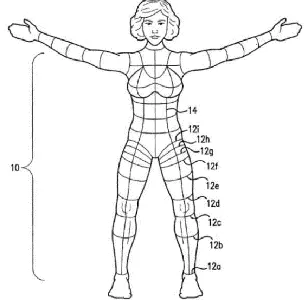
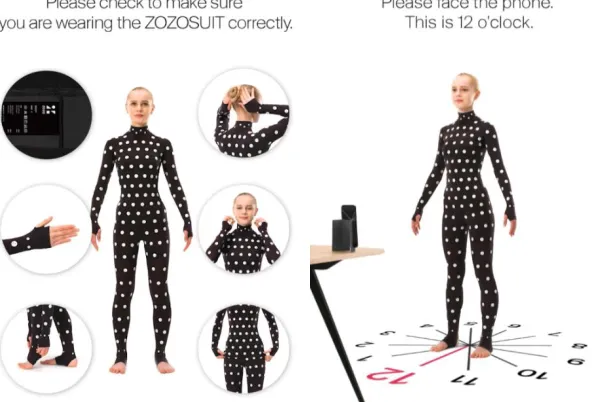
methods can be efficiently conducted. Figure 17 shows the stretch bodysuit for preparing custom-fitted clothing, invented by Liebermann in 2002. This bodysuit splits the surface into multiple parts to locate the landmarks. Figure 18 shows the measuring apparatus designed to work with imaging technologies. The circuit-based suit, as shown in Figure 19, could measure the human body by itself. This sample garment is made by Like A Glove Ltd., circuits and sensors were added to the predicted landmark location to collect human body measurements (Likeaglove, 2015).
45 cannot change batteries, which further limited the application and reduced consumer desire to buy them.
Figure 17. The stretch bodysuit developed for preparing custom-fitted clothing (US 2002/0166254 Al, 2002).
Figure 18. The elastic measuring suit from elasizer (elasizer, 2017).