Review of Isolate and Prevent Selective Packet
Drop Attack in MANET
SagarPatolia
1, HarmandeepSingh
2P.G. Student, Department of Computer Engineering, Lovely Professional University, Phagwara, Punjab, India1
Associate Professor, Department of Computer Engineering, Lovely Professional University, Phagwara, Punjab India2
ABSTRACT:A mobile Ad-Hoc network is wireless networks without any pre-existing infrastructure and centralizes control. They have self-organizing capabilities with mobile nodes. Ad-Hoc network contains multi-hop routes capabilities within short transmission range. Because of openness nature MANET is malicious by attacker. There was notorious security problem in MANET. In this paper we will discuss about various routing protocol e.g. AODV (Ad-Hoc On-Demand Distance Vector), DSR (Dynamic Source Routing)]. Isolate possible attack on ad-hoc network and prevent it with numerous techniques.
KEYWORDS:MANET, AODV, DSR, ATTACK-Selective packet drop
I. INTRODUCTION
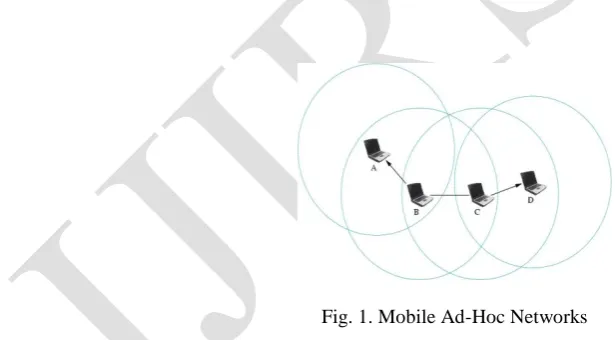
Mobile Ad Hoc Network is a collection of mobile hosts with wireless network interfaces form a temporary network without the aid of any fixed infrastructure or centralized or centralized administration[2]. MANET works with dynamic topology and make temporary network for communication. This type of network works on multi hop reachability for replay packet to destination throughout in network.
Fig. 1. Mobile Ad-Hoc Networks
DOI: 10.15680/IJIRSET.2014.0312042
This attack degrades the network performance and leds to denial of service of attack. The attack is triggerd by the malicious node which is present in the network.
II. CHARACTERISTICSOFMANET
Dynamic Topology: MANET is made up of mobile nodes, for this any node can be frequent change so any random
or dynamic topology required to establish communication.
Multihop Routing: In Ad-Hoc multi-hop routing is very important factor,, Becsause one node want to broadcast its
packet information to destiantion nodebeyond its scope outside networkrange.packet should pass with number of intermediate or neighbour node.
Limited Bandwidth : Bandwidth is law compare to wired network is law due to stale routes ,various noise,
distortion and fadding effect.
Autionomous(Region or Orgiation ) Node[Terminal]: In mANET each node is act as host and router depend on the
situation of communncation so it is called Autonomous system(AS).
Energy Constrained Operation: Some or all MANET nodes relay on batteries so important challenges is to design
the system to consume law battery power.
Limited Physical Security: Mobile nodes or AS(autonomus system) node is vulnerable or malicious from attacker
than wireeed network.So such, Attacks are possible which increase security threats like evasdroping, spoffing, Denial of service attack.[2].
III. AD-HOC ROUTING PROTOCOL
The routing in a MANET is intrinsically different from traditional (current) routing found on centralized stractured networks. Routing in MANET depends on many factor including Route initiation , Topology selection of routers that all could give heuristic approch toward finding the path correctly accurately and efficently.
By this characteeristics MANET protocol classified as proactive( Table-Driven) or Reactive(On-Demand) routing protocol [2]. Proactive routing protocol is also known as Table-driven protocol it self described that it keeps tracks of all the route information towards source to destination.All the route information hop by hop stored in Tablewhich use by each node to forward data to destination when path is undefined. Eg. DSDV, Fishey state, WRP. While Reactive routing protocol known as On-Demand as per its characteristics. Node establish route when it required to flood packet so it is called as On-Demand or lazy protocol.This protocol named as source intiated because when source wants routes to destination it initiates route discovery. It maintain consistent up-to-date routinf information from each node to every node in network
1)AODV [Ad-Hoc On-Demand Distance Vector][5]:
(a) (b)
Fig.2. (a) RREQ Braodcast (b) RREP Forwardpath (Route Determination From Source to Destination)
2) DSR [ Dynamic Source Routing ][6]:
DSR is reactive type of protocol.The indentical features of DSR is source routing in which all mobile node maintain route cashes that preserve the source routes of which all mobile node know (aware). All caches updates for new learned routes 2 Major phase. I] Route Discovery II] Route Maintenance
In DSR when On-Demand route reqquirement comes first it willl check route caches for preevious route information to destionation. If trhe previous route link is expire then route discovery is establish and forward new RREQ. Route maintenance is accomplished when route error and acknowledgement came for fatal transmission problem.
IV. SECURITY THREATS IN WIRELESS AD-HOC NETWORKS
The major threats which Breach security in wirealess network authentication , non-repudiation, availability, integrity, confidentiality.
A) Authentication and non repudiation: Authentication allow node to verify identity of next node with which it is commuincating. Non-repudiation is provethat legitimate sender sent a message[1].
B) Passive Vs. Active Attacks: Passive attacks are launch to release or lose confidentiality of valuable information in
networks.In this type of attack , attacker not harm the system and its resources. Eg. evasdroping. Active attack are made intentionaly either change or delete confidential information fro disturbing the normal functioning o fnetwork. Eg. Falsse message propogating attack, man-in-middle attack[1].
C) Black-hole attack[12]: In blcak hole attack malicious node use its routing protocol to know other node that it has shortest path towards destinationand attacker drop the packet to reduce the quantity of information is available to other node. This type of attack made intentionaly for deniall of service type attack[9]. This make destination system unreachable or shutdown in network.
D) The worm Hole Attack: The worm hole attack is quite tipical and merciless attacks, which can be executed in MAnET. In this type of attack message is captured from the one region of network and replaying in other region. Attacker creates tunnel between two node which participate for communication. One attacker gather all message and other attacker replay to misinterprate to make destination unrechable from network.
E) Selective Packet Drop Attack: Packet drop attack is some what releated to black-hole attack but it hard to detect and
DOI: 10.15680/IJIRSET.2014.0312042 Fig.3.Selective Packet Drop Attack
Proposed technique which is based on acknowledgement based and reputation based. They observe that the problem arise because of misbehaving and selfishness of the intermediate node and the result was packet drop at mid of the path. To avoid selective packet drop attack most powerful technique is to observe the behaviour of traffic in route set the threshold, calculate the reverse path from any point in route and identify the melodious node use the key distribution technique (KD) to secure routing and it will provide the confidentiality that the legitimate source send these packet.
V. LITERATURE REVIEW
Thongchi Chuachan and Somnuk Puangpronpitag et al. [ 10], proposed new methodology how to detect and prevent selective packet drop attack. In this paper they discuss 4 previous method to protect against 1.reputation bsed 2. Acknowledgement based 3. IDS based 4. Trusted based. The new proposed schema called challenge and response schema. It contain 2 phase I) Key distribution phase II) Challenge ad response phase . The message is encrypted using the public key and routed in two-hop neighbor, take ratio of local one compare it with neighbor node.The melocious node can be detect by setting thresold vlaue to cache and at the end this value to the nieighbours value. To simuate this result they use Commn Open Reserch Emulator (CORE).
Bo Sun, Yong Guan et al. [12],In this paper they proposed a neighbour set based approach to detect black hole attack
and a muting recovery protocol to mitigate the effect of black bole attacks. The demonstrated through simulation that
this methods could effectively and efficiently detect black hole attack without introducing much routing control
overhead to the network. The datashows when we simulate that packet throughput is being improved by at least 15%
and the false positive probability is usually less than 1.7%. In the future, they would like to further explore whether
there exists a non-cryptography based method to identify them and destination and the optimal detection and response mechanism to improve the packet throughput.
Tien-Ho Chen and Wei-Kuan Shih et al. [13] In this paper they discussed about importance of mutual authentication for wireless sensor networks .They also discussed about the DES protocol which is the hash-based authentication protocol. This protocol provides the security aligned with the stolen verifier, replay, masqueradeand guessing attacks.
Ahmed M.Abd EL-Haleem and IhabA.Ali etal. [17], Propose mythology to isolate packet dropping attack by using two disjoint routesprotocol in MANET. In this technique two node disjoint routes are selected based in their trust value and use to routes from source to destination. They use DLL-ACK (acknowledgement) and end-to-end Tcp-Ack to identify and examining the behaviour of routing path, node. If any malicious node find in the path then path search engine tool get run and identify the malicious node and prevent it.
K.Sangeetha etal.[18], Propose technique to secure transmission in the MANET using Ad-Hoc On-Demand routingprotocol(AODV). Due to lack of resource and infrastructure ad-hoc network is not able to prove logical operation. Proposed schema called Enhanced Adaptive Acknowledgement (EAACK) which raise Integrity of IDS(Intrusion Detection System) by using digital signature. It reduces overhead which arise during routing in AODV protocol. In this paper they discuss some previous IDS based technique to identify and remove misbehaving node in network, i)watchdog II)TWOACK(two acknowledgement) III) AACK(end-to-end ACK) IV) S-ACK(secure acknowledgement) V) MRA(Misbehaviour report authentication).
VI. FUTUREWORKANDCONCLUSION
Mobile ad-hoc network have been wast area of research work from past few years because its widely used application in battlefield and business purpose. Due to openness and dynamic topology network is vulnerable from attacker. In this paper we have discuss MANET protocol, its characteristics and attack which trigger on it. We have discuss various technique to isolate and prevent selective packet drop attack which degrade the system performance by decreasing latency, throughput and increasing end-to-end delay. There are acknowledgmentsand IDS based schema which prevent this attack in AODV protocol. In our feature work we proposed new algorithm based on monitor node technique to which improves network efficiency.
REFERENCES
[1] W.Stallings,” Network Security Essentials: Application and astandards”, 2nd Edition, prentice Hall ,Upper Saddle River,2003.
[2] C-K Toh,”Ad Hoc Mobile Wireless Networks”,PEARSON,2013
[3] S.Corson, ”Mobile Ad Hoc Networking:Routing Protocol Performance Issues and Evaluation Considerations”.IETF, RFC 2501, January 1999. [4] Ramna,K.S., Chari, A.A., &Kasiviswanth,”A survey on trust management for mobile ad hoc networks. International Journal of Network
Security & Its Application ,“(IJNSA), 2(2),PP.75-85,2010.
[5] C. Perkins, E.Belding-Royer, and S.Das, ” Ad Hoc On-Demand Distance Vector(AODV) Routing”,IETF, RFC 3561, July 2003.
[6] D. Johnson, D. Maltz, Y-C.Hu, J.Jetcheva, ”The Dynamic Source Routing Protocol for Mobile Ad Hoc Networks(DSR)”, Internet-Draft, February 2002.
[7] B.Wu, J.Chen, M.Cardei,” A survey on Attacks and Counter measures in Mobile Ad Hoc Networks,” Wireless Network Security,PP. 103-135, 2007
[8] Dongbin Wang, Mingzeng Hu, Hui Zhi,”A Survey of Secure Routing in Ad Hoc Networks”,The ninth International Conference on web-age Information Management, pp.482-486, 2008
[9] I.Aad, W.E. Knightly,”Impact if Denial of Service Attacks on Ad-Hoc Networks”, IEEE ACM Transactions on Networking,volume 16,No.4,PP.791-802.
[10] Thongchi Chuachan and Somnuk Puangpronpitag ,”A Noveel Challebge & Response Scheme Agaist Selective Forwarding Attacks in MANET”, IEEE, 2013.
[11] M.Shila, Y.Cheng and T.Anjali,” Mitigating Selective Forwarding Attacks with a channel aware approach in WMN”, IEEE Transaction on Wireless Communication, Vol.9, No.5,PP. 1661-1675,210
[12] Bo Sun, Yong Guan, Jian Chen, U.W.Pooch,"Detecting black-hole attack in mobile ad hoc networks",Personal Mobile Communications Conference,5th European (Conf. Publ. No. 492),2003.
[13] Tien-Ho Chen and Wei-Kuan, Shih , “A Robust Mutual Authentication Protocol for Wireless Sensor Networks”ETRI Journal, Volume 32, Number 5, October 2010.
[14] Pradeepkyasanur “Selfish MAC layer Misbehavior in wireless networks”, IEEE Transaction on Mobile Computing,Volume-4, Issue 5,pp. 502-216,2005.
[15] KashyapBalakrishnan, Jing Deng and Pramodk.Varshney, “ TWOACK: Preventing Selfishness in Mobile Ad Hoc Networks” , IEEE Communication Society, PP. 2137-2142,2005.
[16] S.FESLINANISH MON, RAJ KUMAR SHAH, L.RAJAJI, “ A PROGRESSION BASED METHOD FOR THE DETECTION OF BLACK AND GRAY HOLE ATTACKS IN MANET”, IJCNWMC, Volume 3,Issue 3, PP. 33-40, August,2013.