Potential Germline Competition in Animals and Its Evolutionary
Implications
Ian
M.
HastingsInstitute of Animal Genetics, Edinburgh University, Edinburgh EH9 3JN, Scotland Manuscript received January 3, 1989
Accepted for publication May 9, 1989
ABSTRACT
Mutation, mitotic crossing over and mitotic gene conversion can create genetic diversity in otherwise uniform diploid cell lineages. In the germline this diversification may result in competition between diploid germline phenotypes, with subsequent biases in the frequency of alleles transmitted to the offspring. Sperm competition is a well documented feature of many higher organisms and a model is developed to quantify this process. Competition, and hence selection, can also occur by differential survival of diploid lineages before meiosis. It is concluded that under certain circumstances germline selection is an efficient means of eliminating unfavorable alleles from the population. This does not require differences in adult fertility or viability which is the usual mechanism cited as causing changes in gene frequency in a population. It is proposed that such competition may play a role in maintaining the efficiency of basic metabolic pathways.
T
HE phenomenon of gamete competition in plants has been considered and documented [MUL-CAHY ( 1 975); but see CHARLESWORTH, SCHEMSKE and
STORK (1 987)]. This is possible because plant gametes express their haploid genotype. One adult plant pro- duces a population of different haploid phenotypes with the potential for competition to occur between them. In contrast animal germline cells appear only to transcribe their diploid genotype. T h e haploid ga- metes appear transcriptionally silent and function using the metabolic machinery inherited from their diploid progenitor (SIVINSKI 1984). Thus animal germline cells must be functionally identical, all being a product of the adult diploid genotype. This is dem- onstrated by the ability of Drosophila melanogaster sperm to function normally even when nearly devoid of DNA (LINDSLEY and GRELL 1969). Competition between (identical) animal gametes therefore cannot occur and its potential has been largely ignored.
However, this line of reasoning ignores the molec- ular processes that create diversity in diploid cell lineages by mutation and genetic exchange by mitotic crossing over and mitotic gene conversion. T h e analy- sis presented here will investigate whether these pro- cesses can create sufficient diversity for selection be- tween diploid genotypes to occur.
MODEL DESCRIBING DIPLOID CELL LINEAGE DIVERSIFICATION AND SELECTION
T h e meiotic products of diploid cells, the gametes, are considered to be metabolically passive copies of their diploid progenitor cell and to contain a random haplotype, i.e., a heterozygous progenitor will produce a 1: 1 ratio of gametes containing each allele. T h e
Genetics 123: 191-197 (September, 1989)
model will consider selection in only one sex, the male, by sperm competition, while the female germline is not considered to undergo selection. This is the sim- plest, most rigorous case and allows widespread appli- cability even to large mammals where millions of sperm may compete for only one egg. A simple two allele model will be considered where A and a repre- sent the two alleles. T h e molecular processes can be represented as follows: p is the mutation rate from A to a, pr is the reverse mutation rate from a to A and
X is the rate of unbiased mitotic crossing over and unbiased mitotic gene conversion. Note that X repre- sents not only mitotic crossing over plus gene conver- sion but any molecular process that results in recip- rocal exchange between homologous chromosomes. This creates diversity in germline cells as shown in Table 1 .
T h e relative fitness of the germline cells is defined as AA = 1 , Aa = 1
-
hs and aa = 1-
s, where s is the selection coefficient against the homozygote aa, andh is a measure of dominance. If we define the initial frequencies of A as
p
and a as q, the initial adult genotype frequency of AA isp 2 ,
Aa is 2pq and aa isT h e frequency of A gametes derived from males in
4 2.
the next generation is calculated as follows:
Frequency =
= p 2 { ( e d
+
0.5 (ezl)(l-
hs)l/((ell)
+
(ez1)(1-
W l
+
PpqKe12)+
0.5(ez~)(l-
hsl/{(els)+
(endl-
hs) ( 1 )+
(esz)(l-
s))+
q2(0.5(e23)(1-
hs))/192 I. M. Hastings
TABLE 1
Conditional genotype probabilities produced within parental genotypes by mutation from A to a ( p ) , mutation from a to A (fir)
and genetic exchange between homologous chromosomes (X), assuming that p, pr and X are sufficiently small that second
order terms can be ignored
Parental genotype
Gernl cells A a A A a a
AA 1 - 2r (ell) P,
+
0 . 5 X 0Aa 2r (end 1 - r r - X - r (ezz) 2~~ ( e d a a 0 (esd P
+
0 . 5 X ( e 3 ~ ) 1 - 2rL, ( e 3 3 ) T h e probabilities can be regarded as components of a matrix, designated (ell) to (ess), and used to clarify Equation 1 in the text.and the frequency of gametes derived from females is
as in (1) above except that s = 0.
This equation gives the proportion of A gametes produced by each adult genotype and weights them by the relative frequency of their adult genotypes. It therefore assumes no differences in fertility between the three adult genotypes.
In the absence of a precise solution for this equation the equilibrium values of A and a were calculated using an iterative computer program incorporating appropriate values for the parameters. Such a pro- gram also yields information on the dynamics of the process, which was assumed to have reached equilib- rium when the proportionate change in gene fre- quency over one generation was less than 2 X lo-*. T h e program calculated gene frequencies transmitted through each sex and used them to calculate adult genotype frequencies in the next generation. This avoids problems inherent in assuming Hardy-Wein- burg equilibrium when the sexes have differing gene frequencies. T h e program was run for different pa- rameter sets and typical results are illustrated in Fig- ures 1 and
2.
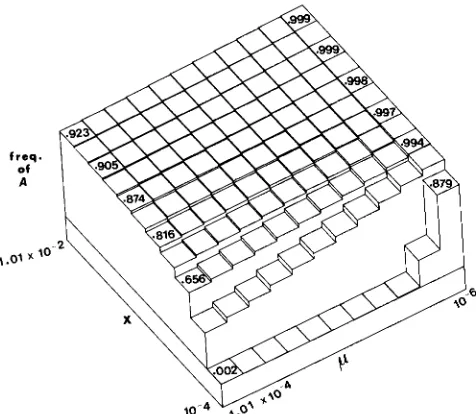
Values of X below 1 OW4 were not consid- ered since the process is slow, large amounts of com- puter time are involved, and the equilibrium levels of the favourable allele are low.The process can be visualized as acting in three stages: mutations (p) create new variants within the population and/or individual, DNA exchange and conversion mechanisms ( X ) generate a range of dip- loid genotypes within the germline and subsequent competition and selection ( h and s) operates to elimi- nate the less beneficial allele. The end product of the process is therefore the result of the interplay between these four parameters p, X , h and s. Simulation studies (Table 2, Figures 1 and 2) suggest that X is the critical parameter, since the diversity generated by X is di- rectly responsible for the subsequent competition. T h e model appears relatively insensitive to changes in h and s at levels of X greater than and particu- larly insensitive to changes in h, an interesting result when applied to selection on biochemical pathways
f r e q .
Of
A
FIGURE 1.-Effects of changing parameters “s” and “h” on the equilibrium frequency of A . X is IO-’, p is 4 X and p, is 4 X 1 O-’. T h e value of s is varied from 0 at the front to 1 at the rear in increments of 0.1. T h e value of h is varied from 1 on the left to 0 on the right, in increments of 0.1.
(see later). Figure 2 illustrates the effect of changing
X and p while holding h and s constant and is a typical result over a range of h and s values. T h e mutation rate p appears influential at lower levels of X but becomes increasing less important at higher levels when sufficient germline diversity is generated to allow effective selection to operate against the unfa- vorable allele. Although there appears to be no simple algebraic solution for the equation, it is possible to make some assumptions and derive approximate expressions to describe the process (see APPENDIX). T h e formulae support these results by showing that at high values of X , the equilibrium value of A will also be large; p and s affect the equilibrium but at the levels of X considered here their contributions are swamped in absolute (but not relative) terms.
T h e dynamics of the process are illustrated graphi- cally for a range of parameter values in Figure 3. Although X is the critical equilibrium-determining factor, h and s influence the speed at which this equilibrium is regained after perturbation.
T h e slow rate of change may make the process vulnerable to the effect of drift in small populations when the adult stage of the life cycle acts as a bottle- neck. T h e magnitude of drift effects will depend on the adult effective population size and subsequent recovery from perturbations will depend on the size of parameters X , h, p and s. An approximate expres- sion for this rate of recovery is derived in the appendix and appears to fit the observations as shown in Figure 3.
When compared with selection against adult phe- notypes
[ p
= 1-
2 p / s for h = 0.5,p
= 1-
( p ) / h s forGermline Competition in Animals
freq. of
A
6
FIGURE 2.-Effects of varying the parameters “ X ” and “p” on the equilibrium frequency of A when s is 0.5 and h is 0.02. The value of X is varied from at the front to 1.01 X IO-* at the rear in increments of IO-’- The value of p is varied from 1.01 X at the left to on the right in increments of p , is p X lo-’.
the model was less effective at screening out the unfavourable allele; see Table
2.
There is of course no reason why the two processes cannot act simulta- neously. Their relative contributions would depend on the magnitude of the relevant parameters.T h e model does not apply to genes coded by the mitochondrial genome which are transmitted mater- nally and are governed by the processes of clonal selection and drift. Enzymes that function in the mi- tochondria but are coded by the nuclear genome (e.g.,
enzymes of the Krebs cycle or electron transport chain) are described by this model, since their site of expression is immaterial. In many species with differ- entiated sex chromosomes, genetic exchange does not occur between the two sex chromosomes. When males are the heterogametic sex, no opportunity exists for genetic exchange between sex-linked loci during sperm formation and the value for X is zero. Sex- linked genes may be subject to a mutation/selection balance within the germline but the value of s would have to be considerably higher to achieve an equilib- rium favouring allele A . T h e model only considers selection in one sex, but if selection occurs in both sexes, genetic exchange ( X ) in the homogametic will result in the same equilibrium frequencies obtained above. Selection in the adult phase of the life cycle may be sufficient to eliminate deleterious sex-linked genes since by definition these loci will be dominant in the heterogametic sex.
PARAMETER VALUES FOR T H E MODEL
T h e parameters X , p and p,. describe diversity within
germline cells immediately prior to meiosis. They
TABLE 2
Equilibrium frequency of A due to selection on germline or adult phenotype, assuming p = 4 X 10“ and pv = 4 X
Germline selection
X
S h
- Adult selection lo-* 10-3 10”
0.9 0.50 1.000 0.999 0.991 0.992 1.000
0.02 1.000 0.998 0.981 0.814 1.000
0.00 1.000 0.998 0.980 0.810 0.998
0.5 0.50 1.000 0.997 0.976 0.753 1.000
0.02 1.000 0.996 0.965 0.652 1.000
0.00 1.000 0.996 0.964 0.647 0.997
0.1 0.50 0.998 0.983 0.828 0.006 1.000
0.02 0.998 0.982 0.818 0.005 0.998
0.00 0.998 0.982 0.817 0.005 0.994
represent cumulative totals of these processes over the cell divisions prior to meiosis. Mitotic crossing over is a well documented phenomenon (WHITEHOUSE 1982) but there are no reliable estimates of its frequency. Mitotic gene conversion has been observed in yeasts but its frequency in higher organisms is unknown
(JOHN and MIKLOS 1988). Any mechanism of recip- rocal exchange between homologous chromosomes is represented by the term X . T h e value of X is essentially guesswork but testis is a rapidly dividing tissue and gametes are the product of a larger number of cell divisions than somatic tissue. T h e value of X in germ- line tissue may therefore be much higher than that estimated for the soma. Mitotic crossing over appears to occur even in the absence of meiotic crossing over, for example in males of higher Diptera. GETHMANN (1988) in a recent review concluded that “mitotic, or somatic crossing over probably occurs at a low fre- quency in all Diptera”; the estimates of its frequency were in the region 2 X lop4 to 1 X Mutation rate per enzyme coding region per gamete is usually regarded as around although the best estimate for
D.
melanogaster is 4 X (VOELKER, SCHAFFER and MUHAI 1980). Mutations restoring enzyme activ- ity are estimated to be 1000 times less frequent than those destroying activity in bacteria (FREIFELDER 1987). Since enzyme structure and function are simi- lar in all organisms it is possible to estimate pr as p XT h e dominance index “h” is likely to be small due to the properties of biochemical pathways de- scribed later. T h e magnitude of these parameters suggest that biases in the transmission frequency are likely to be small. Assuming X = p = 4 X
pr = 4 X lo-’, h = 0.02 and s = 0.9 (resulting in an equilibrium frequency of A = 0.981; table 2), the frequency of A gametes transmitted by an A a individ- ual will be 0.50023; such small biases will be invisible in most experimental protocols.
194 I. M. Hastings
1.0
0.8
<
L
* 0 z
W
2
0 . 4W
m
L L
0.6
0.2
0.01. 8
0.001, 8
0.001, 8
0.001, 8
0.001, 8
0.0001, 0. 0001 ,
= 0.9, h = 0.02 = 0.9, h = 0.5
= 0.9. h = 0.02
= 0.5. h = 0.02 = 0.5, h = 0.5
e = 0.9. h = 0.5
e = 0.9, h = 0.02
0 . 0 ~8000 ” ” ”16000 ” ” 24000 32000 40000 GENERATION
FIGURE 3.-Effects of changing parameters X , s and h on the dynamics of gene frequency change attributable to germline com- petition. p is 4 X and p, is 4 X
NAUCHTON (1974) mated rabbits and later recovered sperm from several regions of the reproductive tract. The recovered sperm were used to inseminate other rabbits and the number required to produce a preg- nancy was estimated. On average 100 sperm from the oviduct, 80,000 from the uterus or 4 X lo6 fresh sperm were sufficient to cause pregnancy; giving rise to a potential value of s as high as 0.999975. This may also reflect differences in the physiological maturation of the sperm but the experimental conditions were designed to favour the fresh sperm. In any case it demonstrates the enormous potential for sperm com- petition which exists within an individual irrespective of its biochemical or physiological basis. BEATTY (1 975) cites experiments designed to measure sperm competitive ability between strains of mice, rabbits and cattle. Fertilizing ability differed by a range of factors up to 12, 12 and
27,
respectively, but these represent differences between genotypes rather than differences generated within an individual. Although these reports cannot give definitive figures for the value of “s,” the selection differentials of sperm within an individual, they provide a guide as to their potential magnitude.GERMLINE CELL METABOLISM
The process of germline competition predicted above can maintain a high frequency of advantageous alleles in the face of persistent mutation pressure. T h e question is whether these alleles are specific to sperm function or of more general metabolic interest.
Biochemical studies of sperm are relatively recent and mainly concerned with mammalian systems (BLUM
1986; ZANEVELD and CHATTERTON 1982). Sperm ex- press the enzymes necessary for the oxidation of fatty acids, glycolysis, Krebs cycle, electron transport, oxi- dative phosphorylation, and possibly the hexose-mon- ophosphate shunt. Evidence also points to their syn- thesis of lipids and glycogen while stored in the testes. Thus all the major biochemical pathways appear to
play a role in sperm metabolism. During internal fertilization the ability of the sperm to reach the egg is dependent largely on its ability to convert metabo- lites into motility. T h e metabolites come either from its surrounding fluids which contain sugars, amino acids etc. (selection on the degredative pathways) or from its internal stores of lipid and glycogen (retro- spective selection on the synthetic pathways). Al- though passive transport of sperm may occur in some mammalian species by smooth muscle contractions of the uterus etc., their own motility still plays a large part. It is possible that sperm must move to avoid depletion of nutrients within its immediate vicinity (PETERSON 1982), this would add an “amplification” step to the process in the form of positive feedback i.e. the more motile sperm gain more nutrients which further increases their motility.
Germline Competition in Animals 195
0 ’ RELATIVE ENZYME RCTIVITY 1
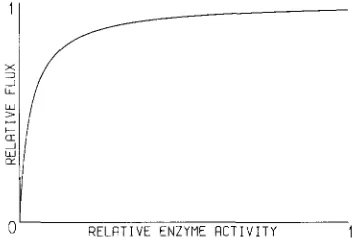
FIGURE 4.-Effect on flux through a biochemical pathway due to changing the activity of one constituent enzyme. After KACSER
and BURNS (1981).
and flourish in the reproductive sacs prior to release will result in the biases predicted above. Once such a process has started even in a rudimentary form, it has the impetus to persist and develop given the marginal cost to the adult of within-germline competition and the benefits of passing on a more efficient basic me- tabolism.
METABOLIC PATHWAYS I N GERMLINE CELLS
T h e model derives circumstantial support from re- cent work examining the influence of individual en- zymes on biochemical pathways. These theoretical and empirical investigations found a law of diminishing returns as shown in Figure 4 (KACSER and BURNS
1981). This states that the activity of an enzyme may fluctuate widely with a negligible effect on flux; even the 50% reduction in a wild type/null heterozygote has a negligible effect on phenotype as demonstrated by the fact that the wild type allele is invariably dominant. HARTL, DYKHUIZEN and DEAN ( 1 985) sum- marized these studies and applied them to population genetics. Using data from
D.
melanogaster they calcu- lated that most metabolic enzymes were located along the plateau of Figure 4. They deduced that enzyme variants spread along this plateau are effectively neu- tral since the value of 4Nes is considerably less than one, where Ne is effective population size and s is the relative selective disadvantage of an allele, in this case taken as equivalent to its effect on flux. In effect they are below the level of resolution possible by natural selection. An appraisal of these approaches leads to a dilemma not usually acknowledged in evolutionary theory. Enzymes are exceedingly efficient and in some cases approach “catalytic perfection,” the stage at which the rate of catalysis is limited by the rate of diffusion bringing substrates into contact with the enzyme molecule. This efficiency is maintained across species and through generations in the face of re- peated mutations. T h e vast majority of mutations will result in decreased catalytic efficiency and it is obvious that some selective pressure(s) must be maintaining them at this level of efficiency. However as pointedout, natural selection as usually envisaged lacks the degree of resolution necessary to achieve this.
A critical assumption in this analysis is that flux equals fitness. This is unlikely to be true in the adult multicellular phenotype where complex physiological systems have evolved to regulate biochemical path- ways. In adults, flux is determined not only by indi- vidual enzymes but also by higher processes of ho- meostasis such as hormonal regulation which modu- late their activity. In this situation, maximum fluxes are less likely to be critical parameters affecting fit- ness. This may explain the results of VOELKER et al.
(1980) and LANGLEY et al. (1981) who found no differences in fertility or viability between adults homozygous or hemizygous for near-null enzyme mu- tations and their wild-type counterparts in
D.
melano- gaster, a result later confirmed by BUKHART et al.1984. Similar results are reported in O’BRIEN and MACINTYRE (1978). In contrast, germline cells appear critically dependent on their basal metabolic pathways and maximum fluxes determine fitness to a larger extent than in adults. Selection pressures acting on individual enzyme activities will therefore be higher in this stage of the life cycle. T h e problem remains as to the ability of germline competition to discriminate between enzyme variants with only a marginal effect on flux. This problem exists only if we continue to regard flux as equivalent to fitness. As stated earlier, sperm motility may have a positive feedback effect since more motile sperm avoid local depletion of nutrients; this phenomenon will generate larger dif- ferences in fitness between genotypes than predicted by consideration of flux alone. In the case of compe- tition between different germline lineages it is possible that flux equals fitness at the level of individual cells, but small differences in fitness act cumulatively to create increasingly large fitness differences over a number of cell generations. These mechanisms am- plify the small fitness differences associated with flux to the extent that selective pressures may be able to discriminate between enzyme variants with only minor changes in activity.
196 I. M. Hastings
chemical pathways and their apparently negligible effects o n adult phenotypes.
EVOLUTIONARY IMPLICATIONS O F GERMLINE
C O M P E T I T I O N
If the model accurately represents processes occur- ring in the germline it has implications for evolution- ary theory beyond the maintenance of enzyme effi- ciency. I t implies that some enzyme variants are se- lected to compete in the internal conditions of the reproductive tract and are effectively buffered from the external environment. Attempts to correlate cer- tain enzyme variants with clines of environmental variables are likely to be unrewarding with the possi- ble exception of temperature clines in poikilotherms.
I t predicts a possible conflict of interests between germline and adult phenotypes in the maintenance of enzyme efficiency. Advantageous phenotypic changes in the adult may be achieved by decreasing the effi- ciency of enzymes, e.g., decreased fat content by mu- tations in the fat synthesising pathway, but such en- zymatic changes might be selected against in the germ- line. This conflict suggests that evolutionary change may occur not by modulation of enzyme activity but by mutations in genes involved at higher levels of physiological control in adults, such as hormones or hormone receptors, and explains why enzymes are functionally so similar even between species of widely divergent phenotype.
Differences in competitive ability can be observed directly as the meiotic drive systems known in many species. These appear to result from physiological disruption of meiotic divisions eliminating the sensi- tive alleles rather than by a biochemically more effi- cient metabolism. They are prevented from spreading to fixation by their deleterious effect when homozy- gous, i.e., are genes of large phenotypic effect. DAWK-
INS (1982) suggested that segregation disorders may be more common than realized since only those with large phenotypic effects will be noticed; those involv- ing small quantitative effects of the type envisaged here are largely invisible. It is tempting to speculate that such genes first arose by eliminating those line- ages in the germline which did not contain a copy i.e. in a heterozygote Aa individual, where A is the driven gene, lineages of type aa would be eliminated with a subsequent bias in the transmission frequency of A. Once started evolution would increase their segregat- ing ability and their frequency would increase until fixation (if no deleterious effects) or until balanced by selection against the homozygote. Considerations of segregation disorders must be speculative because of their different underlying physiology but it is encour- aging to note that biases in transmission frequency do occur in nature as predicted by the model, albeit under different circumstances.
I thank W. G. HILL for comments on the text and deriving the equations contained in the appendix. This work was supported by a grant from the Agricultural and Food Research Council.
L I T E R A T U R E C I T E D
BEATTY, R. A., 1975 Genetics of animal spermatozoa, in Gamete Competition in Plants and Animals, edited by D. L. MULCAHY. Elsevier, New York.
BLUM, V., 1986 Vertebrate Reproduction. Springer-Verlag, Berlin. BURKHARDT, B. D., E. MONTGOMERY, C. H. LANGLEY and R. A.
VOELKER, 1984 Characterisation of allozyme null and low activity alleles from two populations of Drosophila melanogaster.
Genetics 107: 295-306.
CHARLESWORTH, D., D. W. SCHEMSKEand V. L. STORK, 1 9 8 7 T h e evolution of plant reproductive characters: sexual versus nat- ural selection, in The Evolution of Sex and its Consequences, edited by S. C. STEARNS. Birkhauser Verlag, Basel.
COHEN, J., and D. C. MCNAUGHTON, 1974 Spermatozoa: the probable selection of a small population by the genital tract of the female rabbit. J. Reprod. Fert. 39: 297-310.
CROW, J. F., 1986 Basic Concepts in Population, Quantitative, and Evolutionary Genetics. W. H. Freeman, New York.
DAWKINS, R., 1982 The Extended Phenotype. W. H. Freeman, Ox- ford.
FREIFELDER, D., 1987 Molecular Biology. Johnes & Bartlet, Boston. GETHMANN, R. C., 1988 Crossing over in males of higher Diptera
(Brachycera). J. Hered., 79: 344-350.
HARTL, D. L., D. E. DYKHUIZEN and A. M. DEAN, 1985 Limits of adaptation: the evolution of selective neutrality. Genetics 111:
655-674.
JOHN, B., and G. L. G. MIKLOS, 1988 The Eukaryotic Genome in Development and Evolution. Allen and Unwin, London. KACSER, H., and J. A. BURNS, 1981 T h e molecular basis of dom-
inance. Genetics 97: 639-666.
LANGLEY, C. H., R. A. VOELKER, A. J. LEIGH BROWN, S . OHNISHI, B. DICKSON and E. MONTGOMERY, 1981 Null allele frequen- cies at allozyme loci in natural populations of Drosophila mela- nogaster. Genetics 99: 15 1-1 56.
LINDSLEY, D. L., and E. L. GRELL, 1969 Spermiogenesis without chromosomes in Drosophila melanogaster. Genetics 61 (Suppl. 1):
MULCAHY, D. L., 1975 Gamete Competition in Plants and Animals.
Elsevier, New York.
O'BRIEN, S. J., and R. J. MACINTYRE, 1978 Geneticsand biochem- istry of enzymes and specific proteins of Drosophila, in Genetics and Biology of Drosophila, Vol. 2, edited by M. ASHBURNER and T . R. F. WRIGHT. Academic Press, New York.
PETERSON, R. N., 1982 The sperm tail and midpiece, in Biochem- istry of Mammalian Reproduction, edited by L. J. D. ZANEVELD and R. T. CHATTERTON. John Wiley & Sons, New York. SIVINSKI, J., 1984 Sperm in competition, in Sperm Competition and
the Evolution of Animal Mating Systems, edited by R. M. SMITH. Academic Press, New York.
SMITH, R. M., 1984 Sperm Competition and the Evolution of Animal Mating Systems. Academic Press, New York.
STEARNS, S. C., 1987 The Evolution of Sex and Its Consequences.
Birkhauser Verlag, Basel.
VOELKER, R. A,, H. E. SCHAFFER and T. MUHAI, 1980 Spontaneous allozyme mutations in Drosophila melanogaster:
rate of occurrence and nature of the mutants. Genetics 94:
9 6 1-968.
VOELKER, R. A,, C. H. LANGLEY, A. J. LEIGH BROWN, S. OHNISHI, B. DICKSON, E. MONTGOMERY and S. C. SMITH, 1980 Enzyme null alleles in natural populations of Drosophila melanogaster:
frequencies in a North Carolina population. Proc. Natl. Acad. Sci. USA 77: 1091-1095.
Germline Competition in Animals
WHITEHOUSE, H . L. K . , 1982 Genetic Recombination. John Wiley 8c Sons, Chichester.
ZANEVELD, L. J. D., and R. T. CHATTERTON, 1982 Biochemistry of
Mammalian Reproduction. John Wiley 8c Sons, New York.
Communicating editor: D. CHARLESWORTH
APPENDIX
Derivation of some simple approximations for Equation 1
In the following it is assumed that the frequency q
of the mutant type a is sufficiently small that terms in
q 2 can be ignored relative to q. T h e frequency of a
gametes transmitted from AA males is:
q ; , = p ( 1
-
h s ) / ( l-
2phs)=
p( 1-
hs).Similarly for Aa males:
qk, = [ ( I
-
P-
X ) ( 1 - h s ) / 2+
(P+
X / 2 ) ( 1-
s ) ] / [ ( l-
hs(1-
p-
X )-
s ( p+
X / 2 ) ]which if we also consider s to be small and disregard higher order terms reduces to:
q L
=
( 1+
p-
ps-
X s / 2 ) / 2 .For q small we can approximate the adult genotype frequencies of AA as 1
-
2 q and Aa as 2 q . Thus:q’ = (1
-
2 q ) p ( 1-
hs)+
q ( l+
/.t-
/As-
X s / 2 )= q ( l
-
p-
ps+
2psh-
X s / 2 )+
L /.-
phs.In females the same equation applies but with s = 0. Thus the mean frequency transmitted through both
sexes is:
q
’
= q+
q(2p.h-
2 p-
PS-
X s / 2 ) / 2+
p-
p h s / 2 .At equilibrium q’ = q and, ignoring deviations from Hardy-Weinburg equilibrium the equilibrium fre-
quency of q, represented by q. is:
q e = p ( 1
-
h s / 2 ) / [ s ( X / 2+
P-
2 & ) / 2+
PI.Consider some special cases:
For h = 0: qe = p / [ s ( X / 2
+
p ) / 2+
p ]For X
>>
p: qe = p ( 1-
h s ) / ( s X / 4 )For X
>>
p and h or s small: qe = 4 p / s X ,which is analogous to selection against the adult ( q = p / h s for partial dominance) since the equation can be rewritten as q = ( 2 p / s ) / ( X / 2 ) .
The effects of drift
From the previous section, the expected change in terms of the equilibrium frequency can be shown to be:
6q = -(q
-
q e ) ( p-
phs+
ps/2+
X s / 4 )6q = -(q
-
qe)(p+
W 4 ) .which if s is small and X
>>
p reduces to:T h e variance among lines due to drift is given by q ( l