Volume 2006, Article ID 95491, Pages1–11 DOI 10.1155/ASP/2006/95491
Robust Distant Speech Recognition by Combining Multiple
Microphone-Array Processing with Position-Dependent CMN
Longbiao Wang, Norihide Kitaoka, and Seiichi Nakagawa
Department of Information and Computer Sciences, Toyohashi University of Technology, Toyahashi-shi 441-8580, Japan
Received 29 December 2005; Revised 20 May 2006; Accepted 11 June 2006
We propose robust distant speech recognition by combining multiple microphone-array processing with position-dependent cep-stral mean normalization (CMN). In the recognition stage, the system estimates the speaker position and adopts compensation parameters estimated a priori corresponding to the estimated position. Then the system applies CMN to the speech (i.e., position-dependent CMN) and performs speech recognition for each channel. The features obtained from the multiple channels are inte-grated with the following two types of processings. The first method is to use the maximum vote or the maximum summation likelihood of recognition results from multiple channels to obtain the final result, which is calledmultiple-decoder processing. The second method is to calculate the output probability of each input at frame level, and a single decoder using these output prob-abilities is used to perform speech recognition. This is calledsingle-decoder processing, resulting in lower computational cost. We combine the delay-and-sum beamforming withmultiple-decoder processingorsingle-decoder processing, which is termed multiple microphone-array processing. We conducted the experiments of our proposed method using a limited vocabulary (100 words) distant isolated word recognition in a real environment. The proposed multiple microphone-array processing using multiple de-coders with position-dependent CMN achieved a 3.2% improvement (50% relative error reduction rate) over the delay-and-sum beamforming with conventional CMN (i.e., the conventional method). The multiple microphone-array processing using a single decoder needs about one-third the computational time of that using multiple decoders without degrading speech recognition per-formance.
Copyright © 2006 Longbiao Wang et al. This is an open access article distributed under the Creative Commons Attribution License, which permits unrestricted use, distribution, and reproduction in any medium, provided the original work is properly cited.
1. INTRODUCTION
Automatic speech recognition (ASR) systems are known to perform reasonably well when the speech signals are cap-tured using a close-talking microphone. However, there are many environments where the use of a close-talking micro-phone is undesirable for reasons of safety or convenience. Hands-free speech communication [1–5] has been more and more popular in some special environments such as an of-fice or the cabin of a car. Unfortunately, in a distant envi-ronment, channel distortion may drastically degrade speech recognition performance. This is mostly caused by the mis-match between the practical environment and the training environment.
Compensating an input feature is the main way to re-duce a mismatch. Cepstral mean normalization (CMN) has been used to reduce channel distortion as a simple and ef-fective way of normalizing the feature space [6,7]. CMN re-duces errors caused by the mismatch between test and train-ing conditions, and it is also very simple to implement. Thus,
it has been adopted in many current systems. However, the system should wait until the end of speech to activate the recognition procedure when adopting a conventional CMN [6]. The other problem is that the accurate cepstral mean cannot be estimated especially when the utterance is short. However, the recognition of short utterances such as com-mands, city names is very important in many applications. In [8], the CMN was modified to estimate compensation pa-rameters from a few past utterances for real-time recogni-tion. But in a distant environment, the transmission charac-teristics from different speaker positions are very different. This means that the method in [8] cannot track the rapid change of the transmission characteristics caused by change in the speaker position, and thus cannot compensate for the mismatch in the context of hands-free speech recognition.
in the room a priori. Four microphones were arranged in a T-shape on a plane, and the sound source position was esti-mated by time delay of arrival (TDOA) among the micro-phones [9–11]. The system then adopts the compensation parameter corresponding to the estimated position and ap-plies a channel distortion compensation method to the speech (i.e., position-dependent CMN) and performs speech recognition. Speech recognition uses the input features com-pensated by proposed position-dependent CMN. In our method, cepstral means have to be estimated a priori from utterances spoken in each area, but this is costly. The simple solution is to use utterances emitted from a loudspeaker to estimate them. But they cannot be used to compensate for real utterances spoken by a human, because of the effects of recording and playing equipment. We also solve this problem by compensating the mismatch between voices from human and loudspeaker using compensation parameters estimated by a low-cost method.
In a distant environment, the speech signal received by a microphone is affected by the microphone position and the distance from the sound source to the microphone. If an ut-terance suffers fatal degradation by such effects, the system cannot recognize it correctly. Fortunately, the transmission characteristics from the sound source to every microphone should be different, and the effect of channel distortion for every microphone (it may contain estimation errors) should also be different. Therefore, complementary use of multiple microphones may achieve robust recognition. In this paper, the maximum vote (i.e.,voting method(VM)) or the max-imum summation likelihood (i.e., maximum-summation-likelihood method (MSLM)) of all channels is used to ob-tain the final result [12], which is called multiple-decoder processing. This should obtain robust performance in a dis-tant environment. However, the computational complexity of multiple-decoder processing is K (the number of input streams) times that of a single input. To reduce the computa-tional cost, the output probability of each input is calculated at frame level, and a single decoder using these output proba-bilities is used to perform speech recognition, which is called single-decoder processing.
Even when using multiple channels, each channel ob-tained from a single microphone is not stable because it does not utilize the spatial information. On the other hand, beamforming is one of the simplest and the most robust means of spatial filtering, which can discriminate between signals based on the physical locations of the signal sources [13]. Therefore beamforming cannot only separate multiple sound sources but also suppress reverberation for the speech source of interest. Many microphone-array-based speech recognition systems have successfully used delay-and-sum processing to improve recognition performance because of its simplicity, and it remains the method of choice for many array-based speech recognition systems [2,3,5,14]. Nev-ertheless, beams with a different property would be formed depending on the array structure, sensor spacing, and sen-sor quality [15]. Using a different sensor array, more robust
spatial filtering would be obtained in a real environment. In this paper, a delay-and-sum beamforming combined with
multiple-decoder processing or single-decoder processing is proposed. This is called multiple microphone-array process-ing. Furthermore, position-dependent CMN (PDCMN) is also integrated with the multiple microphone-array process-ing.
Section 2describes the 3D space speaker position esti-mation based on the time delay of arrival (TDOA). An en-vironmentally robust real-time effective channel compensa-tion method called posicompensa-tion-dependent CMN is described inSection 3. A multiple microphone-array processing using multiple decoders or single decoder is proposed inSection 4, whileSection 5describes the experimental results of distant speech recognition in a real environment. Finally,Section 6
summarizes the paper and describes future directions.
2. SPEAKER POSITION ESTIMATION
Speaker localization based on time delay of arrival (TDOA) between distinct microphone pairs has been shown to be ef-fectively implementable and to provide good performance even in a moderately reverberant environment and in noisy conditions [9,11,16–18]. Speaker localization in an acousti-cal environment involves two steps. The first step is estima-tion of time delays between pairs of microphones. The next step is to use these delays to estimate the speaker location.
The performance of TDOA estimation is very impor-tant to the speaker localization accuracy. The prevalent tech-nique for TDOA estimation is based upon generalized cross-correlation (GCC) in which the delay estimation is ob-tained as the time lag which maximizes the cross correla-tion between filtered versions of the received signals [10]. In [9,18,19], some more effective TDOA estimation methods
in noisy and reverberant acoustic environments were pro-posed.
It should be recalled, however, that it is necessary to find the speaker position using estimated delays. The max-imum likelihood (ML) location estimate is one of the com-mon methods because of its proven asymptotic consistency. It does not have a closed-form solution for the speaker posi-tion because of the nonlinearity of the hyperbolic equaposi-tions. The Newton-Raphson iterative method [20], Gauss-Newton method [21], and least-mean-squares (LMS) algorithm are among possible choices to find the solution. However, for these iterative approaches, selecting a good initial guess to avoid a local minimum is difficult, the convergence consumes much computation time, and the optimal solution cannot be guaranteed. Therefore, it is our opinion that an ML lo-cation estimate is not suitable for real-time implementation of a speaker localization system.
than 4 microphones, we can also estimate the location by us-ing the other combinations of 4 microphones. Thus, we can estimate the location by the average of estimated locations at only a small computational cost.
As will be mentioned inSection 5.1, we did not use po-sition estimation for experiments but assumed that we could estimate accurate position because various previous works revealed the sufficient accuracy of the methods based on TDOA for our purpose.
3. POSITION-DEPENDENT CMN
3.1. Conventional CMN and real-time CMN
A simple and effective way of channel normalization is to subtract the mean of each cepstrum coefficient (CMN) [6,7], which will remove time-invariant distortions caused by the transmission channel and the recording device.
When speechsis corrupted by convolutional noisehand additive noisen, the observed speechxbecomes
x=h⊗s+n. (1)
Spectral subtraction, and so forth, can be used to com-pensate for the additive noise, and then the channel noise can be compensated by the CMN. In this paper, we propose methods to compensate for the effect of channel distortion dependent on speaker position. For the sake of simplicity, we assumed that the additive noises were negligible or well re-duced by other methods. So the effect of additive noise was ignored in this paper. We did, in fact, conduct our experi-ment in a silent seminar room. So (1) is modified asx=h⊗s. Cepstrum is obtained by DCT transforming a loga-rithm of a power spectrum of the signal (i.e., Cx =
DCT(log|DFT(x)|2)), and thus (1) becomes
Cx=Ch+Cs, (2)
where Cx, Ch, and Cs express the cepstrums of observed
speechx, transmission characteristicsh, and clean speechs, respectively.
Based on this, the convolutional noise is considered as additive bias in the cepstral domain, so the noise (transmis-sion characteristics or channel distortion) can be compen-sated by CMN in the cepstral domain as
Ct=Ct−ΔC (t=0,. . .,T), (3)
whereCtandCtare compensated and original cepstrums at
time framet, respectively.
In conventional CMN, the compensation parameterΔC is approximated by
ΔC≈Ct−Ctrain, (4)
where Ct and Ctrain are cepstral means of utterances to be recognized and those to be used to train the speaker-independent acoustical model, respectively. Thus, when us-ing conventional CMN, the compensation parameterΔCcan
be calculated at the end of input speech. This prevents real-time processing of speech recognition. The other problem of conventional CMN is that accurate cepstral means cannot be estimated especially when the utterance is short.
We solve these problems under the assumption that the channel distortion does not change drastically. In our method, the compensation parameter is calculated from ut-terances recorded a priori. The new compensation parameter is defined by
ΔC=Cenvironment−Ctrain, (5)
whereCenviornmentis the cepstral mean of utterances recorded in a practical environment a priori. Using this method, the compensation parameter can be applied from the beginning of recognition of current utterance. Moreover, as the com-pensation parameter is estimated from a sufficient number of cepstral coefficients of utterances, so it can compensate for the distortion better than the conventional CMN. We call this methodreal-time CMN. In our early work [8], the com-pensation parameter is calculated from past recognized utter-ances. Thus, the calculation of the compensation parameter for thenth utterance is
ΔC(n)=(1−α)ΔC(n−1)−α×C
train−C(n−1)
, (6)
whereΔC(n)andΔC(n−1) are the compensation parameters for thenth and (n−1)th utterances, respectively, andC(n−1) is the mean of cepstrums of the (n−1)th utterance. Using this method, the compensation parameter can be calculated before recognition of the nth utterance. This method can indeed track the slow changes in transmission characteris-tics, but the characteristic changes caused by the change in speaker position or speaker are beyond the tracking ability of this method.
3.2. Incorporate speaker position information
into real-time CMN
In a real distant environment, the transmission characteris-tics of different speaker positions are very different because of the distance between the speaker and the microphone, and the reverberation of the room. Hence, the performance of a speech recognition system based on real-time CMN will be drastically degraded because of the great change of channel distortion.
In this paper, we incorporate speaker position informa-tion into real-time CMN [23]. We call this method position-dependent CMN. The new compensation parameter for position-dependent CMN is defined by
ΔC=Cposition−Ctrain, (7)
1.85 m
1 m
0.3 m
1.15 m 1.15 m
Microphone array 0.2 m
1 2 3
4 5 6
7 8 9
10 11 12
0.6 m
0.6 m
0.6 m
1 m
0.6 m 0.6 m 0.6 m 3 m
4.45 m 3.45 m
Figure1: Room configuration (room size: (W) 3 m×(L) 3.45 m×
(H) 2.6 m).
3.3. Problem and solution
In position-dependent CMN, the compensation parameters should be calculated a priori depending on the area, but it is not realistic to record a sufficient amount of utterances spo-ken in each area by a sufficient number of humans because that would take too much time. Thus, in our experiment, the utterances were emitted from a loudspeaker in each area. However, because the cepstral means were estimated by us-ing utterances distorted by the transmission characteristics of the channel including the loudspeaker, they cannot be used to compensate for real utterances spoken by human.
In this paper, we solve this problem by compensating the mismatch between voices from humans and loudspeaker. An observed cepstrum of a distant human’s utterance is as fol-lows:
Cx
human=Chumans +Chenvironment, (8) whereChumanx ,Chumans , andCenvironmenth are the cepstrums of observed human utterance, emitted human utterance, and transmission characteristics from human’s mouth to the mi-crophone, respectively. However, an observed cepstrum of a distant loudspeaker’s utterance is as follows:
Cloudspeakerx =Cloudspeakers +Cenvironmenth
=Chumans +Chloudspeaker+Chenvironment, (9)
where Cx
loudspeaker, Cloudspeakers , and Cloudspeakerh are the cep-strums of observed speech emitted by the loudspeaker, hu-man utterances emitted by the loudspeaker, and transmis-sion characteristics of the loudspeaker, respectively. That is,
the speech emitted by the loudspeaker is human speech cor-rupted by the transmission characteristics of the loudspeaker. The difference between (8) and (9) isChloudspeaker, and this is independent of the other environment such as the speaker position.
Thus, the compensation parameterΔCin (7) is modified as
ΔC=Cposition−Ctrain
−Cloudspeaker−Chuman
, (10)
where Chuman and Cloudspeaker are cepstral means of close-talking human utterances and those of utterances from a close-loudspeaker. We used far fewer human utterances to es-timateChumanthan to estimate position-dependent cepstral means. In addition, we need only close-talking utterances, which are easier to record than distant-talking utterances.
A detailed illustration is shown inFigure 2.
4. MULTIPLE MICROPHONE SPEECH PROCESSING
The voting method (VM) and maximum-summation-likeli-hood method(MSLM) using multiple decoders (i.e., multiple-decoder processing) are proposed inSection 4.1. To reduce the computational cost of the methods described inSection 4.1, a multiple-microphone processing using a single decoder (i.e., single-decoder processing) is proposed in Section 4.2. In Section 4.3, we combine multiple-decoder processing or single-decoder processingwith the delay-and-sum beamform-ing.
4.1. Multiple-decoder processing
In this section, we proposed a novel multiple-microphone processing using multiple decoders, which is called multiple-decoder processing. The procedure of multiple-microphone processing using multiple decoders is shown inFigure 3, in which all results obtained by different decoders are inputted to a so-called VM or MSLM decision method to obtain the final result.
4.1.1. Voting method
Because of the subtle differences in the features between in-put streams, different channels may lead to different results for a certain utterance. To achieve robust speech recognition for the multiple channels, a good decision method for the final result from the results obtained from these channels is important. The signal received by each channel is recognized independently, and the system votes for a word according to the recognition result. Then the word which obtained the maximum number of votes is selected as the final recogni-tion result, which is calledvoting method(VM). Thevoting methodis defined as
W=arg max
WR
#channel
i=1
IWi,WR
,
IWi,WR
=
⎧ ⎨ ⎩
1 ifWi=WR
,
0 otherwise,
Chumanx Chenvironment Chumans
Cloudspeakerx Chenvironment
Chloudspeaker
Chenvironment
Chumans
Ch loudspeaker
Chumans =Cxloudspeaker Chloudspeaker Chenvironment
Figure2: Illustration of compensation of transmission characteristics between human and loudspeaker (same microphone).
Input 1 Output probability 1 Decoder 1
Input 2
Output probability 2 Decoder 2 Result 1
Result 2
VM/MSLM
Final result
InputK Output probabilityK DecoderK
ResultK .
. .
. . .
Figure3: Illustration of multiple-microphone processing using multiple decoders (utterance level).
where Wi is the recognition result of theith channel, and
I(Wi,WR) denotes an indicator. If there are more than two
results that obtain the same number of votes, the result of the microphone which is nearest to the sound source is se-lected as the final result. In our proposed position-dependent CMN method, speaker position is estimated a priori, so it is possible to calculate the distance from the microphone to the speaker.
4.1.2. Maximum-summation-likelihood method
The likelihood of each microphone can be seen as a potential confidence score, so combining the likelihood of all channels should obtain a robust recognition result. In this paper, the maximal summation likelihood is defined as
W =arg max
WR
#channel
i=1
LWR(i), (12)
where LWR(i) indicates the log likelihood of WR obtained
from ith channel. We call this the maximum-summation-likelihood method(MSLM). In other words, it is a maximum production rule of probabilities.
4.2. Single-decoder processing
The multiple-microphone processing using multiple de-coders may be more robust than a single channel. However, the computational complexity of multiple-microphone pro-cessing using multiple decoders isK (the number of input channels) times that of a single input. To reduce the com-putational cost, instead of obtaining multiple hypotheses or likelihoods at the utterance level using multiple decoders, the output probability of each input is calculated at frame level, and a single decoder using these output probabilities is used to perform speech recognition. We call this method single-decoder processing, andFigure 4shows its processing proce-dure.
In a multiple-decoder method, a conventional Viterbi al-gorithm [24] is used in each decoder, and the probability α(t,j,k) of the most likely state sequence at timet which has generated the observation sequenceOk(1)· · ·Ok(t)
(un-til timet) of kth input (1 ≤k ≤ K) and ends in state j is defined by
α(t,j,k)=max 1≤i≤S
α(t−1,i,k)ai j
m
λm jbm j
Ok(t)
,
whereai j = P(st = j | st−1 = i) is the transition proba-bility from state ito state j, 1 ≤ i, j ≤ S, 2 ≤ t ≤ T; bm j(Ok(t)) is the output probability ofmth Gaussian
mix-ture (1 ≤ m ≤ M) for an observation sequence Ok(t) at
state j; and λm j is the mixture weights. In the
multiple-decoder method shown asFigure 3, the Viterbi algorithm is performed by each decoder independently, soK(the num-ber of input streams) times computational complexity is re-quired. Thus, both the calculation of output probability and the rest of the processing cost such as finding a best path (state sequence), and so forth, areK times that of a single input.
In order to use a single decoder for multiple inputs shown inFigure 4, we modify the Viterbi algorithm as follows:
α(t,j)=max 1≤i≤S
α(t−1,i)ai jmax k
m
λm jbm j
Ok(t)
.
(14)
In (14), the maximum output probability of allK inputs at timetand state jis used. So only one best state sequence for allKinputs using the maximum output probability of allK inputs is obtained. This means that extraK−1 times only the calculation of the output probability is required compared to that of a single input.
Here, we investigate further reduction of the computa-tional cost. We assume that the output probabilities ofK fea-tures at timetfrom each Gaussian component are similar to each other. Hence, if we obtained the maximum output probability of the 1st input from themth component among those in state j, it is highly likely that the maximum out-put probability ofkth input will also be obtained frommth component. Thus, we modify (14) as follows:
α(t,j)=max 1≤i≤S
α(t−1,i)ai jmax k bm j
Ok(t)
,
m=arg max
m λm jbm j
O1(t)
.
(15)
In (15), only extra (M+K−1)/M−1 = (K−1)/Mtimes calculation of output probability is required compared to that of a single input. The methods defined by (14) and (15) both involve multiple-microphone processing using the single decoder shown inFigure 4. To distinguish these two methods, the method given by (14) is called thefull-mixture single-decoder method, while the method given by (15) is called thesingle-mixture single-decoder method.
4.3. Multiple microphone-array processing
Many microphone-array-based speech recognition systems have successfully used delay-and-sum processing to improve recognition performance because of its spatial filtering ability and simplicity, so it remains the method of choice for many array-based speech recognition systems [3, 4, 13]. Beam-forming can suppress reverberation for the speech source of interest. Beams with different properties would be formed by the array structure, sensor spacing, and sensor quality [15]. As described in Sections 4.1 and 4.2, the multiple-microphone-array processing using multiple decoders or a
Input 1
Output probability 1
Output probability 2 Input 2
Output probabilityK InputK
Decoder Final result .
. .
Figure4: Illustration of multiple microphone processing using sin-gle decoder (frame level).
M3(0, 0,d)
M4(0, d, 0) M1(0, 0, 0) M2(0,d, 0) Z
Y
X
Figure5: Microphones’ setup (d=20 cm).
single decoder should obtain a more robust performance than a single channel or a single-microphone array, because only microphone-array processing may yield estimation er-ror. We integrated a set of the delay-and-sum beamforming withmultiple- or single-decoder processings.
In this paper, the 4 T-shaped microphones are set as shown in Figure 5. Array 1 (microphones 1, 2, 3), array 2 (microphones 1, 2, 4), array 3 (microphones 1, 3, 4), array 4 (microphones 2, 3, 4), and array 5 (microphones 1, 2, 3, 4) are used as individual arrays, and thus we can obtain 5 chan-nel input streams using delay-and-sum beamforming. These streams are used as inputs of themultiple- or single-decoder processingsto obtain the final result. We call this method mul-tiple microphone-array processing. These streams can also be compensated by the proposed position-dependent CMN, and so forth, before they are inputted intomultiple-decoder processingorsingle-decoder processing.
5. EXPERIMENTS
5.1. Experimental setup
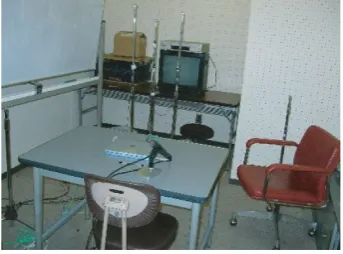
We performed the experiment in the room shown inFigure 6
our experiments, the room was set up as the seminar room shown inFigure 6with a whiteboard beside the left wall, one table and some chairs in the center of the room, one TV and some other tables, and so forth.
In our method, the estimated speaker position should be used to determine the area (60 cm×60 cm) in which the speaker should be. It has been shown in [25] that an aver-age location error of less than 10 cm could be achieved using only 4 microphones in a room measuring 6 m×10 m×3 m, in which source positions are uniformly distributed in 6 m×6 m area. In our past study [22], we also revealed that the speaker position could be estimated with estimation errors of 20– 25 cm by the 4 T-shaped microphone system as shown in
Figure 5without interpolation between consecutive samples. In the present study, therefore, we assumed that the position area was accurately estimated, and we purely evaluated only our proposed speech recognition methods.
Twenty male speakers uttered 200 isolated words, each with a close microphone. The average time of all utterances was about 0.6 second. For the utterances of each speaker, the first 100 words were used as test data and the rest for es-timation of cepstral mean Cposition in (7) and (10). All the utterances were emitted from a loudspeaker located in the center of each area and recorded for test and estimation of Cposition to simulate the utterances spoken at various posi-tions. The sampling frequency was 12 kHz. The frame length was 21.3 ms, and the frame shift was 8 ms with a 256-point Hamming window. Then, 116 Japanese speaker-independent syllable-based HMMs (strictly speaking, mora-unit HMMs [26]) were trained using 27992 utterances read by 175 male speakers (JNAS corpus). Each continuous-density HMM had 5 states, 4 with pdfs of output probability. Each pdf consisted of 4 Gaussians with full-covariance matrices. The feature space was comprised of 10 MFCCs. First- and second-order derivatives of the cepstrums plus first and second derivatives of the power component were also included.
5.2. Recognition experiment by single microphone
5.2.1. Recognition experiment for speech emitted by a loudspeaker
We conducted the speech recognition experiment of isolated words emitted by a loudspeaker using a single microphone in a distant environment.
The recognition results are shown inTable 1. The pro-posed method is referred to as PDCMN (position-dependent CMN). InTable 1, the average results obtained by the 4 in-dependent microphones shown inFigure 5are indicated. In
Table 1, PDCMN is compared with the baseline (recognition without CMN), conventional CMN, “CM of area 5,” and PICMN (position-independent CMN). Area 5 is in the center of all 12 areas, and “CM of area 5” means that a fixed cepstral mean (CM) in the central area was used to compensate for the input features of all 12 areas. PICMN means the method by which the averaged compensation parameters over 12 ar-eas were used. Without CMN, the recognition rate was dras-tically degraded according to the distance between the sound
Figure6: Experimental environment.
Table1: Recognition results emitted by a loudspeaker (average of results obtained by 4 independent microphones: %).
Area W/O Conv. CM of PICMN PDCMN
CMN CMN area 5
1 86.3 92.8 94.2 95.0 95.7
2 95.4 95.7 97.4 97.7 97.4
3 94.3 94.6 96.8 97.1 96.8
4 87.4 92.9 93.1 94.6 95.6
5 92.1 93.8 96.3 96.0 96.3
6 90.9 93.2 95.2 96.1 95.9
7 89.0 92.4 94.3 94.8 95.7
8 91.4 91.4 93.8 94.1 94.7
9 92.3 93.1 95.9 96.4 96.0
10 84.9 90.0 90.5 91.8 93.5
11 86.9 90.9 91.7 93.2 94.1
12 85.9 89.8 90.9 93.3 93.3
Average 89.7 92.5 94.2 94.9 95.4
source and the microphone. Conventional CMN could not obtain enough improvement because the average duration of all utterances was too short (about 0.6 second). By compen-sating the transmission characteristics using the compensa-tion parameters measured a priori, all CM of area 5, PICMN, and PDCMN effectively improved the performance of speech recognition from without CMN and conventional CMN.
In a distant environment, the reflection may be very strong and may be very different depending on the given ar-eas, so the difference of transmission characteristics in each area should be very large. In other words, obstacles caused complex reflection patterns depending on the speaker po-sitions. The proposed PDCMN could also achieve more ef-fective improvement than “CM of area 5” and PICMN. The PDCMN achieved a relative error reduction rate of 55.3% from without CMN, 38.7% from conventional CMN, 20.7% from CM of area 5, and 9.8% from PICMN, respectively. The experimental result also shows that the greater the distance between the sound source and the microphone, the greater the improvement.
Table2: Recognition results of human utterances (results obtained by microphone 1 shown inFigure 5(%)).
Area W/O CMN Conv. CMN CMN by human
utterances
CMN by utterances
from a loudspeaker Proposed method
5 95.8 94.6 96.6 96.0 96.8
9 93.4 90.6 94.4 91.2 94.2
10 84.8 83.8 89.8 83.0 90.0
Average 91.3 89.7 93.6 90.1 93.7
Extended area Original area
1 2 3
4 5 6
7 8 9
10 11 12
Figure7: Extended area.
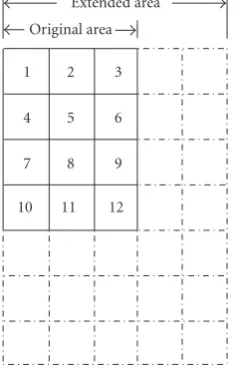
be much larger. So, we assume the extended area described in
Figure 7and then the area 12 of the original area correspond to the center of the extended area. We used “CM of area 12” to compensate the utterances emitted from area 1 to simulate the extended area. The result degraded from 94.2% (CM of area 5) to 92.9%. This was much inferior to that of PDCMN (95.7%). These results indicated that the proposed method works much better in the larger area. This degradation means a larger variation of the transmission characteristics, and this variation must cause the degradation of the performance of PICMN.
5.3. Recognition experiment of speech uttered
by humans
We also conducted experiments with real utterances spoken by humans using a single microphone (i.e., microphone 1 in
Figure 5in this case).
The utterances were directly spoken by 5 male speak-ers instead of those emitted from a loudspeaker in the first experiment. The experimental results are shown inTable 2, in which “CMN by human utterances” means the result of CMN with the cepstral means of real utterances recorded along with the test set (i.e., the ideal case). “CMN by utter-ances from a loudspeaker” means the result of CMN with the cepstral means of utterances emitted by a loudspeaker. The “proposed method” is the result of the proposed CMN given
by (10) which compensated for the mismatch between hu-man (real) and loudspeaker (simulator). In the cases of CMN by human utterances and proposed method, we estimated the compensation parameters for a certain speaker from the utterances by the other 4 persons. We also conducted recog-nition experiments without CMN and with conventional CMN. Since the utterances were too short (about 0.6 s) to estimate the accurate cepstral mean, conventional CMN was not robust in this case. InTable 1, the utterances were emitted by a loudspeaker whose distortion is relatively large. Hence, the gain of compensating these transmission characteristics is greater than the loss caused by the inaccurate cepstral mean estimated by short utterances. Conventional CMN worked better than without CMN. On the contrary, inTable 2, the utterances were spoken by humans, so the transmission char-acteristics were much smaller than those in Table 1. Then the degradation caused by the inaccurately estimated cepstral mean became dominant, and the conventional CMN worked even worse than without CMN. The results show that the proposed method could approximate the CMN with the hu-man cepstral mean and was better than the CMN with the loudspeaker cepstral mean.
5.4. Experimental results for multiple-microphone
speech processing
The experiments in Section 5.3 showed that the proposed method given by (10) could well compensate for the mis-match between voices from humans and the loudspeaker. For convenience’s sake, we used utterances emitted from a loud-speaker to evaluate the multiple-microphone speech process-ing methods.
The recognition results of a single microphone and mul-tiple microphones are compared in Table 3. The multiple-microphone processing methods described in Section 4.1
Table3: Comparison of recognition accuracy of single microphone with multiple microphones using multiple decoders (%).
Single Multiple microphones
micro-VM MSLM Beamforming VM + MSLM +
phone Array 1 Array 2 Array 3 Array 4 Array 5 beamforming beamforming
W/O CMN 89.7 91.3 91.6 90.9 91.3 91.3 91.0 91.4 91.9 91.9
Conv. CMN 92.5 94.2 94.5 93.5 93.3 93.3 93.4 93.6 94.1 94.2
PICMN 94.9 96.0 96.2 95.7 96.1 95.8 96.0 96.1 96.3 96.4
PDCMN 95.4 96.4 96.6 96.2 96.3 96.2 96.1 96.4 96.7 96.8
Table4: Comparison of recognition accuracy of multiple microphone-array processing using single decoder with that using multiple de-coders (%).
Multiple decoders (seeTable 3) Single decoder
VM + MSLM + Full-mixture+ Single-mixture+
beamforming beamforming beamforming beamforming
Recognition rate
W/O CMN 91.9 91.9 93.0 92.0
Conv. CMN 94.1 94.2 93.9 92.9
PICMN 96.3 96.4 96.5 96.1
PDCMN 96.7 96.8 96.9 96.6
Computation ratio 5 5 3.58 1.77
proved more robust than the VM in almost all cases because the summation of the likelihoods can be seen as the potential confidence of all channels. The proposed PDCMN achieved more efficient improvement than PICMN by using multiple microphones. In the case of MSLM combining with beam-forming, PDCMN achieved a relative error reduction rate of 11.1% from PICMN. Both PDCMN and PICMN could improve speech recognition performance significantly more than without CMN and conventional CMN. It is not neces-sary for PICMN to estimate the speaker postion. Therefore, PICMN may also be a good choice because it simplifies sys-tem implementation.
As described in Section 4.2, the computational cost of multiple-microphone processing using multiple decoders given by (13) is 5 (the number of microphone arrays) times that of a single channel. Experiments were also conducted on afull-mixture single-decoder processinggiven by (14) and single-mixture single-decoder processing given by (15). The computational costs offull-mixture single-decoder processing and single-mixture single-decoder processing are 3.58 times and 1.77 times that of a single channel, respectively. The recognition results of the multiple microphone-array pro-cessing using the multiple decoders and single decoder are shown inTable 4. Since the multiple microphone-array pro-cessing using thefull-mixture single decoderselected a max-imum likelihood of each input sequence at every frame, it achieved slightly more improvement than the multiple microphone-array processing using the multiple decoders. The multiple microphone-array processing using the single-mixture single decoder reduced computational cost about 50% more than that using the full-mixture single decoder. In theory, the improvement of computational complexity between thesingle-mixture single-decoder processingand the
multiple-microphone processing using the multiple decoders is determined by the number of inputsKand the number of Guassian mixturesM, as decribed inSection 4.2. The larger the number of Gaussian mixtures was, the greater the reduc-tion of computareduc-tional cost became. In our experiments, the number of Gaussian mixtures was 4. Comparing the results in Tables3and4, the delay-and-sum beamforming using the single-mixture single decoder based on position-dependent CMN achieved a 3.0% improvement (46.9% relative error re-duction rate) over the delay-and-sum beamforming based on conventional CMN with 1.77 times the computational cost.
6. CONCLUSION AND FUTURE WORK
Vot-ing methodand theMaximum-summation-likelihood method was used to obtain robust distant speech recognition. To reduce the computational cost, the output probability of each input was calculated at frame level, and a single de-coder using these output probabilities was used to perform speech recognition. Furthermore, we combined delay-and-sum beamforming withmultiple-decoder processingor single-decoder processing. The proposed multiple microphone-array using the single decoder achieved a significant improvement over the single-microphone array. Combining the multiple microphone-array using the single decoder with position-dependent CMN, a 3.0% improvement (46.9% relative error reduction rate) over the delay-and-sum beamforming with conventional CMN was achieved in a real environment at 1.77 times the computational cost.
In future work, we will integrate the speaker position esti-mation with our speech recognition methods. Furthermore, we will also attempt to track a moving speaker and expand our speech recognition method to accommodate an adverse acoustic environment.
REFERENCES
[1] B. H. Juang and F. K. Soong, “Hands-free telecommunica-tions,” inProceedings of the International Workshop on Hands-Free Speech Communication (HSC ’01), pp. 5–10, Kyoto, Japan, April 2001.
[2] M. Omologo, M. Matassoni, P. Svaizer, and D. Giuliani, “Ex-periments of hands-free connected digit recognition using a microphone array,” inProceedings of the IEEE Workshop on Au-tomatic Speech Recognition and Understanding, pp. 490–497, Santa Barbara, Calif, USA, December 1997.
[3] T. B. Hughes, H.-S. Kim, J. H. DiBiase, and H. F. Silverman, “Performance of an HMM speech recognizer using a real-time tracking microphone array as input,” IEEE Transactions on Speech and Audio Processing, vol. 7, no. 3, pp. 346–349, 1999. [4] T. Takiguchi, S. Nakamura, and K. Shikano,
“HMM-separation-based speech recognition for a distant moving speaker,”IEEE Transactions on Speech and Audio Processing, vol. 9, no. 2, pp. 127–140, 2001.
[5] M. L. Seltzer, B. Raj, and R. M. Stern, “Likelihood-maximizing beamforming for robust hands-free speech recognition,”IEEE Transactions on Speech and Audio Processing, vol. 12, no. 5, pp. 489–498, 2004.
[6] S. Furui, “Cepstral analysis technique for automatic speaker verification,”IEEE Transactions on Acoustics, Speech, and Sig-nal Processing, vol. 29, no. 2, pp. 254–272, 1981.
[7] F. Liu, R. M. Stern, X. Huang, and A. Acero, “Efficient cepstral normalization for robust speech recognition,” inProceedings of the ARPA Speech and Natural Language Workshop, pp. 69–74, Princeton, NJ, USA, March 1993.
[8] N. Kitaoka, I. Akahori, and S. Nakagawa, “Speech recogni-tion under noisy environments using spectral subtracrecogni-tion with smoothing of time direction and real-time cepstral mean nor-malization,” inProceedings of the International Workshop on Hands-Free Speech Communication (HSC ’01), pp. 159–162, Kyoto, Japan, April 2001.
[9] S. Doclo and M. Moonen, “Robust adaptive time delay estima-tion for speaker localizaestima-tion in noisy and reverberant acoustic environments,”EURASIP Journal on Applied Signal Processing, vol. 2003, no. 11, pp. 1110–1124, 2003.
[10] C. H. Knapp and G. C. Carter, “The generalized correlation method for estimation of time delay,”IEEE Transactions on Acoustics, Speech, and Signal Processing, vol. 24, no. 4, pp. 320– 327, 1976.
[11] M. Omologo and P. Svaizer, “Acoustic source location in noisy and reverberant environment using CSP analysis,” in Proceed-ings of the IEEE International Conference on Acoustics, Speech, and Signal Processing (ICASSP ’96), vol. 2, pp. 921–924, At-lanta, Ga, USA, May 1996.
[12] L. Wang, N. Kitaoka, and S. Nakagawa, “Robust distant speech recognition based on position dependent CMN using a novel multiple microphone processing technique,” inProceedings of the 9th European Conference on Speech Communication and Technology (EUROSPEECH ’05), pp. 2661–2664, Lisbon, Por-tugal, September 2005.
[13] B. Van Veen and K. Buckley, “Beamforming: a versatile ap-proach to spatial filtering,”IEEE ASSP Magazine, vol. 5, no. 2, pp. 4–24, 1988.
[14] T. Yamada, S. Nakamura, and K. Shikano, “Distant-talking speech recognition based on a 3-D Viterbi search using a mi-crophone array,”IEEE Transactions on Speech and Audio Pro-cessing, vol. 10, no. 2, pp. 48–56, 2002.
[15] J. Flanagan, J. Johnston, R. Zahn, and G. W. Elko, “Computer-steered microphone arrays for sound transduction in large rooms,”The Journal of the Acoustical Society of America, vol. 78, no. 5, pp. 1508–1518, 1985.
[16] Y. Huang, J. Benesty, G. W. Elko, and R. M. Mersereau, “Real-time passive source localization: a practical linear-correction least-squares approach,”IEEE Transactions on Speech and Au-dio Processing, vol. 9, no. 8, pp. 943–956, 2001.
[17] M. Brandstein,A framework for speech source localization using sensor arrays, Ph.D. thesis, Brown University, Providence, RI, USA, 1995.
[18] J. DiBiase, H. Silverman, and M. Brandstein, “Robust local-ization in reverberant rooms,” inMicrophone Arrays: Signal Processing Techniques and Applications, chapter 8, pp. 157–180, Springer, Berlin, Germany, 2001.
[19] V. Raykar, B. Yegnanarayana, S. Prasanna, and R. Duraiswami, “Speaker localization using excitation source information in speech,”IEEE Transactions on Speech and Audio Processing, vol. 13, no. 5, pp. 751–760, 2005.
[20] Y. Bard,Nonlinear Parameter Estimation, Academic Press, New York, NY, USA, 1974.
[21] W. Foy, “Position-location solutions by Taylor-series estima-tion,”IEEE Transactions on Aerospace and Electronic Systems, vol. 12, no. 2, pp. 187–194, 1976.
[22] L. Wang, N. Kitaoka, and S. Nakagawa, “Distant speech recog-nition based on position dependent cepstral mean normaliza-tion,” inProceedings of the 6th IASTED International Confer-ence on Signal and Image Processing (SIP ’04), pp. 249–254, Honolulu, Hawaii, USA, August 2004.
[23] L. Wang, N. Kitaoka, and S. Nakagawa, “Robust distant speech recognition based on position dependent CMN,” in Proceed-ings of the 9th International Conference on Spoken Language Processing (ICSLP ’04), pp. 2409–2052, Jeju Island, Korea, Oc-tober 2004.
[26] S. Nakagawa, K. Hanai, K. Yamamoto, and N. Minematsu, “Comparison of syllable-based HMMs and triphone-based HMMs in Japanese speech recognition,” inProceedings of the IEEE Workshop on Automatic Speech Recognition and Under-standing, pp. 393–396, Keystone, Colo, USA, December 1999.
Longbiao Wang received his B.E. degree from Fuzhou University, China, in 2000 and an M.E. degree from Toyohashi University of Technology, Japan, in 2005. He is now a Ph.D. student at Toyohashi University of Technology, Japan. From July 2000 to Au-gust 2002, he had been working at the China Construction Bank. His research interests include robust speech recognition, speaker recognition, and source localization. He is
a Member of the Institute of Electronics, Information and Com-munication Engineers (IEICE), and the Acoustical Society of Japan (ASJ).
Norihide Kitaoka received his B.E. and M.E. degrees from Kyoto University in 1992 and 1994, respectively, and a Dr. Engineer-ing degree from Toyohashi University of Technology in 2000. He joined Denso Cor-poration, Japan, in 1994. He then joined the Department of Information and Computer Sciences at Toyohashi University of Tech-nology as a Research Associate in 2001 and has been a Lecturer since 2003. His research
interests include speech processing, speech recognition, and spoken dialog. He is a Member of the IEICE, the Information Processing Society of Japan (IPSJ), the ASJ, and the Japan Society for Artificial Intelligence (JSAI).
Seiichi Nakagawa received his B.E. and M.E. degrees from the Kyoto Institute of Technology, in 1971 and 1973, respectively, and Dr. of Engineering degree from Kyoto University in 1977. He joined the Faculty of Kyoto University, in 1976, as a Research As-sociate in the Department of Information Sciences. From 1980 to 1983, he had been an Assistant Professor, and from 1983 to 1990 he had been an Associate Professor. Since