Volume 2006, Article ID 60796, Pages1–11 DOI 10.1155/ASP/2006/60796
Subpixel Registration Directly from the Phase Difference
Murat Balci and Hassan Foroosh
School of Computer Science, University of Central Florida, Orlando, FL 32816, USA Received 1 December 2004; Revised 31 May 2005; Accepted 21 June 2005
This paper proposes a new approach to subpixel registration, under local/global shifts or rotation, using the phase-difference matrix. We establish the exact relationship between the continuous and the discrete phase difference of two shifted images and show that their discrete phase difference is a 2-dimensional sawtooth signal. As a result, the exact shifts or rotations can be determined to subpixel or subangle accuracy by counting the number of cycles of the phase-difference matrix along the frequency axes. The subpixel portion is represented by a fraction of a cycle corresponding to the noninteger part of the shift or rotation. The rotation angle is estimated by applying our method using a polar coordinate system. The problem is formulated as an overdetermined system of equations and is solved by imposing a regularity constraint. The tradeofffor imposing the constraint is determined by exploiting the rank constraint leading to a closed-form expression for the optimal regularization parameter.
Copyright © 2006 Hindawi Publishing Corporation. All rights reserved.
1. MOTIVATION
Registration is a crucial step in the analysis and fusion of in-formation between multiple images. Examples can be found in remote sensing, robotics, and biomedical imaging, among others [1–3]. Some applications, such as coding and com-pression registration, need to be established locally, while other applications require only global registration. In this paper, we are particularly motivated by applications that re-quire registration at subpixel accuracy. An important exam-ple of such applications is multi-frame super-resolution [4– 20], which aims to combine several degraded low-resolution images into a single high-resolution image in order to ap-proach the Nyquist rate.
The key to success in these multiframe super-resolution techniques is the accurate registration with subpixel pre-cision. Essentially, subpixel registration is the step that al-lows merging the samples of the low-resolution data in a denser grid. In the absence of subpixel registration and fusion, the super-resolution problem would essentially re-duce to that of classical deconvolution. Among existing sub-pixel registration techniques, Fourier domain methods [21– 25] and also closely related spatial domain variations [26] are an important class of registration techniques that have gained popularity due to their remarkable accuracy. Most of these methods are in fact variations of the original phase-correlation method [27]. For instance, in [21], Foroosh et al. demonstrated how the method can be extended to subpixel accuracy, in [25] Stone et al. investigated the
ef-fect of aliasing error, and in [23] Hoge describes how the shift parameters can be decoupled in the dominant left and right eigenvectors of the phase-correlation matrix (not the phase-difference matrix) using its rank-one con-straint.
This paper revisits the concepts underlying the phase-correlation method and shows how these methods are inter-related. By deriving an exact model for the phase difference of two discrete shifted images, we show that for shifted images (or for rotated images if we work with polar coordinates) the discrete phase-difference matrix is a 2-dimensional sawtooth signal. This in particular leads to a simple solution directly from the phase-difference matrix in the form of an overde-termined system of linear equations. The overdeoverde-termined na-ture of the formulation allows for handling random noise. In the next section, in order to describe the algorithms in the discrete domain, we will discuss the concepts and the theory that are commonly borrowed from the continuous domain. We then argue inSection 3that the continuous domain rep-resentation is rather misleading, and that a proper represen-tation can be derived directly in the discrete domain. Once an exact model is known, the formulation of the problem becomes straightforward as described in the subsequent sec-tions.
2. BACKGROUND
Consider two continuous signals f1(x,y) and f2(x,y)=f1(x
−xo,y−yo), whose Fourier transforms exist (i.e., are square
integrable). Their cross-power spectrum (also known as the phase correlation) is then given by
c(u,v)= f1f2∗
f1f2∗
=exp−ixou−iyov
, (1)
where the hat sign indicates the Fourier transform and the asterisk stands for the complex conjugate.
This result follows immediately from the Fourier shift property, which states that the translations in the spatial do-main lead to linear phase differences between the two signals along each frequency axis, that is,1
ϕ(u,v)=∠c(u,v)=xou+yov, (2)
which is a planar surface through the origin. As a result, the spatial translations can be determined by inverse transform-ing c(u,v), which leads a Dirac delta function centered at (xo,yo).
A discrete interpretation of this result is used in practice for image registration [27,28], which yields very good re-sults. In the discrete case, the shift parameters are similarly determined by inverse transforming the discrete cross-power spectrum, which yields a unit impulse centered at (xo,yo).
This, of course, is true only for pixel displacements. For shifts that include subpixel components, additional results are de-rived in [21].
When applying this approach locally, within a small win-dow size, the estimation of local motion becomes inaccurate and dominated by noise. The main cause for this is due to the fact that the Fourier transform is an operator that cannot localize signals both in space and frequency. As a result, the noise process and the aliasing errors, which often are local-ized at the high-frequency components of the Fourier spec-trum, become dispersed in the spatial domain upon inver-sion ofc(u,v).
A possible approach to overcome this problem is there-fore to avoid inverse transforming the cross-power spectrum and try to estimate the shifts directly in the Fourier domain, typically by also applying the method within a window of smaller size and smooth shape [23,25]. A practical solution for estimating registration directly in the Fourier domain was first proposed by Hoge [23]. His method requires the follow-ing two steps prior to computfollow-ing the shifts:
(i) a subspace approximation of the noisy phase-correlation matrix (not the phase difference) to im-pose a rank-1 constraint,
1Note that, throughout the paper, we call exp(−ix
ou−iyov) the
phase-correlation function andϕ(u,v) =∠c(u,v) the phase-difference func-tion. Similarly, their discrete counterparts are referred to as the discrete phase-correlation matrix and the discrete phase-difference matrix, re-spectively.
(ii) unwrapping of the dominant left and right eigenvec-tors.
He then estimates the shift parameters using the slopes of these unwrapped eigenvectors.
It is worth noting that 2-dimensional phase unwrap-ping is a notoriously ill-posed problem. This is perhaps why Hoge proposed to perform the unwrapping step on the 1-dimensional dominant eigenvectors of the phase-correlation matrix rather than directly on the phase-difference matrix itself. We will show below that due to the special shape of the phase-difference matrix, its unwrapped version has to be rank 2. As a result, the unwrapping process becomes separa-ble along the two frequency axes. In other words, it reduces to two 1-dimensional unwrapping steps. Therefore, very good results may also be found without subspace approximation. We will also show that even phase unwrapping is an un-necessary step since we will determine the exact paramet-ric shape of the discrete phase-difference matrix by examin-ing the relationship between the discrete and the continuous cases. This exact relationship allows for determining the reg-istration parameters by simply fitting a model directly to the phase-difference matrix.
3. RELATION BETWEEN DISCRETE AND CONTINUOUS PHASE DIFFERENCES
From (2), the phase difference of the underlying continu-ous signals has the following representation in the spatial do-main:
ϕ(x,y)=
∞
−∞
x0u+yov
exp(iux+ivy)du dv (3)
= −ixodδ
(x)
dx −iyo
dδ(y)
dy , (4)
where the derivatives are understood in the distributional sense [29].
Although inverse transforming the phase-difference function in this way may not be customary, it facilitates our understanding of the relationship between the continuous and the discrete phase difference. In particular, this will lead to an exact parametric model of the discrete phase-difference matrix, as shown below.
From bandlimited sampling theory and (4), it follows that the spatial domain representation of a component of the discrete phase-difference matrix is given by
ϕkl= −ixo πk
2 sinc k xo−2 cos
πk xo
−iyπlo
2 sinc l
yo −2 cos πl yo
.
(a) (b)
50 100 150 200 250 300 350 400 450 450
400 350 300 250 200 150 100 50
(c)
50 100 150 200 250 300 350 400 450 450
400 350 300 250 200 150 100 50
(d)
0 50 100 150 200 250 300 350 400 450
−4
−3
−2
−1 0 1 2 3
4 One cycle
7.3 Cycles
(e)
0 50 100 150 200 250 300 350 400 450
−4
−3
−2
−1 0 1 2 3 4
(f)
Figure1: (a), (b) Two aerial images with some shifts, (c) noisy sawtooth phase-difference matrix corresponding to shifts of (7.3,5.6) pixels, (d) noisy sawtooth phase-difference matrix corresponding to shifts of (30.5,25.4) pixels, and (e), (f) one row of the phase-difference matrices shown in (c) and (d), respectively.
On the other hand, note that
iϕkl= x 2 o π2k2
2 sinπk xo −2
πk xo cos
πk xo
+π y
2 o π2l2
2 sinπl yo −
2πl yo
cosπl yo
(6)
=xo π
2 2π/xo
π/xo
−π/xousinku du
+ yo π
2 2π/yo
π/yo
−π/yovsinlv dv.
(7)
It can also be verified that
xo π
2 2π/xo
π/xo
−π/xoucosku du
+ yo π
2 2π/yo
π/yo
−π/yovcoslv dv=0
(8)
and similarly,
xo π
2 2π/xo
π/xo
−π/xou du+
yo π
2 2π/yo
π/yo
−π/yov dv=0. (9)
From (7), (8), and (9), and using the definition of the dis-crete Fourier transform (DFT) based on Fourier series [30],
it follows immediately upon substitutingu= n(2π/N) and v =m(2π/M) thatϕklis a DFT coefficient of the following
discrete periodic signal:
φmn=2π N
xon+JN xo
+2π M
myo+KM yo
, (10)
whereJandKare arbitrary integers.
In other words, the discrete phase-difference matrix for a pair of shifted images is given by
Φ= φmn
, (11)
wherem=0,. . .,M−1 andn=0,. . .,N−1.
approximation can be disregarded. But even a more inter-esting conclusion that can be drawn from the above result is that unwrapping is also an unnecessary step for registra-tion.
For this purpose, note how the period of the sawtooth signal along each axis determines the shifts along corre-sponding axis: the period along theu-axis isN/xo, and hence
there arexorepeated cycles along each row of the phase
dif-ference, wherexomay or may not be an integer. Whenxois
not an integer, the number of repeated cycles in a row is given by the integer part ofxoplus a fraction of a cycle defined by
the noninteger portion ofxo. A similar argument applies to
the columns ofΦ. This process of counting the number of cycles along the rows and columns of the phase-difference matrix is essentially all that is required to determine the local or the global shifts. The challenge of course is to determine the exact fractional portion of the repeated cycles. In the next two sections, we will design a linear estimator for this prob-lem.
4. PROBLEM FORMULATION
As indicated above, the key to solve the problem is to find how many cycles of the discrete sawtooth phase difference fit in the range [0, 2π] along each frequency axis. The number of cycles, that is,xoandyo, may or may not be integer values
and are given by
xo=
cycles 2π =
N 2π
dΦ(m,n) dn
yo=
cycles 2π =
M 2π
dΦ(m,n) dm .
(12)
Due to noise and other sources of error, however, counting the number of cycles per 2π using (12) may lead to inaccu-rate results. To overcome this problem, we exploit the fact that a total ofM×Ndata points are available for regression. Therefore, an accurate solution can be obtained by minimiz-ing an appropriate error function, that is, by solvminimiz-ing a largely overdetermined problem of fitting the parameters to the data set.
For this purpose note that the 2D sawtooth signal Φ has constant slopes for the vast majority of frequencies along each row or each column, except for a small number of frequencies, where discontinuities occur. As depicted in Figure 1(e), visually we use a landmark point of the cycle to count the number of cycles along each row or each column. This idea can be implemented as follows. A particular useful landmark point is the zero-crossing of the phase-difference matrix, whereφmn =0. Since the same set of zero-crossings
can be independently obtained by scanning along the rows or columns, we can fixJ =0 in (10), and after some algebraic manipulations obtain
ncosθ+msinθ+ρ=0, (13)
where
tanθ= N yo
Mxo, ρ=K M
yosinθ. (14)
This shows that the zero-crossings are represented by a family of lines in the phase space parameterized byK—that is, each integer value ofKwould give a different line along which the phase difference is zero. Each line itself is parameterized by the angleθand its distanceρfrom the center frequency (i.e., the origin of the frequency domain). This set of zero-crossing lines form a function that is ideal for detection using Hough transform. The Hough transform basically maps these lines to a parameter space of (θ,ρ). As can be verified from the above derivations,θremains invariant among all lines andρ varies as integer multiples of some other invariant parameter, that is,ρ=Kρo. Therefore in the Hough-transform domain
(i.e., in the Hough matrix), we expect to see a set of peak val-ues situated at equal distances from each other, and parallel to theρ-axis.Figure 2shows an example of the Hough trans-form of the zero-crossing of the phase-difference matrix of two shifted images, where the peaks can be clearly identified by a simple thresholding process. As is customary in Hough transform, we used the local maxima for finding a suitable threshold value. In our case, since all the peaks are known to be aligned parallel to theρ-axis, we took the maximum of the Hough matrix for eachρas the local maximum. This yields a curve similar to the one shown inFigure 2(b). We then used the average of the local maxima curve as a threshold.
The problem now reduces to estimating (xo,yo) from
these peak values in the Hough transform domain. For this purpose note that by combining (14), we can obtain the fol-lowing linear constraint onxoandyo:
ρ cosθxo+
ρ
sinθyo=K(M+N). (15)
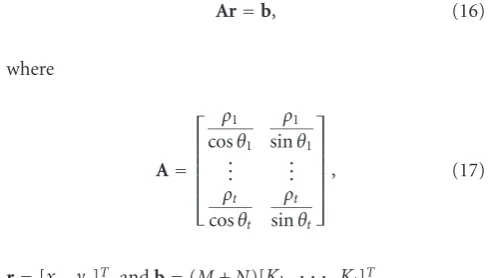
Each peak point in the Hough-transform domain provides one such linear constraint onxoandyo. Given a total oftsuch
peak values, we can construct a system of linear equations of the form
Ar=b, (16)
where
A=
⎡ ⎢ ⎢ ⎢ ⎢ ⎢ ⎣
ρ1
cosθ1
ρ1
sinθ1
.. . ... ρt
cosθt ρt
sinθt
⎤ ⎥ ⎥ ⎥ ⎥ ⎥
⎦, (17)
r=[xo yo]T, andb=(M+N)[K1 · · · Kt]T.
0 20 40 60 80 100 120 140 160 Angle (θ)
150 100 50 0 −50 −100 −150 Distanc e fr o m the ce n te r ( ρ ) (a)
0 100 200 300 400 500 600 ρ 0 50 100 150 200 250 Lo cal m axi m a Average (b)
0 20 40 60 80 100 120 140 160 Angle (θ)
150 100 50 0 −50 −100 −150 Distanc e fr o m the ce nt er ( ρ )
R >50
(c)
Figure2: (a) The Hough transform of the phase discontinuities, (b) the local maxima and the threshold, and (c) the peaks detected by thresholding.
5. PROPOSED SOLUTION
In order to solve the overdetermined system of equations in (16), we formulate it as the following constrained optimiza-tion problem
ropt=arg minAr−b+λLr, (18)
whereλis the regularization parameter, andLis such that
LTL=
2 −1 −1 2
. (19)
This choice of L [31] implies that our a priori belief is that our solution should be constant over all equations in the system, that is, the equations should be consistent with each other. The formulation in (18) is basically a Tikhonov-Arsenin norm-regularization of the least-squares solution to the problem in (16). The first term imposes the faithfulness to data and the second term the regularity. The solution is given by
ropt=
ATA+λLTL−1ATb. (20)
We now have the solution given by (20) up to an unknown regularization parameter. The optimal value of this param-eter is given by the method of generalized cross validation (GCV), which amounts to minimizing
GCV(λ)=
I−AATA+λLTL−1ATb2
trI−AATA+λLTL−1AT2
(21)
with respect toλ, where tr(·) is the trace of a matrix. The minimizer of (21) is usually obtained using numer-ical techniques by making simplifying assumptions, for ex-ample, circulantAandL, or by using numerical techniques such as quadrature rules and Lanczos algorithm [32]. How-ever, in our case, due to the rank constraint of A, we can find a simplified closed-form solution. For this purpose, let P=I−A(ATA+λLTL)−1AT. The GCV function can then be
written as
GCV(λ)=Pb2
tr(P)2. (22) Upon rearrangingPas follows:
P=I−AL−1LATA+λLTL−1LTL−TAT
=I−AL−1L−TATAL−1+λL−TLTLL−1−1L−TAT =I−KKTK+λI−1KT
(23)
and applying the matrix inversion lemma, we find
P=
I+1 λKK
T
−1
, (24)
whereK=AL−1.
Now, let
KKT =VΣVT = t
j=1
σjvjvTj (25)
be the eigen decomposition of KKT, where v
j’s are the
columns ofVthat form a set of orthonormal basis, andσj’s
are the corresponding eigenvalues.Pcan then be written as
P= t
j=1
λ λ+σj
vjvTj
=
2
j=1
λ λ+σj
vjvTj + t
j=3
vjvTj,
(26)
where the last equality follows from the fact thatAis rank 2. In order to simplify the GCV function in (22), we make a first-order approximation of the rank-2 matrixKKT using
its largest eigenvalueKKT σ
1v1v1T. In practice, we found
that the dominant eigenvalue is usually orders of magnitude larger than the second eigenvalue (see the appendix for more formal discussions). Therefore
GCV(λ)
λ/(λ+σ1)
2
s21+
t
j=2s2j
t−1 +λ/λ+σ1
Figure3: Some of the images used for simulation.
where sj are the components of the vector VTb =
[s1 s2 · · · st]T.
Differentiating this equation with respect toλand setting it equal to zero, we find after simplification that the optimal regularization parameter is given by
λ∗= σ1
t
j=2s2j
(t−1)s2 1−
t
j=2s2j
. (28)
Using (20) and (28), we can compute the optimal solu-tions forxoandyo.
6. EXPERIMENTAL RESULTS
We applied the technique to both the global subpixel regis-tration problem and the local motion estimation. We also applied our approach to rotated images using polar coor-dinate transformation. The experimentations included both synthetically generated shifts and real data with and without ground truth. In all cases, very good results were obtained. We used the synthetic simulations to evaluate our approach under various conditions.
For global registration, we synthetically generated the shifts by filtering and downsampling shifted versions of a high-resolution image. Using appropriate combinations of these operations, shifts with subpixel contents were pro-duced.Figure 3shows some of the images to which the tech-nique was applied. Results are shown inTable 1and are com-pared to those reported in [21]. The accuracy was predom-inantly higher than [21], which we attribute to the largely overdetermined nature of the problem in the proposed ap-proach. This of course introduces resiliency to random noise (assuming that random noise is zero-mean and has a well-behaved distribution).
As for random noise, it is worth noting that in many practical problems, dealing with data obtained from real imaging instrumentation, one may typically have the high-frequency portion of the phase-difference matrix cluttered and highly corrupted with noise. Figure 4shows an exam-ple of such phase-difference matrix. This in practice does not introduce a major difficulty in our algorithm, since similar to [23,25], we can apply our algorithm within a window in the low-frequency portion by cropping out the lower frequencies
Table1: Results for global shifts of the images inFigure 3.
Image True Foroosh et al. Proposed
shifts [21] method
Pentagon
(0.50,−0.50) (0.48,−0.51) (0.496,−0.493) (0.25, 0.50) (0.28, 0.49) (0.255, 0.498) (−0.25,−0.50) (−0.25,−0.52) (−0.25,−0.52)
(0.0, 0.75) (0.0, 0.80) (0.0, 0.744)
Paris
(0.167,−0.5) (0.152,−0.49) (0.163,−0.51) (0.67, 0.25) (0.69, 0.33) (0.679, 0.242) (−0.33,−0.167) (−0.32,−0.15) (−0.331,−0.159)
(0.33, 0.33) (0.325, 0.32) (0.333, 0.329)
of the phase-difference matrix. The important remark to re-alize is that, we would then be counting the number of cycles within less than 2π. So for instance (12) (or other equations thereafter) would be adjusted accordingly.
When the data is contaminated with random noise or aliasing, the high-frequency portion of the phase-difference matrix is not useful, and in fact can introduce error in the results. In order to avoid this problem, similar to [23,25], we windowed the Fourier spectra of the images to their low-frequency portion. Therefore, in order to evaluate the per-formance of our approach under noise, we introduced addi-tive Gaussian random noise with standard deviation in the range [0, 5]. We then computed the peak signal-to-noise ra-tio (PSNR) over 100 independent trials as we varied the size of the lowpass window, where we took the true shift value as the peak value of the signal. The results are shown inFigure 4 forσ =5, and lowpass windows of width 10–100. It can be seen that the method is fairly stable over a wide range of win-dow sizes. The SNR for the ycoordinate was better in this experimentation, because the shift along that direction was an integer value.
(a)
0 10 20 30 40 50 60 70 80 90 100110 Window size (pixels)
15 20 25 30 35 40 45 50 55
Av
er
ag
e
S
N
R
x-shift y-shift
(b)
Figure4: (a) A phase-difference matrix corrupted by aliasing and high-frequency noise, (b) average PSNR over 100 independent trials with varying window sizes and the standard deviation of noiseσ=5.
Figure5: Pentagon stereo pair and the estimated local motion.
somewhat subjective. For our real data, however, it is im-portant to note that we used small windows (e.g., of width 15–25) to compute the short-length Fourier transform. This has a very important implication, since unlike global regis-tration, we now have a very small set of linear equations to estimate the parameters.
Essentially, in global registration, we estimate two pa-rameters using a huge number of pixels (i.e., for a 256×256 image,tis typically a very large number). In the case of lo-cal motion estimation, if we for instance use window sizes of 15×15,tis typically reduced by a factor of 300. As a result, it is quite natural to assume that the accuracy will drop. It should be however noted that this comment equally applies to all existing methods in the literature. In order to be able to evaluate how the method performs for varying lengths of short-length Fourier transform, we synthetically gener-ated a stereo pair with known ground truth (seeFigure 8), where the parallax for the house in the image is artificial. We then computed the PSNR for varying range of window sizes of short-length Fourier transform. The plot inFigure 8 shows the result of this experimentation. One can notice that the PSNR reaches the highest value for an optimal window size. Our interpretation is that for local motion, if the win-dow size is too small, then the number of data points will be insufficient to get the optimal result, and if it is too large it
may get dominated by the motion in the neighboring pix-els. This is similar to what is known to as the aperture prob-lem in optical flow. There is in fact an optimal window size for which we get the best tradeoff between the two con-straints.
Figure6: Baseball stereo pair and the estimated local motion.
Figure7: Tsukuba stereo pair and the estimated local motion.
5 10 15 20 25 30 35
Window size (pixels) 0
0.5 1 1.5 2 2.5 3 3.5 4
Av
er
ag
e
S
N
R
x-shift y-shift
Figure8: A synthetic stereo pair and the PSNR as a function of the window size used for short-length Fourier transform in local motion estimation.
7. CONCLUSION
The analyses and the experimentations presented in this pa-per show that accurate results can be obtained for subpixel registration directly in the Fourier domain by counting the number of cycles of the phase-difference matrix. Since no inverse transforming is required, the computational com-plexity is mostly dominated by the forward Fourier trans-form, which isNlogN. There are of course small overheads associated with computing the phase-difference matrix and its Hough transform. In the context of super-resolution, sub-pixel registration directly in the Fourier domain is particu-larly advantageous and of interest for the super-resolution
algorithms that work directly in the Fourier domain. It is also worth mentioning that some sensor modalities naturally provide the Fourier spectrum of the field of view. Examples of such imaging modalities are magnetic resonance imaging (MRI) [34] and synthetic aperture radar (SAR) [35].
APPENDIX
In this appendix we show that the largest singular value of KKTis at least three times the second singular value. For this
20 40 60 80 100 120 140 160 180 Angle (degress)
10090 80 70 60 50 40 30 20 10
D
is
ta
n
ce
to
ce
n
te
r
20 40 60 80 100 120 140 160 180 Angle (degress)
10090 80 70 60 50 40 30 20 10
D
is
ta
n
ce
to
ce
n
te
r
20 40 60 80 100 120 140 160 180 10090
80 70 60 50 40 30 20 10
0 20 40 60 80 100 120 140 160 180
−2.5
−2
−1.5
−1
−0.5 0 0.5 1 1.5 2 2.5
Figure9: Top and middle: stereo pair and their corresponding polar representations; bottom: their phase-difference matrix and one row of the matrix.
(i) The nonzero singular values ofKKT are equal to the
singular values ofKTK.
(ii) The singular values of a real-square symmetric matrix are always real, see [36, Theorem 6.6.3].
It therefore follows that the two nonzero singular values of KKT(which are also the two largest singular values) are given
by the solution of the characteristic polynomial of the 2×2 real-square symmetric matrixKTK, that is,
λ2−trKTKλ+ detKTK=0. (A.1)
The two solutions are given by
λ1=1
2tr
KTK1 + trKTK2−4 detKTK,
λ2=
1 2tr
KTK1− trKTK2−4 detKTK.
(A.2)
SinceKTKis a real-square symmetric matrix, both singular
values have to be real. This implies that
trKTK2
detKTK≥4. (A.3)
First-order Taylor series approximation of these singular val-ues are given by
λ1=
trKTK2−detKTK
trKTK +O 2,
λ2=
detKTK
trKTK +O 2.
(A.4)
The ratio of these two singular values is therefore given by
λ1
λ2 =
trKTK2
detKTK −1. (A.5)
Combining (A.3) and (A.5), we conclude that
λ1
λ2 ≥
0 0.1 0.2 0.3 0.4 0.5 0.6 0.7 0.8 0.9 1 det (KTK)/tr (KTK)2
0 0.1 0.2 0.3 0.4 0.5 0.6 0.7 0.8 0.9 1
Δ
of
char
ac
te
ri
st
ic
eq
uat
ion
True value
Linear approximation (a)
0 0.1 0.2 0.3 0.4 0.5 0.6 0.7 0.8 0.9 1 det (KTK)/tr (KTK)2
0 50 100 150 200 250 300 350 400
λ1 /λ2
Approximated ratio True ratio
(b)
Figure10: (a) Discriminant of the characteristic equation and its linear approximation, (b) ratios of the singular values.
A question that may be raised with regards to this demon-stration is the error involved in the Taylor series truncations and its effect on the results in (A.6). These truncations are ba-sically based on expanding the discriminant of the quadratic characteristic equation of the matrixKTK. We now show that
this truncation is practically unconsequential. Basically, al-though (A.4) have truncation errors, the error in their ratio is extremely negligible.
Instead of giving a formal proof of this claim, we give a graphical proof. Figure 10(a) shows the possible values of the discriminant of the characteristic equation and its linear approximation using first-order Taylor series, where the discriminant of the characteristic equation is plotted against det(KTK)/[tr(KTK)]2(i.e., the independent variable
in the Taylor series expansion). Although the errors grow for small values of the discriminant, the error in the ratio of the two singular values is practically negligible as shown in Figure 10(b).
REFERENCES
[1] L. G. Brown, “A survey of image registration techniques,”ACM Computing Surveys, vol. 24, no. 4, pp. 325–376, 1992. [2] J. B. A. Maintz and M. A. Viergever, “A survey of medical image
registration,”Medical Image Analysis, vol. 2, no. 1, pp. 1–36, 1998.
[3] B. A. Zitov´a and J. Flusser, “Image registration methods: a sur-vey,”Image and Vision Computing, vol. 21, no. 11, pp. 977– 1000, 2003.
[4] J. B. Abbiss, B. J. Brames, and M. A. Fiddy, “Super-resolution algorithms for a modified Hopfield neural network,” IEEE Transactions on Signal Processing, vol. 39, no. 7, pp. 1516–1523, 1991.
[5] K. Aizawa, T. Komatsu, and T. Saito, “A scheme for acquiring very high resolution images using multiple cameras,” in Pro-ceeding of IEEE International Conference on Acoustics, Speech, and Signal Processing (ICASSP ’92), vol. 3, pp. 289–292, San Francisco, Calif, USA, March 1992.
[6] T. E. Boult and G. Wolberg, “Local image reconstruction and subpixel restoration algorithms,” CVGIP: Graphical Models and Image Processing, vol. 55, no. 1, pp. 63–77, 1993.
[7] M. Elad and A. Feuer, “Restoration of a single super-resolution image from several blurred, noisy, and undersampled mea-sured images,”IEEE Transactions on Image Processing, vol. 6, no. 12, pp. 1646–1658, 1997.
[8] S. Farsiu, M. D. Robinson, M. Elad, and P. Milanfar, “Fast and robust multiframe super-resolution,”IEEE Transactions on Im-age Processing, vol. 13, no. 10, pp. 1327–1344, 2004.
[9] H. (Shekarforoush) Foroosh, M. Berthod, J. Zerubia, and M. Werman, “Sub-pixel Bayesian estimation of albedo and height,” International Journal of Computer Vision, vol. 19, no. 3, pp. 289–300, 1996.
[10] M. Irani and S. Peleg, “Improving resolution by image reg-istration,” CVGIP: Graphical Models and Image Processing, vol. 53, no. 3, pp. 231–239, 1991.
[11] D. Keren, S. Peleg, and R. Brada, “Image sequence enhance-ment using sub-pixel displaceenhance-ments,” inProceeding of IEEE Computer Society Conference on Computer Vision and Pattern Recognition (CVPR ’88), pp. 742–746, Ann Arbor, Mich, USA, June 1988.
[12] S. P. Kim, N. K. Bose, and H. M. Valenzuela, “Recursive recon-struction of high resolution image from noisy undersampled multiframes,”IEEE Transactions on Signal Processing, vol. 38, no. 6, pp. 1013–1027, 1990.
[13] W. B. Lim, M. K. Park, and M. G. Kang, “Spatially adap-tive regularized iteraadap-tive high-resolution image reconstruction algorithm,” in Visual Communications and Image Processing (VCIP ’01), vol. 4310 ofProceedings of SPIE, pp. 10–20, San Jose, Calif, USA, January 2001.
[14] M. K. Ng and A. M. Yip, “A fast MAP algorithm for high-resolution image reconstruction with multisensors,” Multidi-mensional Systems and Signal Processing, vol. 12, no. 2, pp. 143–164, 2001.
[16] A. J. Patti, M. I. Sezan, and A. Murat Tekalp, “Super-resolution video reconstruction with arbitrary sampling lattices and nonzero aperture time,”IEEE Transactions on Image Process-ing, vol. 6, no. 8, pp. 1064–1076, 1997.
[17] S. Peleg, D. Keren, and L. Schweitzer, “Improving image res-olution using subpixel motion,” Pattern Recognition Letters, vol. 5, no. 3, pp. 223–226, 1987.
[18] R. R. Schultz and R. L. Stevenson, “Improved definition video frame enhancement,” in Proceeding of IEEE Interna-tional Conference on Acoustics, Speech, and Signal Processing (ICASSP ’95), vol. 4, pp. 2169–2172, Detroit, Mich, USA, May 1995.
[19] H. (Shekarforoush) Foroosh and R. Chellappa, “Data-driven multichannel super-resolution with application to video se-quences,”Journal of Optical Society of America A, vol. 16, no. 3, pp. 481–492, 1999.
[20] R. Y. Tsai and T. S. Huang, “Multiframe image restoration and registration,” inAdvances in Computer Vision and Image Pro-cessing, vol. 1, chapter 7, pp. 317–339, JAI Press, Greenwich, Conn, USA, 1984.
[21] H. (Shekarforoush) Foroosh, J. B. Zerubia, and M. Berthod, “Extension of phase correlation to subpixel registration,”IEEE Transactions on Image Processing, vol. 11, no. 3, pp. 188–200, 2002.
[22] H. (Shekarforoush) Foroosh, M. Berthod, and J. Zerubia, “Subpixel image registration by estimating the polyphase de-composition of cross power spectrum,” inProceeding of IEEE Computer Society Conference on Computer Vision and Pattern Recognition (CVPR ’96), pp. 532–537, San Francisco, Calif, USA, June 1996.
[23] W. S. Hoge, “A subspace identification extension to the phase correlation method [MRI application],”IEEE Transactions on Medical Imaging, vol. 22, no. 2, pp. 277–280, 2003.
[24] S. P. Kim and W. Y. Su, “Subpixel accuracy image registra-tion by spectrum cancellaregistra-tion,” inProceeding of IEEE Inter-national Conference on Acoustics, Speech, and Signal Processing (ICASSP ’93), vol. 5, pp. 153–156, Minneapolis, Minn, USA, April 1993.
[25] H. S. Stone, M. T. Orchard, E.-C. Chang, and S. A. Martucci, “A fast direct Fourier-based algorithm for subpixel registration of images,”IEEE Transactions on Geoscience and Remote Sens-ing, vol. 39, no. 10, pp. 2235–2243, 2001.
[26] G. Wolberg and S. Zokai, “Robust image registration using log-polar transform,” inProceeding of International Conference on Image Processing (ICIP ’00), vol. 1, pp. 493–496, Vancouver, British Columbia, Canada, September 2000.
[27] C. D. Kuglin and D. C. Hines, “The phase correlation image alignment method,” inProceeding of IEEE International Con-ference on Cybernetics and Society, pp. 163–165, New York, NY, USA, September 1975.
[28] E. De. Castro and C. Morandi, “Registration of translated and rotated images using finite Fourier transforms,”IEEE Transac-tions on Pattern Analysis and Machine Intelligence, vol. 9, no. 5, pp. 700–703, 1987.
[29] A. H. Zemanian,Distribution Theory and Transform Analysis, Dover, New York, NY, USA, 1965.
[30] A. V. Oppenheim and R. W. Schafer,Discrete Time Signal Pro-cessing, Prentice-Hall, Englewood Cliffs, NJ, USA, 1st edition, 1989.
[31] A. Tikhonov and A. Arsenin,Solutions of Ill-Posed Problems, Winston & Sons, Washington, DC, USA, 1977.
[32] G. H. Golub, M. Heath, and G. Wahba, “Generalized cross-validation as a method for choosing a good ridge parameter,” Technometrics, vol. 21, no. 2, pp. 215–223, 1979.
[33] CMU, Vision and autonomous systems center’s image data-base.http://vasc.ri.cmu.edu/idb/.
[34] G. A. Wright, “Magnetic resonance imaging,”IEEE Signal Pro-cessing Magazine, vol. 14, no. 1, pp. 56–66, 1997.
[35] M. I. Skolnik,Radar Handbook, McGraw-Hill, New York, NY, USA, 2nd edition, 1990.
[36] M. Stein, Introduction to Matrices and Determinants, Wads-worth, Belmont, Calif, USA, 1967.
Murat Balcireceived the B.S. and M.S. de-grees in computer engineering from METU, Turkey. He is currently a doctoral student in the School of Computer Science, Univer-sity of Central Florida. His research inter-ests include image processing, computer vi-sion, computer graphics, and pattern recog-nition. He is an ACM Student Member and a Member of Upsilon Pi Epsilon Computing Sciences Honor Society.
Hassan Forooshis an Assistant Professor of computer science at the University of Central Florida (UCF). Prior to joining the UCF, he was a Senior Research Scien-tist at the University of California, Berke-ley (2000–2002), and prior to that an Assis-tant Research Scientist at the Center for Au-tomation Research, University of Maryland, College Park (1997–2000). He received the M.S. and Ph.D. degrees in computer