Elsevier Editorial System(tm) for Computer Vision and Image Understanding
Manuscript Draft
Manuscript Number: CVIU-16-93R1
Title: Frequency domain subpixel registration using HOG Phase Correlation
Article Type: Research paper
Keywords: Phase Correlation; registration in frequency domain; subpixel; Fourier; Histogram of Oriented Gradients.
Corresponding Author: Dr. Vasileios Argyriou, PhD
Corresponding Author's Institution: Kingston University First Author: Vasileios Argyriou, PhD
Order of Authors: Vasileios Argyriou, PhD; Georgios Tzimiropoulos Abstract: We present a novel frequency-domain image registration technique, which employs histograms of oriented gradients providing subpixel estimates. Our method involves image filtering using dense Histogram of Oriented Gradients (HOG), which provides an advanced
representation of the images coping with real-world registration problems such as non-overlapping regions and small deformations. The proposed representation retains the orientation information and the corresponding weights in a multi-dimensional representation. Furthermore, due to the overlapping local contrast normalization characteristic of HOG, the proposed Histogram of Oriented Gradients - Phase Correlation (HOG-PC) method improves significantly the estimated motion parameters in small size blocks. Experiments using sequences with and without ground truth including both global and local/multiple motions demonstrate that the proposed method outperforms the state-of-the-art in frequency-domain motion estimation, in the shape of phase correlation, in terms of
Dear Review Coordinator,
We would like to submit the attached manuscript, “Frequency domain subpixel registration using HOG
Phase Correlation,” for consideration for possible publication in Elsevier Computer Vision and Image
Understanding journal.
This paper has not been published or accepted for publication from another journal or conference.
The major contributions of this paper include a novel high-performance version of the phase
correlation algorithm based on histogram of oriented gradients (HOG-PC).
Sincerely,
Vasileios Argyriou
Kingston University London
Faculty of Science, Engineering and Computing.
Penrhyn Road
Kingston upon Thames
Surrey KT1 2EE, UK
Email:
[email protected]
Phone: +44 (0) 208 417 2591
Frequency domain subpixel registration using
HOG Phase Correlation
June 14, 2016
1
General Comments
We would like first to thank the reviewers for their valuable comments and suggestions.
2
Reviewer #1
In this paper, combination of histograms of oriented gradients (HOG) and phase
correlation was used for image registration, which is a reasonable extension of phase
correlation approach for more robustness. Although slightly improved results are
reported, the paper needs address the following issues to improve its presentation.
1) The motivation: as the improvement in comparison to other approaches is
less significant, the author need further justify the motivation of the combination;
The main motivation of our work is to propose a dense HOG-based PC method for sub-pixel
translation estimation that is also invariant to small deformations, and performs well when the
assumption for translation invariance breaks. To the best of our knowledge this is one of the
most important problems in block-based motion estimation, as the problem of noise has been
addressed by many authors in the past. The robustness and accuracy of the proposed scheme
is particularly evident when small blocks (8
×
8) are used. Please notice that in this case (see
tables 1, 4, 7 and Figs 5-10), the proposed HOG phase correlation significantly outperforms
other methods.
More details were added in line 45,
The main point of this work is to propose...
2) Need compare the complexity with other relevant algorithms, especially those
from Ren, GC, NGC and Xiaohua.
Comments on the complexity of the relevant algorithms were added and a new table with
times was included (line 306, table 14).
Overall the complexity of the proposed HOG-PC is higher compared to the other approaches
due to the computational power required for the pre-processing stage and the estimation of the
dense HOG transform. In the current architecture we did not considered any parallel
implemen-tation but if a GPU HOG [1] was used it could be no actual difference among them. [1] Victor
Prisacariu and Ian Reid, “FastHOG - a real-time GPU implementation of HOG”, Department
of Engineering Science, Oxford University”, 2310/09”, 2009
3) Show results from Ren in Figs 11, 13 and Fig 14. You can test on cases with
more noise for better comparisons
All the above figures were updated including more noise (pages 21, 26 and 27). In the case
of real videos the proposed method outperforms the other methods. Regarding the MRI images
since the image/block size is significantly higher most of the approaches are very close in terms
of accuracy with Ren’s method to outperform especially in very large levels of noise.
4) Show results under different noise rather than Gaussian
Experiments were performed using different levels of motion blur noise. From the obtained
results it can be observed that the proposed HOG-PC method outperforms the others especially
in very small block sizes.
The updates are in lines 250 and 301,
Furthermore, experiments with motion blur present
were performed...
and tables 4-9.
Furthermore, experiments were performed with 8 different levels of motion blur. In each
case...
and table 13.
5) Any way to extend the proposed approach to deal with other motions such
as rotation and zooming?
Thank you for the suggestion, this is something that we have also thought about, however it
is not clear how to apply the principles of scale and rotation estimation in the frequency domain
for multi-channel representations like the dense HOG (for up to 2-channel representation one
can use a complex number representation). This is an interesting extension and we hope to
pursue it in the future.
6) If the estimated motion is block by block, how do you distinguish from
back-ground motion and foreback-ground motion? Also will you do block by block motion
compensation?
We did not consider to distinguish foreground background motion in this work and more
details were added explaining that the estimated motion is block based and that the motion
compensation was block by block too.
7) Check the format and English usage.
3
Reviewer #2
This paper presented a new motion estimation method by combining the power of
HOG representation and phase correlation. Generally this paper is well written
and easy to follow. I have one concern regarding the computational time, which
is an important factor in video processing. However, I didn’t see the results on
computation cost.
As it was mentioned above comments on the complexity of the relevant algorithms were
added and a new table with times was included (line 306, table 14).
Overall the complexity of the proposed HOG-PC is higher compared to the other approaches
due to the computational power required for the pre-processing stage and the estimation of the
dense HOG transform. In the current architecture we did not considered any parallel
implemen-tation but if a GPU HOG [1] was used it could be no actual difference among them. [1] Victor
Prisacariu and Ian Reid, “FastHOG - a real-time GPU implementation of HOG”, Department
of Engineering Science, Oxford University”, 2310/09”, 2009
Please give more detail information about the medical images used in the last
experiment. For example, what is the image resolution, are they 3D images or the
video clip? In medical imaging, it is very difficult to get the ground truth. Please
explain how do you obtain the ground truth in sub-voxel accuracy.
More details on the MRI images were added in line 218.
The images show real MRI data from a grapefruit that was acquired using a production quality
Fast Spin Echo (FSE) sequence on a GE (Faireld, CT, USA) Signa Lx 1.5 Tesla MRI scanner.
The
256
×
256
pixel images cover a 16
cm
2FOV corresponding to a 0.0625mm square per pixel.
Five images were acquired with the fruit at dierent positions in the FOV, by manually moving
the scanner table.
Also, Gaussian noise is not common in real clinical applications. On the contrary,
the noise is highly related with machine (scanner). Actually motion blur is more
common than noise. It would be great if the authors can show the motion estimation
accuracy in that scenario.
As it was mentioned above experiments were performed using noise generated by blur filter.
From the obtained results it can be observed that the proposed HOG-PC method outperforms
the others especially in very small block sizes.
The updates are in lines 250 and 301,
Furthermore, experiments with motion blur present
were performed...
and tables 4-9.
Furthermore, experiments were performed with 8 different levels of motion blur. In each
Highlights
A dense HOG Phase Correlation method
Invariant to small deformations
Performs well when the assumption for translation invariance breaks
The robustness and accuracy is particularly evident when small blocks
Frequency domain subpixel registration using
HOG Phase Correlation
Vasileios Argyriou and Georgios Tzimiropoulos
Kingston University and University of Nottingham
Abstract
We present a novel frequency-domain image registration technique, which
em-ploys histograms of oriented gradients providing subpixel estimates. Our method
involves image filtering using dense Histogram of Oriented Gradients (HOG),
which provides an advanced representation of the images coping with real-world
registration problems such as non-overlapping regions and small deformations.
The proposed representation retains the orientation information and the
cor-responding weights in a multi-dimensional representation. Furthermore, due
to the overlapping local contrast normalization characteristic of HOG, the
pro-posed Histogram of Oriented Gradients - Phase Correlation (HOG-PC) method
improves significantly the estimated motion parameters in small size blocks.
Experiments using sequences with and without ground truth including both
global and local/multiple motions demonstrate that the proposed method
out-performs the state-of-the-art in frequency-domain motion estimation, in the
shape of phase correlation, in terms of subpixel accuracy and motion
compen-sation prediction for a range of test material, block sizes and motion scenarios.
Keywords: Phase Correlation, registration in frequency domain, subpixel,
Fourier, Histogram of Oriented Gradients.
1. Introduction 1
A critical component of various high-level computer vision and video pro-2
cessing systems is motion estimation and registration. To perform image reg-3
istration, we usually assume that the input images are related by a parametric 4
geometrical transformation. Then, in order to obtain the unknown motion pa-5
rameters, an optimisation approach is applied on a matching criterion. Pure 6
translation is assumed in this work, which is fundamental in a number of appli-7
cations such as standards conversion, noise reduction, image super-resolution, 8
medical image registration, restoration, and compression. In such systems, mo-9
tion compensated prediction is widely used for filtering and redundancy re-10
duction purposes. International standards for video communications such as 11
MPEGx and H.26x employ motion compensation prediction, which is based on 12
regular block-based partitions of incoming frames. 13
Recently there has been a lot of interest in motion estimation techniques op-14
erating in the frequency domain. Perhaps the best-known method in this class is 15
phase correlation [1, 2], which has become one of the motion estimation methods 16
of choice for a wide range of professional studio and broadcasting applications 17
[3]. Phase Correlation (PC) and other frequency domain approaches (that are 18
based on the shift property of the Fourier Transform (FT)) offer speed through 19
the use of FFT routines and enjoy a high degree of accuracy featuring several 20
significant properties: immunity to uniform variations of illumination, insen-21
sitivity to changes in spectral energy and excellent peak localization accuracy. 22
Furthermore, it provides sub-pixel accuracy that has a significant impact on mo-23
tion compensated error performance and image registration for super-resolution 24
and other applications, as theoretical and experimental analyses have suggested 25
[4]. Sub-pixel accuracy mainly can be achieved through the use of bilinear in-26
terpolation, which is also applicable to frequency domain motion estimation 27
methods. 28
One of the main issues of frequency domain registration methods is that in 29
order to obtain reliable motion estimates large blocks of image data are required. 30
Although this requirement is not an issue when there is a single motion, it causes 31
problems when multiple motions are present and affects the accuracy and the 32
overall motion compensated error (especially at the motion borders). On the 33
other hand, reducing the block size increases the sensitivity to noise and reduces 34
selecting useful and reliable features is essential. In computer vision and image 36
processing, histogram of oriented gradients (HOG) [5] is a feature descriptor 37
that is invariant to geometric and photometric transformations used mainly for 38
object recognition. Histogram of oriented gradients describe local shapes within 39
an image by the distribution of intensity gradients. The image is divided into 40
cells, and for the pixels within each cell, a histogram of gradient directions is 41
calculated. The local histograms can be normalized by calculating a measure 42
of the intensity across a larger block over a set of neighbouring cells providing 43
invariance to changes in illumination and shadowing. 44
The main point of this work is to propose a dense HOG-based PC method 45
that is invariant to small deformations, and performs well when the assumption 46
for translation invariance breaks. To the best of our knowledge this is one of 47
the most important problems in block-based motion estimation, as the problem 48
of noise has been addressed by many authors in the past. Additionally, the 49
limitations of frequency based methods when small blocks are used is key part 50
of the motivation of the combination, since HOG transform provides an extra 51
advantage in very small block sizes. In more details, in this paper we introduce 52
a novel high-performance version of the phase correlation algorithm based on 53
histogram of oriented gradients (HOG-PC). The key advances introduced by 54
this paper are the use of a dense histogram of oriented gradients to represent 55
the images. Note that the proposed dense representation is quite different from 56
the traditional representation of a block (or patch) based on HOG. The lat-57
ter achieves invariance to small translational displacements and hence does not 58
appear to be suitable for motion estimation. In contrast, we propose to use 59
a very dense representation by calculating a descriptor per pixel. This allows 60
us to interpret the obtain representation as a multi-channel block representa-61
tion. Then, motion estimation is performed by correlating the multi-channel 62
representations from two blocks. Our main contribution lies in showing that 63
this representation not only can recover translational motion very accurately 64
but is also better able to cope with real-world registration problems such as 65
due to the overlapping local contrast normalization characteristic of HOG, the 67
proposed HOG-PC method improves significantly the estimated motion param-68
eters in smaller size blocks. Finally, subpixel accuracy is obtained through 69
the use of simple interpolation schemes [6, 7]. Experiments with ground truth 70
data, noisy MR images, and real video sequences have shown that our scheme 71
performs significantly better than recently proposed subpixel extensions to the 72
phase correlation method. 73
This paper is organised as follows. In Section 2, we review the state-of-the-74
art in sub-pixel motion estimation using phase correlation. In Section 3, we 75
discuss the principles of the proposed HOG-PC and the key features of this 76
method are analysed. In Section 4 we present experimental results while in 77
Section 5 we draw conclusions arising from this paper. 78
2. Related work 79
In this section, a brief review of current state-of-the-art Fourier-based meth-80
ods for image registration is presented [8]. In many practical encoder implemen-81
tations, sub-pixel motion estimation is achieved by straightforward extensions 82
to the baseline integer-pixel block-matching algorithm mainly through the use of 83
bilinear interpolation. Interpolation in the data domain is also applicable to fre-84
quency domain motion estimation methods such as phase correlation. Moreover 85
such an approach cannot provide estimates of true floating-point accuracy, only 86
approximations to the nearest negative power of two. To circumvent the above 87
difficulties associated with interpolation, alternative approaches have been de-88
veloped. 89
Recently, several subpixel extensions have been proposed [9, 10, 11, 12, 13, 90
14]. In [15], Hoge proposes to perform the unwrapping after applying a rank-1 91
approximation to the phase difference matrix. In more detail, Hoge presents 92
a so-called Subspace Identification Extension method, which is based on the 93
observation that a ‘noise-free’ phase correlation matrix (i.e. a matrix computed 94
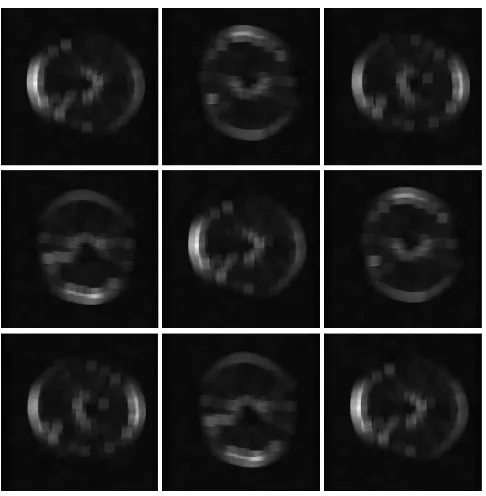
Figure 1: An example of the dense HOG features represented with orientation histograms
(top) and a obtained correlation surface (bottom).
For a “noisy phase correlation matrix (i.e. a matrix computed from consecu-96
tive frames of a moving sequence), the sub-pixel motion estimation problem can 97
be recast as finding the rank one approximation to that matrix. This can be 98
achieved by using Singular Value Decomposition (SVD) followed by the identifi-99
cation of the left and right singular vectors. These vectors allow the construction 100
of a set of normal equations, which can be solved to yield the required estimate. 101
The work in [16] is a noise-robust extension to [15], where noise is assumed to be 102
AWGN. The authors in [17] derive the exact parametric model of the phase dif-103
ference matrix and solve an optimization problem for fitting the analytic model 104
Figure 2: The firstθ= 9 channels of the dense HOG that were used in the proposed HOG-PC.
To estimate the subpixel shifts, Stone et al. [18] fit the phase values to a 2-D 106
linear function using linear regression, after masking out frequency components 107
corrupted by aliasing. The method inevitably requires 2-D phase unwrapping 108
which is a difficult ill-posed problem, while the parameters controlling masking 109
are arbitrarily chosen and require fine tuning. Thus, after obtaining an integer-110
precision alignment of the input images their method takes steps towards alias 111
cancellation by eliminating certain spectral components of each of the two input 112
images. Elimination is based on two criteria: (i) radial distance of a spectral 113
component from the component located at the origin and (ii) magnitude of 114
a spectral component in relation to a threshold. The latter is dynamically 115
determined as follows. Spectral components are sorted by magnitude and are 116
progressively eliminated starting with the lowest. The authors claim that there 117
exists a range in which the accuracy of the computed motion estimate becomes 118
stable and independent of the degree of progressive elimination. This stability 119
operation on the frequencies that have survived the above two criteria yields 121
the required motion estimates. An extension to the method for the additional 122
estimation of planar rotation has been proposed in [19]. 123
Foroosh et al. [20] showed that the phase correlation function is the Dirich-124
let kernel and provided analytic results for the estimation of the subpixel shifts 125
using thesincapproximation. According to [20], images mutually shifted by a 126
sub-pixel amount can be assumed as having been obtained by an integer pixel 127
displacement on a higher resolution grid followed by subsampling. This assump-128
tion allows the analytic computation of the normalised cross-power spectrum as 129
a polyphase decomposition of a filtered unit impulse. The authors demonstrate 130
that the signal power of the resulting phase correlation surface is not concen-131
trated in a single peak but is distributed to several coherent peaks adjacent to 132
each other. The authors further show that this amounts to a Dirichlet kernel, 133
which can be closely approximated by a sinc function. This approximation 134
allows for the development of a closed-form solution for the sub-pixel shift esti-135
mate. 136
Finally, a fast method for subpixel estimation based on FFTs has been pro-137
posed in [21]. Notice that the above methods either assume aliasing-free images 138
[20, 22, 21, 17], or cope with aliasing by frequency masking [18, 16, 15, 19], 139
which requires fine tuning. 140
3. HOG-PC for Subpixel Registration 141
LetIi(x),x= [x, y]T ∈ R2,i= 1,2 be two image functions, related by an
142
unknown translationt= [tx, ty]T ∈ R2
143
I2(x) =I1(x−t) (1)
To estimate the translational displacement, we use phase based correlation 144
schemes. Each image Ii(x) can be considered as a continuous periodic im-145
age function with periodTx=Ty = 1, [23]. The Fourier series coefficients ofI
146
are given by 147
FI(k) =
Z
Ω
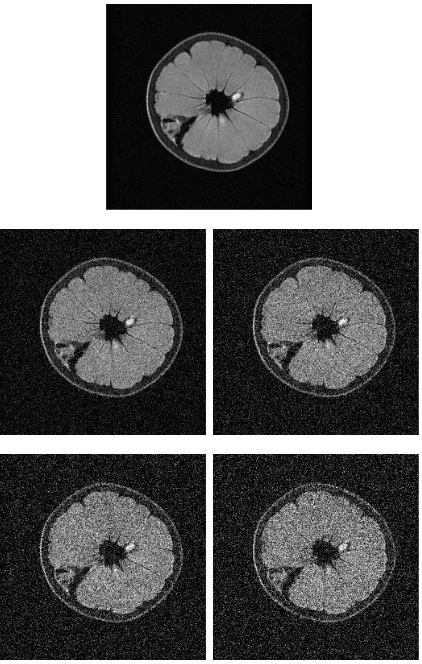
Figure 3: An example of the MRI data without and with noise of different levels
(0.01,0.02,0.03,0.04).
where Ω ={x:−1/2≤x≤1/2}, k= [k, l]T ∈Z2 andω0= 2π. If we sample
148
Iat a rateN with a 2-D Dirac comb functionD(x) =P
sδ(x−s/N), we obtain
149
a set ofN×N discrete image valuesI1(m) =I(m/N), m= [m, n]T ∈ R2and
150
−N/2≤m< N/2, [23]. UsingD, we can write the DFT of I1 as
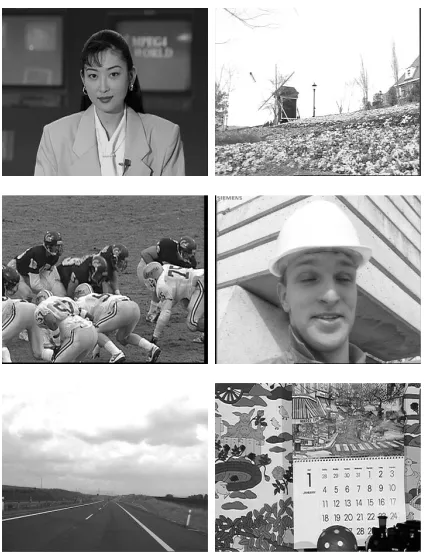
Figure 4: A frame of each video sequence that was used in our evaluation process.
ˆ
I1(k) = X
m
I1(m)e−j(2π/N)k
Tm
=
Z
Ω
D(x)I(x)e−j(2π/N)kTxdx
=FI(k)?X s
e−j(2π/N)kTs/N
=N2X s
FI(k−sN) (3)
where−N/2≤k< N/2 and? denotes convolution. 152
Moving to the shifted version of the image [23], given by the equation (1) 153
witht= [tx, ty]T,{t:−1< Nt<1}. Sampling withD in a similar fashion we
154
getI2 and its DFT is given based on the Fourier shift property by
155
ˆ
I2(k) =N2 X
s
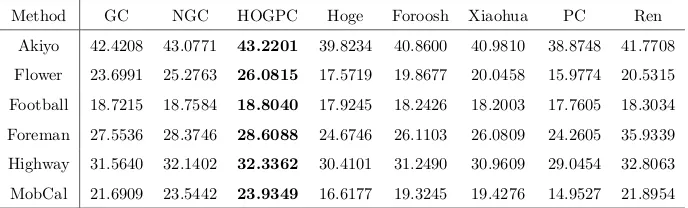
Table 1: Average PSNR (dB) values for all the video sequences and block size 8×8.
Method GC NGC HOGPC Hoge Foroosh Xiaohua PC Ren
Akiyo 42.4208 43.0771 43.2201 39.8234 40.8600 40.9810 38.8748 41.7708
Flower 23.6991 25.2763 26.0815 17.5719 19.8677 20.0458 15.9774 20.5315
Football 18.7215 18.7584 18.8040 17.9245 18.2426 18.2003 17.7605 18.3034
Foreman 27.5536 28.3746 28.6088 24.6746 26.1103 26.0809 24.2605 35.9339
Highway 31.5640 32.1402 32.3362 30.4101 31.2490 30.9609 29.0454 32.8063
MobCal 21.6909 23.5442 23.9349 16.6177 19.3245 19.4276 14.9527 21.8954
Table 2: Average PSNR (dB) values for all the video sequences and block size 16×16.
Method GC NGC HOGPC Hoge Foroosh Xiaohua PC Ren
Akiyo 43.1677 43.2094 43.1455 43.1980 41.4381 41.8490 41.2989 41.0237
Flower 28.3028 28.5663 28.7076 23.8995 25.9038 25.3230 15.7029 24.4162
Football 19.6813 19.7728 20.0338 18.1636 18.6105 18.4471 17.6603 18.5527
Foreman 29.5387 29.7872 30.2192 25.9039 27.3208 28.0282 24.2521 36.3688
Highway 32.5355 32.8818 33.6166 31.3321 31.7945 30.7668 28.5041 32.8148
MobCal 24.5285 24.8592 24.9101 21.7679 23.0760 23.6421 14.6892 22.7079
Assuming no aliasing and combining equations (3) and (4) we have 156
ˆ
I2(k) = ˆI1(k)e−j(2π/N)k
T(Nt)
(5)
Note that the well-known shift property of the DFT refers to integer shifts 157
and does not assume aliasing-free signals. Hereafter, we assume that our sam-158
pling device eliminates aliasing. Traditionally to estimate the translational dis-159
placement, we use phase correlation (PC), which is perhaps the most widely 160
used correlation-based method in image registration. It looks for the maxi-161
mum of the phase difference function which is defined as the inverse FT of the 162
normalized cross-power spectrum [1] 163
PC(u),F−1 (
ˆ
I2(k) ˆI1∗(k)
|Iˆ2(k)||Iˆ1∗(k)| )
=F−1{ejkTt}=δ(u−t) (6)
where∗denotes complex conjugate and F−1the inverse Fourier transform.
[image:16.612.135.479.294.395.2]Table 3: Average PSNR (dB) values for all the video sequences and block size 32×32.
Method GC NGC HOGPC Hoge Foroosh Xiaohua PC Ren
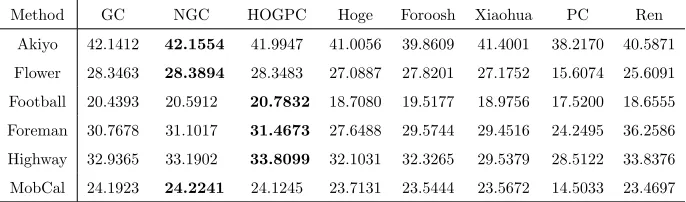
Akiyo 42.1412 42.1554 41.9947 41.0056 39.8609 41.4001 38.2170 40.5871
Flower 28.3463 28.3894 28.3483 27.0887 27.8201 27.1752 15.6074 25.6091
Football 20.4393 20.5912 20.7832 18.7080 19.5177 18.9756 17.5200 18.6555
Foreman 30.7678 31.1017 31.4673 27.6488 29.5744 29.4516 24.2495 36.2586
Highway 32.9365 33.1902 33.8099 32.1031 32.3265 29.5379 28.5122 33.8376
[image:17.612.134.478.305.410.2]MobCal 24.1923 24.2241 24.1245 23.7131 23.5444 23.5672 14.5033 23.4697
Table 4: Average PSNR (dB) values for all the video sequences (50 first frames) and block
size 8×8 with 0.75 variance motion blur.
Method GC NGC HOGPC Hoge Foroosh Xiaohua PC Ren
Akiyo 46.9358 47.9122 48.1894 43.8985 44.0877 43.5653 43.4136 46.3062
Flower 28.4947 30.4891 31.5629 22.6101 24.8113 22.4272 21.7711 26.0737
Football 18.2997 18.2785 18.3126 17.3936 17.6461 17.3321 17.3271 17.8680
Foreman 31.4301 32.5690 33.3006 28.3002 29.1089 28.1744 27.9264 30.5642
Highway 36.2005 36.8582 37.1551 34.6884 35.0371 34.3573 33.5344 36.0504
MobCal 25.3502 27.3564 27.6531 20.4433 22.0091 20.0361 19.5922 23.6230
3.1. Proposed methodology for HOG-PC
165
In this section, we introduce the proposed phase correlation algorithm based 166
on histogram of oriented gradients (HOG-PC). Note that the proposed dense 167
representation is quite different from the traditional representation of a block 168
(or patch) based on HOG. The latter achieves invariance to small translational 169
displacements and hence does not appear to be suitable for motion estimation. 170
In contrast, we propose to use a very dense representation by calculating a de-171
scriptor per pixel. This allows us to interpret the obtain representation as a 172
multi-channel block representation. Then, motion estimation is performed by 173
correlating the multi-channel representations from two blocks. Our main contri-174
bution lies in showing that this representation not only can recover translational 175
motion very accurately but is also better able to cope with real-world registra-176
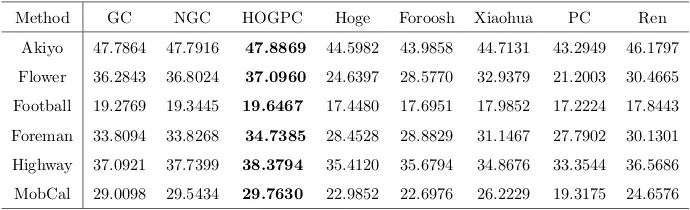
Table 5: Average PSNR (dB) values for all the video sequences (50 first frames) and block
size 16×16 with 0.75 variance motion blur.
Method GC NGC HOGPC Hoge Foroosh Xiaohua PC Ren
Akiyo 47.7864 47.7916 47.8869 44.5982 43.9858 44.7131 43.2949 46.1797
Flower 36.2843 36.8024 37.0960 24.6397 28.5770 32.9379 21.2003 30.4665
Football 19.2769 19.3445 19.6467 17.4480 17.6951 17.9852 17.2224 17.8443
Foreman 33.8094 33.8268 34.7385 28.4528 28.8829 31.1467 27.7902 30.1301
Highway 37.0921 37.7399 38.3794 35.4120 35.6794 34.8676 33.3544 36.5686
[image:18.612.133.480.321.423.2]MobCal 29.0098 29.5434 29.7630 22.9852 22.6976 26.2229 19.3175 24.6576
Table 6: Average PSNR (dB) values for all the video sequences (50 first frames) and block
size 32×32 with 0.75 variance motion blur.
Method GC NGC HOGPC Hoge Foroosh Xiaohua PC Ren
Akiyo 47.2598 47.0844 46.9395 42.8979 43.2420 45.2531 42.8459 45.1704
Flower 37.7471 37.7145 37.5289 34.4633 31.8037 35.6403 21.0538 33.7585
Football 20.0454 20.2501 20.4676 17.9476 17.4846 18.2341 17.0028 17.5864
Foreman 34.4031 34.5012 35.1448 29.4785 28.9129 32.9204 27.6481 29.9641
Highway 38.3238 38.8231 39.3635 36.4025 36.3173 34.2663 33.3791 36.9849
MobCal 29.3901 29.4741 29.3422 27.5164 23.2643 27.5576 18.9994 25.1790
noise. Furthermore, due to the overlapping local contrast normalization char-178
acteristic of HOG, the proposed HOG-PC method improves significantly the 179
estimated motion parameters in smaller size blocks. Finally, subpixel accuracy 180
is obtained through the use of simple interpolation schemes [6, 7]. 181
We first describe the traditional HOG descriptor. HOG uses the normalized 182
combination of gradient vectors from a given number of pixels to build up a 183
histogram of binned angles that relate to the feature. The process begins by 184
breaking the image up into set features spacesf comprised of a number of cells 185
c, which in turn is made up of pixels. For each pixel within a cell the filter mask 186
[−1,0,1] is applied to its neighbouring pixels giving us the gradient vector~g. 187
Table 7: Average PSNR (dB) values for all the video sequences (50 first frames) and block
size 8×8 with 1.75 variance motion blur.
Method GC NGC HOGPC Hoge Foroosh Xiaohua PC Ren
Akiyo 50.2757 51.0925 51.3390 47.4929 47.0069 47.3463 47.2890 49.0431
Flower 31.4674 32.8165 33.3934 27.2786 27.6245 27.2046 26.9964 29.2145
Football 19.4725 19.3277 19.3736 18.5606 18.6270 18.5354 18.5142 18.8796
Foreman 32.3824 33.2128 33.7498 29.9563 29.9954 29.8935 29.6478 31.4852
Highway 38.8627 39.1613 39.4571 37.5952 37.3573 37.5161 36.8784 38.2206
MobCal 28.1125 29.4835 29.6976 24.4869 24.6221 24.3584 24.1381 26.2775
Table 8: Average PSNR (dB) values for all the video sequences (50 first frames) and block
size 16×16 with 1.75 variance motion blur.
Method GC NGC HOGPC Hoge Foroosh Xiaohua PC Ren
Akiyo 51.4247 51.3765 51.6485 47.3513 46.8294 50.0535 47.1346 48.8104
Flower 38.2331 39.0902 39.7536 27.5034 27.9538 35.9841 27.0223 29.7296
Football 20.2406 20.3819 20.6140 18.4652 18.5598 19.0224 18.4073 18.7527
Foreman 34.5928 34.2964 35.3176 29.8665 29.7574 33.3645 29.6204 30.9343
Highway 40.1471 40.3989 41.0301 37.7915 37.6942 38.7673 36.9909 38.5279
MobCal 31.6078 32.2799 32.4236 24.8317 24.6213 29.8854 24.1093 26.2672
expressed using angleθ.
θ= tan−1(gy, gx) (7)
Additionally a weight w is defined for each pixel, which is used to scale its 188
contribution to its cell’s histogram. This is given by the mean value of the pixels 189
within a given 2D kernel indicating the density over this area. By applying this 190
weight, the proposed approach provides accurate estimates also in the presence 191
of noise. 192
Once these values are established the pixels within each cell are binned into 193
a histogramH according to theirθ angle. The value added to a bin is given as 194
the weighted magnitude of the vectorwk~gk. Finally all cell histograms within 195
a multi-dimensional featureHj are normalised using theL2 norm.
[image:19.612.135.479.320.424.2]Table 9: Average PSNR (dB) values for all the video sequences (50 first frames) and block
size 32×32 with 1.75 variance motion blur.
Method GC NGC HOGPC Hoge Foroosh Xiaohua PC Ren
Akiyo 51.2539 50.7153 50.6264 40.8783 46.4685 49.6346 46.6632 47.7458
Flower 43.1483 42.6464 42.5386 30.6144 28.6057 41.1037 27.2853 30.8018
Football 21.1975 21.3593 21.7731 18.5759 18.3757 18.6508 18.2522 18.5016
Foreman 35.4305 35.2909 36.2796 29.6047 29.6118 33.8368 29.4914 30.6552
Highway 41.0594 41.7453 42.0343 37.8387 38.3018 39.9322 37.2725 39.0443
MobCal 33.2915 33.2234 33.2526 26.9309 24.4869 30.5041 24.1541 26.2379
Hj→
Hj p
k~gk2 2+e2
(8)
The obtained features are then vectorised as aθ−dimensional descriptor
~
d={H1, ..., Hθ} (9)
Having defined HOG for a single cell, we now turn to the proposed dense 197
HOG representation. For Ii, i = 1,2, we extract d from (9) at each pixel 198
locationIi(m): 199
Hi(m) ={Hi,1(m), Hi,2(m), ..., Hi,θ(m)} (10)
The resulting histograms can be re-arranged as a multi-channel feature repre-200
sentation (see figures 1 and 2). 201
To estimate the subpixel shifttfrom (1) using HOG-PC, we simply compute 202
the correlation between the two multi-channel representation: 203
HOGP C(m) =
θ X
j=1
H1,j(m)? H2,j(−m) (11)
and findt= arg maxmHOGP C(m). We can estimate sub-pixel accuracy
reg-204
istrationt0= (x0, y0) by fitting a 1Dkernel to the vicinity of the maximum on
205
the correlation surface. A parametric kernel is used, which can adapt its shape 206
Frame No
0 50 100 150
PSNR (dB) 30 32 34 36 38 40 42 44 46 48
50 Akiyo (8x8)
GC NGC Hoge Foroosh PC HOGPC Xiaohua Ren Frame No
0 50 100 150 200 250 300
PSNR (dB) 32 34 36 38 40 42 44 46 48
50 Akiyo (16x16)
GC NGC Hoge Foroosh PC Xiaohua Ren HOGPC Frame No
0 50 100 150 200 250 300
PSNR (dB) 25 30 35 40 45
50 Akiyo (32x32)
[image:21.612.162.449.125.357.2]GC NGC Hoge Foroosh PC Xiaohua Ren HOGPC
Figure 5: The PSNR values for the Akiyo sequence versus the frame number for all the block
sizes.
subpixel shifts. Based on the work in [23] a reasonable choice for our kernel is 208
given by 209
K1D(x;{x0,p}) =p1{1−(p2(x−x0))2}
1 √
2πp3 e
−(x−x0 )2 2p2
3 (12)
which is a simple modification of the mexican hat wavelet [24]. To estimatey0,
we set up a similar problem with the kernel defined as
K1D(y;{y0,q}) =q1{1−(q2(y−y0))2}
1 √
2πq3 e
−(y−y0 )2
2q32 (13)
Our algorithm estimates the kernel parameters{x0,p= [p1, p2, p3]T}and{y0,q=
210
[q1, q2, q3]T}in a least-squares sense.
211
4. Results 212
To evaluate and illustrate the efficiency of the proposed scheme a compar-213
Frame No
0 50 100 150 200 250
PSNR (dB) 14 16 18 20 22 24 26 28
30 Flower (8x8)
GC NGC Hoge Foroosh PC HOGPC Xiaohua Ren Frame No
0 50 100 150 200 250
PSNR (dB) 14 16 18 20 22 24 26 28 30 32
34 Flower (16x16)
GC NGC Hoge Foroosh PC HOGPC Xiaohua Ren Frame No
0 50 100 150 200 250
PSNR (dB) 14 16 18 20 22 24 26 28 30
32 Flower (32x32)
[image:22.612.161.449.124.359.2]GC NGC Hoge Foroosh PC Xiaohua Ren HOGPC
Figure 6: The PSNR values for the Flower sequence versus the frame number for all the block
sizes.
niques. Both data with ground truth and video sequences have been used for 215
evaluating the performance. A set of MRI images are employed which have 216
undergone sub-pixel displacement and it is available by the authors in [15] (see 217
figure 3). The images show real MRI data from a grapefruit that was acquired 218
using a production quality Fast Spin Echo (FSE) sequence on a GE (Faireld, 219
CT, USA) Signa Lx 1.5 Tesla MRI scanner. The 256×256 pixel images cover a 220
16cm2 FOV corresponding to a 0.0625mm square per pixel. Five images were
221
acquired with the fruit at dierent positions in the FOV, by manually moving the 222
scanner table. Regarding the real videos the well-known sequences of ‘Akiyo’, 223
‘Flower’, ‘Football’, ‘Foreman’, ‘Highway’ and ‘MobCal’ were used including 224
150−300 frames each (see figure 4). 225
4.1. Video sequences without ground truth
226
Regarding the real video sequences without ground truth, in order to eval-227
Frame No
0 50 100 150 200 250 300
PSNR (dB) 14 16 18 20 22 24 26 28 30
32 Football (8x8)
GC NGC Hoge Foroosh PC Xiaohua Ren HOGPC Frame No
0 50 100 150 200 250 300
PSNR (dB) 14 16 18 20 22 24 26 28 30 32
34 Football (16x16)
GC NGC Hoge Foroosh PC Xiaohua Ren HOGPC Frame No
0 50 100 150 200 250 300
PSNR (dB) 14 16 18 20 22 24 26 28 30 32
34 Football (32x32)
[image:23.612.161.449.124.358.2]GC NGC Hoge Foroosh PC Xiaohua Ren HOGPC
Figure 7: The PSNR values for the Football sequence versus the frame number for all the
block sizes.
motion compensated sequence is considered. It is defined as the closeness be-229
tween the motion compensated frames and the original ones, and the peak signal 230
to noise ratio (PSNR) is used in this work defined by 231
P SN R= 10 log
2552 M SEI
(14)
whereM SEI is the mean square error of the original and motion compensated 232
frames. 233
The performance of the proposed HOGP C scheme is compared with more 234
than five popular P C based methods [15, 20, 22, 6, 17, 7, 23, 9]. Foroosh’s 235
method [20] estimates the subpixel shifts by fitting asincfunction to the avail-236
able correlation samples. Hoge’s and Xiaohua’s [15, 14] methods are based on 237
frequency masking, phase unwrapping and linear regression, while Ren’s [22] 238
approach applies a linear weighting of the height of the main peak on the one 239
Frame No
0 50 100 150 200 250 300
PSNR (dB) 15 20 25 30 35
40 Foreman (8x8)
GC NGC Hoge Foroosh PC Xiaohua Ren HOGPC Frame No
0 50 100 150 200 250 300
PSNR (dB) 15 20 25 30 35
40 Foreman (16x16)
GC NGC Hoge Foroosh PC Xiaohua Ren HOGPC Frame No
0 50 100 150 200 250 300
PSNR (dB) 15 20 25 30 35
40 Foreman (32x32)
[image:24.612.161.449.124.358.2]GC NGC Hoge Foroosh PC Xiaohua Ren HOGPC
Figure 8: The PSNR values for the Foreman sequence versus the frame number for all the
block sizes.
In the second part of our evaluation process, experiments were performed 241
using read video sequences and applying block based motion estimation. The 242
selected block sizes were 32×32, 16×16 and 8×8 pixels and the motion 243
compensated prediction error was estimated for each block size over all the 244
sequences. The average PSNR values are shown in Tables 1,2 and 3 and it can 245
be observed that the proposed approach results the highest values indicating 246
better visual quality. In figures 5, 6, 7, 8, 9, and 10 the PSNR values over time 247
for the video sequences are shown with the proposed scheme to be the most 248
accurate and consistent in comparison with the other state-of-the-art methods. 249
Furthermore, experiments with motion blur present were performed indicating 250
the accuracy of the proposed method especially in the case of small block sizes 251
(e.g. 8×8). The average PSNR values are shown in Tables 4,5 and 6 for motion 252
blur variance equal to 0.75 and in Tables 7,8 and 9 for motion blur variance 253
Frame No
0 50 100 150 200 250 300
PSNR (dB) 22 24 26 28 30 32 34
36 Highway (8x8)
GC NGC Hoge Foroosh PC Xiaohua Ren HOGPC Frame No
0 50 100 150 200 250 300
PSNR (dB) 22 24 26 28 30 32 34
36 Highway (16x16)
GC NGC Hoge Foroosh PC Xiaohua Ren HOGPC Frame No
0 50 100 150 200 250 300
PSNR (dB) 22 24 26 28 30 32 34
36 Highway (32x32)
[image:25.612.160.449.124.357.2]GC NGC Hoge Foroosh PC Xiaohua Ren HOGPC
Figure 9: The PSNR values for the Highway sequence versus the frame number for all the
block sizes.
Finally, in figure 11 we can see the gain of theHOGP C method as a ratio 255
over the other approaches moving from larger to smaller block sizes. As it 256
was expected the ratio increases due to the characteristics of our scheme and 257
HOG. So, since HOG is utilising neighboring information (i.e. surrounding 258
cells) even for small blocksHOGP Cscheme contains more information allowing 259
more accurate estimates especially if larger motions are present. Furthermore, 260
observing the results in Tables 1,2 and 3 focusing on the proposed method and 261
especially for the Akiyo sequence that is characterised of small motion vectors 262
in average, it shows that HOGPC provides the best results for the case of 8×8 263
pixels. Also, it outperforms other methods used over larger blocks such as 16×16 264
pixels, indicating the accuracy of the proposed HOGPC method that exploits 265
Frame No
0 50 100 150
PSNR (dB) 12 14 16 18 20 22 24 26
28 Mobile Calendar 15fps (8x8)
GC NGC Hoge Foroosh PC HOGPC Xiaohua Ren Frame No
0 50 100 150
PSNR (dB) 12 14 16 18 20 22 24 26
28 Mobile Calendar 15fps (16x16)
GC NGC Hoge Foroosh PC HOGPC Xiaohua Ren Frame No
0 50 100 150
PSNR (dB) 12 14 16 18 20 22 24
26 Mobile Calendar 15fps (32x32)
[image:26.612.161.449.124.358.2]GC NGC Hoge Foroosh PC Xiaohua Ren HOGPC
Figure 10: The PSNR values for the MobCal sequence versus the frame number for all the
block sizes.
4.2. Real data with ground truth
267
In the case that ground truth is available, the mean square error (MSE) 268
between the estimated subpixel motion vectors and the ground truth is used 269
as a performance measure. Considering two vectorsuand v representing the 270
original (ground truth) and the estimated one, respectively, then 271
M SEM V = 1
n X
i=x,y
(ui−vi)2 (15)
Consequently, a good quality estimate is expected to minimize MSE, which 272
provides the accuracy of the estimates. 273
In more details, a set of five 256×256 pixel real MR images [15] was used 274
and a sample of them is shown in figure 3. The 5 images yield a total of 10 275
possible pairwise registrations and the ground truth of the subpixel translations 276
Block Size
8x8 16x16 32x32
PSNR Ratio of HOGPC over the other methods
1 1.02 1.04 1.06 1.08 1.1 1.12 1.14 1.16
1.18 Averaged over all Video Sequences
[image:27.612.188.416.128.317.2]GC NGC Hoge Foroosh HOGPC Xiaohua Ren
Figure 11: The PSNR ratio of the proposed HOGPC scheme over all the other methods for
the different block sizes.
The estimated shifts and the corresponding measurements of their average 278
MSE are shown in Tables 4-12. Observing the results, the proposed method 279
provides the most accurate overall estimates with the lowest mean square error. 280
Furthermore, since ground truth measurements can be significantly biased [15]; 281
the performance of each method was assessed by computing the peak signal-to-282
noise ratio (PSNR) of the motion compensated prediction error. Figure 12 shows 283
the obtained results for each method and all the image pairs. The proposed 284
scheme achieves marginally the best registration accuracy in comparison with 285
N GC [23], while the difference with the other methods is higher. 286
Additionally, the five MR images were used to evaluate the performance of 287
each method in the presence of additive white Gaussian noise. In this case we 288
assume that the correct shift is given by the corresponding noise-free estimate 289
for each method and image pair. In figure 13 the mean value of the registration 290
error for noise variance in the range [0.005,0.045] is illustrated for each method. 291
Observing the results it can be seen that the proposed method is one of the most 292
Table 10: Average MSE with the corresponding PSNR values, and the estimated motion
vectors for the 10 image pairs of the MRI data (Part 1).
Image pairs [1,2] [1,3] [1,4] [1,5]
GT (-2.40,4.00) (-4.80,8.00) (-7.20,4.32) (-7.20,12.00)
Hoge (-2.03,4.01) (-4.13,8.01) (-6.81,4.17) (-6.82,12.02)
Foroosh (-2.22,4.23) (-4.36,8.24) (-6.59,4.41) (-6.59,12.26)
Balci (-2.11,4.10) (-3.90,8.05) (-6.22,4.34) (-6.39,12.15)
Gaussian (-2.07,4.02) (-4.33,8.01) (-6.57,4.37) (-6.57,12.06)
Quadratic (-2.03,4.01) (-4.18,8.00) (-6.73,4.25) (-6.74,12.03)
Sinc (-2.00,4.00) (-4.12,8.00) (-6.72,4.12) (-6.73,12.00)
ESinc (-2.00,4.00) (-4.25,8.00) (-6.54,4.31) (-6.54,12.04)
Ren (-2.09,4.02) (-4.34,8.01) (-6.58,4.38) (-6.59,12.08)
GC (-2.04,4.02) (-4.24,8.00) (-6.67,4.30) (-6.68,12.03)
NGC (-2.04,4.02) (-4.24,8.00) (-6.67,4.30) (-6.68,12.02)
Xiaohua (-2.04,3.95) (-4.23,7.97) (-6.66,4.36) (-6.68,12.06)
HOGPC (-2.06,4.04) (-4.25,8.03) (-6.67,4.33) (-6.67,12.04)
case of the other methods, the error rapidly increases for noise beyond a certain 294
level, since they do not always provide the correct pixel accuracy. The proposed 295
HOGP Cscheme exploiting the accuracy of HOG over noisy data allows precise 296
estimates even for noise variance over the above range. Also, the PSNR was 297
used to further compare the proposed scheme with the other state-of-the-art 298
methods in the case of noise and the obtained results are shown in figure 14 299
demonstrating further the accuracy ofHOGP Cin terms of motion compensated 300
prediction error. Furthermore, experiments were performed with 8 different 301
levels of motion blur. In each case the variance was increased moving from 0.25 302
up to 2 and for each level five repetitions were performed. The overall results 303
are in Table 13 showing that most of the methods to have similar performance 304
with the one in [22] and the proposed HOG-PC to result the best performance. 305
Table 11: Average MSE with the corresponding PSNR values, and the estimated motion
vectors for the 10 image pairs of the MRI data (Part 2).
Image pairs [2,3] [2,4] [2,5] [3,4]
GT (-2.40,4.00) (-4.80,0.32) (-4.80,8.00) (-2.40,-3.68)
Hoge (-2.10,3.99) (-4.28,0.15) (-4.78,8.00) (-2.17,-3.84)
Foroosh (-2.32,3.75) (-4.55,0.39) (-4.55,8.24) (-2.40,-3.61)
Balci (-2.18,3.86) (-4.16,0.30) (-4.13,7.92) (-2.34,-3.62)
Gaussian (-2.26,3.97) (-4.55,0.35) (-4.56,8.01) (-2.43,-3.66)
Quadratic (-2.13,3.98) (-4.65,0.22) (-4.65,8.00) (-2.25,-3.78)
Sinc (-2.09,4.00) (-4.72,0.11) (-4.71,8.00) (-2.27,-3.89)
ESinc (-2.19,4.00) (-4.59,0.28) (-4.60,8.00) (-2.46,-3.72)
Ren (-2.27,3.96) (-4.54,0.36) (-4.54,8.01) (-2.40,-3.65)
GC (-2.17,3.98) (-4.59,0.27) (-4.60,8.00) (-2.31,-3.71)
NGC (-2.17,3.98) (-4.59,0.27) (-4.60,8.00) (-2.31,-3.71)
Xiaohua (-2.18,3.96) (-4.59,0.34) (-4.58,8.04) (-2.39,-3.64)
HOGPC (-2.19,3.99) (-4.60,0.28) (-4.60,8.00) (-2.35,-3.68)
of the other approaches due to the computational power required for the pre-307
processing stage and the estimation of the dense HOG transform. In this work 308
all the methods were implemented in Matlab and the average required time per 309
method is shown in table 14. In the current architecture we did not considered 310
any parallel implementations, but if a GPU-HOG transform [25] was used it 311
could be no significant difference among them. 312
5. Conclusion 313
In this paper, a phase correlation technique based on histograms of oriented 314
gradients that operates in the frequency domain for subpixel image registration 315
was presented. The proposed method takes full account of all the advantages 316
of HOG filter providing especially higher accuracy in small block sizes. One of 317
Table 12: Average MSE with the corresponding PSNR values, and the estimated motion
vectors for the 10 image pairs of the MRI data (Part 3).
Image pairs [3,5] [4,5] Average MSE (x,y) PSNR dB
GT (-2.40,4.00) (0.00,7.68) (0.0000, 0.0000)⇒0.0000 0.0000
Hoge (-2.18,4.51) (0.01,7.85) (0.3667, 0.1914)⇒0.5581 30.2380
Foroosh (-2.41,3.76) (-0.18,7.61) (0.3368, 0.1945)⇒0.5313 30.3865
Balci (-2.49,4.07) (-0.03,7.66) (0.5857, 0.0841)⇒0.6697 30.0364
Gaussian (-2.44,4.00) (-0.01,7.64) (0.3558, 0.0324)⇒0.3882 30.7528
Quadratic (-2.27,4.00) (-0.01,7.78) (0.3334, 0.0602)⇒0.3936 30.6963
Sinc (-2.27,4.00) (0.00,7.87) (0.3490, 0.1281)⇒0.4771 30.5317
ESinc (-2.47,4.00) (0.00,7.54) (0.3834, 0.0494)⇒0.4329 30.7081
Ren (-2.41,4.00) (-0.02,7.64) (0.3488, 0.0403)⇒0.3892 30.7583
GC (-2.32,4.02) (-0.01,7.73) (0.3367, 0.0297)⇒0.3664 30.7835
NGC (-2.32,4.02) (-0.01,7.73) (0.3366, 0.0299)⇒0.3664 30.7835
Xiaohua (-2.39,4.04) (-0.02,7.70) (0.3399, 0.0411)⇒0.3810 30.7700
HOGPC (-2.35,4.04) (0.01,7.72) (0.3301, 0.0301)⇒0.3601 30.7901
entation information and the corresponding weights of HOG filter and exploits 319
its robustness to noise. HOG phase correlation yields very accurate subpixel 320
motion estimates for a variety of test material and motion scenarios and out-321
performs techniques, which are the current registration methods of choice in the 322
frequency domain. 323
[1] C. Kuglin, D. Hines, The phase correlation image alignment method, in: 324
Proc. IEEE Conf. Cyber. and Soc., 1975, pp. 163–165. 325
[2] J. Pearson, D. Hines, S. Goldsman, C. Kuglin, Video rate image correlation 326
processor, Proc. SPIE Application of Digital Image Processing 119. 327
[3] G. Thomas, Television motion measurement for datv and other applica-328
tions, BBC Res. Dept. Rep., No. 1987/11. 329
[4] B. Girod, Motion-compensating prediction with fractionalpel accuracy, 330
Table 13: Average MSE of the estimated motion vectors with the corresponding PSNR values,
for the 10 image pairs of the MRI data using 8 different motion blur levels and 5 repetitions
for each one.
Method GC NGC HOGPC Hoge Foroosh Xiaohua Ren
PSNR 39.4322 39.4368 39.4384 36.7849 38.5084 39.4287 39.3615
MSE 0.0220 0.0117 0.0114 0.3692 0.0183 0.0102 0.0079
Image pair
1 2 3 4 5 6 7 8 9 10
PSNR (dB)
28.5 29 29.5 30 30.5 31
31.5 MRI Images Without Noise
Hoge Foroosh Balci Gaussian Quadratic Sinc ESinc Ren GC NGC HOGPC Xiaohua
Figure 12: The PSNR values in dB over all image pairs.
[5] N. Dalal, B. Triggs, Histograms of oriented gradients for human detection, 332
in: Proceedings of the 2005 IEEE Computer Society Conference on Com-333
puter Vision and Pattern Recognition (CVPR’05) - Volume 1 - Volume 01, 334
CVPR ’05, 2005, pp. 886–893. 335
[6] I. Abdou, Practical approach to the registration of multiple frames of video 336
images, in Proc. SPIE Conf. Vis. Commun. Image Process. 3653 (1999) 337
371–382. 338
[7] V. Argyriou, T. Vlachos, A study of sub-pixel motion estimation using 339
phase correlation, in Proc. Brit. Mach. Vis. Assoc. (2006) 387–396. 340
Noise Level
0.005 0.01 0.015 0.02 0.025 0.03 0.035 0.04 0.045 0.05
Mean Error
0 5 10 15 20 25
[image:32.612.193.416.135.315.2]NGC GC Hoge Foroosh Xiaohua Ren HOGPC
Figure 13: The Mean Error over all image pairs with different levels of noise for the top five
methods.
Table 14: Average complexity for each method.
Method GC NGC HOGPC Hoge Foroosh Xiaohua PC Ren
Time (sec) 0.3824 0.4340 0.6988 0.1826 0.0701 1.5374 0.0372 0.0389
timating affine motion parameters, In Proc. IEEE International Conf. on 342
Image Processing (1996) 113116. 343
[9] X. Tong, Z. Ye, Y. Xu, S. Liu, L. Li, H. Xie, T. Li, A novel subpixel phase 344
correlation method using singular value decomposition and unified random 345
sample consensus, Geoscience and Remote Sensing, IEEE Transactions on 346
53 (8) (2015) 4143–4156. doi:10.1109/TGRS.2015.2391999. 347
[10] L. Zhongke, Y. Xiaohui, W. Lenan, Image registration based on hough 348
transform and phase correlation, Neural Networks and Signal Processing, 349
2003. Proceedings of the 2003 International Conference on 2 (2003) 956– 350
959. 351
Noise Level
0.005 0.01 0.015 0.02 0.025 0.03 0.035 0.04 0.045 0.05
Mean Error
10 12 14 16 18 20 22
[image:33.612.195.414.134.316.2]NGC PC GC Hoge Foroosh Xiaohua Ren HOGPC
Figure 14: The PSNR values in dB over all image pairs with different levels of noise.
H. JinHee, J. Paik, Robust sub-pixel image registration based on combina-353
tion of local phase correlation and feature analysis, Consumer Electronics 354
(ISCE 2014), The 18th IEEE International Symposium on (2014) 1–2. 355
[12] M. Uss, B. Vozel, V. Dushepa, V. Komjak, K. Chehdi, A precise lower 356
bound on image subpixel registration accuracy, Geoscience and Remote 357
Sensing, IEEE Transactions on 52 (6) (2014) 3333–3345. 358
[13] P. Cheng, C.-H. Menq, Real-time continuous image registration enabling 359
ultraprecise 2-d motion tracking, Image Processing, IEEE Transactions on 360
22 (5) (2013) 2081–2090. 361
[14] X. Tong, Y. Xu, Z. Ye, S. Liu, L. Li, H. Xie, F. Wang, S. Gao, U. Stilla, 362
An improved phase correlation method based on 2-d plane fitting and the 363
maximum kernel density estimator, Geoscience and Remote Sensing Let-364
ters, IEEE 12 (9) (2015) 1953–1957. 365
[15] W. Hoge, Subspace identification extension to the phase correlation 366
[16] Y. Keller, A. Averbuch, A projection-based extension to phase correlation 368
image alignment, Signal Process. 87 (2007) 124–133. 369
[17] M. Balci, H. Foroosh, Subpixel estimation of shifts directly in the fourier 370
domain, IEEE Trans. Image Process. 15 (7) (2006) 1965–1972. 371
[18] H. Stone, M. Orchard, E. Chang, S. Martucci, A fast direct fourier-based 372
algorithm for subpixel registration of images, IEEE Trans. Geosci. Remote 373
Sens. 39 (10) (2001) 2235–2243. 374
[19] P. Vandewalle, S. Susstrunk, M. Vetterli, A frequency domain approach 375
to registration of aliased images with application to superresolution, 376
EURASIP J. Appl. Signal Process. (2006) 1–14. 377
[20] H. Foroosh, J. Zerubia, M. Berthod, Extension of phase correlation to sub-378
pixel registration, IEEE Trans. Image Process. 11 (2) (2002) 188–200. 379
[21] J. Ren, T. Vlachos, J. Jiang, Subspace extension to phase correlation ap-380
proach for fast image registration, in Proc. IEEE ICIP (2007) 481–484. 381
[22] J. Ren, J. Jiang, T. Vlachos, High-accuracy sub-pixel motion estimation 382
from noisy images in fourier domain, Image Processing, IEEE Transactions 383
on 19 (5) (2010) 1379–1384. 384
[23] G. Tzimiropoulos, V. Argyriou, T. Stathaki, Subpixel registration with 385
gradient correlation, Image Processing, IEEE Transactions on 20 (6) (2011) 386
1761–1767. 387
[24] S. Mallat, A wavelet tour of signal processing, 2nd ed. New York: Academic. 388
[25] V. Prisacariu, I. Reid, Fasthog - a real-time gpu implementation of hog, 389