Volume 2010, Article ID 572748,10pages doi:10.1155/2010/572748
Research Article
Time-Frequency-Based Speech Regions Characterization and
Eigenvalue Decomposition Applied to Speech Watermarking
Irena Orovi´c and Srdjan Stankovi´c
Faculty of Electrical Engineering, University of Montenegro, 81000 Podgorica, Montenegro
Correspondence should be addressed to Irena Orovi´c,[email protected]
Received 13 February 2010; Revised 21 June 2010; Accepted 30 July 2010
Academic Editor: Bijan Mobasseri
Copyright © 2010 I. Orovi´c and S. Stankovi´c. This is an open access article distributed under the Creative Commons Attribution License, which permits unrestricted use, distribution, and reproduction in any medium, provided the original work is properly cited.
The eigenvalues decomposition based on the S-method is employed to extract the specific time-frequency characteristics of speech signals. This approach is used to create a flexible speech watermark, shaped according to the time-frequency characteristics of the host signal. Also, the Hermite projection method is applied for characterization of speech regions. Namely, time-frequency regions that contain voiced components are selected for watermarking. The watermark detection is performed in the time-frequency domain as well. The theory is tested on several examples.
1. Introduction
Digital watermarking has been developed to provide efficient solutions for ownership protection, copyright protection, and authentication of digital multimedia data by embedding a secret signal called the watermark into the cover media. Depending on the applications, two watermarking scenarios are available: robust and fragile. The robust watermarking assumes that the watermark should be resistant to various signal processing techniques called attacks. At the same time, the watermark should be imperceptible. In order to meet these requirements, a number of watermarking techniques have been proposed, many of which are related to speech and audio signals [1–11]. One of the earliest and simplest techniques is based on the LSB coding [1–4]. The watermark embedding is done by altering the individual audio samples represented by 16 bits per sample. The human auditory system is sensitive to the noise introduced by LSB replacement, which limits the number of LSBs that can be imperceptibly modified. The main disadvantage of these methods is their low robustness [1]. In a number of watermarking algorithms, the spread-spectrum technique has been employed [5–7]. The spread spectrum sequence can be embedded in the time domain, FFT coefficients, cepstral coefficients, and so forth. The embedding is performed in
a way to provide robustness to common attacks (noise, compression, etc.). Furthermore, several algorithms use the phase of audio signal for watermarking, such are the phase coding and phase modulation approaches [8,9], assuring good imperceptibility. Namely, imperceptible phase modi-fications are exploited by the controlled phase alternation of the host signal. However, the fact that they are nonblind watermarking methods (the presence of the original signal is required for watermark detection) limits the number of their applications.
The time-frequency distributions have been used to char-acterize the time-varying spectral content of nonstationary signals [12–16]. As the most commonly used, the Wigner distribution can provide an ideal representation for linear frequency-modulated monocomponent signals [12,15]. For multicomponents signals, the S-method, that is, a cross-terms-free Wigner distribution, can be used [16]. The S-method can be also used to separate the signal components. Note that the signal components separation could be of interest in many applications. In particular, in watermarking it allows creating the watermark that is shaped by using an arbitrary combination of the signal components. The eigenvalues-based S-method decomposition is applied to separate the signal components [17,18].
In order to provide suitable compromise between imper-ceptibility and robustness, the watermark should be shaped according to the time-frequency components of speech sig-nal, as proposed in [19,20]. Therein, the speech components selection is performed by using the time-frequency support function with a certain energy threshold. However, the threshold is chosen empirically and it does not provide sufficient flexibility. Namely, it includes all components with the energy between the maximum and the threshold level.
Therefore, in this paper, the eigenvalue decomposition method is employed to create a time-frequency mask as an arbitrary combination of speech components (formants). Only the components from voiced time-frequency regions are considered [19]. The Hermite projection method-based procedure for regions characterization is applied[21, 22]. The speech regions are reconstructed within the time-frequency plane by using a certain number of Hermite expansion coefficients. The mean square error between the original and reconstructed region is used to characterize dynamics of regions. It allows distinguishing between voiced, unvoiced, and noisy regions. Finally, the watermark embed-ding and detection are performed in the time-frequency domain. The robustness of the proposed procedure is proved under various common attacks.
The considered watermarking approach can be useful in numerous applications assuming speech signals. These applications include, but are not limited to, the intellectual property rights, such as proof of ownership, speaker verifi-cation systems, VoIP, and mobile appliverifi-cations such as cell-phone tracking. Recently, an interesting application of speech watermarking has appeared in air traffic control [11]. The air traffic control relies on voice communication between the aircraft pilot and air traffic control operators. Thus, the embedded digital information can be used for aircraft identification.
The paper is organized as follows. A theoretical back-ground on the time-frequency analysis is given inSection 2. Section 3describes the speech regions characterization pro-cedure. In Section 4, the formants selection based on the eigenvalues decomposition is proposed. The time-frequency-based watermarking procedure is presented in Section 5. The performance of the proposed procedure is tested on examples in Section 6. Concluding remarks are given in Section 7.
2. Theoretical Background—Time-Frequency
Analysis
The simplest time-frequency distribution is the spectrogram. It is defined as a square module of the short-time Fourier transform (STFT) [15]:
SPEC(t,ω)= |STFT(t,ω)|2=
∞
−∞x(t+τ)w(τ)e
−jωτdτ2,
(1)
wherex(t) is a signal whilew(t) is a window function. The time-frequency resolution in spectrogram depends on the window functionw(t) (window shape and window width). Namely, if the signal phase is not linear, it cannot simultaneously provide a good time and frequency resolu-tion. Various quadratic distributions have been introduced to improve the spectrogram resolution. Among them, the most commonly used, [1,14,15], is the Wigner distribution, defined as follows:
WD(t,ω)= ∞
−∞x
t+τ 2
x∗
t−τ
2
e−jωτdτ. (2)
However, for multicomponent signals the Wigner dis-tribution produces a large amount of cross-terms. The S-method has been introduced to reduce or remove the cross-terms while keeping the autocross-terms concentration as in the Wigner distribution [16]:
SM(t,ω)= ∞
−∞P(θ)STFT(t,ω+θ)STFT
∗(t,ω−θ)dθ.
(3)
A finite frequency domain window is denoted asP(θ). Note that, forP(θ)=2πδ(θ) andP(θ)=1, the spectrogram and the pseudo-Wigner distribution are obtained, respectively. By taking the rectangular frequency domain window, the discrete form of the S-method can be written as follows:
SM(n,k)=
L
l=−L
P(l)STFT(n,k+l)STFT∗(n,k−l)
= |STFT(n,k)|2
+ 2Real
⎧ ⎨ ⎩
L
l=1
STFT(n,k+l)STFT∗(n,k−l)
⎫ ⎬ ⎭,
(4)
wheren andkare discrete time and frequency samples. If the minimal distance between autoterms is greater than the window width (2L+ 1), the cross-terms will be completely removed. Also, if the autoterms width is equal to (2L+ 1), the S-method produces the same autoterms concentration as the Wigner distribution. Moreover, since the convergence within P(l) is fast, in many practical applications a good concentration can be achieved by settingL=3.
The output of the time-varying filter is defined as follows [23]:
Hx(t)= 1
2π
∞
−∞LH(t,ω)STFTx(t,ω)dω, (5)
where LH(t,ω)is a space-varying transfer function (i.e.,
support function) which is defined as Weyl symbol mapping of the impulse response into the time-frequency domain. Assuming that the signal components are located within the time-frequency regionRf, the support functionLH(t,ω) can
be defined as follows:
LH(t,ω)=
⎧ ⎨ ⎩
1, for (t,ω)∈Rf,
0, for (t,ω)∈/ Rf.
(6)
Although it was initially introduced for signal denoising, the concept of nonstationary filtering can be used to retrieve the signal with specific characteristics from the time-frequency domain.
Therefore, the time-frequency analysis can provide com-plete information about the time-varying spectral compo-nents, even when their number is significant as in the case of speech signals. Namely, these components appear in the time-frequency plane as recognizable time-varying structures that could be used to characterize different speech regions (voiced, unvoiced, noisy, etc.), as proposed in the sequel. Furthermore, the extraction of individual speech components from the time-frequency domain could be useful in many applications assuming speech signals. This is generally a highly demanding task due to the number of speech components. As an effective solution, a method based on the eigenvalues decomposition and the speech signal time-frequency representation is presented inSection 4.
3. Speech Regions Characterization by
Using the Fast Hermite Projection Method of
Time-Frequency Representation
3.1. Fast Hermite Projection Method. The fast Hermite pro-jection method has been introduced for image expansion into a Fourier series by using an orthonormal system of Hermite functions [21,22]. Namely, the Hermite functions provide better computational localization in both the spa-tial and the transform domain, in comparison with the trigonometric functions. The Hermite projection method has been mainly used in image processing applications, such as image filtering, and texture analysis. Here, we provide a brief overview of the method.
Theith order Hermite function is defined as follows:
ψi(x)=
(−1)iex2/2
2ii!√π ·
die−x2
dxi . (7)
Generally, the Hermite projection method for two-dimensional signal f(x,y) can be defined as follows:
Fx,y= ∞
i=0
∞
j=0
ci jψi j
x,y, (8)
where ψi j(x,y)are the two-dimensional Hermite functions
while ci j =
∞ −∞
∞
−∞f(x,y)ψi j(x,y)dx d y are the Hermite
coefficients.
In our case, the two-dimensional function f(x,y) is a time-frequency representation of a speech region, which will be represented by a certain number of Hermite coefficients ci j. Note that the number of coefficients ci j depends on
the number of the employed Hermite functions. The more functions is used, the less error is introduced in the reconstructed versionF(x,y).
However, for the sake of simplicity, the expansion can be performed even along one dimension only. Thus, the decomposition intoNHermite functions can be defined as follows:
Fy(x)= N−1
i=0
ciψi(x), (9)
where Fy(x) = F(x,y) holds for a fixed y while the
coefficients of the Hermite expansion are obtained as follows:
ci=
∞
−∞ fy(x)ψi(x)dx. (10)
Accordingly, the functions fy(x) correspond to the rows
of the time-frequency representation.
The Hermite coefficients could also be defined by using the Hermite polynomials as follows:
ci= 1
2ii!√π
∞
−∞e −x2
f(x)ex2Hi(x)dx, (11)
where
Hi(x)=(−1)iex
2d
ie−x2
dxi , (12)
is the Hermite polynomial. Thus, the calculation of the Hermite coefficients could be approximated by the Gauss-Hermite quadrature:
ci= 1
2ii!√π M
m=1
Am
f(xm)e(x
2 m/2)
Hi(xm), (13)
where xm are zeros of Hermite polynomials while Am =
2M−1M!√π/(M2H2
M−1(xm)) are associated weights.
By using Hermite functions instead of Hermite polyno-mials, the following simplified expression is obtained:
ci(x)≈
1
M
M
m=1
μiM−1(xm)f(xm). (14)
The constantsμiM−1(xm)are obtained by
μiM−1(xm)= ψi
(xm)
ψM−1(xm)
1 2 3 4 5 6 7 8 9 10 11 12 13 14 15 161718 19
1000 2000 3000 4000 5000 6000 7000 8000
50 100 150 200 250
(a)
20 21 22 23 24
1000 2000 3000 4000 5000 6000 7000 8000 9000 10000
50 100 150 200 250
(b)
Figure1: Illustration of various regions within the speech signal.
3.2. Speech Regions Characterization by Using the Concept of Hermite Projection Method. According to (8) or its simplified form (9), the time-frequency representation of a speech region as a two-dimensional function can be expanded into a certain number of Hermite functions. Thus, we may assume that f(x,y) = D(t,ω) and F(x,y) = Dr(t,ω),
where D denotes the original time-frequency region and Dris the region reconstructed from the Hermite expansion
coefficients. The difference betweenDandDrwill depend on
the number of Hermite functions used for the expansion, as well as on the complexity of the considered region.
The S-method is used for time-frequency representation of speech signals. By observing time-frequency character-istics, a significant difference between noise, pauses, and speech can be noted. Moreover, the voiced and unvoiced speech parts are significantly different. The voiced parts are characterized by higher energy and complex structure.
Let us consider different regions of speech signal having different structure complexity. The fast Hermite projection method is applied to these regions. By using a small number of Hermite functions, a certain error will be intentionally produced. The regions with simpler structures will have smaller errors, and vise versa. The mean square errors are calculated as follows:
MSE(i)= 1
d1d2
t
ω
Di(t,ω)−Dir(t,ω)
, (16)
where Di(t,ω) and Dri(t,ω) denote the original and the
reconstructed ith region from SM(t,ω) while d1 and d2 are dimensions of the regions. Thus, the region Dri(t,ω),
containing either noise or unvoiced sounds, will produce a significantly lower MSE than the region Dri(t,ω) with
complex voiced structures. The dimensionsd1andd2are the same for all regions. They are chosen experimentally such that the region includes most of the sound components.
Table1: MSEs for some of the tested speech regions.
No. Region description MSE
1 Noise 3∗10−4
2 Noise 3∗10−5
3 Noise 1∗10−4
4 Noise 1∗10−6
5 Noise 4∗10−7
6 Noise 6∗10−7
7 Noise 5∗10−4
8 Voiced 9971
9 Voiced 2265
10 Voiced 5917
11 Voiced 16587
12 Voiced 5245
13 Unvoiced 55
14 Voiced 4466
15 Voiced 3242
16 Unvoiced 606
17 Voiced 19016
18 Voiced 23733
19 Voiced 7398
20 Unvoiced 0.018
21 Unvoiced 1.25
22 Unvoiced 0.007
23 Unvoiced 0.049
24 Unvoiced 4.38
An illustration of various regions within a speech signal is given in Figure 1. The MSEs are presented in Table 1 (ten Hermite functions have been used). It can be observed that the noisy regions (without speech components) have MSEs below 10−3 while the regions containing complex formant structures have a large value of MSE (generally, it is significantly above 103). The MSEs for the unvoiced regions are between the two cases.
Therefore, based on the numerous experiments, the voiced regions with emphatic formants are determined by MSE > 2 ∗ 103. These regions have a rich formants structure and they will be appropriate for watermarking. A set of arbitrary selected formants could be used to shape the watermark. It will provide a flexibility to create the watermark with very specific time-frequency characteristics. The combination of time-frequency components could be an additional secret key to increase robustness and security of this procedure.
4. Eigenvalue Decomposition Based on
the Time-Frequency Distribution
method. Let us start from the discrete form of the Wigner distribution
WD(n,k)=
N/2
m=−N/2
x(n+m)x∗(n−m)e−j(2π/N+1)2mk,
(17)
where m is a discrete lag coordinate. Consequently, the inverse of the Wigner distribution can be written as follows:
x(n1)x∗(n2)
= 1
N+ 1
N/2
k=−N/2 WD
n1+n2
2 ,k
ej(2π/N+1)k(n1−n2), (18)
where n1 = n+ m and n2 = n −m. Furthermore, for a multicomponent signal, x(n) = M
i=1xi(n), (18) can be
written as follows [17,18]:
M
i=1
xi(n1)x∗i (n2)
= 1
N+ 1
N/2
k=−N/2 M
i=1 WDi
n1+n2
2 ,k
×ej(2π/N+1)k(n1−n2).
(19)
Having in mind that the S-method is SM(n,k) = M
i=1WDi(n,k), the previous equation can be written as follows:
M
i=1
xi(n1)x∗i(n2)
= 1
N+ 1
N/2
k=−N/2 SM
n1+n2 2 ,k
ej(2π/N+1)k(n1−n2). (20)
By introducing the following notation:
RSM(n1,n2)= 1
N+ 1
N/2
k=−N/2 SM
n1+n2
2 ,k
ej(2π/N+1)k(n1−n2), (21)
we have
RSM(n1,n2)= M
i=1
xi(n1)x∗i (n2). (22)
The eigenvalue decomposition of the matrixRSM is defined as follows [17,18]:
RSM= N+1
i=1
λivi(n)vi∗(n), (23)
whereλi are eigenvalues andvi(n) are eigenvectors ofRSM.
Furthermore,λi=Efi, i=1,. . .,M(Efiis the energy of the
ith component), andλi=0 fori=M+ 1,. . .,N, that is,
λi= M
l=1
Eflδ(i−l), (24)
whereδ(i) denotes the Kronecker symbol.
As it will be explained in the sequel, the autocorrelation matrixRSM(n1,n2) is calculated according to (21) for each time-frequency region SM(n,k)(obtained by using the S-method). Then, the eigenvalue decomposition is applied to RSM according to (23), resulting in eigenvalues and eigenvectors. Each of these components is characterized by a certain location in the time-frequency plane.
Once separated, they could be further combined in various ways to provide an arbitrary time-frequency map used as a support function in watermark modelling.
4.1. Selection of Speech Formants Suitable for Watermarking. After the regions have been selected, the formants that will be used for watermark modeling need to be determined. This can be realized by considering the formants whose energy is above a certain floor value, as it is done in [19]. Namely, the energy floor was defined as a portion of the maximum energy value of the S-method within the selected region. Therein, it has been assumed that the significant components have approximately the same energy. However, this may not always be the case as the number of selected components could vary between different regions. Consequently, it may lead to a variable amount of watermark within different regions. Thus, in order to overcome these difficulties, the eigenvalue decomposition method is employed for speech formants selection.
For each selected region within the S-method SMD(t,ω), the autocorrelation matrixRSMD is calculated according to (21). The eigenvalues and eigenvectors are obtained by using the eigenvalues decomposition ofRSMD. The eigenvectors are equal to the signal components up to the phase and ampli-tude constants. Furthermore, the number of components of interest can be limited toK. Each of these components can be reconstructed as fi(n) =
λivi(n). Thus, a signal that
containsKcomponents of the original speech is obtained as:
fK rec(n)=
K
i=1
λivi(n). (25)
The S-method of the signal fK
rec(n) will be denoted as SMfrecK(t,ω). Note that it represents a time-frequency map that is used for watermark modelling.
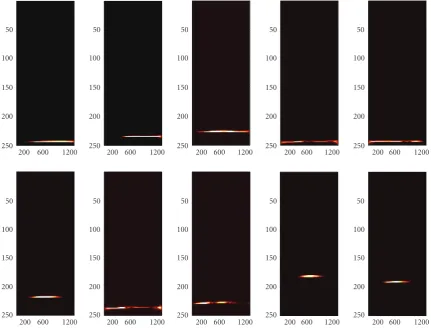
The original S-method, the S-method of reconstructed signal, as well as the corresponding eigenvalues are shown in Figure 2. The reconstructed formants that will be used in watermarking procedure and their support function are zoomed inFigure 3. The formants separated by the proposed eigenvalues decomposition are shown inFigure 4(although
K =20 is used, only ten formants are related to the positive frequency axes).
5. Time-Frequency-Based Speech
Watermarking Procedure
5.1. Watermark Modelling and Embedding. The
Original signal (SM) Reconstructed formants (SM)
Fre
q
u
en
cy
Fre
q
u
en
cy
Time Time
(a)
0 2 4 6 8 10 12 14 16 18 20
0 5 10 15 20
Eigenvalue number Components eigenvalues
(b)
0 2 4 6 8 10 12 14 16 18 20
0 1 2 3
Eigenvector number Components concentration (log scale)
(c)
Figure2: An illustration of the formants reconstruction by using the eigenvalues decomposition method.
an arbitrary combination of decomposed formants. The pro-cedure for watermark modelling can be described through the following steps:
(1) consider a random sequences,
(2) calculate the STFT of the sequence s denoted as STFTs(t,ω),
(3) the support function LH(t,ω) is defined by using
SMfrecK(t,ω) as follows:
LH(t,ω)=
⎧ ⎪ ⎨ ⎪ ⎩
1, forSMfrecK(t,ω)> λ,
0, otherwise, (26)
whereλcould be set to zero or, for a sharpen mask, to a small positive value,
(a) (b)
Figure 3: The reconstructed region of formants and the corre-sponding support function.
(4) finally, the watermark is obtained at the output of the time-varying filter as follows [19]:
wat(t)=
ω
LH(t,ω)STFTs(t,ω). (27)
The signal is watermarked according to
xw(t)=
ω
(STFTx(t,ω) +LH(t,ω)STFTs(t,ω)), (28)
where STFTx(t,ω) is the STFT of the host signal within the
selected region.
5.2. Watermark Detection. Following the similar concept
as in the embedding process, the watermark detection is performed, within the time-frequency domain, by using the standard correlation detector [19]
Det(wat)=
t
ω
SMxw(t,ω)SMwat(t,ω), (29)
where SMxw(t,ω) and SMwat(t,ω) are the S-method of the watermarked signal and watermark, respectively.
The watermark detection is tested by using a set of wrong keys (trials), created in the same way as the watermark. Hence, the successful detection is provided if
Det(wat)>Detwrong, (30)
that is, if
t
ω
SMxw(t,ω)SMwat(t,ω)
>
t
ω
SMxw(t,ω)SMwrong(t,ω)
(31)
50
100
150
200
250
200 600 1200 50
100
150
200
250
200 600 1200 50
100
150
200
250
200 600 1200 50
100
150
200
250
200 600 1200 50
100
150
200
250
200 600 1200
50
100
150
200
250
200 600 1200 50
100
150
200
250
200 600 1200 50
100
150
200
250
200 600 1200 50
100
150
200
250
200 600 1200 50
100
150
200
250
200 600 1200
Figure4: The formants components isolated by using the eigenvalues decomposition method.
Note that the S-method is used in the detection pro-cedure. The detection performance is improved due to the higher components concentration. Additionally, for larger values of L (in the S-method), the cross-terms appear and they are included in detection, as well [19]. Namely, the cross-terms also contain the watermark, and hence they contribute to the watermark detection. The detection performance is tested by using the following measure of detection quality [24,25]:
R=Dwr−Dww
σ2
wr+σ2ww
, (32)
whereDandσ2represent the mean value and the standard deviation of the detector responses, while the subscriptswr
andww indicate the right and wrong keys (trials),
respec-tively. The corresponding probability of error is calculated as follows:
Perr=1
4erfc
R
2
−1
4erfc
−R
2
+1
2. (33)
6. Examples
Example 1. In this example, we will demonstrate the advan-tages of the proposed formants selection procedure over the
threshold-based procedure given in [19]. Namely, two cases are observed.
(1) Formants whose energy is above a threshold ξ are selected for watermarking. The threshold is deter-mined as a portion of the S-method’s maximum value ξ = λ10λlog10(max|SM|) (max|SM|is the max-imum energy value of the S-method within the observed region), [19]. Thus, the threshold is adapted to the maximum energy within the region.
(2) The eigenvalues-based decomposition is used to create an arbitrary composed time-frequency map.
In the first case, the number of selected formants depends on the threshold value. An illustration of formants selected by using two different thresholdsξ1andξ2(ξ1> ξ2) is given inFigure 5(a). Note that a higher thresholdξ1(calculated for
(a)
(b)
Figure5: (a) The components selected by two different thresholds ξ1andξ2(ξ1 > ξ2) within the same region. (b) The components selected within two different regions when the threshold is 0.6·
100.6log10(max|SM|).
not enough components, it could be difficult to detect the watermark. An illustration of two different regions, obtained by using the thresholdξwithλ=0.6, is given inFigure 5(b). Although the threshold is calculated for both regions in the same way 0.6·100.6log10(max|SM|), the number of selected components is significantly different. The components in the first region (Figure 5(b)left) are approximately at the same energy level. Thus, a significant number of them will be selected with this threshold. However, in the second region (Figure 5(b) right), the energy varies for different components and the given threshold selects just a few strongest components.
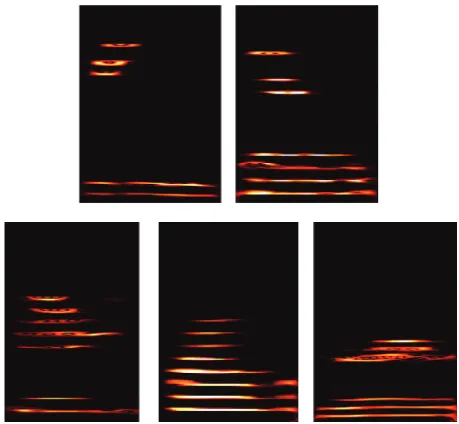
On the other hand, the eigenvalues decomposition method provides a flexible choice of the components number. Furthermore, it is possible to arbitrarily com-bine the components that belong to the low-, middle- or high-frequency regions. Consequently, an arbitrary time-frequency mask can be composed as a combination of signal components. It will be used for watermark modelling. Some illustrative examples are shown inFigure 6. Each component is available separately and we can freely choose the number and positions of the components that we intend to use within the time-frequency mask. For instance, when observing the region in Figure 5(a) (right), we can combine a few strong low-frequency components with a few high-frequency
Figure6: Illustrations of components selections provided by the proposed method.
components, as shown inFigure 6(upper row, left), which could be difficult to achieve by using the threshold-based approach.
Example 2. The speech signal with maximal frequency 4 kHz is considered. A voiced time-frequency region is used for watermark modelling and embedding. The procedure is implemented in Matlab 7. The STFT is calculated using the rectangular window with 1024 samples, and then, it is used to obtain the signal S-method. Since the speech components are very close to each other in the time-frequency domain, the S-method is calculated with the parameterL=3 to avoid the presence of cross-terms. After calculating the inverse transform (the IFFT routine is applied to the S-method), the eigenvalues and eigenvectors are obtained by using the Matlab built-in function (eigs). Twenty eigenvectors are selected, weighted by the corresponding eigenvalues, and merged into a signal with desired components. Furthermore, the S-method is calculated for the obtained signal providing the support functionLH for watermark shaping. Here, the
Hanning window with 512 samples is used for the STFT calculation while in the S-methodL = 3. The watermark is created as a pseudorandom sequence, whose length is determined by the length of the voiced speech region (approximately 1300 samples). The STFT of the watermark is also calculated by using the Hanning window with 512 samples. It is then multiplied by the functionLH to shape
its time-frequency characteristics. For each of the right keys (watermarks), a set of 50 wrong trials is created following the same modelling procedure as for the right keys. The correlation detector based on the S-method coefficients is applied withL=32.
0 500 1000 0
0.5 1
Right keys
Wrong trials
Figure7: The normalized detector responses for a set of right keys and wrong trials (for the proposed approach).
of normalized detector responses for right keys (red line) and wrong trials (blue line) is shown inFigure 7. Furthermore, the robustness is tested against several types of attacks, all being commonly used in existing procedures [5, 8, 10]. Namely, in the existing algorithms, the usual amount of attacks is time scaling up to 4%, wow up to 0.5% or 0.7%, echo 50 ms or 100 ms [5], and so forth, providing the probability of error of order 10−6. We have applied the same types of attacks, but with higher strength, showing that the proposed approach provides robustness even in this case. The proposed procedure is tested on: mp3 compression with constant bit rate (128 Kbps), mp3 compression with variable bit rate (40−50 Kbps), delay (180 ms), Echo (200 ms), pitch scaling (5%), wow (delay 20%), flutter, and amplitude normalization. The measures of detection quality and cor-responding probabilities of error are calculated according to (32). The results are given inTable 2. Note that the proposed method provides very low probabilities of error, mostly of order 10−7, even in the presence of stronger attacks. Also, the robustness to pitch scaling has been improved when compared to the results reported in [19].
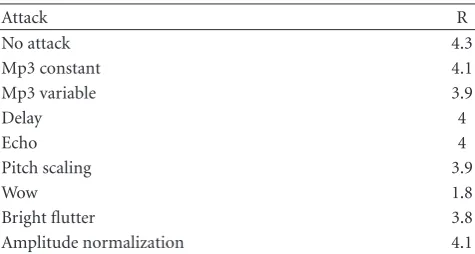
As expected, the detection results are similar as in [19] where the threshold is well adapted to the energy within the considered speech region. However, in the previous example, it is shown that the optimal threshold selection for one region does not have to be optimal for the other ones. Thus, it can include only a few formants (Figure 5(b)right). Consequently, the detection performance decreases, due to the smaller number of components available for correlation in the time-frequency domain. The procedure performance can vary significantly for different regions, since it is not easy to adjust thresholds separately for each of them. In this example, a single threshold is used. The detection results obtained for the region where the threshold is not optimal are shown inFigure 8. The measures of detection quality have decreased, as shown inTable 3. From this point of view, the flexibility of components selection provided by the proposed approach assures more reliable results.
0 500 1000
0 0.5 1
Right keys
Wrong trials
Figure8: The normalized detector responses for a set of right keys and wrong trials; the threshold is not optimal for the considered region.
Table 2: The measures of detection quality for the proposed approach under various attacks.
Attack R Perr
No attack 8 10−9
Mp3 constant 7.2 10−7
Mp3 variable 6.8 10−7
Delay 7 10−7
Echo 6.9 10−7
Pitch scaling 6.4 10−6
Wow 6.2 10−6
Bright flutter 6.8 10−7
Amplitude normalization 6.2 10−6
Table3: The measures of detection quality.
Attack R
No attack 4.3
Mp3 constant 4.1
Mp3 variable 3.9
Delay 4
Echo 4
Pitch scaling 3.9
Wow 1.8
Bright flutter 3.8
Amplitude normalization 4.1
the cryptography can be used to prove the presence of a specific watermark in a digital object without compromising the watermark security.
7. Conclusion
The paper proposes an improved formants selection method for speech watermarking purposes. Namely, the eigenvalues decomposition based on the S-method is used to select different formants within the time-frequency regions of speech signal. Unlike the threshold-based selection, the pro-posed method allows for an arbitrary choice of components number and their positions in the time-frequency plane. This method results in better performance when compared to the method based on a single threshold. An additional improvement is achieved by adapting the Hermite projection method for characterization of speech regions. This has led to an efficient selection of voiced regions with formants suitable for watermarking. Finally, the watermarking pro-cedure based on the proposed approach provides greater flexibility in implementation and it is characterised by reliable detection results.
Acknowledgment
This work is supported by the Ministry of Education and Science of Montenegro.
References
[1] S. K. Pal, P. K. Saxena, and S. K. Mutto, “The future of audio steganography,” in Proceedings of Pacific Rim Workshop on Digital Steganography, 2002.
[2] N. Cvejic and T. Sepp¨anen, “Increasing the capacity of LSB based audio steganography,” inProceedings of the 5th IEEE International Workshop on Multimedia Signal Processing, pp. 336–338, St. Thomas, Virgin Islands, USA, December 2002. [3] C.-S. Shieh, H.-C. Huang, F.-H. Wang, and J.-S. Pan, “Genetic
watermarking based on transform-domain techniques,” Pat-tern Recognition, vol. 37, no. 3, pp. 555–565, 2004.
[4] F.-H. Wang, L. C. Jain, and J.-S. Pan, “VQ-based watermarking scheme with genetic codebook partition,”Journal of Network and Computer Applications, vol. 30, no. 1, pp. 4–23, 2007. [5] D. Kirovski and H. S. Malvar, “Spread-spectrum watermarking
of audio signals,”IEEE Transactions on Signal Processing, vol. 51, no. 4, pp. 1020–1033, 2003.
[6] H. Malik, R. Ansari, and A. Khokhar, “Robust audio water-marking using frequency-selective spread spectrum,” IET Information Security, vol. 2, no. 4, pp. 129–150, 2008. [7] N. Cvejic, A. Keskinarkaus, and T. Seppanen, “Audio
water-marking using m-sequences and temporal masking,” in Pro-ceedings of IEEE Workshop on Applications of Signal Processing to Audio and Acoustics, pp. 227–230, New York, NY, USA, October 2001.
[8] N. Cvejic,Algorithms for audio watermarking and steganogra-phy, Academic dissertation, University of Oulu, Oulu, Finland, 2004.
[9] S.-S. Kuo, J. D. Johnston, W. Turin, and S. R. Quackenbush, “Covert audio watermarking using perceptually tuned signal independent multiband phase modulation,” inProceedings of
IEEE International Conference on Acoustic, Speech and Signal Processing, pp. 1753–1756, Orlando, Fla, USA, May 2002. [10] S. Xiang and J. Huang, “Histogram-based audio watermarking
against time-scale modification and cropping attacks,”IEEE Transactions on Multimedia, vol. 9, no. 7, pp. 1357–1372, 2007. [11] K. Hofbauer, H. Hering, and G. Kubin, “Speech watermarking for the VHF radio channel,” in Proceedings of EUROCON-TROL Innovative Research Workshop (INO ’05), pp. 215–220, Br´etigny-sur-Orge, France, December 2005.
[12] L. Cohen, “Time-frequency distributions—a review,” Proceed-ings of the IEEE, vol. 77, no. 7, pp. 941–981, 1989.
[13] P. J. Loughlin, “Scanning the special issue on time-frequency analysis,”Proceedings of the IEEE, vol. 84, no. 9, p. 1195, 1996. [14] B. Boashash,Time-Frequency Analysis and Processing, Elsevier,
Amsterdam, The Netherlands, 2003.
[15] F. Hlawatsch and G. F. Boudreaux-Bartels, “Linear and quadratic time-frequency signal representations,”IEEE Signal Processing Magazine, vol. 9, no. 2, pp. 21–67, 1992.
[16] L. Stankovic, “Method for time-frequency analysis,” IEEE Transactions on Signal Processing, vol. 42, no. 1, pp. 225–229, 1994.
[17] L. Stankovi´c, T. Thayaparan, and M. Dakovi´c, “Signal decom-position by using the S-method with application to the analysis of HF radar signals in sea-clutter,”IEEE Transactions on Signal Processing, vol. 54, no. 11, pp. 4332–4342, 2006. [18] T. Thayaparan, L. Stankovi´c, and M. Dakovi´c,
“Decompo-sition of varying multicomponent signals using time-frequency based method,” inProceedings of Canadian Confer-ence on Electrical and Computer Engineering (CCECE ’06), pp. 60–63, Ottawa, Canada, May 2006.
[19] S. Stankovi´c, I. Orovi´c, and N. ˇZari´c, “Robust speech water-marking procedure in the time-frequency domain,”EURASIP Journal on Advances in Signal Processing, vol. 2008, Article ID 519206, 9 pages, 2008.
[20] S. Stankovi´c, I. Orovi´c, N. ˇZari´c, and C. Ioana, “An approach to digital watermarking of speech signals in the time-frequency domain,” inProceedings of the 48th International Symposium focused on Multimedia Signal Processing and Communications (ELMAR ’06), pp. 127–130, Zadar, Croatia, June 2006.
[21] D. Kortchagine and A. Krylov, “Image database retrieval by fast Hermite projection method,” inProceedings of the 15th International Conference on Computer Graphics and Applica-tions (GraphiCon ’05), pp. 308–311, Novosibirsk Akadem-gorodok, Russia, June 2005.
[22] D. Kortchagine and A. Krylov, “Projection filtering in image processing,” inProceedings of the 10th International Conference on Computer Graphics and Applications (GraphiCon ’00), pp. 42–45, Moscow, Russia, August-September 2000.
[23] S. Stankovi´c, “About time-variant filtering of speech signals with time-frequency distributions for hands-free telephone systems,”Signal Processing, vol. 80, no. 9, pp. 1777–1785, 2000. [24] D. Heeger,Signal Detection Theory, Department of Psychiatry,
Stanford University, Stanford, Calif, USA, 1997.
[25] T. D. Wickens, Elementary Signal Detection Theory, Oxford University Press, Oxford, UK, 2002.