693
A Patchwork-Based Audio Watermarking: Review
Y. D. Chincholkar, S. R. Ganorkar
Abstract:The internet technology used to release and distribute multimedia rights requires scruples copyright protection and detection policy. In the current context, the multimedia industry is suffering from multibillion-dollar annual financial loss. The entire music industry is hunting for a concrete solution that undermines the owner‘s and an artist‘s work as per International Federation of the Phonographic standards. This paper proposes a review of digital watermarking techniques to enhance and enrich performance characteristics such as piracy, security, and reliable distribution of copyright contents to distributors and retailers through theoretically and by performance analysis. It helps researchers to develop effective encryption and decryption algorithms to trade off performance characteristics such as imperceptibility of digital content, reducing the computational complexity, increasing the security by optimizing the algorithm payload and improving robustness are present challenges. From the survey, it is observed that 95 to 97 % of copyright information gets changed due to the transformation and leads to piracy leakage. Likewise, it surmised the various signal processing attacks that are used for the evaluation of watermarking systems, which supplies guidelines to select substantial patchwork method based watermarking procedures for an option for the specific application area to significant improvement could observe in the audio copyright information.
Index Terms— Digital audio watermarking, Imperceptibility, intellectual property rights (IPR), International Federation of the Photography industry, Multimedia, Robustness, and Security.
————————————————————
1
I
NTRODUCTIONrecent development in multimedia technology and advances in communication technology has made ample information available on global networks. As a result of this, duplication, distribution, and management of multimedia data in digital form are easily accessible than ever before. These developed communication and multimedia technologies have contributed enormous benefits to individuals as well as society. At the same time, the music industry claims a multibillion-dollar annual financial loss due to piracy and directly loss of 70,000 jobs annually, which is likely to increase due to illegal downloads and distribution. Therefore, the International Federation of the Phonographic Industry (IFPI), Institute of Policy information and recording companies are motivating to produce a reliable solution for preventing unlawful use of copyrighted multimedia data. Due to the rising of this demand, many researchers are proposing solutions and developing algorithms for monitoring the illegal distribution of multimedia data[1]. One of the best solution or technology for copyright protection integrity, authentication of multimedia data is digital watermarking. One of India's most prominent web-based business organizations closes their online music store inside one year of its earliest stages because of the online robbery and techniques to conflict the equivalent (Flipkart to shut down Flyte MP3 Music store on June 17, 2013). For the protection of multimedia content such as images, video, and audio different digital watermarking schemes are proposed [2],[3],[4],[5].
Digital watermarking is the process of embedding or hiding of secret information in the form of the name, signature, logo, ID number, and user identity into the media file. However, the required data can be extracted to demand ownership or copyright [6],[7]. This process can be embedded in the spatial or frequency domain. Both of these domains are different and used in the various circumstances with their pros and cons. Image watermarking [8],[9], video watermarking [10],[11], and audio watermarking [2],[5],[12],[13] are the categorisation of digital watermarking. That is classified based on signal integrity, security, and robustness applications. This paper explores the twenty-three-year history of patchwork-based audio watermarking technologies in terms of robustness against various attacks. The organization of this paper is as follows: Section 2, provides an overview of the digital audio watermarking technique and section 3, puts forth the history of the patchwork method. In section 4, a broad review of digital audio watermarking techniques based on the patchwork method is presented. A brief finding of the limitation, challenges, and future scope of the probable research is provided in section 5, and section 6 provides the conclusion.
2
D
IGITALA
UDIOW
ATERMARKING2.1 Audio Watermarking Process
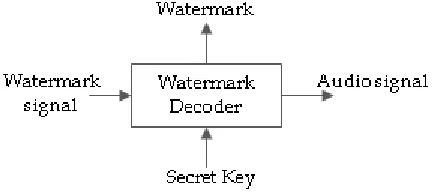
The audio signal is a one-dimensional array signal. Moreover, it is observed that as a human auditory system (HAS) is more sensitive as compared to the human visionary system (HVS)[6],[12],[14],[15]. Without degrading the quality of the audio signal, to embed additional data into an audio signal than other multimedia data such as video and image is a prominent task that is carried out as a research work domain. Embedding of a watermark data in an audio signal as permanent signs is the challenging process of digital audio watermarking. Watermark is secret information. The watermark embedder output is called the watermark signal, which is perceptually indistinguishable from the original audio signal. The secret key is to incorporate with a watermark to provide security to the audio signal. Figure 1 shows the general structure of a digital audio watermark inserting process. The watermark signal is then downloaded, modified, tampered with the malicious attempt, recorded or broadcasted and afterward offered to the watermark decoder. The decoder detects the presence or absence of the watermark. Figure 2 gives an overview of the watermark detection process.
____________________________________
Y D Chincholkar is currently pursuing Doctor of Philosophy in electronics and telecommunication power engineering in Savitribai Phule Pune University, India Country, PH-+919011041593. E-mail: [email protected]
694 Fig. 1: The general structure of digital audio watermark
embedding process
Fig. 2: The general structure of digital audio watermark decoding process.
2.2 Audio Watermarking Performance Characteristics An implementation of the Digital audio watermarking scheme should meet some essential performance characteristics such as imperceptibility, robustness, payload, reliability, computational complexity, and security [16]. Imperceptibility denotes the ability of the watermarking algorithm where the inserted watermark data should not be noticeable, and the quality of the audio signal should not be degraded. It measures fidelity based on ITU-R recommendation BS.562 quality rating on a scale of 1 to 5 as well as Signal to Noise ratio or Peak Signal to Noise ratio and Subjective Human Evaluation [17]. Robustness refers to as watermarking algorithms ability to recover the watermark data from the watermarked audio signal in the presence or absence of conventional signal processing operations and hostile attacks. Its measuring fidelity is the Signal to Noise Ratio (SNR), Detection Ratio (DR), Misdetection Rate (MR), Bit Error Rate (BER) and Normalized Correlation Coefficient (NCC)[15]. Payload refers to the as watermarking algorithm employed to embedded amount watermark data bits into an audio signal per second, and it measured as bits per second (bps). It is different for different applications such as copy control application may require four to eight bits for every 10 seconds, and music broadcast monitoring needs 24 bits per second. Reliability means the watermarking algorithm employed to identify fidelity requirements for a specific set of attacks to detect and decode a watermark correctly. Computational complexity implies the design of the watermark embedding and decoding algorithm or procedure as low computational complexity as possible. Hence, a different type of watermark can be inserted. It also considers the speed of embedding and detection process[4]. Security means that without knowing the secret key, no one can extract the watermark data. The design requirements, such as imperceptibility, robustness, and payload, are contradictory but must be satisfied.
2.3 Audio Watermarking Application
Digital audio watermarking provides several application areas such as[16]. Ownership Protection: Proprietorship information contains a watermark implanted into an audio signal and known only by an authorized person. It supports the owner to validate the presence of the watermark in case of dispute to show his ownership. Proof of ownership: It helps the owner to prove their ownership when some unauthorized persons made changes in the multimedia file and then claiming its work. Authentication and tampering detection: In such an application, the secondary data set is implanted in the host signal and afterward used to decide whether the host signal tampered or not. Fingerprinting: In such application supplementary data inserted by watermark and used to locate the inventor or receivers of a specific multimedia file. Access control and copy: In this application, watermark insertion signifies some access control and copy control policy, which directed to specific software and hardware for unable or disables record device. It can also help in broadcast monitoring and Information carrier application
2.4 Audio Watermarking Algorithms
In a decade, a lot of audio watermarking algorithms have been developed by using various techniques for embedding watermark in the time domain or transform domain. These methods, are generated based on additive, multiplicative model and psychoacoustic model, such as Spread Spectrum [18],[19],[20],[21],[22], Echo-Hiding[23],[24],[25],[26], Support Vector Regression (SVG)[27],[28],[29], the Least Significant Bit (LSB)[13], Phase[3], Histogram[30] and Patchwork[12], [31], [32],[33],[34],[35],[36],[37],[38],[39],[40],[41]. Implementation of said methods is possible by using Discrete Fourier Transform (DFT), Discrete Cosine Transform (DCT)[36],[42[,[44],[45], Discrete Wavelet Transform (DWT)[46],[47],[48], Discrete Sine Transform[49] and Quantization Index Modulation (QIM)[50] in the transform domain. Least Significant Bit (LSB) technique is comfortable to carry out and gives tangible results, but lowers mortification of signal quality, high perceptual transparency, and low-bit encoding. However, it suffers a problem of robustness due to added noise, cropping, and scaling. Echo hiding technique is easy to implement, but its detection is more complicated and requires more computation. Echo hiding technique provides inclination towards inevitable mistakes and for smaller amplitude; the echo detection becomes difficult. Phase coding technique is a fundamental technique; it facing a problem of low data payload because embedding is done only in the first block, and dissemination of watermark over the entire set of data is not available. By using spectrum spreading technique, any stream of information can be embedded into an audio signal via Spread Spectrum method; so, it is difficult to take out or observe a signal, which permits a significant level of robustness. For real-time applications, it is not a practical solution because it causes a delay due to the transformation process. Watermark and quality of the audio signal do not get affected by any attack due to the utilization of mid-frequency coefficient of DCT for watermark embedding. During quantization process invariance properties of the system get destroyed and suppress high-frequency component. For frequency and time domain DWT is the best suitable technique and offer higher compression ratio. Computing cost becomes higher and takes much more time for compression. DFT is a rotational, scaling, and translational invariant. It helps to Watermark
Embedder Audio signal
Secret Key
695 retrieve watermarked data from geometric distortions, but its
implementation becomes complicated, and the calculation cost may be higher. The fundamental principle of data embedding is as follow: Let host signal segmentation be represented in time and transform domain as z i( j)respectively where i and j represent respective domain samples. Then embedding of watermark process can be expressed in both domains as
( / ) ( / ) ( / )
z i j x i j w i j (1) Where controls the
watermark intensity,w i( / )j represents the watermark in time and transform domain which is not modulated. In multiplicative
modeling, it can be expressed as z i( ) x i( ) 1
w i( )
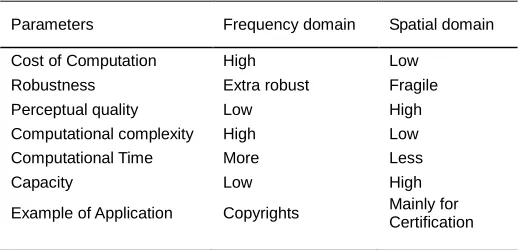
(2) The blind, non-blind, and semi-blind scheme is the base for the development of this algorithm; watermark extraction process executed by using the secret key only in the blind system. Whereas in the non-blind scheme original audio signal and secret keys required. Semi-blind schemes need watermark and secret key for extraction. In general, it is found that the executions of audio watermarking techniques are relatively straightforward in time-domain. Similarly, the computing resource requirement is also less. However, the drawback is, it becomes less robust. They are employed based on the frequency masking characteristics of the human auditory system and human perceptual properties. Presently, the patchwork-based watermarking is the best technique and offers better imperceptibility, high level of security, and offers reliable robustness against signal processing standard attack. Table 1 provides a comparison between the frequency domain and spatial domain watermarking.TABLE 1
Comparison between Frequency and Spatial domain
3
H
ISTORY OFP
ATCHWORKT
ECHNIQUESince the last several decades, an enormous amount of work is carried out for audio watermarking using the patchwork method. It is a dual-channel statistical approach based on a pseudorandom and mathematical process with the hypothetical approach. Patchwork applied to a small segment of the host audio signal which is selected randomly and get added with a specific statistic; Gaussian distribution is one of them which is explained below. Let randomly selected
nonoverlapping channels toX( )k become ( )
j
X j
where j0 , 1 andJ
0 , 1, ...,J 1
,J K is the subsets dimension. Thus, the function of watermark embedding can be written as( ) ( )
1 jz z
Y j X j (3)
Where is an arbitrary scalar quantity represents the intensity of the patchwork method and its value selected greater than zero. In decoding methodsY k( ), are formed indices of the randomly selected samples of ( )
z
Y j , ( ) z
X j .
Thus, the value is calculated as
0 - 1 0 - 1
2
j Y j Y j j X j X j
b
J J
(4)
Above equation consist of two terms, the first term on the right side represent host signal interference, and the second on the left-hand side is the watermark interference. This
interference term becomes zero if X ( )j
z has zero mean
value. In connection with this improved design is proposed by using DCT and DWT domain. Patchwork based audio watermarking algorithms performance depends on the difference between samples mean values and constant value.
4
L
ITERATURES
URVEYBender et al. [51] predicting the patchwork method as a future method for watermarking with high giving robustness against conventional signal processing attack and introduced initially for image watermarking. Implanting of watermark done utilizing Gaussian distribution statistical approach. The select two patches randomly and add a small constant in one patch and simultaneously removed from another patch. In the detection method subtraction of sample value from patches are done. Laurence Boney et al. presented the watermarking method first time for audio in the year 1996. PN sequence is used as a watermark and inserted into each segment of the sample by calculating the masking threshold of the signal, which is a weighted Hanning window. In the detection process, the original and PN sequence is required to detect the watermark. This scheme robust in the presence of a specific common attack. Arnold [12] proposed his work in the Fourier domain by utilising power density function and analytical testing approach, which is one of the outstanding contributions of his research work. The development of the algorithm entirely based on the statistical parameter, such as mean and variance. They embed a 1-bit watermark in the interval of 1.2 seconds of the audio clip in mapping with a secret key in a two different patch based on characteristics of the audio signal. The embedding function used in an algorithm follows the multiplicative approach for addition and subtraction of a constant value adaptively, which acts as an embedding factor. For the detection of the watermark, they use the mean and variances of the sample along with the reasonable distribution of the sample values. The proposed watermarking technique was evaluated based on quality, security, and robustness. It fails to provide robustness against the jitter attack. In-Kwon Yeo et al. [31] proposed his work based on transforming domain, such as DCT, DFT, and DWT, by using the modified (enhanced version) patchwork algorithm. In the embedding process mapping of the secret key with the watermark is done to form a random sequence generator. Four patches were generated, out of which, two patches are for one bit and others two are dedicated to the zero-bit message. Embedding of a message done in the opposite direction by moving the means of its correlated patches according to the signal conditions and the strength of the watermark. It uses the embedding function
here for embedding watermark bit 0, and 1
Parameters Frequency domain Spatial domain
Cost of Computation High Low
Robustness Extra robust Fragile
Perceptual quality Low High
Computational complexity High Low
Computational Time More Less
Capacity Low High
696
, ( ) , ( ) 1 ( ) ( )
i
i m i m
Y j X j A m S m (5) Where
0 , 1 ,
( ) sg n ( ) ( )
m m
j
A m
X j X j , denotes the embeddingfactor, ,
( )
im
X j DCT coefficients and ‗sgn‘ is sign function and
2
, ( ) , ( ) /
( )
( 1 )
im im i j
X j X j L
S m
L L
(6)Variance and the
mean value of the sample are used to select the embedding factor is adaptively. Because of this detector has to determine whether a watermark is introduced or not as well as needs to detected which bit has embedded within the watermarked signal. The developed algorithm is more resistant to attack, but the information needs to insert repeatedly. The limitation of this technique is the recognition of the watermark data is done under the low rate of compression. Whereas filtering becomes a challenging process, and the least amount of information is embedded. Hyunho Kang et al. [33] proposed a blind algorithm for watermarking based on a full index embedding by using psychoacoustically - adapted patchwork technique. They recommend two improvements in the algorithm of the audio watermarking method proposed by In-Kwon Yeo [31] and reduce complexity. First, by using a Bark frequency scale, the strength of psychoacoustically adapted watermark embedding process changed frame by frame. Second, the probable error of misdetection reduced due to modification carried in all index set. The high rate of embedding (up to 43 bps) is achieved by using discrete wavelet packet transform (DWPT) in the algorithm. Insertion of watermark data into a host signal is performed by using DWPT operation on audio, and hence complexity reduces. In this algorithm, it is assumed that the samples average value difference is close to zero and valid only for a K number of samples. For embedding one watermark symbol required K samples of the host signal to reduce the probability of error; otherwise, the probability of error becomes higher. Therefore, the trade-off value of the probability of error and the amount of data embedded need to find. They generate K samples from a signal — first, half samples used for addition and second half samples used for subtraction of incremental level. Embedding operation performed based on the difference between the average value of the first half and second half sample is not zero else not embedded. It followed a psychoacoustic model by selecting a critical frequency band and their sub-band of frequency by using the Bark scale with their signal energy. (7)Where f denotes the frequency, measured in Hertz. Thus, the general masking threshold (GMT) calculated by using an equation:
( ) ( , )
2 8
1 0 1 0
1 0
1
1 0 lo g 1 0 1 0
q i i j
T x M x x
i
j
G M T x
(8)WhereTq(xi) is the minimally distinct level of the Bark
frequency scale. Detection of a watermark symbol does not use the host signal, and symbol estimation done based on the difference between the average values of all the index set. Because of this, it gives excellent misdetection rate. N. K. Kalantari et al. [32] proposed a robust multiplicative patchwork method for the audio watermarking. In this proposed work, two subsets of audio signals are formed randomly by using the secret key with equal size. Embedding of single-bit data done
by modifying one of the subsets by multiplying or dividing one of the samples keeping another subset intact. The multiplicative method is more secure, robust watermark embedding process and watermarked audio quality maintained at an acceptable level. An embedding process is executed by finding the approximate coefficient of the host signal using
DWT. The embedding process for 0 or 1, i.e.,Y0 / 1 is as follows
0 / 1( ) 0 / 1( )
k
X i Y i (9) With the additive model
0 / 1( ) 0 / 1( ) ( 1) 0 / 1( )
k
X i Y i Y i (10) Where, 0 1 The embedding factor value α is selected using an iterative algorithm for better imperceptibility, and maintain the quality of the watermarked audio signal and evaluated by using Perceptual Evaluation of Audio Quality (PEAQ) method. They use the comparative method for the detection of whether watermark bit is embedded or not based on the energy of
0
( ) X i and
1
( )
X i . The BER is used as a performance
low-697 frequency coefficient is then partitioned into the same number
of frame pairs, and then selected frames are used for embedding based on the following criterion and modified their coefficient. The secret key used for control and security while executing the modification process of the coefficient of the frames. The embedding criteria follow the rule for embedding
bit 0/1 for the lth frame is,
,1 , 2l l l
if c c c For bit 0 (11) if
cl, 2 cl,1
cl For bit 1 (12)then' '
,1 ,1 , 2 , 2 .
l l l l
c c a n d c c (13) Otherwise,
' '
,1 1 0 .5 , 2 1 0 .5
l l l l
c c a n d c m c (14Where
and used for embedding bit 0 and 1,cl,1 andcl, 2 is the first
and second fragments absolute mean value of front lth frames, is a positive constant parameter value, cl',1 and
' , 2
l
c is the
modified coefficient of the first and the second fragment of the front and rear lth frames. Letclis the average absolute mean value of the first and second fragment absolute mean value of front lthframes. Ensured robustness and maintained the perceptual quality of the audio signal. In the detection process first, watermarked frame pair from watermark signal needs to identify the same as embedding process. Once the watermark frame pairs detected by using the secret key, then the watermark extraction process executed for identifying watermark. The proposed scheme is better than earlier techniques and additional information required for watermark detection curtail down but required synchronization between encoder and decoder. For conventional attacks, the proposed method is more robust and proved by evaluating performance parameter such as BER. The proposed algorithm fails to provide robustness against advanced attacks such as de-synchronisation attacks, pitch, and time shifting. I. Natgunanathan et al.[38] have analysed a patchwork-based audio watermarking scheme he proposed earlier in [34]. In this method, the audio signal segmented into a different number of a subsegment of equal lengths, and then the coefficients of sub-segments are calculated by applying the DCT. The low-frequency components of selected DCT frame pairs are used for embedding based on pseudo noise sequence. In this analysis, a derivative of the probability density function of a random variable used for calculating the absolute mean value of the respective DCT coefficients of frames. This PDF value used for the selection of suitable pair for inserting watermarks bit, they indicate how the watermark parameters affect the performance of audio watermark scheme. This analysis is verified by simulation applying to various audio signals and provides the guidelines for the selection of watermark parameter. Theoretically calculated values are tested via simulation for the realistic audio signal. Peng Hu et al. [40] proposed an improved audio watermarking algorithm in Constant-Q Transform (CQT) domain. The Log-frequency spectrogram is calculated by using CQT and offer equal Q factor to all. In the watermark insertion process, the first coefficient of the audio signal is calculated by applying CQT, and some number of frame pairs are from in octave with equal length. Only selected middle frequency; frame pairs are used for watermark embedding based on some reason such as low CQT coefficient offer weakly stable energy which readily attacks externally. The second is, the location of frame pairs
cannot be done precisely because modification of coefficients of a frame leads to the energy fluctuation in adjacent frames and alters the energy ration of the frame. The third is if the frame pair offers high energy ratio, then more effort required in the coefficient modification of both frames because of this quality of the audio signal degraded. The energy of the lth
frame in octave d calculated by using
2
, 1
(
( ,
) )
a C Q
d l n d
q
X
l n
(15) Where l =1, 2, R - s, ‗a‘is the number of bins per octave , C Q d
X , qd l, denotes the nth coefficient and the energy of frame lth in octave d, ‗s‘ denoted the spacing between the frame and R is the total number of frames For the jth frame watermark embedding rule
for bit 0 is
, ,
, , , 1
, 1
, ,
, , , 2
, 2
,
, , , , 3
, , , , , , 1 1 , , , 3 2 1
, 1 , ,
2
3
1, , ,
2
3
, 2 , ,
2
d j s d j s
d j d j s d j
d j
d j s d j s
d j d j s d j
d j
d j s
d j d j d j s d j
d j
d j s
d j d j d j s
d j
p p
if p p p r
p r
p p
if p p p r
p r
p
if p p p p r
p
p
if p p p
p
, ,, , 4 , ,
,
2 , 3 , ,
d j s
d j s
d j d j s d j s d j s
d j
p
p
if p p r p p
p
(16) Similarly, bit 1 embedding process is by following the
opposite process of modification of energy value. Wherepd,j
andpd,j s
is the modified energy value of pd,j,
,
d j s
p
respectively, and r1, r2, r3 and r4 are the watermarking
parameters satisfying r1 > 0.5, r2 > 1, r3 > 1.5, r4 > 0.5 and
698 will be in a similar manner with the embedding technique. This
proposed technique becomes the best method among existing patchwork methods, and it does not require information about the watermarked signal segment consisting of a watermark or not and provides more robust against traditional attacks. Detection rate is used to prove the validity of the algorithm as a performance parameter and achieved 99% and above. The proposed algorithm fails to provide robustness against advanced attacks such as de-synchronisation attacks, pitch, and time shifting. Yong Xiang et al. [37] proposed a contemporary and advanced stage of the digital audio watermarking algorithm using patchwork-embedding and decoding scheme to protest de-synchronised attacks. In the proposed technique, the embedding process is implemented by scrambling a watermark bit with a secret key (PN Sequence) and then by applying the DCT to the host signal to find its coefficients. DCT coefficients of mid-frequency are further segmented into a different number with equal length. In this process, by modifying the DCT coefficient of associated segment scrambled watermark bits inserted into a non-silent segment of audio. Afterward, by using logarithmic DCT (LDCT), a set of synchronisation bits is embedded in the watermarked signal in association with the watermark bits insertion location. An embedding process needs to ensure that watermark embedding capacity does not reduce due to adding of synchronisation bits. Correspondingly, Advance, and normal signal processing attack should not be able to remove added synchronisation bits. Watermark bit 0/1 embedding process is implemented in non-silent DCT Segments of subsegment
following way i f(i ,1 i , 2) ii For bit 0 (17)
i ,1 i , 2 i
( ) i
i f For bit 1 (18) '
, i ,
i k k
Otherwis i k',
1m 0 .5s g n
k1 .5
i
i (19) Where used for embedding bit 0 and 1, k =1,2ands g n ( ) denotes sign function.i,1,
, 2
i
is the absolute
mean value of DCT Segments of subsegment and
,
'
ij is the
modified value. Letiindicates introduced error parameter adaptively andiis the respective segment absolute mean value. In the decoding process needs to identify, whether any offence has been scaled the received watermark signal or not by doing analysing of synchronisation bits locations in the LDCT domain. If it is found that the received signal is scaled, then the synchronisation bits location information helps to find the scaling factor, and later, re-scaled the received signal to remove the synchronisation bits and the scaling factor. Afterward, from the modified version of the received signal, scrambled embedded watermark bits are extracted. In the last stage of the decoding algorithm, by using the secret key and unscrambling phenomenon extracted watermark bits converted into the original watermark bits. They use the DR for analysing the performance of algorithms developed under normal and desynchronization attack and achieved more than 99%. Its DR decreases as its embedding rate increases. Avni Gupta et al. [41] suggested a robust audio watermarking technique based on a patchwork method using spread spectrum to enhancement the embedding and detection process. Robustness of the watermark is enabled using the repetitive coding method for the protection against psycho-acoustic frequency masking (PAFM) and de-synchronisation
attacks. In the proposed work, the watermark used as text data, which converts a decimal number first and onward turned into a 7-bit binary number by using 7-bit ASCII converter. An Original audio signal of length L divided into an equal N number of frames consisting of an M number of PCM sample in the range of power of two. The coefficients of the samples of each frame are calculated by applying a DFT. In the embedding process, embedder selects pairs pseudo-randomly, that generate using a key. Selection of pairs is made based on independent and identically coefficients of samples. For inserting bit 1 and 0, the coefficients of one of the pairs slightly increased while the coefficients in another pair are somewhat decreased above or below the threshold value. In the decoding process, the watermark signal first divided an M number of samples, and then the DFT applied to each sample for finding out the coefficients. With the help of a key, embedder selects pairs pseudo-randomly, and then the difference between the pair is calculated. If the difference is more or lesser than the threshold value, then bit 1 is extracted otherwise bit 0 extracted. Without synchronisation between the decoder and encoder, watermark extraction cannot be possible. Proposed algorithm not robust against common attacks, such as compression, channel fading, jitter, and packet drop attacks. Bit-rate and PSNR are used to prove the validity of the algorithm as a performance parameter and achieved 96 kbps and 19. 84 dB. It fails to achieve standard PSNR mention by IFPI. I. Natgunanathan et al. [36] proposed a new audio watermarking algorithm using a multilayer embedding process. Typically, distribution of multimedia data follows network; data pass through various stages from producer to wholesaler distributor to regional distributor. It is necessary to discover where a multimedia file gets a leak and trace its distribution path whenever a multimedia object is found in the pirated form. In the embedding process, the host signal is segmented in different number with equal length, and then the DFT is applied to its every segment to calculate its coefficients. DCT coefficients of intermediate frequency are further segmented into a different number with equal length and arranged in a specific manner. In the method of embedding bits in layer k (i.e., First layer), initially, two segments of adjacent DCT coefficient considered as a fragment pair. Each fragment absolute mean value is
calculated by using
1 , 1 ,
2 , 2 ,
( ) ( j )
,
f
j k
f
k k
E Y j
E Y
(20) Similarly,
the average value of the absolute mean value and a minimum value of the two fragments is calculated by using
1 , 2 ,
1 , 2 ,
2
m i n ,
,
k k
k
k k k
i n
(21) WhereY1 ,fk(j)and Y2 ,fk(j) is
the fragment pair in layer-k,E stands for expected
operation,k is the average value andi nk is the absolute minimum value of the fragment pair. Watermark bit 0/1 embedding process is done in the following way
1 ,k 2 ,k
k kif in For bit 0 (22)
2 ,k 1 ,k
k k699
'
1,k 1,k
(24) 1,'k 1,k Otherwise,
' 1 ,
' 2 ,
2 ,
2
k k k k
k k k k
i n
i n
m
(25)Where and used for embedding bit 0 and 1,k is the introduced error parameter,1,'kand 2 ,' k is the modified absolute mean value of the fragment.Similar way, watermark bit inserted into all the fragments. A watermark fragment pair of DCT is rearranged back to the original position. Similarly, a watermark embedding process applied to the next layer (i.e., k+1). In this layer, adjacent DCT coefficients of four segments are considered to fragment pair, and then a watermark bit is embedded using the similar embedding mechanism. A similar approach used for embedding watermark bit in the N-layer. In this layer adjacent, 2N DCT coefficients are used to form the next set of fragment pair. Then the modification of DCT coefficients is done in the respective layer without disturbing watermark bits embedded in the previous layers. At the detector side, multi-layer watermarked audio is divided into a different number (segments) of equal length and then applied DCT to find its coefficients. Then it follows the same procedure of embedding for attack free decoding of watermark bit for Layer k by computing the absolute mean value of each fragment. Moreover, then by calculating the difference of absolute mean value using the following equation
' '
1, 2 ,
k k k
(26) 0
k
i f Watermark bit 0 is extracted otherwise bit 1 extracted from a fragment pair of the watermark. Now considering without loss of generality, from a fragment pair of watermarks, the watermark bit zero was retrieved based on equation 26 and the following equation
k k i nk
(27) Moreover, watermark bit one is extracted based on k k i nk (28) Proposed algorithm not robust against collusion attacks. Due to the insertion of a watermark into multiple layers, the perceptual quality degraded. Detection rate is used to prove the validity of the algorithm as a performance parameter and achieved 93% and above.Z. Liu et al. [52] proposed a robust work technique against de-synchronization and recapturing attacks using the patchwork method based on frequency domain coefficients logarithmic mean (FDLM) concept. They focus their work on robustness improvement against recapturing and desynchronization attack using by analysing frequency domain coefficients logarithmic mean (RFDLM) features of the audio signal. DCT coefficients of the low and middle frequency of samples are used for calculating FDLM feature. Then RFDLM is calculated by taking a difference of two FDLM features of the sample. In the watermark embedding process, they form a watermarked frame consisting of three segments based on the synchronization phenomenon. In watermark recognition process, for extraction of synchronization codes and watermark bits from each segment, each watermarked frame gets separate it into three segments. On the off chance that the synchronization code removed from the first segment is equivalent to the second segment then it shows that the edge is synchronized and that the watermark bits separated from the third segment can be kept. If the entire watermark is too long ever to be installed into a solitary casing, we separate the watermark into a few frames and implant the watermark parts
700 TABLE2
PERFORMANCE PARAMETER COMPARISON FOR THE PATCHWORK WATERMARKED AUDIO IN RESEARCH
.
Reference Performance Parameter Performance Parameter values in %
Michael Arnold (2000) Error 1.2 - 1.47
In-Kwon Yeo et al. (2003) BER 0 - 1.4
Hyunho Kang et al. (2008) SNR and MR
24.95 dB, 0.00 - 8.01
N. K. Kalantari et al. (2009) BER 0 - 5.85
Chi-Man Pun et al. (2011) PSNR 42.95- 62.96 dB
I. Natgunanathan et al. (2012) BER 0 – 1.6
Peng Hu et al. (2013) BER 0 - 1.2
Yong Xiang et al. (2014) DR 100 for Common and 97.5-100 for de-synchronised attacks
I. Natgunanathan et al. (2014) DR 98.87 – 100
Avni Gupta et al. (2014) Bit Rate PSNR
96kbps 16.01-19.84 dB
I. Natgunanathan et al. (2017) DR 93.2 – 100
Z. Liu et al. (2018) SNR 29.5 dB
TABLE3
DIFFERENT TYPES OF ATTACKS DISCUSSED BY VARIOUS RESEARCHERS.
Reference Duration of Audio clip in the second
Attacks
Laurence Boney et al. (1996) - Additive noise, lossy coding/decoding, multiple watermarks, resampling, and time-scaling.
Michael Arnold (2000) 12 MP3, Filtering, Resampling, Quantization, Cropping.
In-Kwon Yeo et al. (2003) - Resampling, Filtering such as band-pass, Addition of echo, Equalization, Low bit-rate codec, and copy attack.
Hyunho Kang et al. (2008) 30 Resampling, Filtering such as low and high pass, Addition of echo, Re-quantization, Additive White Gaussian noise, MP3, and AAC.
N. K. Kalantari et al. (2009) 30 Addition of noise, MP3 and AAC, Resampling, Re-quantization, Amplification of amplitude, Addition of echo, Filtering such as low and high pass.
Chi-Man Pun et al. (2011) - Resampling, Re-quantization, Amplification of amplitude, Addition of echo, Filtering such as low and high pass.
I. Natgunanathan et al. (2012) 10 Closed-loop, Re-quantization, Addition of noise, Amplification of amplitude, MP3 and AAC, Resampling, filtering.
I. Natgunanathan et al. (2013) 10 Closed-loop, Re-quantization, Addition of noise, Amplification of amplitude, MP3 and AAC, Resampling, filtering.
Peng Hu et al. (2013) 10 Closed-loop, Re-quantization, Addition of noise, Amplification of amplitude, MP3 and AAC, Resampling, filtering
Yong Xiang et al. (2014) 10 Closed-loop, Re-quantization, Addition of noise, Amplification of amplitude, MP3 and AAC, Resampling, Low and high pass filtering, de-synchronisation attacks such as Pitch scaling, time scaling, time and jitter shifting.
I. Natgunanathan et al. (2014) 60 Closed-loop, Re-quantization, Addition of noise, Amplification of amplitude, MP3 and AAC, Resampling, Filtering such as low and high pass.
Avni Gupta et al. (2014) 30 Resampling, Re-quantization, Amplification of amplitude, Addition of echo, Filtering such as low and high pass.
I. Natgunanathan et al. (2017) 10 Closed-loop, Re-quantization, Addition of noise, Amplification of amplitude, MP3 and AAC, Resampling, Filtering such as low and high pass, Time scaling and pitch scaling attack, Cropping.
701
5 L
IMITATION,
C
HALLENGES ANDF
UTURES
COPE5.1 Limitation
Till date, almost all proposed audio watermarking algorithms are formulated for Monotype audio signals and are limited due to their performance characteristics which need to satisfy. Thus, all suggested audio watermarking algorithm is designed based on the trade-off between some characteristics such as imperceptibility, robustness, payload, and security and becomes difficult to satisfy under such standard processing and malicious attack.
5.2 Challenges
Currently, there is a need to develop an audio watermarking algorithm having good imperceptibility, high payload, and computational efficiency. Security has been one of the essential but less focus criteria of the watermarking algorithm. There is a broad scope for researching by incorporating cryptography concept with the conventional watermarking system. At last, the most critical and complicated criterion is robustness. It is required in all application suggested in the proposed paper and had become the most challenging criterion to satisfy. The ultimate challenges under de-synchronisations attack are to develop a reliable algorithm which satisfies performance characteristics in the best manner and reducing the computational complexity.
5.3 Future Scope
Various audio watermarking algorithms are proposed based on the transformation phenomenon with prons and cons. It is observed that dealing with the de-synchronisation, Mask, and Replacement attacks by developing an algorithm is a challenging task in the audio watermarking domain. Due to the rapid expansion of development in audio technology, nowadays most of the music industries producing musical signals are in stereo form. Thus, there is a broad scope for development audio watermarking algorithm for the stereo signal for intellectual property right (IPR) and with its orientation towards high security by using multilevel security. Most of the algorithms developed for Monotype audio signals because the implementation and complexity of the algorithm become comfortable and straightforward, and very few algorithms developed for stereotype audio signals. Using FPGA and Raspberry Pi real-time implementation of audio watermarking is possible. There is a broad scope for implementing the algorithm in a content-based audio retrieval scheme.
6 C
ONCLUSIONSIn this paper, an extensive review of the patchwork method-based audio watermarking is provided. All proposed schemes demand exacts synchronisation of embedding and decoding process. Therefore, they become active against vulnerable to various attacks and demands their utilisation in real-world applications. Here we attempted to present several aspects of digital watermarking as a framework, techniques, performance criteria, demands, challenges, and limitations. A short and relative analysis of different watermarking methods is presented with their benefits and drawbacks. Classification of the digital watermarking based on favourite features such as host signal, performance characteristics and parameter, type of watermark, transform domain, detecting process, and secret keys utilisation is also presented here. Amongst the current
watermarking technique available, the patchwork-based methods prove the significant potential to resist formal and advanced attacks. They also attain good imperceptibility and high-security level. This review flagstone the way for the beginning researchers to extend their research work by knowing approximately the patchwork techniques offered for digital audio watermarking.
A
CKNOWLEDGMENTThis work supported by the Board of College and University Development (BCUD) Department of Savitribai Phule Pune University, Pune, and their family member for their constant support and encouragement.
R
EFERENCES[1] "Global Music Report 2018: Annual State of The Industry", Int. Federation Phonogr. Ind., pp. 1–44. 2017, https: // www.ifpi.org /downloads / GMR2018.pdf.
[2] G. Hua, J. Huang, Y. Q. Shi, J. Goh and V. L. L. Thing, " Twenty Years of Digital Audio Watermarking -A Comprehensive Review." Signal Processing, 128: 222– 242., 2016.
[3] Y. Lin and W. H. Abdulla, "Audio Watermark- A Comprehensive Foundation Using MATLAB," Springer International Publishing, Switzerland, pp. 1-213, 2015. [4] N. Nikolaidis and I. Pitas, ―Digital Image Watermarking: An
Overview," In Proceedings of IEEE International Conference on Multimedia Computing and Systems, pp. 1– 6, 1988.
[5] M. Nosrati, R. Karimi and M. Hariri, ―Audio Steganography: A Survey on Recent Approaches," World Appl. Program., 2(3): 202–205, 2012.
[6] H. Wang, R. Nishimura, Y. Suzuki and L. Mao," Fuzzy Self-Adaptive Digital Audio Watermarking Based on Time-Spread Echo Hiding," Appl. Acoust., 69(10): 868–874, 2008.
[7] Wen-Nung Lie and Li-Chun Chang, "Robust and High-Quality Time-Domain Audio Watermarking Based on Low-Frequency Amplitude Modification," IEEE Trans. Multimedia., vol. 8, no. 1, pp. 46–59, 2006.
[8] D. Kannan and M. Gobi," An Extensive Research on Robust Digital Image Watermarking Techniques: A Review," Int. J. Signal Imaging Syst. Eng., 8(1/2): 89–104., 2015. [9] Luo Lixin, Chen Zhenyong, Chen Ming, Zeng Xiao, and
Xiong Zhang," Reversible Image Watermarking Using Interpolation Technique," IEEE Trans. Inf. Forensics Secur., 5(1) :187–193, 2010.
[10] Chun-Hsiang Huang, Shang-Chih Chuang, Yen-Lin Huang & Ja-Ling Wu "Unseen Visible Watermarking: A Novel Methodology For Auxiliary Information Delivery Via Visual Contents," IEEE Trans. Inf. Forensics Secur., 4(2) :193– 206, 2009
[11] H. Huang, C. Yang and W. Hsu," A Video Watermarking Technique Based on Pseudo-3-D DCT and Quantization Index Modulation," IEEE Trans. Inf. Forensics Secur., 5(4) :625–637, 2010.
[12] M. Arnold, ―Audio Watermarking: Features, Applications, and Algorithms," In: 2000 IEEE International Conference on Multimedia and Expo. ICME2000. Proceedings. Latest Advances in the Fast-Changing World of Multimedia (ICME 2000), pp. 1013–1016, 2010.
702 IEEE International Conference on Multimedia Computing
and Systems, pp. 473–480, 1966.
[14] Chen OT-C and Wen-Chih Wu, "Highly Robust, Secure, And Perceptual-Quality Echo Hiding Scheme," IEEE Trans. Audio, Speech Lang. Processing, 16(3): 629–638, 2008. [15] C. S. Lu, "Multimedia Security: Steganography And Digital
Watermarking Techniques For Protection Of Intellectual Property," IDEA Group Publishing, pp. 1-269, 2005. [16] J. Seitz, "Digital Watermarking For Digital Media,"
Information Science Publishing, pp. 1- 262, 2005.
[17] RECOMMENDATION ITU-R BS. 1387-1 method for objective measurements of perceived audio quality (1998-2001). pp. 1-100, 2011
[18] G. Hua, J. Goh and V. L. L. Thing," Time-Spread Echo-Based Audio Watermarking with Optimized Imperceptibility and Robustness," IEEE/ACM Trans. Audio, Speech, Lang. Process., 23(2): 227–239, 2015.
[19] A. Valizadeh and Z. J. Wang, "Correlation-and-Bit-Aware Spread Spectrum Embedding For Data Hiding," IEEE Trans. Inf. Forensics Secur., 6(2): 267–282, 2011.
[20] A. Valizadeh and Z. J. Wang, "An Improved Multiplicative Spread Spectrum Embedding Scheme For Data Hiding," IEEE Trans. Inf. Forensics Secur., 7(4): 1127–1143, 2012. [21] Y. Xiang, I. Natgunanathan, Y. Rong and S. Guo," Spread
Spectrum-Based High Embedding Capacity Watermarking Method For Audio Signals," IEEE Trans. Audio, Speech Lang. Process., 23(12): 2228–2237, 2015.
[22] Liu Zheng and Inoue," Audio Watermarking Techniques Using Sinusoidal Patterns Based on Pseudorandom Sequences," IEEE Trans. Circuits Syst. Video Technol., 13(8): 801–812, 2003.
[23] Byeong-Seob Ko, R. Nishimura, and Y. Suzuki, "Time-Spread Echo Method For Digital Audio Watermarking," IEEE Trans. Multimedia., 7(2): 212–221, 2005.
[24] J. K. Hyoung and H. C. Yong, "A Novel Echo-Hiding Scheme with Backward and Forward Kernels," IEEE Trans. Circuits Syst. Video Technol., 13(8): 885–889, 2003. [25] Y. Xiang, D. Peng, I. Natgunanathan and W. Zhou,"
Effective Pseudonoise Sequence and Decoding Function for Imperceptibility and Robustness Enhancement in Time-Spread Echo-Based Audio Watermarking," IEEE Trans. Multimedia., 13(1): 2–13, 2011.
[26] Y. Xiang, I. Natgunanathan, D. Peng, W. Zhou, and S. Yu, "A Dual-Channel Time-Spread Echo Method For Audio Watermarking," IEEE Trans. Inf. Forensics Secur., 7(2): 383–392, 2012.
[27] S Kirbiz and B Gunsel," Robust Audio Watermark Decoding by Supervised Learning," In Proceedings of IEEE International Conference on Acoustics Speed and Signal Processing, pp. V-761-V-764, 2006.
[28] D. Lakshmi, R. Ganesh, S. R. Marni, R. Prakash, and P. Arulmozhivarman , "SVM Based Effective Watermarking Scheme For Embedding Binary Logo and Audio Signals In Images," In TENCON 2008 - 2008 IEEE Region 10 Conference, pp. 1–5, 2008.
[29] X. Wang, W. Qi and P. Niu," A New Adaptive Digital Audio Watermarking Based On Support Vector Regression," IEEE Trans. Audio, Speech Lang. Process., 15(8): 2270– 2277, 2007.
[30] X. Zhang, X. Yin, and Z. Yu, "Histogram Specification-Based Audio Watermarking Technology Against Filtering Attacks in The Time Domain," Proc. Int. Symp. Electron. Commer. Secur. ISECS, 2008, pp. 951–956, 2008.
[31] In-Kwon Yeo and Hyoung Joong Kim, "Modified Patchwork Algorithm: A Novel Audio Watermarking Scheme," IEEE Trans. Speech Audio Process., 11(4): 381–386, 2003. [32] N. K. Kalantari, M. A. Akhaee, S. M. Ahadi, and H.
Amindavar, "Robust Multiplicative Patchwork Method For Audio Watermarking," IEEE Trans. Audio, Speech Lang. Processing., 17(6): 1133–1141, 2009.
[33] H. Kang, K. Yamaguchi, B. Kurkoski, K. Yamaguchi and K. Kobayashi," Full-Index-Embedding Patchwork Algorithm for Audio Watermarking," IEICE Trans. Inf. Syst., E91–D (11): 2731–2734, 2008.
[34] I. Natgunanathan, Y. Xiang, Y. Rong, W. Zhou, and S. Guo, "Robust Patchwork - Based Embedding and Decoding Scheme for Digital Audio Watermarking," IEEE Trans. Audio, Speech Lang. Process., 20(8): 2232–2239, 2012. [35] I. Natgunanathan, Y. Xiang, Y. Rong and D. Peng," Robust
Patchwork-Based Watermarking Method for Stereo Audio Signals," Multimedia Tools Appl., 72(2): 1387–1410, 2014. [36] I. Natgunanathan, Y. Xiang, G. Hua, G. Beliakov and J.
Yearwood," Patchwork - Based Multilayer Audio Watermarking," IEEE/ACM Trans. Audio, Speech, Lang. Process., 25(11): 2176–2187, 2017.
[37] Y. Xiang, I. Natgunanathan, G. Song, Z. Wanlei and S. Nahavandi," Patchwork -Based Audio Watermarking Method Robust to De-Synchronization Attacks," IEEE/ACM Trans. Audio, Speech Lang. Process., 22(9): 1413–1423, 2014.
[38] I. Natgunanathan, Y. Xiang, S. S. M. Elbadry, W. Zhou, and Y. Xiang,‖ Analysis of A Patchwork - Based Audio Watermarking Scheme," In Proceedings of the 2013 IEEE 8th Conference on Industrial Electronics and Applications (ICIEA 2013), pp. 900–905, 2013.
[39] C. Pun and J. Jiang, "Adaptive Patchwork Method for Audio Watermarking Based on Neural Network," Int. J. of Digit Content Technol. and its Appl., 5(5): 84–94, 2011.
[40] P. Hu, Q. Yan, L. Dong, and M. Liu, "An Improved Patchwork-Based Digital Audio Watermarking in CQT Domain," In Proceedings of the 22nd European Signal Processing Conference (EUSIPCO), pp. 4–7, 2014. [41] A. Gupta and R. Sharma," Robust Spread
Spectrum-Based Patchwork Audio Watermarking," Int. J. Sci. Res. Dev., 2(06): 194–203, 2014.
[42] Z. Zhou and L. Zhou," A Novel Algorithm for Robust Audio Watermarking Based on Quantification DCT Domain," Proc. - 3rd Int. Conf. Intell. Inf. Hiding Multimedia. Signal Process. IIHMSP 2007., vol. 1, pp. 441–444, 2007.
[43] W. Yongqi and Y. Yang, "Asynchronous Audio Watermarking Algorithm Based on Chaotic Encryption in DCT Domain," 2008 Int. Symp. Inf. Sci. Eng. ISISE, 2008, vol. 2, pp. 371–374, 2008.
[44] H. Hu and L. Hsu," Robust, Transparent and High-Capacity Audio Watermarking in DCT Domain," Signal Processing. 109: 226–235, 2015.
[45] X. H. Huang, W. Z. Jiang and X. X. Jing," Robust Audio Watermarking Based Non-Uniform DCT," In 2010 IEEE International Conference on Intelligent Computing and Intelligent Systems, 2010, no. 3, pp. 585–588, 2010. [46] A. Al-Haj," An Imperceptible and Robust Audio
Watermarking Algorithm," EURASIP J. Audio, Speech, Music Process., 2014(1): 1-12, 2014.
703 Appl. Technol., pp. 42–48, 2016.
[48] A. Al-Haj, L. Bata and A. Mohammad," Audio Watermarking Using Wavelets," 2009 1st Int. Conf. Networked Digit. Technol. NDT, 2009, pp. 398–403, 2009.
[49] M. Fan and H. Wang," Chaos-Based Discrete Fractional Sine Transform Domain Audio Watermarking Scheme,' Comput. Electr. Eng., vol. 35, no. 3, pp. 506–516, 2009. [50] H. Hu and L. Hsu, "Robust, Transparent and High-Capacity
Audio Watermarking in DCT Domain," Signal Processing, vol. 109, pp. 226–235, 2015.
[51] W. Bender, D. Gruhl, N. Morimoto and A. Lu,‖ Techniques for Data Hiding,‖ IBM Syst. J. vol. 35, no. 3/4, pp. 313-336, 1996.